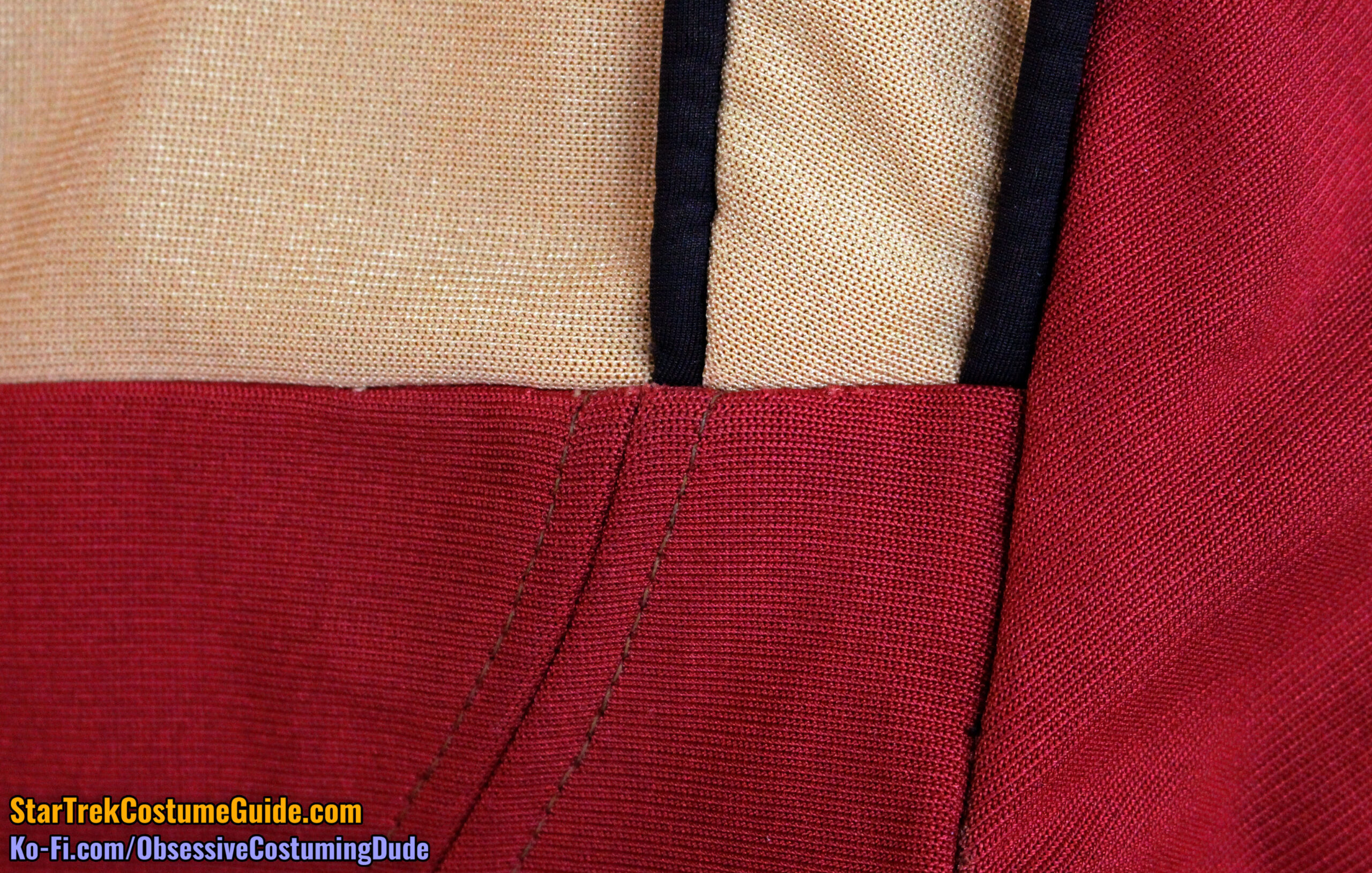
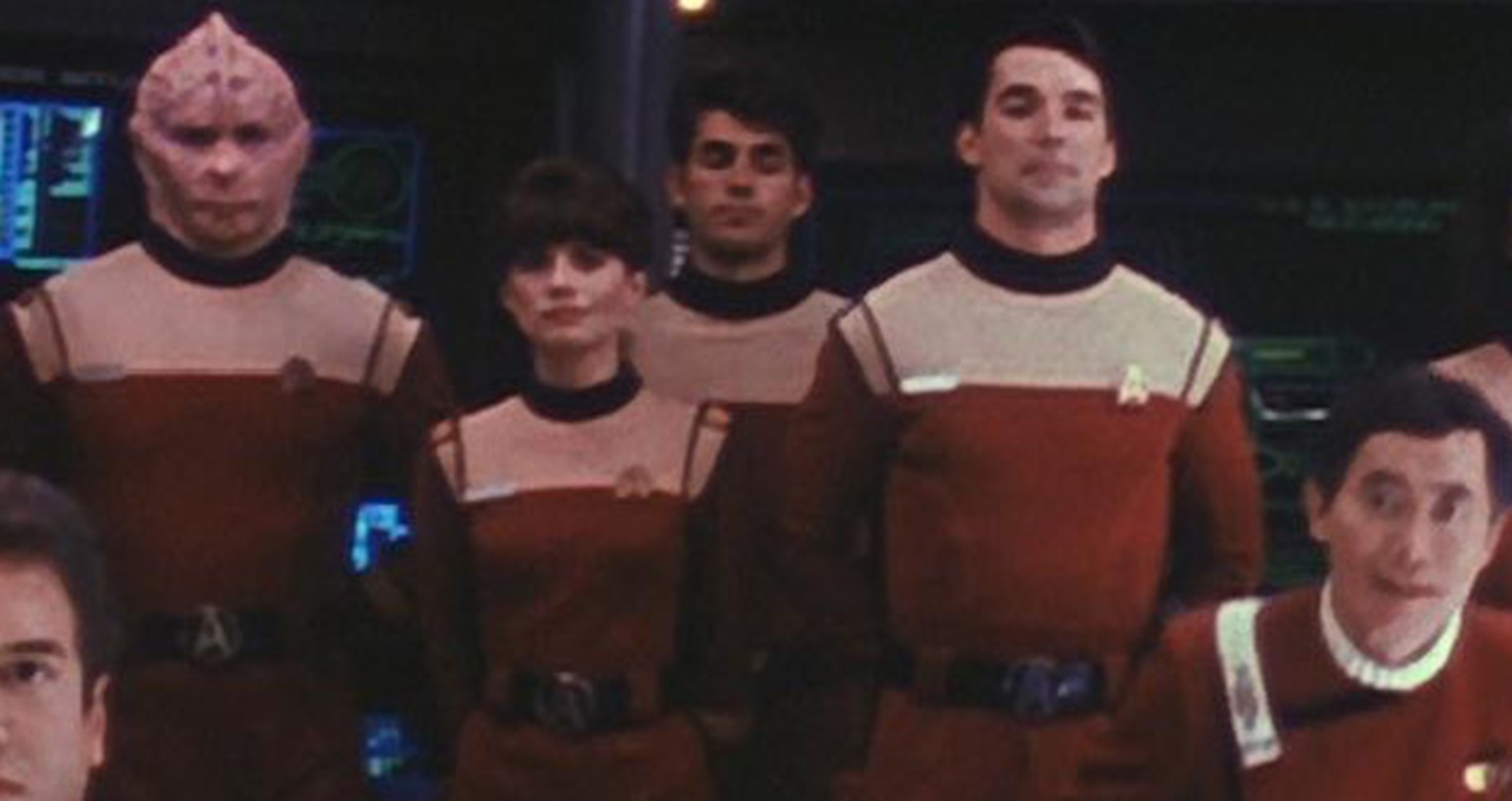
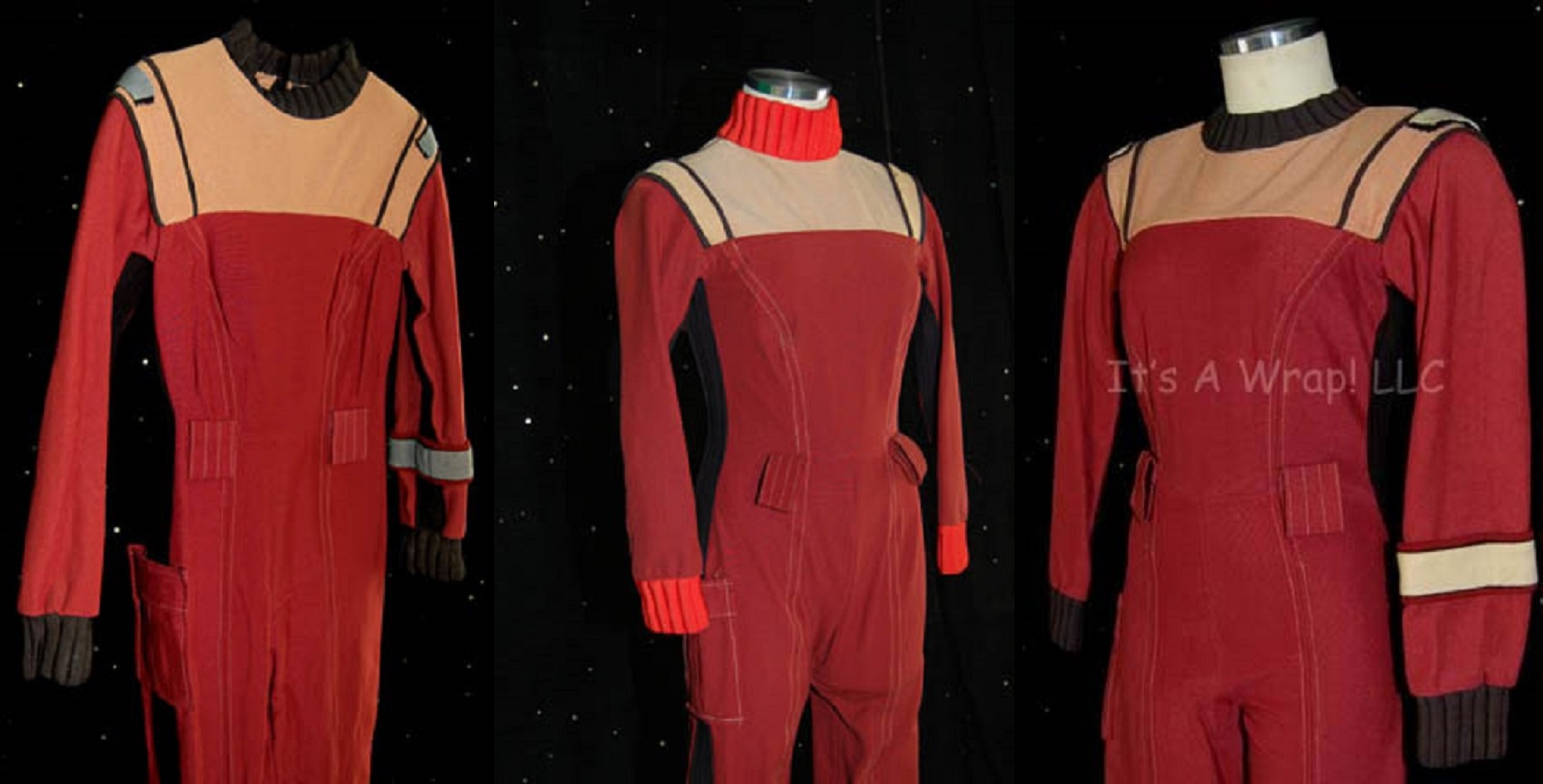
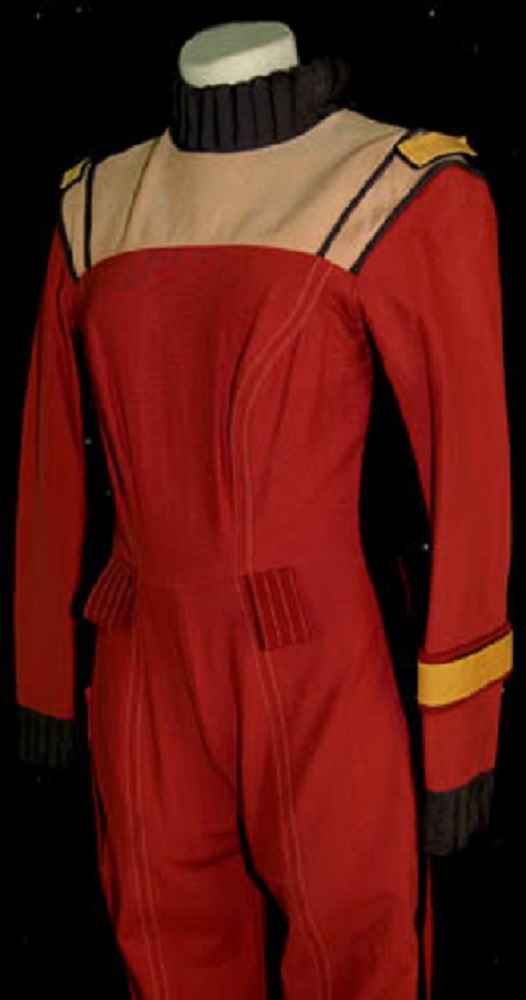
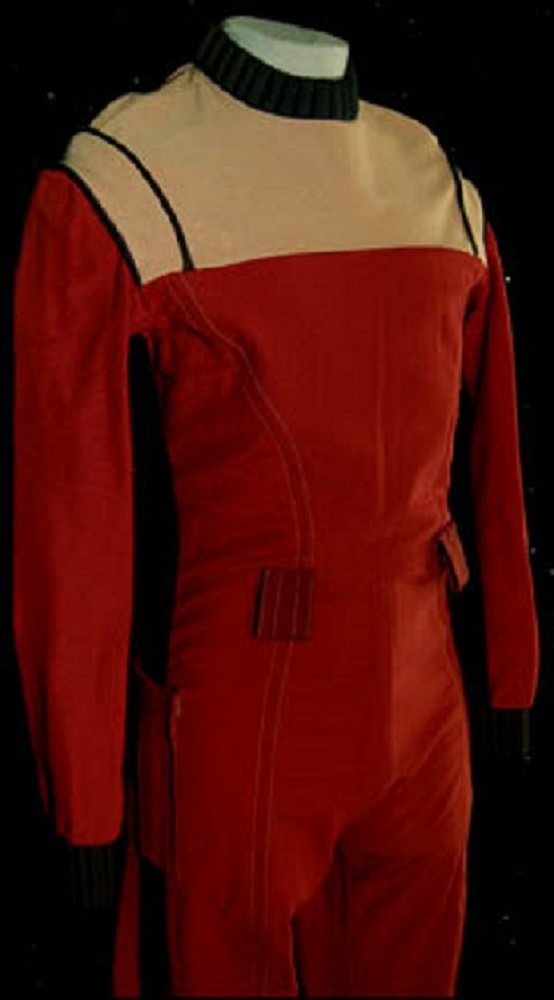
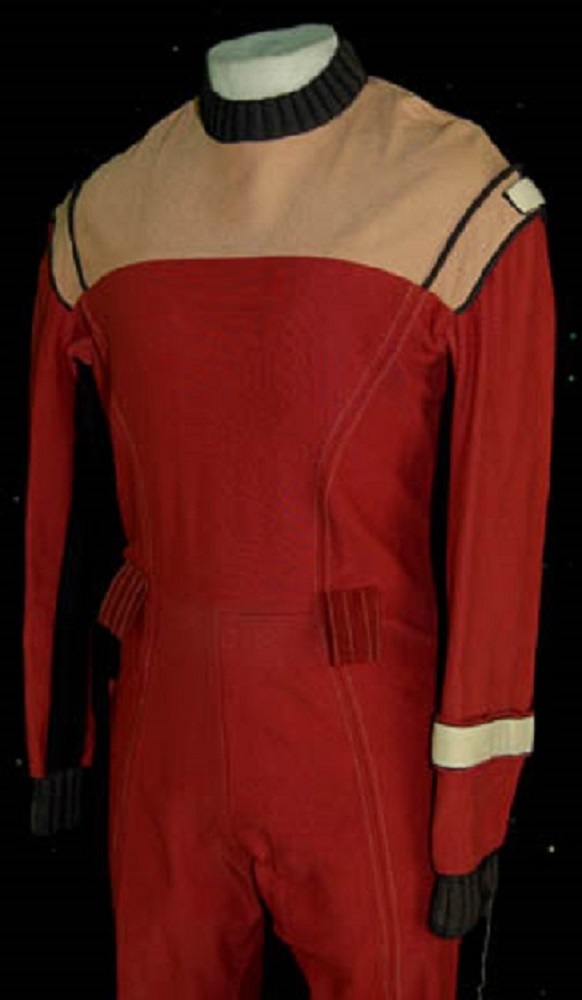
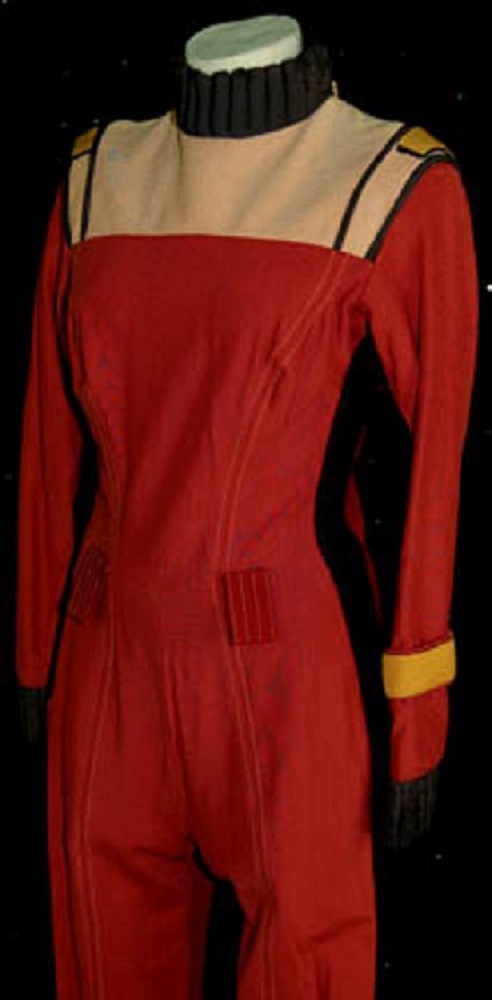
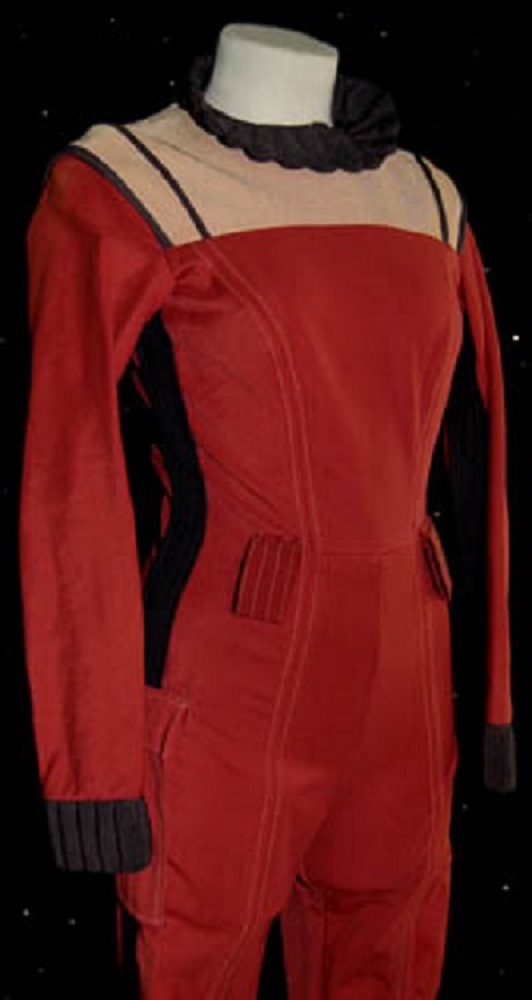
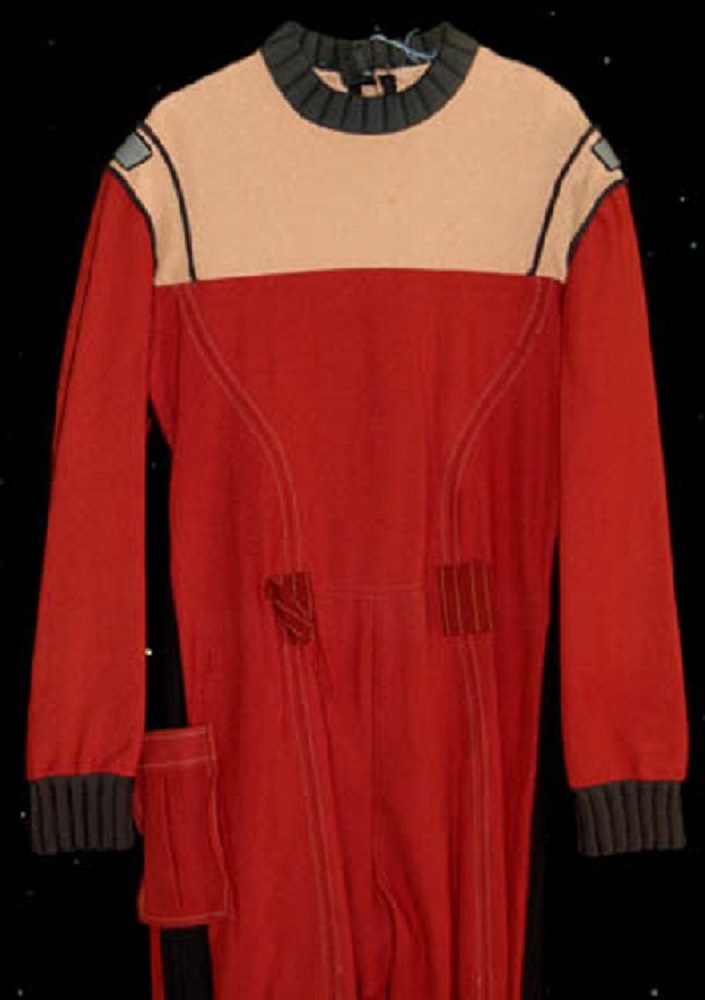
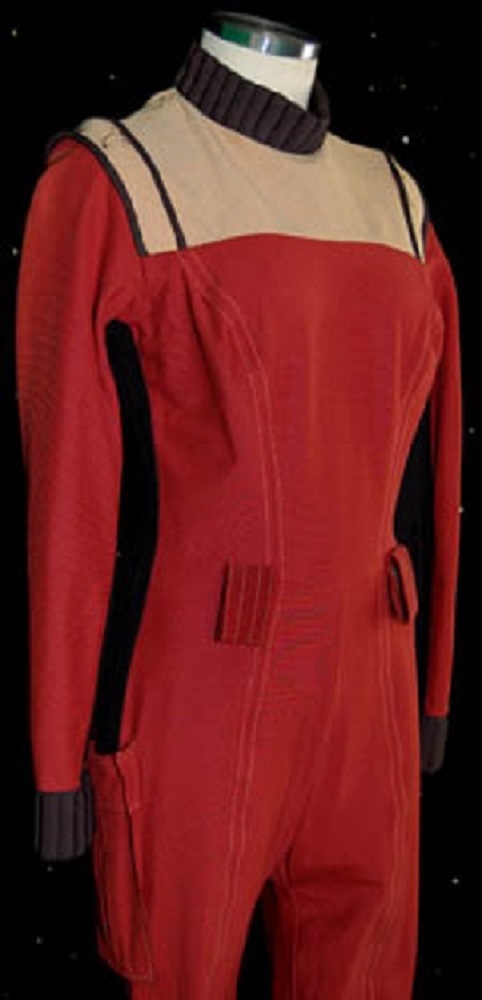
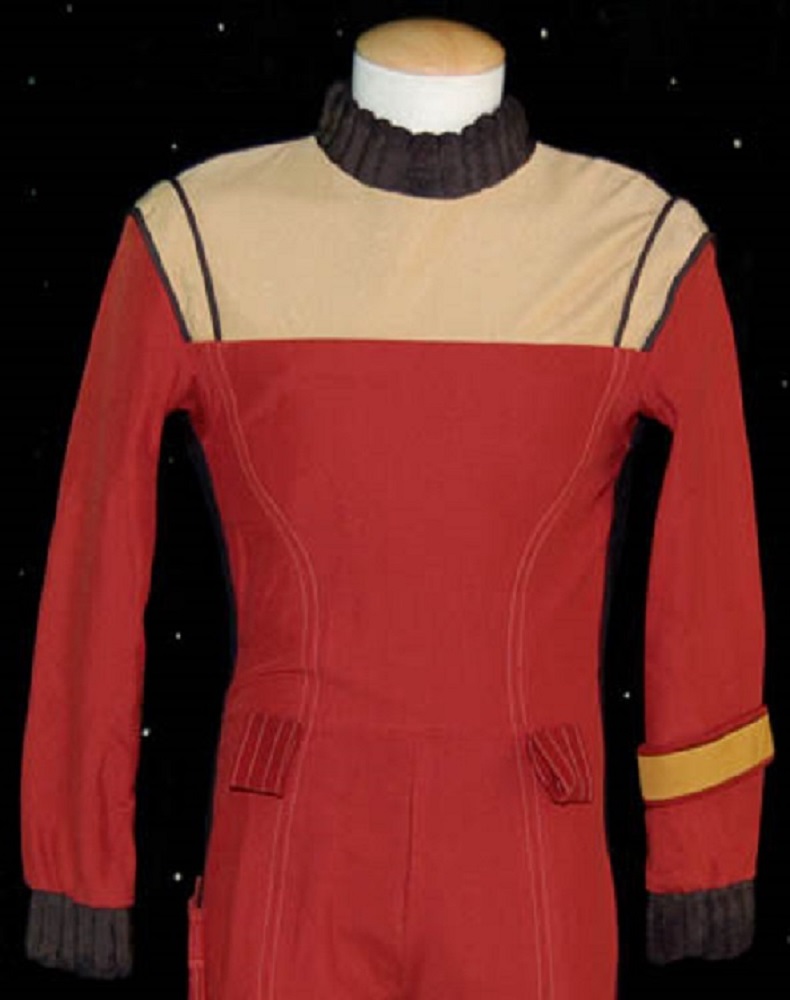
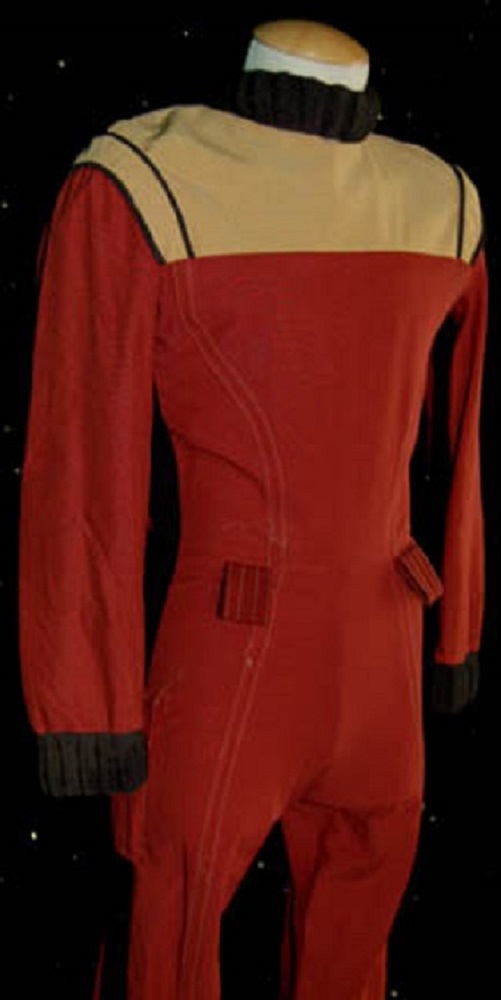
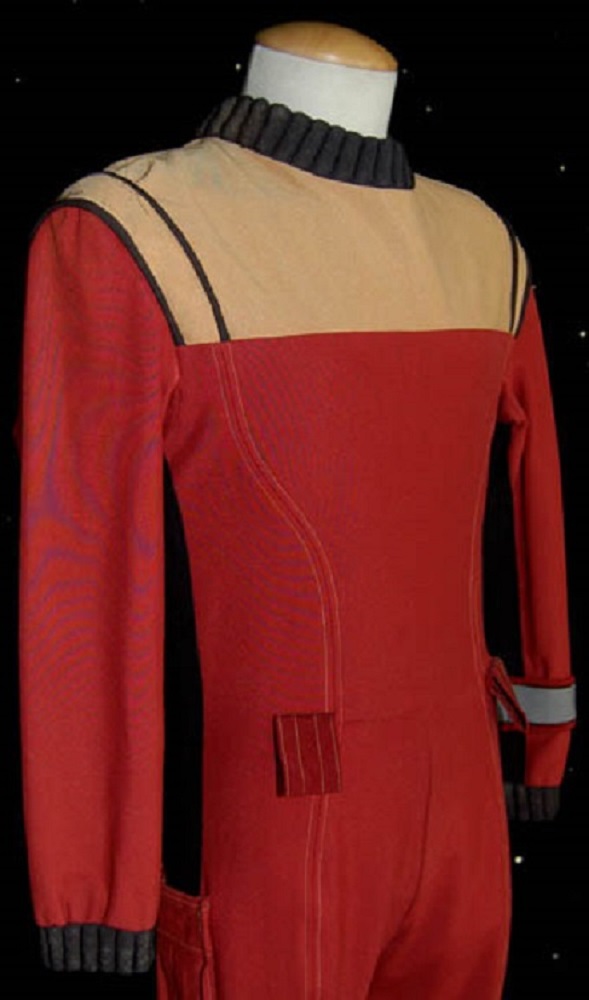
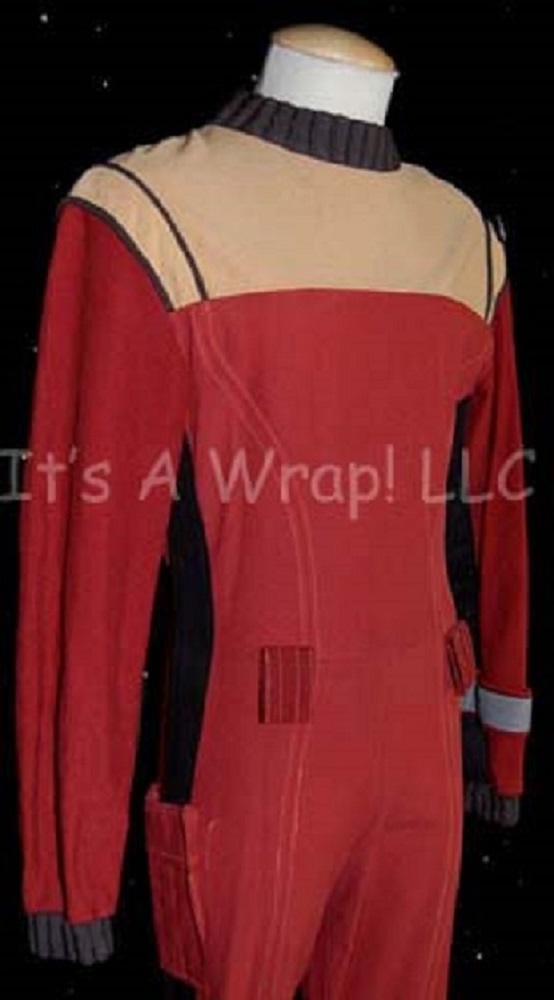
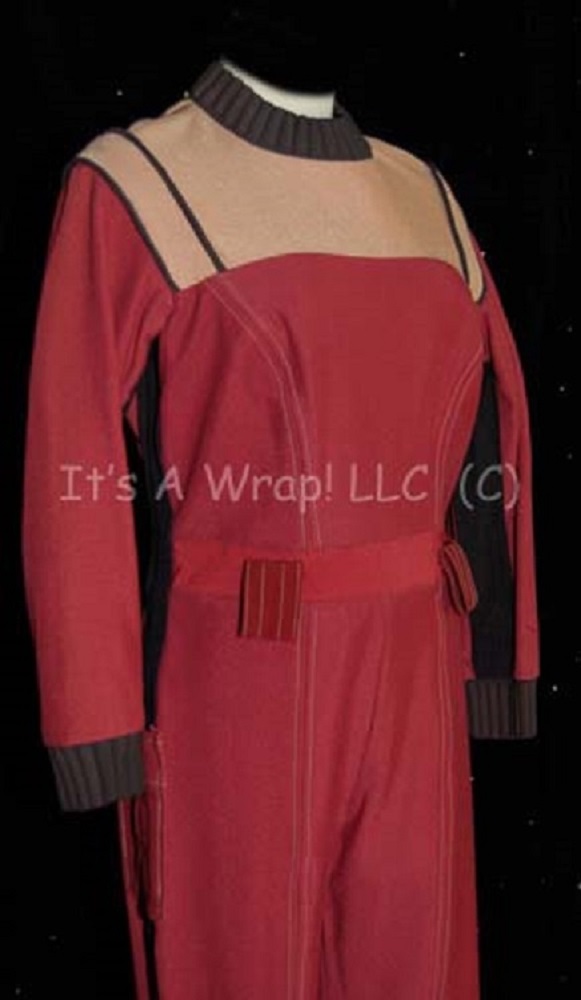
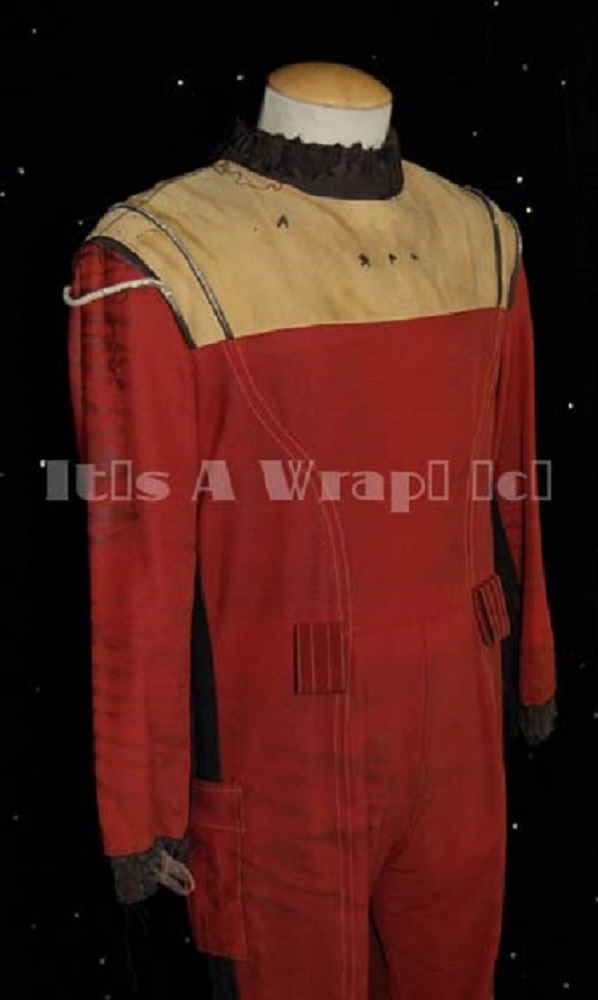
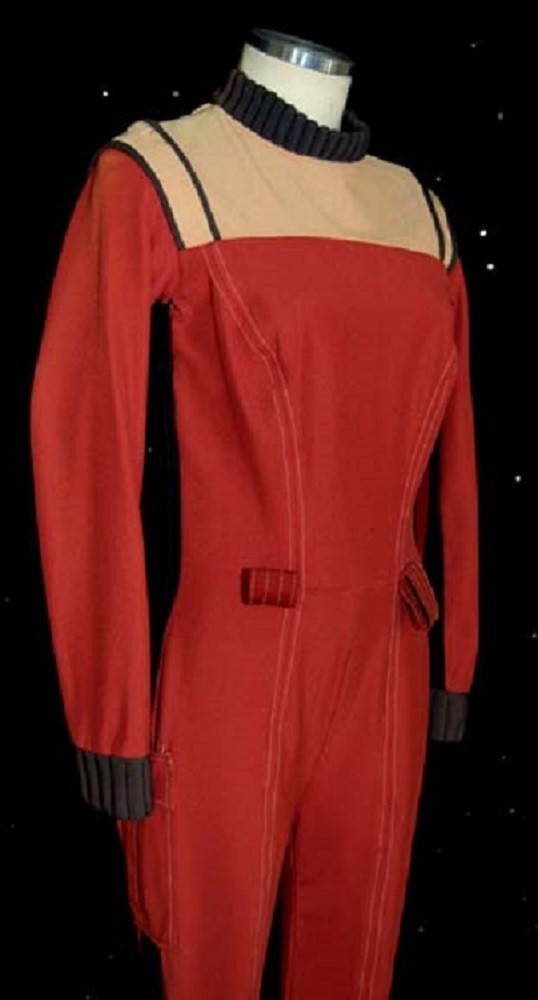
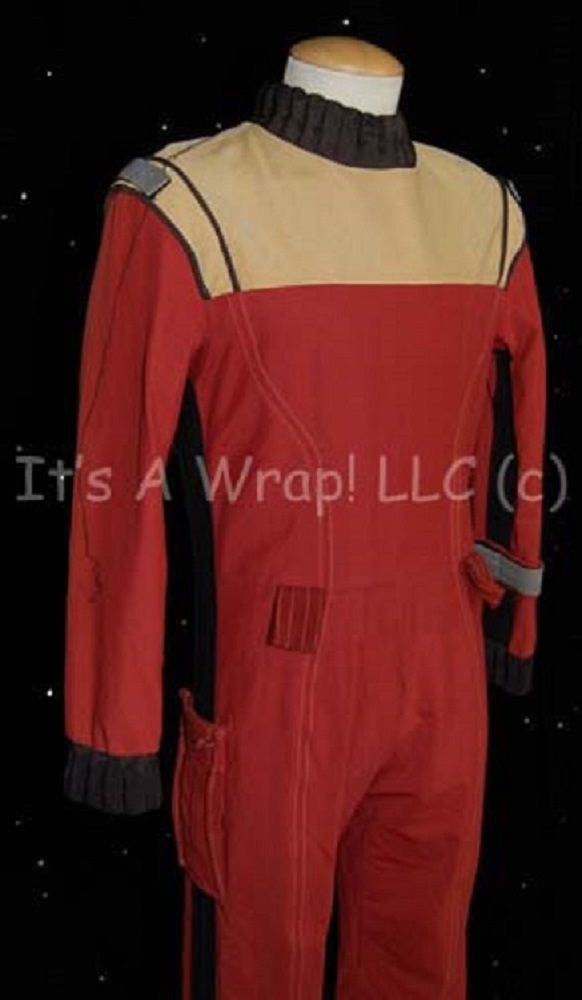
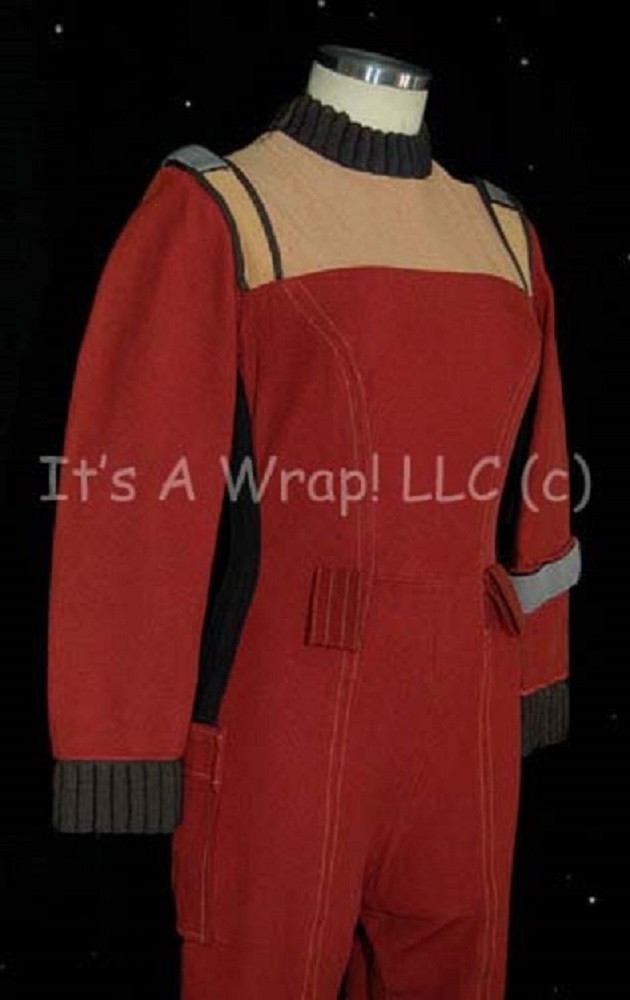
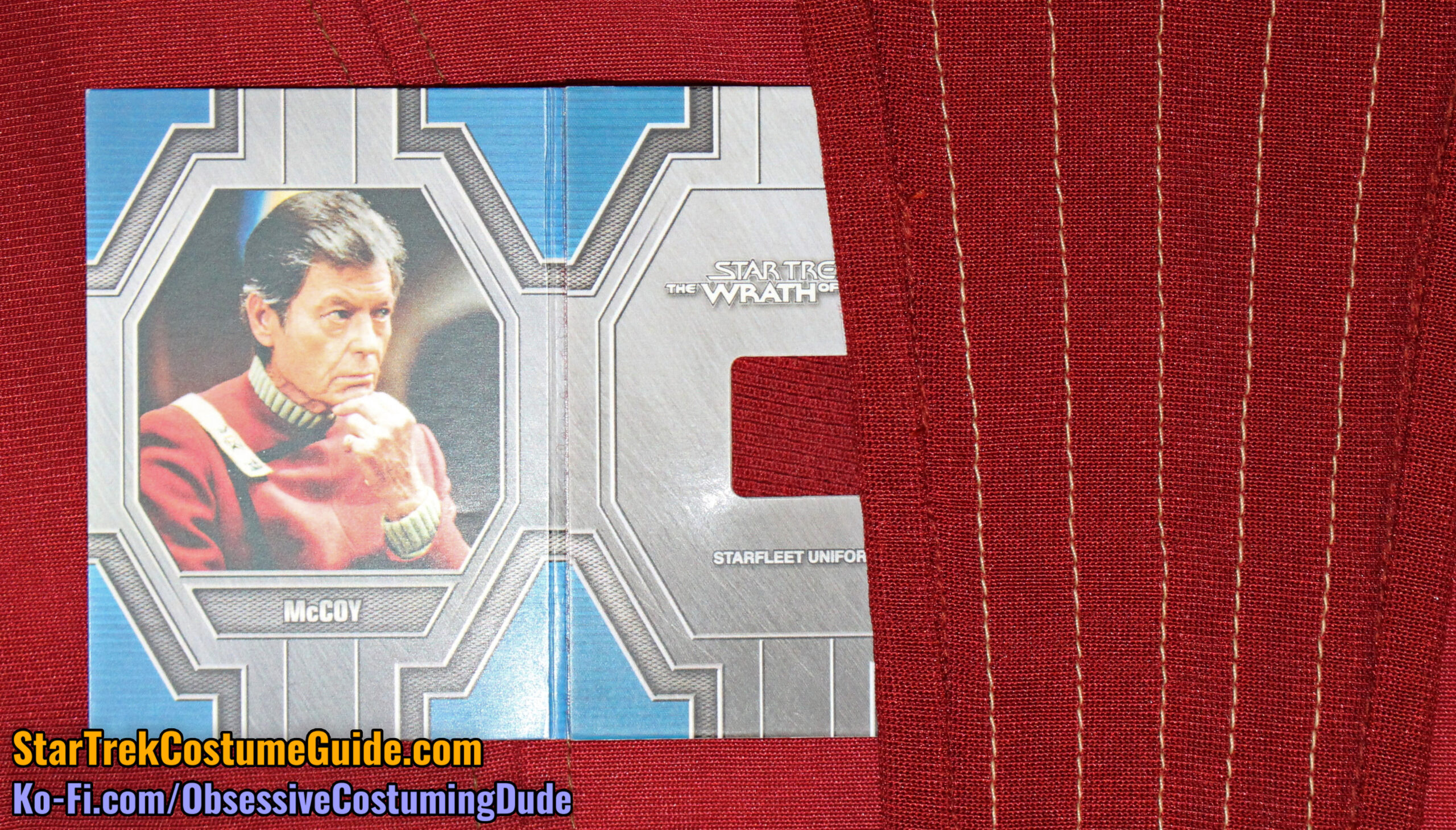
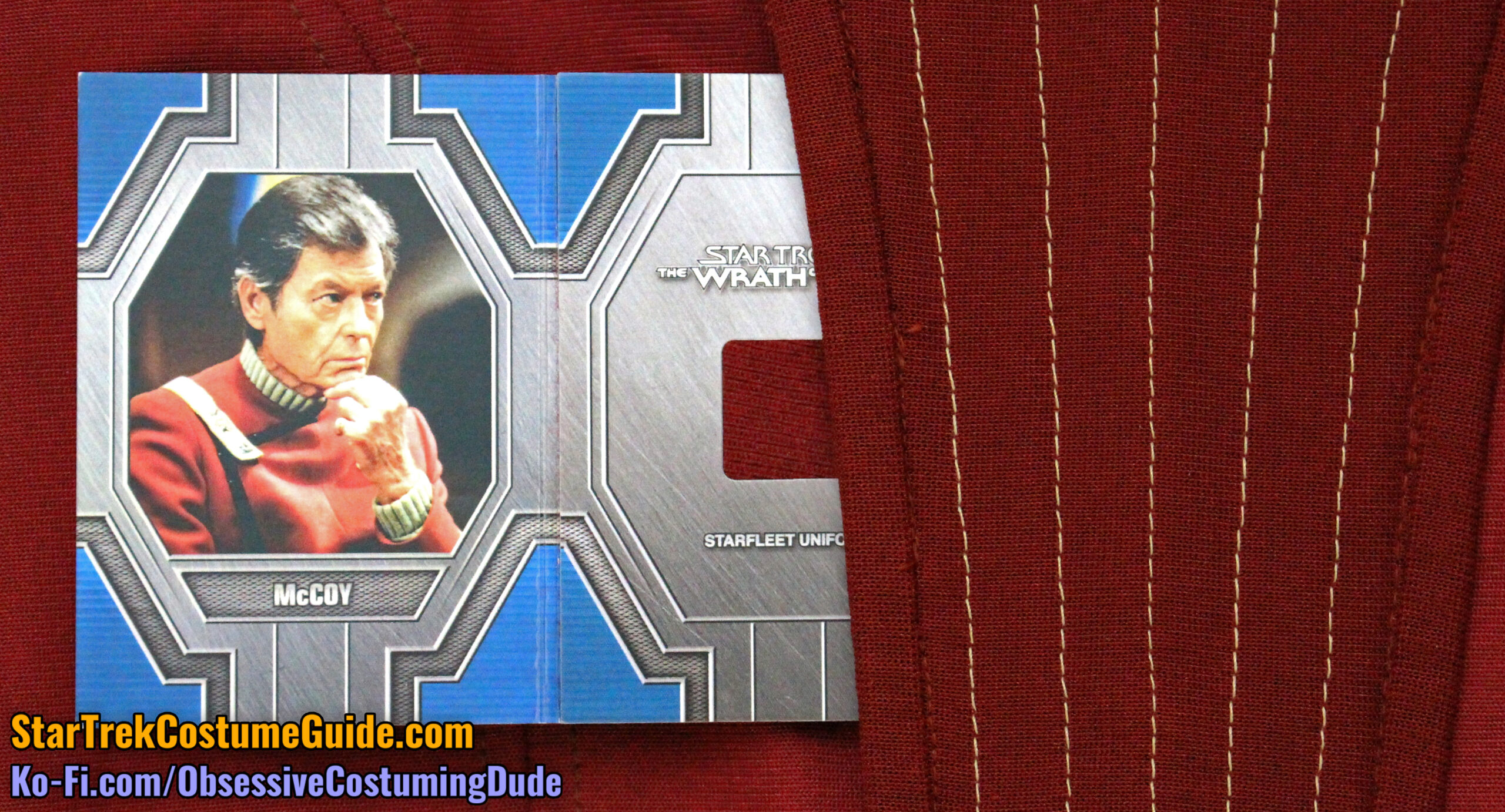
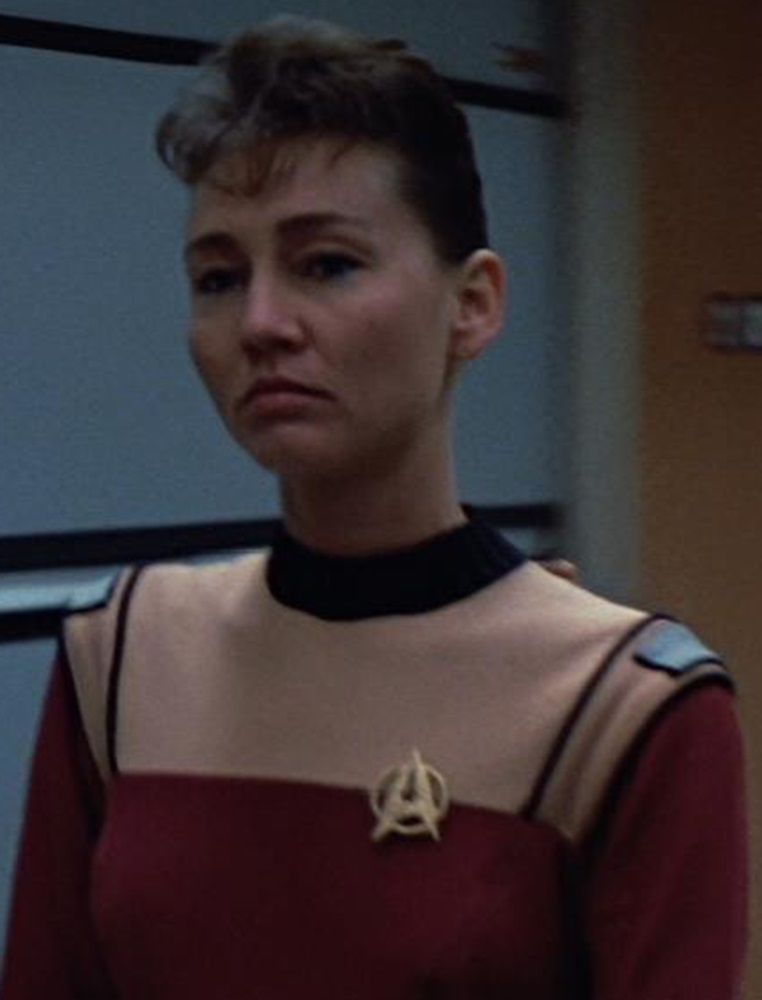
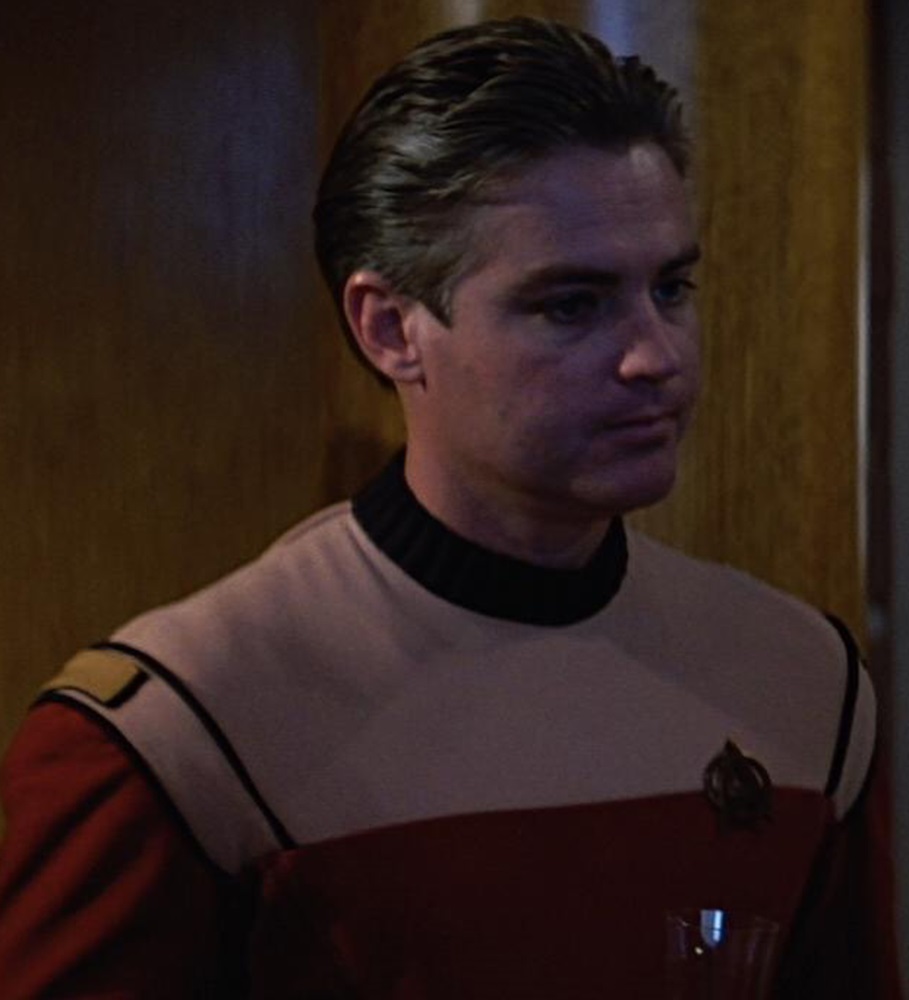
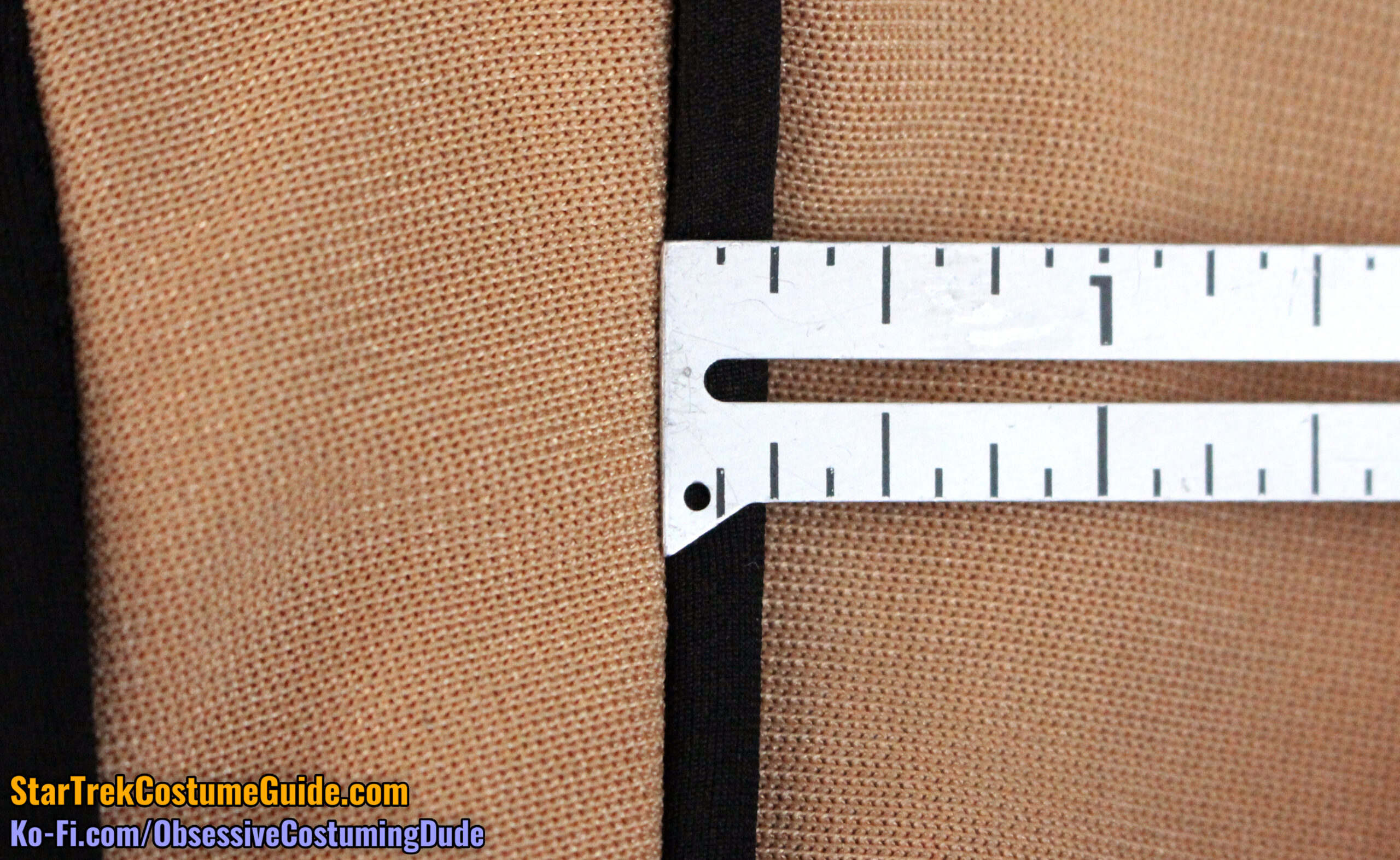
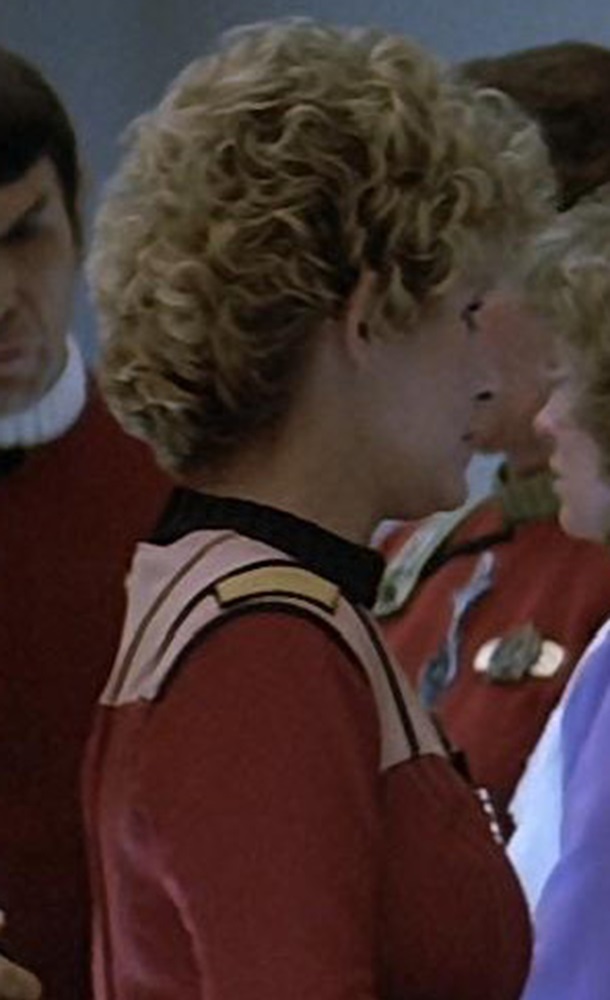
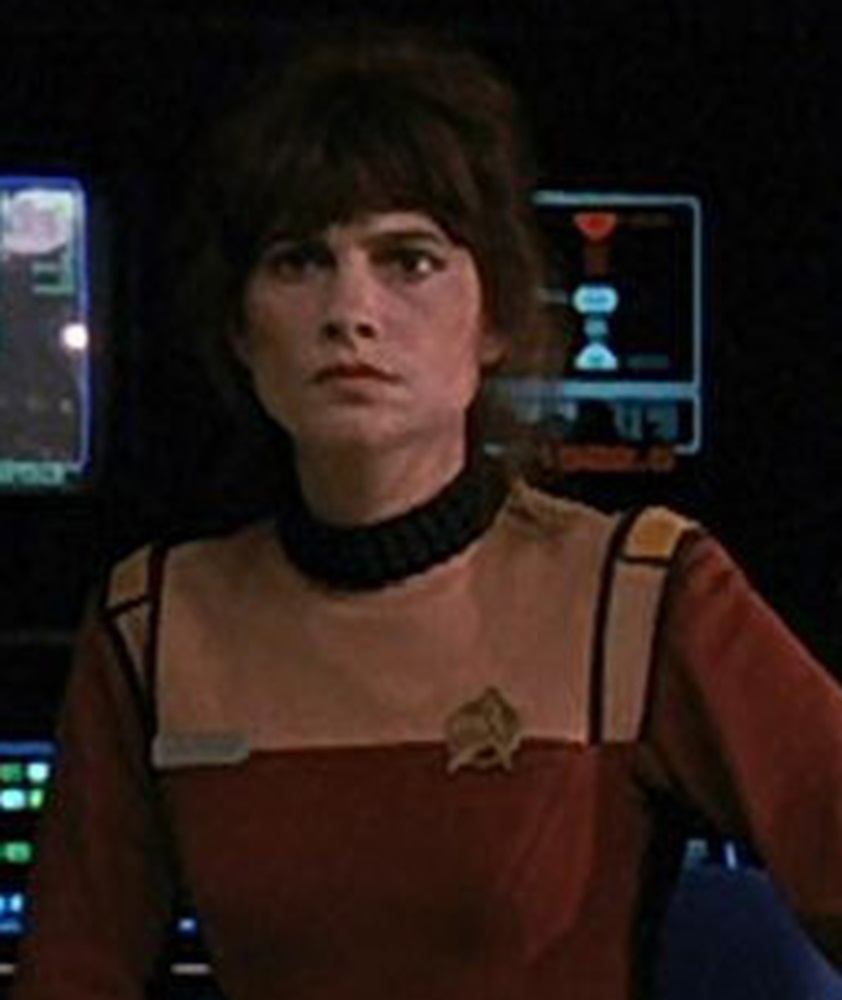
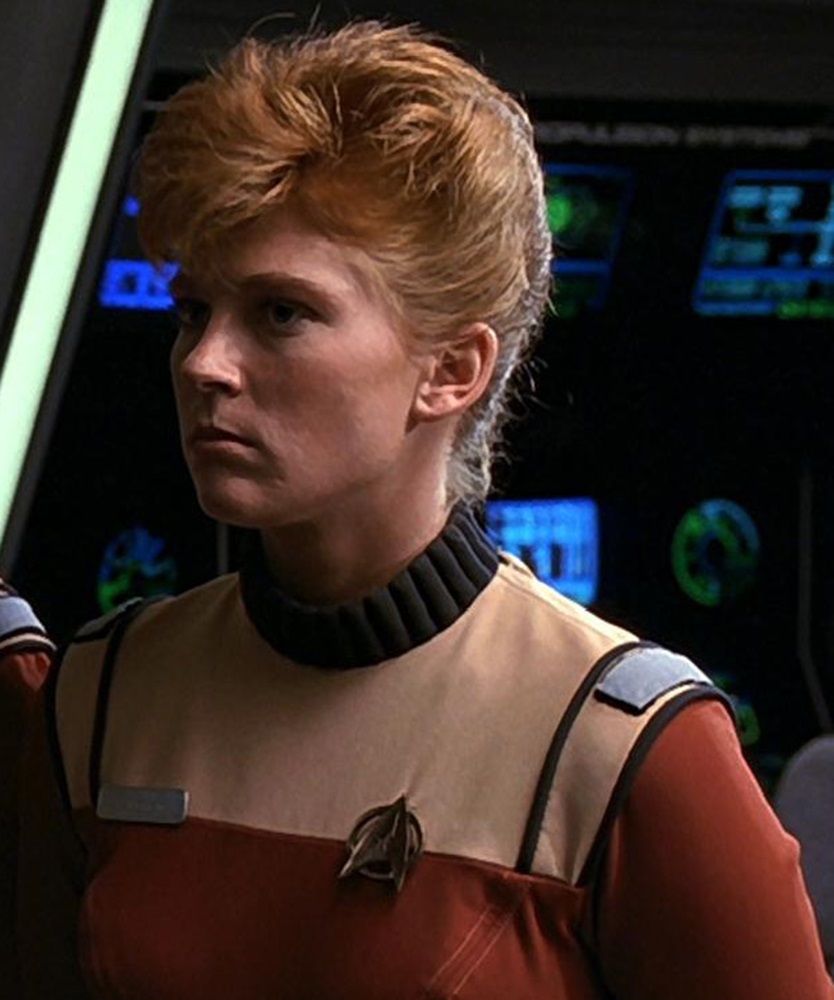
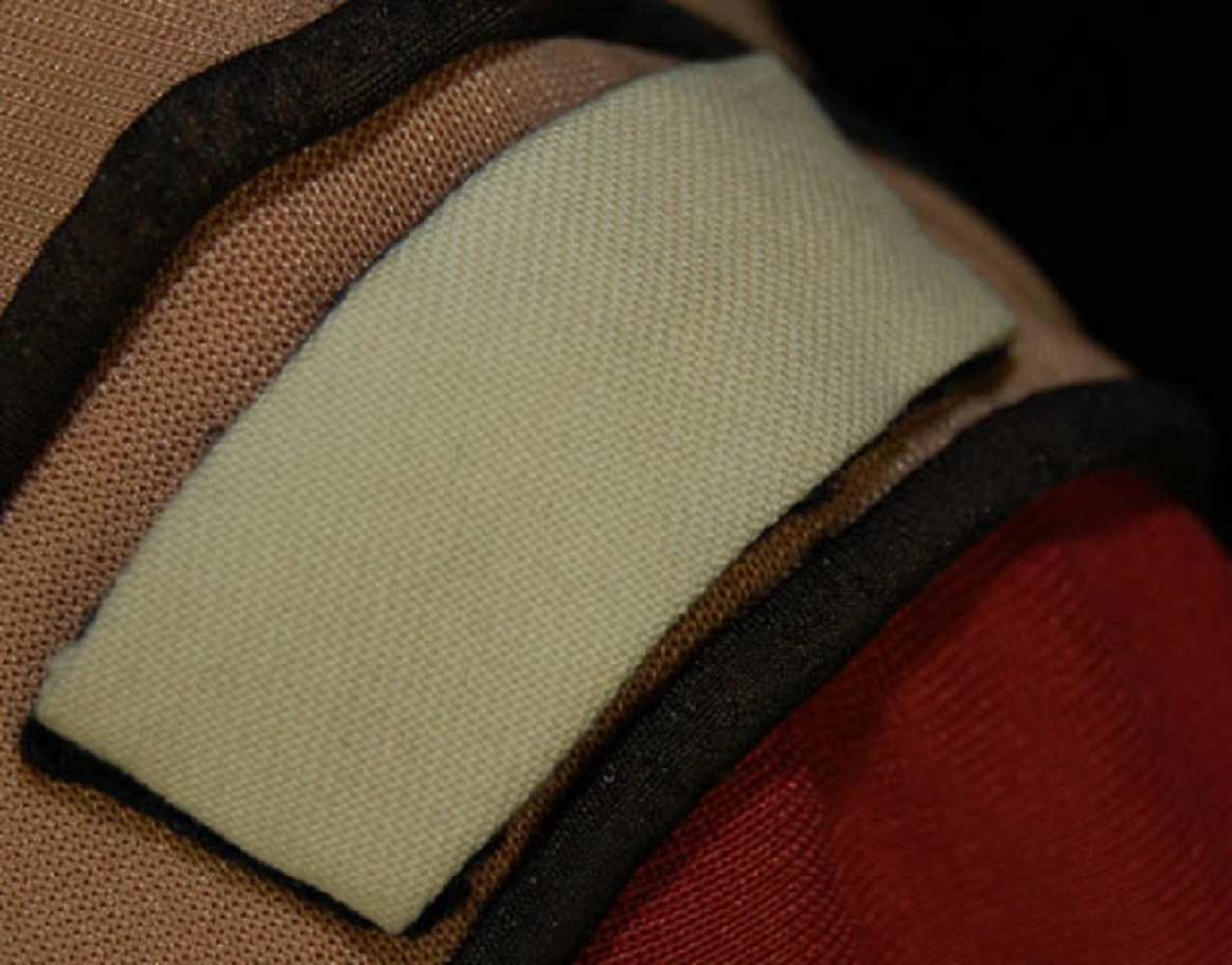
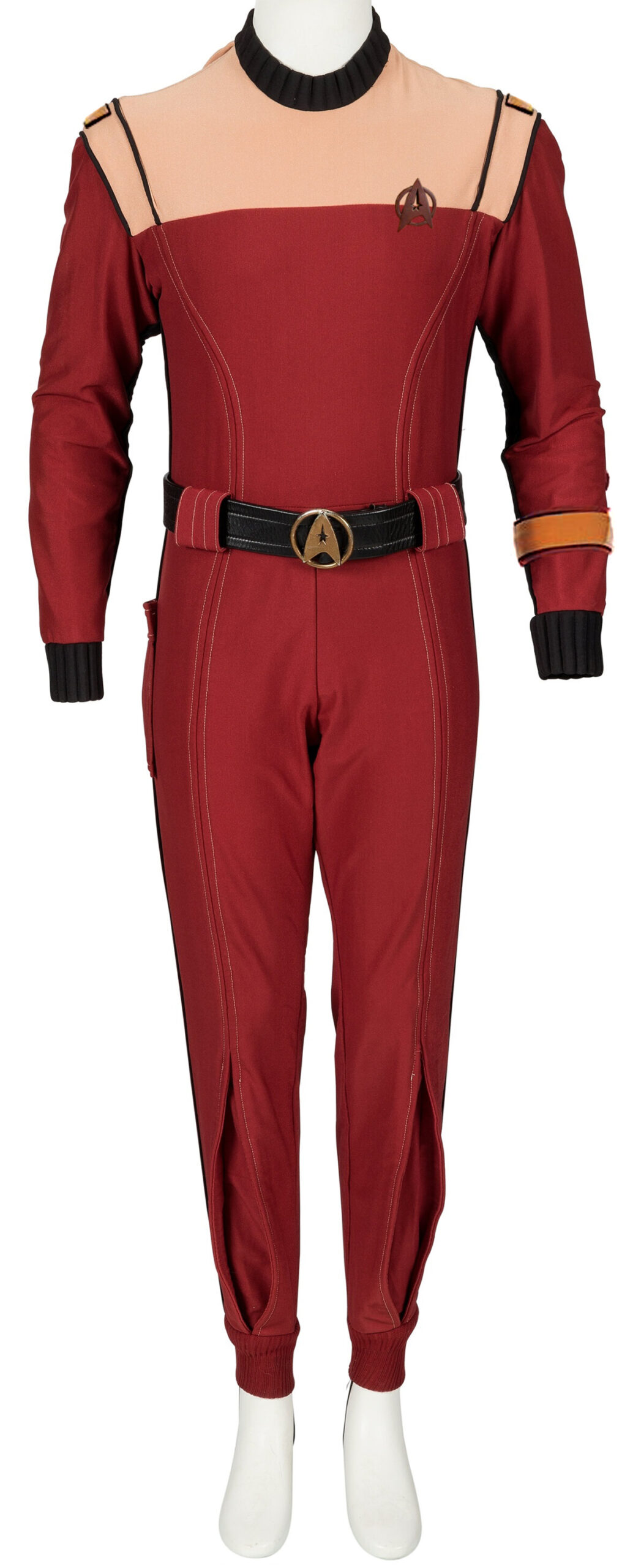
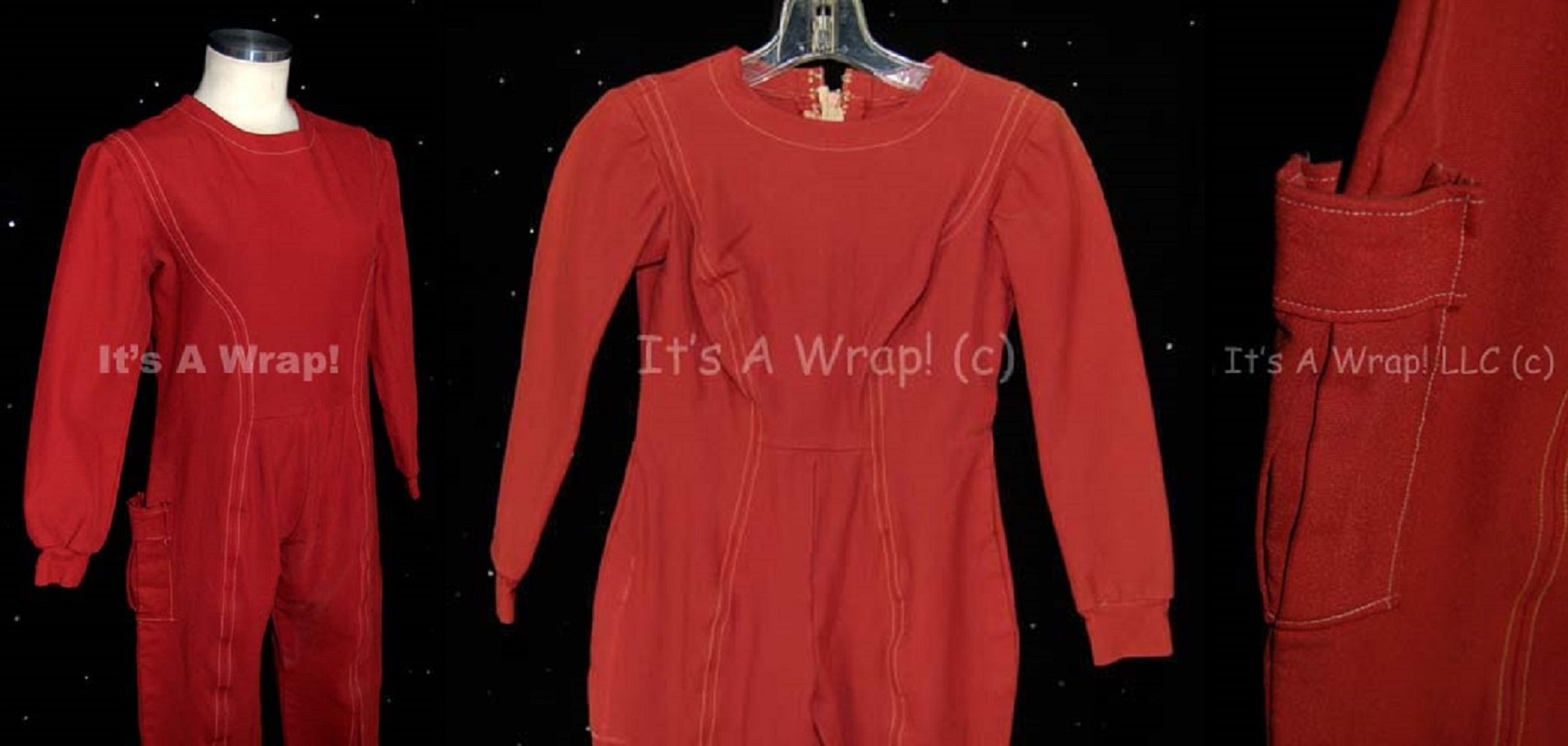
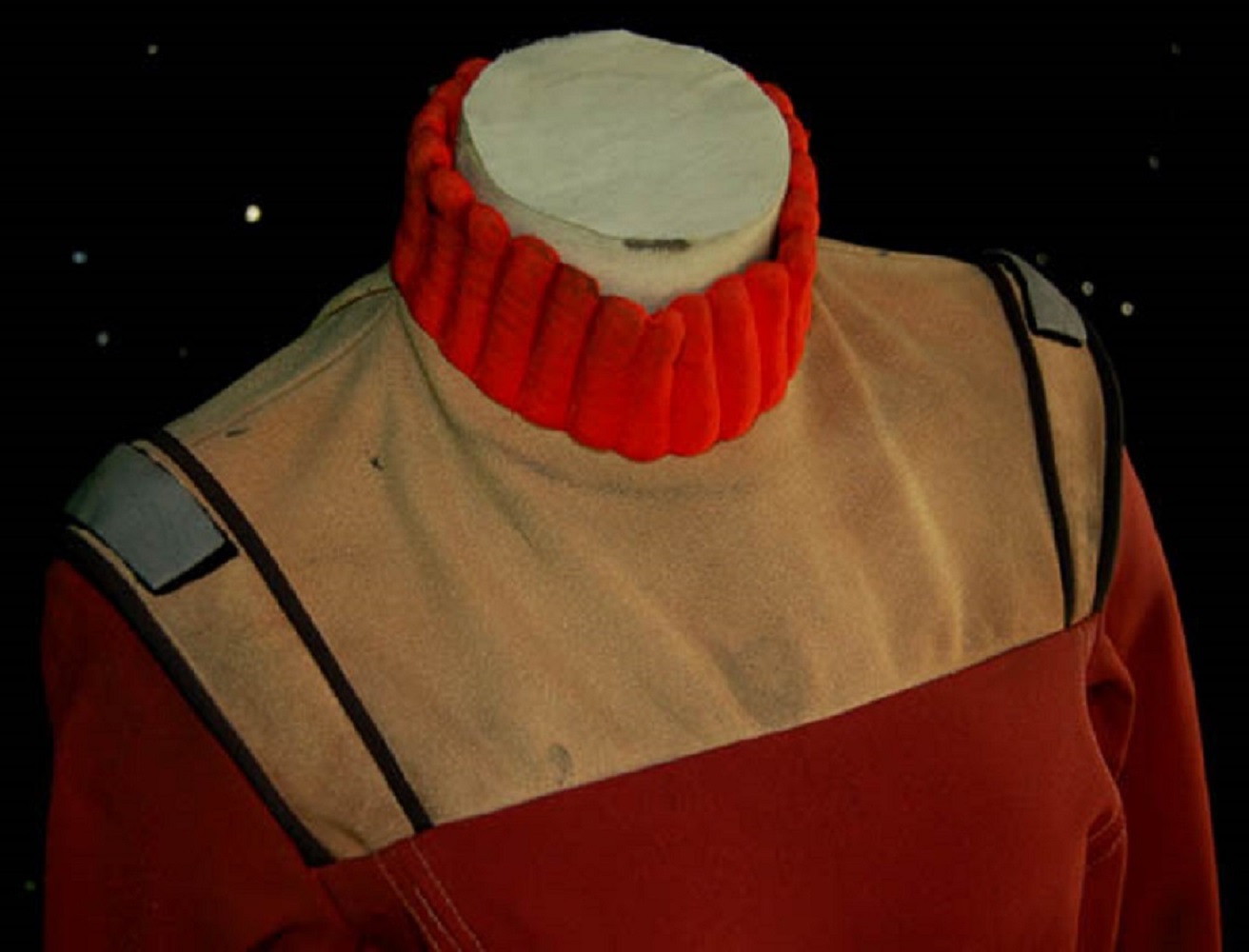
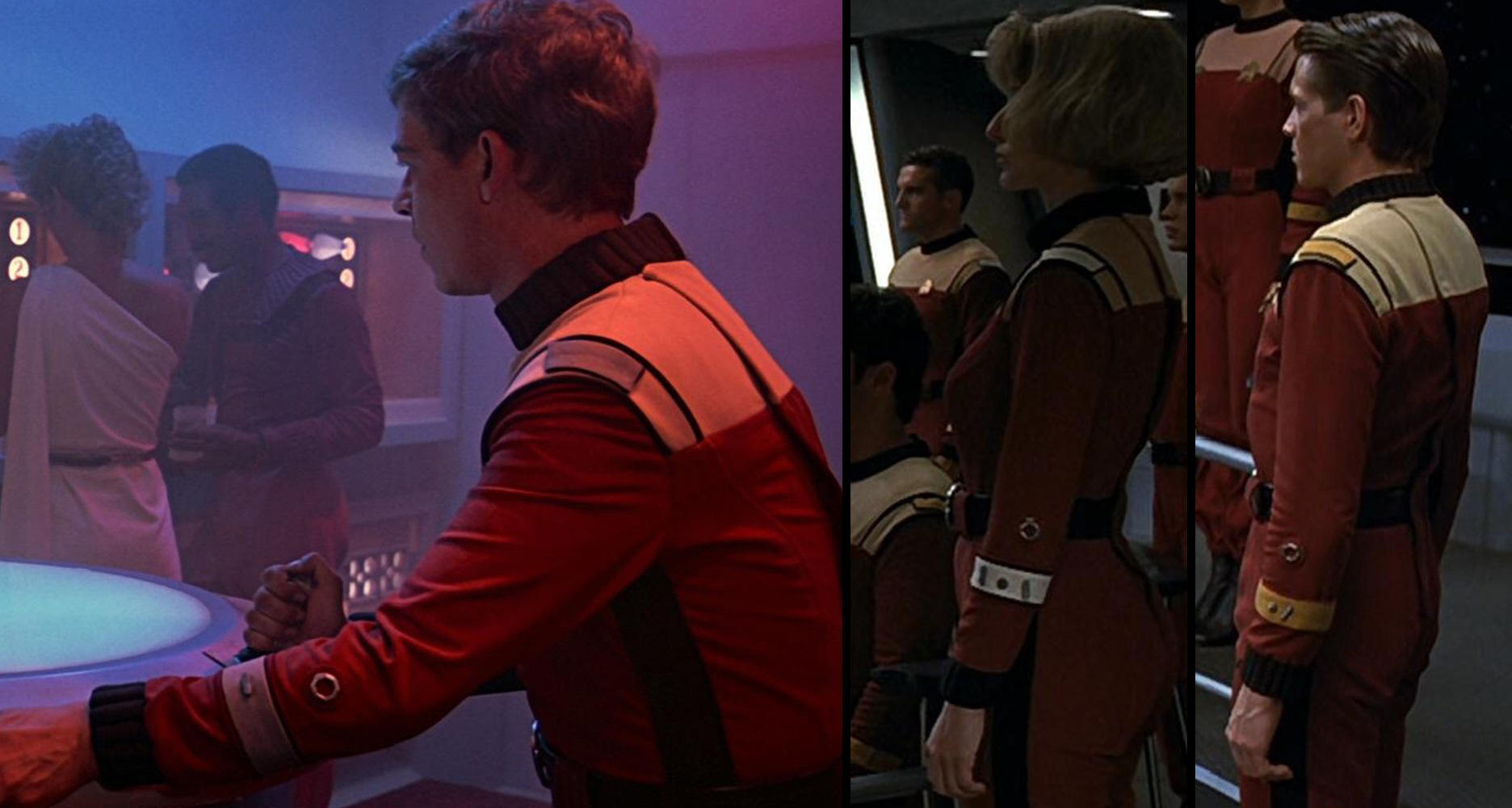
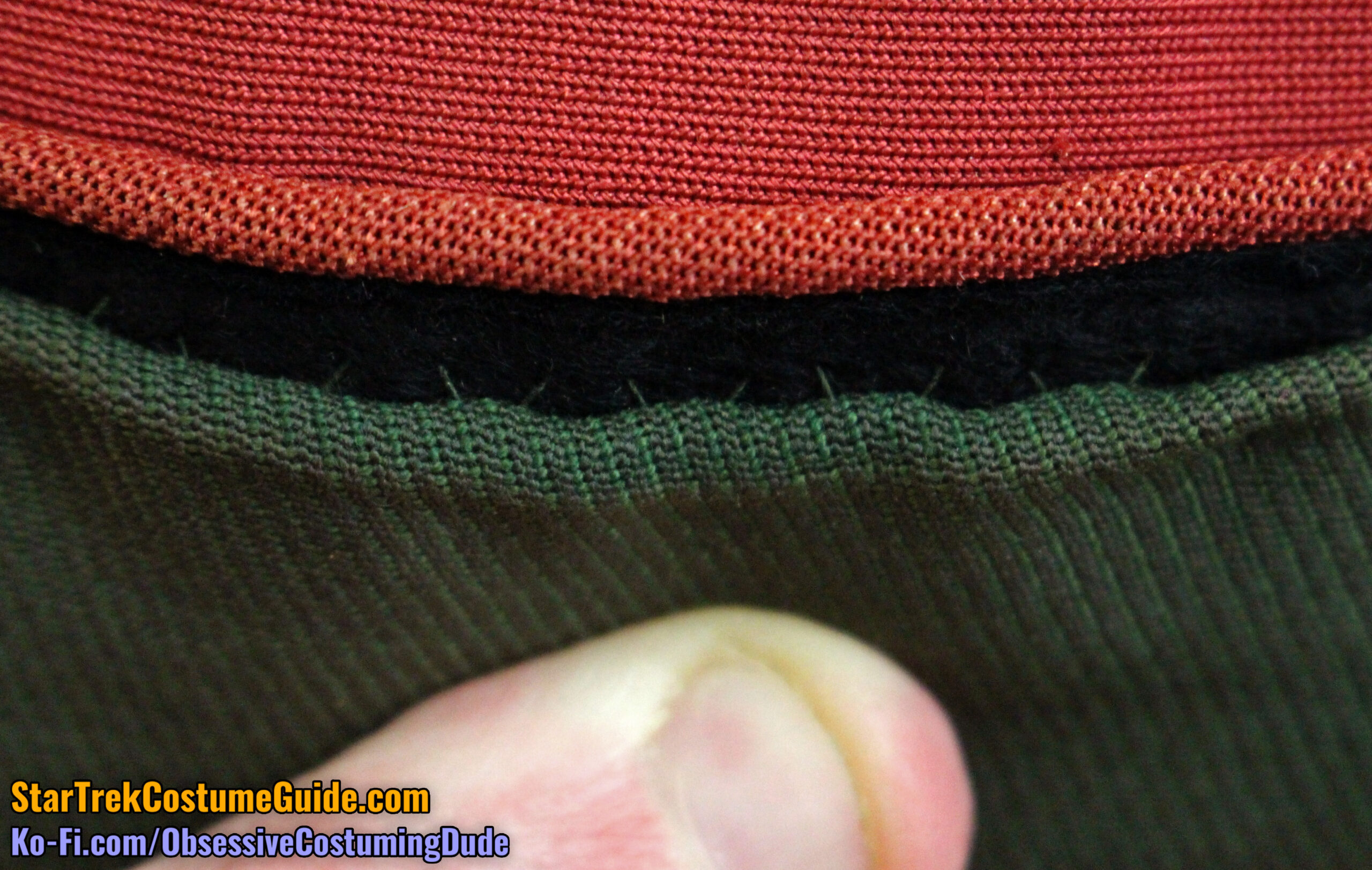
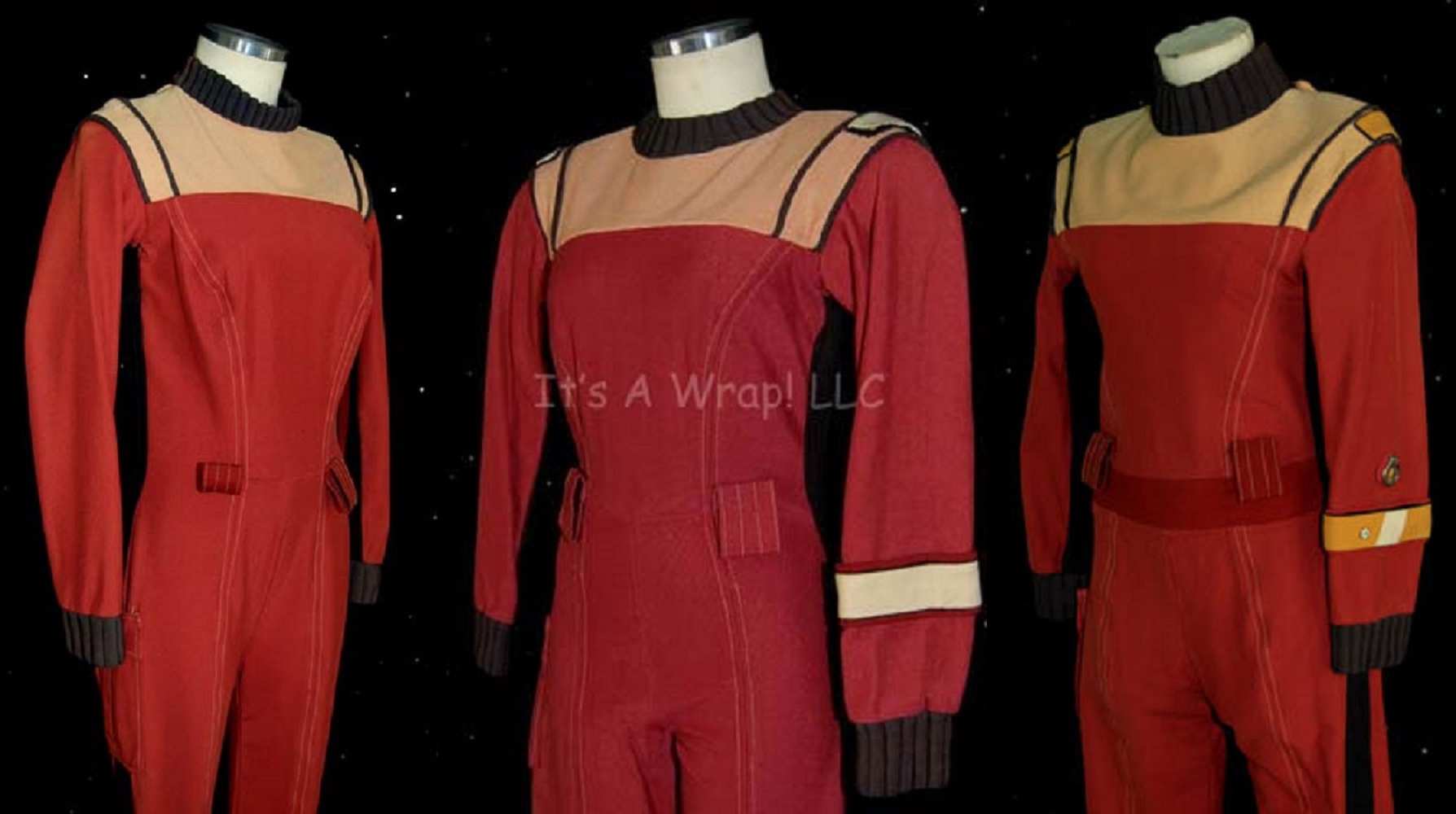
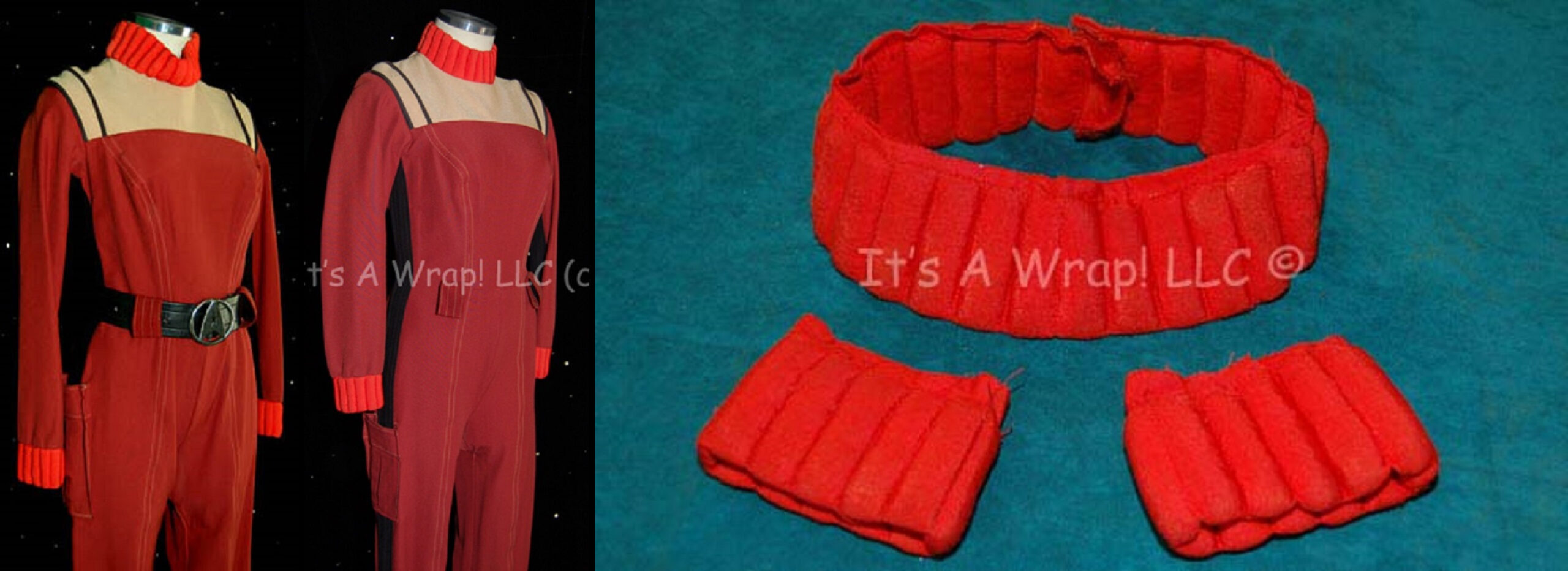
Being repurposed TMP jumpsuits, these enlisted jumpsuits were made of heavy jumbo spandex, sewn with the dull side out – although some faint sparkling could occasionally be seen.
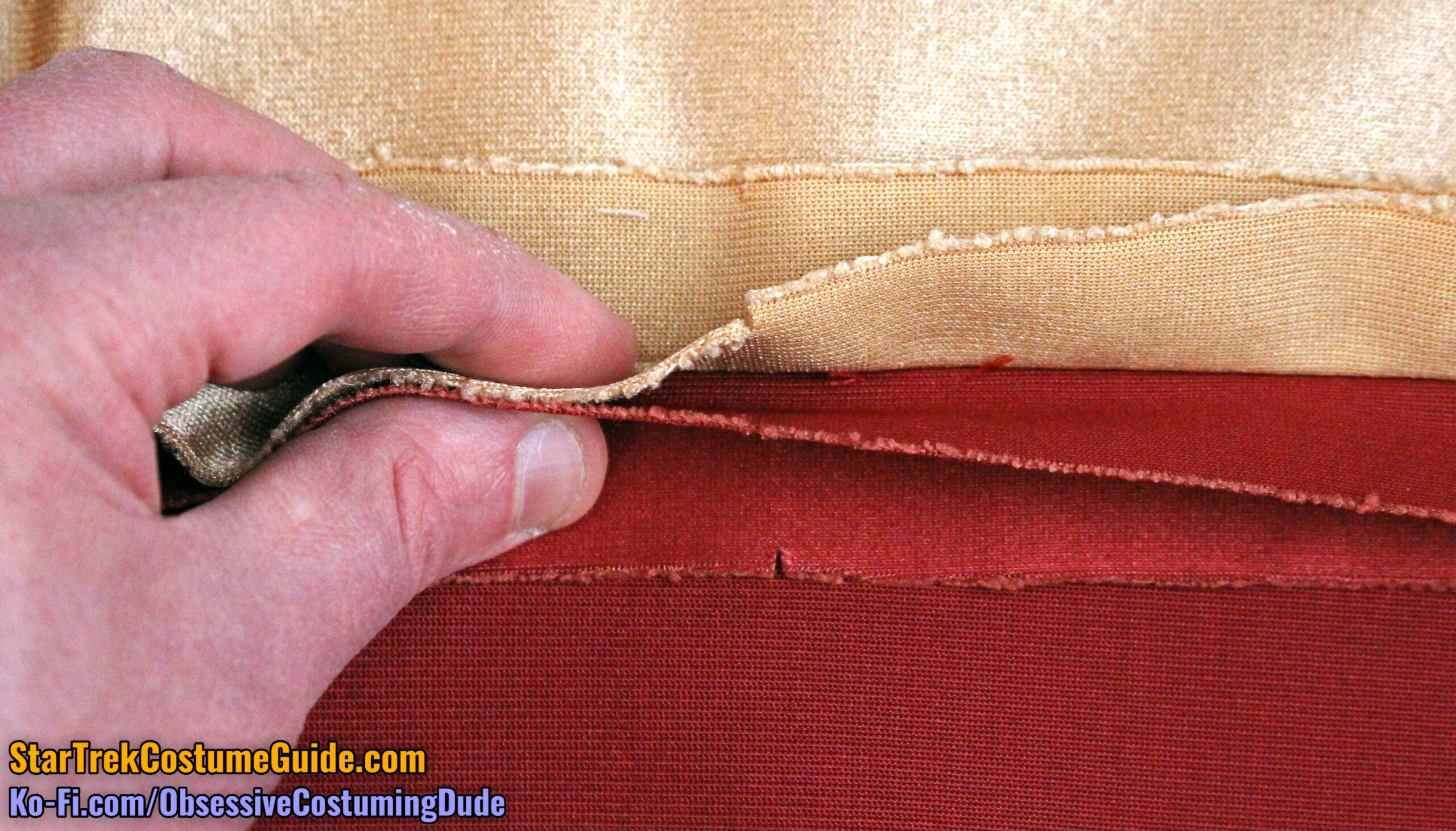
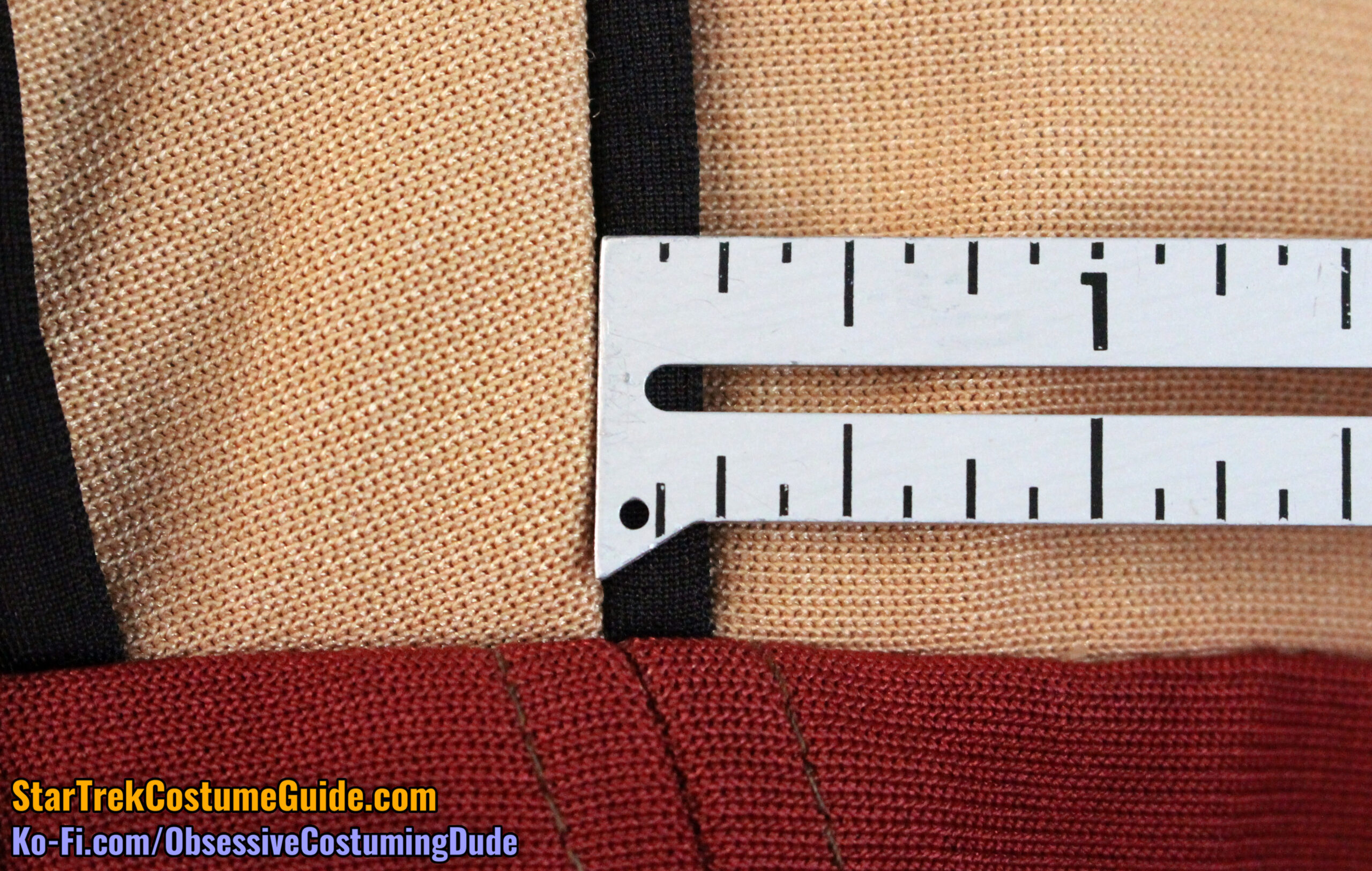
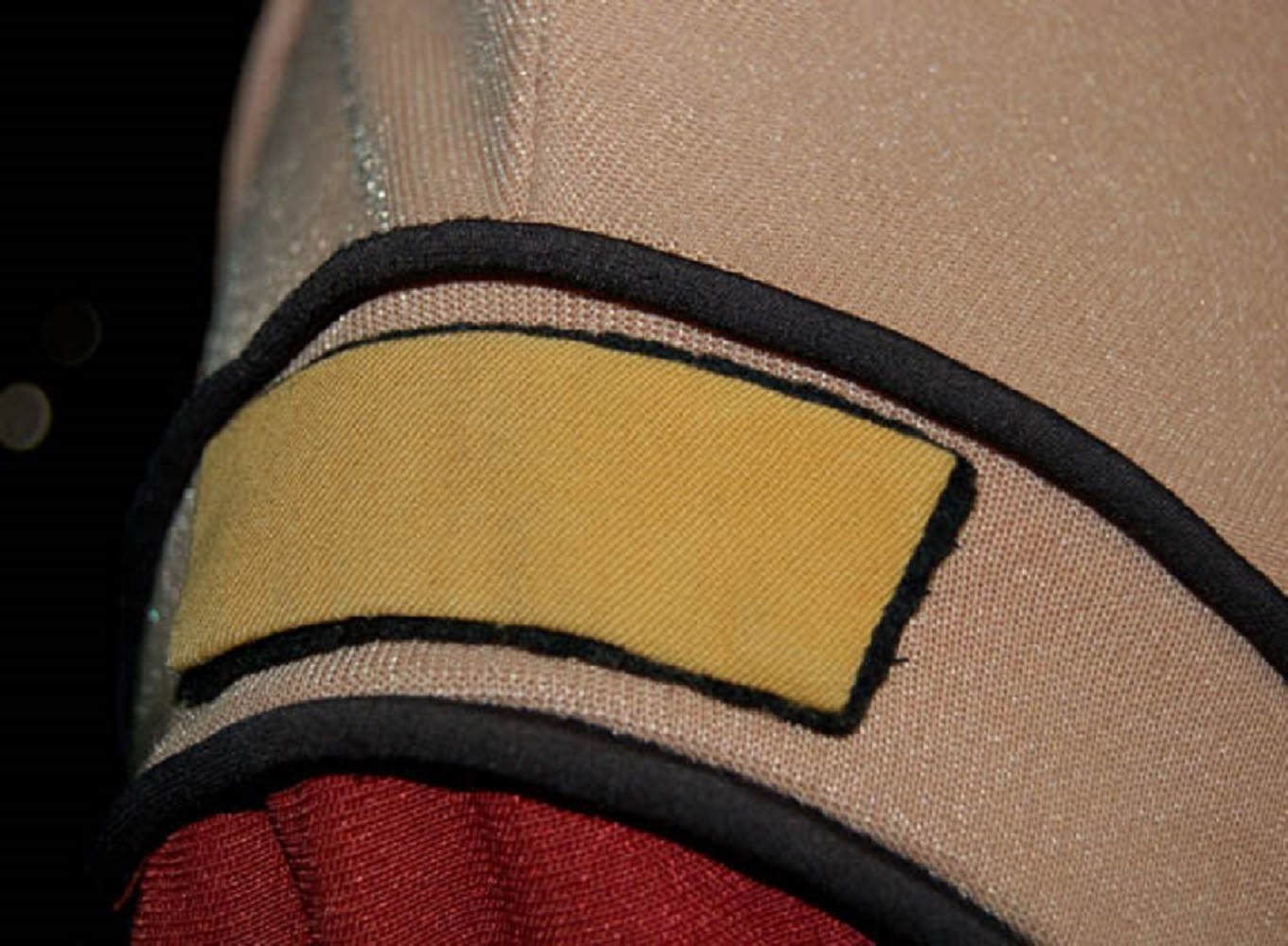
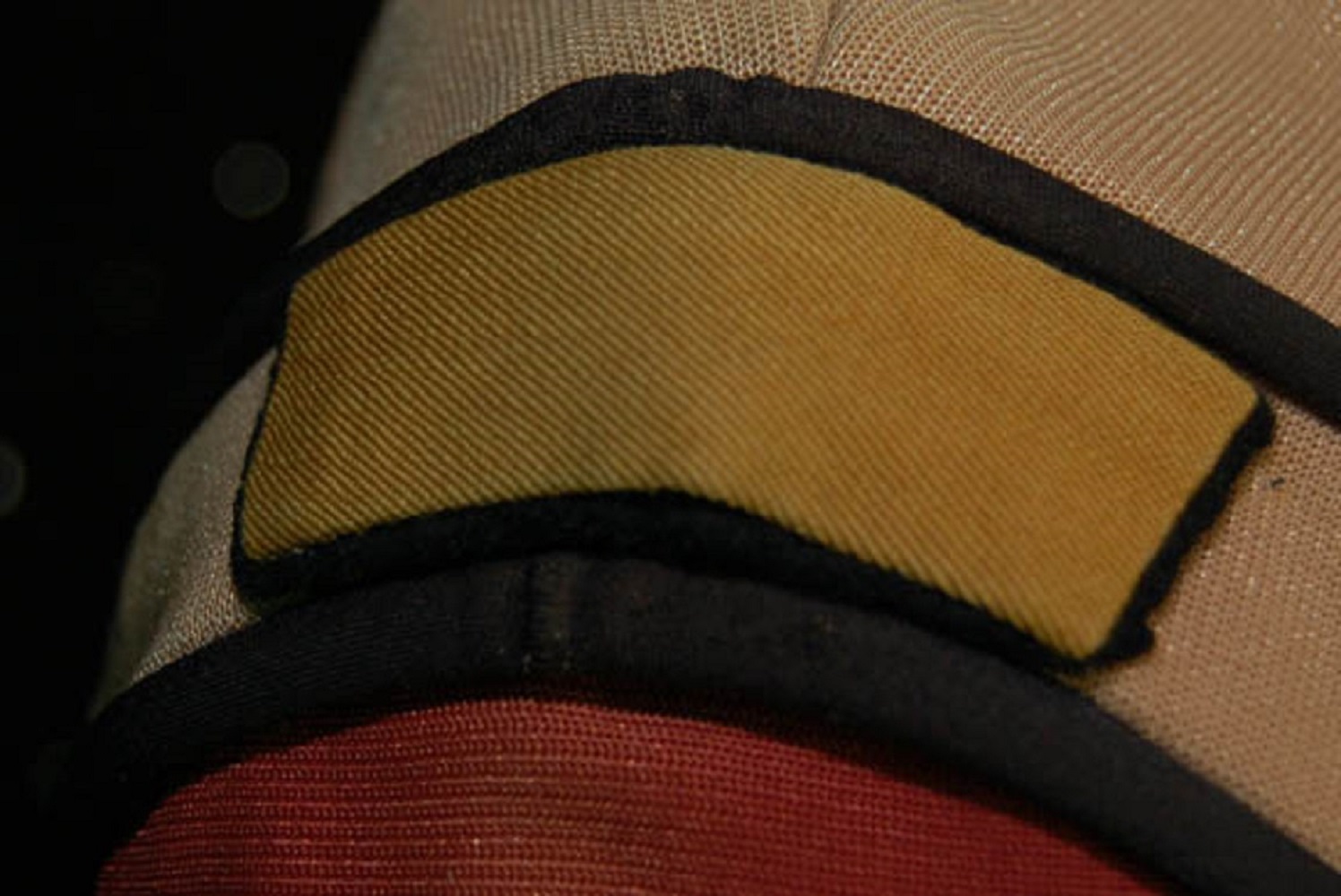
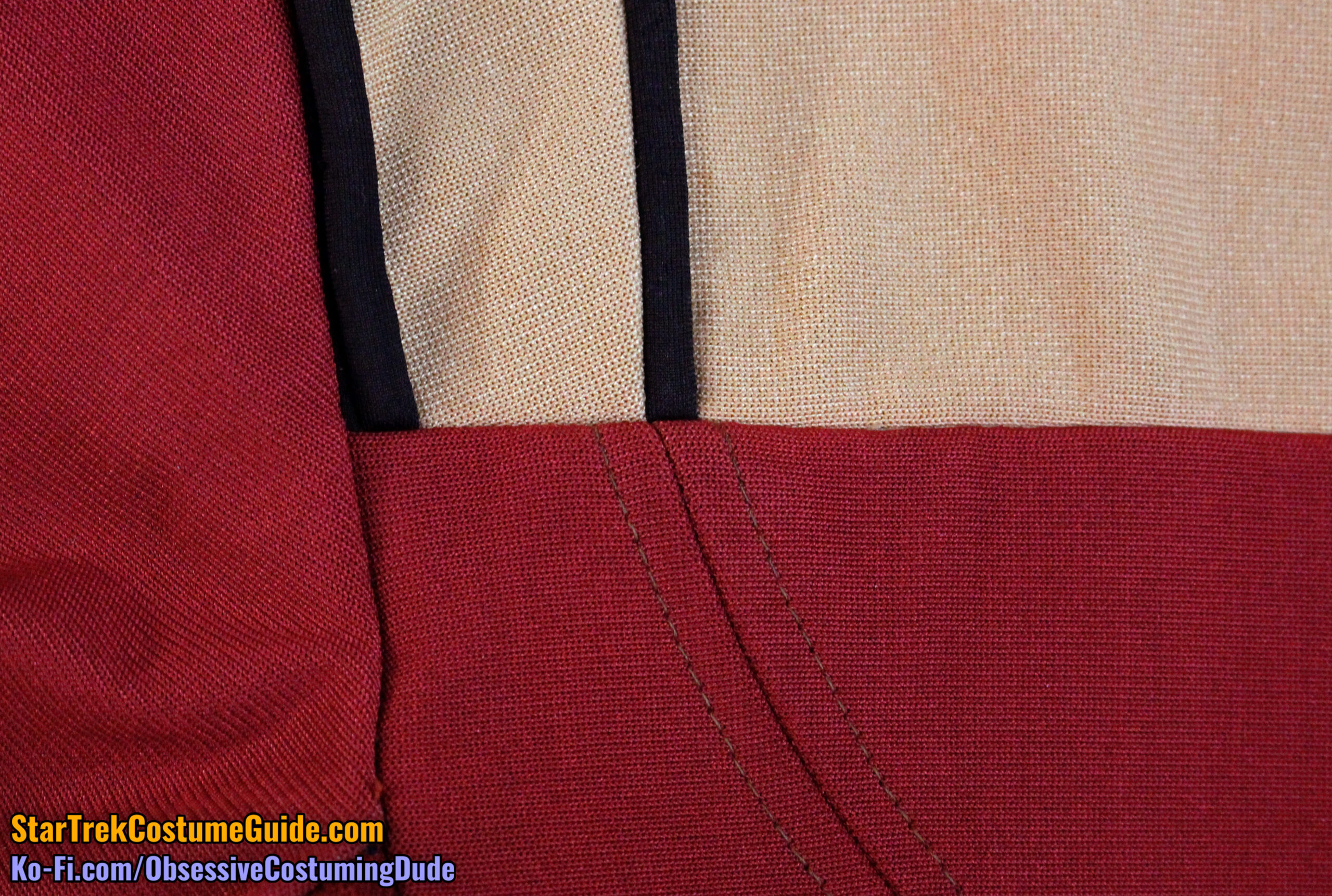
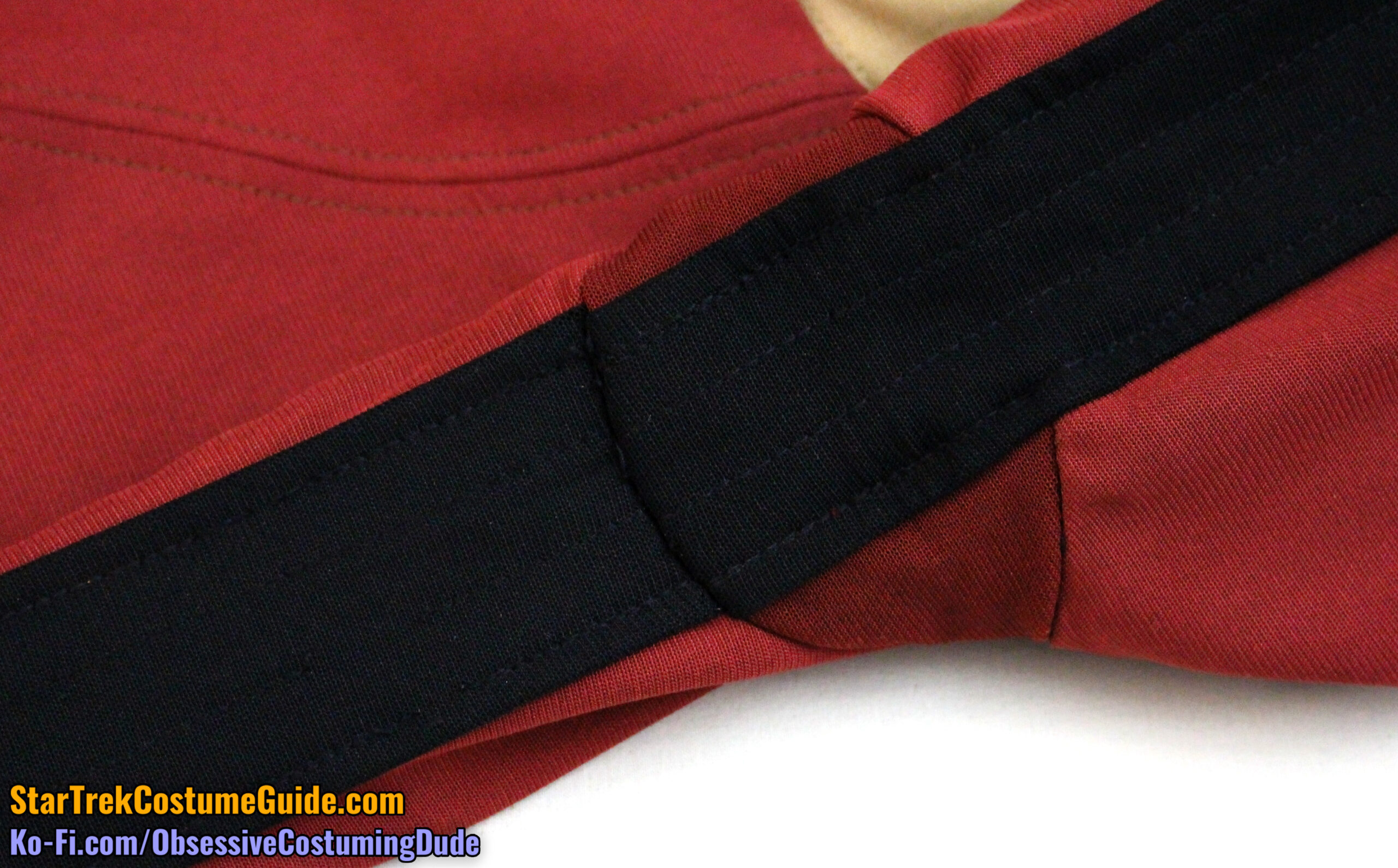
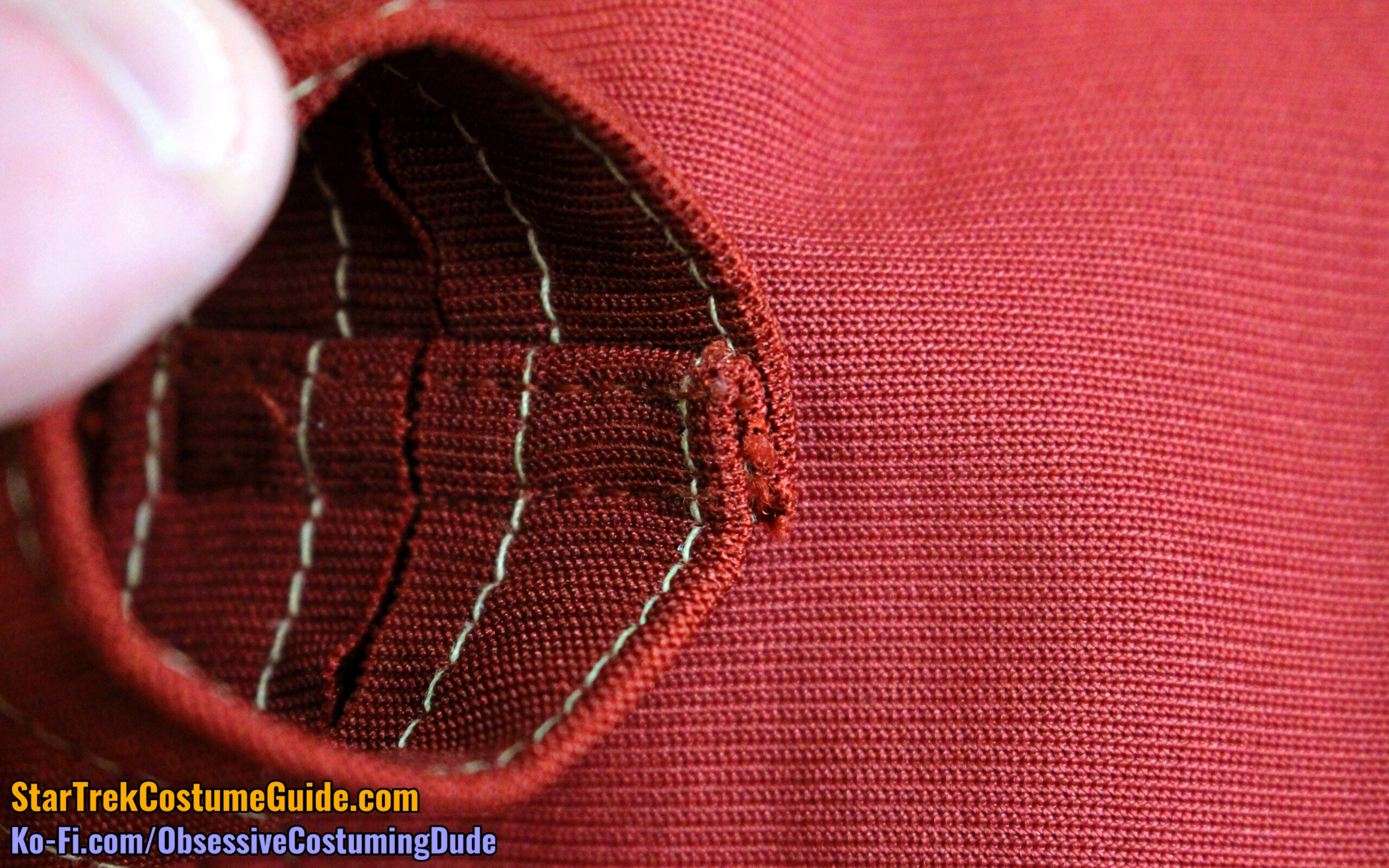
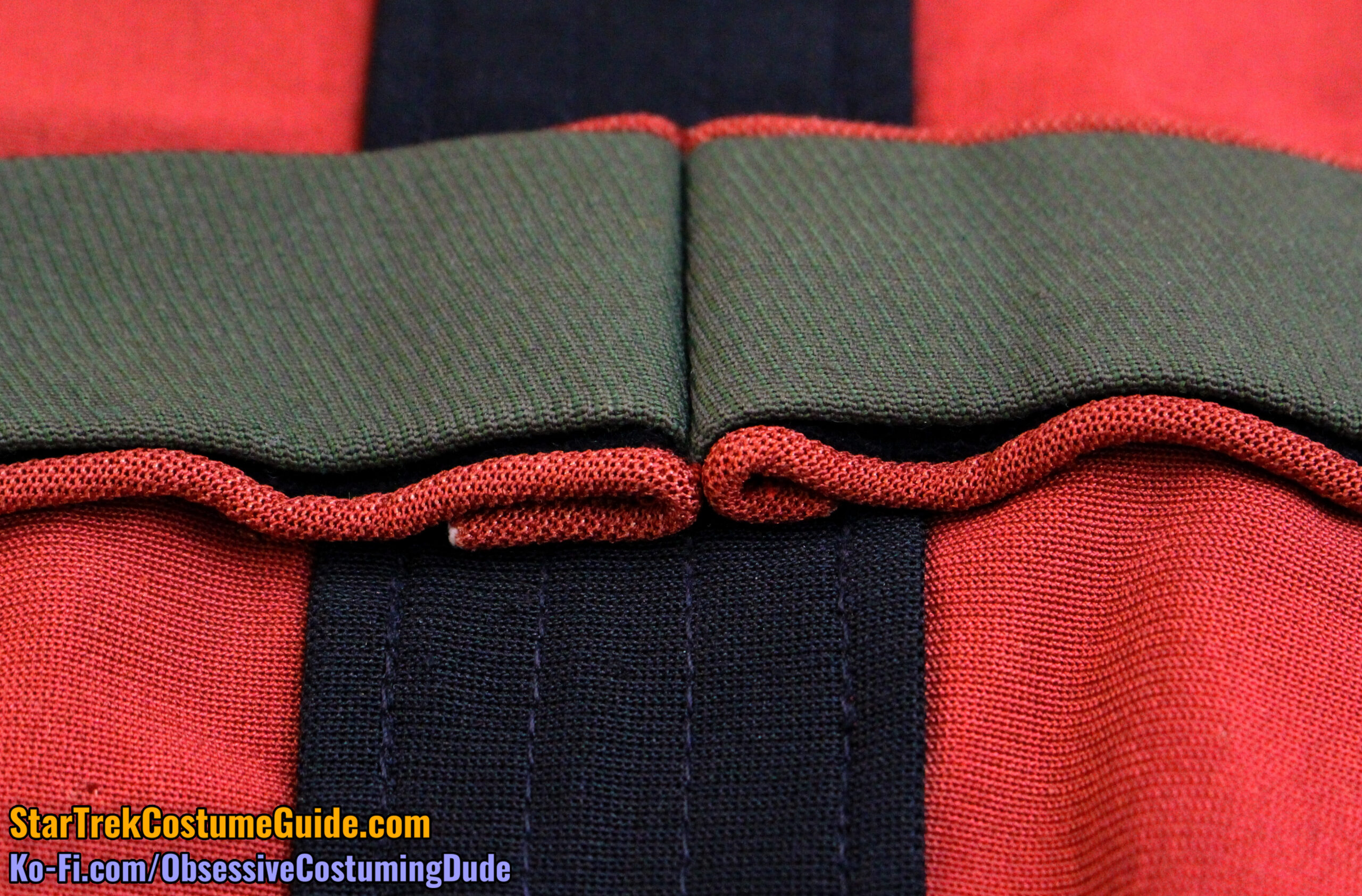
Here’s a close-up photo of the screen-used enlisted jumpsuit I examined, in which the jumbo spandex weave is clearly visible:
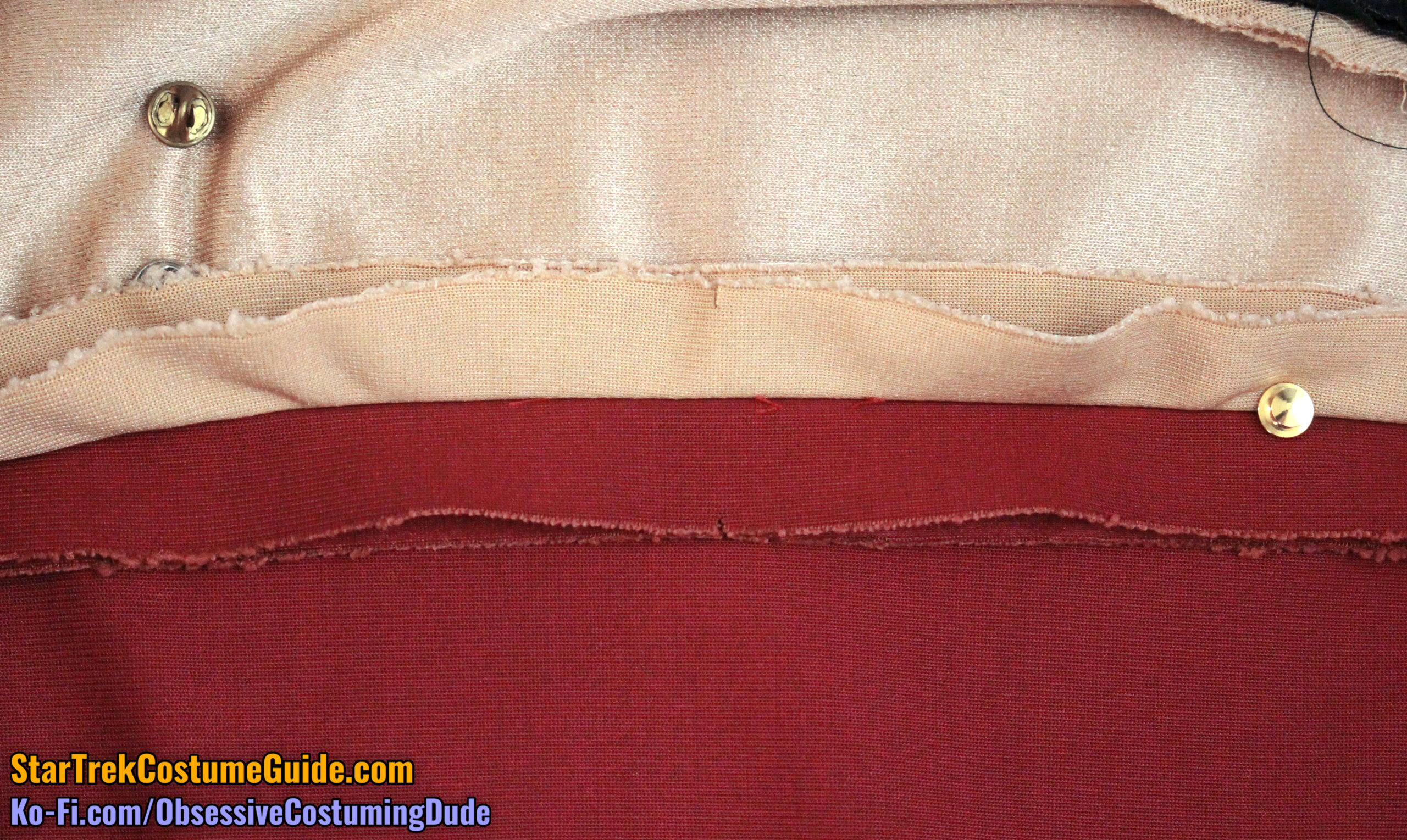
In fact, these jumpsuits were double-layered jumbo spandex!
For the jumpsuit body (the red areas), the two layers of spandex were sewn with the “shiny” sides together and the “dull” sides out.
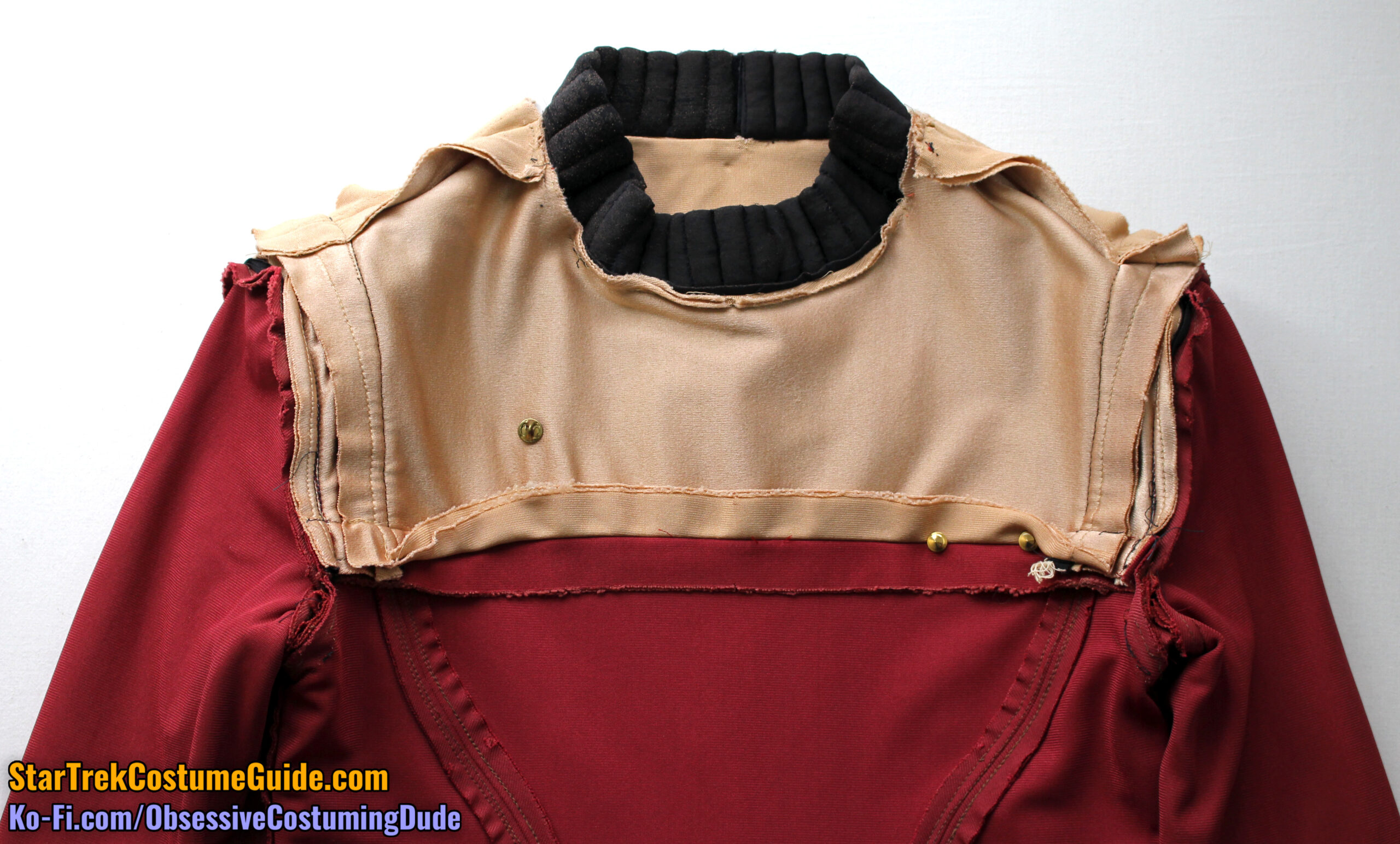
However, for the yoke, the two layers of spandex were oriented in the same direction, with the “shiny” side on the underside facing the wearer.
Yoke Colors
There are two points of interest regarding the enlisted jumpsuit fabric colors.
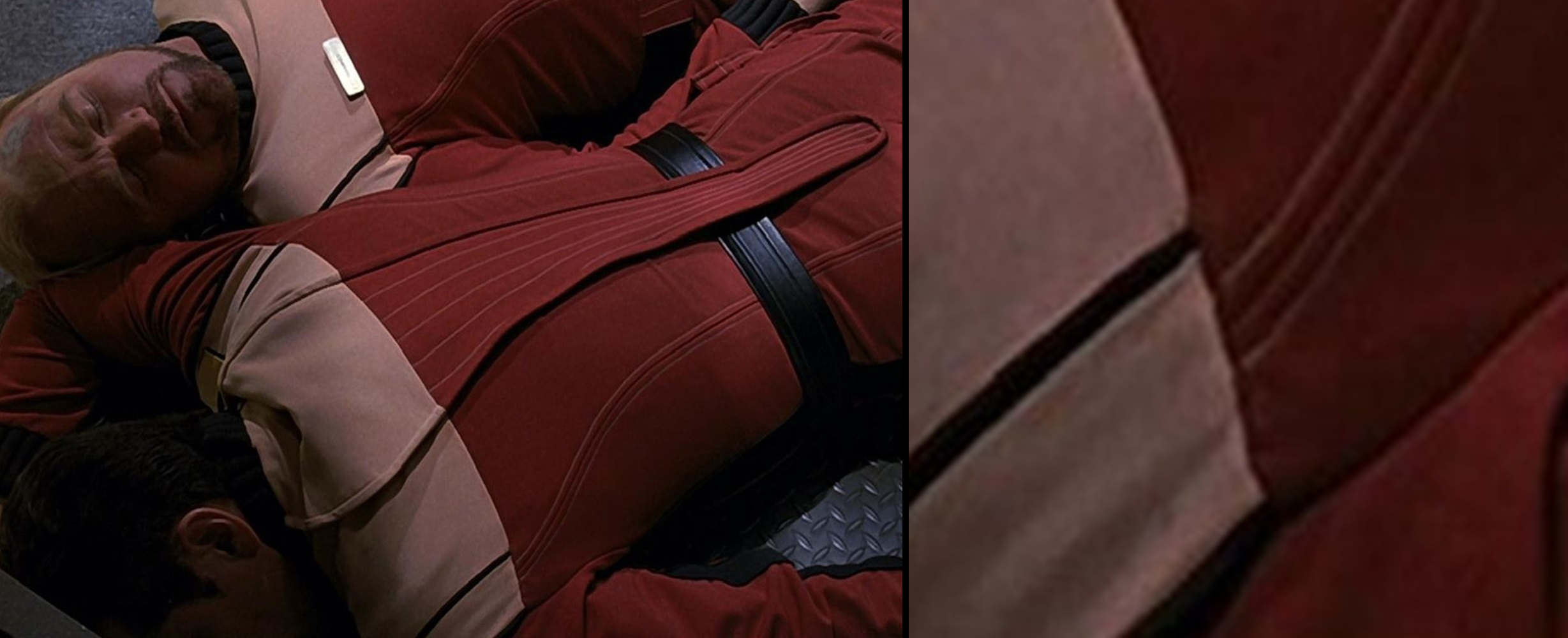
WARNING: YOU MAY NOT EVER BE ABLE TO UNSEE THIS!
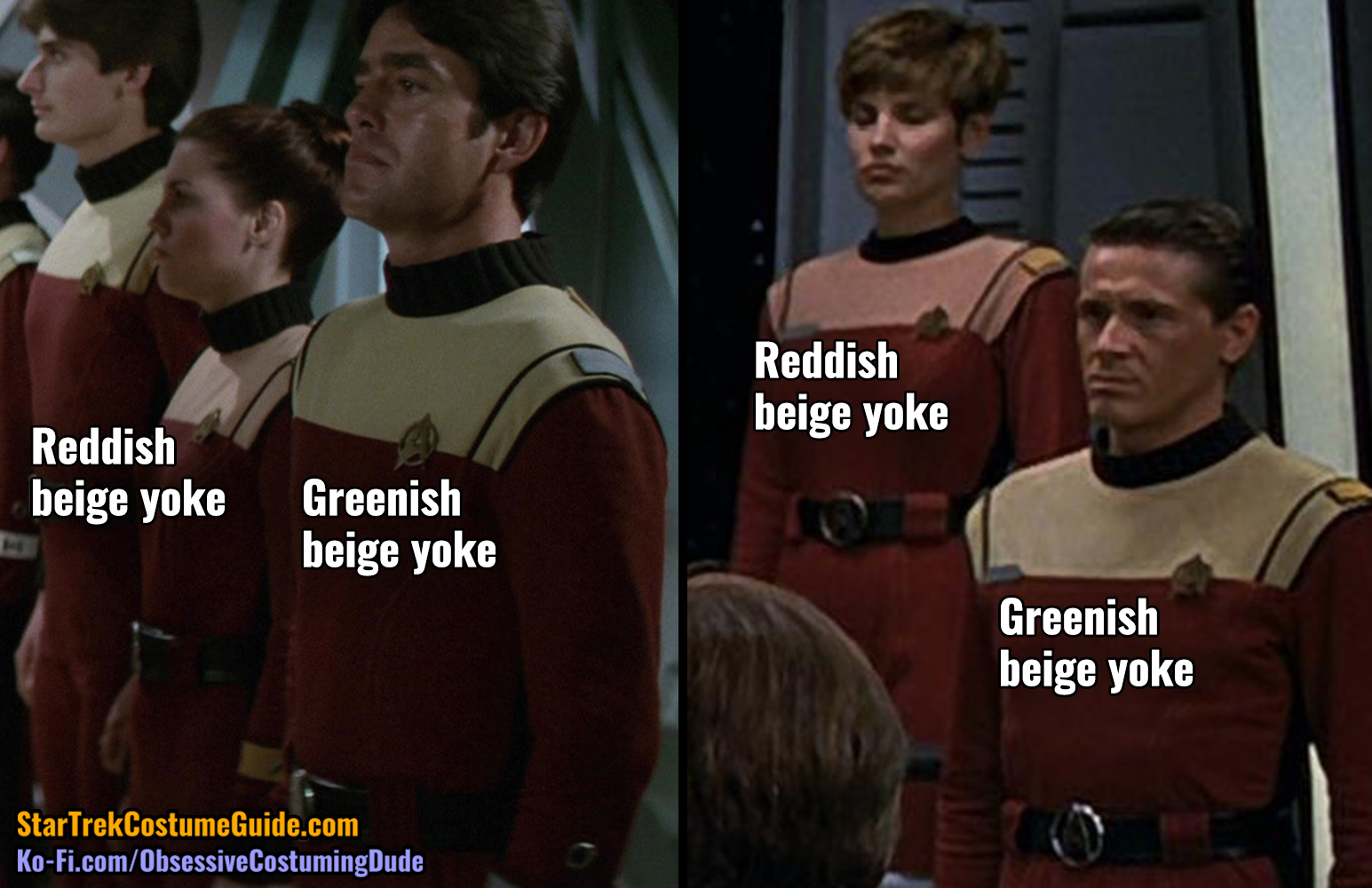
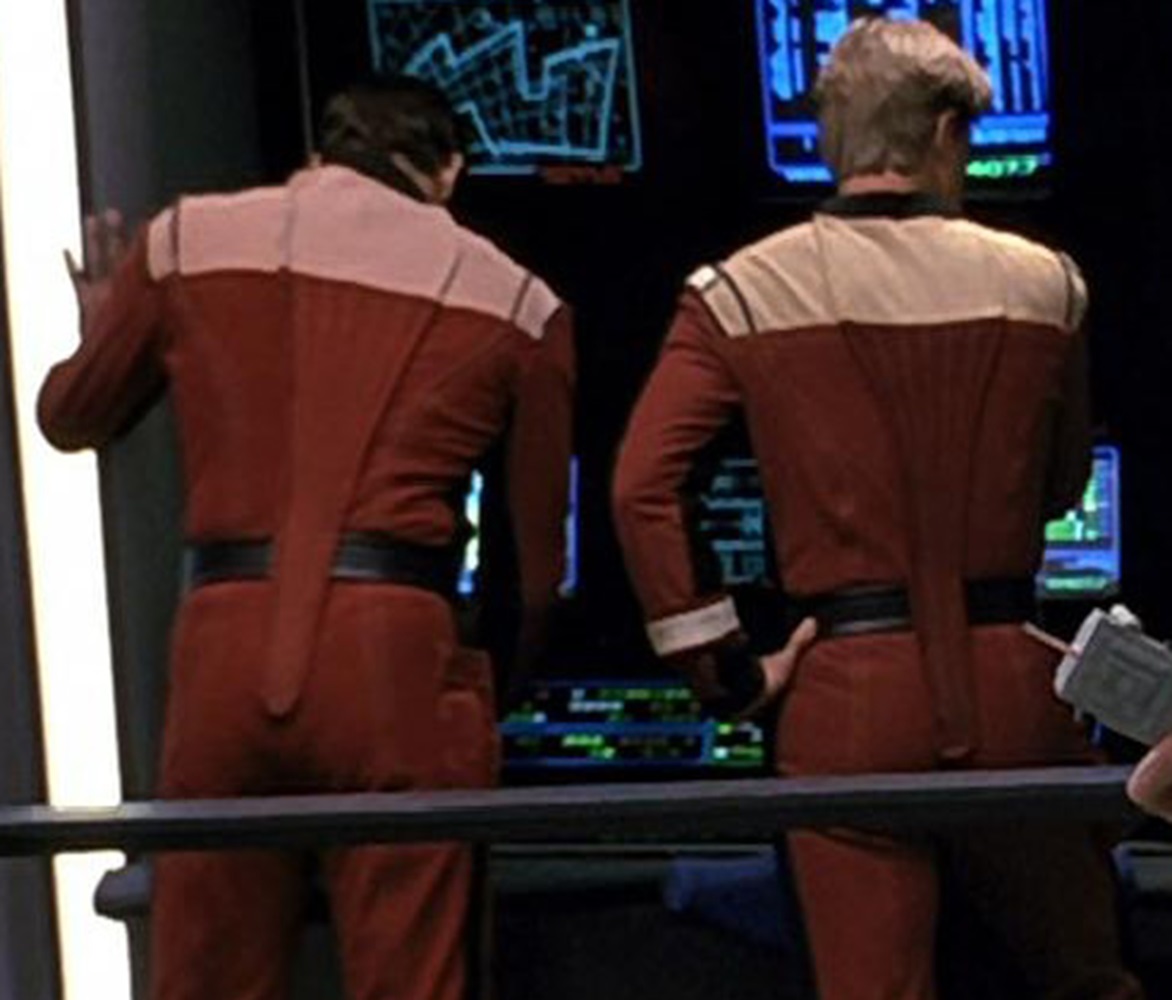
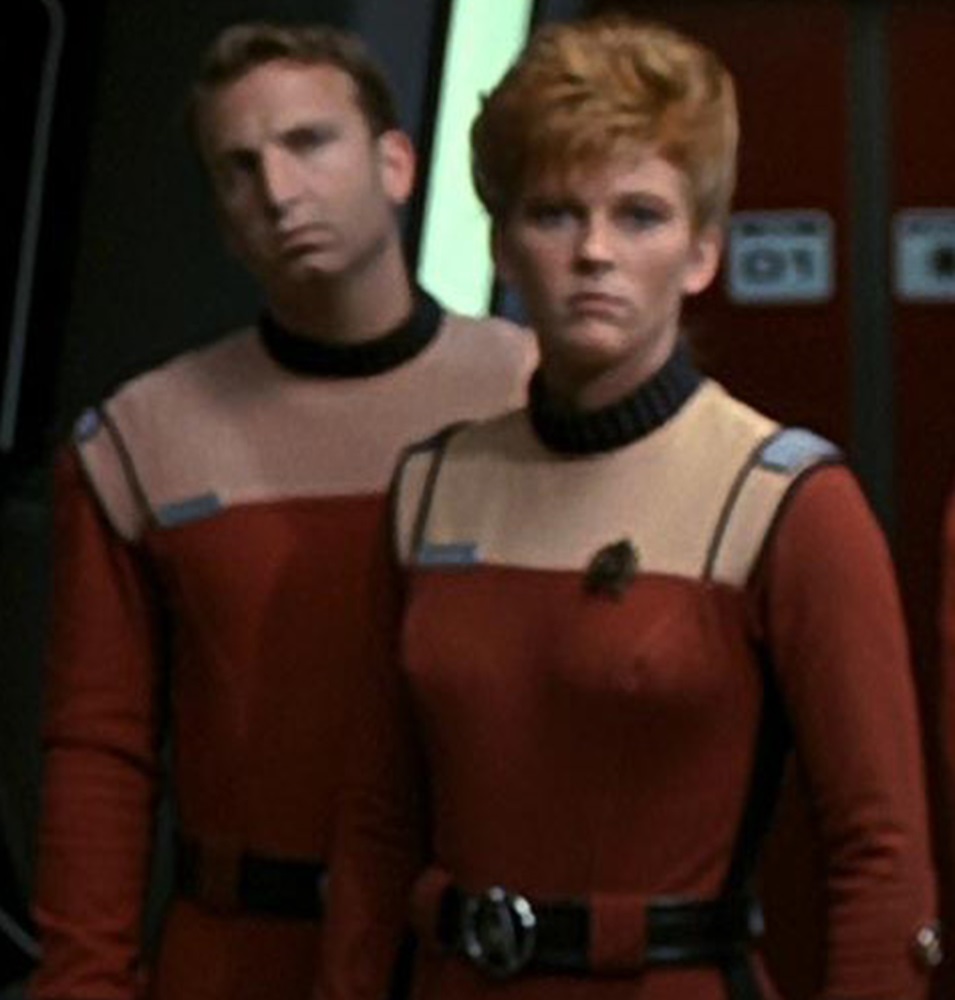
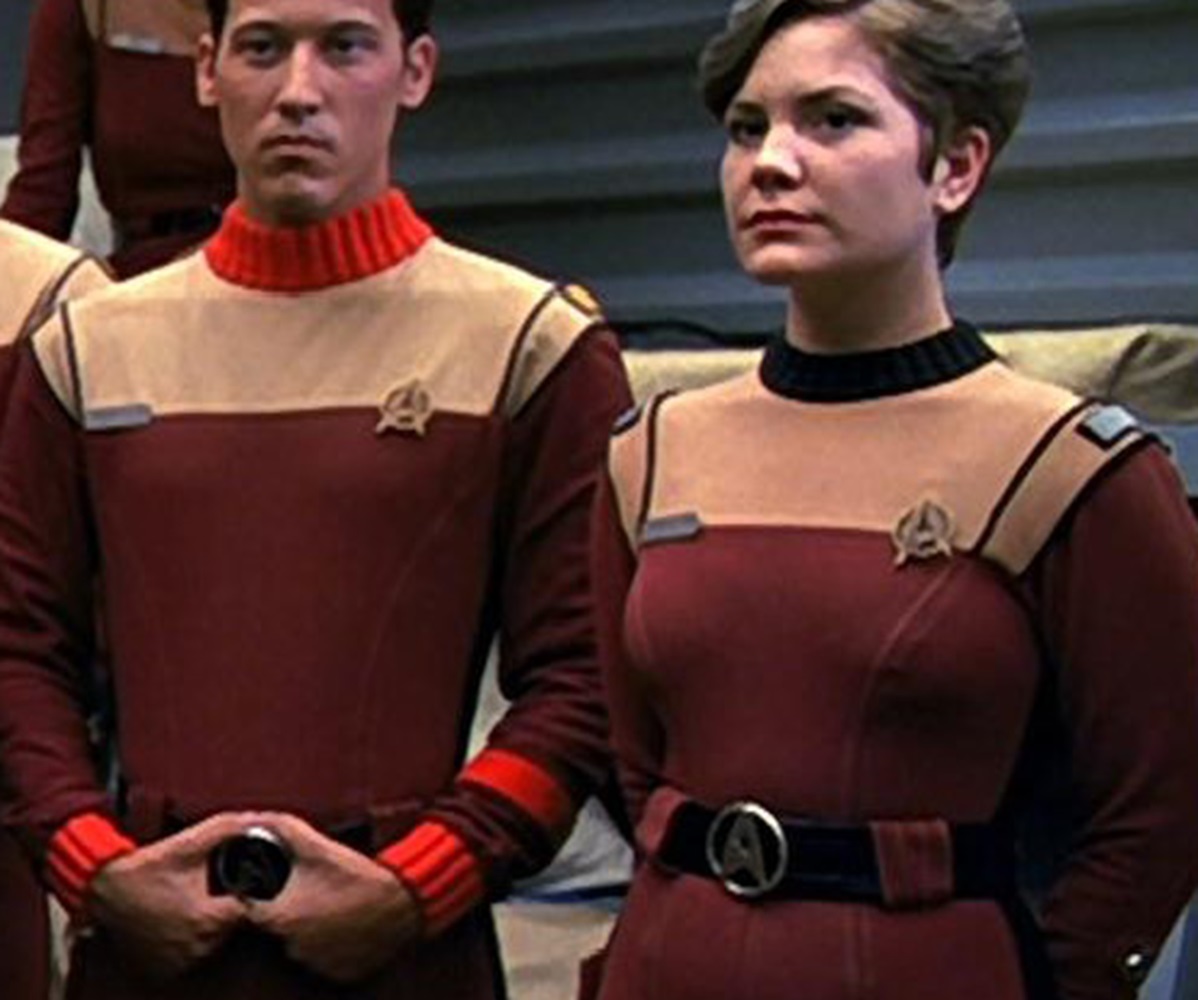
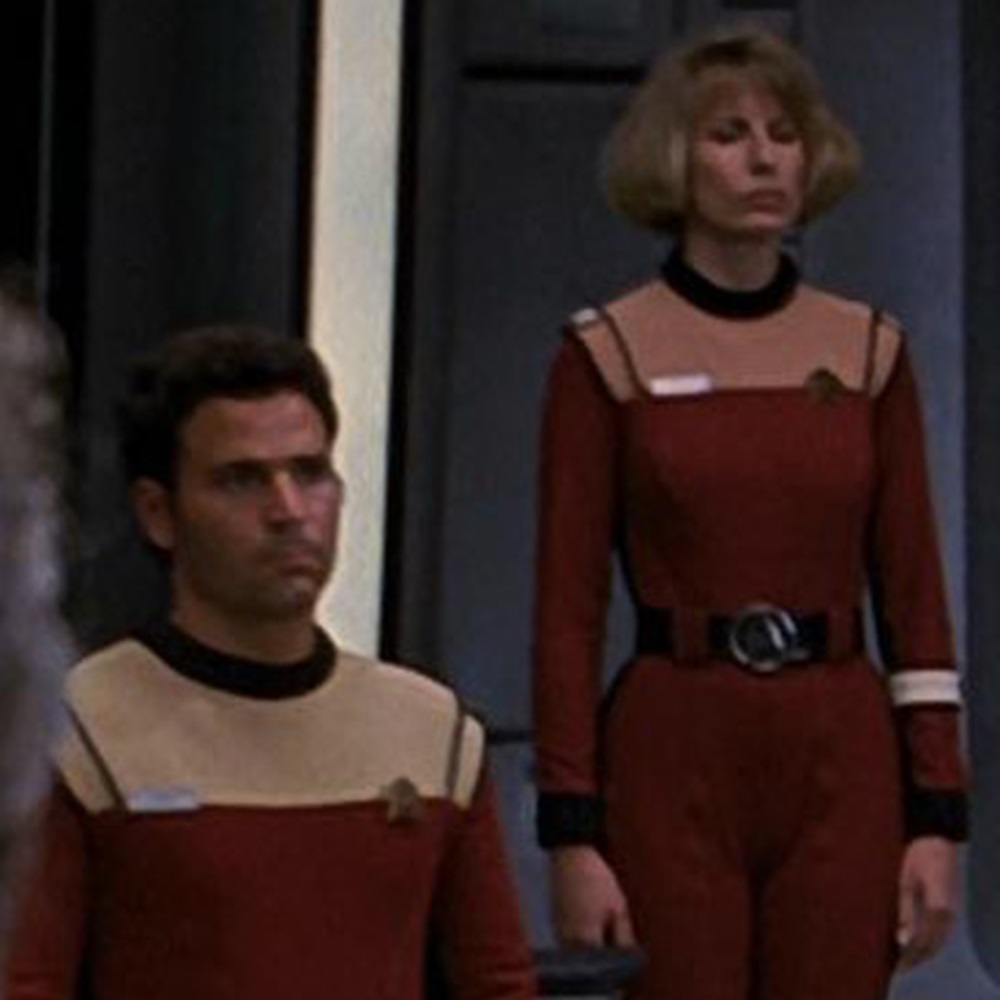
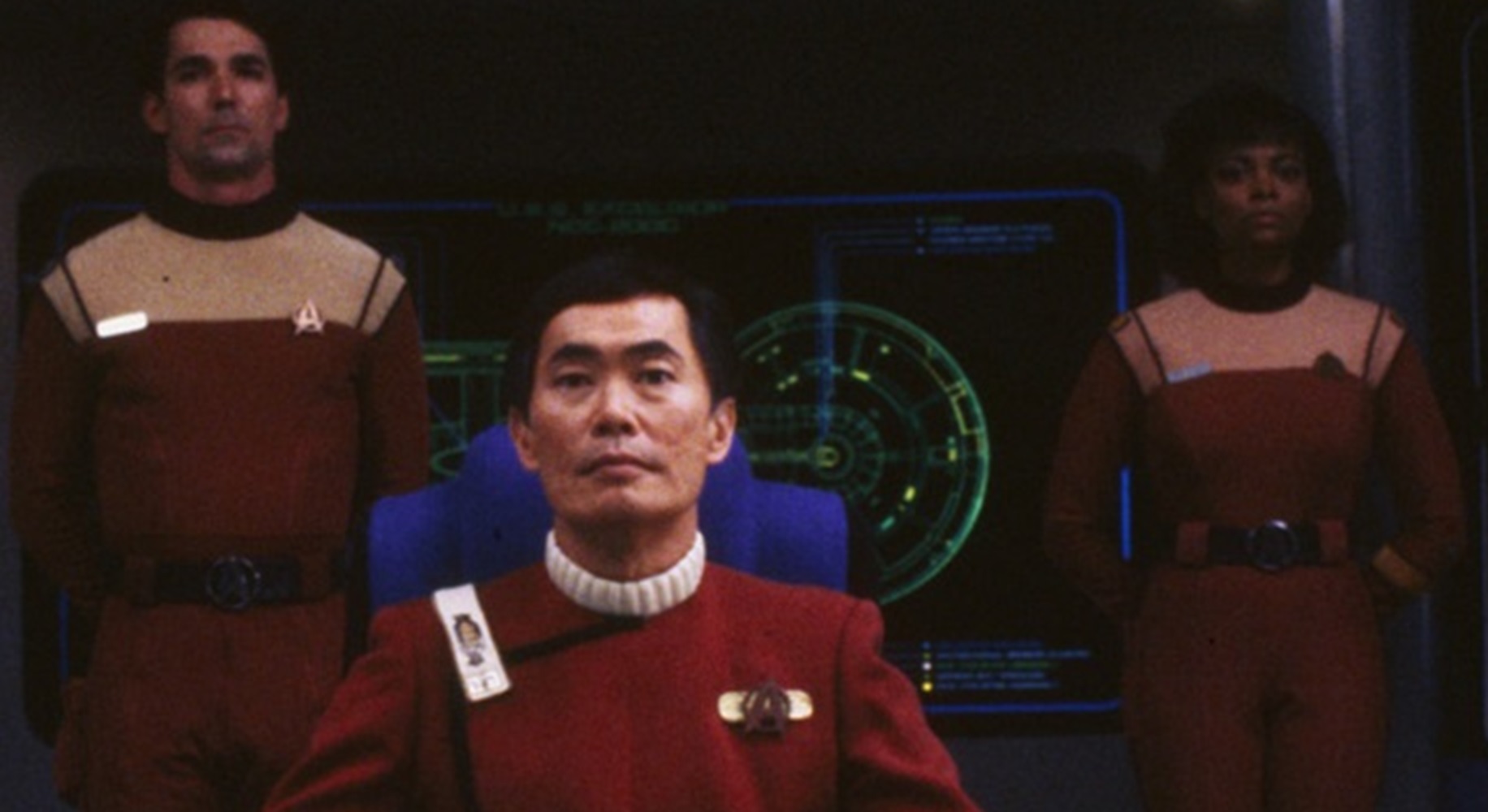
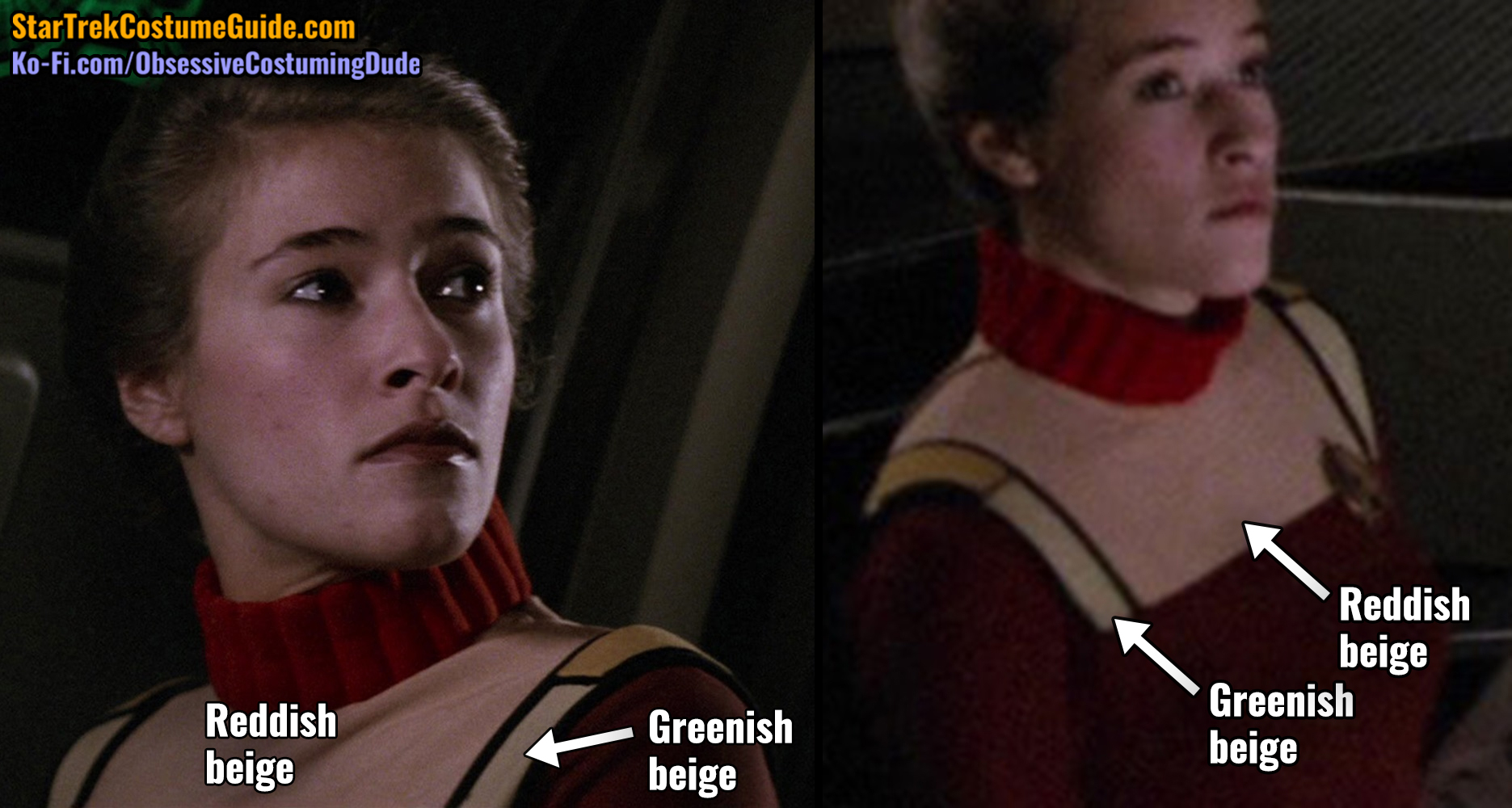
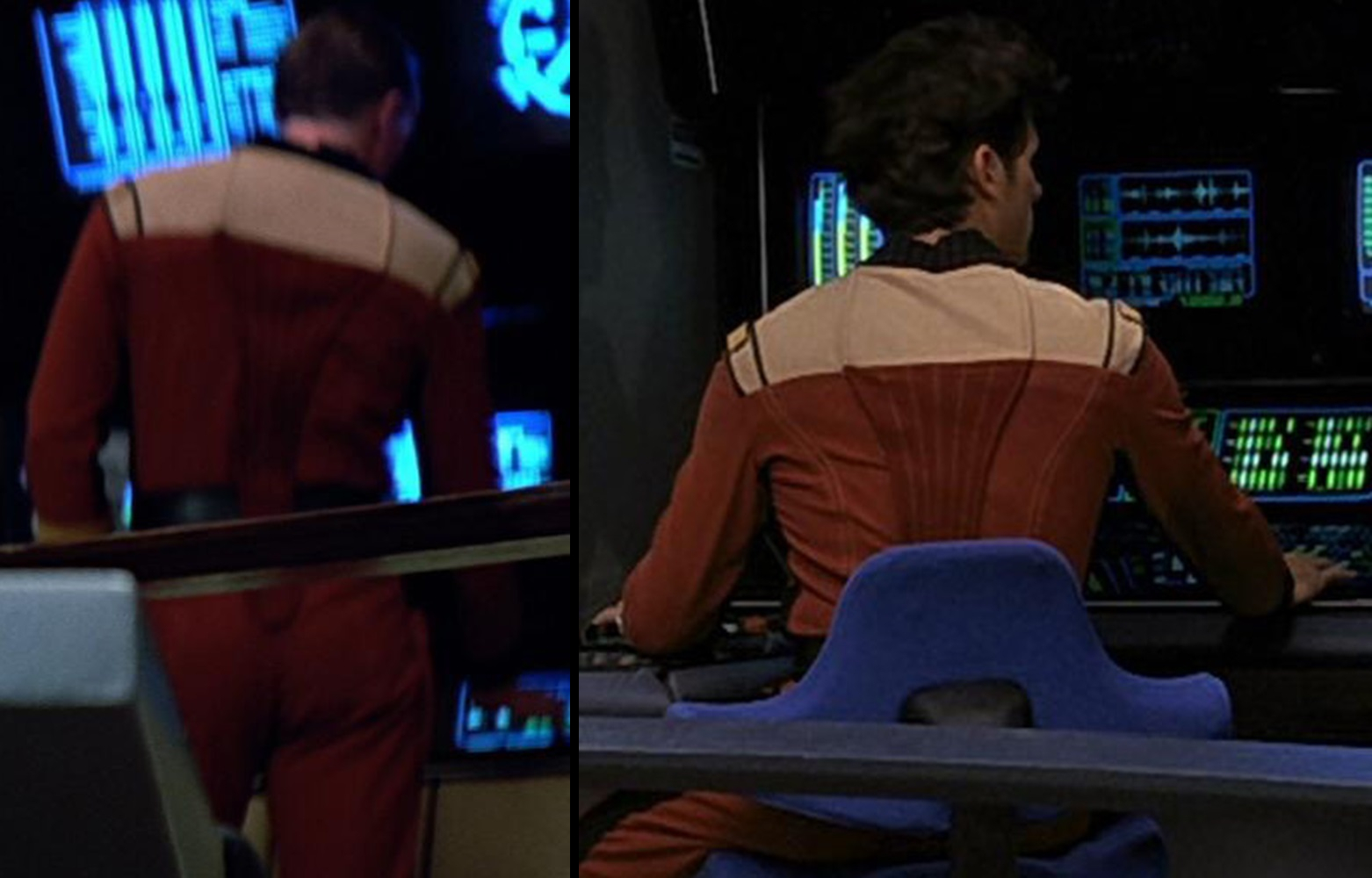
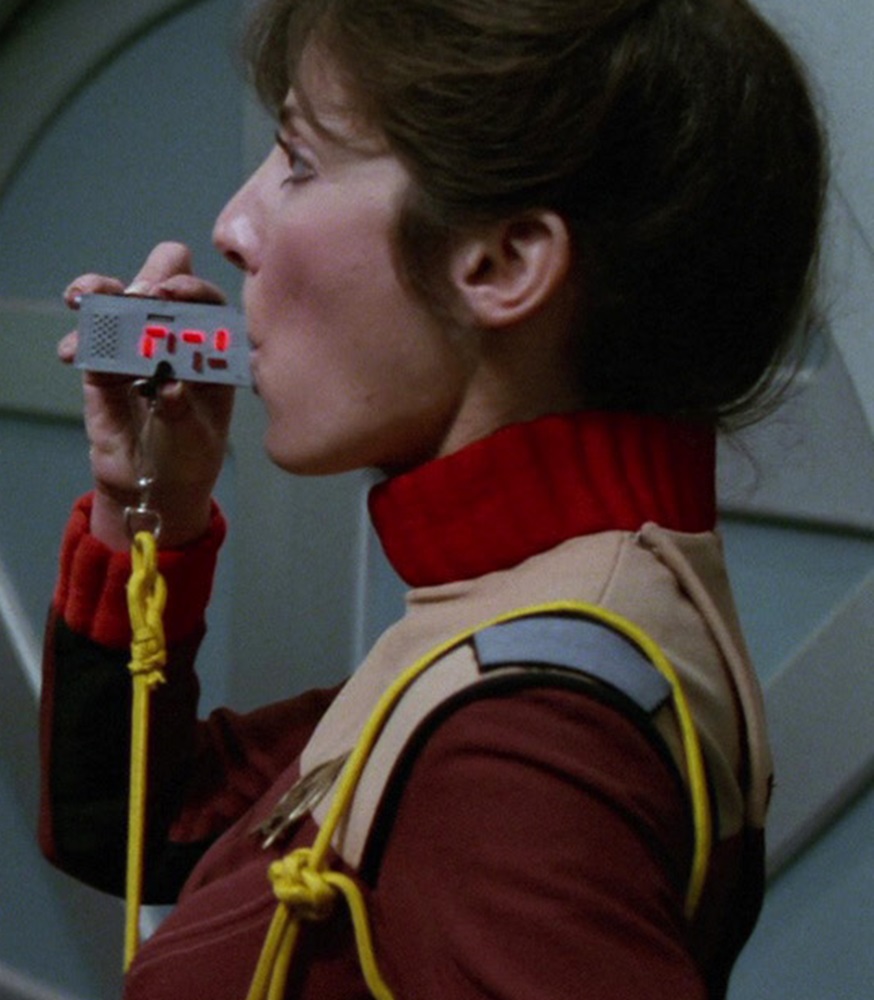
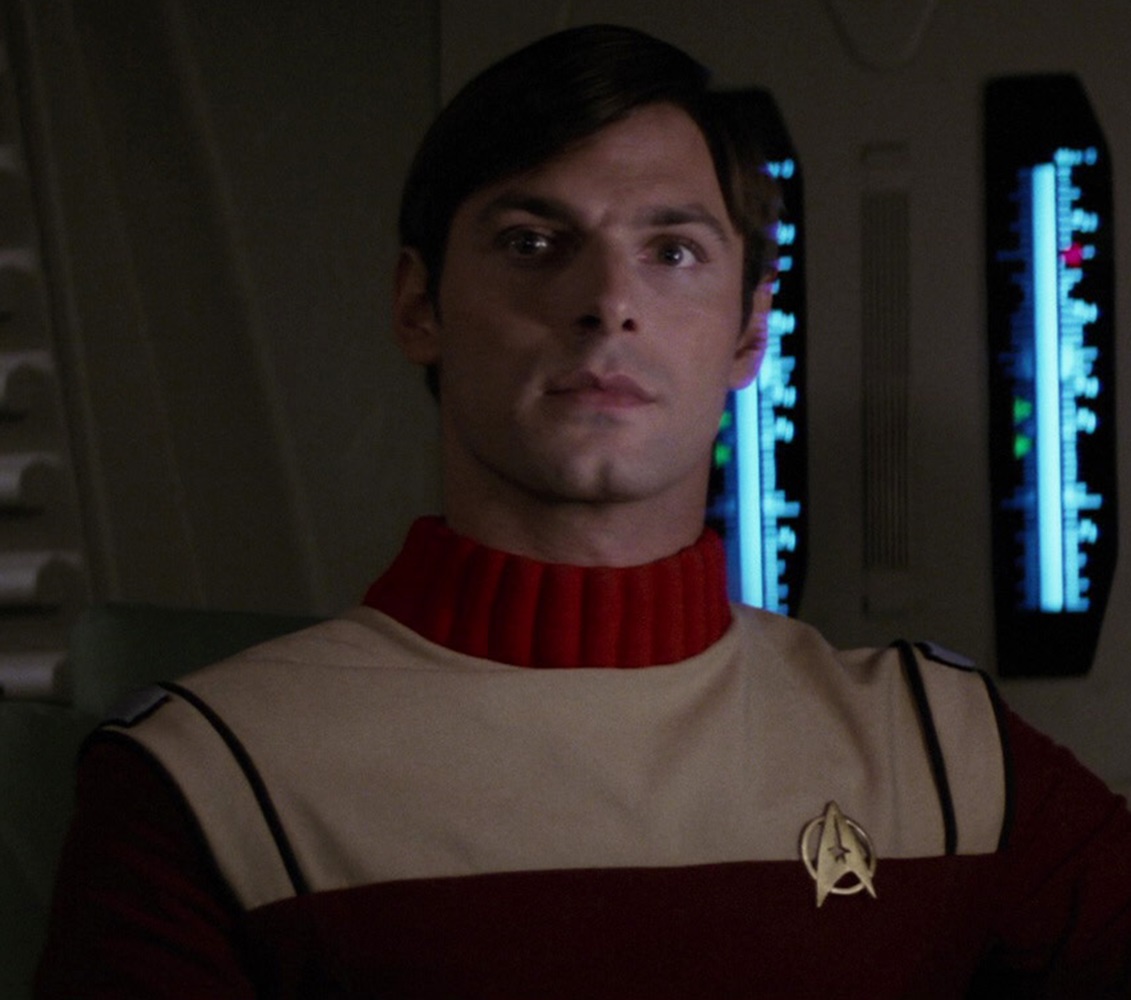
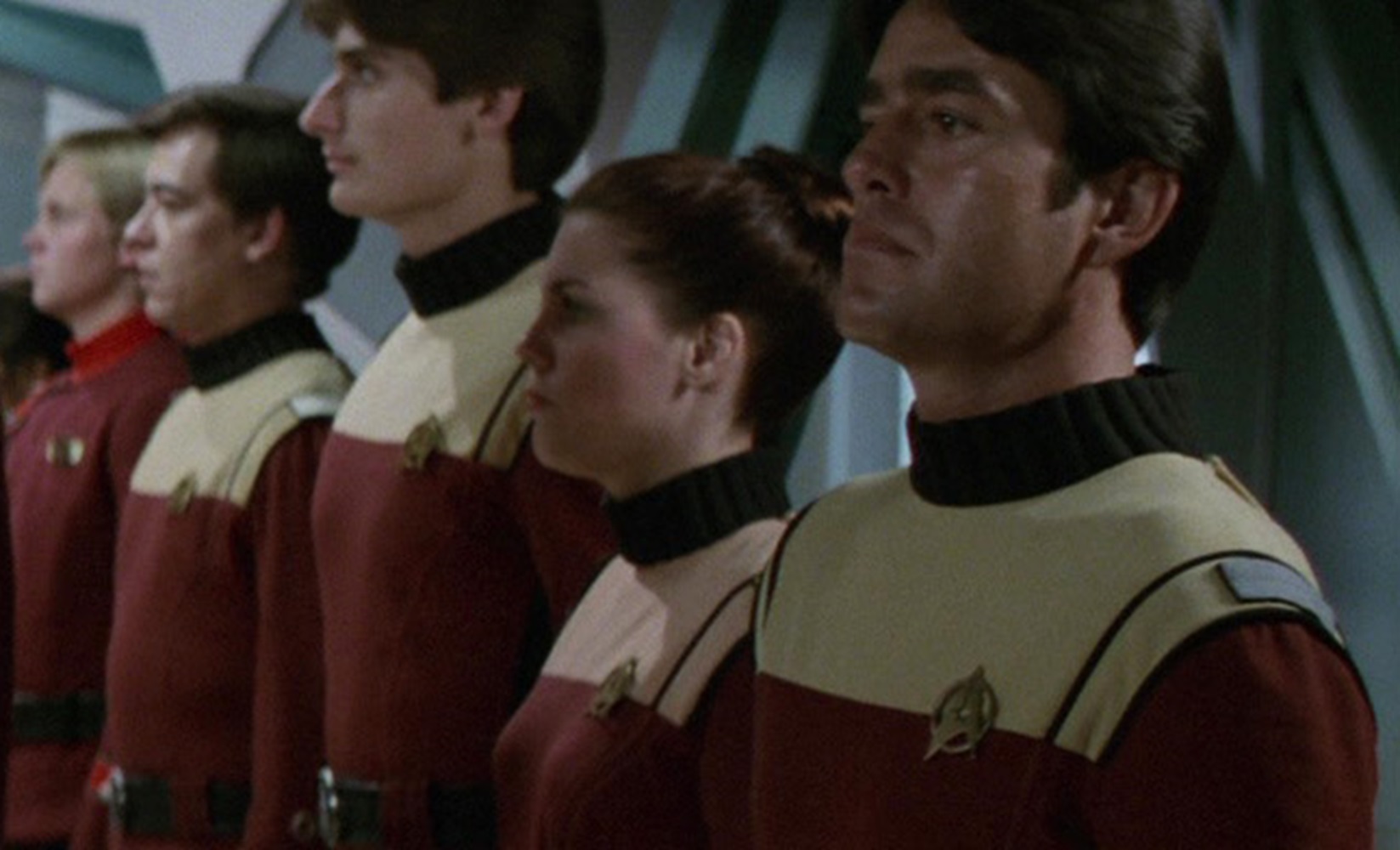
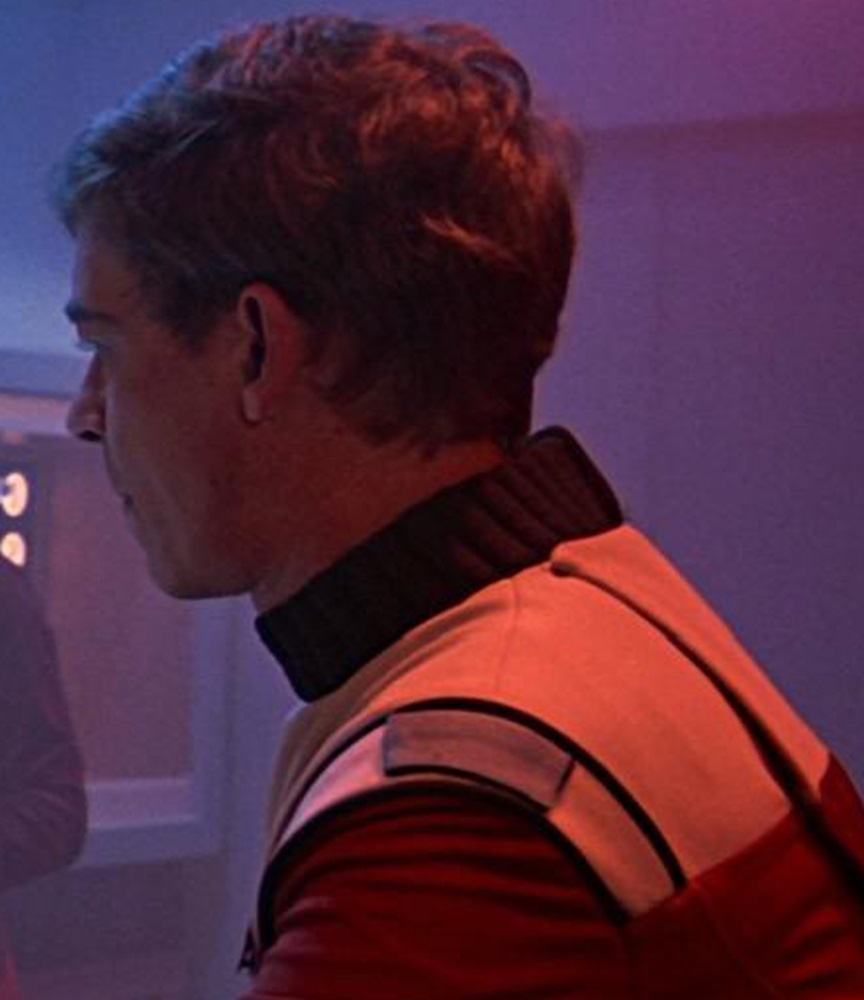
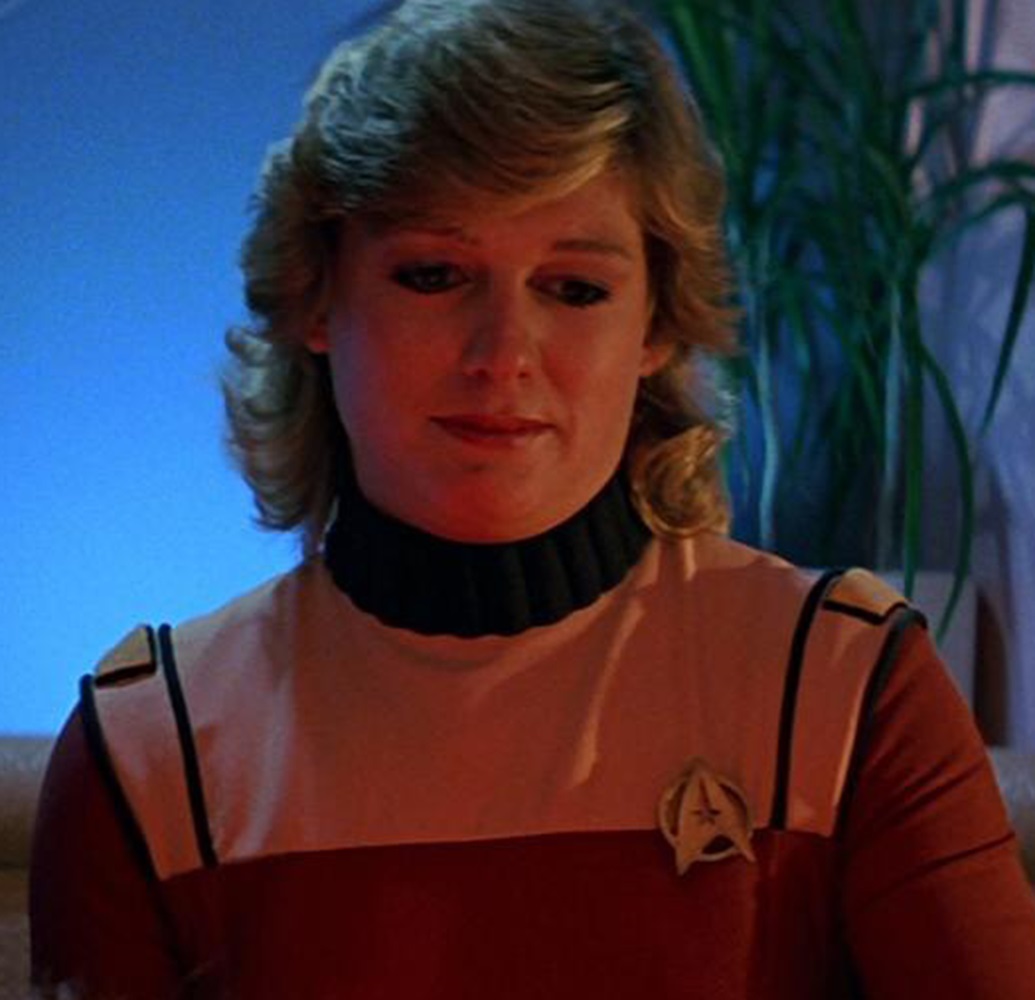
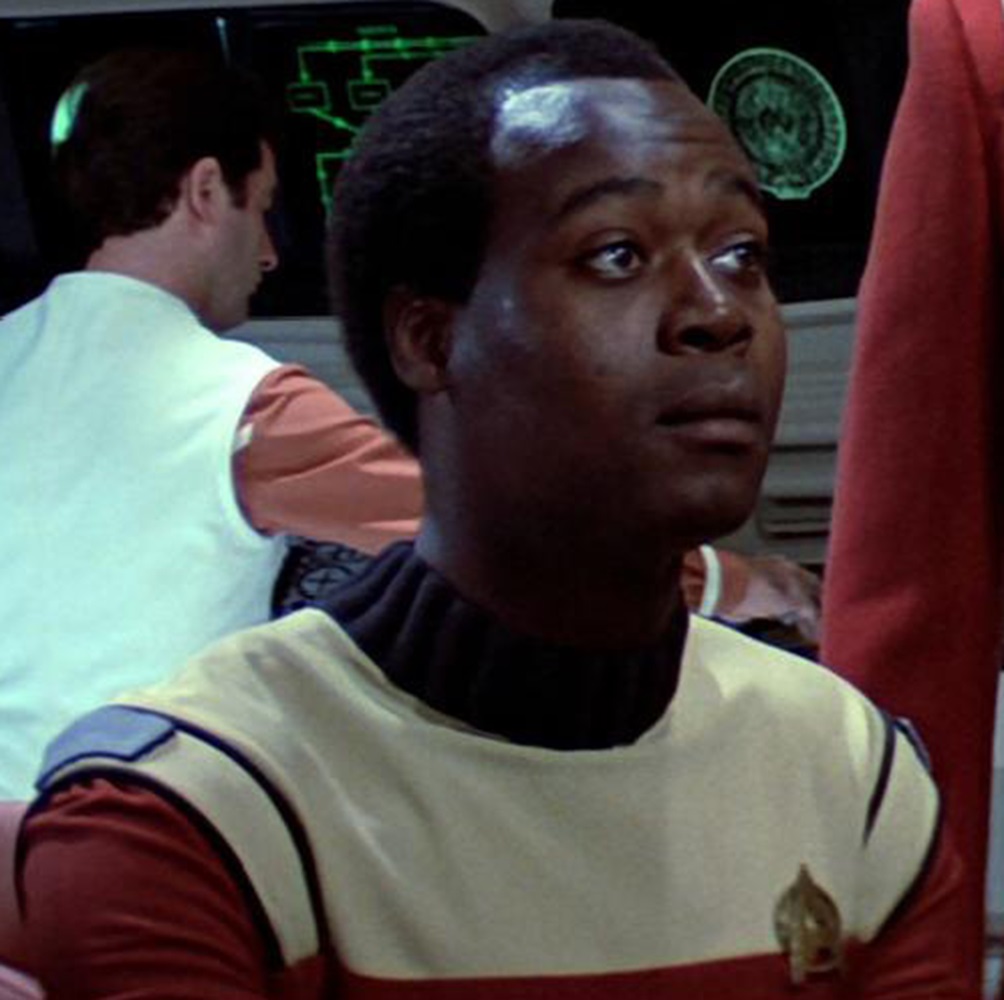
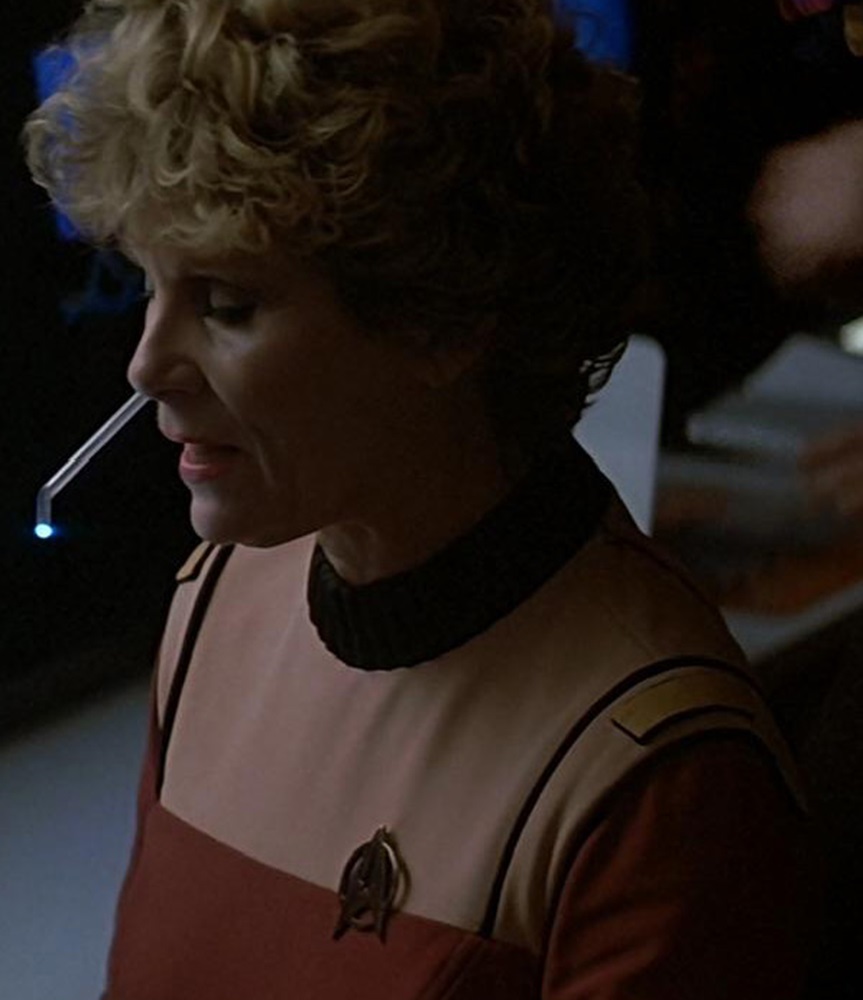
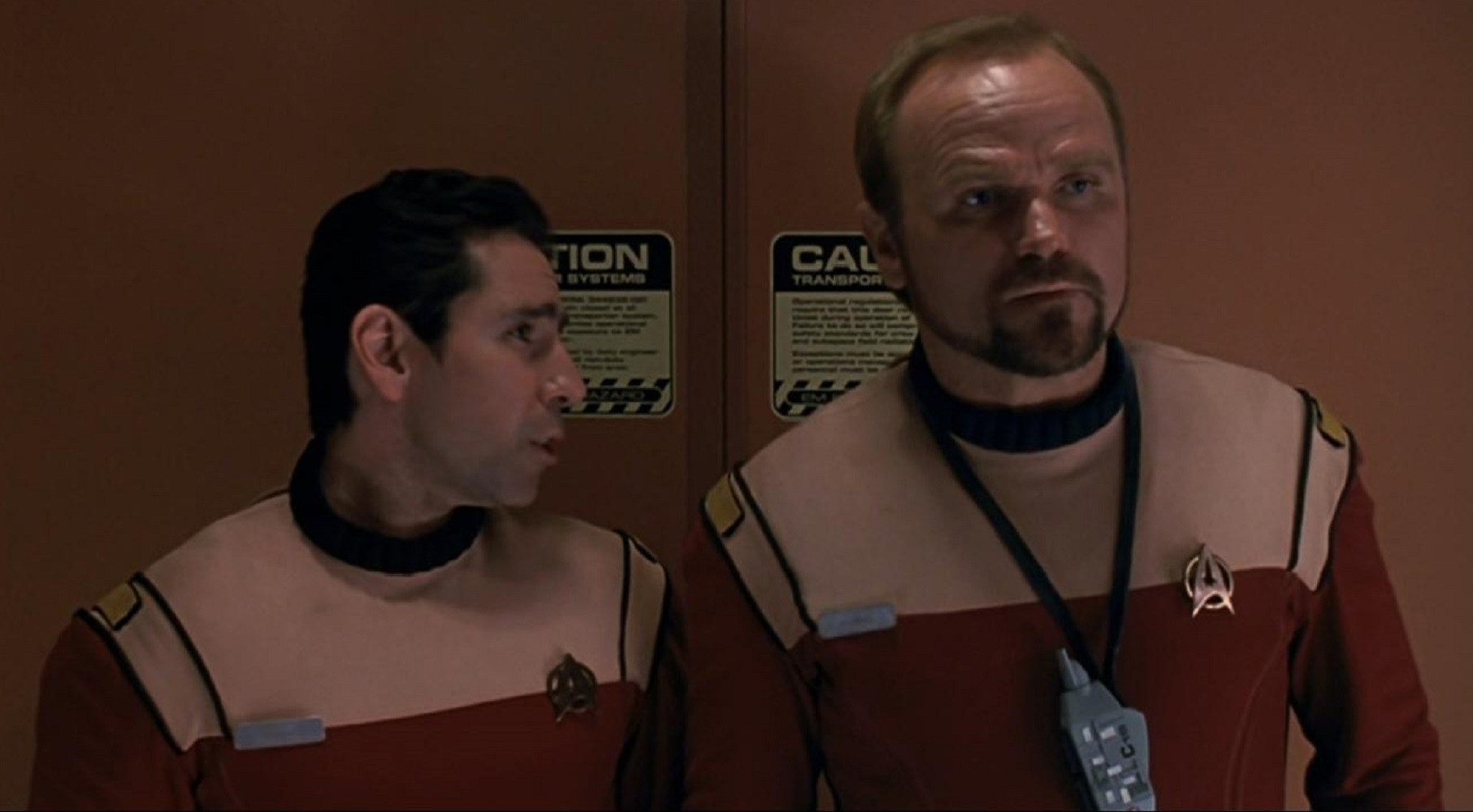
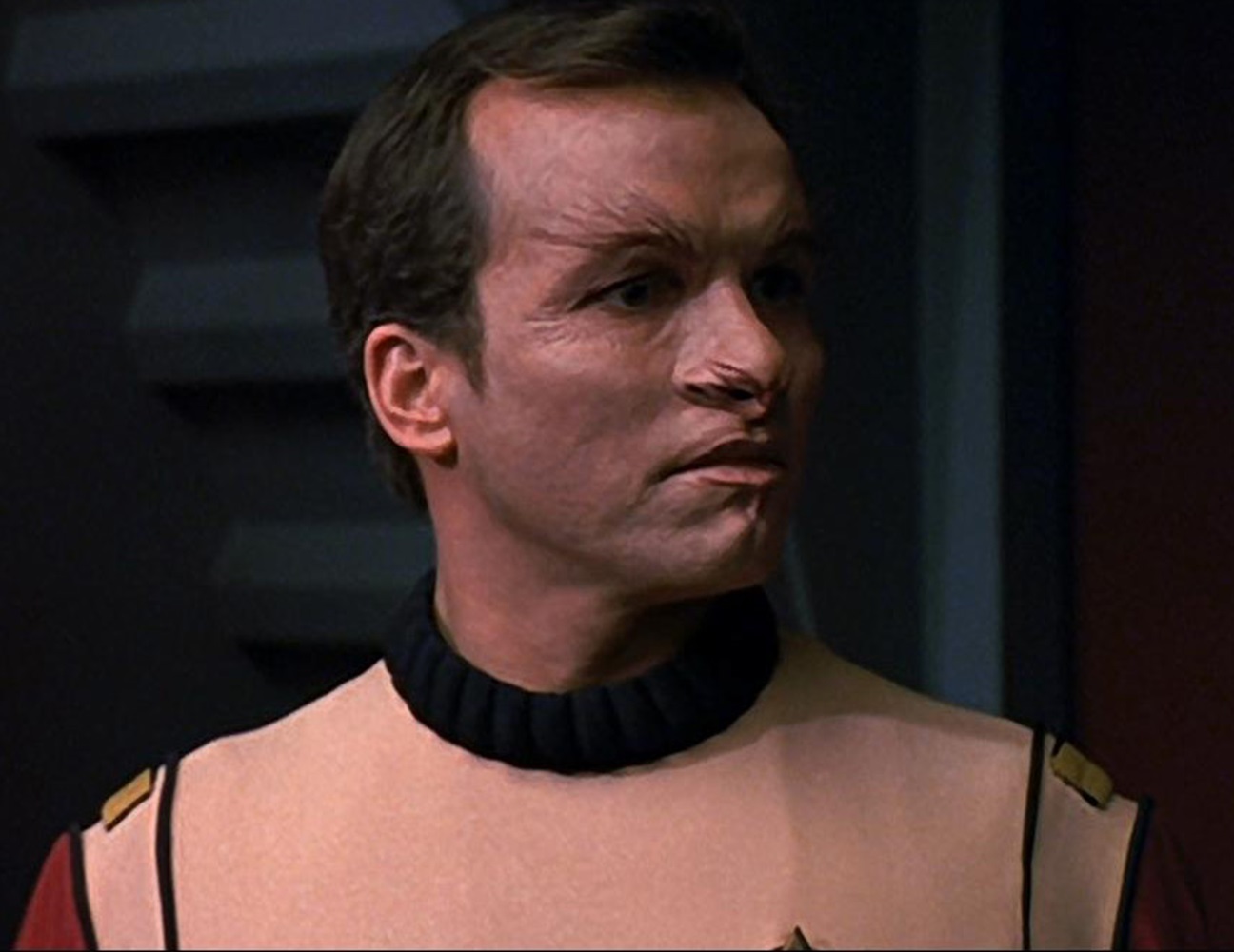
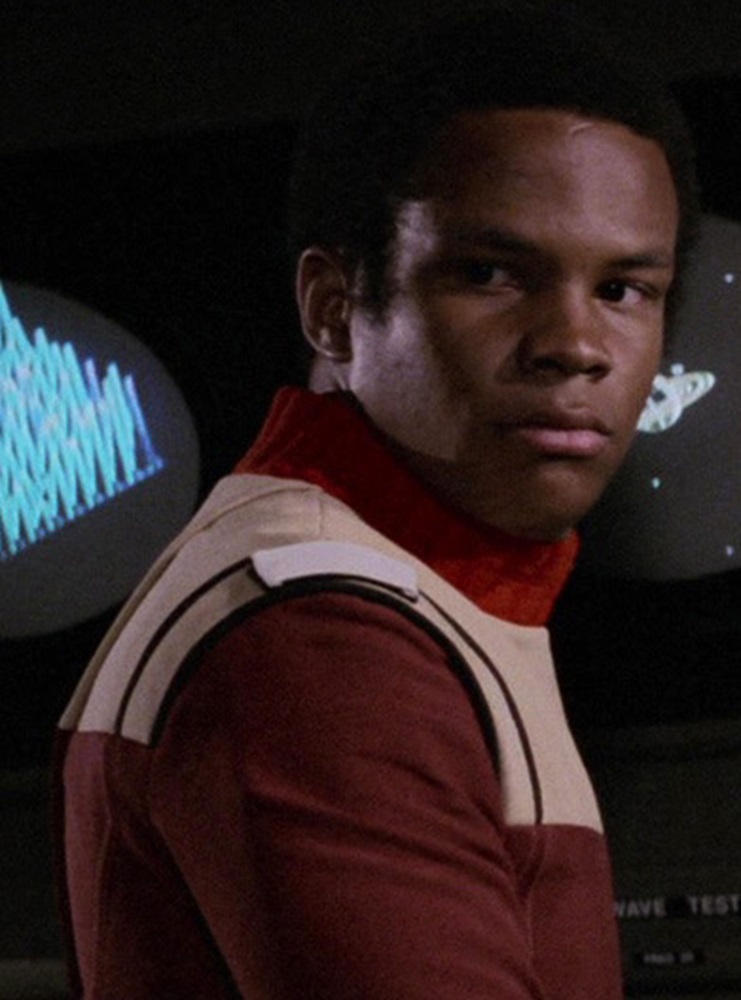
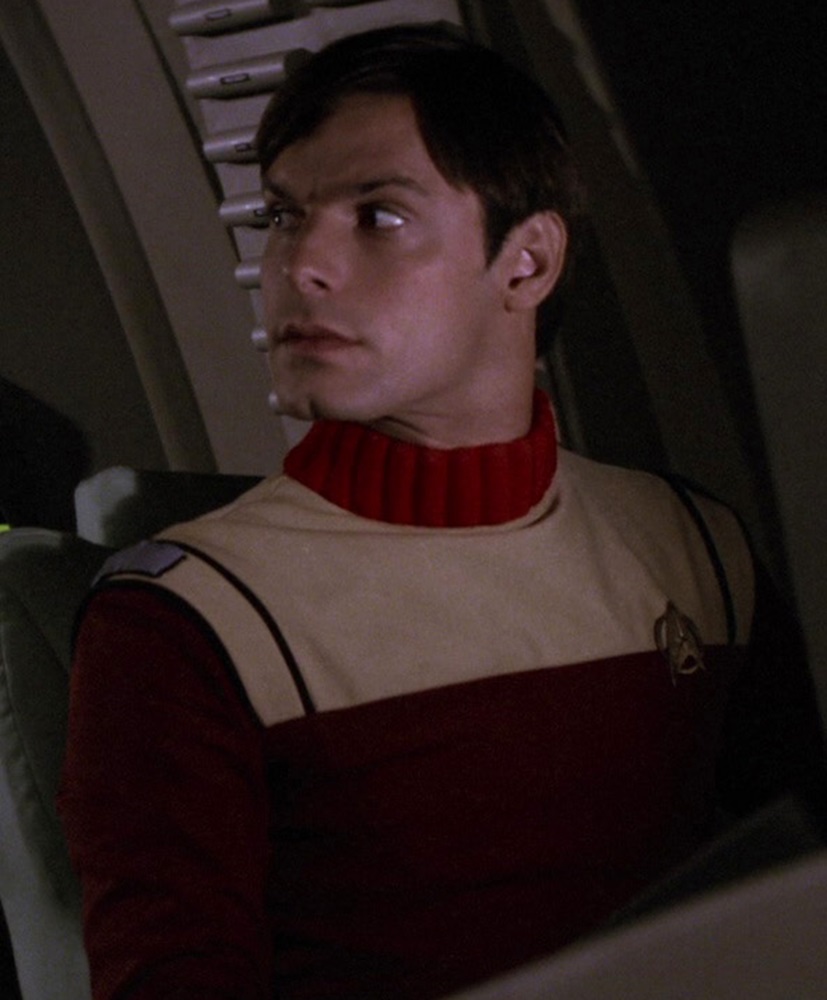
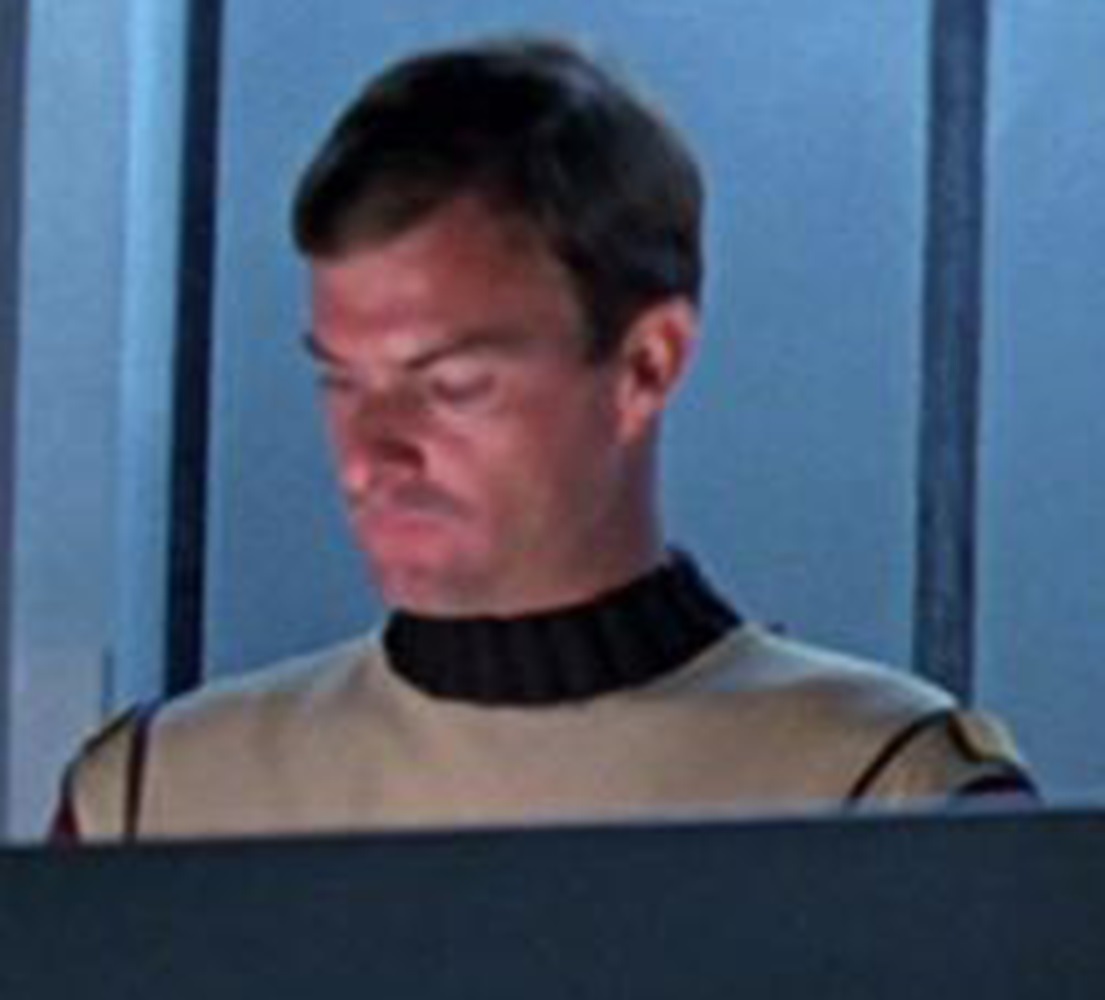
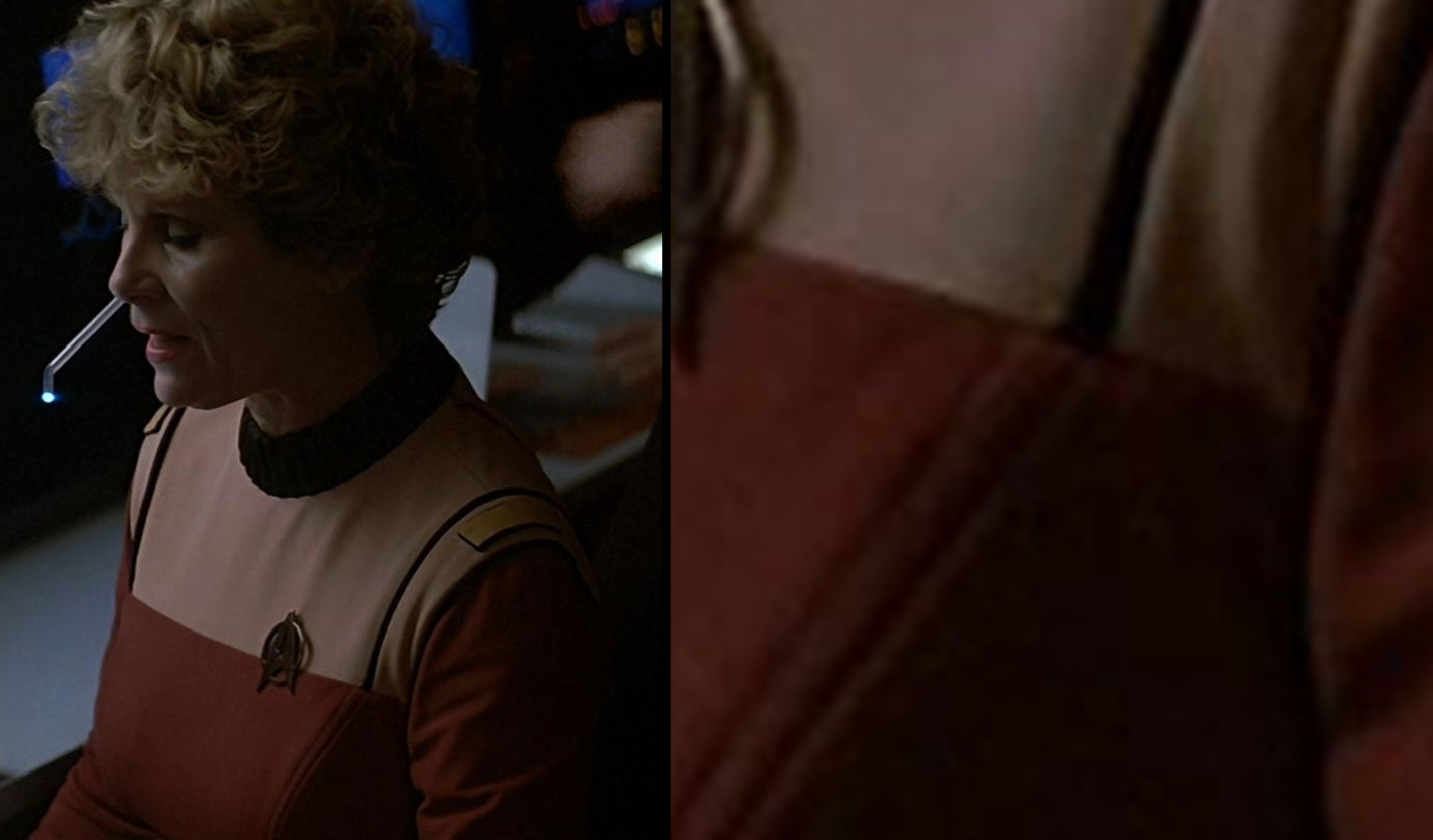
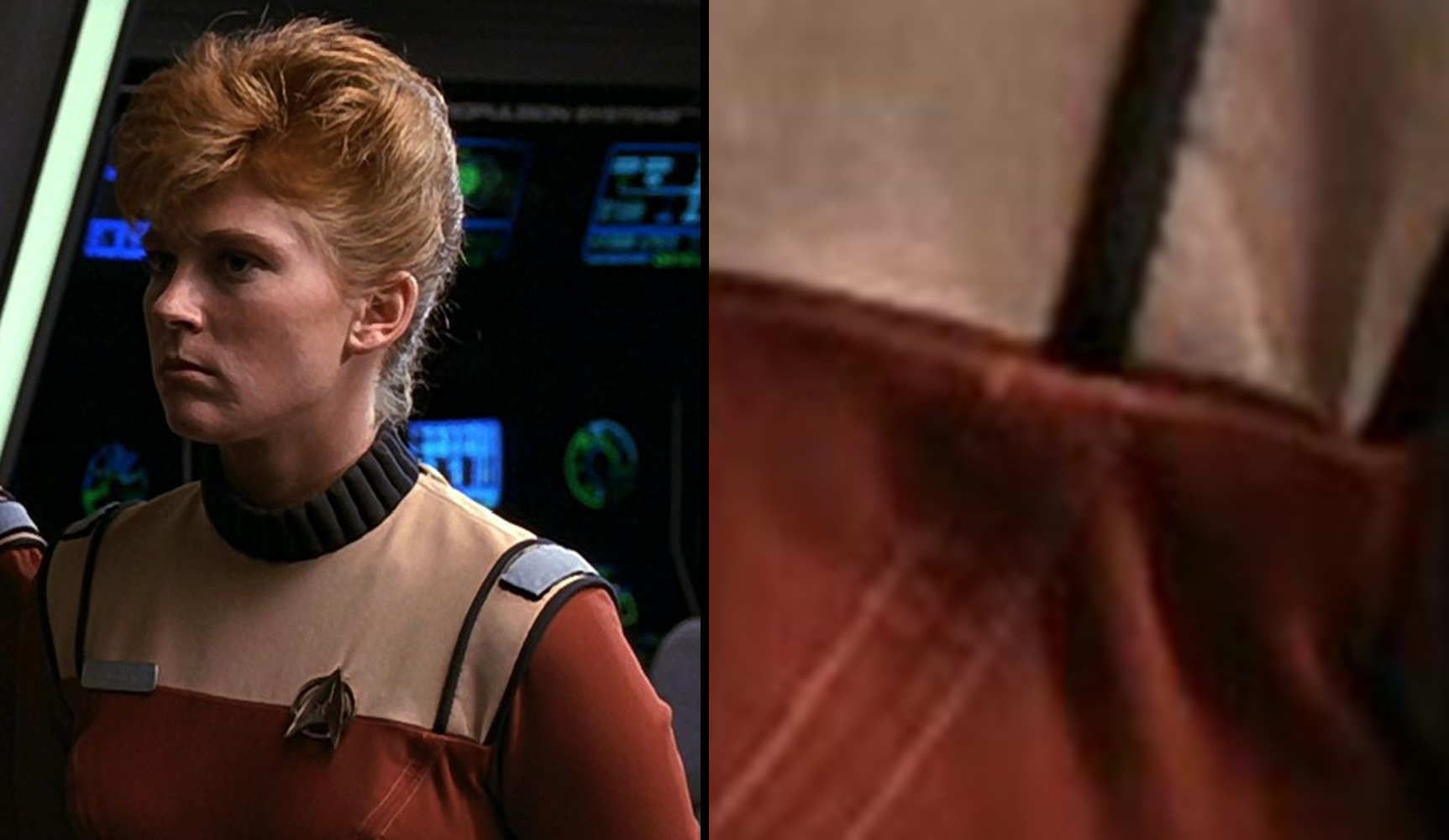
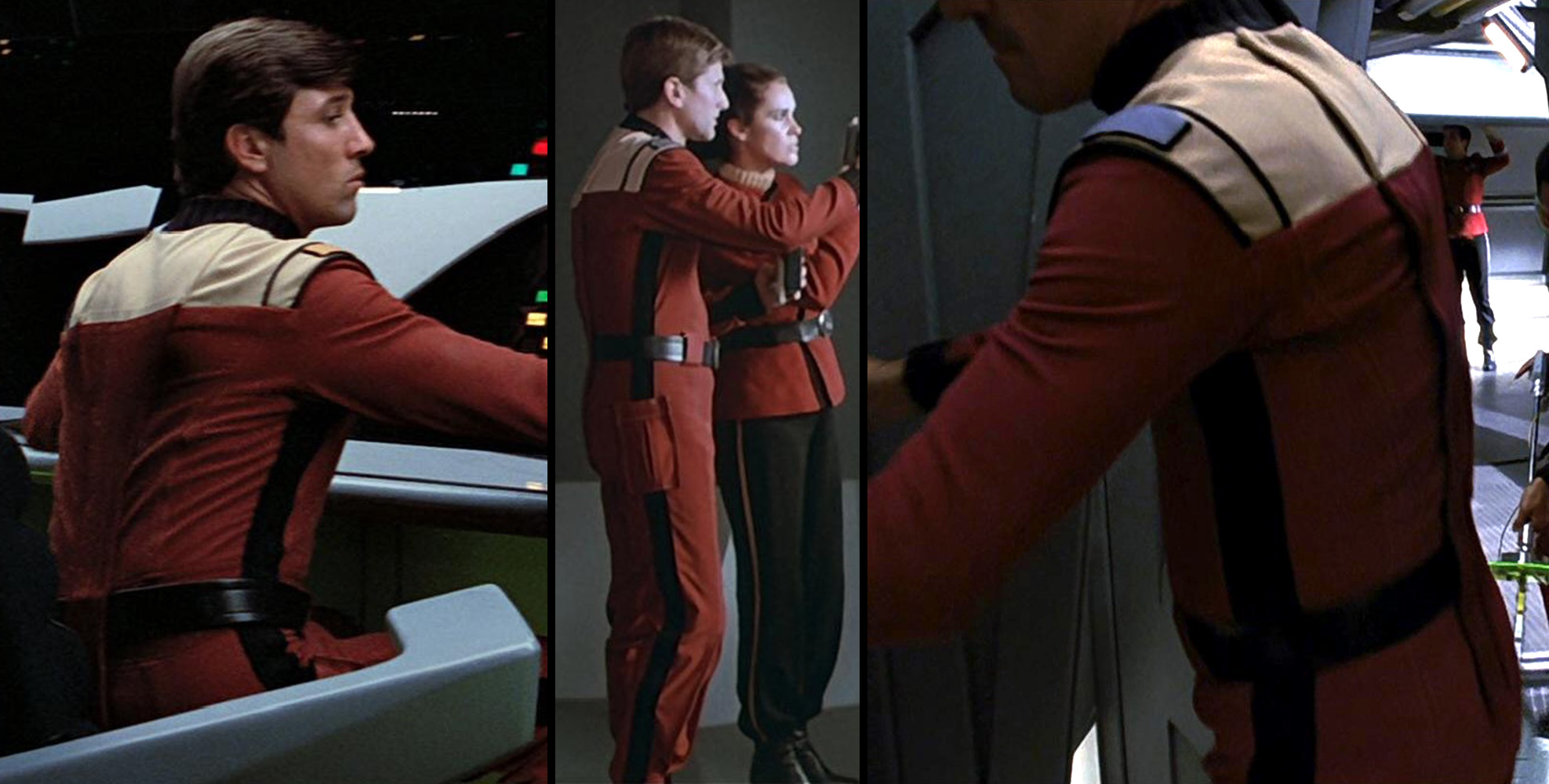
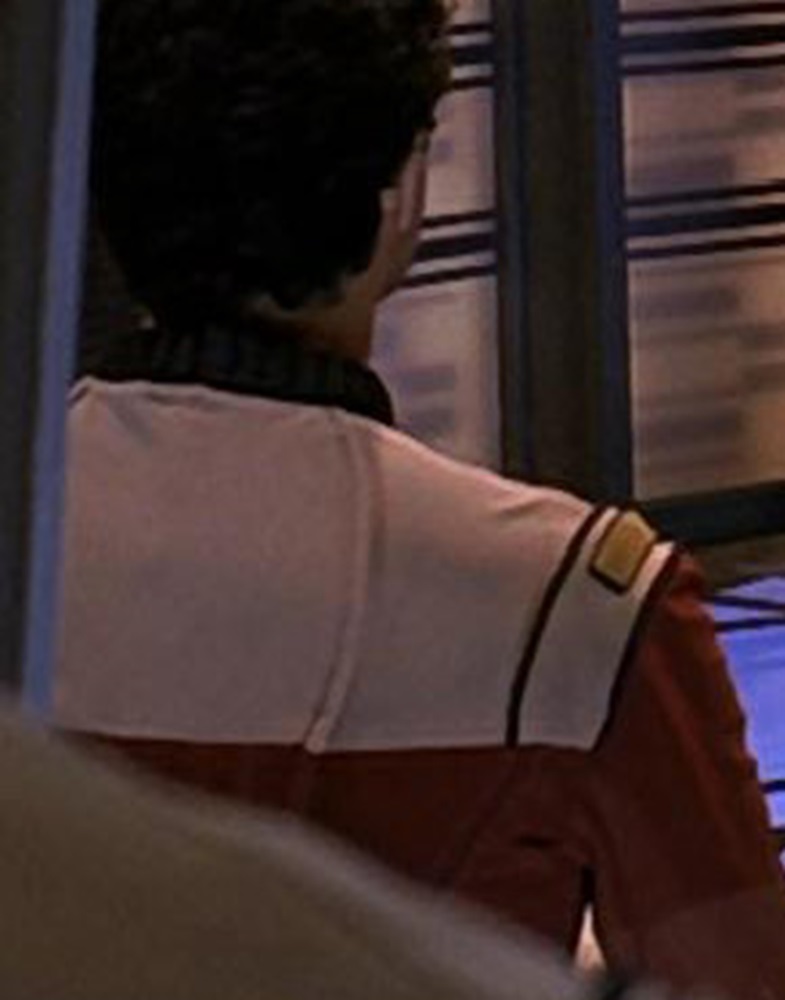
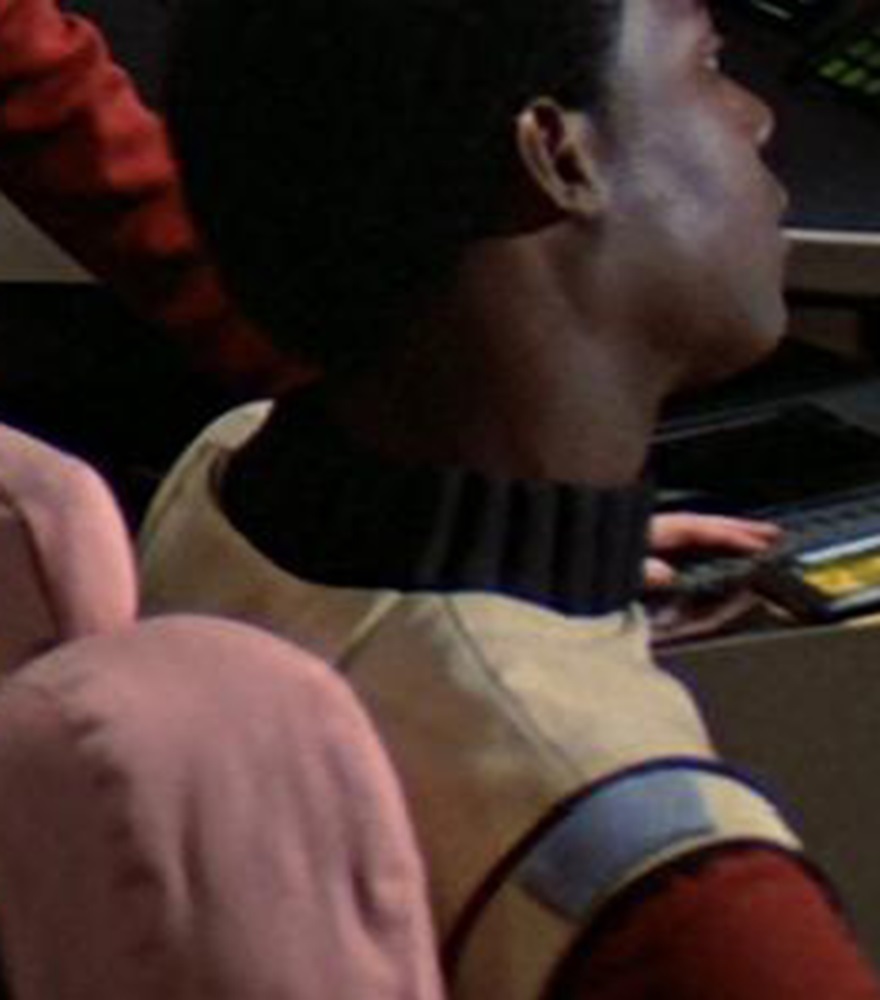
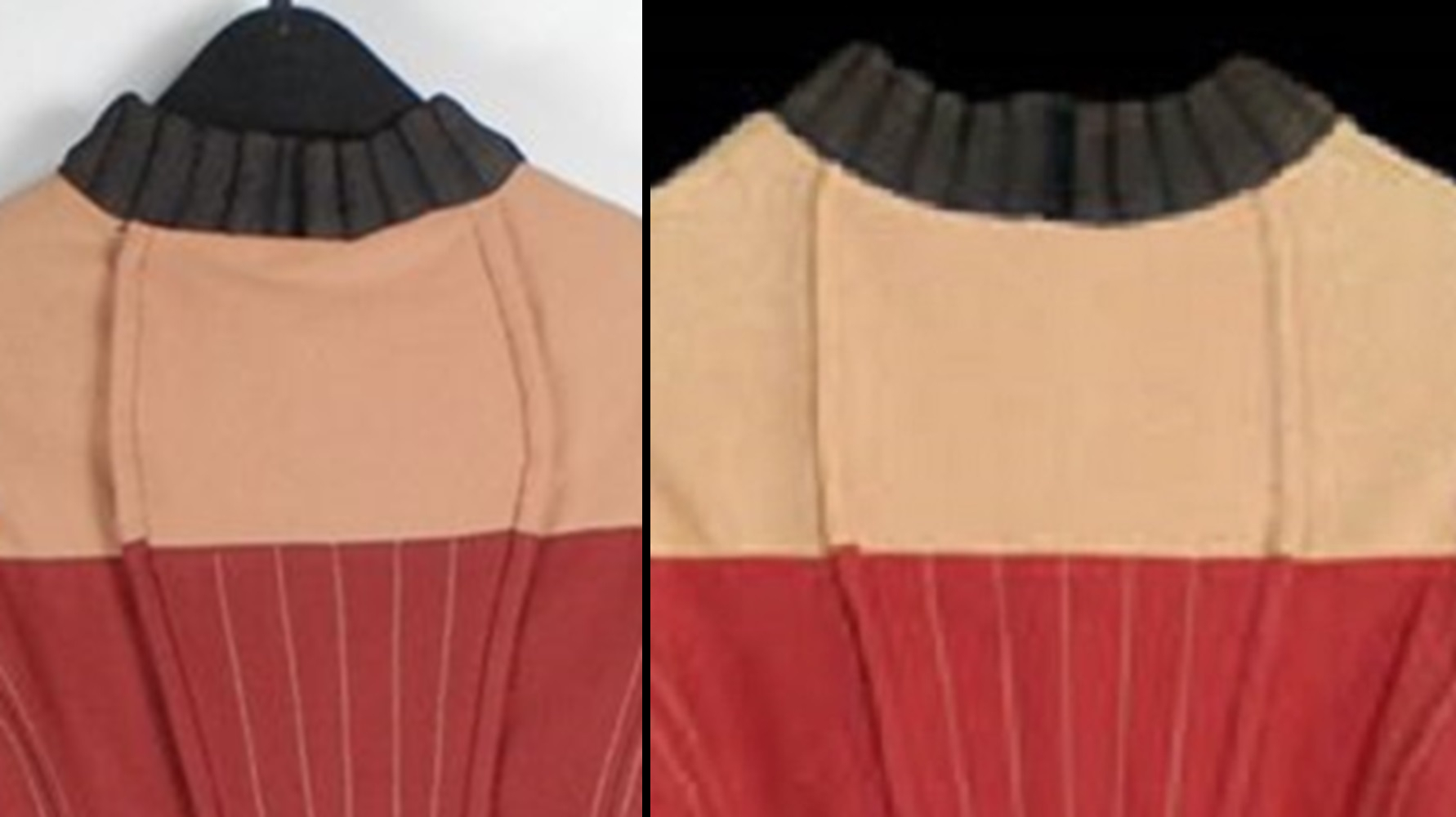
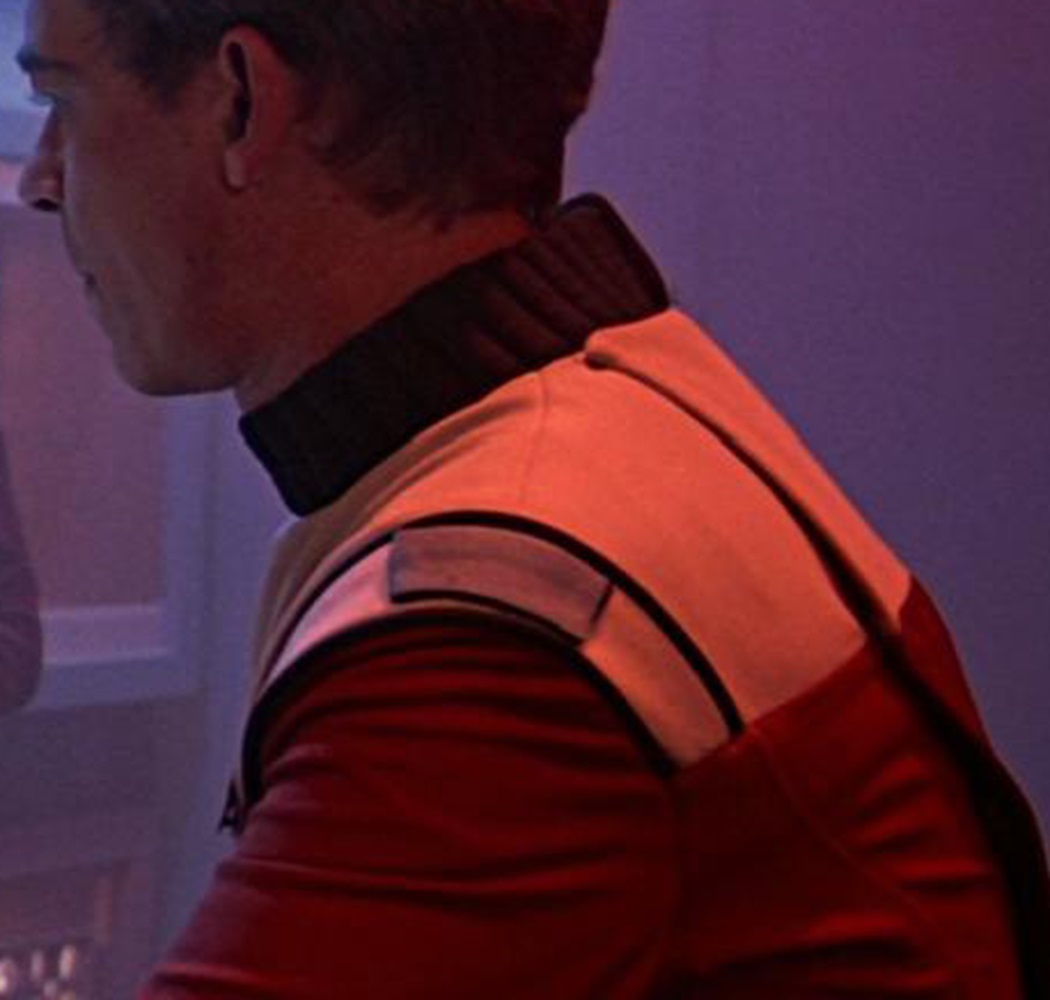
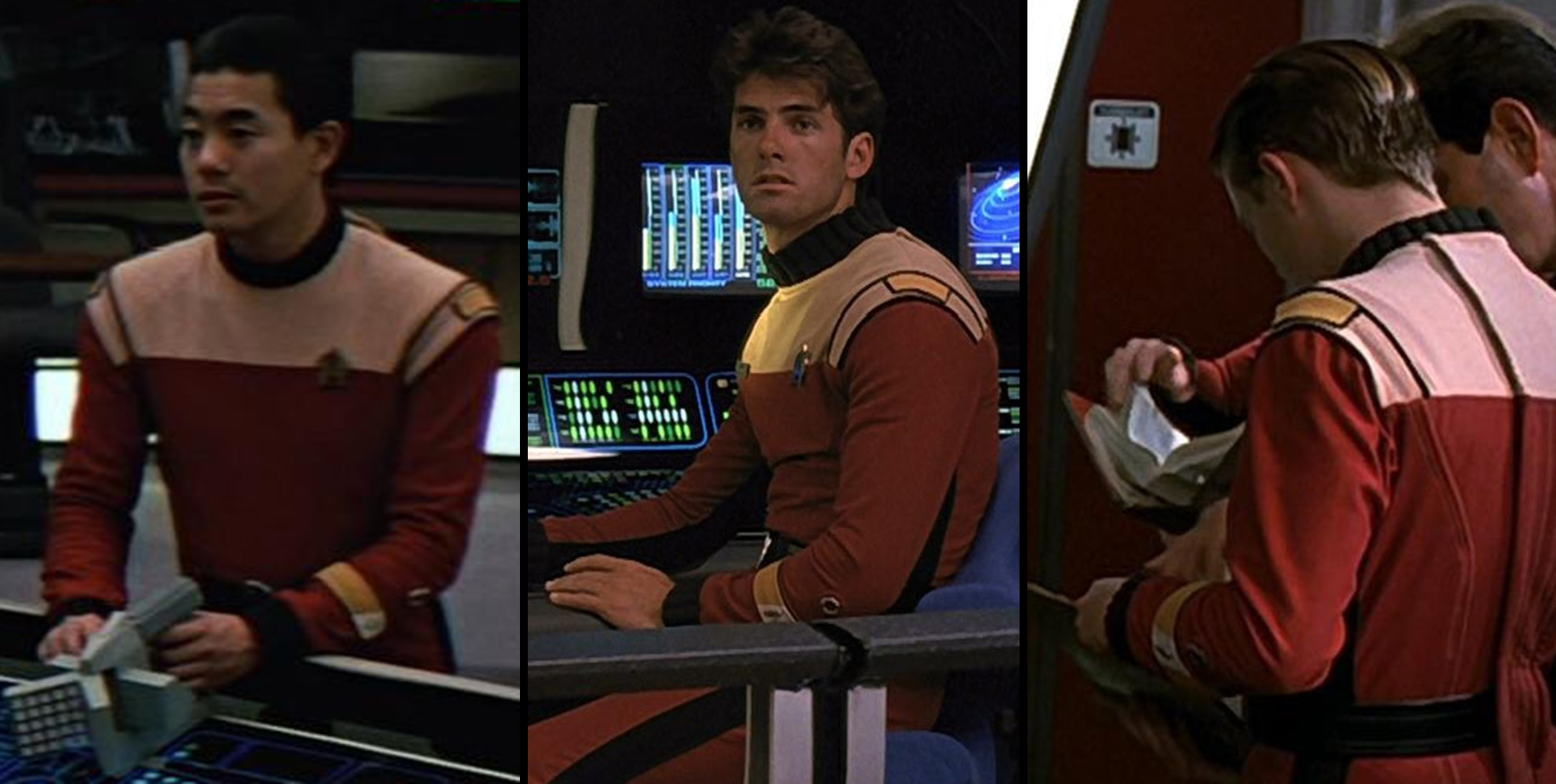
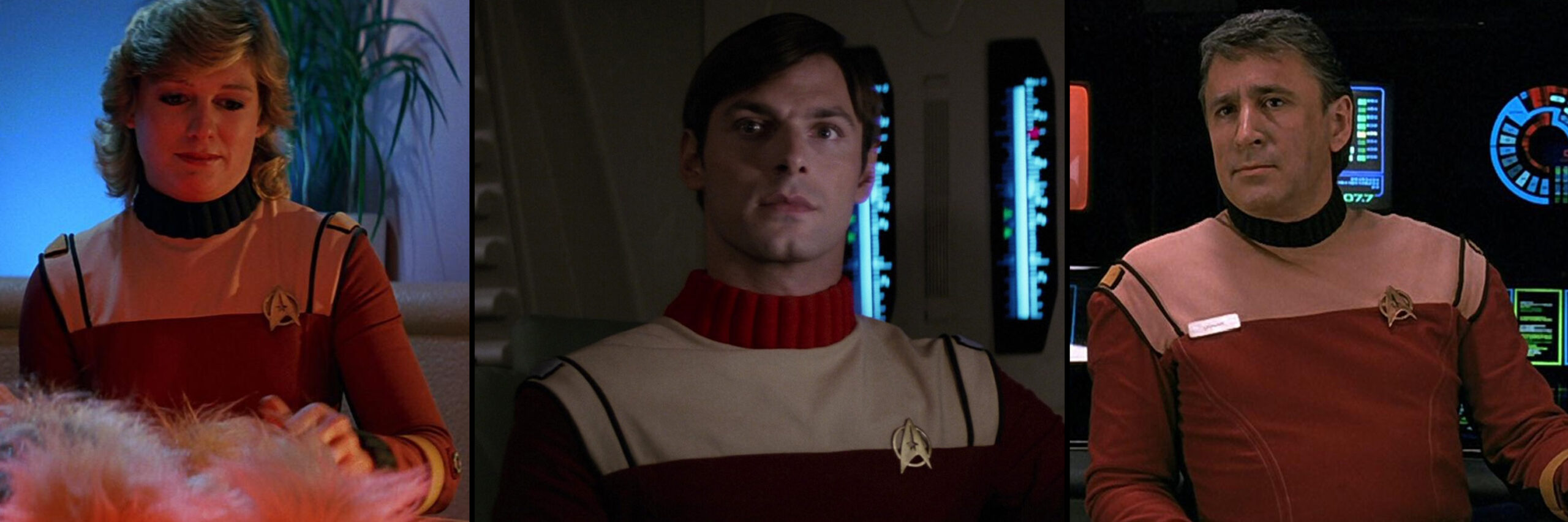
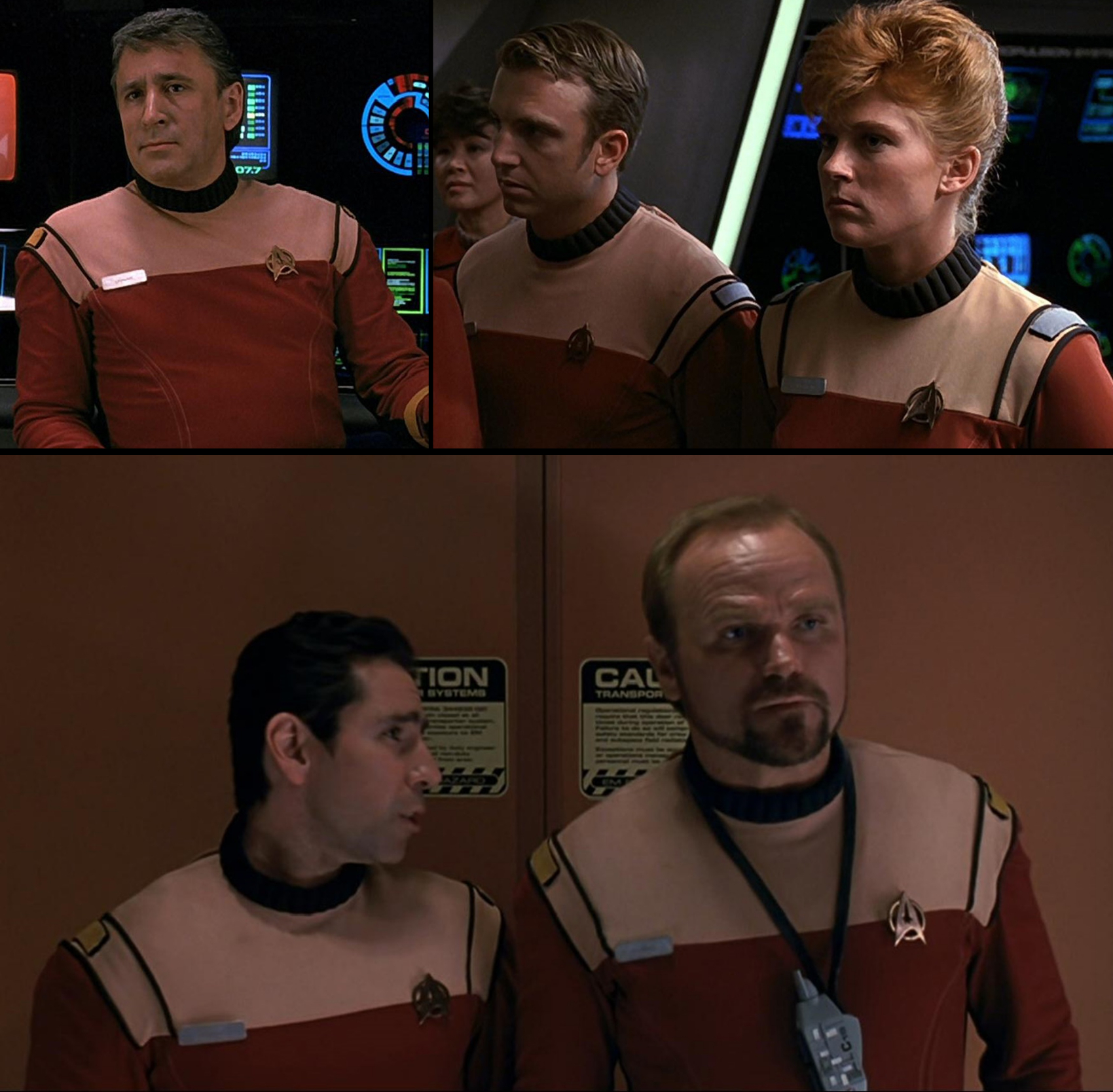
There were at least two subtly different beige colors used for the jumpsuit yokes: one slightly greenish, and one slightly reddish.
This wasn’t a case of the fabric source(s) changing over time or between productions; we saw this right out of the gate in The Wrath of Khan, all the way through ST6.
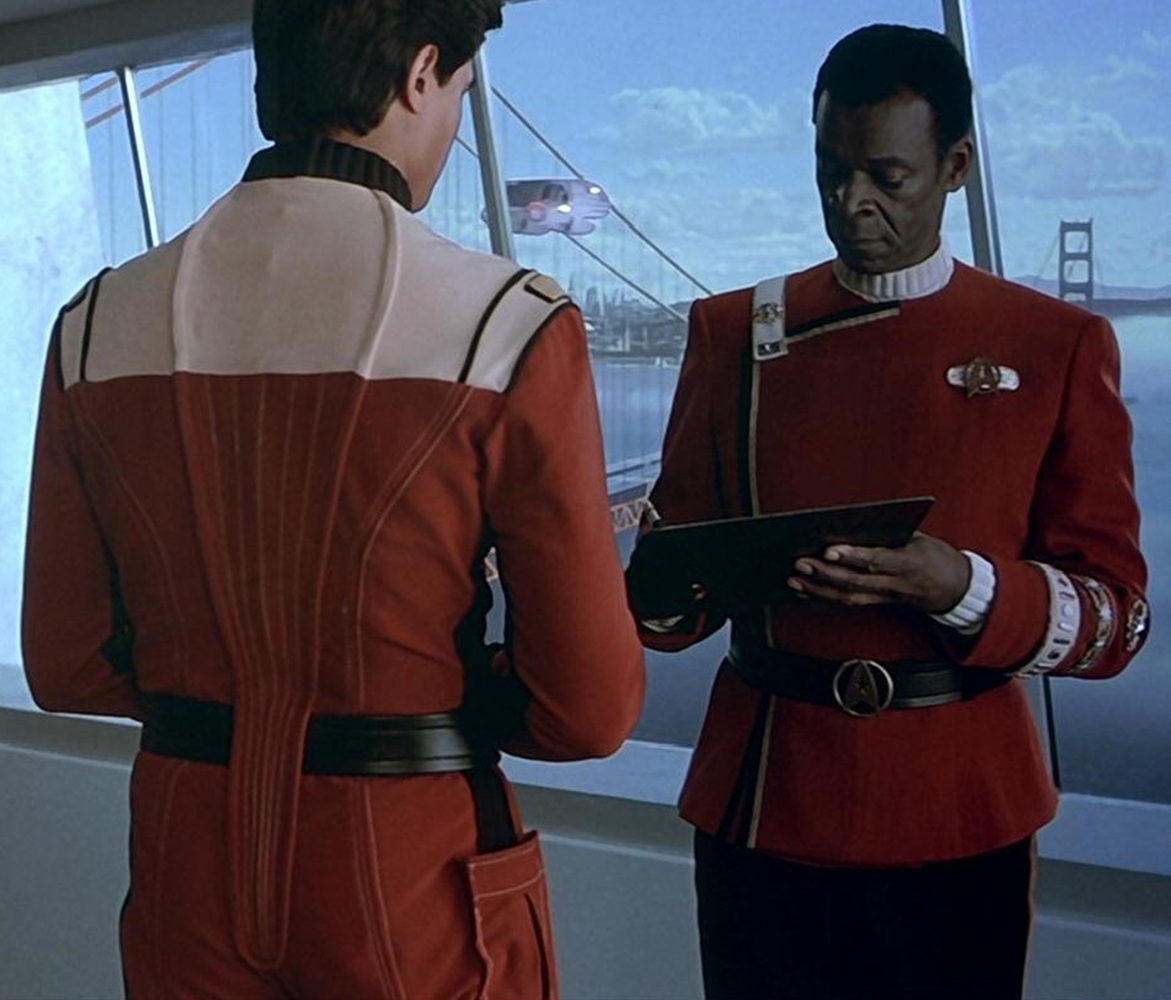
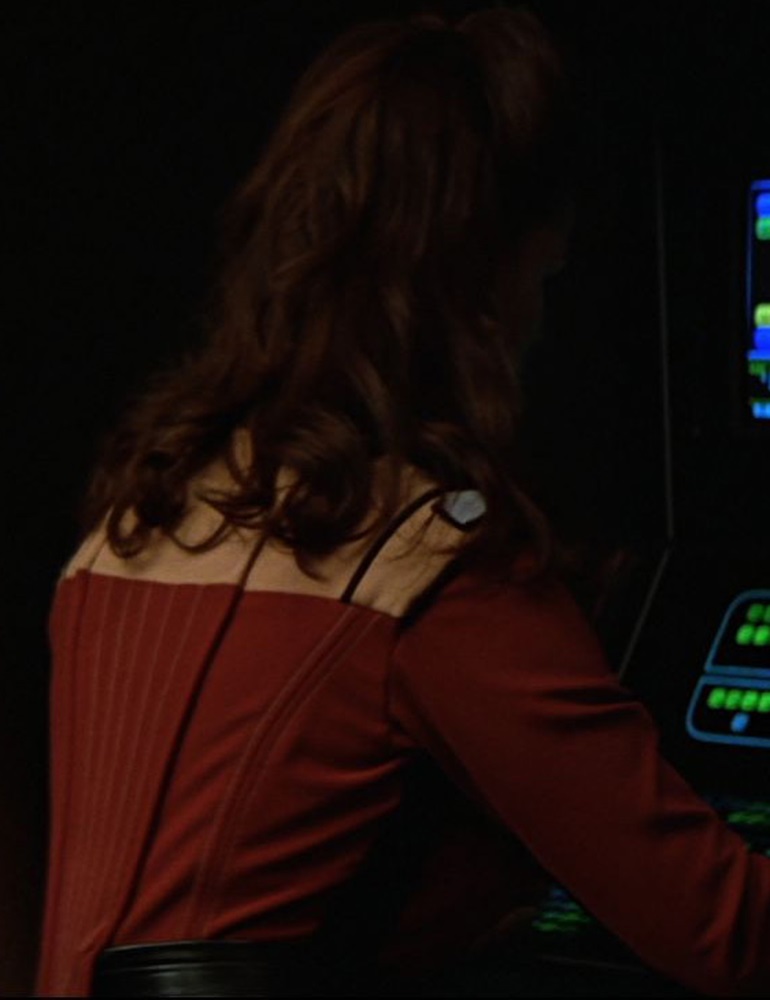
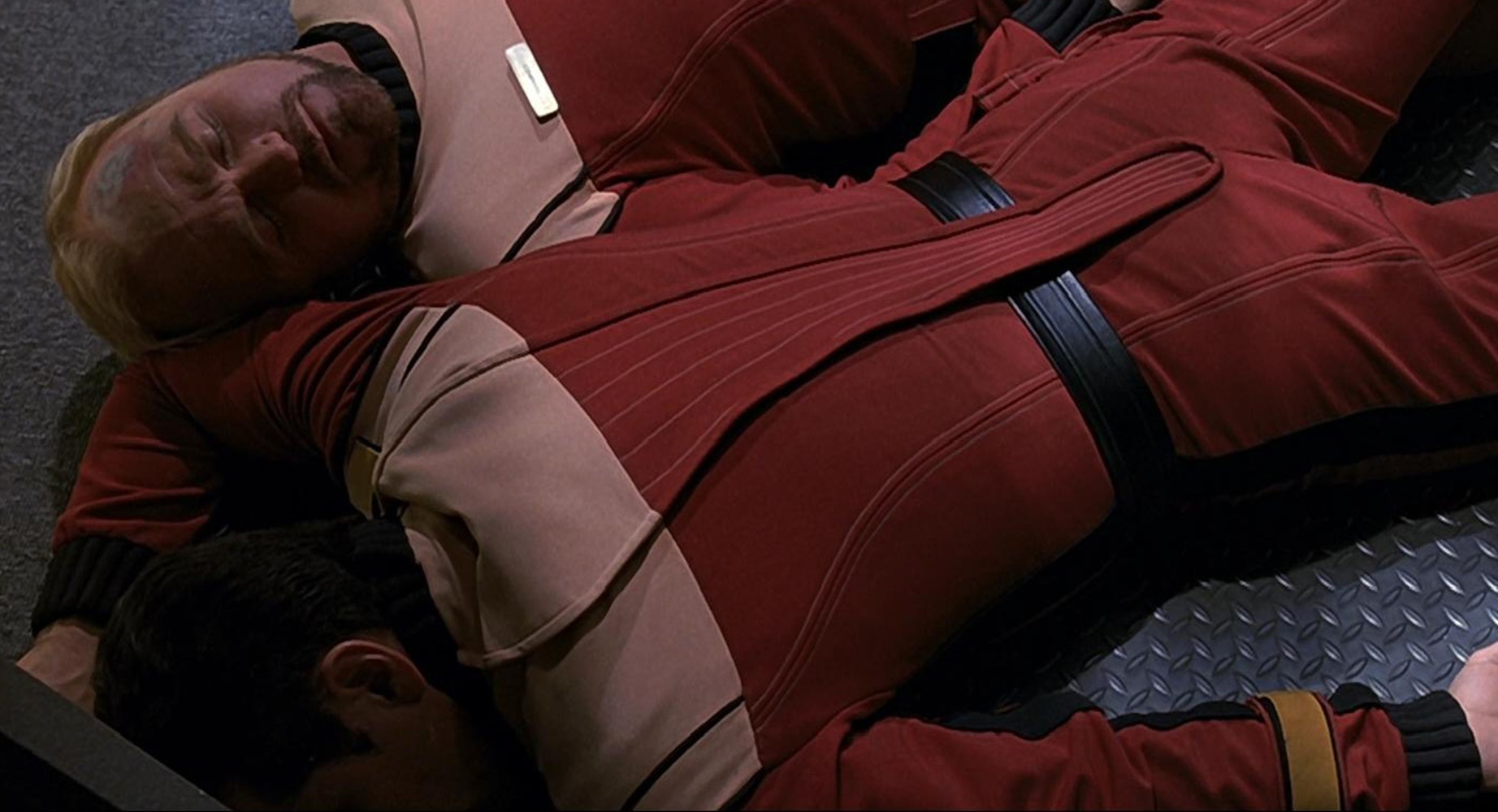
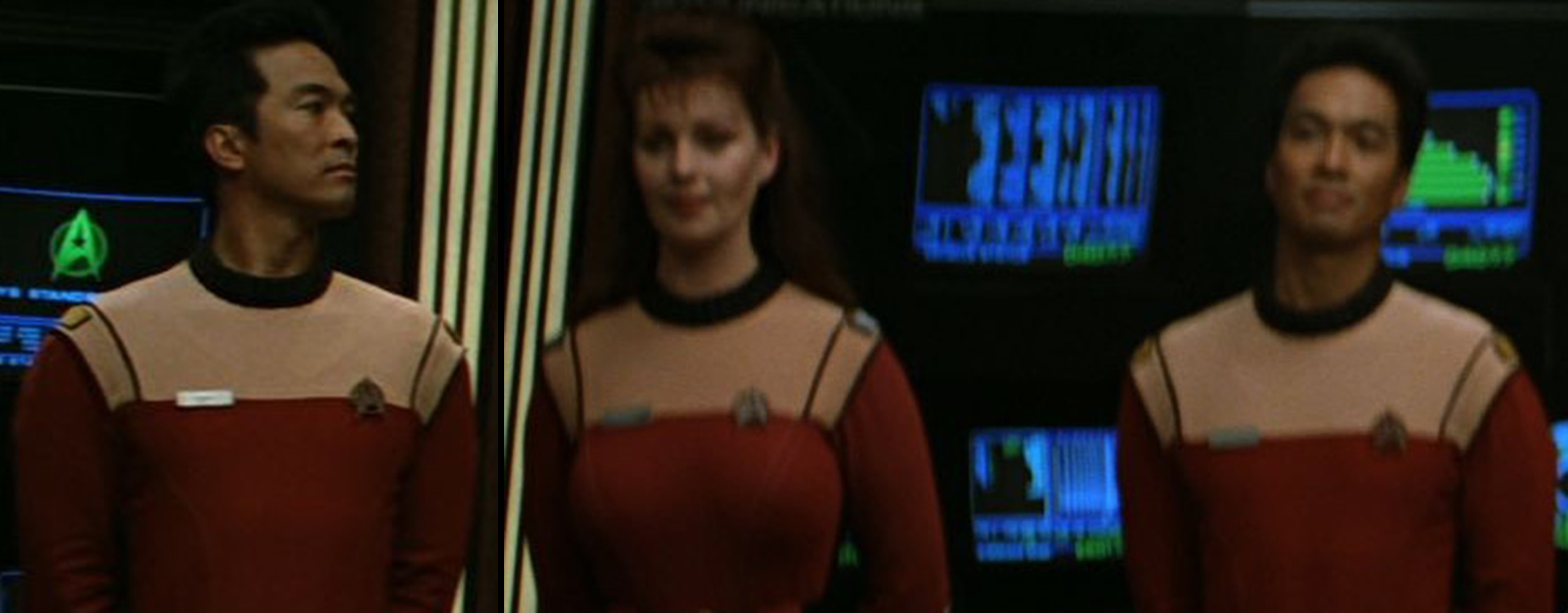
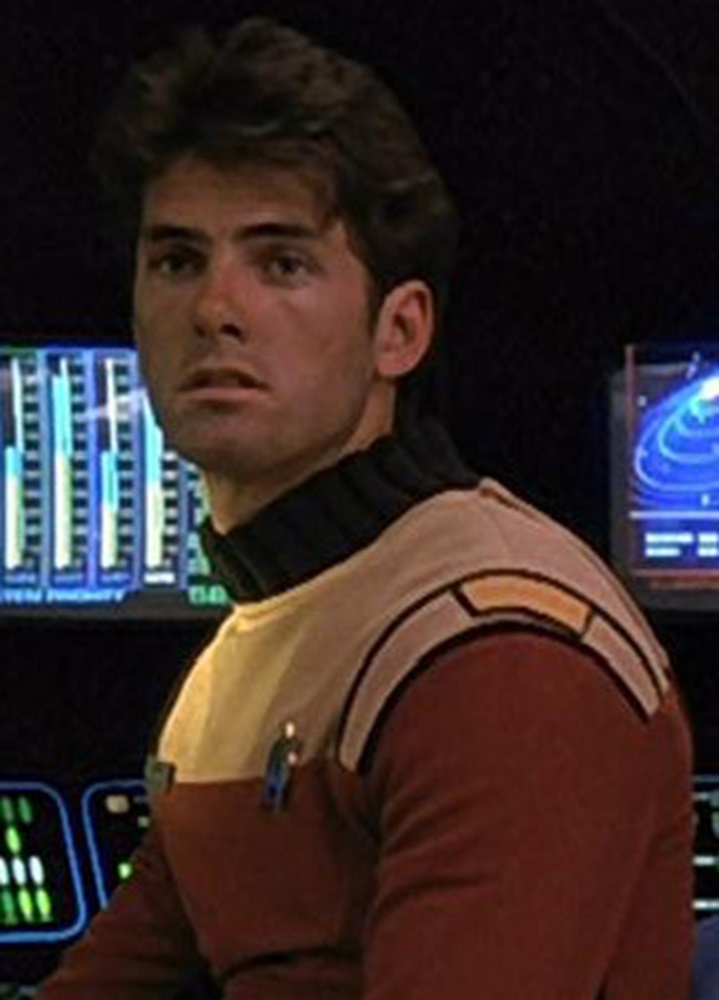
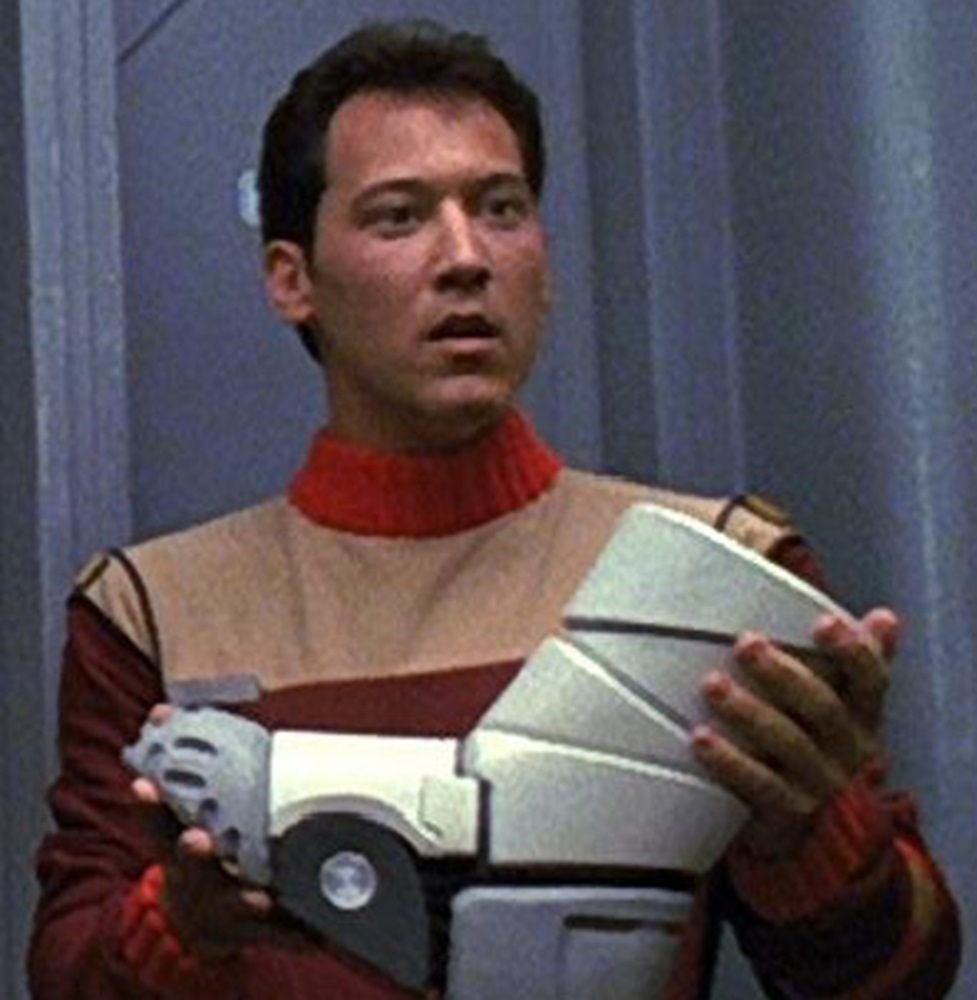
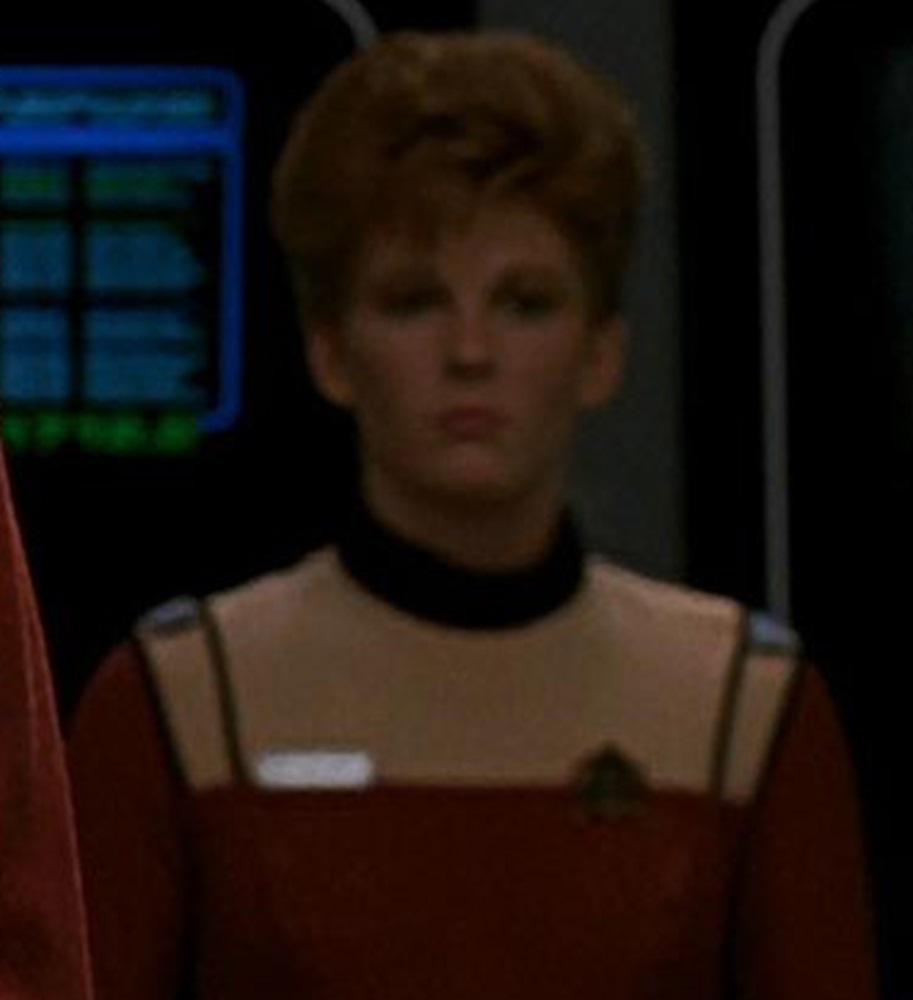
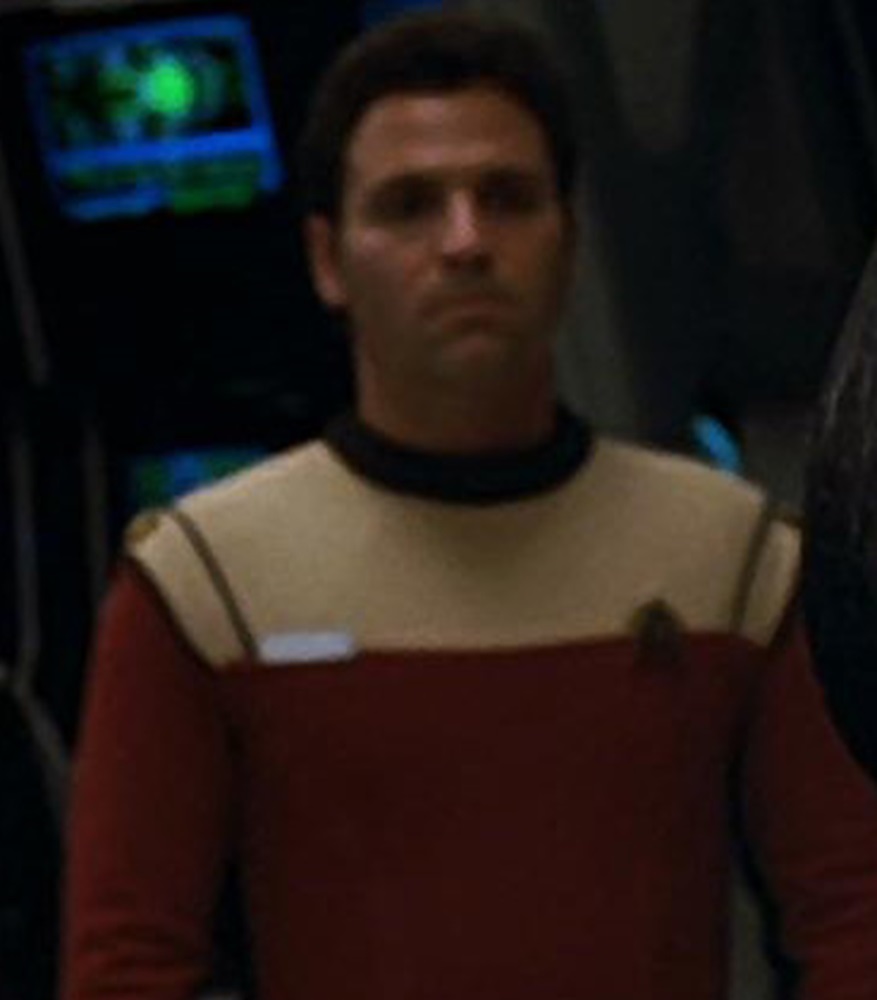
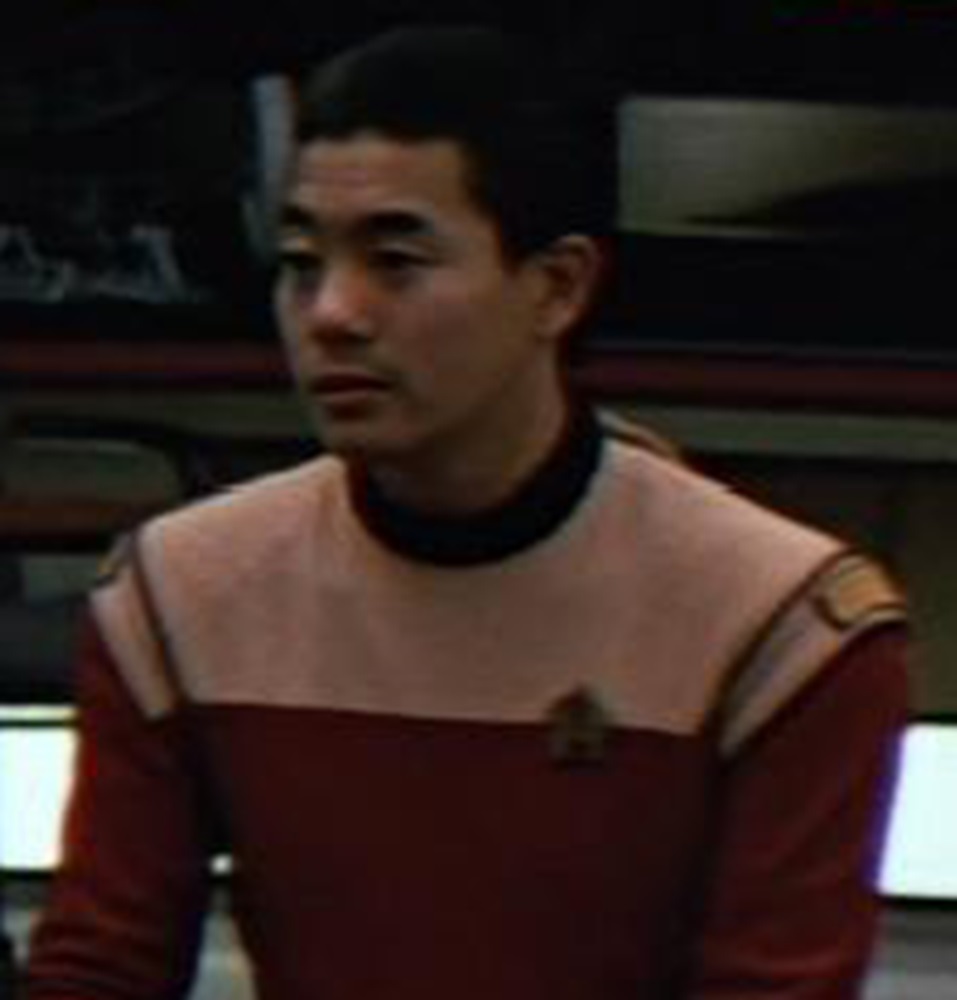
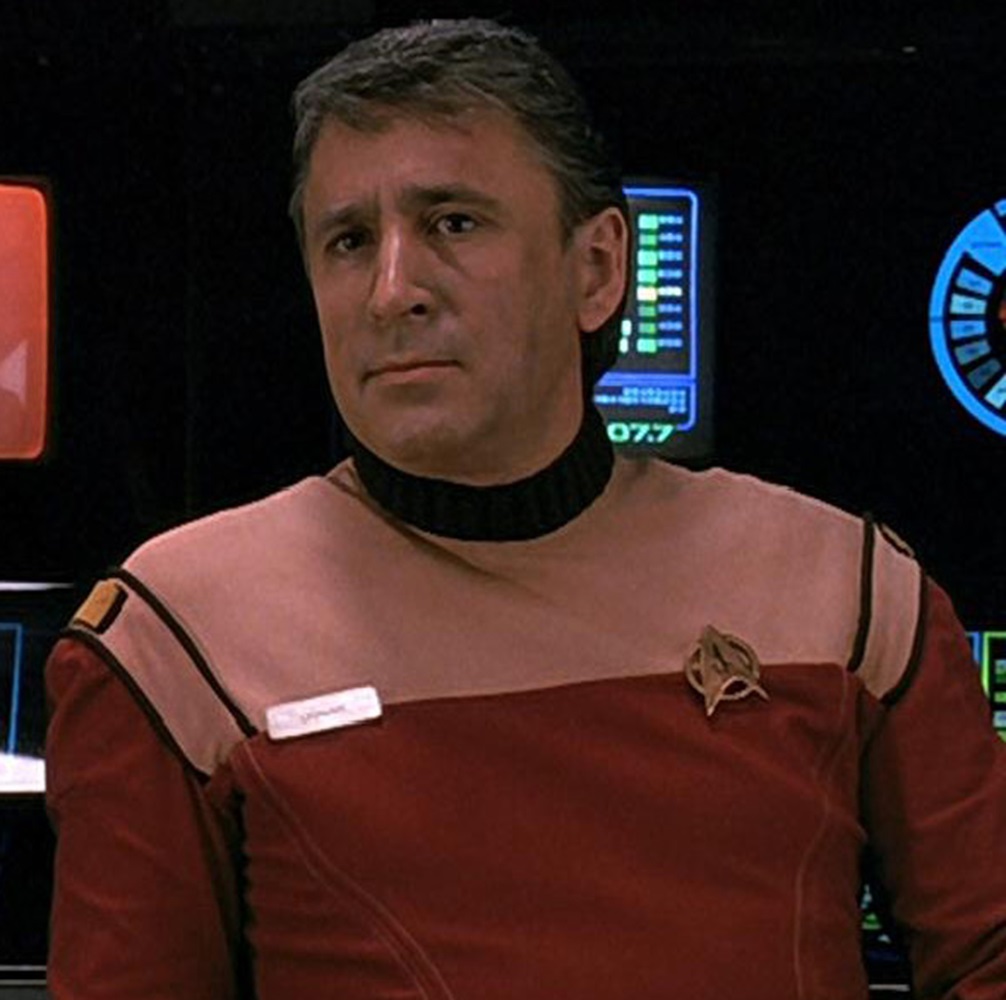
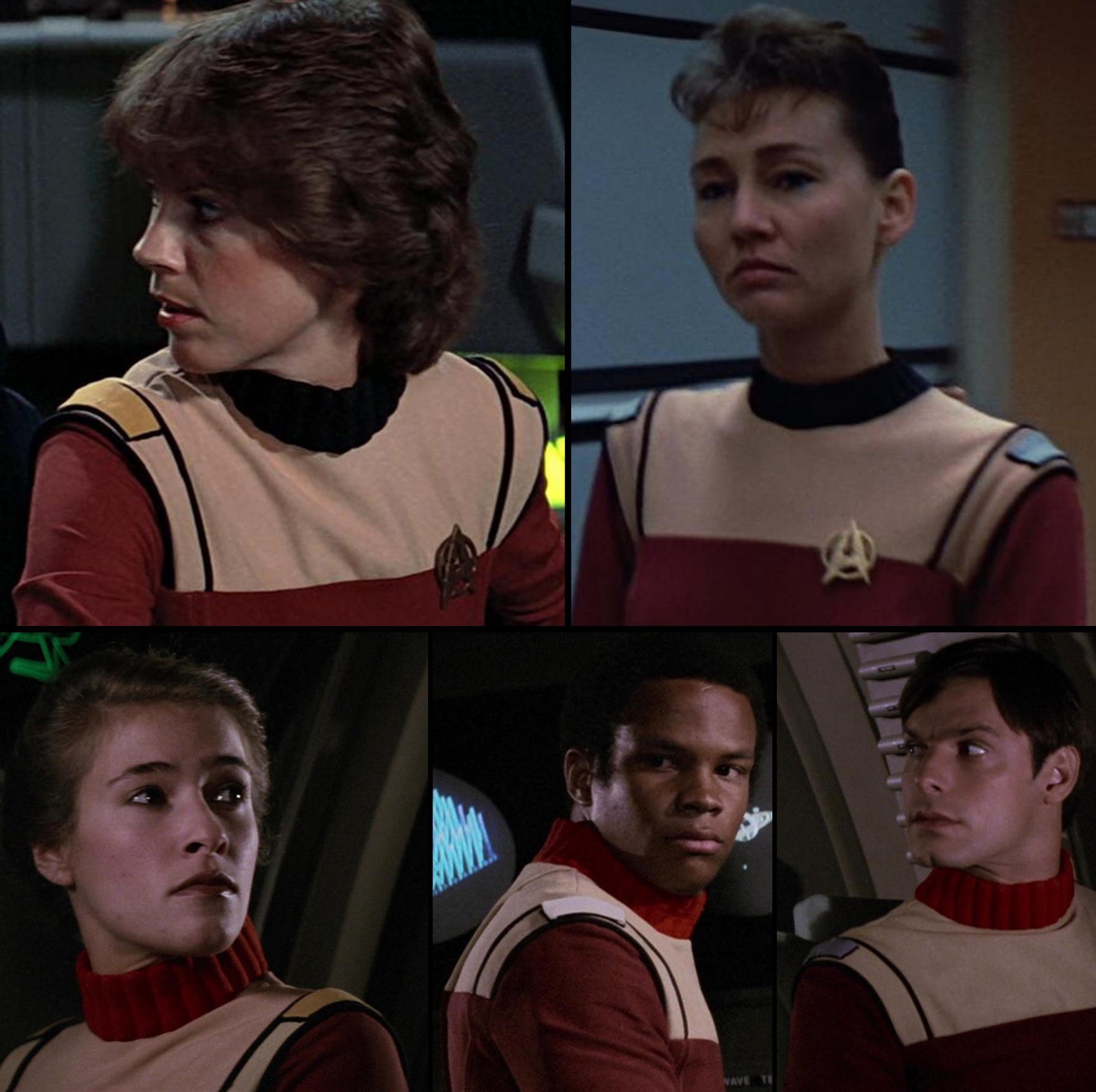
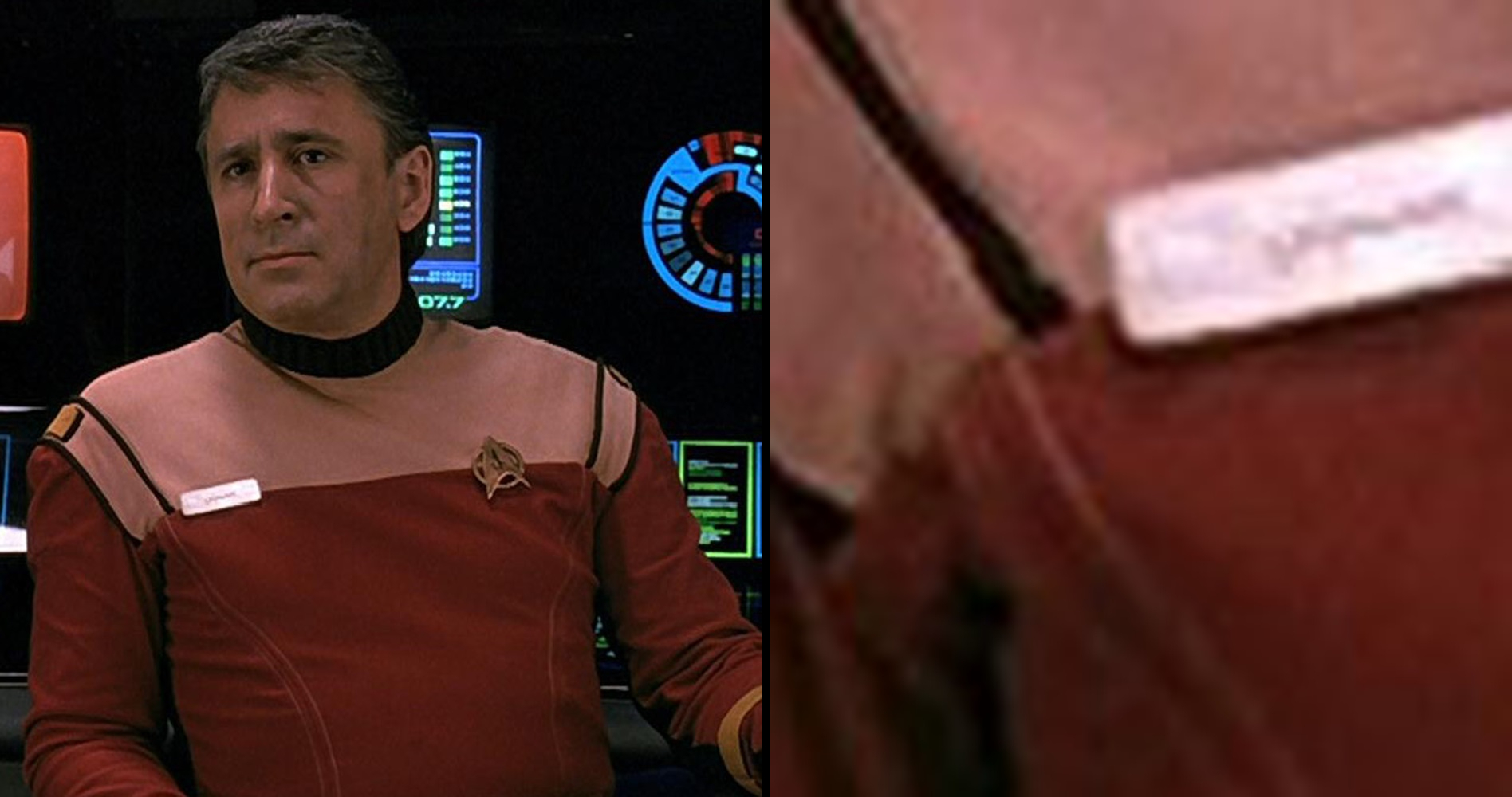
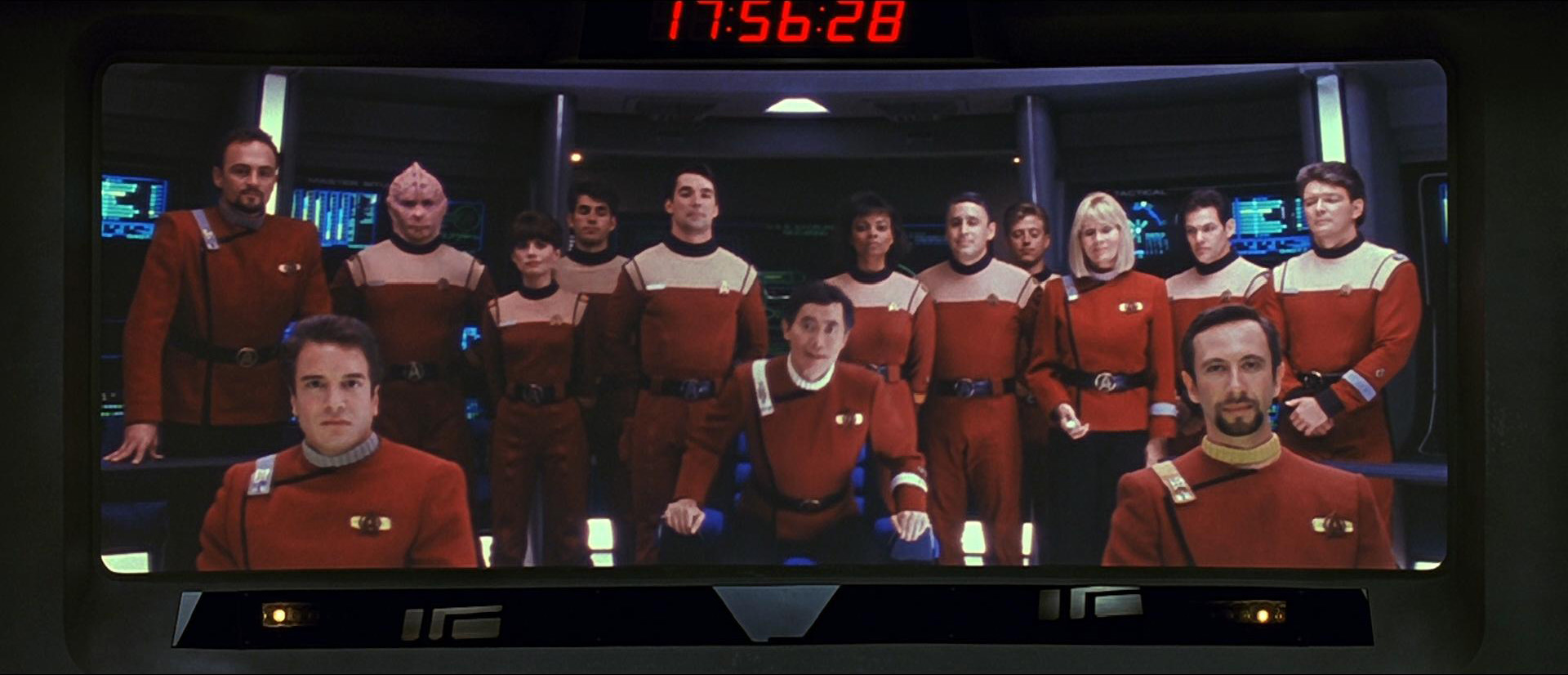
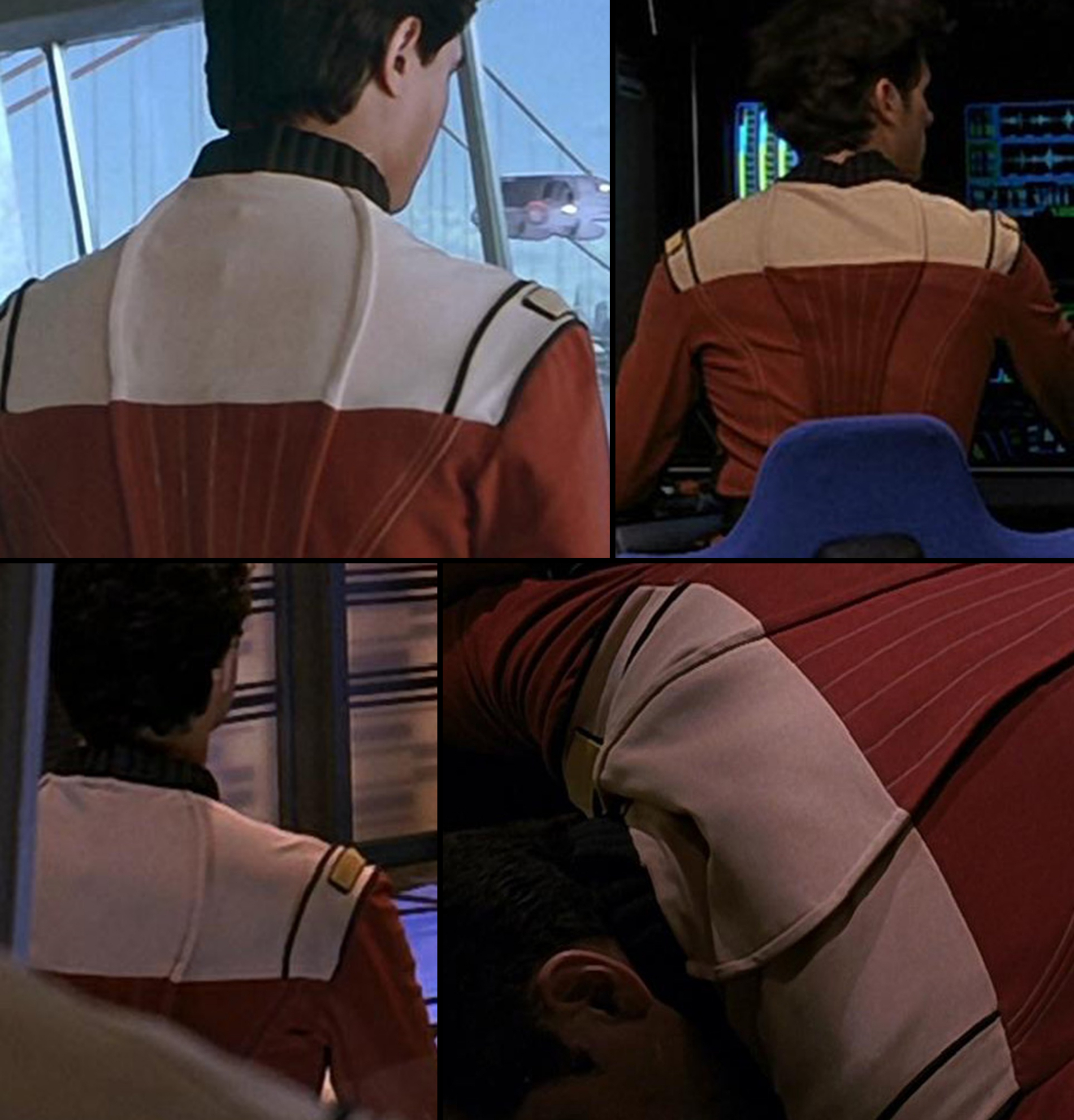
Here are some other examples of characters with different yoke colors standing in close proximity:
One of these things is not like the other …
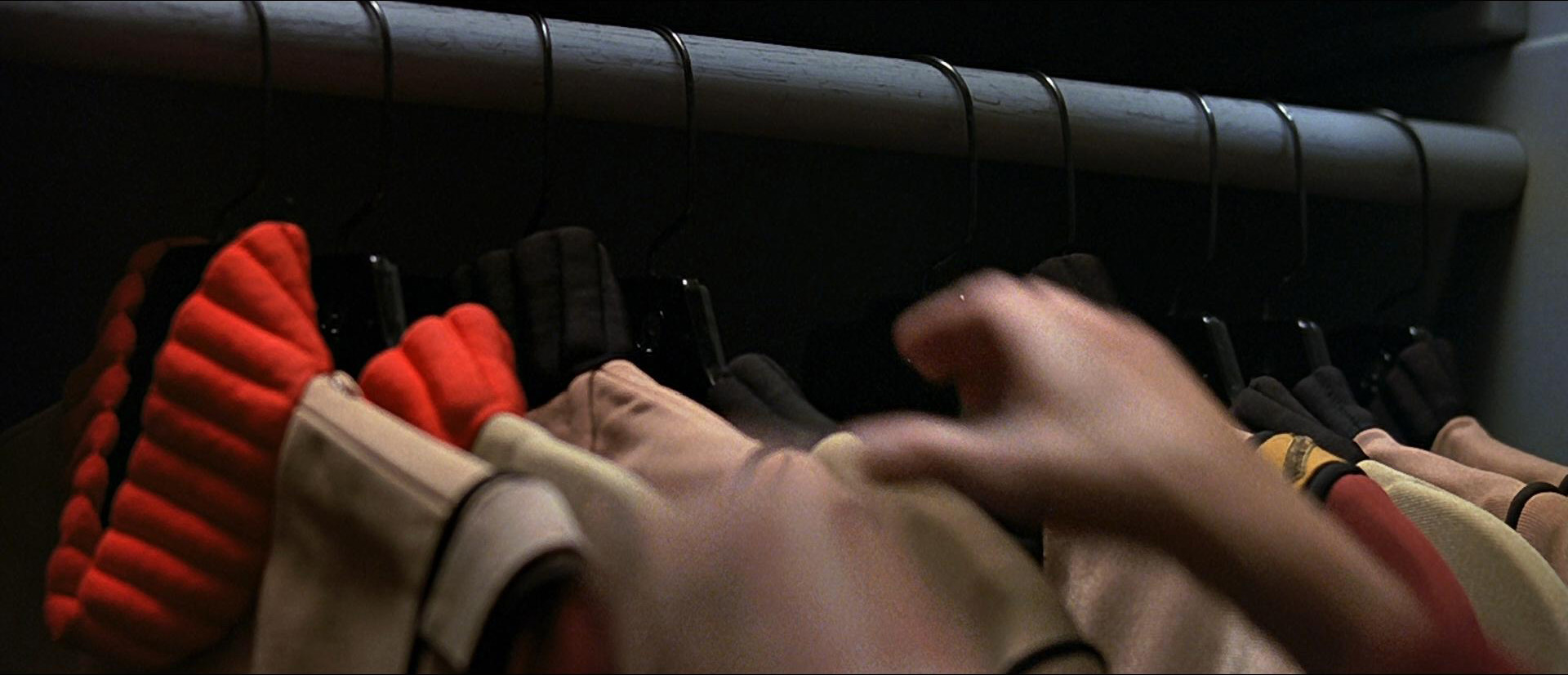
Imagine opening your closet and asking yourself, “Hmm, which shade of beige do I want to wear today?”
If there was any rhyme or reason to who wore which, then it eluded me; I think it was just something that we were never supposed to actually notice.
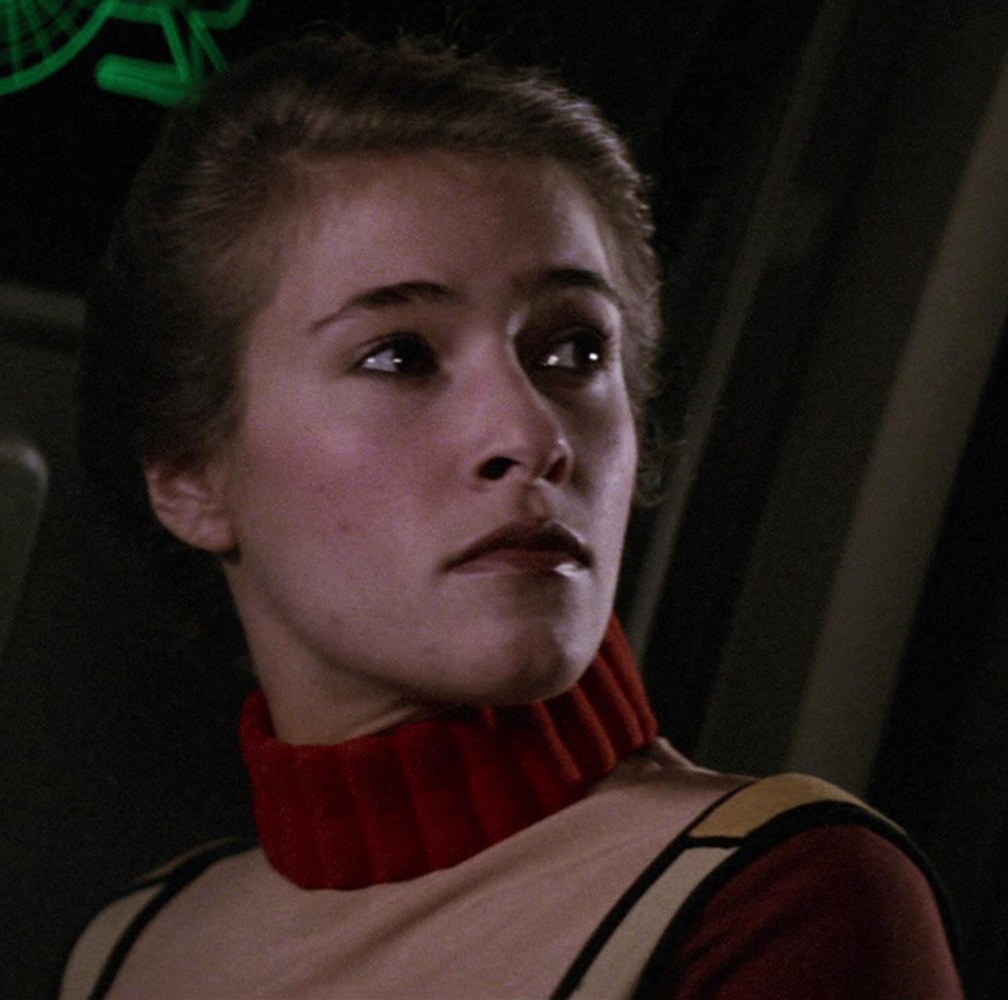
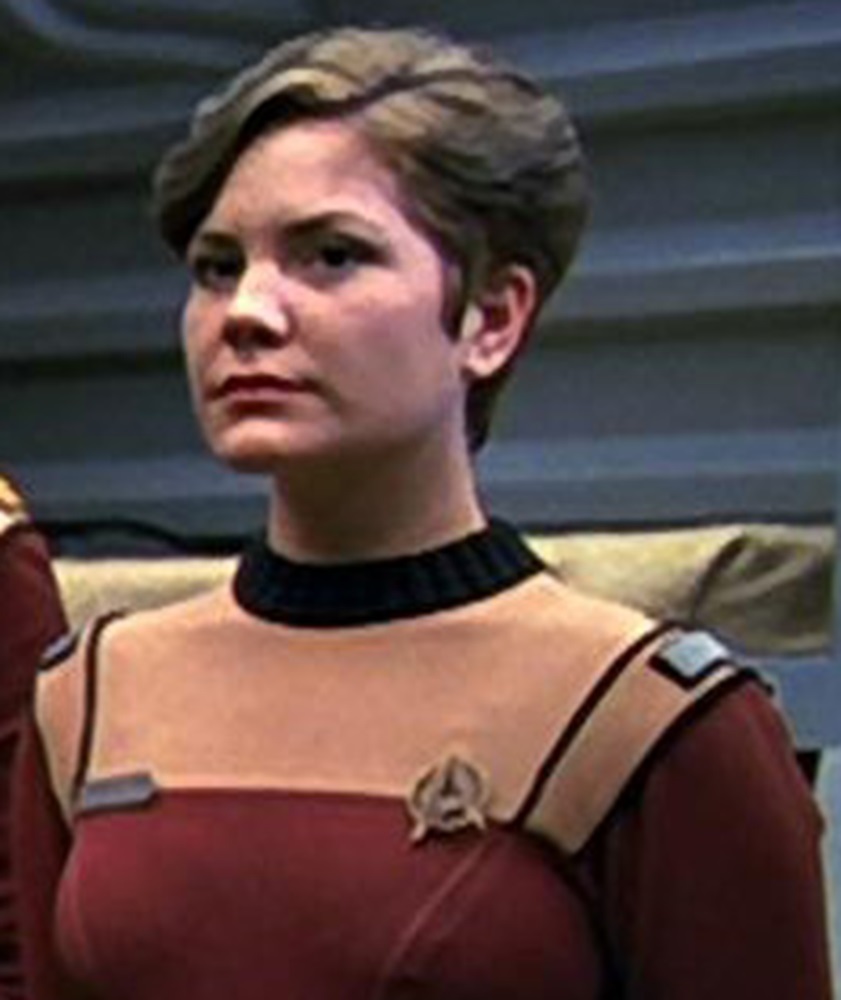
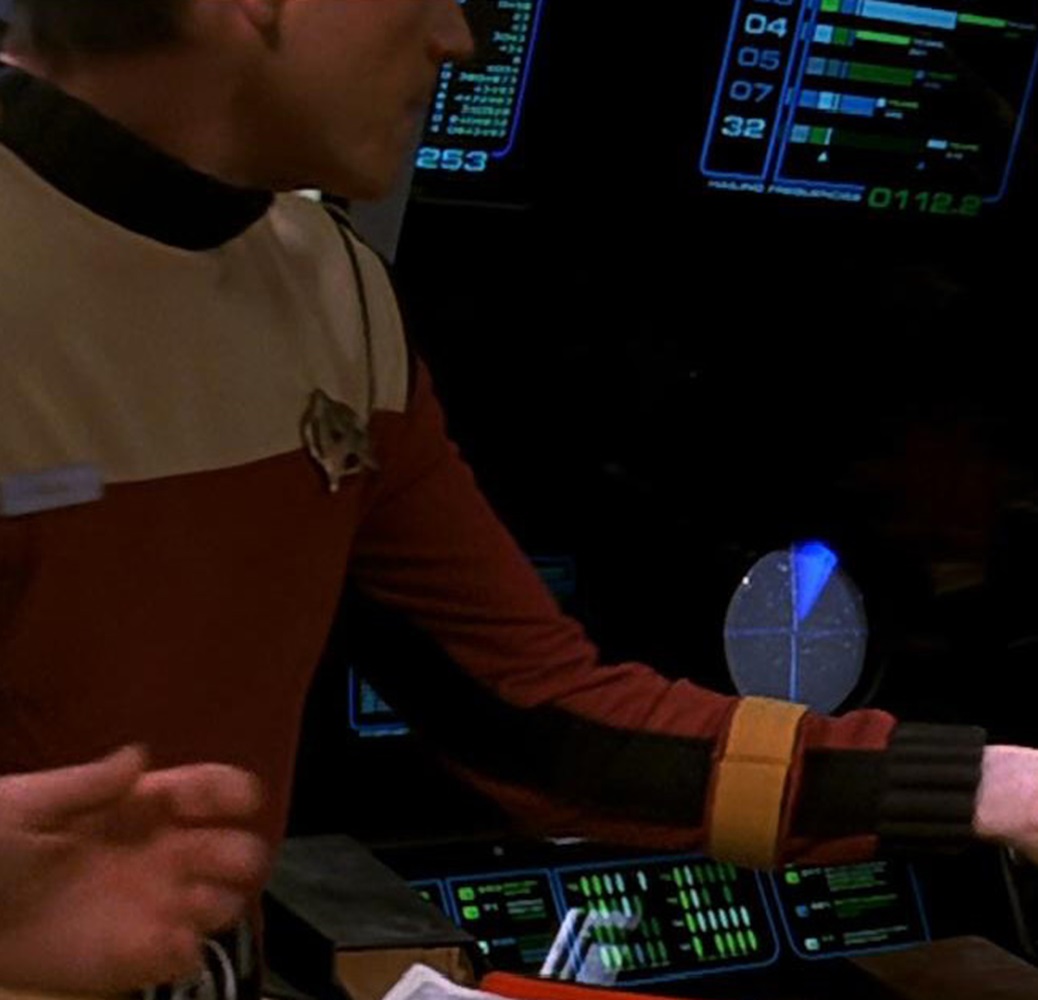
In The Wrath of Khan, this trainee’s jumpsuit yoke actually had both colors! The reddish-beige was used for the center panels, but the greenish-beige was used for the outer panels.
Body Colors
There were also at least two different red colors used for the jumpsuit body and corresponding attachments.
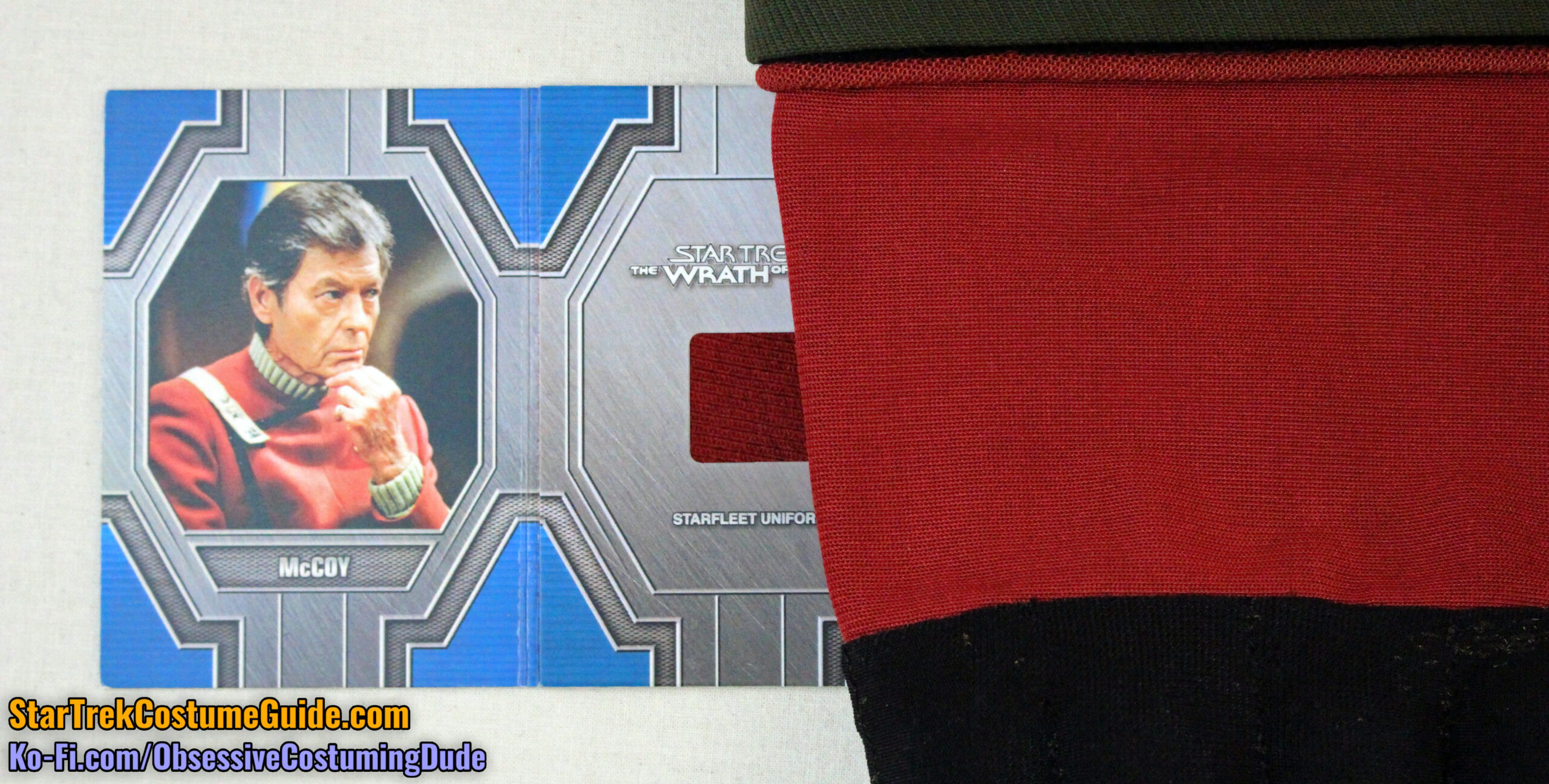
The standard red spandex had a nearly identical color balance to the red “monster maroon” wool, but it wasn’t quite as deep.
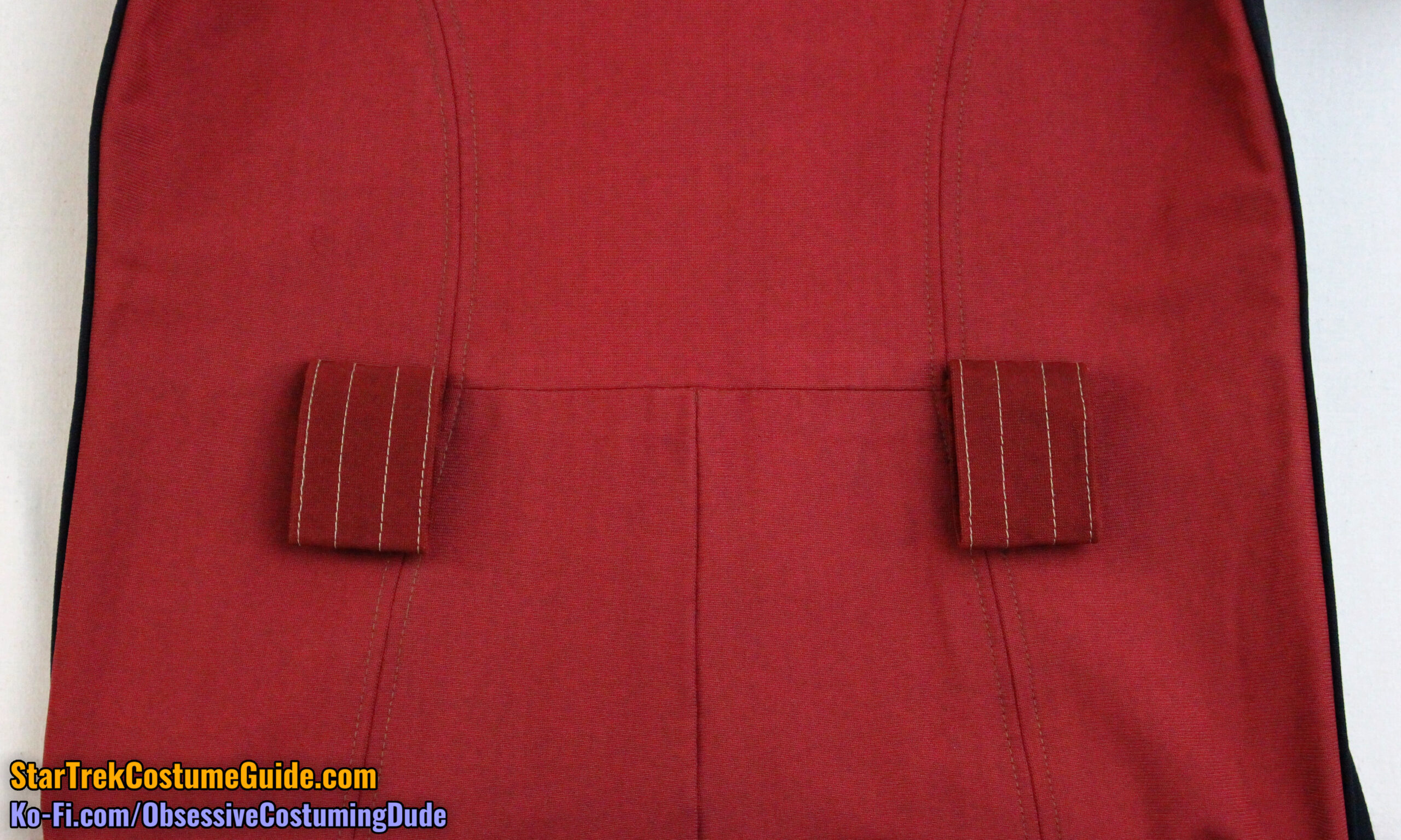
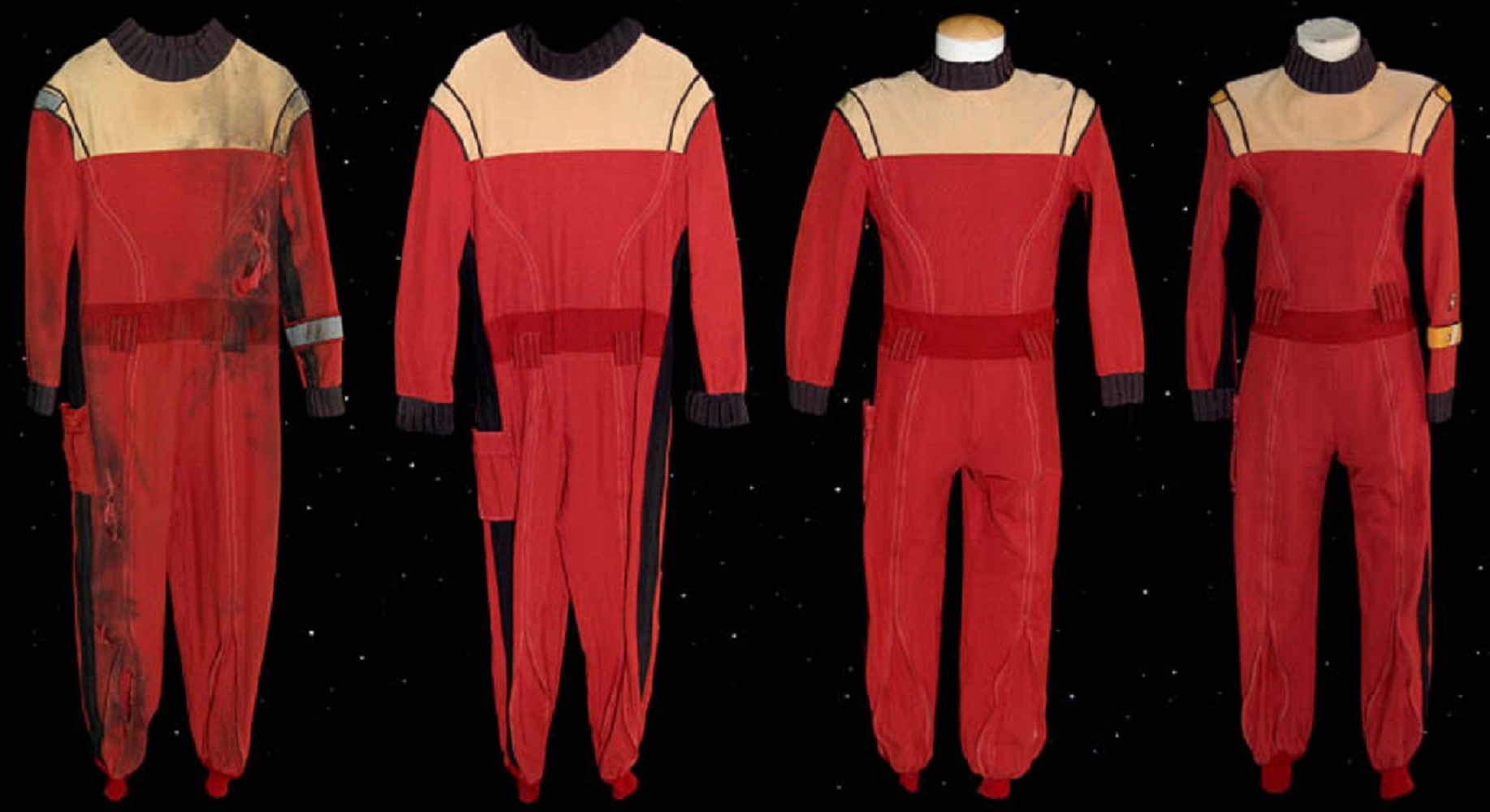
On some jumpsuits, the belt loops were made of matching red spandex.
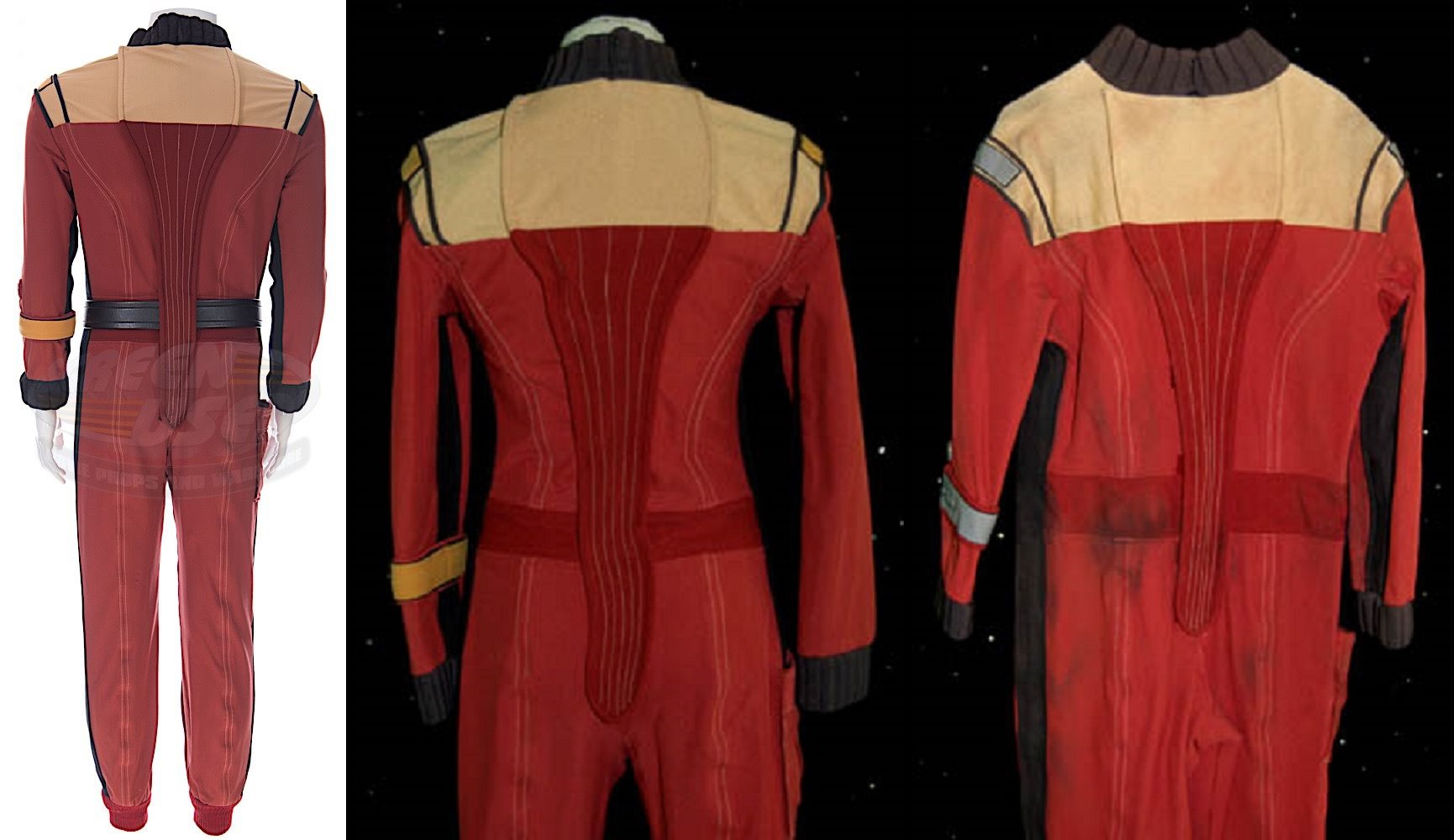
TWOK-era enlisted jumpsuit auction photos
However, on most of the jumpsuits, the belt loops were a slightly darker red than the body fabric.
They were darker red on the screen-used enlisted jumpsuit I examined, too.
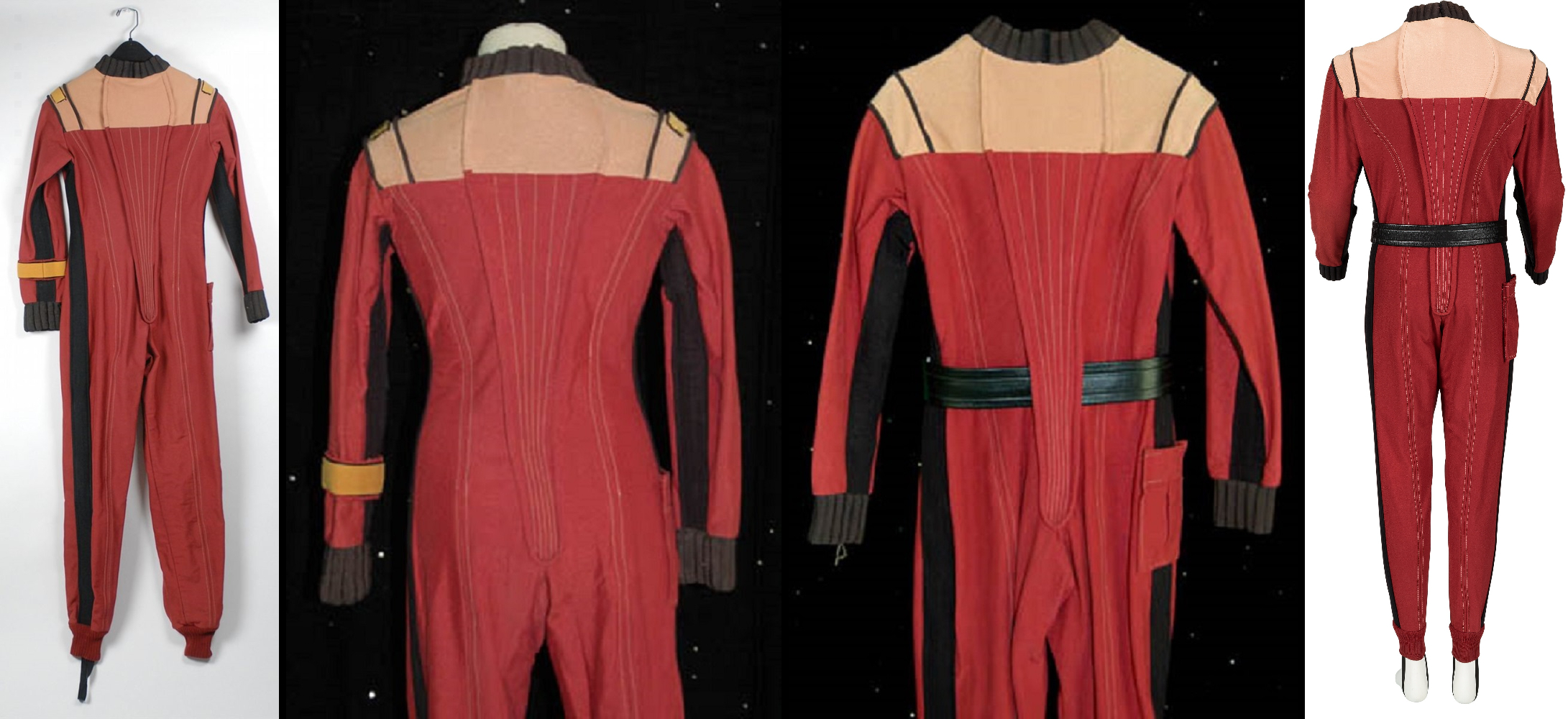
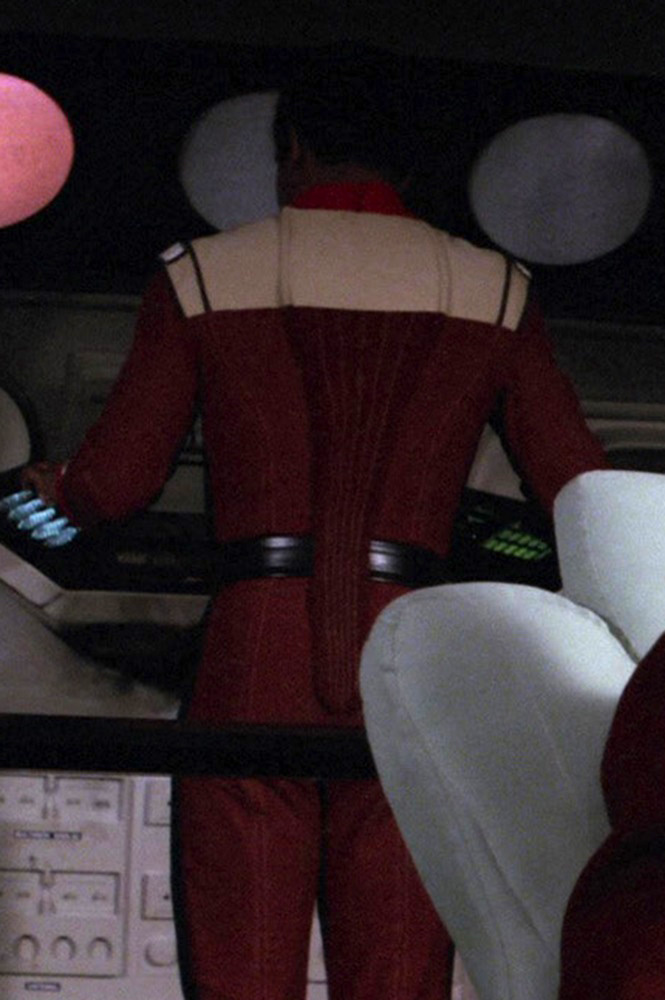
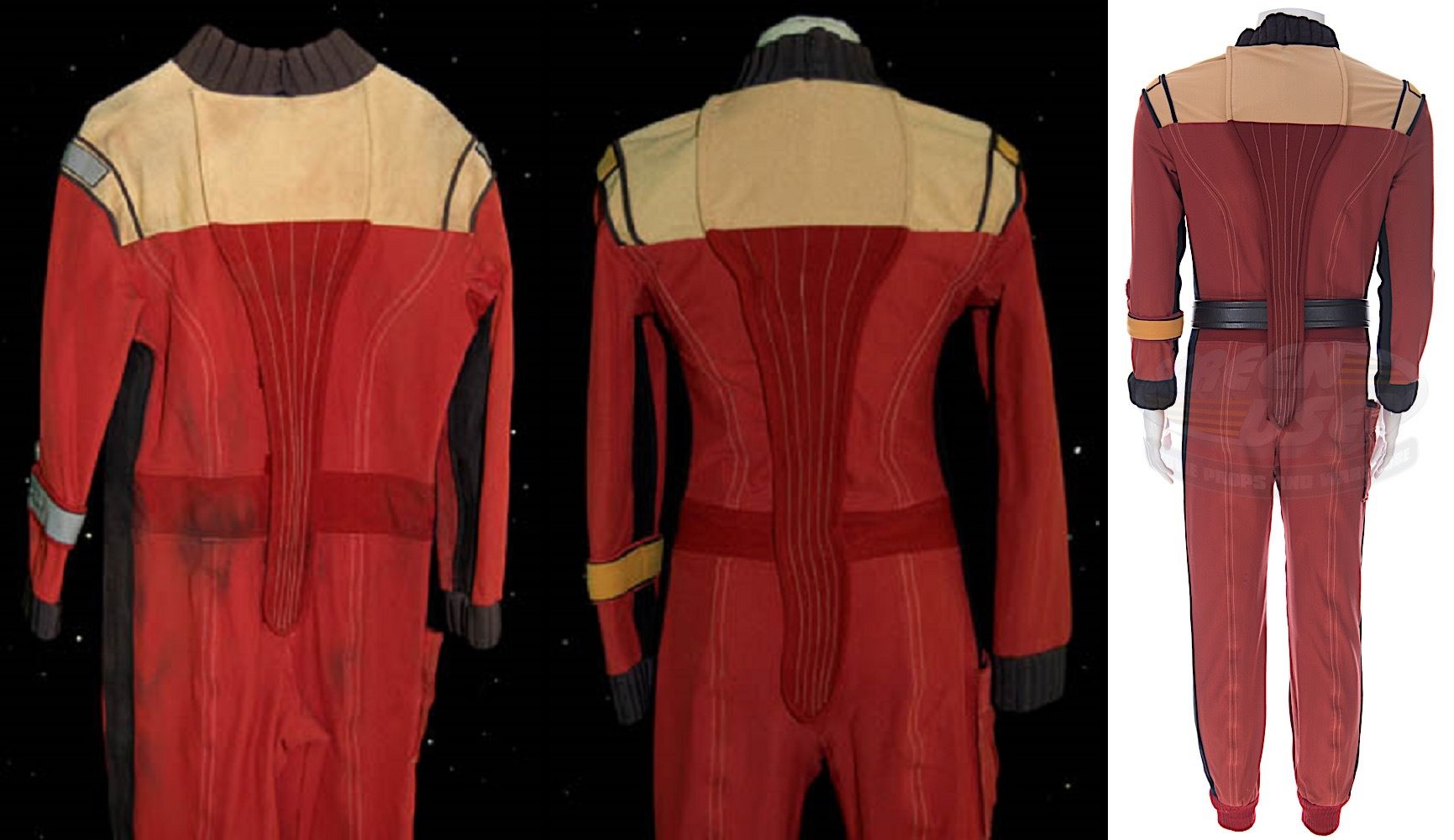
Likewise, on some jumpsuits the lower portion of the center back panel was made with matching red spandex:
TWOK-era enlisted jumpsuit auction photos
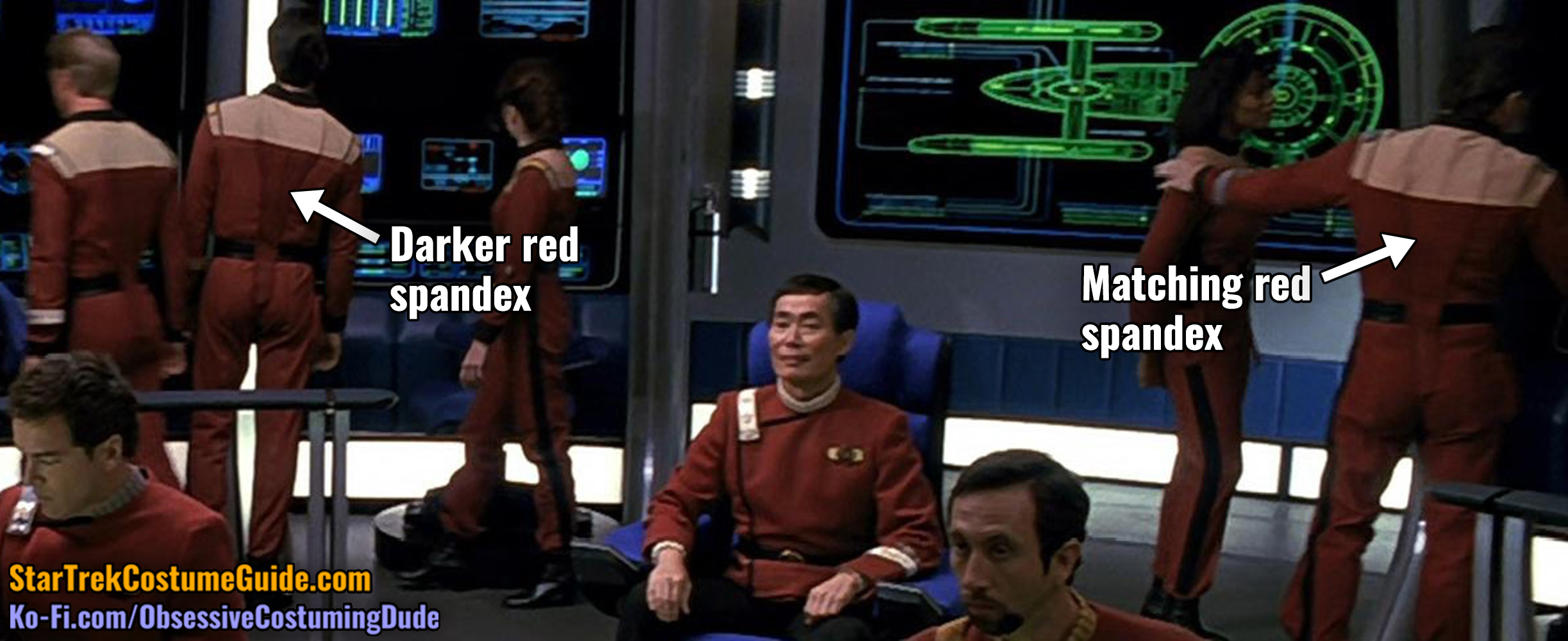
However, on many of the enlisted jumpsuits, the center back panel was made with darker red spandex.
TWOK-era enlisted jumpsuit auction photos
My initial theory was that the red fabric colors changed over the course of the movies (similarly to how the “monster maroon” wool did) and eventually, the older jumpsuits began having bits added using the newer mismatched spandex.
However, we saw these mismatched back panels (again) right out of the gate in The Wrath of Khan, so while the colors may indeed have evolved, that wasn’t a determining factor.
Since the jumpsuit bodies were (at least initially) overdyed TMP “Class D” jumpsuits but the belt loops and back panels were made and attached afterward, my assumption is that those new bits were made with spandex procured elsewhere, and the mismatched colors were simply a casualty of the movie’s budget.
Here are a couple more:
In this shot, the jumpsuit on the right has a matching back panel, but the second-from-left jumpsuit has a contrasting darker one.
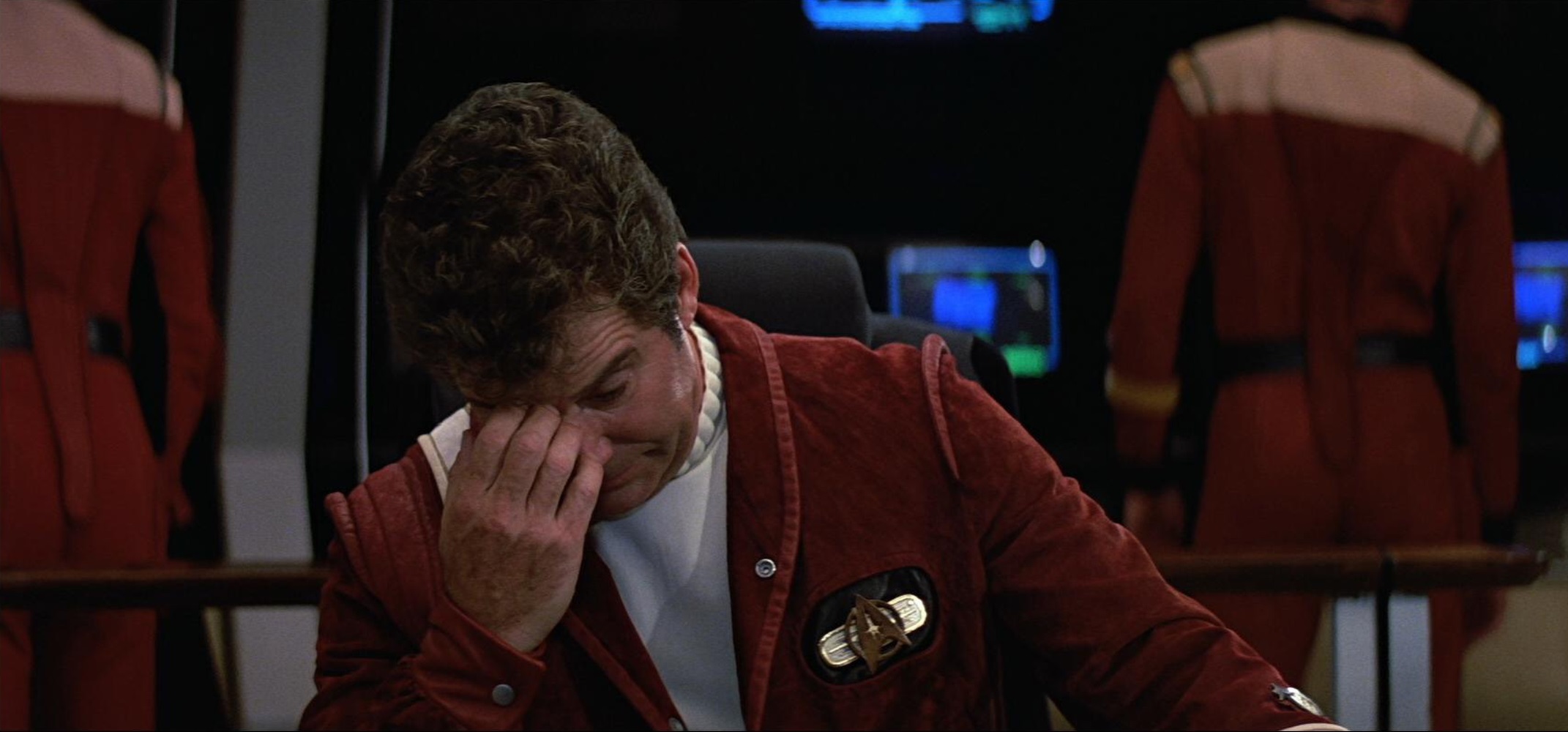
In this shot, one of the jumpsuits behind Captain Kirk had a matching back panel, but the other didn’t.
“Can we please make up our minds about whether or not the back panels are supposed to match?”
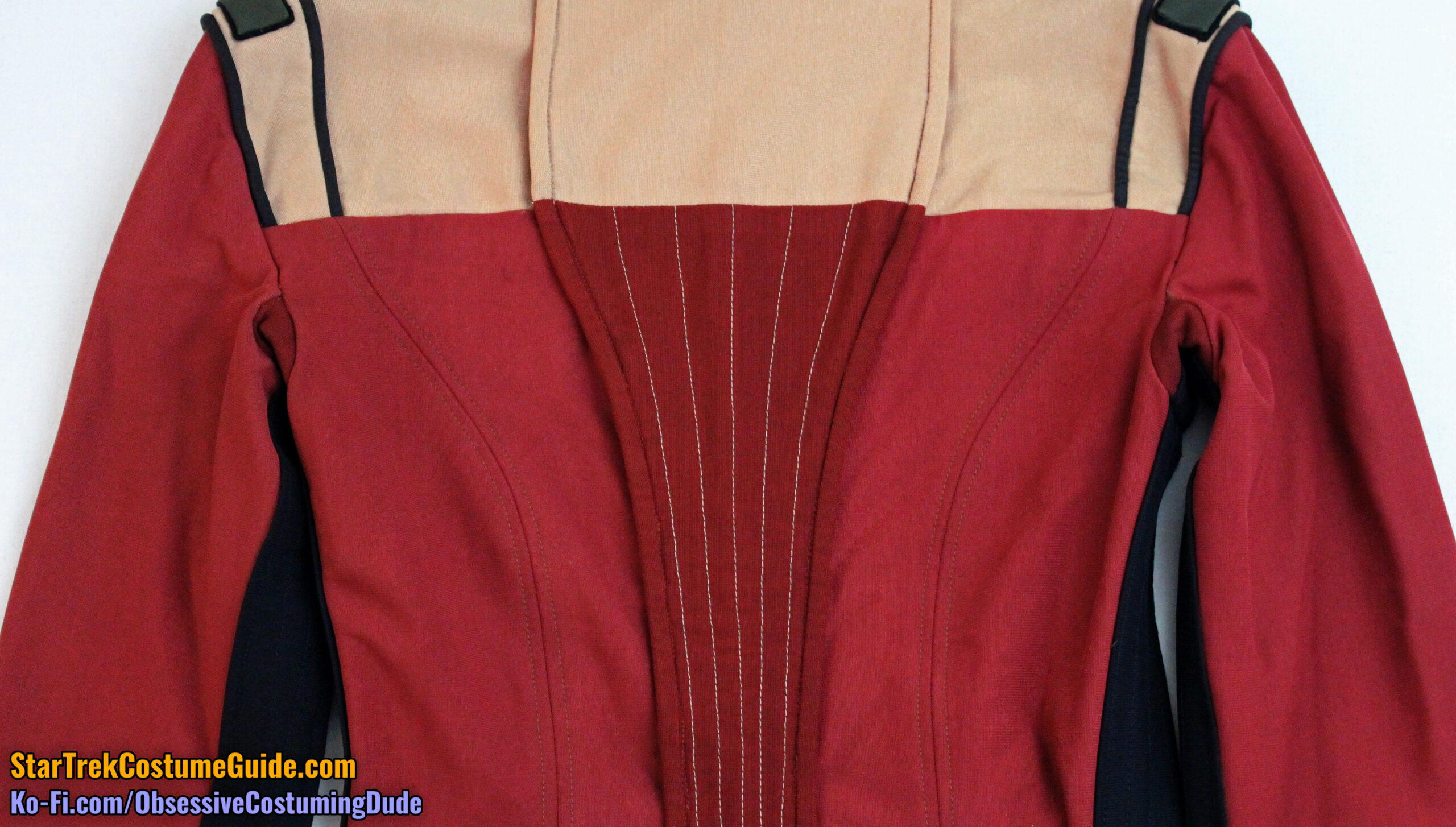
The screen-used enlisted jumpsuit I examined had a darker center back panel.
This darker red spandex is very close to the color of the “monster maroon” wool, but it’s actually darker.
With flash
No flash
Collar
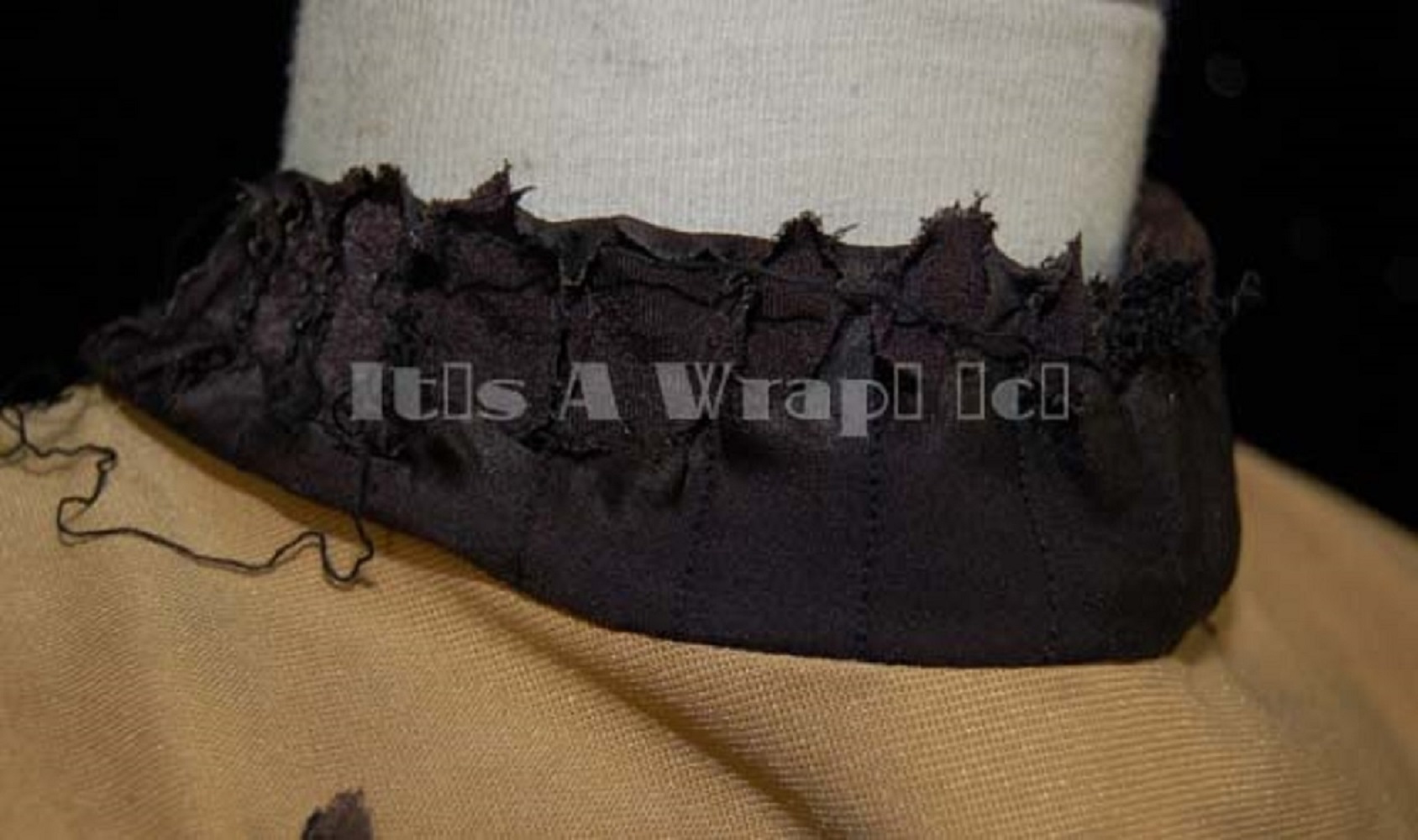
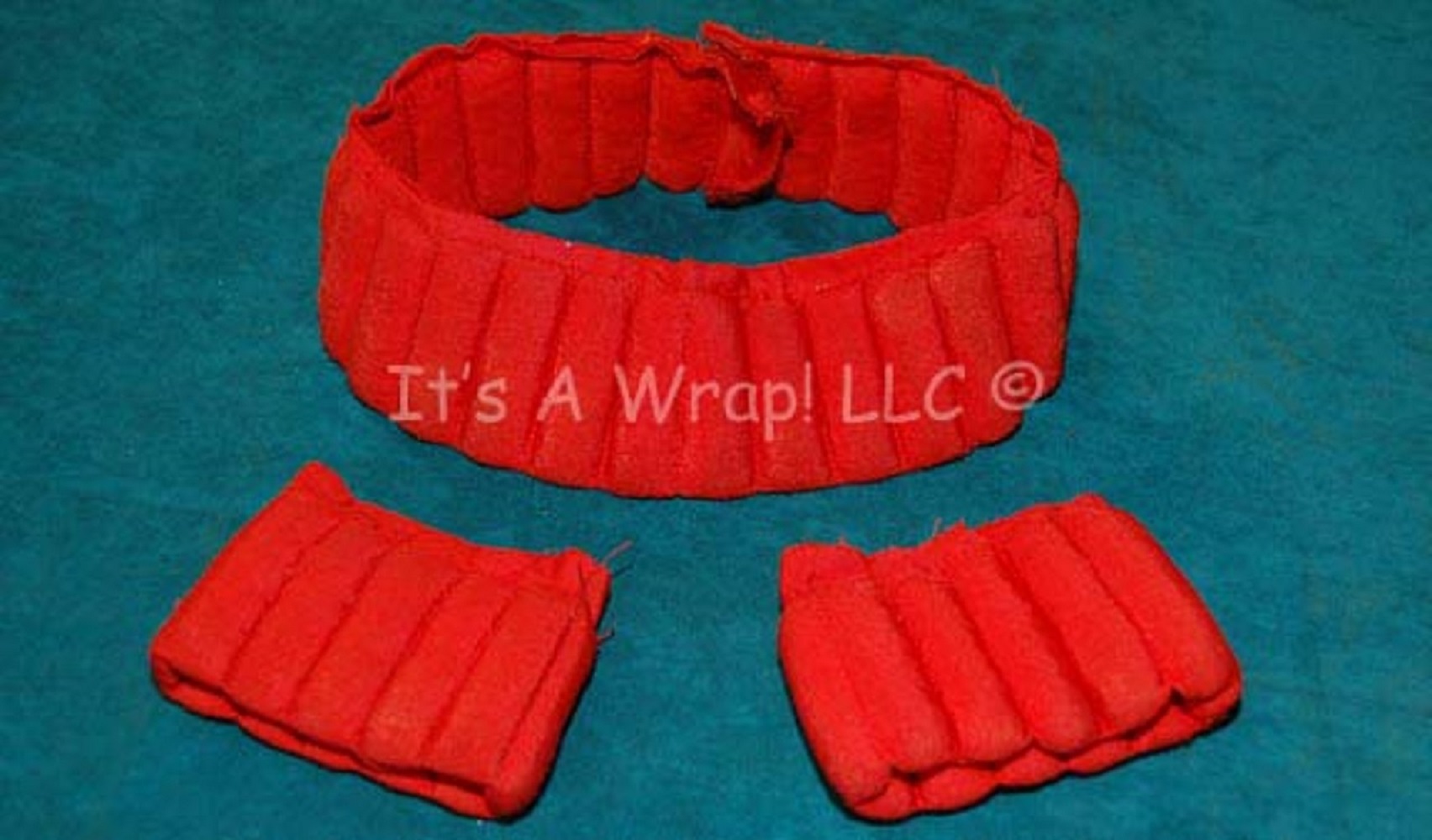
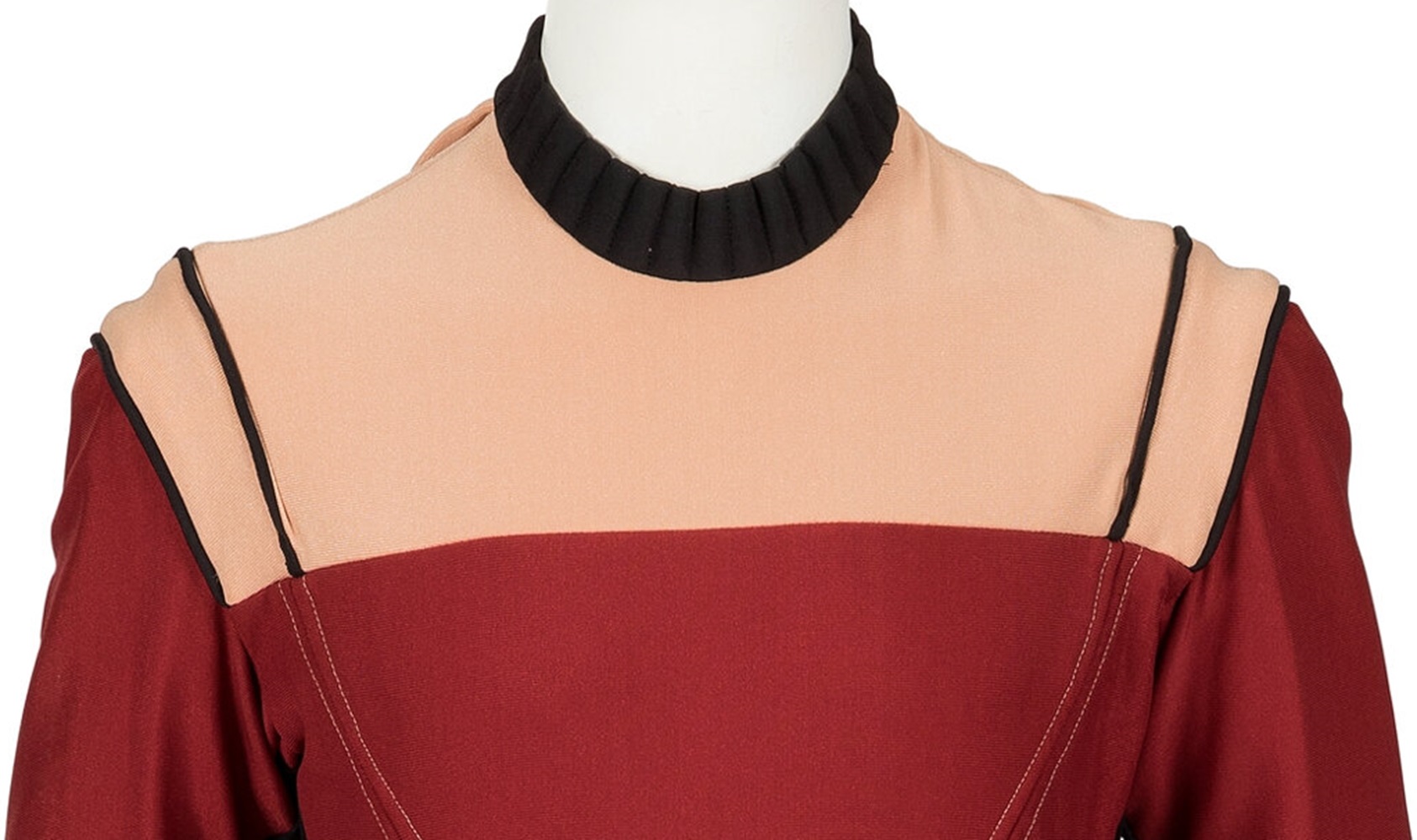
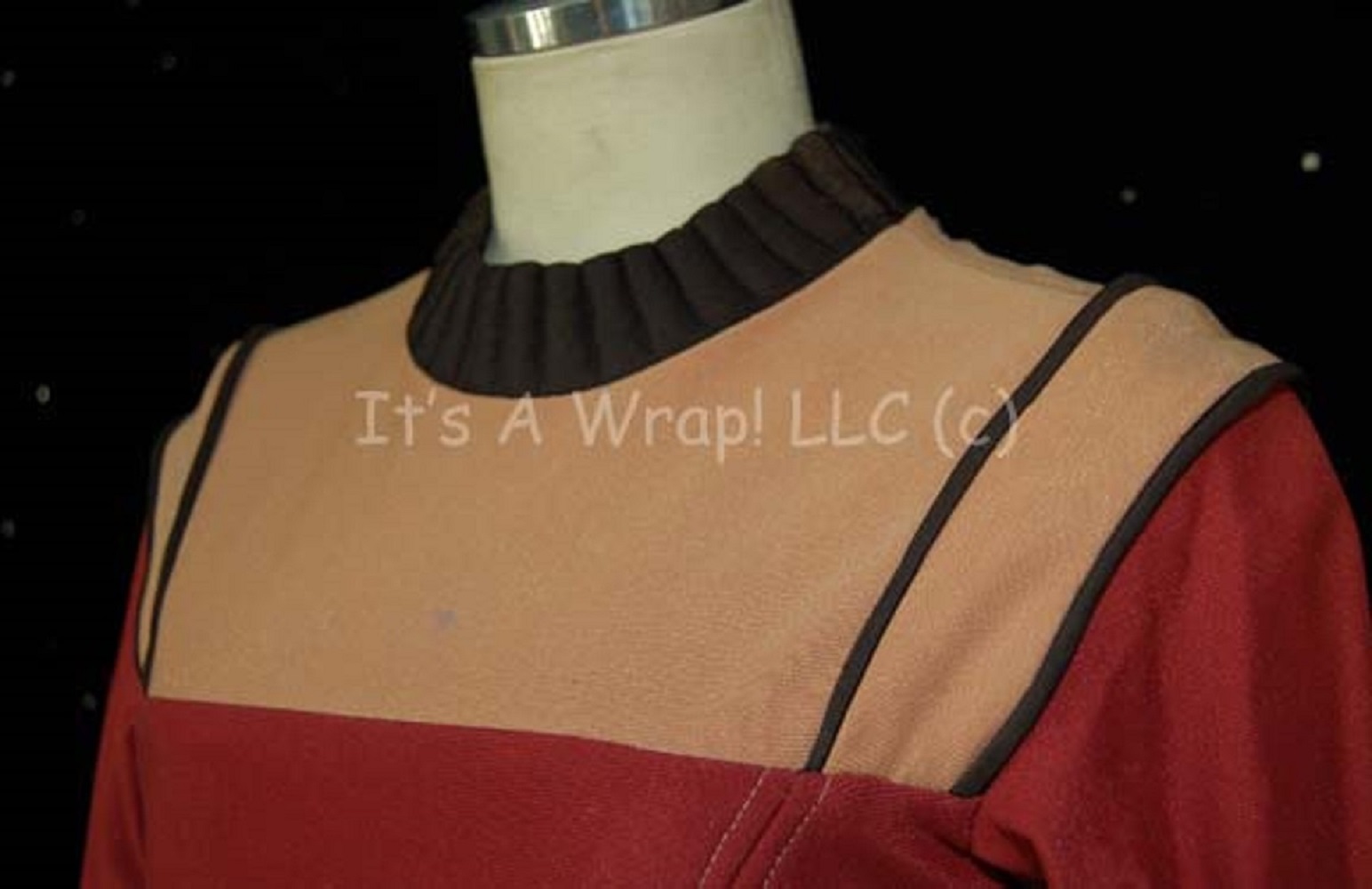
The enlisted jumpsuits had trapunto-quilted collars, similar to those seen on the officers’ division shirts.
As I mentioned earlier, enlisted personnel had black collars, while trainees had red ones.
Unlike the jumpsuit body, these collars were made of a more lightweight spandex, either milliskin spandex or a similar product.
TWOK-era enlisted jumpsuit auction photos
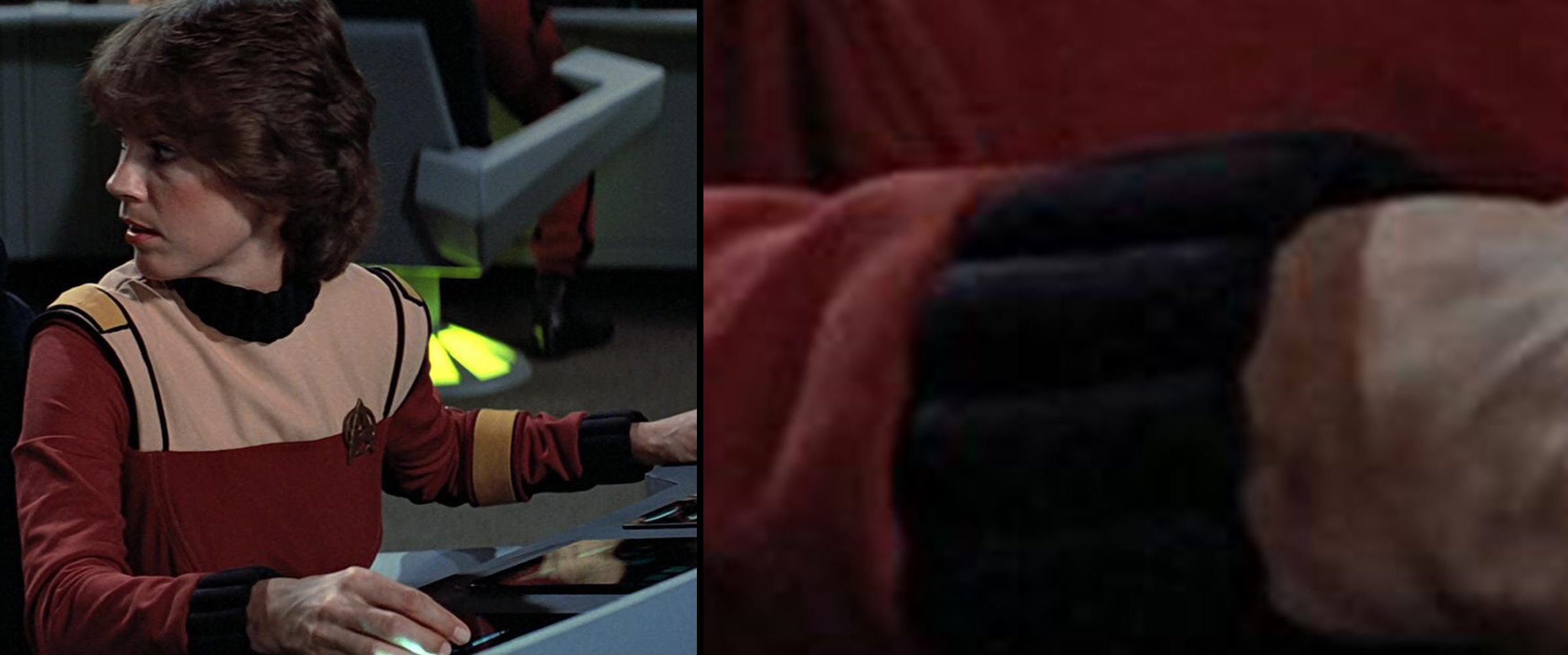
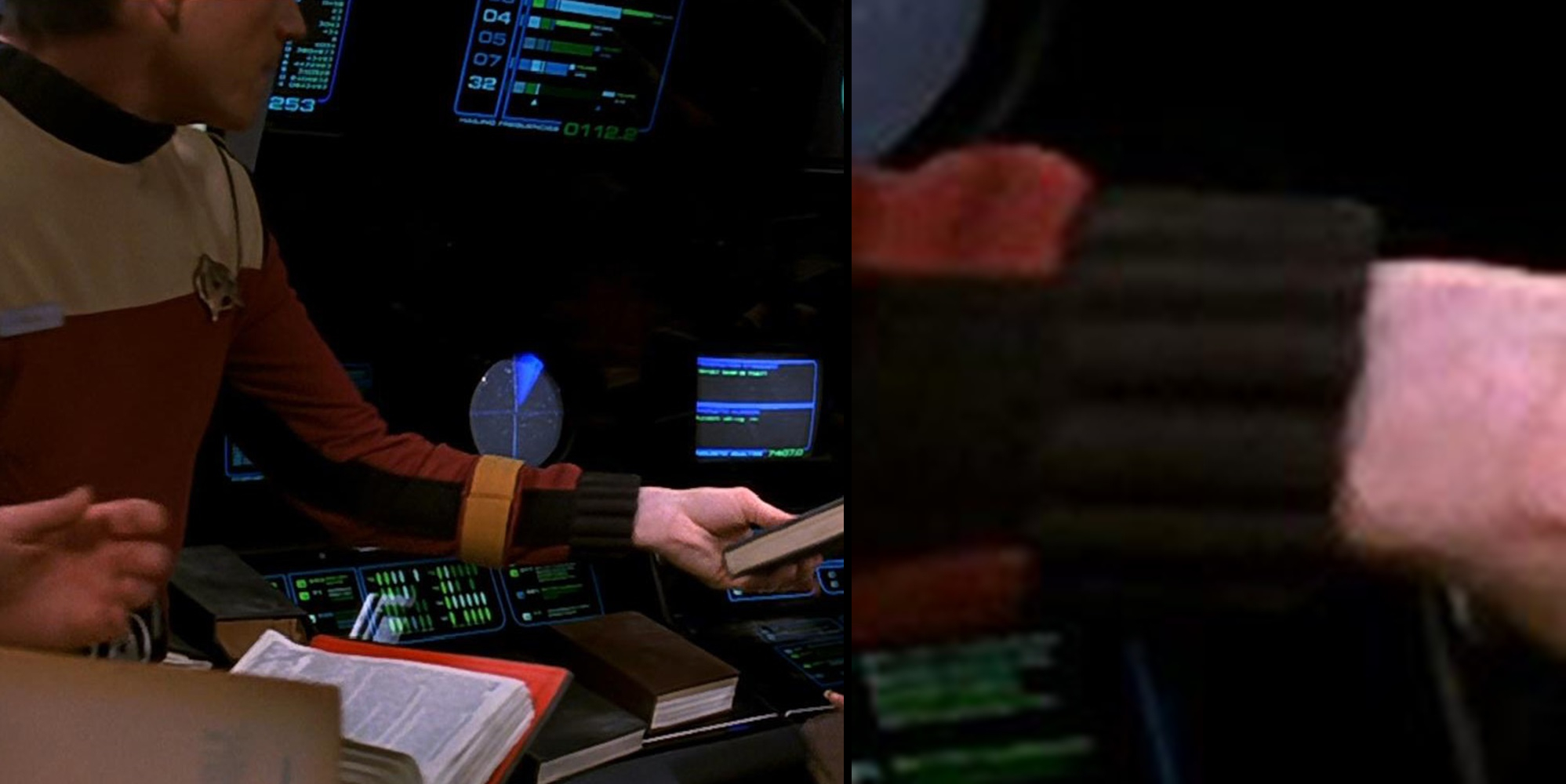
These collars varied in height, although broadly speaking most of them were taller in ST2 and ST3.
In ST4 through ST6, the collars began getting shorter overall.
There were exceptions, of course; some of the earlier, taller collars were also seen in the later movies (probably because the older uniforms themselves continued to be used).
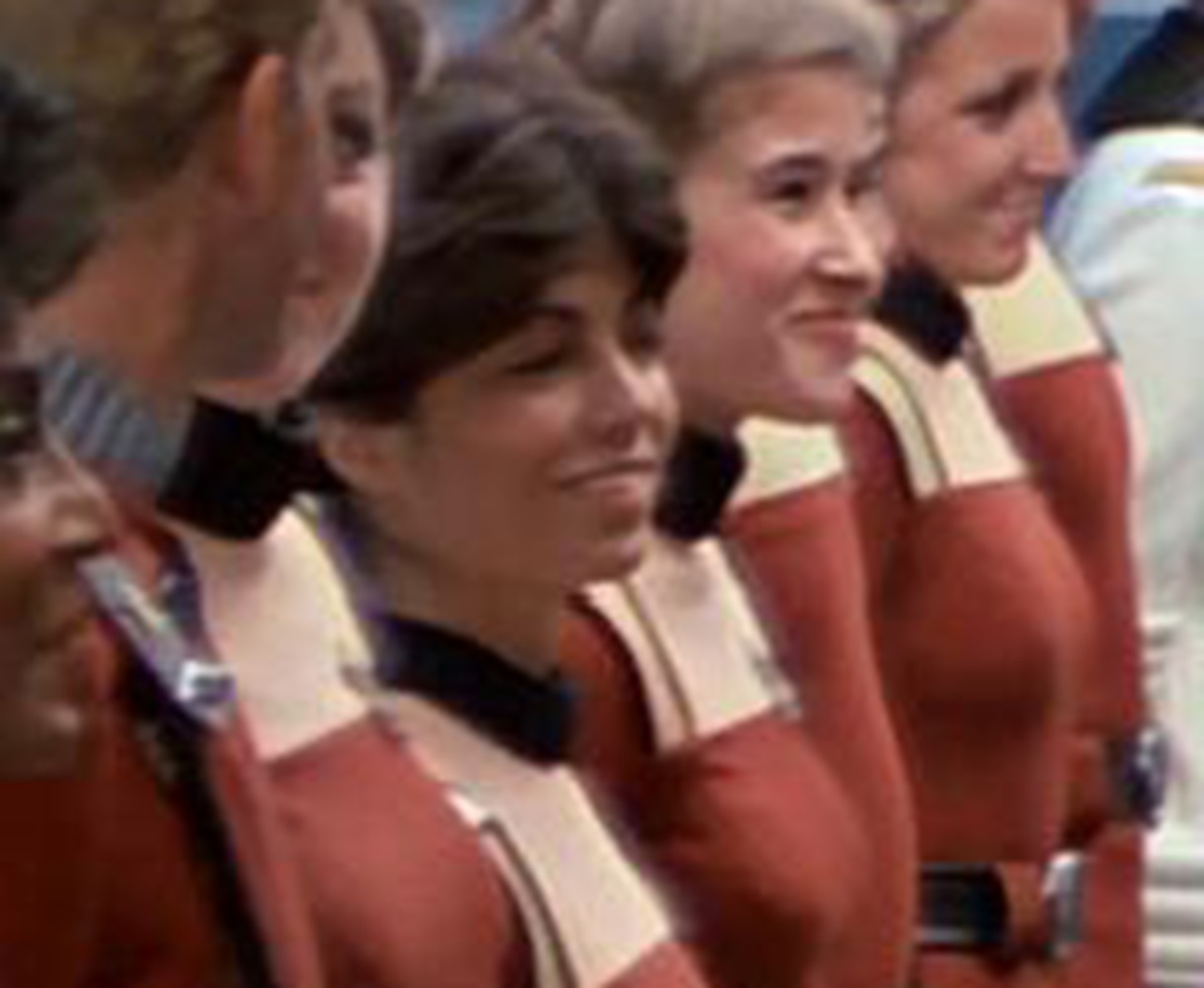
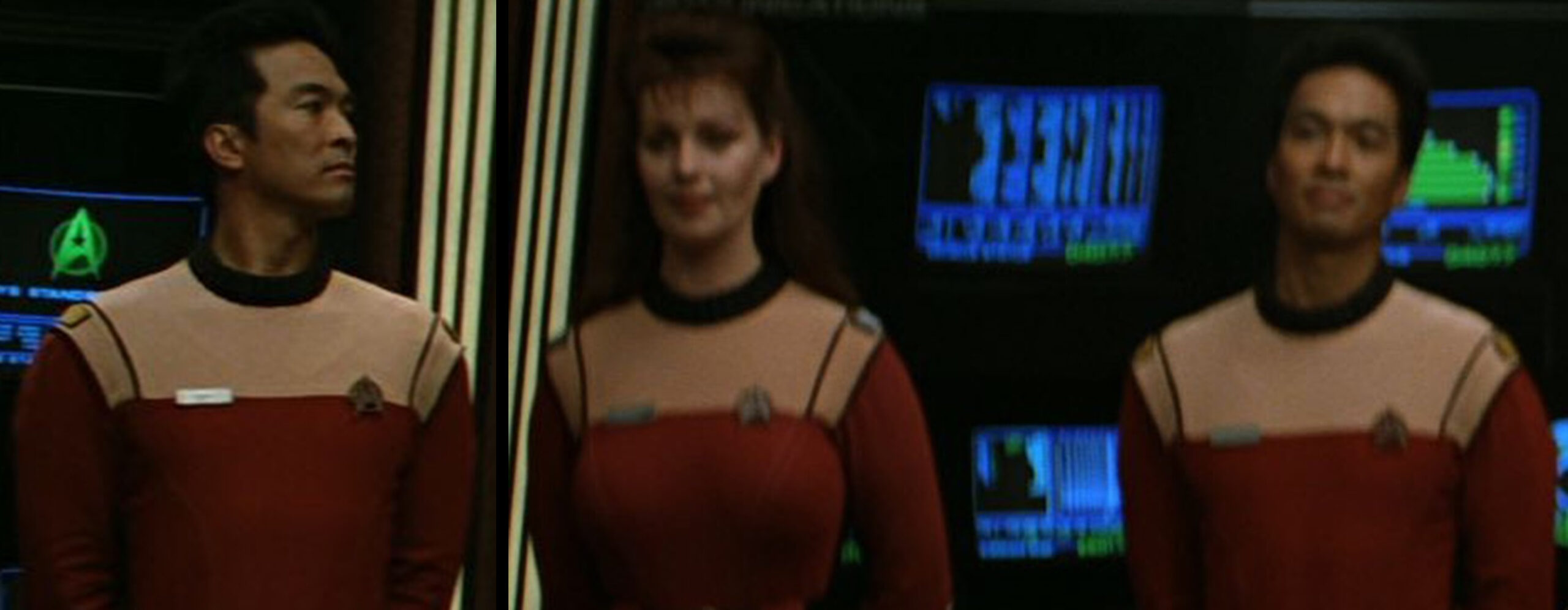
The collar height varied in the same productions too; in this (cropped) shot, the lady in the middle clearly had a shorter collar than the other two ladies beside her.
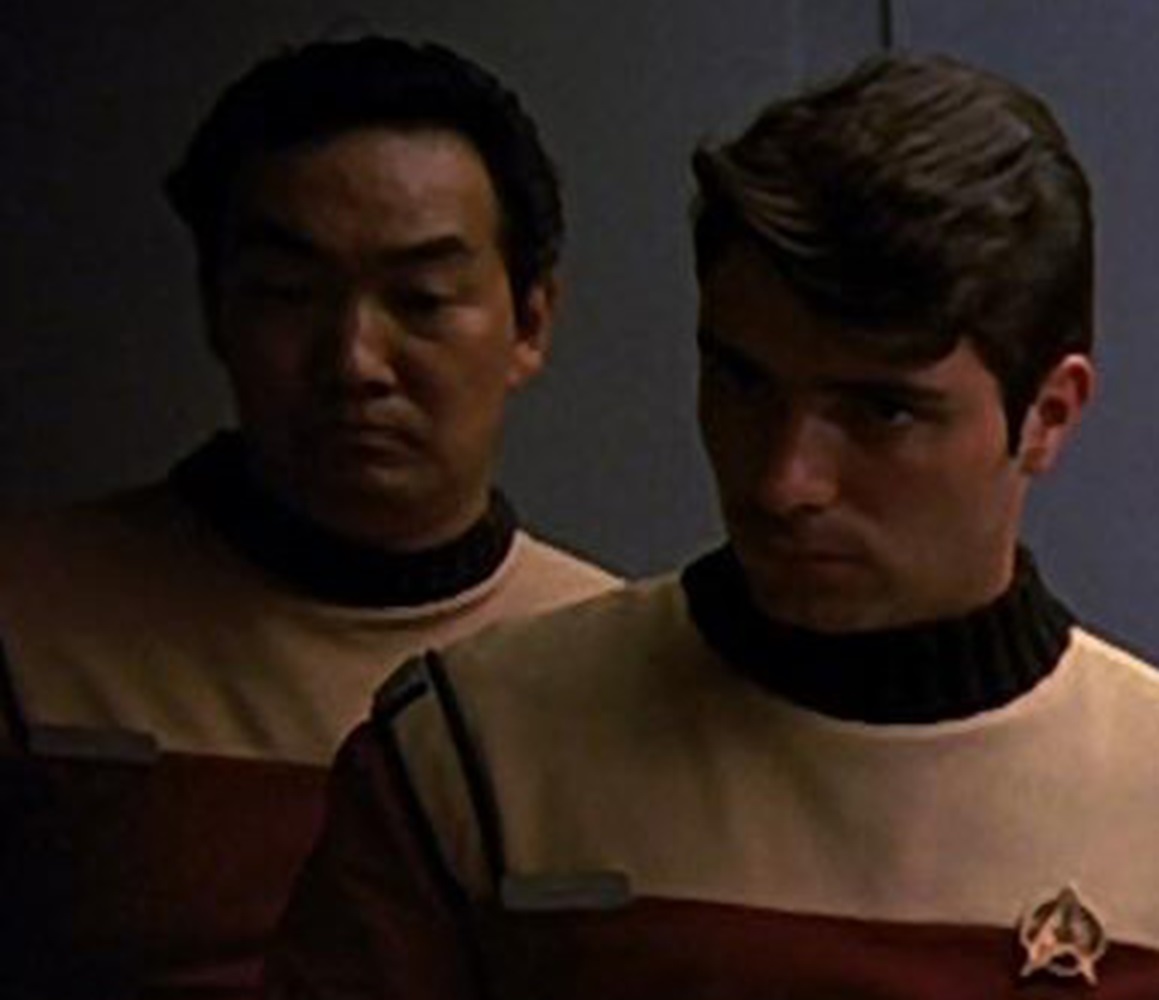
In this shot, the fellow on the left had a shorter collar than the one on the right.
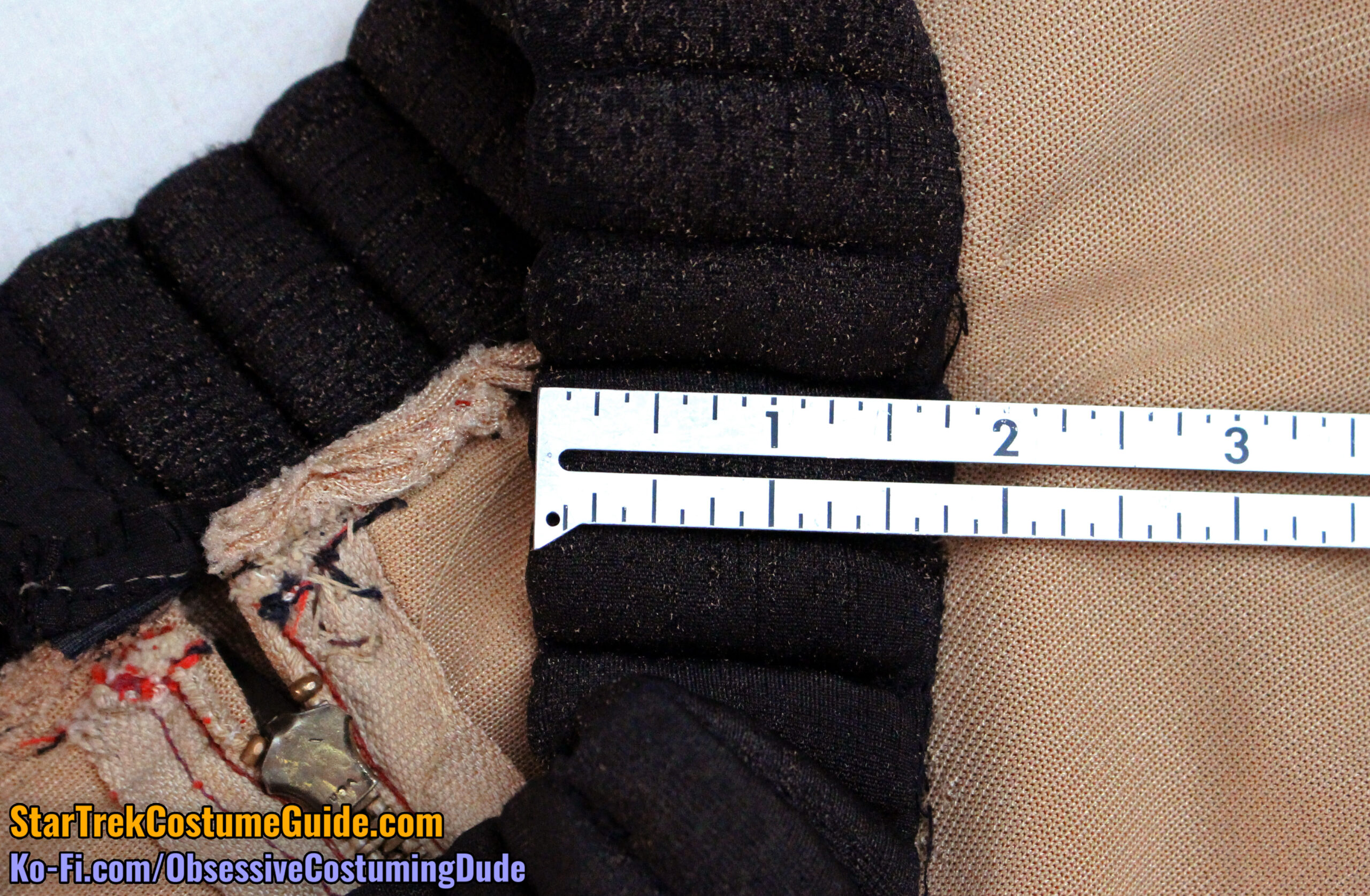
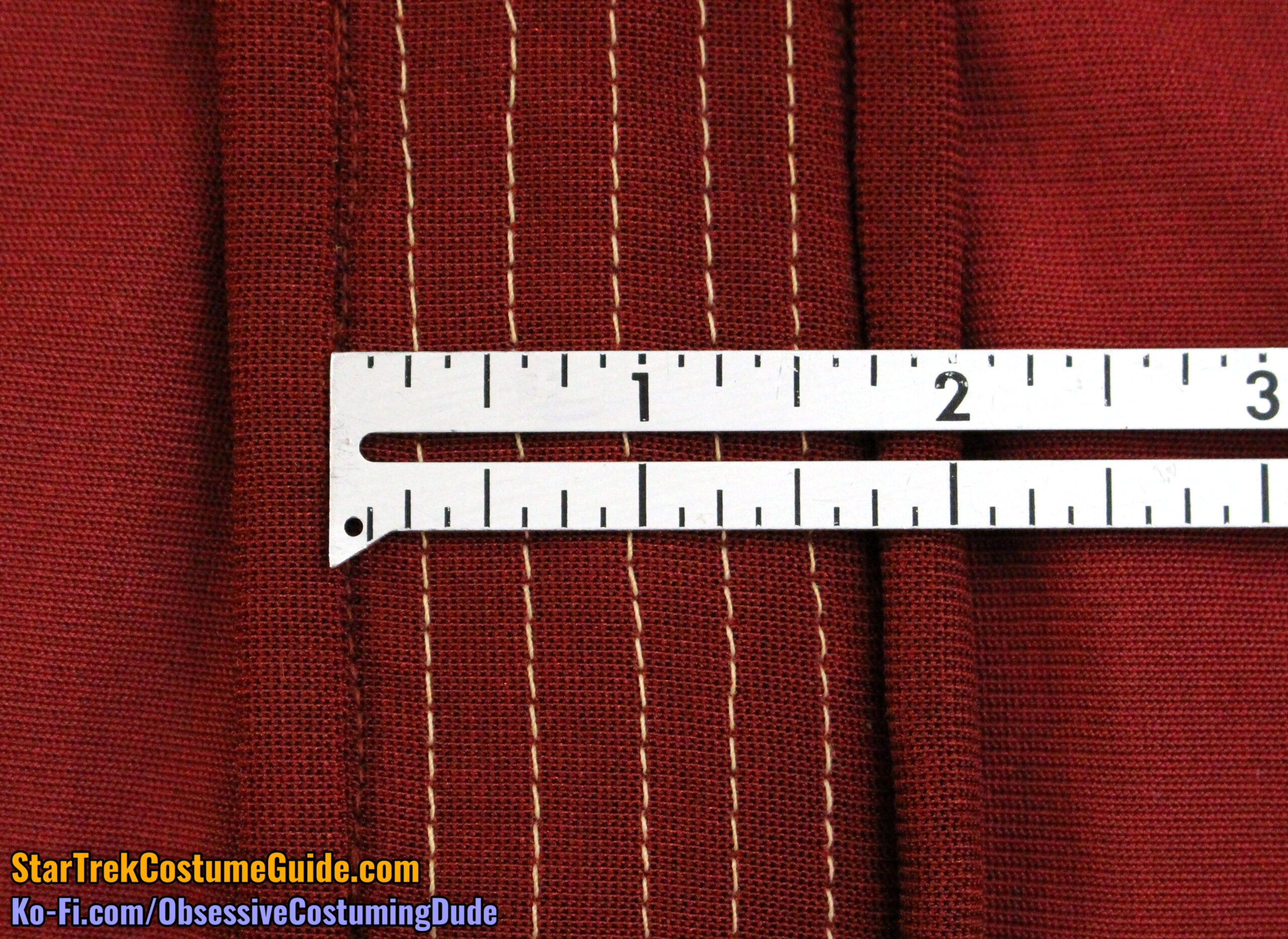
For what it’s worth, the collar on the screen-used enlisted jumpsuit I examined was 1 ¾” tall, and the quilted channels ranged from about ½” to ⅝” wide.
Yoke
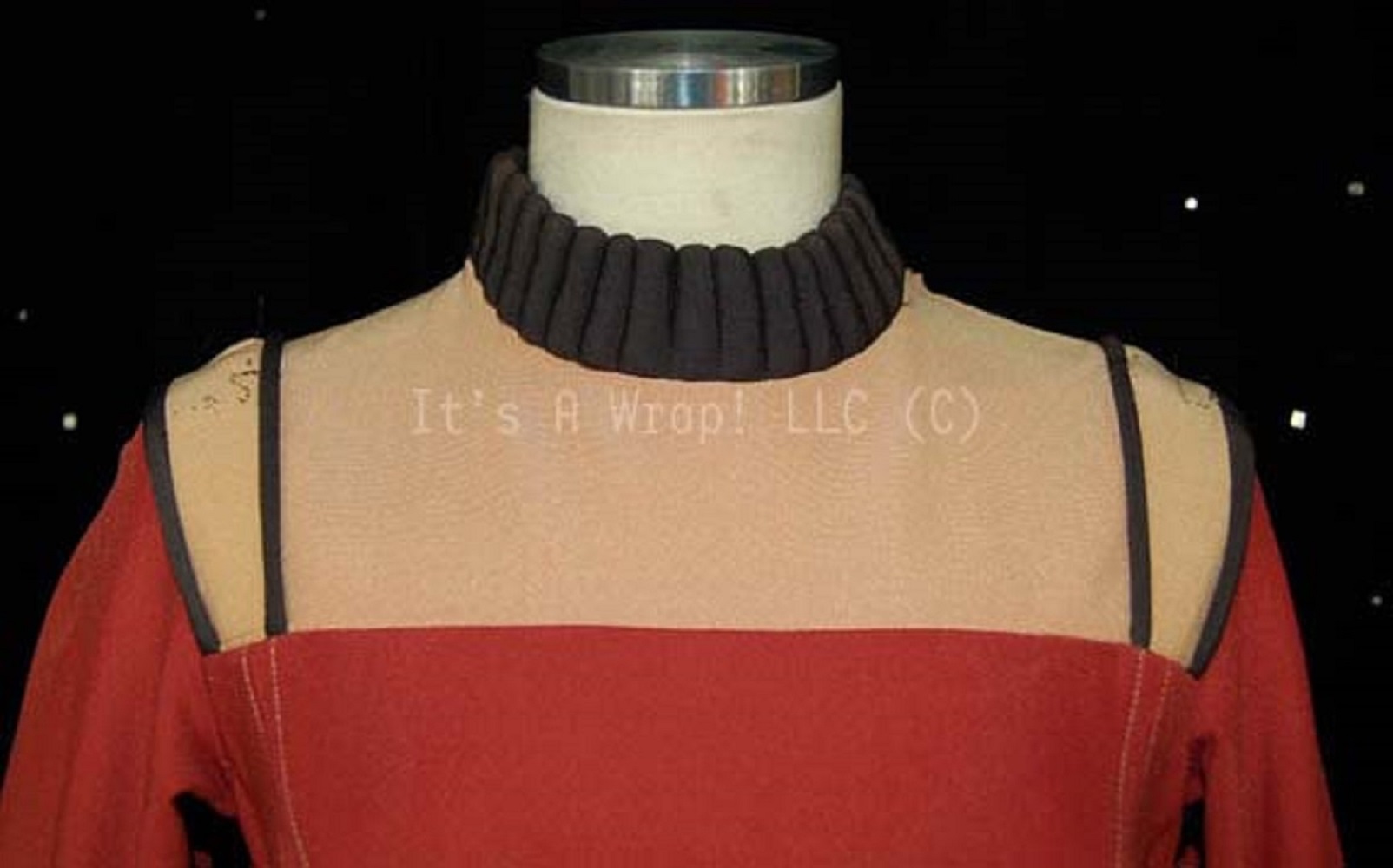
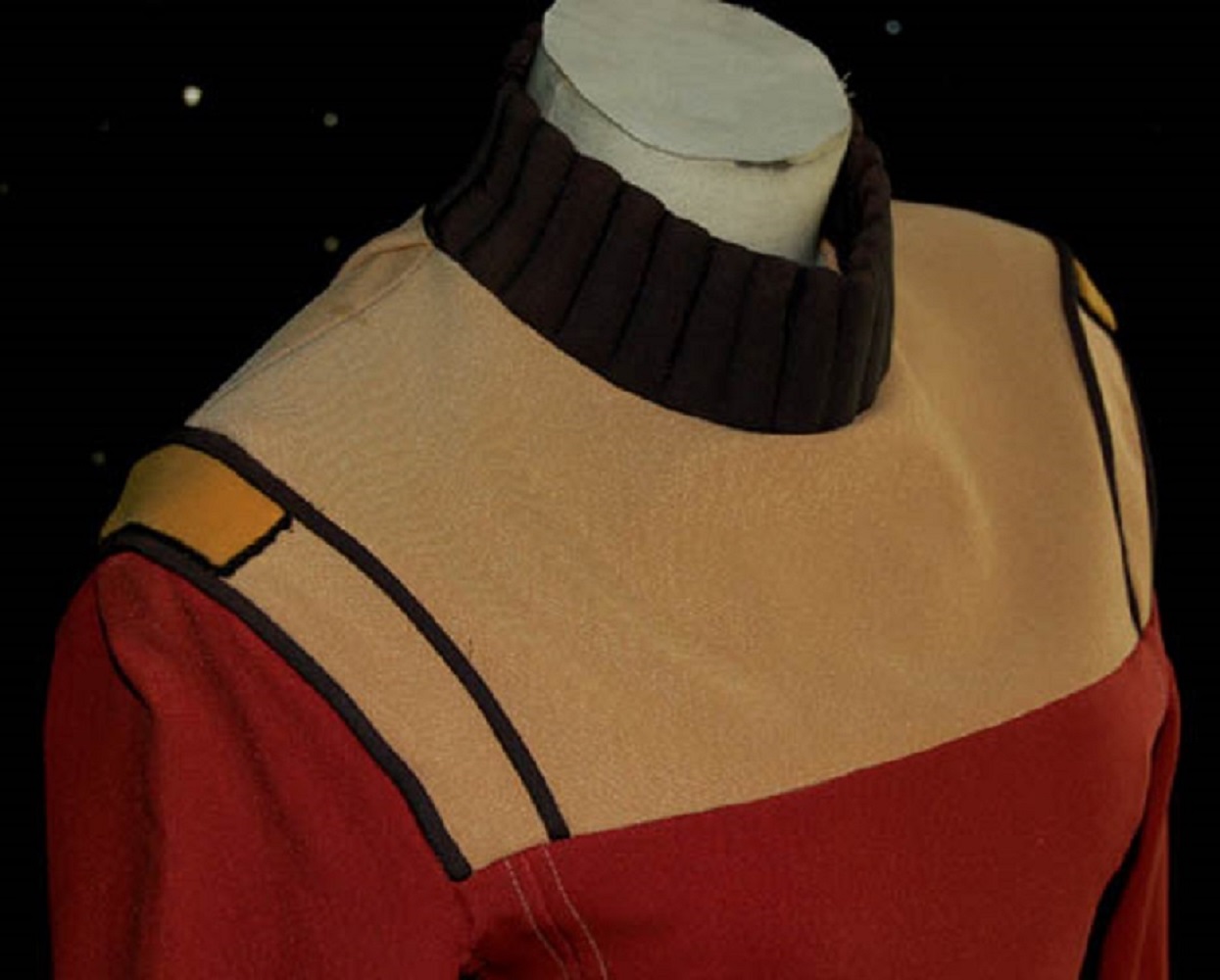
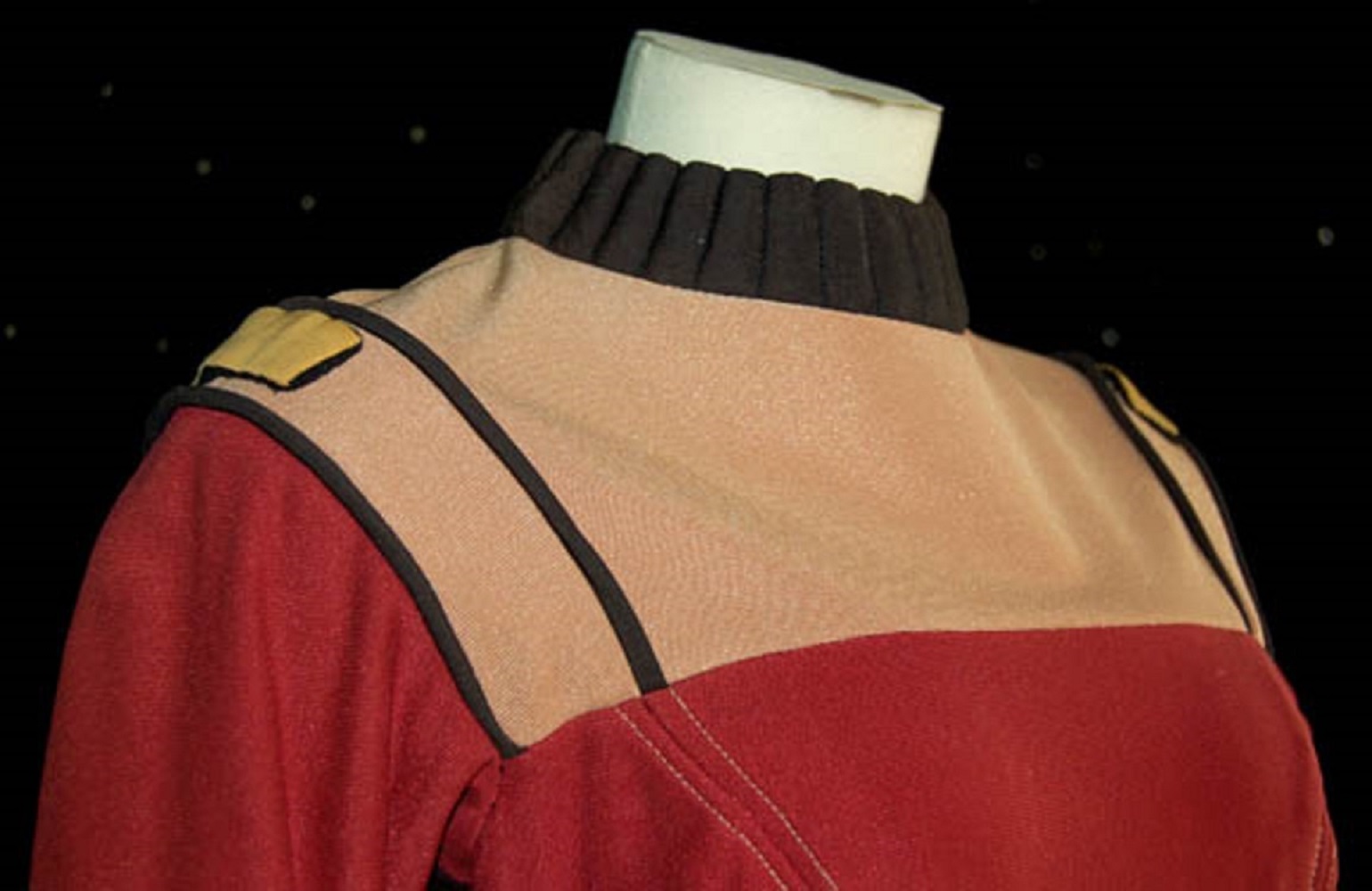
The beige yokes were a new addition to the overdyed TMP “Class D” jumpsuits, but they weren’t simply attached over the existing jumpsuit body; the tops of the jumpsuits were cut off, and the new yokes were sewn on.
In addition to the front and back yoke panels, there was an additional, narrower panel to the sides, which I refer to as the “outer yoke extension.”
This was an entirely separate panel that spanned across both the front and back yokes, with no shoulder seam.
The grain was oriented where the shoulder seam would be, resulting in the panel being on a slightly diagonal grain in relation to the yoke.
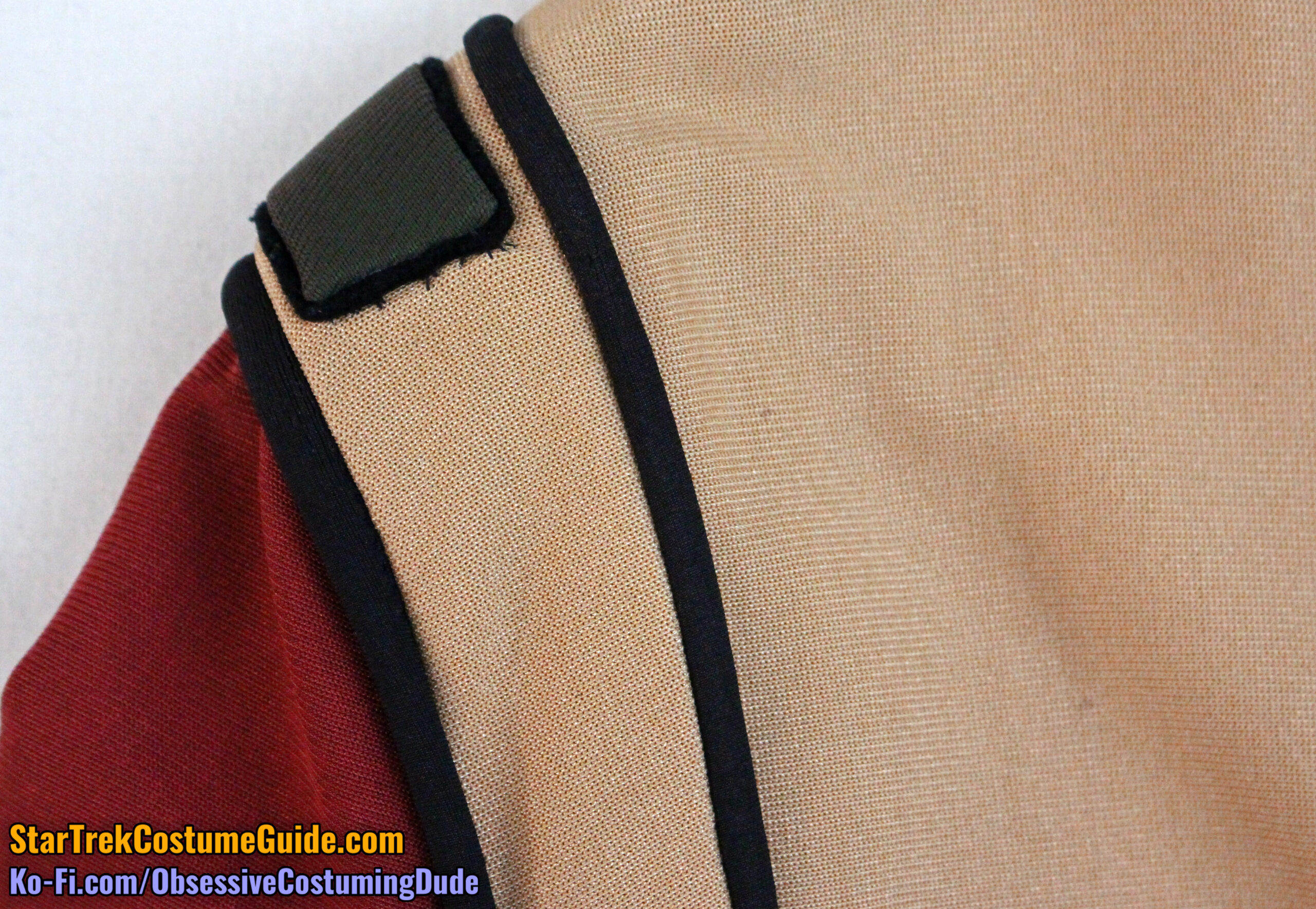
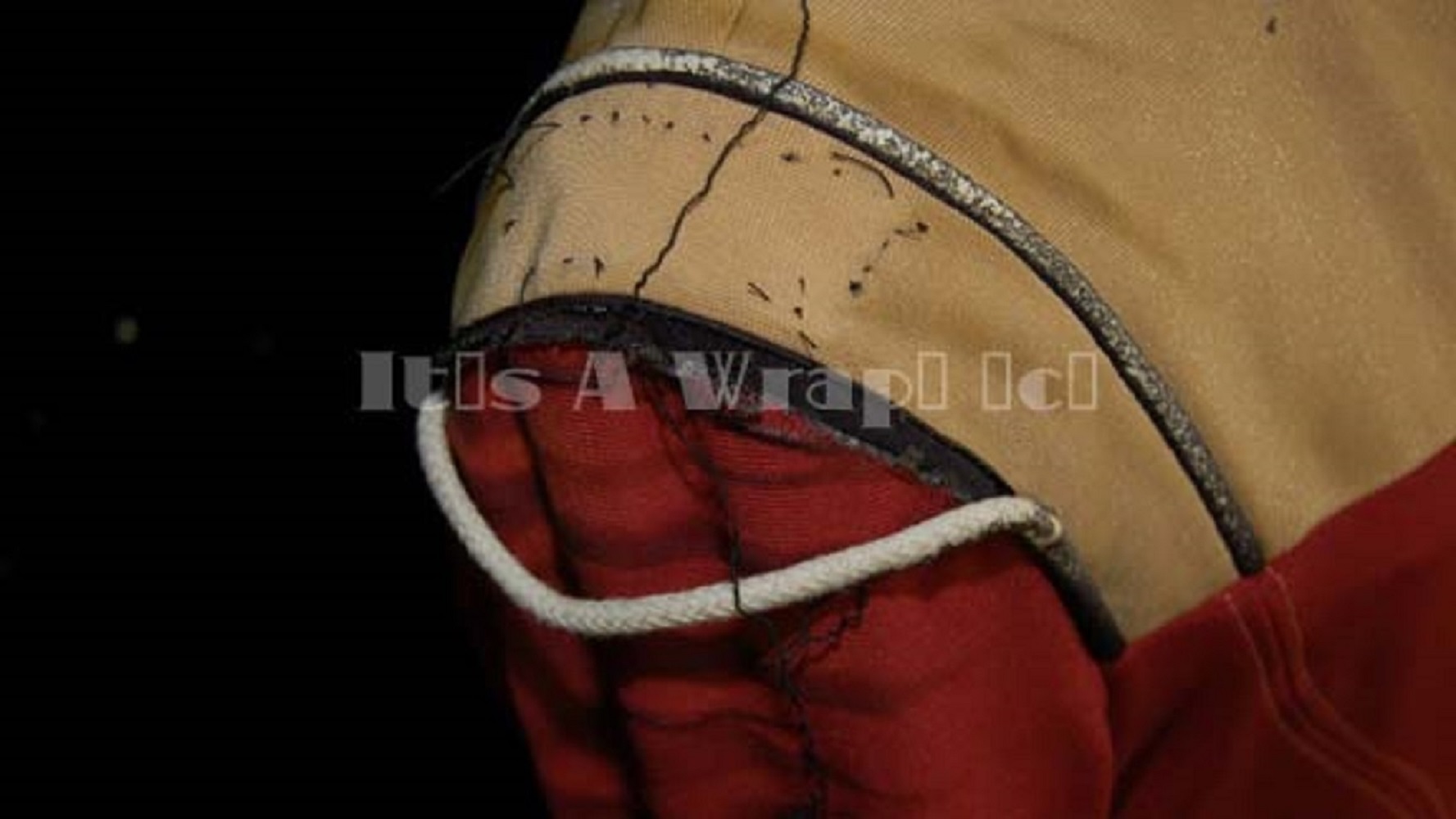
Both the yoke/yoke extension seams and the outer armscye seams were embellished with narrow black piping sewn into the seams.
This piping ranged from 3/16” to ¼” wide and was custom-made by wrapping lightweight black spandex (the same fabric used for the collar and cuffs) around cord.
TWOK-era enlisted jumpsuit auction photo
The yokes were slightly deeper in the front than the back.
On the women’s jumpsuits, the outer edges of the yoke extension were about where conventional armscye seams would be.
The men’s jumpsuits were somewhat inconsistent in this regard; sometimes they also extended to where conventional armscyes would.
Other times, they noticeably extended over the shoulders and onto the upper sleeves a bit.
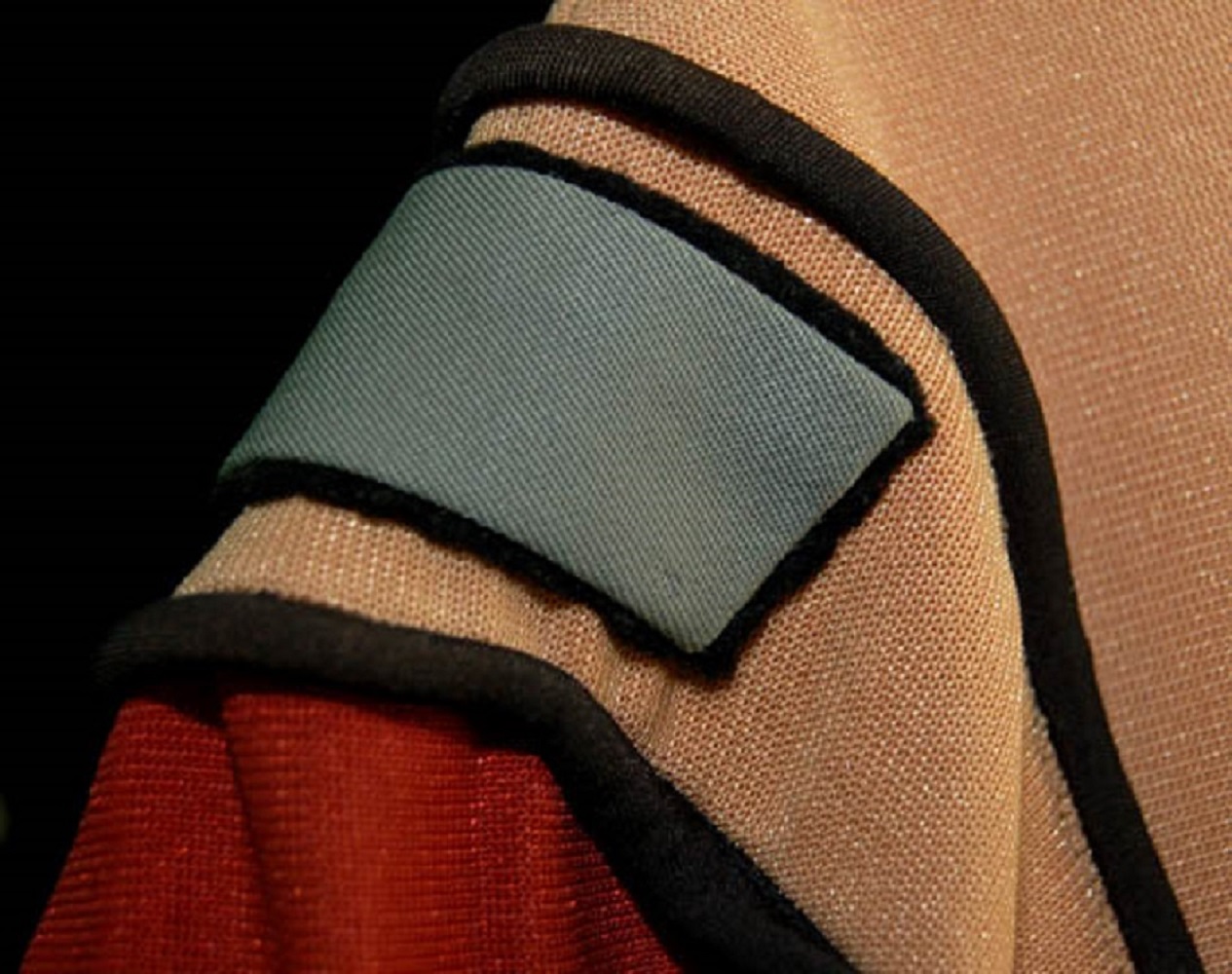
Shoulder Tabs
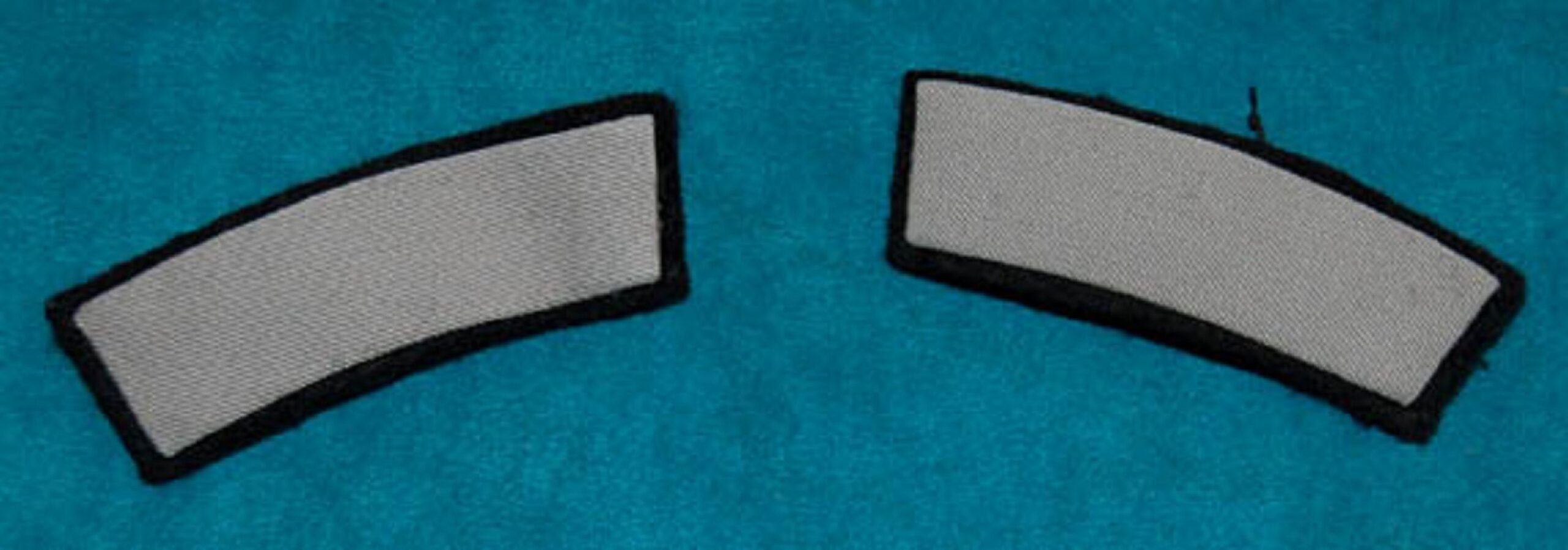
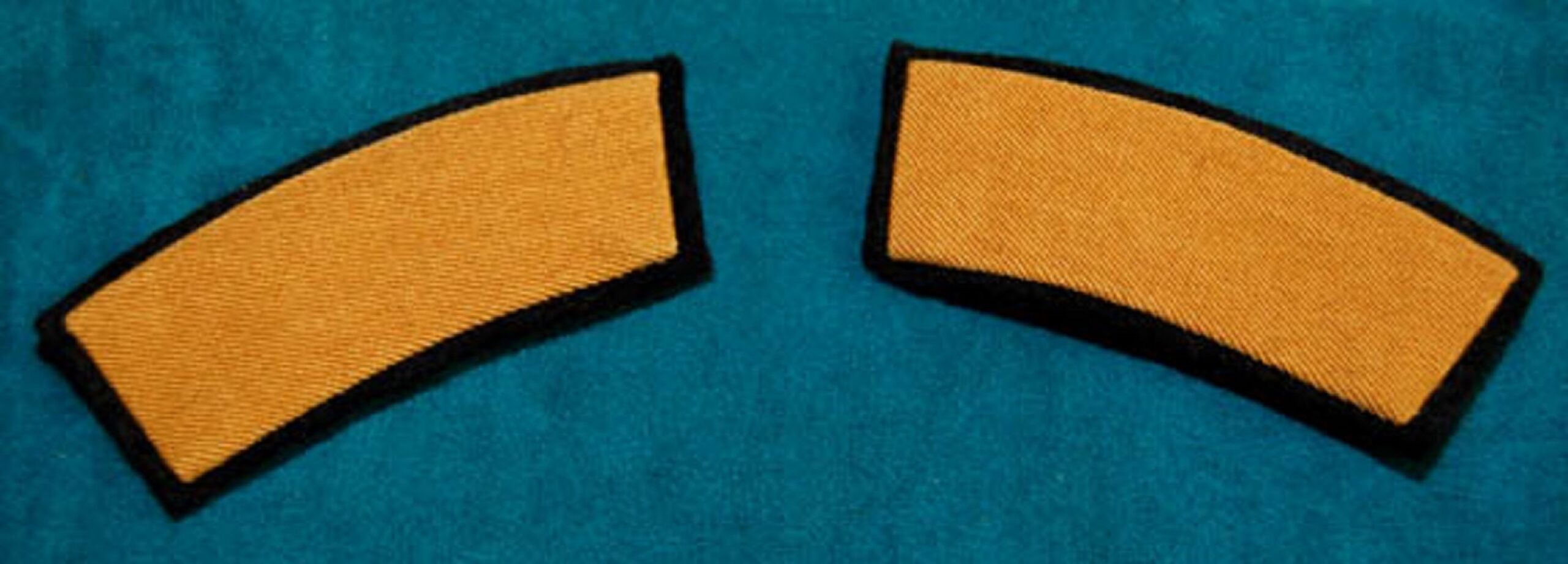
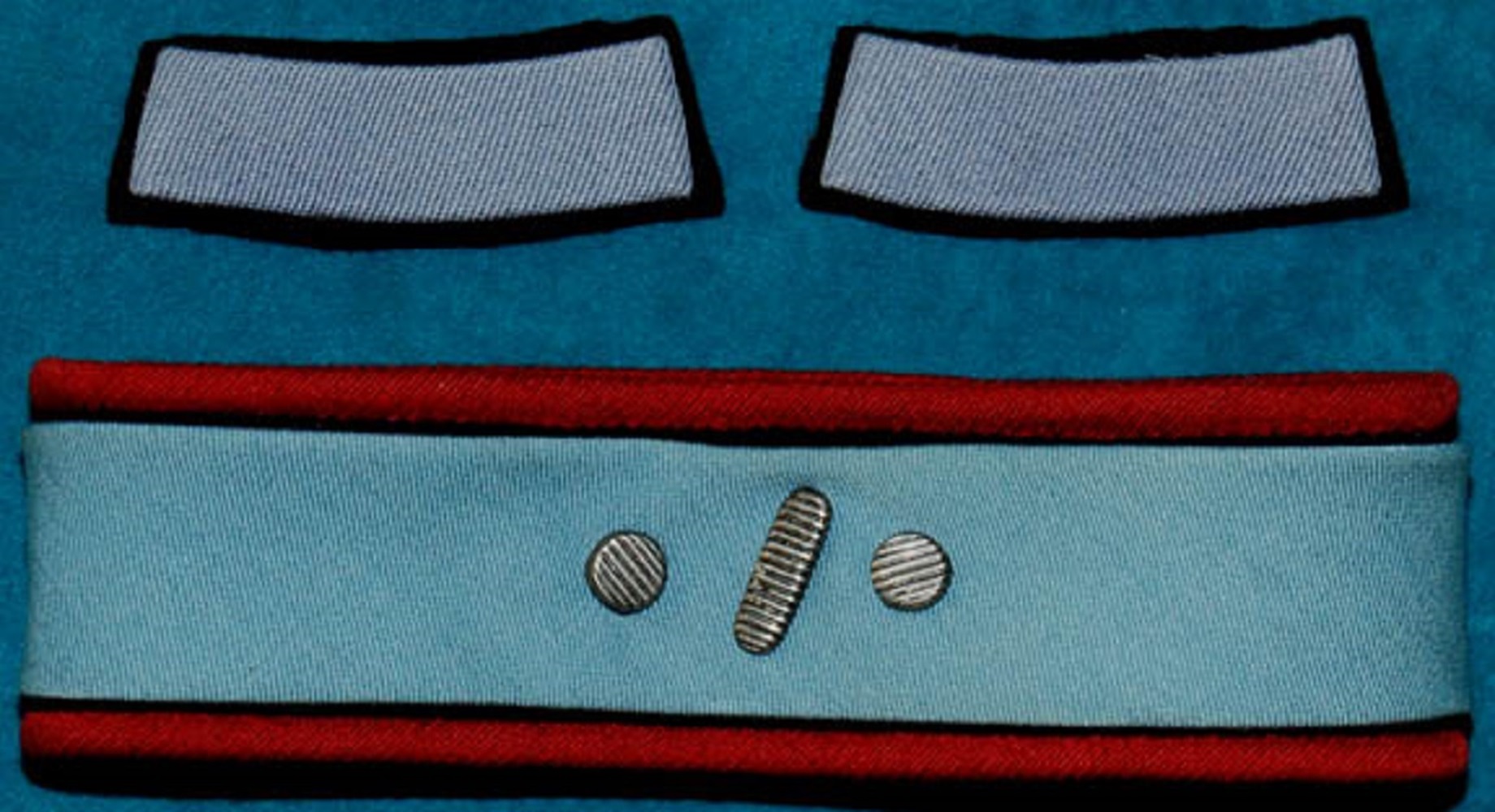
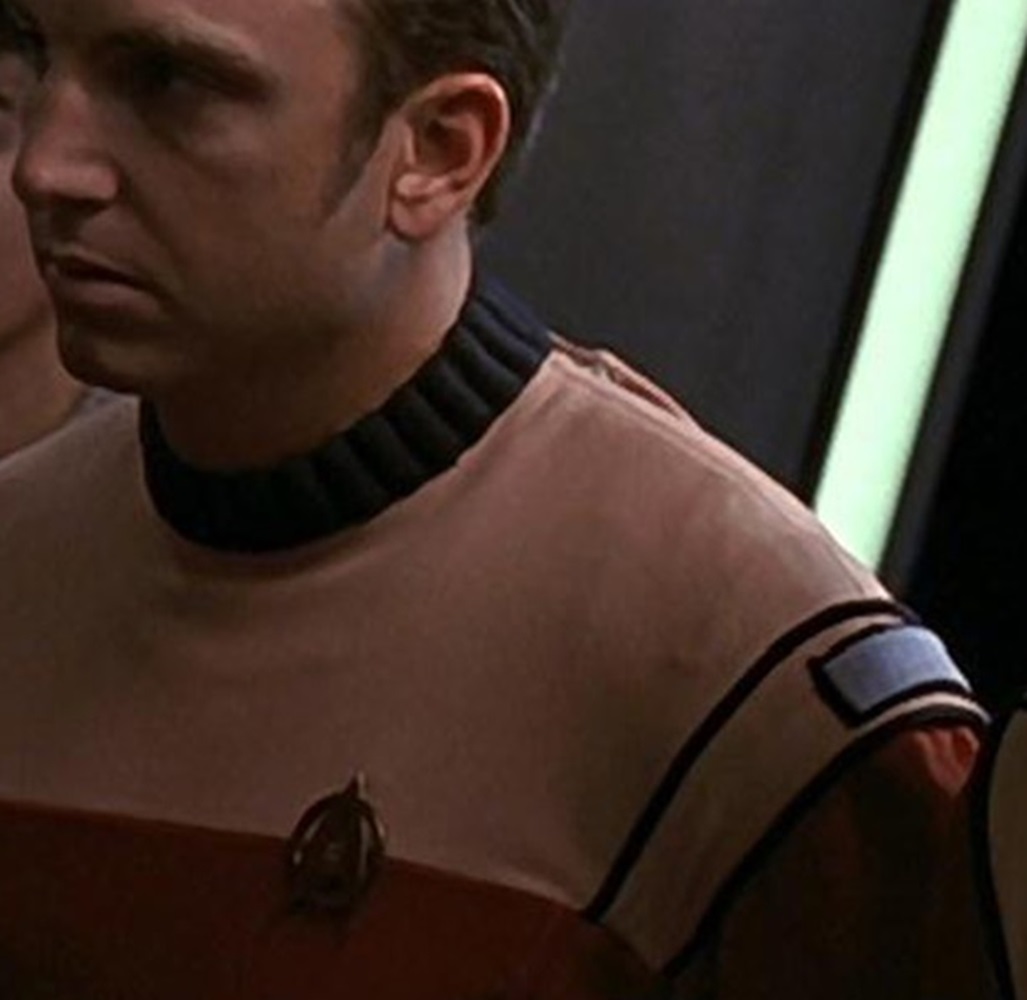
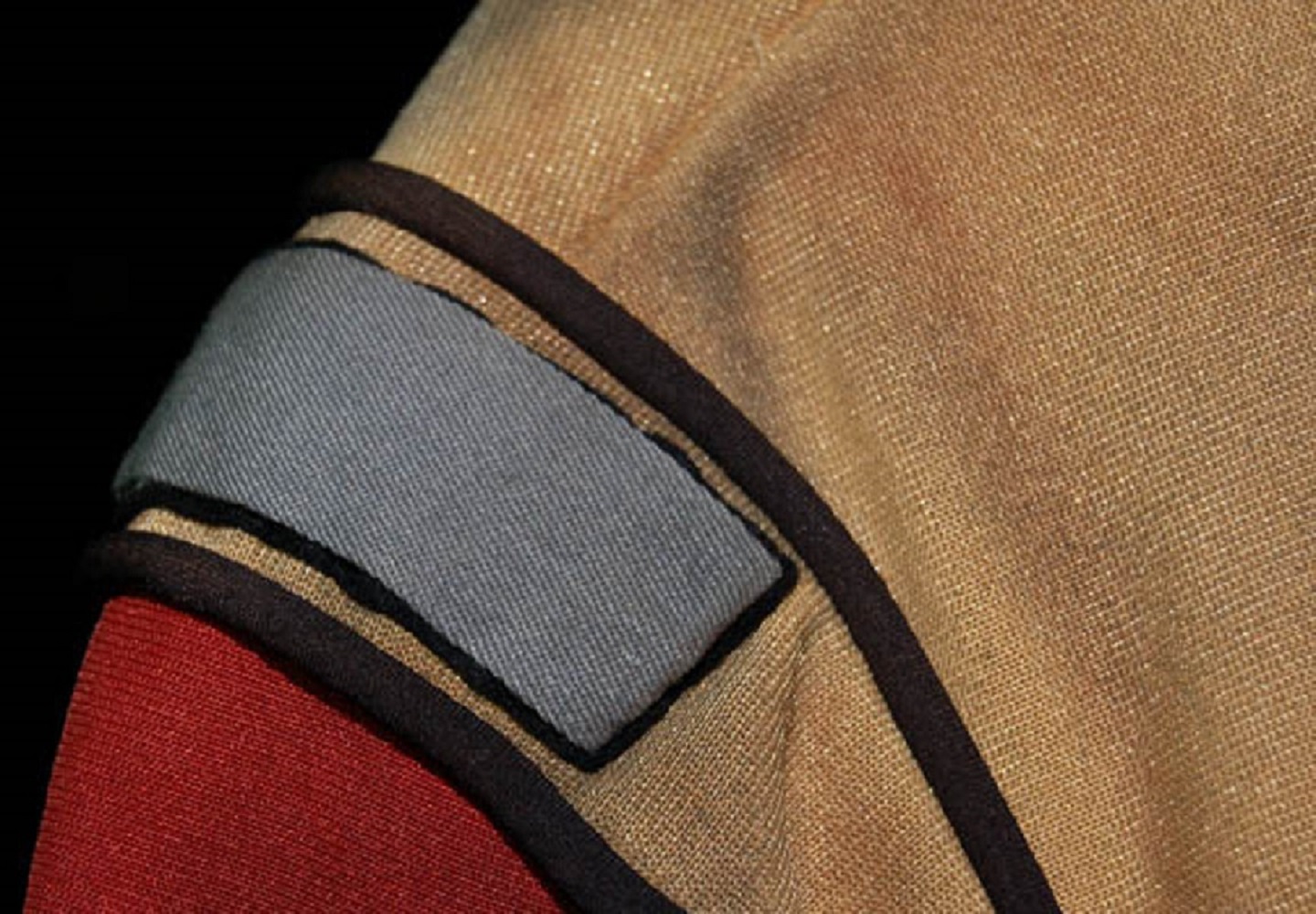
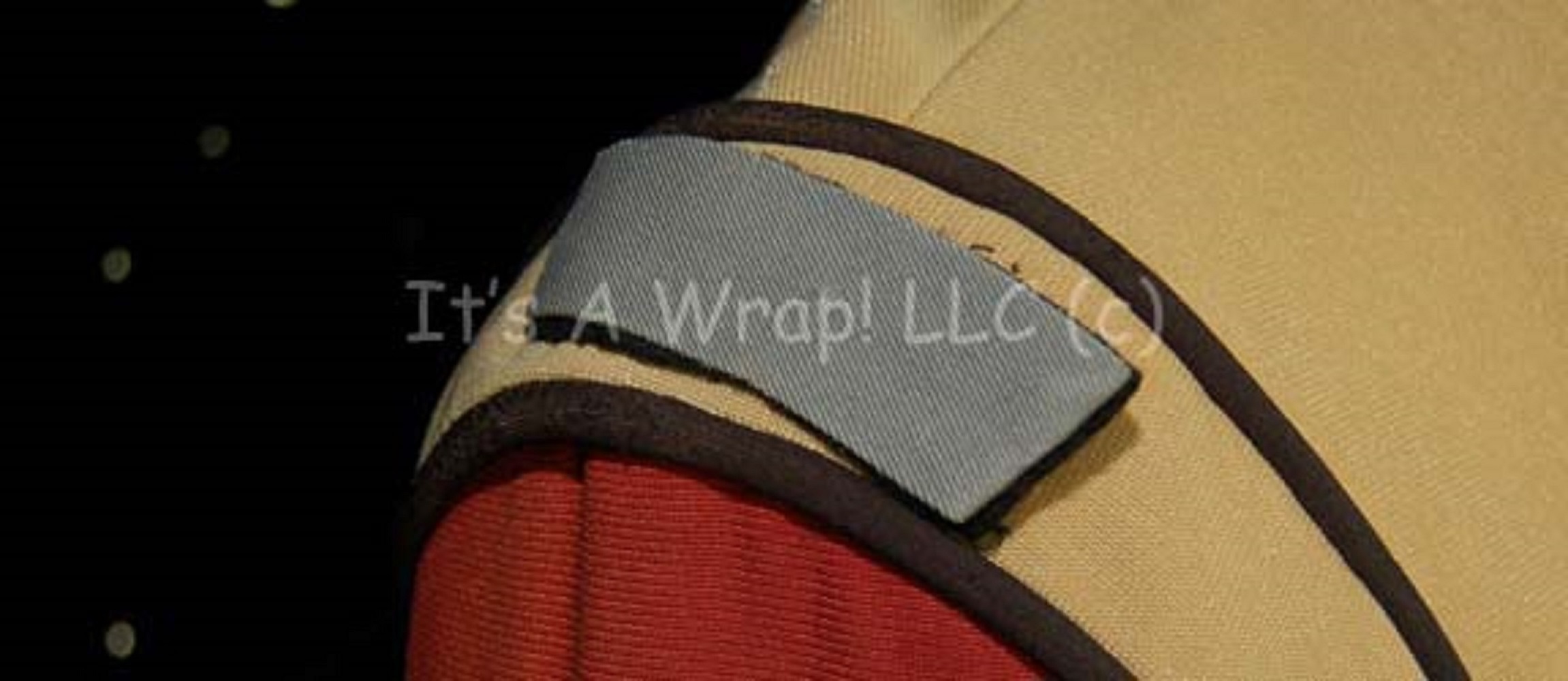
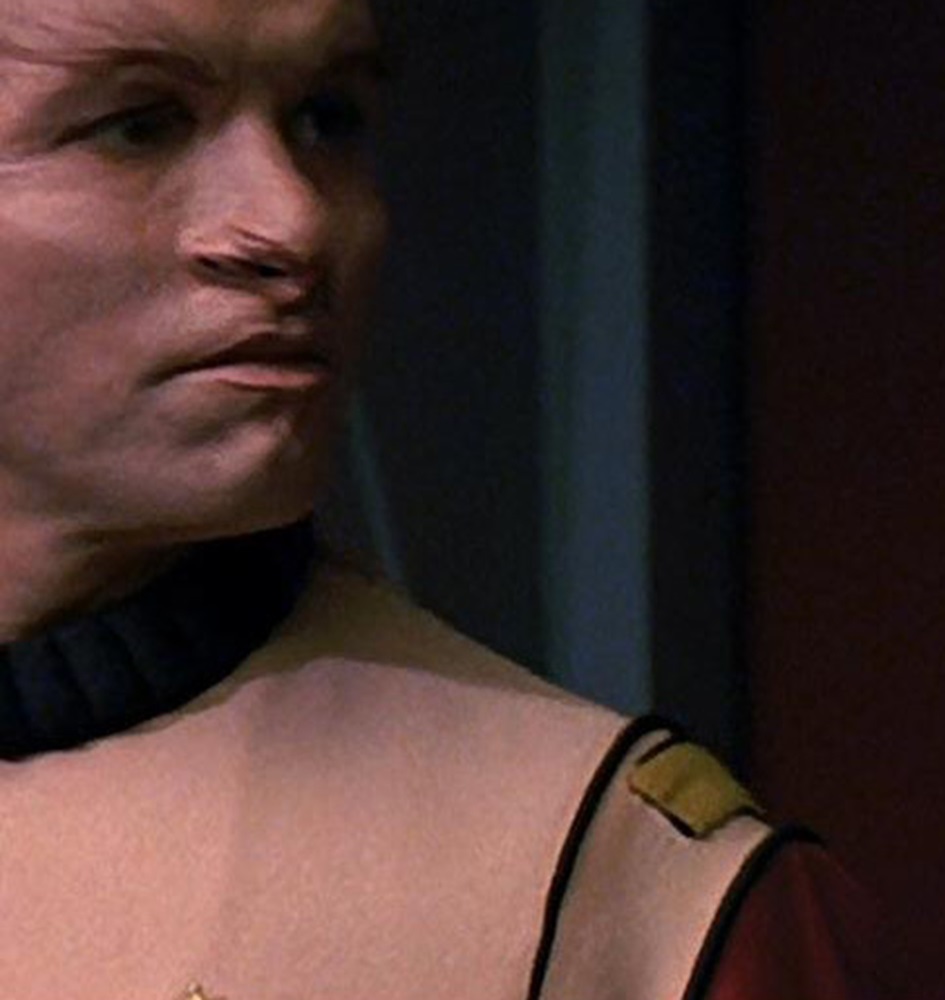
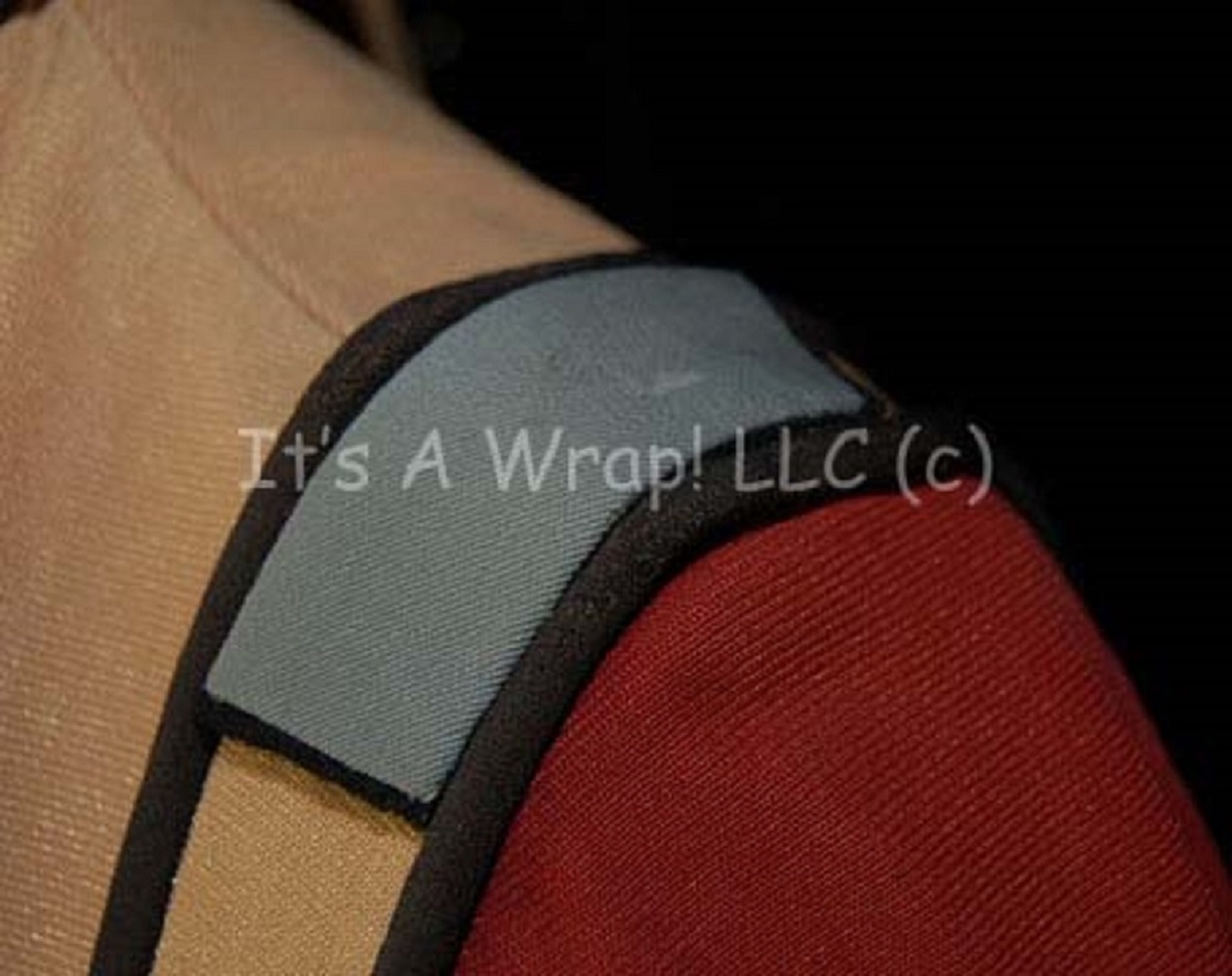
Both the enlisted trainees and crew members wore division-colored shoulder tabs, which were another “echo” of the TMP uniforms.
Like their predecessors, these shoulder tabs were usually division-colored wool gabardine over a black felt base.
These division-colored wool areas were usually ⅞” wide, with 1/16” of black felt extending outward from underneath along each edge.
However, unfortunately this wasn’t an exact science; some tabs clearly had a wider black base:
TWOK-era enlisted jumpsuit auction photos
On the other hand, some had only the tiniest sliver of black visible around the edges:
TWOK-era enlisted jumpsuit auction photos
Some tabs definitely looked better than others; Crewman Dax’s looked terrible.
The division-colored wool appears to have usually been glued to the felt, although the shoulder tab on this particular jumpsuit was clearly edge-stitched into place.
TWOK-era enlisted jumpsuit auction photo
On the jumpsuits, the tab was centered between the two lengths of black piping at the shoulder seam, usually with a little bit of room to spare on each side.
However, the actual widths of the outer yoke extensions seem to have varied; on some jumpsuits there was barely any room for the tab at all.
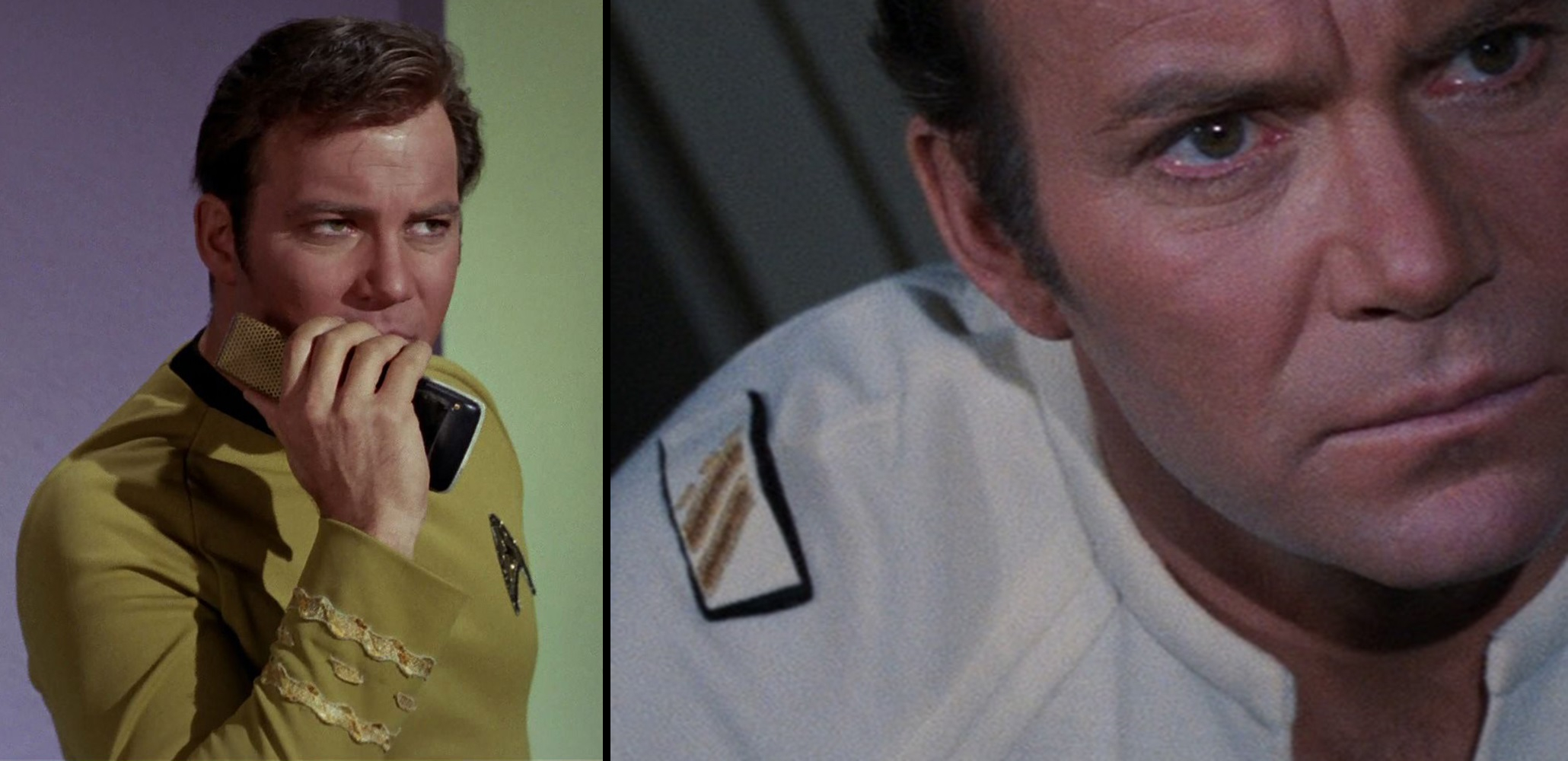
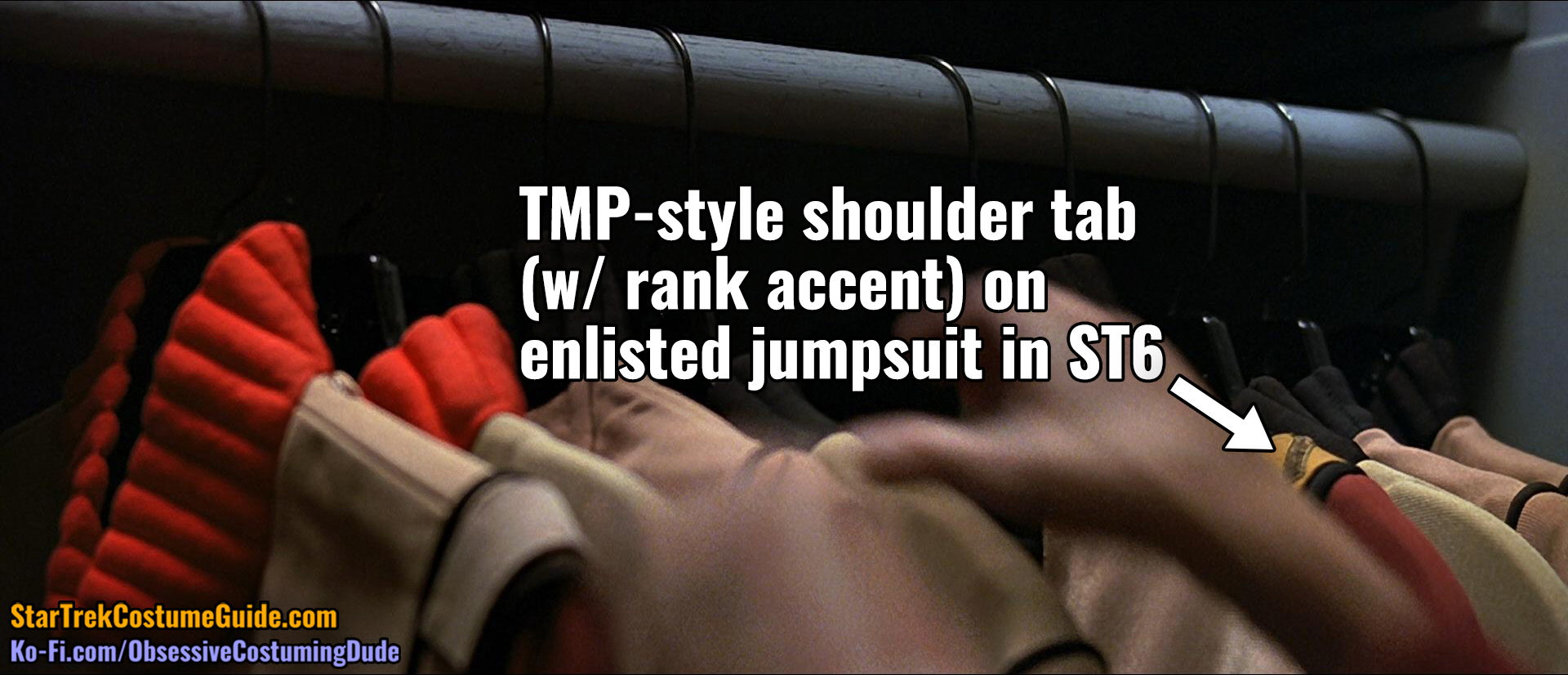
In The Motion Picture these shoulder tabs also showed the wearer’s rank, mostly using the same schema seen in The Original Series.
On the TWOK-era enlisted jumpsuits the shoulder tabs were plain … although there was a random TMP “hiccup” in this shot from ST6!
Body Panels
The enlisted jumpsuits had fourteen body panels, not including the collar, sleeves, and center back panel:
Front yoke
Back yoke (x2)
Outer yoke extension (x2)
Upper center front
Lower center front pant legs (x2)
Side front (x2)
Side back (x2)
Center back (x2)
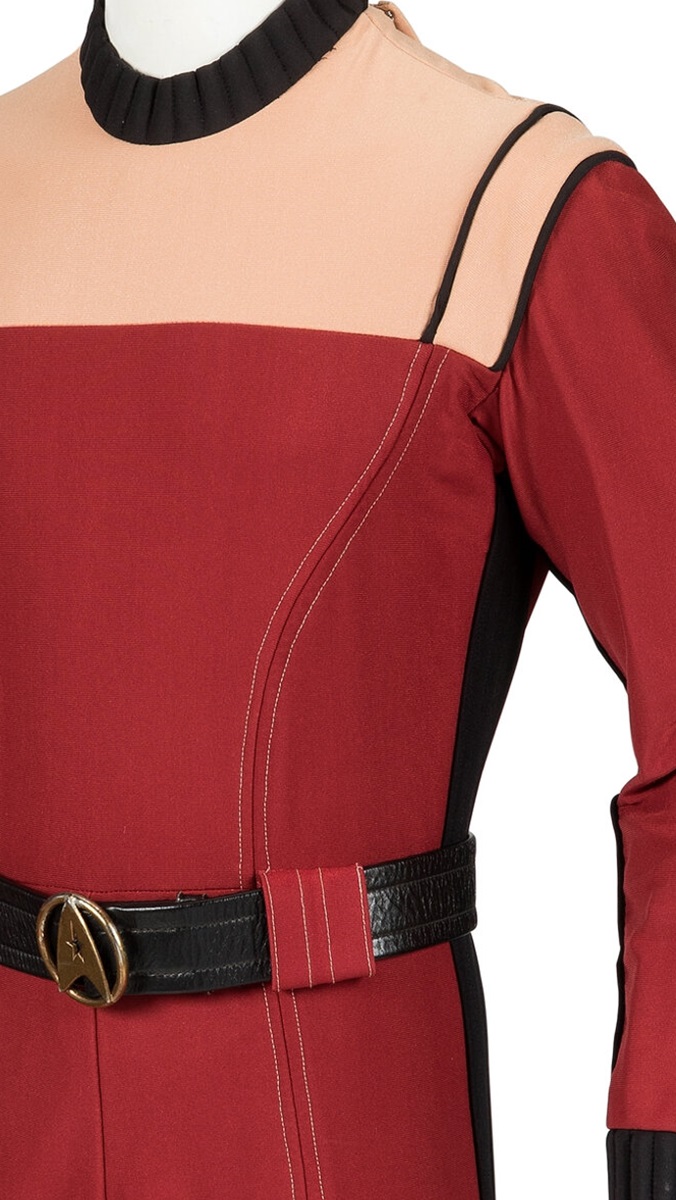
The upper front panel and lower front pant legs were sewn together at the front waist, although the seam was mostly covered by the belt when worn.
The side front and side seams extended all the way from the shoulders to the lower pant leg cuffs.
These seams narrowed toward the waist and curved outward toward the fullness of the chest, just like “princess seams” normally do – except instead of curving into the armscye seams like conventional princess seams are typically patterned, they curved back upward again toward the yoke.
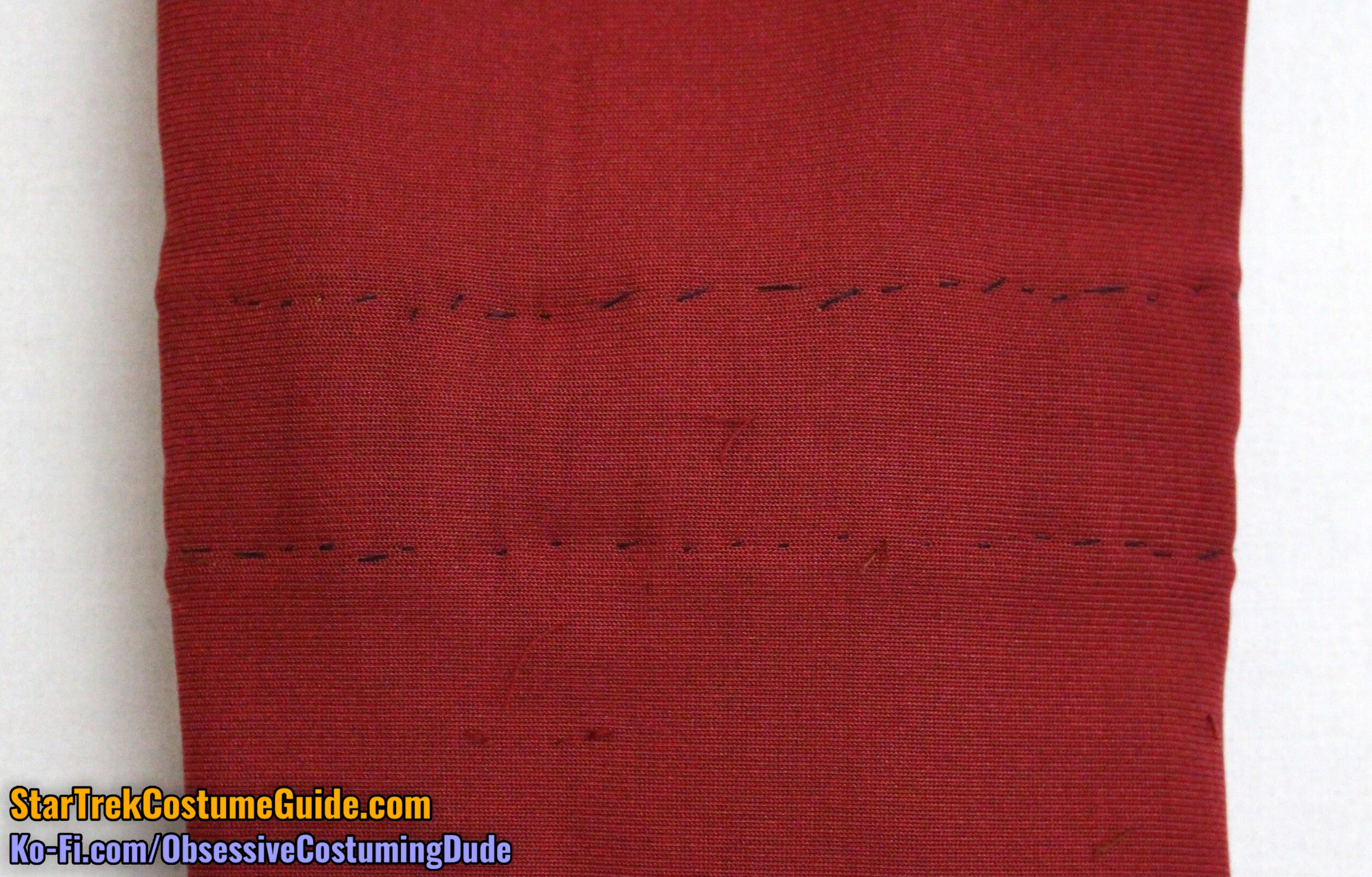
These seam allowances were pressed open and topstitched into place approximately 3/16” to ¼” from the seam lines using a lighter, contrasting thread.
The topstitching looked great and added some visual interest, but I do wonder to what degree this original effect was intentional.
When fabric dyeing to a target color, it’s ideal to start with fabric that’s white, or as close to white as possible.
If the white (cream) TMP jumpsuits were overdyed to the enlisted red color using acid dyes, the nylon jumbo spandex would take the dye, but the polyester topstitching thread wouldn’t; it would remain the original color – possibly tinged with a little bit of unbonded red that didn’t wash out.
Here are some other photos of the presumed dye tests; observe how the nylon spandex is solid red, but the topstitching thread remained its original color:
An inconsistent detail with these jumpsuits is the alignment (or lack thereof) between the side front/side back seams and the black yoke piping.
Sometimes the black piping was noticeably offset from the side front/side back seams:
TWOK-era enlisted jumpsuit auction photos
Sometimes the piping was flush (or nearly flush) with the inner row of topstitching:
On some jumpsuits, the piping was nicely aligned between the body seam and the inner row of topstitching.
Sometimes the black piping was more or less centered over the body seam.
And on other jumpsuits, the piping was aligned between the body seam and outer row of topstitching.
TWOK-era enlisted jumpsuit auction photo
Even on the screen-used enlisted jumpsuit I examined, these alignments were inconsistent; on one side the piping was aligned between the body seam and inner row of topstitching (my preference), but on the other side it was aligned between the body seam and outer row of topstitching.
Given the range of alignments, I don’t believe there ever was an “official standard” … it’s not difficult to imagine a wardrobe department hacking the tops off dozens of TMP jumpsuits and slapping these yokes onto them any which way they could in a mad production rush.
As I mentioned, the piping between the body seam and inner row of topstitching is my “ideal” standard.
In any event, thick black stripes were added to the sides of the overdyed TMP jumpsuits.
These black stripes ran down the underside of the sleeve as well.
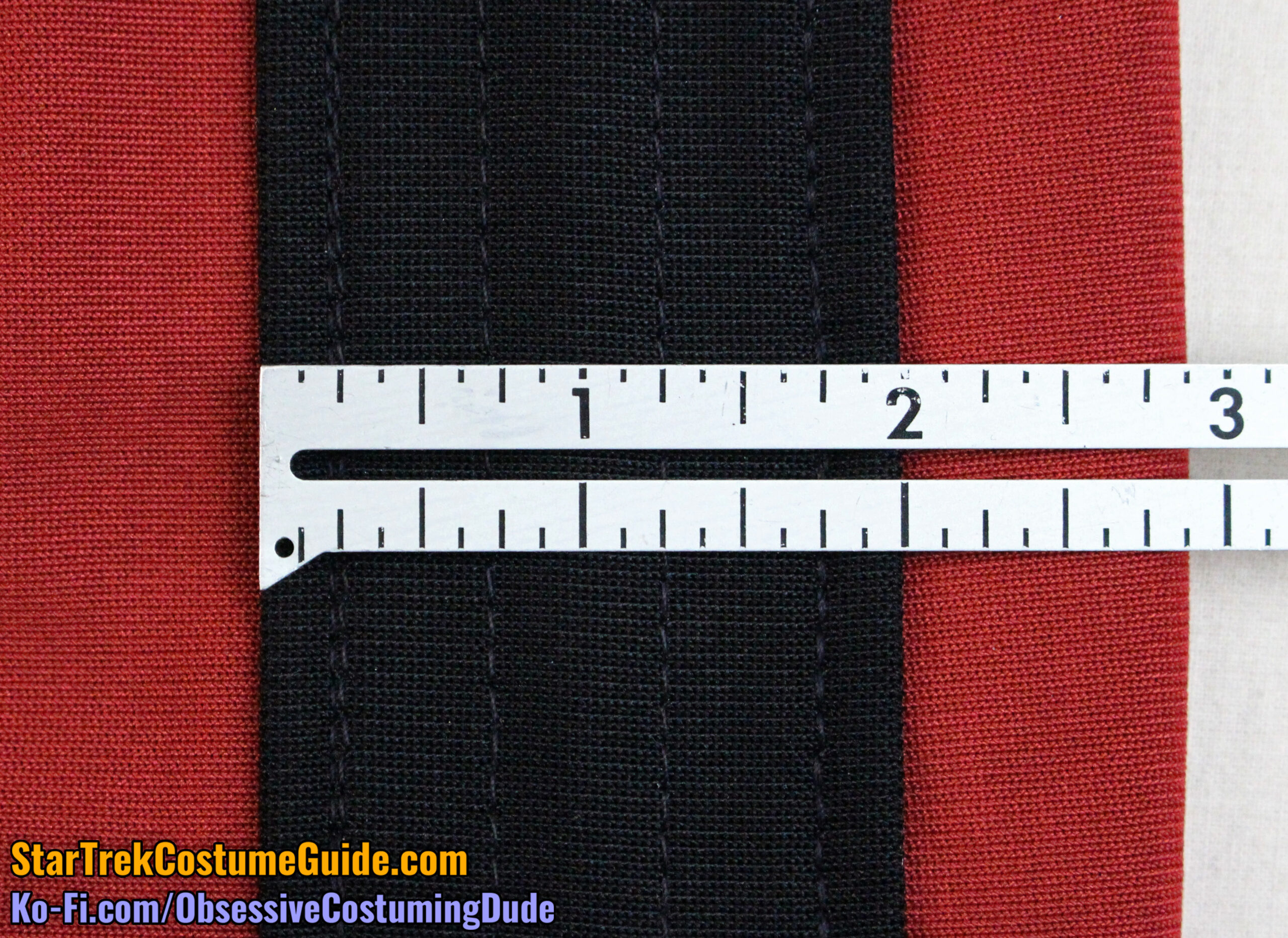
These stripes were 2” wide and made of black jumbo spandex.
They had four rows of matching black topstitching in similar proportions to the stripes on the officers’ trousers, albeit with no division stripe.
The black stripes on the jumpsuit body and sleeves were separate pieces, which met at the underarm.
Body Extensions
There was another production “hack” we were probably never meant to notice …
WARNING: YOU MAY NOT EVER BE ABLE TO UNSEE THIS!
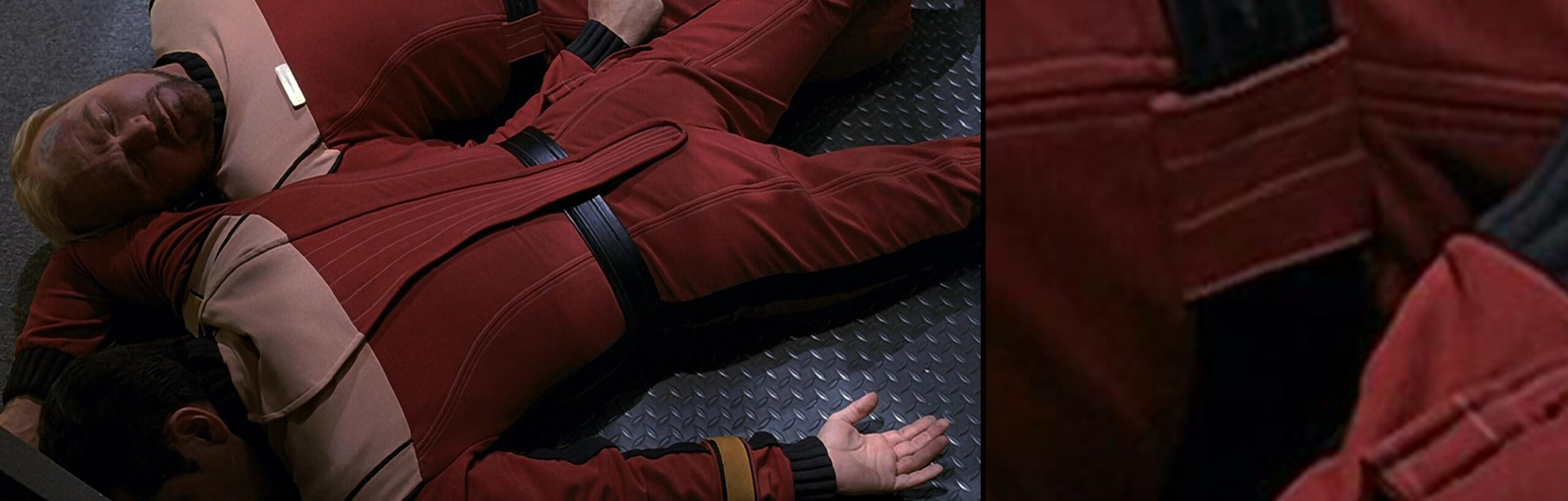
One of the caveats of jumpsuits is that once they’re made, the torso can’t be lengthened or shortened unless there are horizontal (or horizontal-ish) seams to take in or let out.
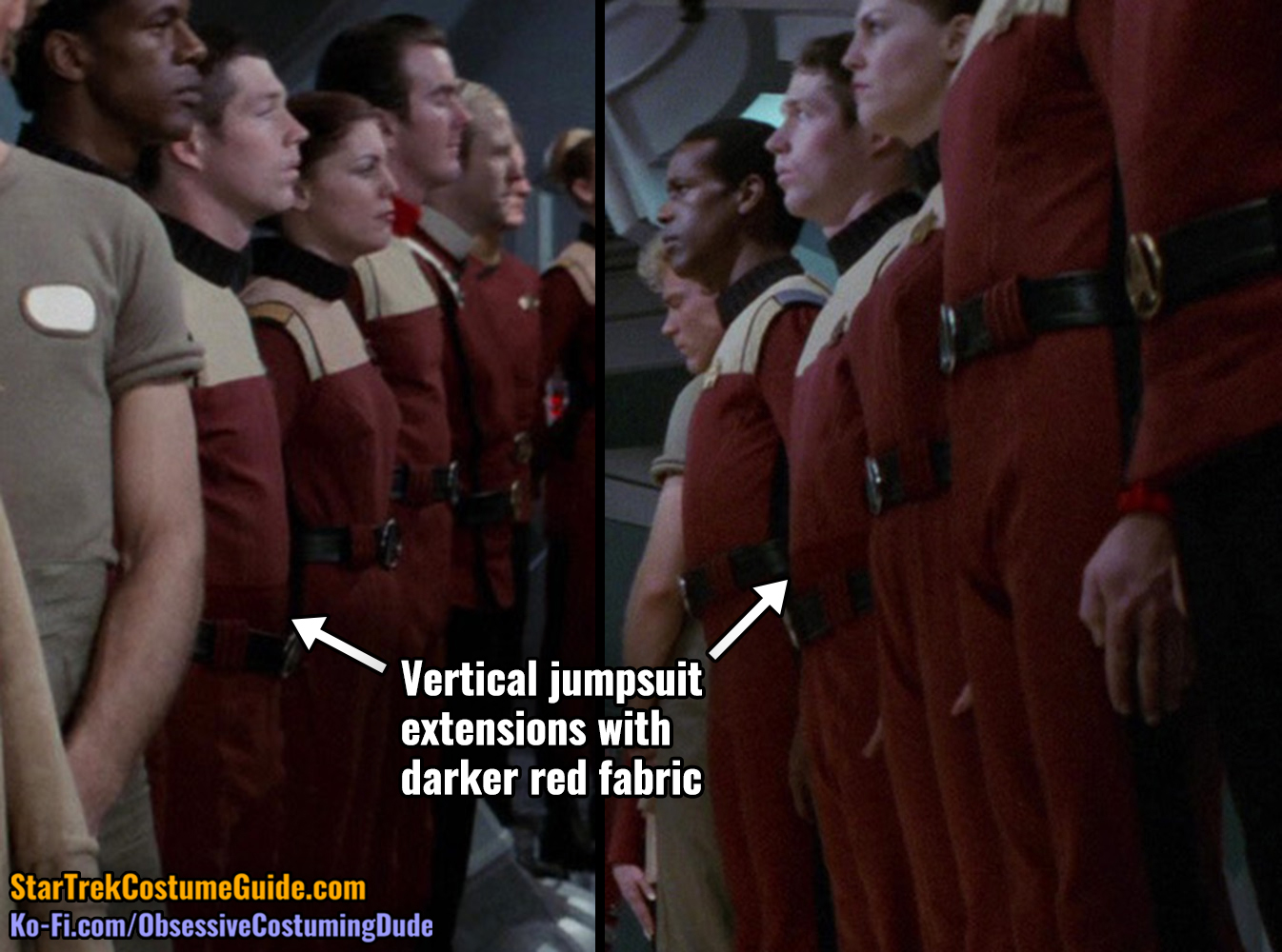
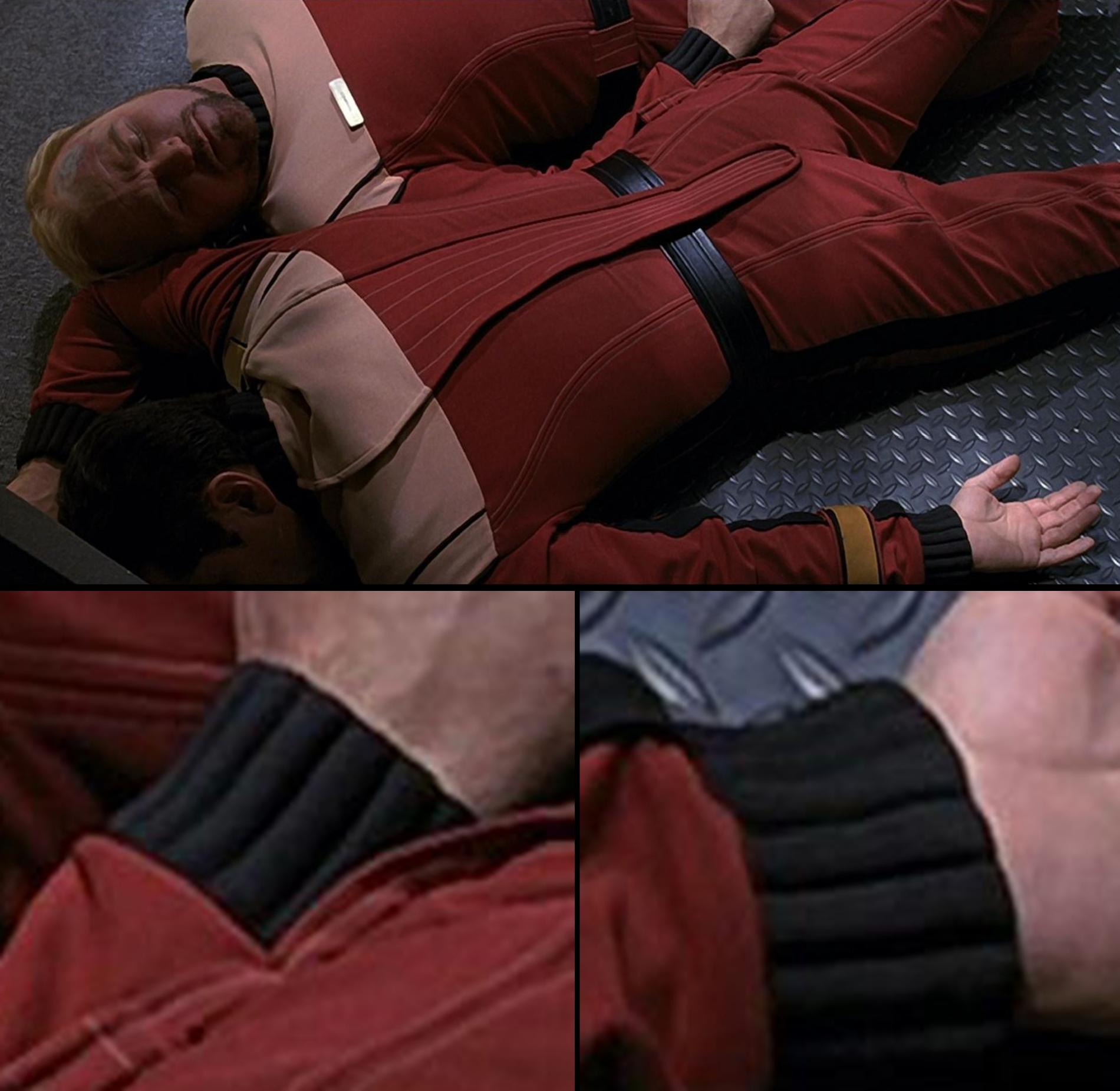
The only other way to extend them is to actually cut the jumpsuit into two pieces, insert a horizontal panel extension, then sew it back to together – which is exactly what was done on several of these enlisted jumpsuits.
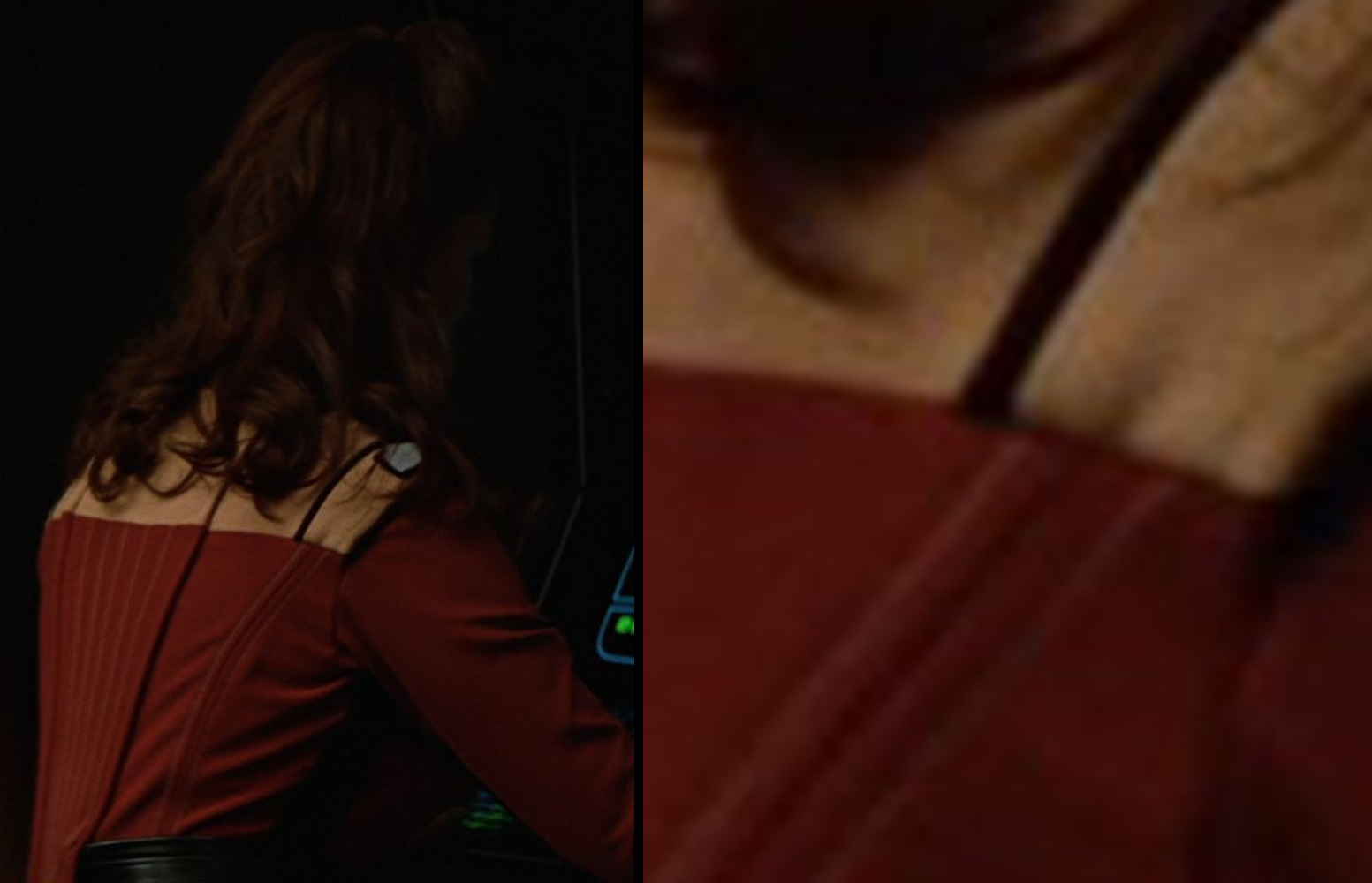
The thing is, the body extensions were cut from darker red spandex that clearly didn’t match the rest of the jumpsuit!
TWOK-era enlisted jumpsuit auction photos
This appears to have been the same darker red spandex used for the belt loops and some of the back panels.
TWOK-era enlisted jumpsuit auction photos
And yes, some of these unsightly extensions were visible in the movie, if one looks closely enough …
Belt Loops
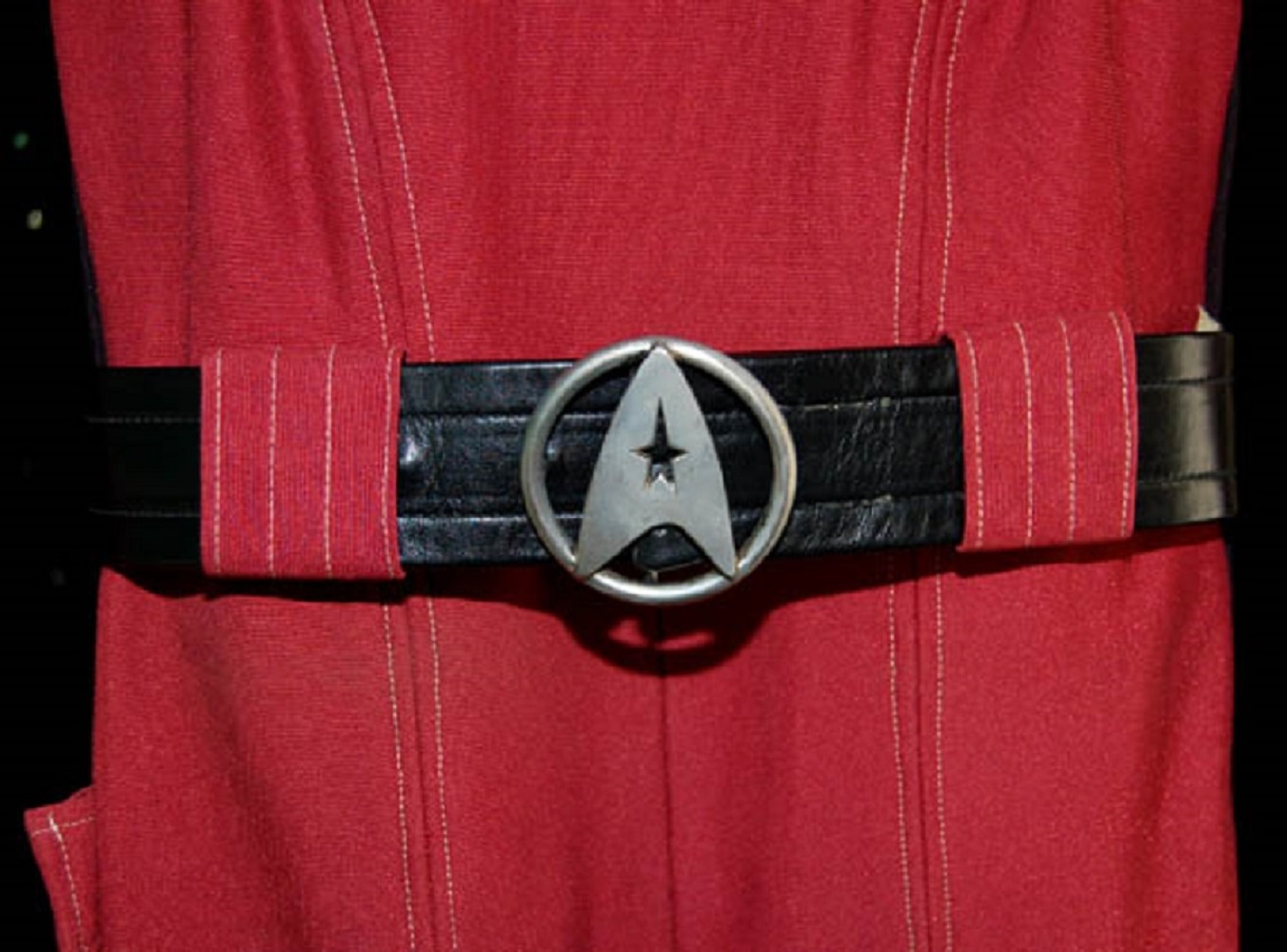
The enlisted jumpsuits were worn with belts – technically unnecessary for a jumpsuit, but I think these accomplished two things:
First, they helped make the enlisted uniforms look more analogous to the officers’.
Second, and on a more practical level, they hid the front waist seams that were covered by the “perscan” devices in The Motion Picture.
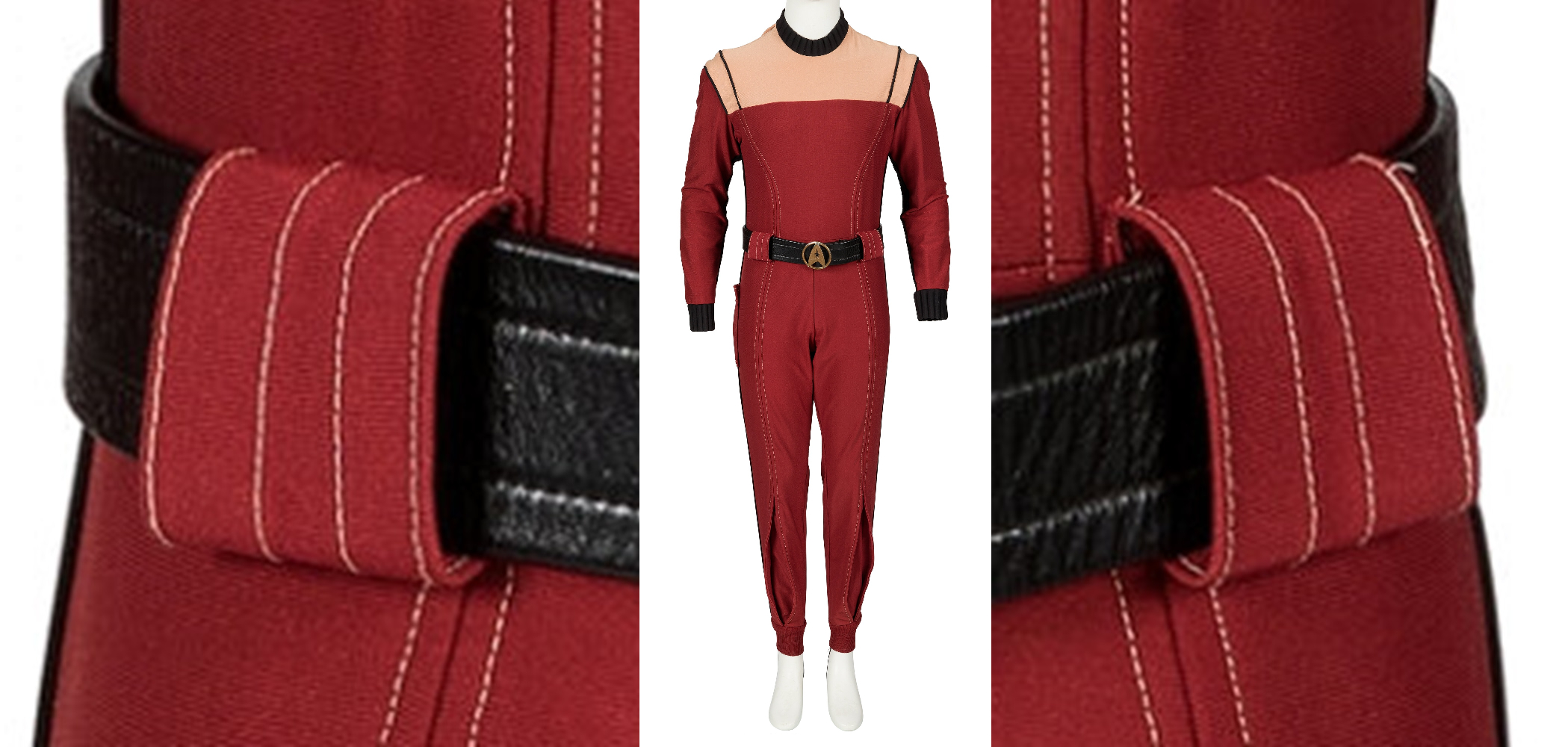
Two belt loops were added to the front to help keep the belt in place.
The inner edges of these belt loops were vertically positioned slightly above the waist seam, and horizontally flush with the side front seams at the waist.
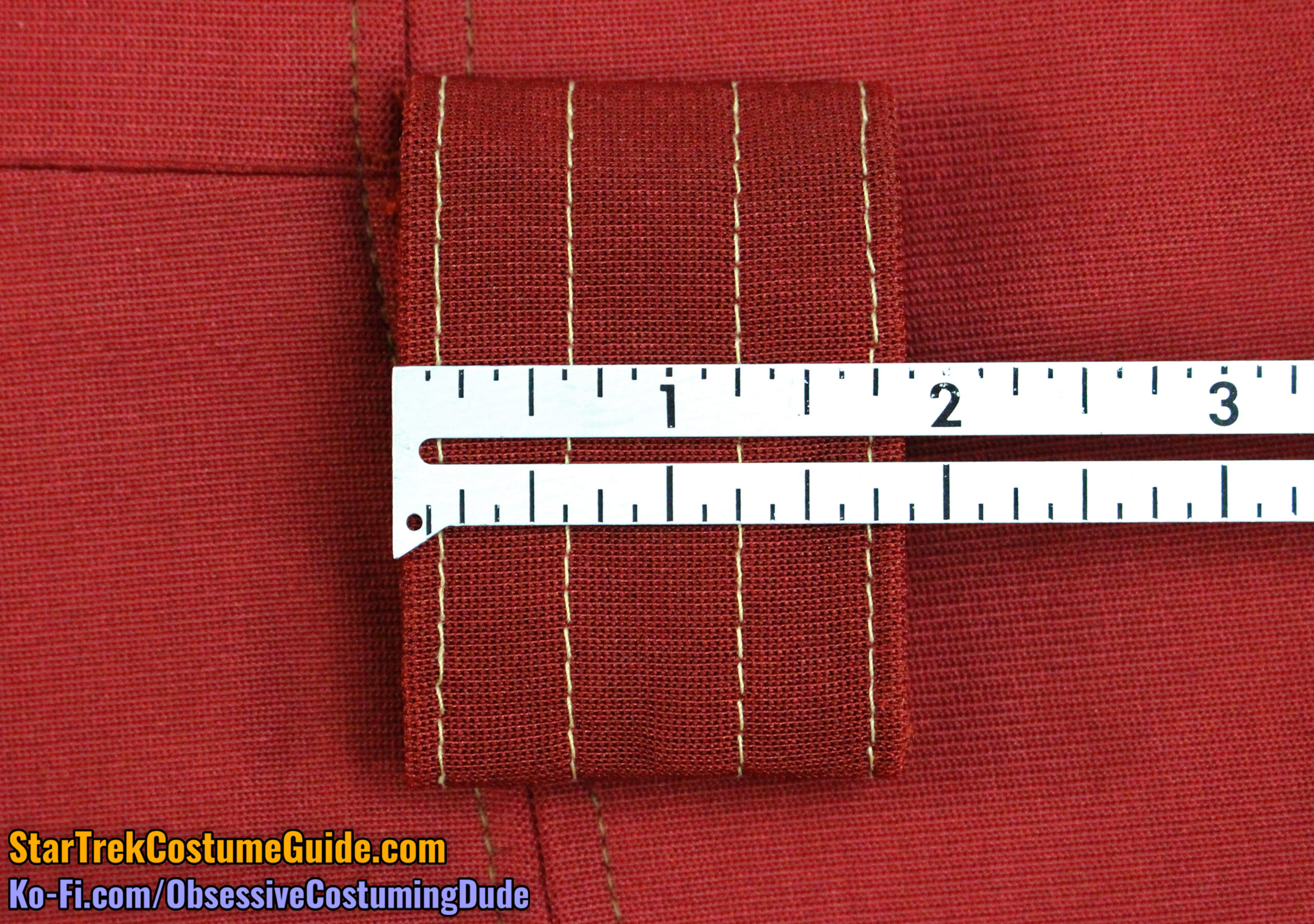
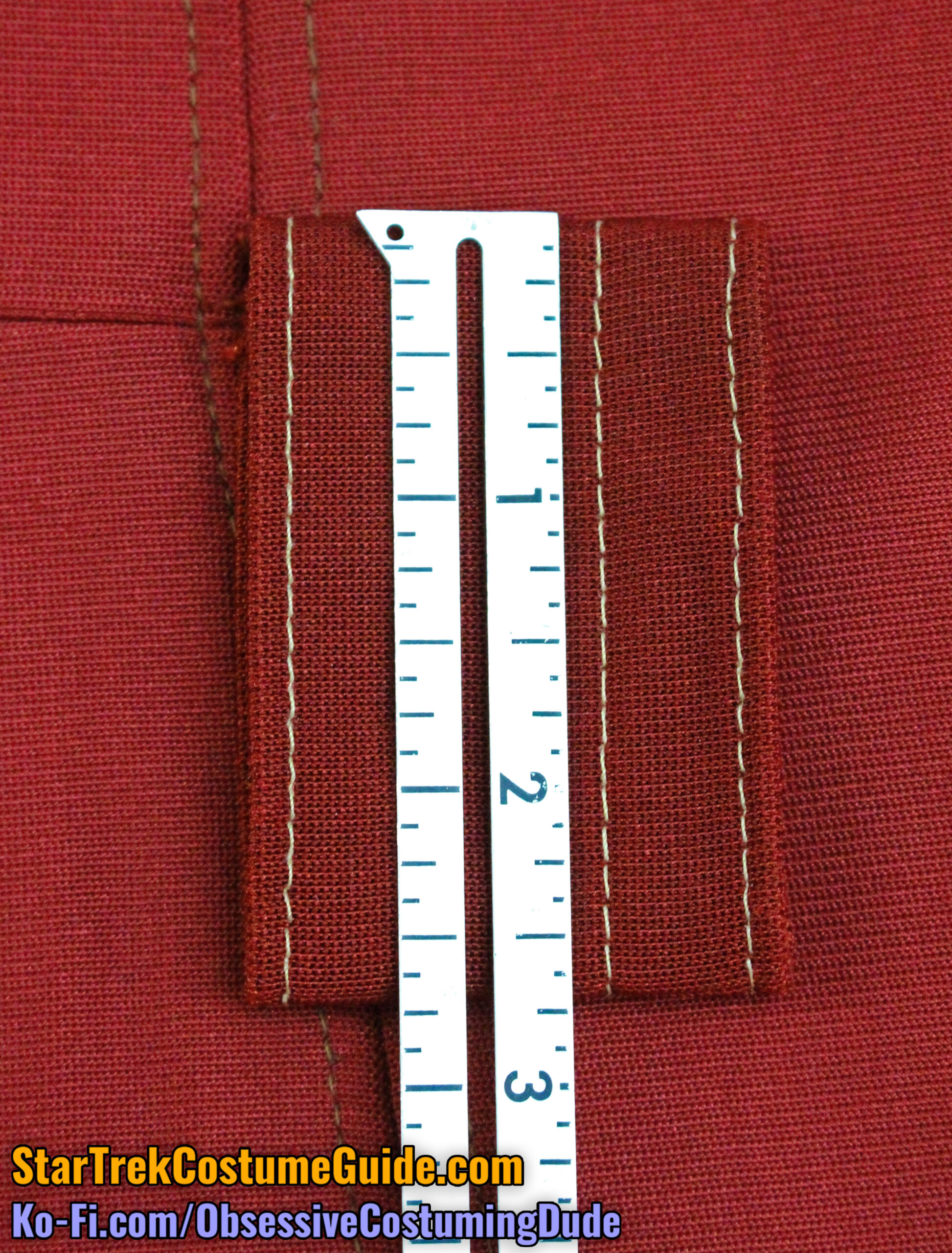
On the screen-used enlisted jumpsuit I examined, the belt loops were 1 ⅞” wide and 2 ¾” tall.
The loops were topstitched in contrasting lighter thread ⅛” from the outer edges, and ½” inside those (⅝” from the outer edges, with ⅝” between the two centermost rows of stitching).
The topstitching on this jumpsuit’s belt loops appears to have been similarly proportioned:
TWOK-era enlisted jumpsuit auction photo
However, the belt loop stitching was (again) somewhat inconsistent on the original uniforms.
The belt loops were long rectangles of fabric, with the long edges folded under and secured by the topstitching.
The short ends were sewn together about ¼” from the edges, and the belt loop was fastened to the jumpsuit with a rectangular “box” of stitching that also enclosed the raw ends.
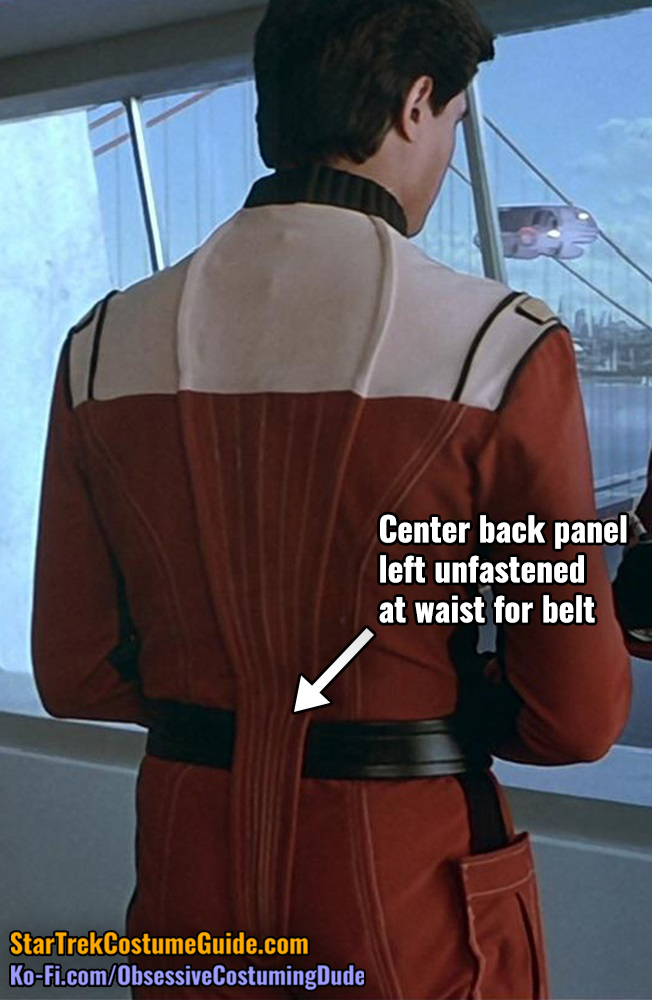
No belt loops were needed on the back of the jumpsuit, because a small gap in the center back panel stitching allowed the belt to be threaded underneath it.
Belt
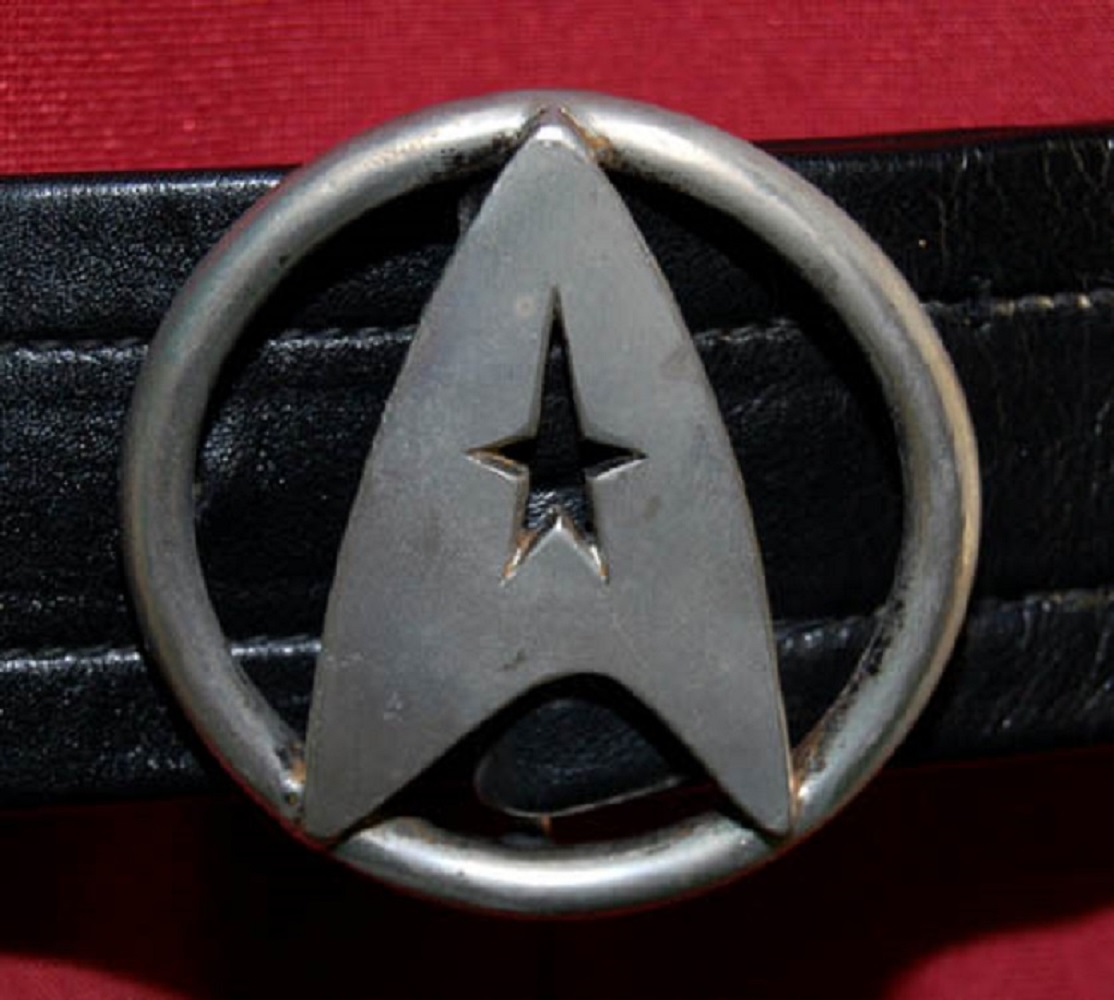
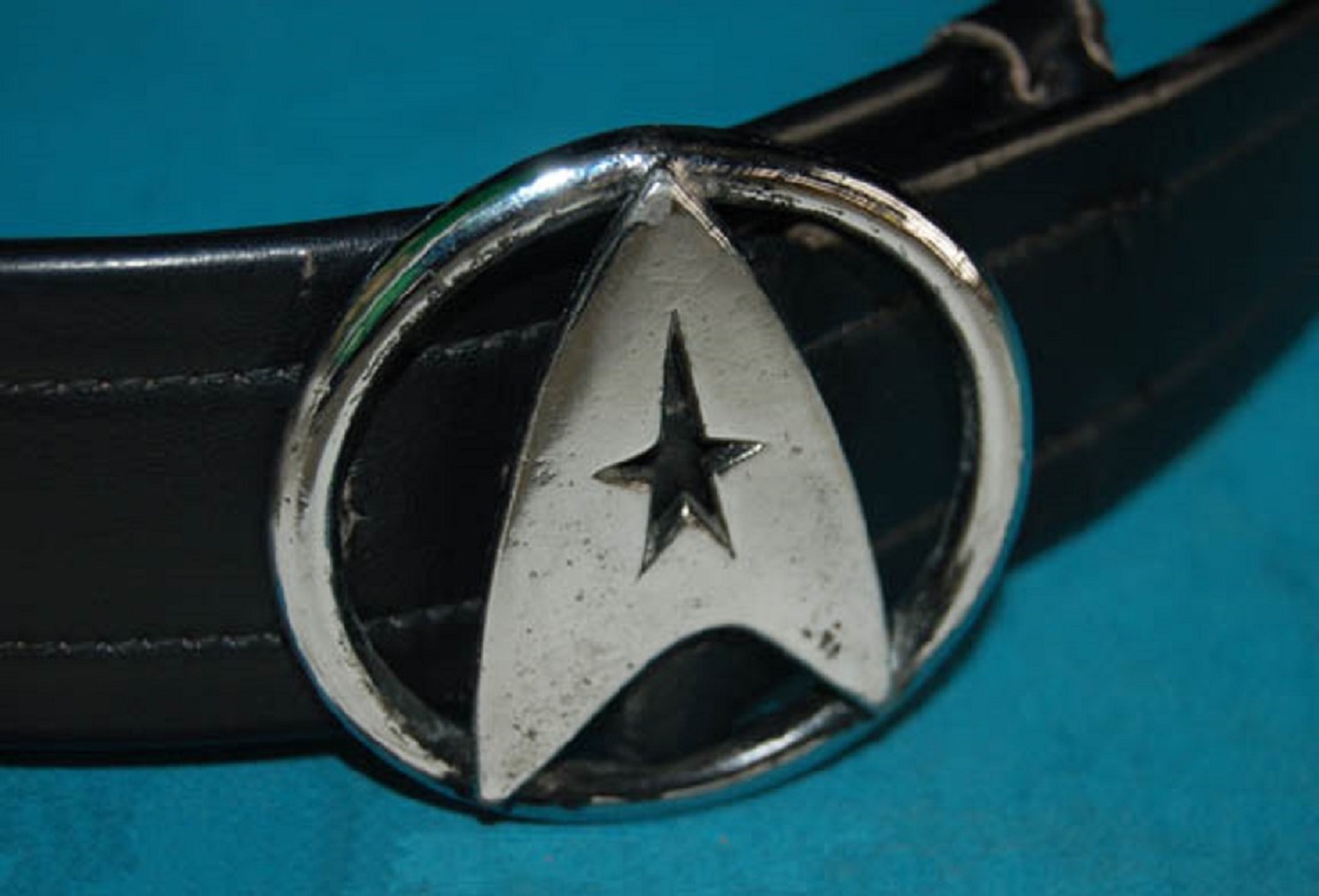
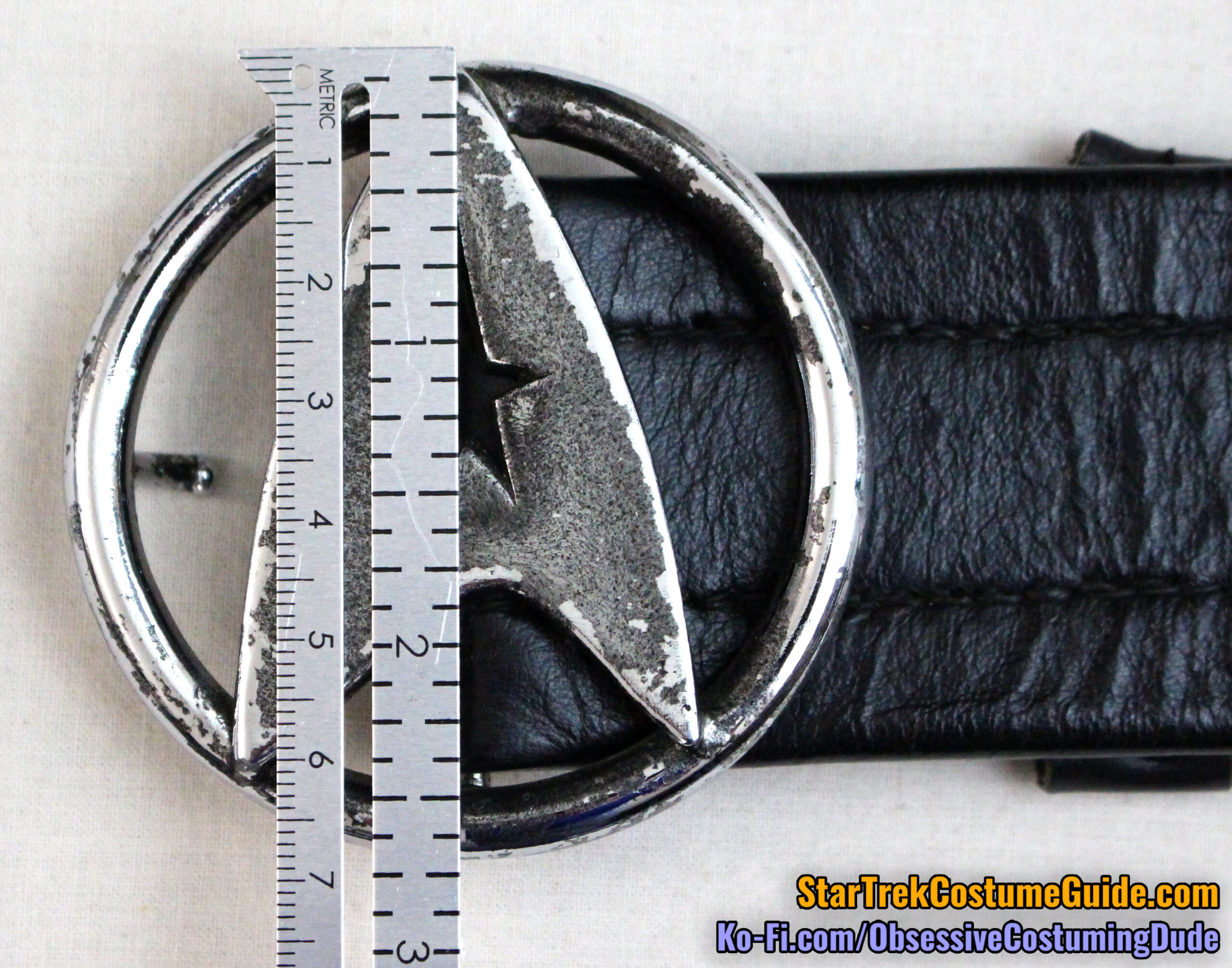
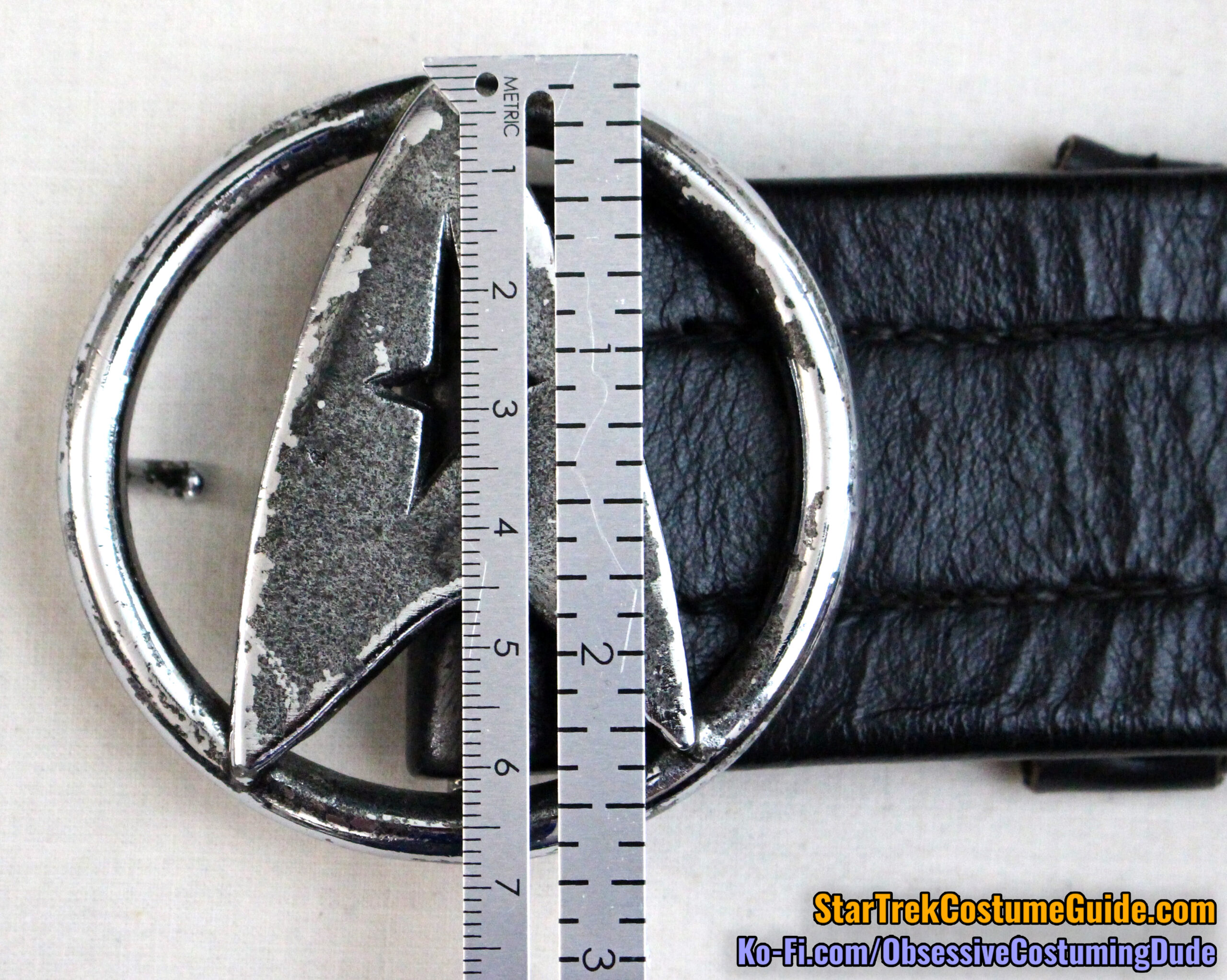
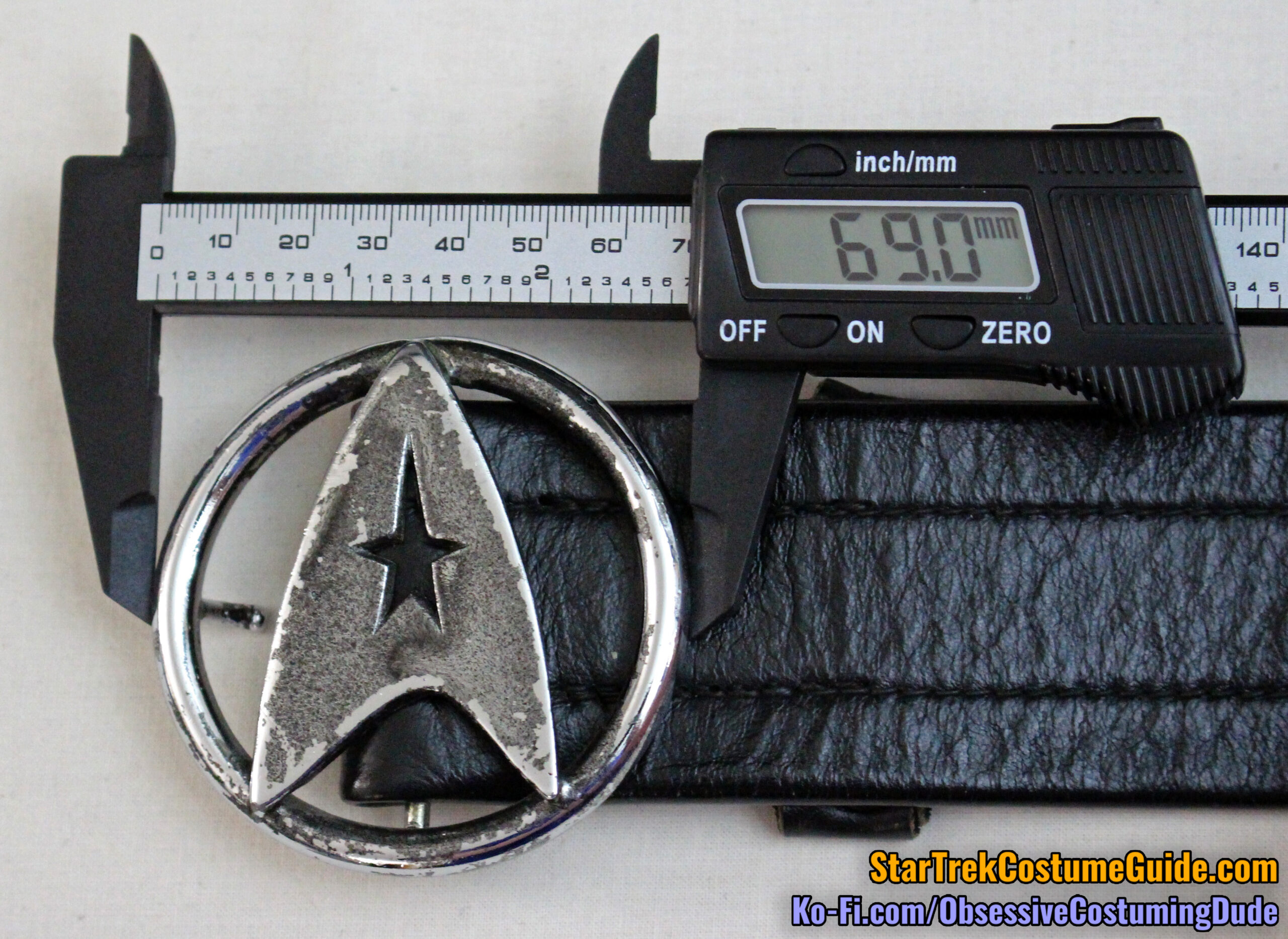
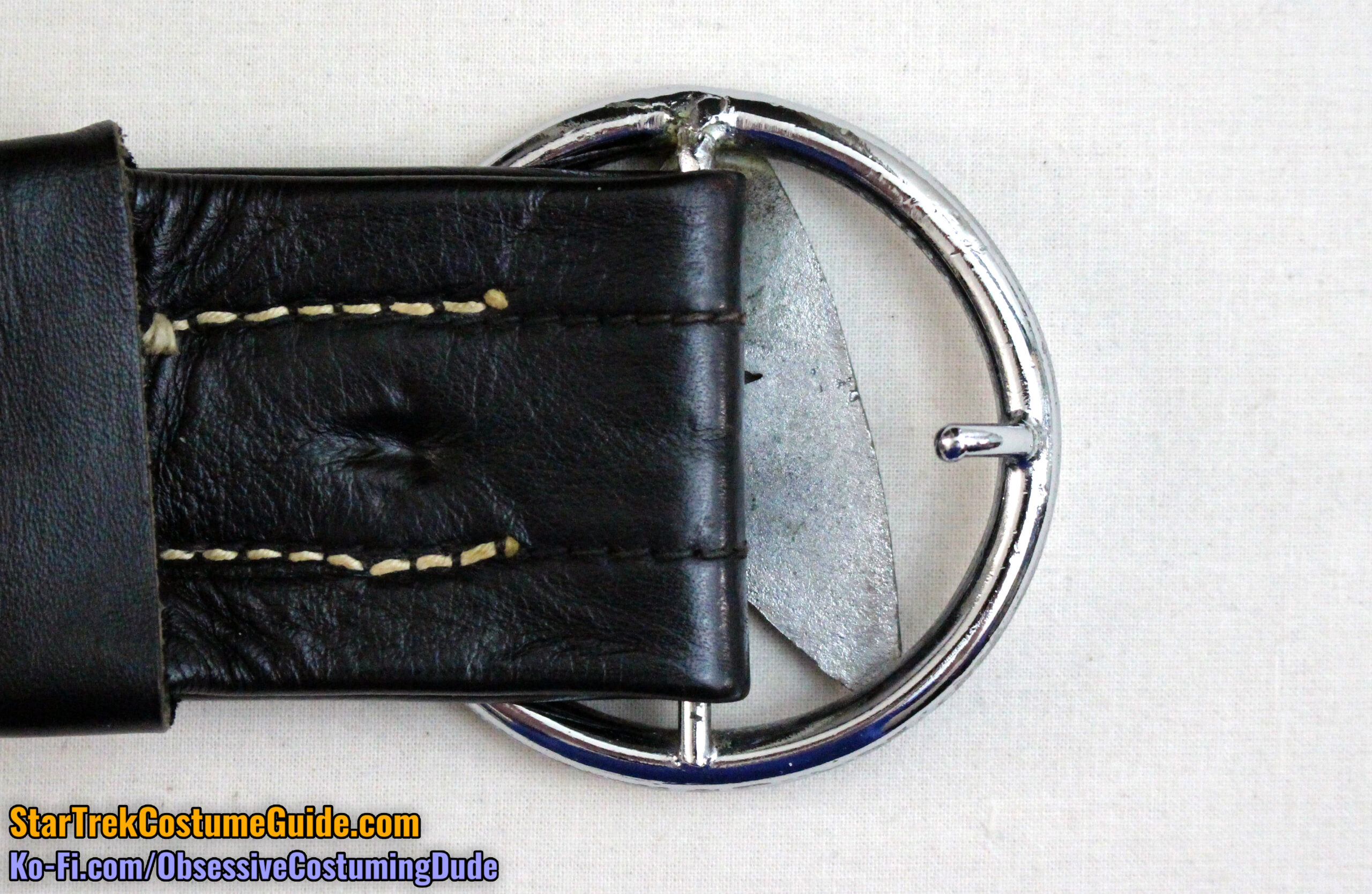
These belts seem to have been identical to the ones worn by the officers, except enlisted crew had silver belt buckles.
The belt buckle I examined was a little under 2 ¾” in diameter, approximately 68-69mm (depending on which implement I used).
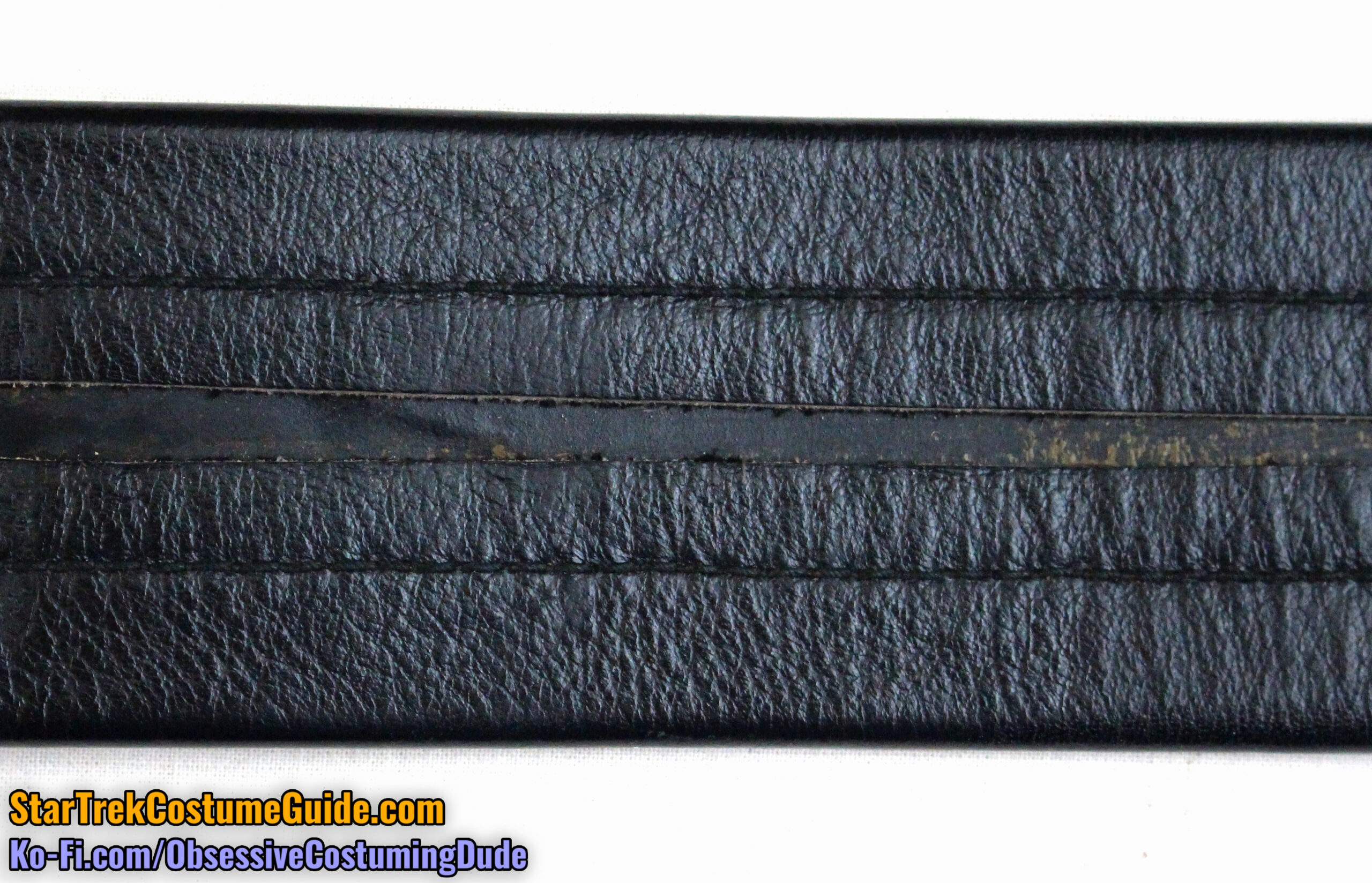
The belt itself was a layer of thin leather wrapped around a length of significantly thicker leather.
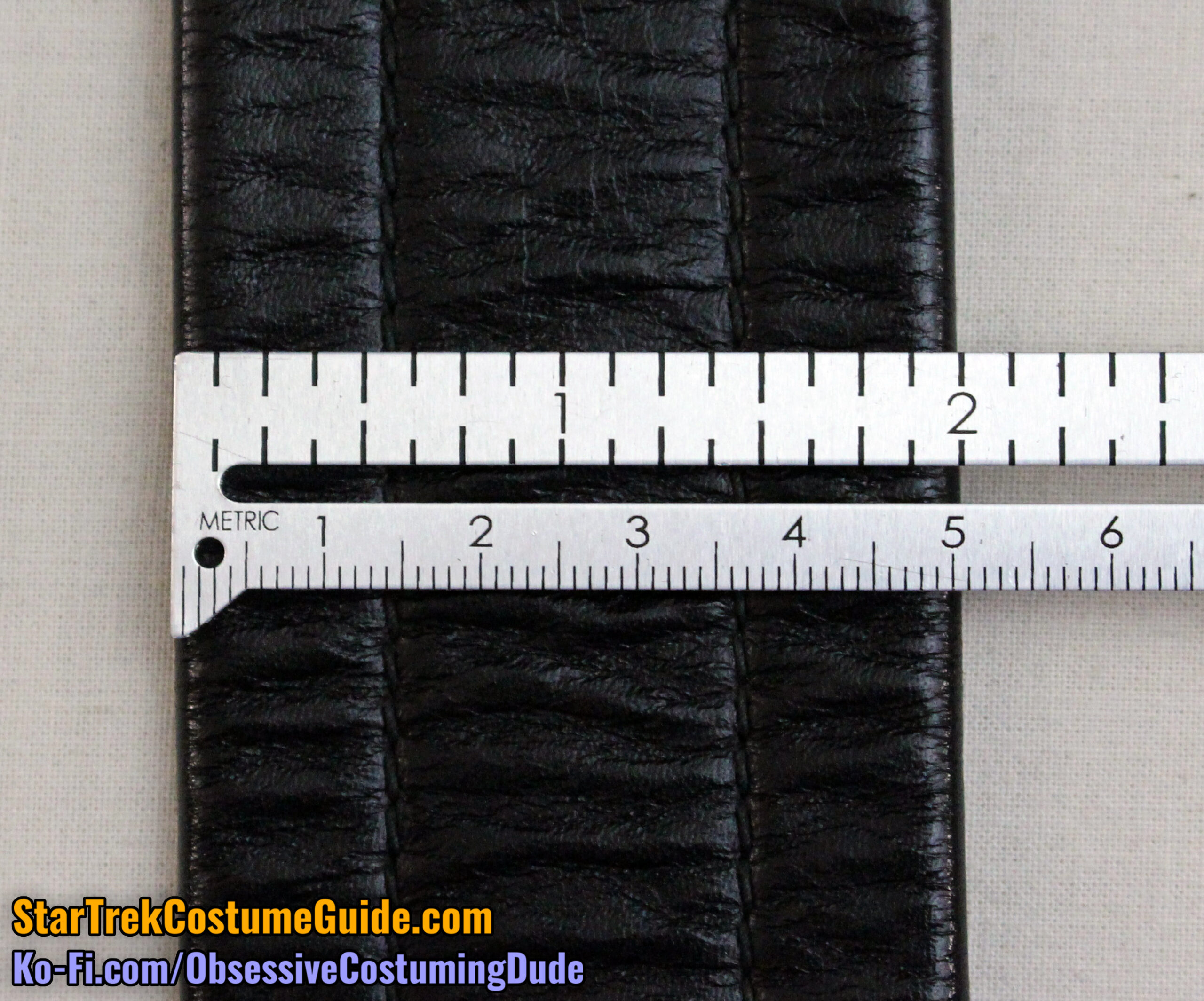
The belt was 2” wide, with rows of topstitching in matching black thread approximately ½” from the upper and lower edges.
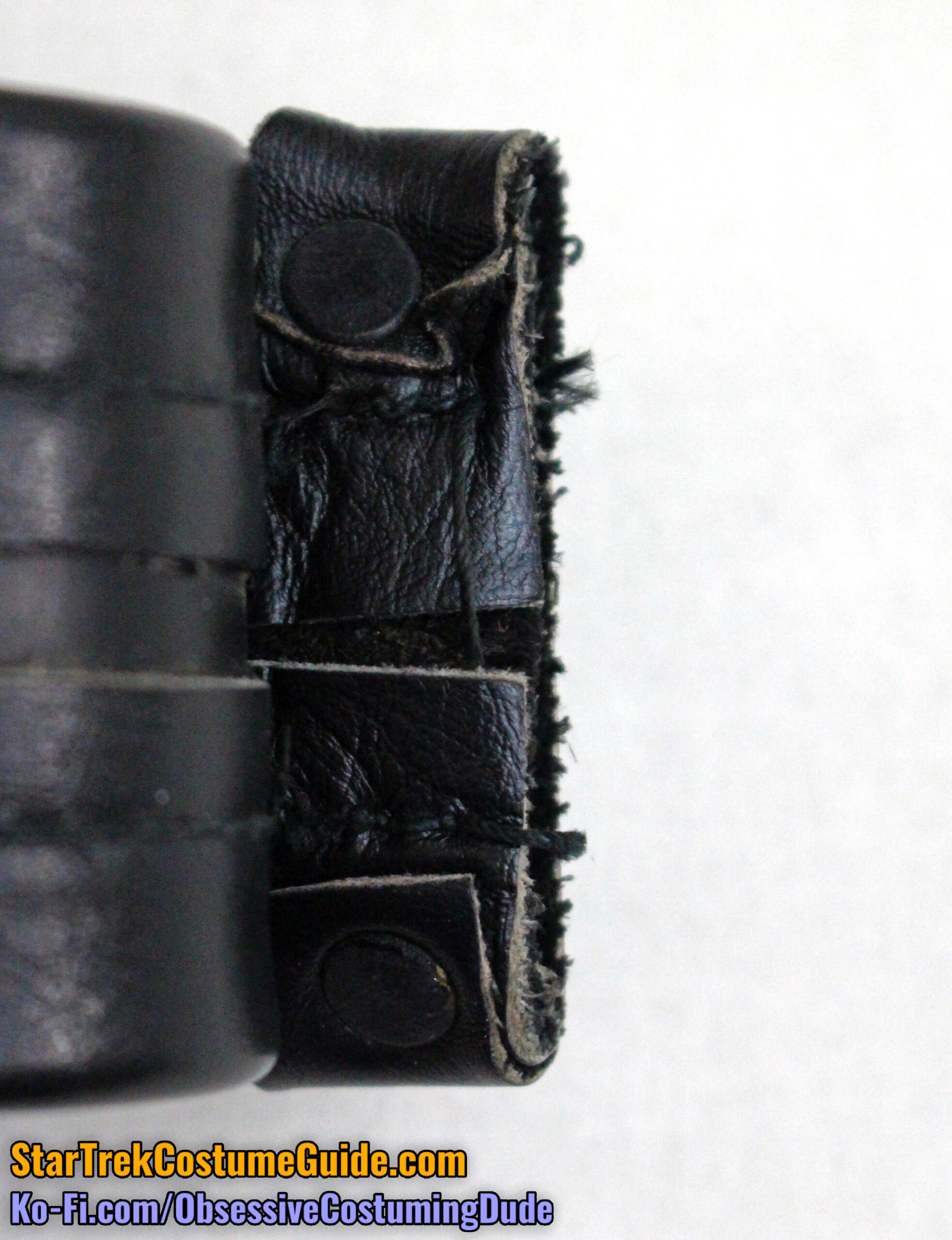
The left front of the belt was wrapped around the center backing bar of the buckle, turned under, and hand-sewn into place.
A narrow loop was attached to the edge of this left front underlap.
This loop was riveted into place.
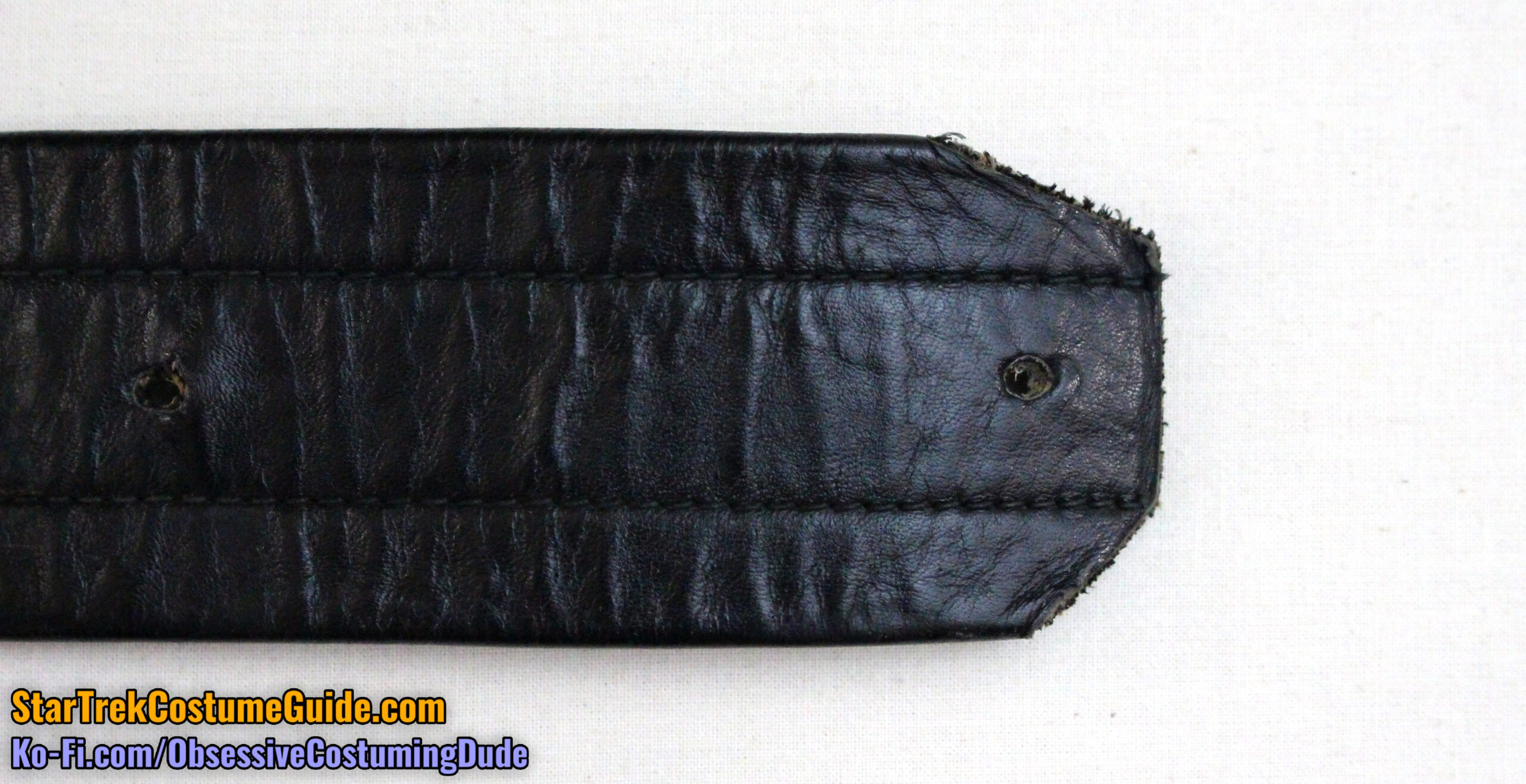
The corners of the right front were diagonally trimmed away, and holes were punched as-needed for the buckle to fasten.
For more photos of the belt and buckle, check out my screen-used enlisted jumpsuit examination.
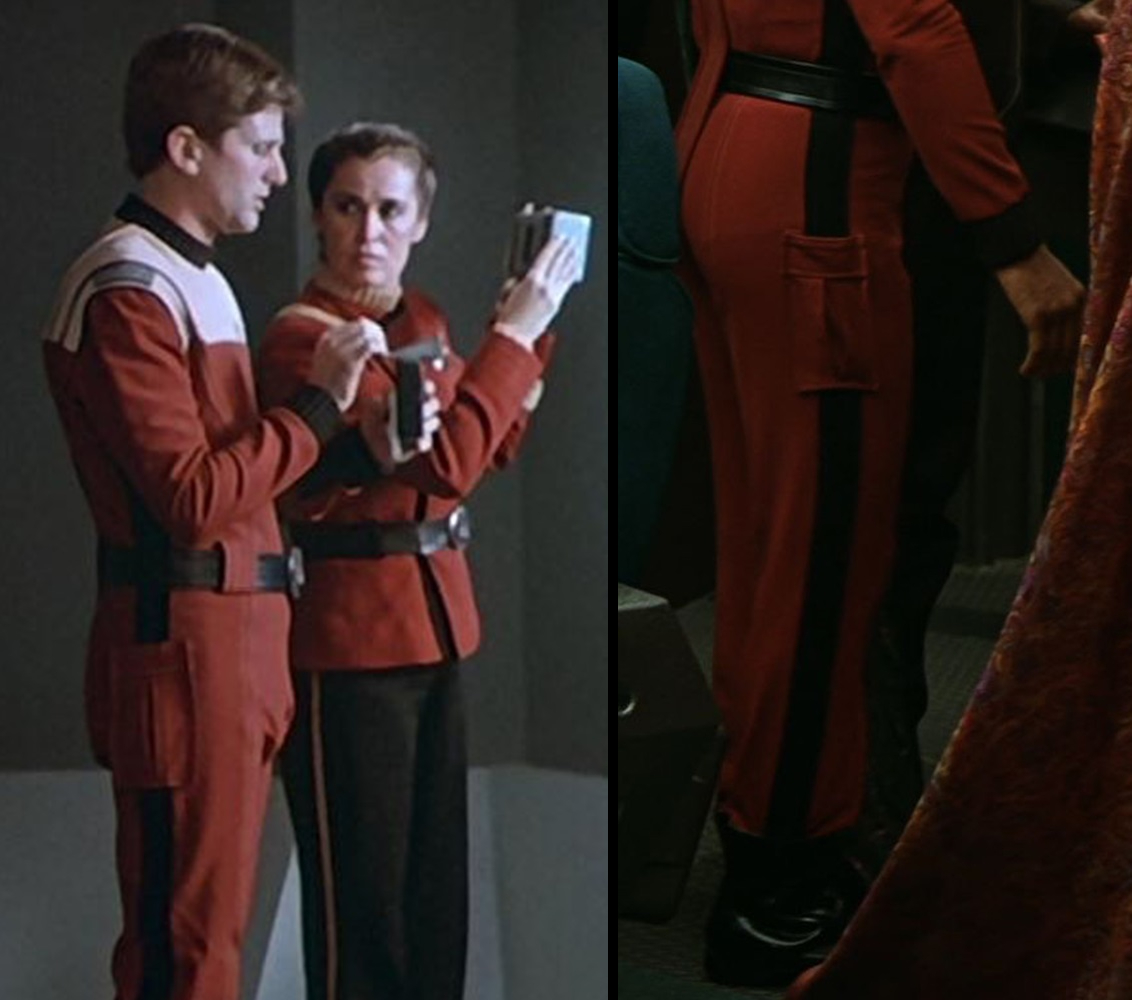
Right Hip Pocket
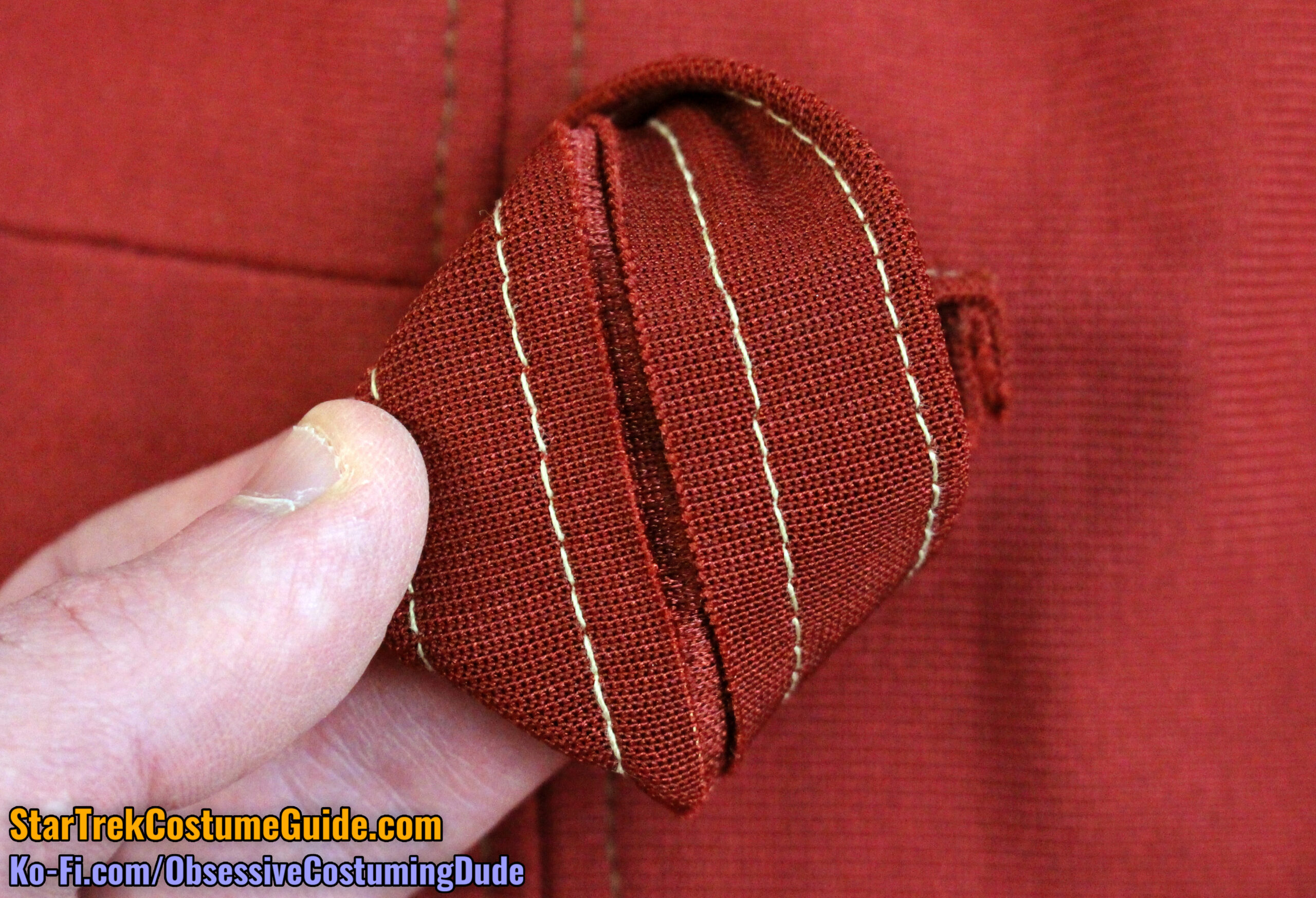
Like their predecessors, these uniforms had a patch pocket attached to the right hip – a rarity for Star Trek costumes!
These pockets were made of the same jumbo spandex as the rest of the jumpsuit.
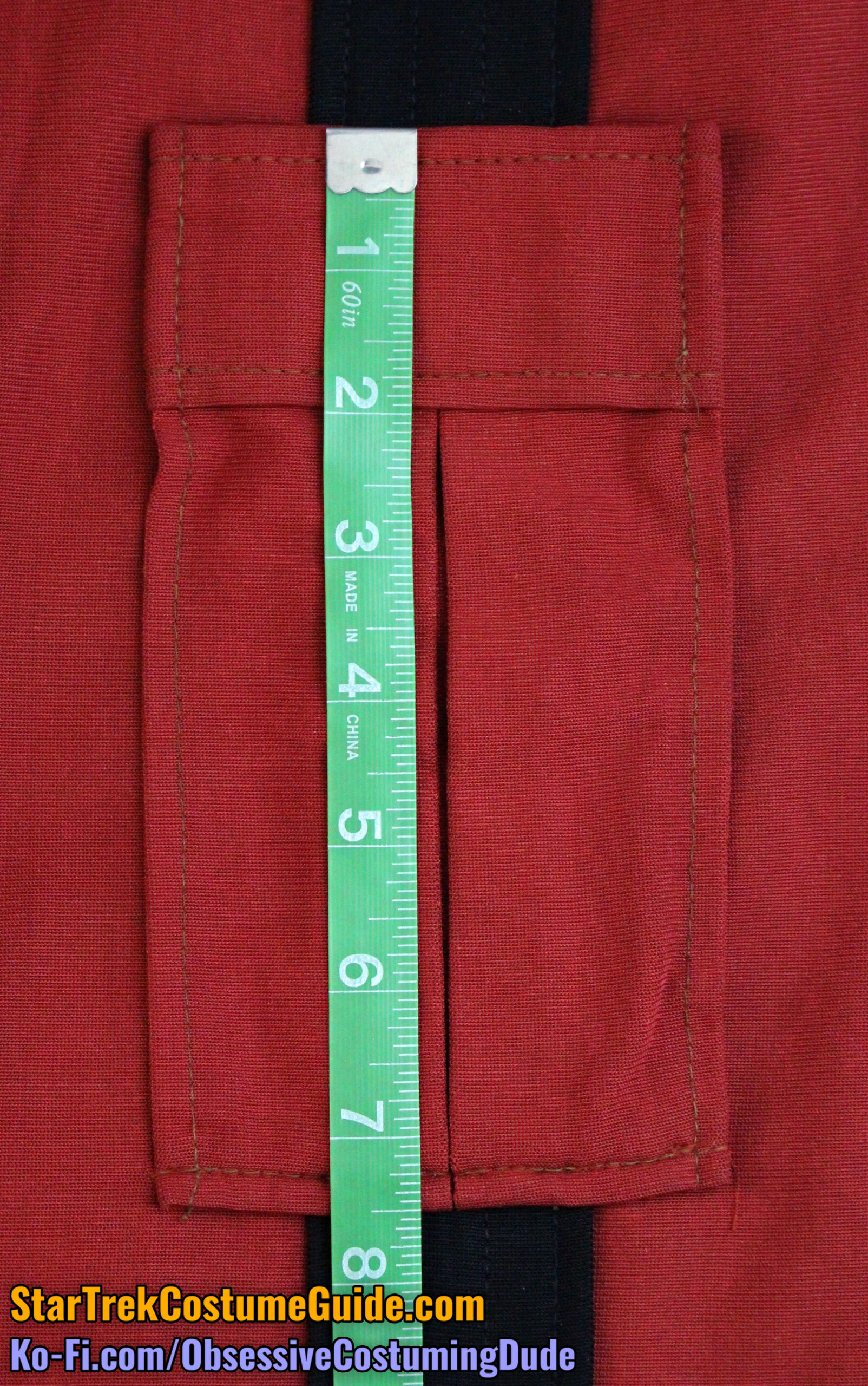
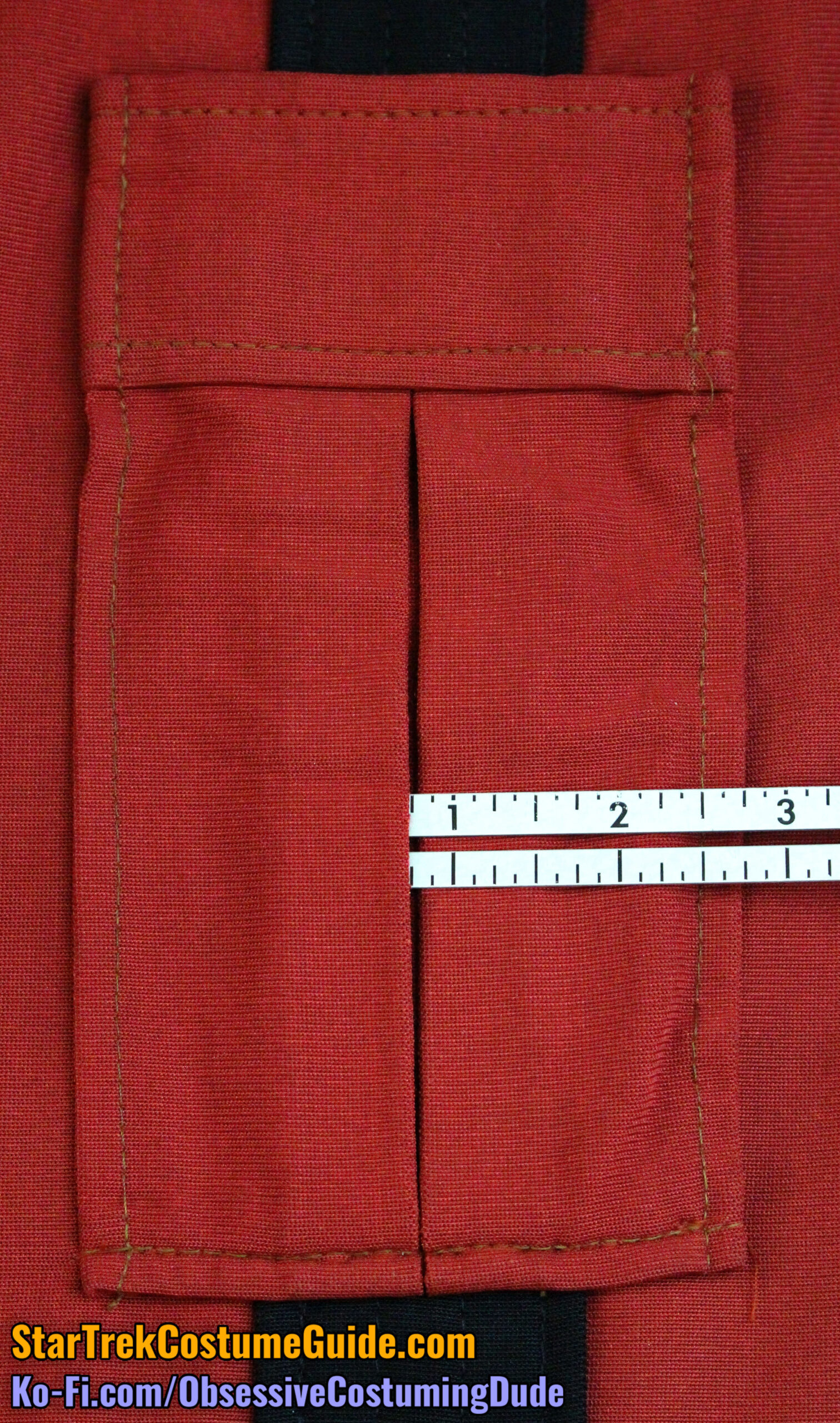
On the screen-used enlisted jumpsuit I examined, the pocket was approximately 7 ½” tall and 4” wide.
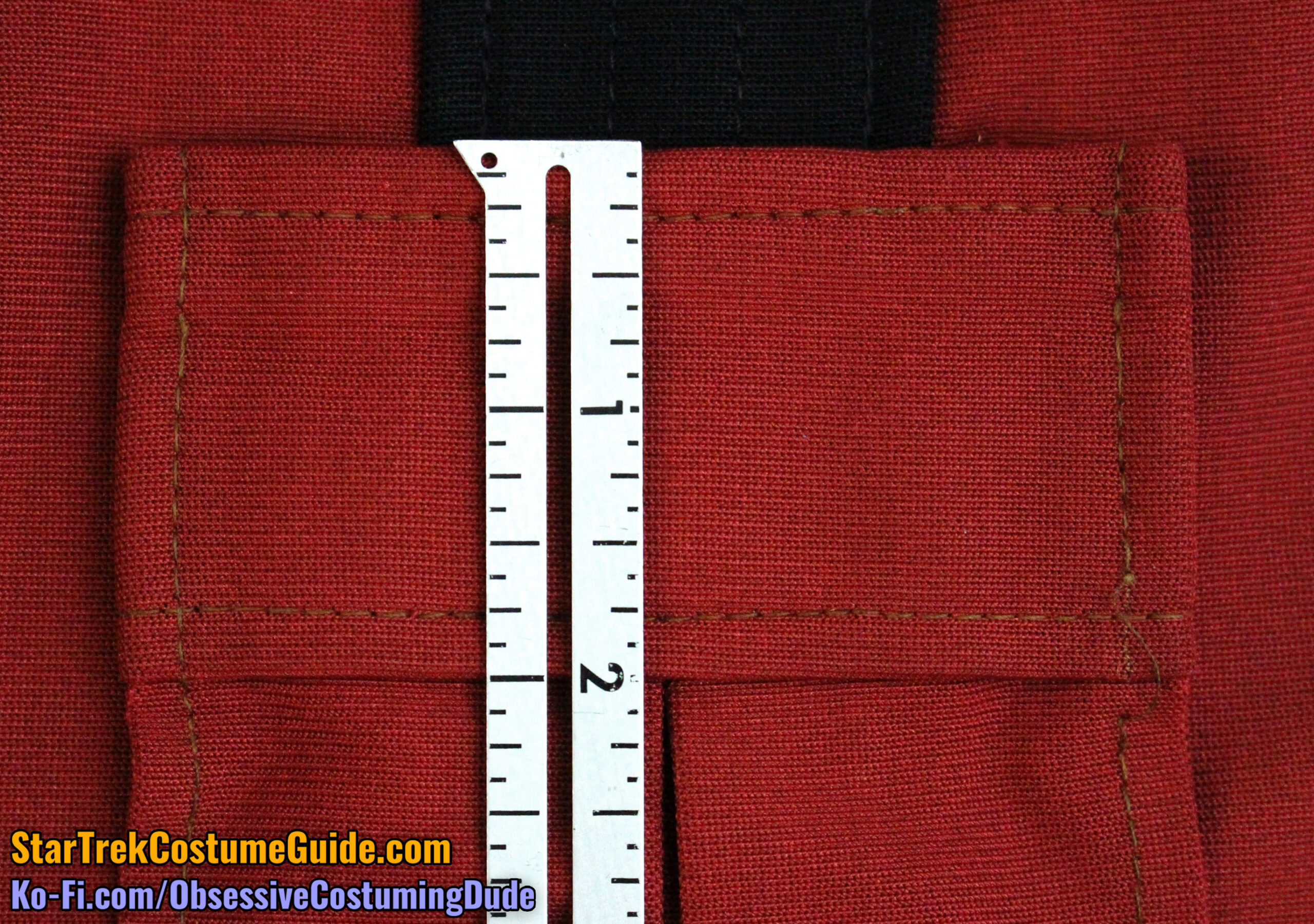
The pocket had an attached faux-flap across the top, which was 2” tall.
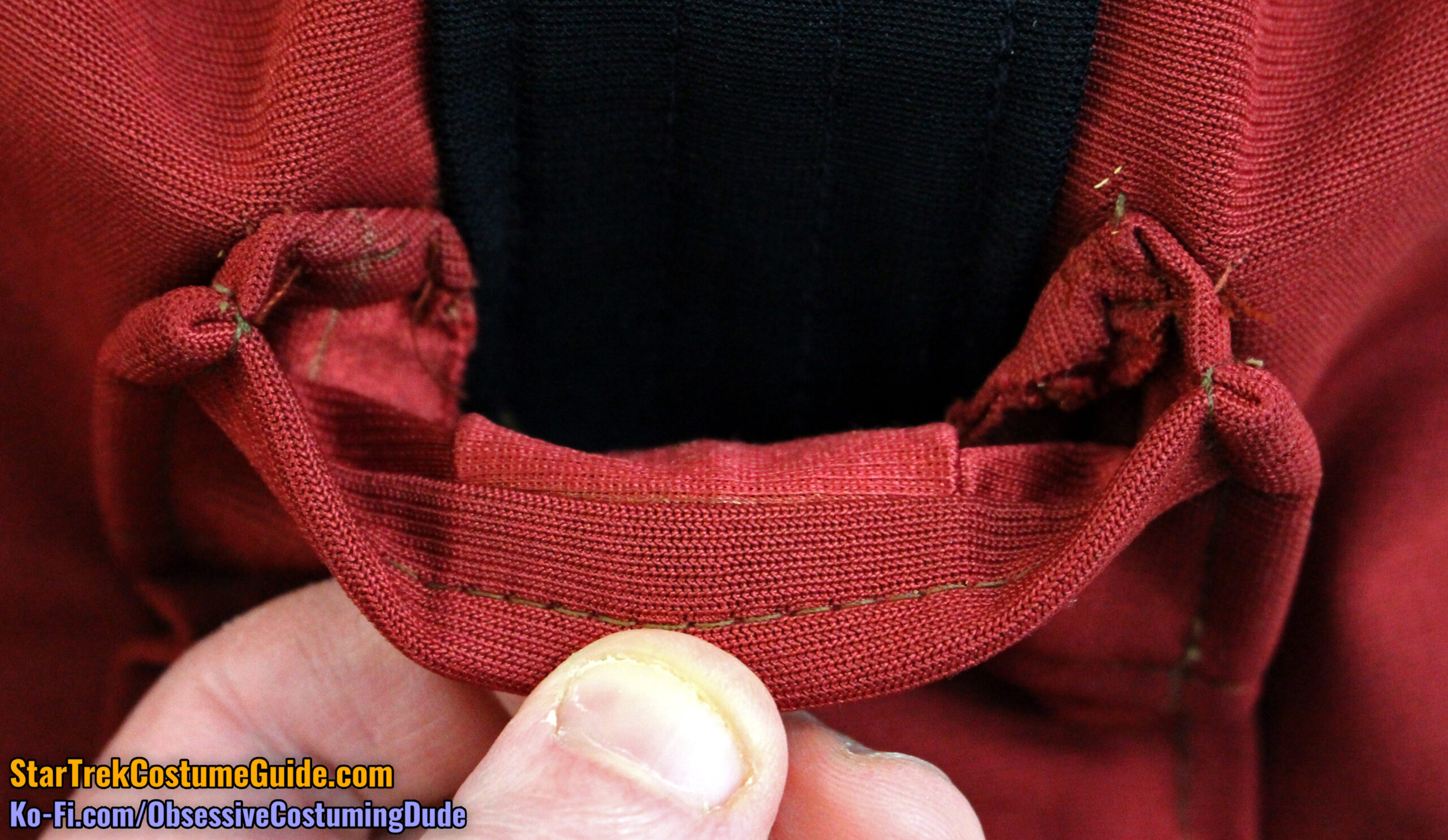
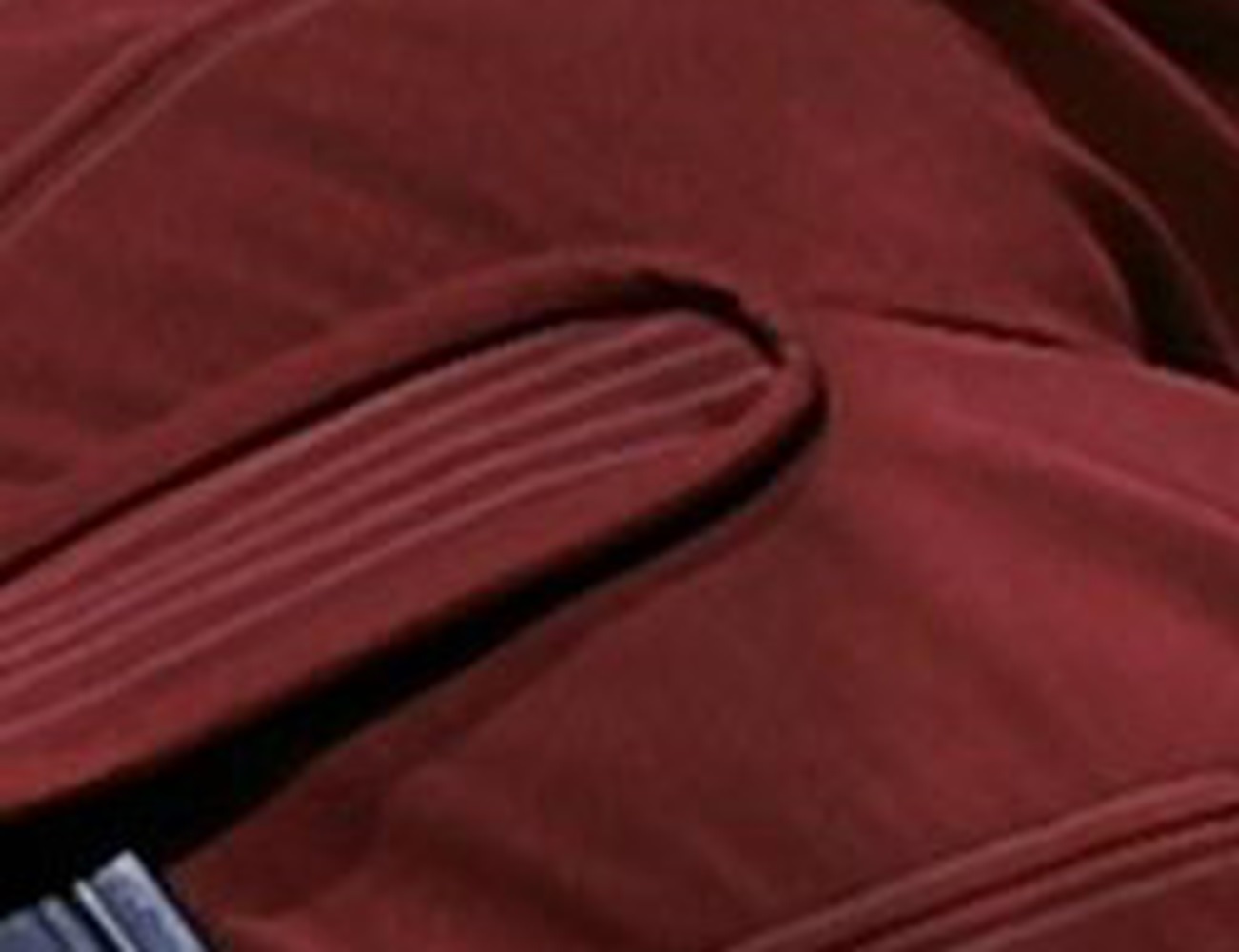
Here you can see how the “faux-flap” wrapped over the upper edge of the pocket.
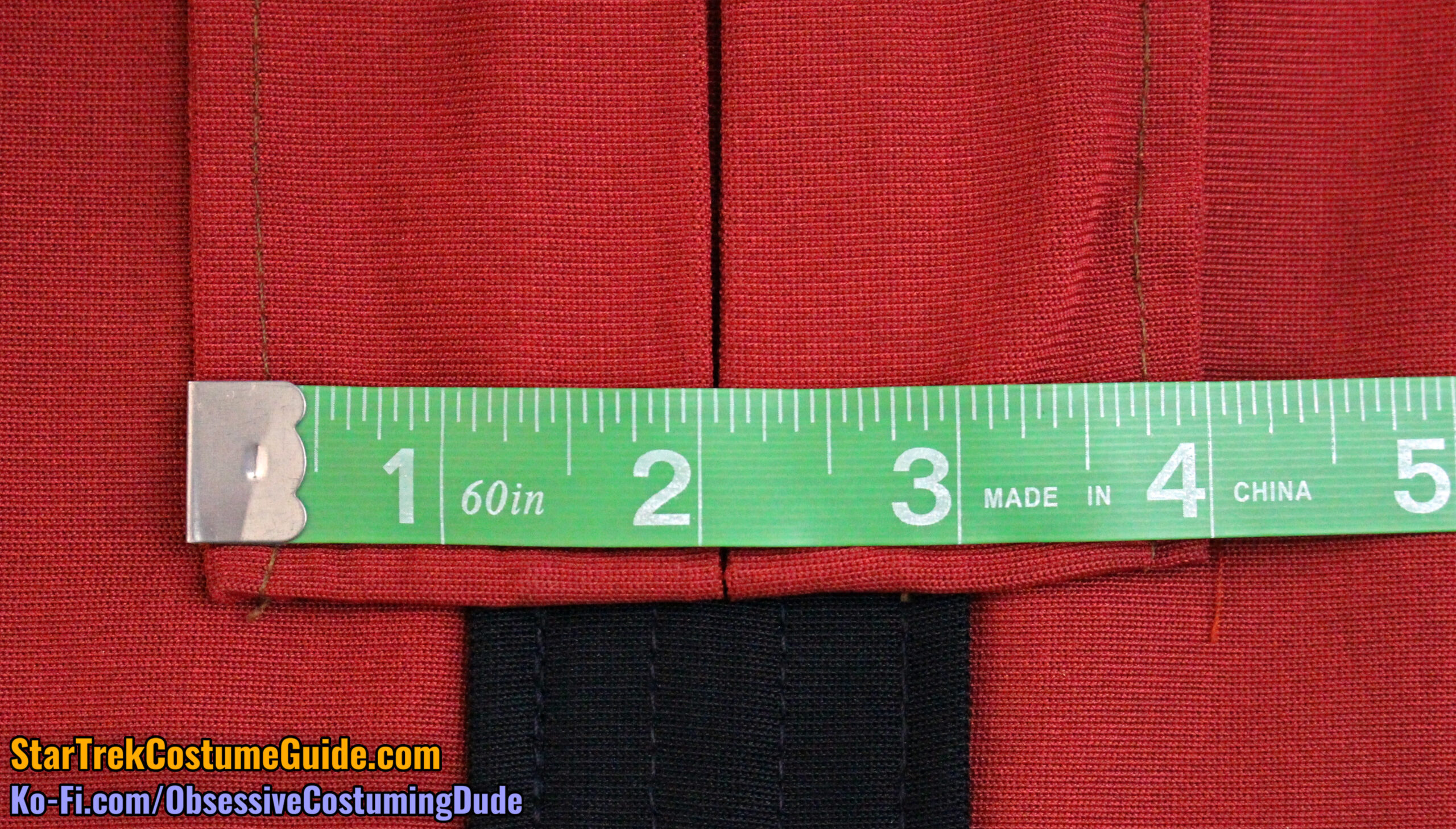
An inverted box pleat was horizontally centered beneath the faux-flap.
Each side of the pleat was ¾” from fold to fold.
Each edge of the pocket and faux-flap was accented with topstitching ¼” from the edges.
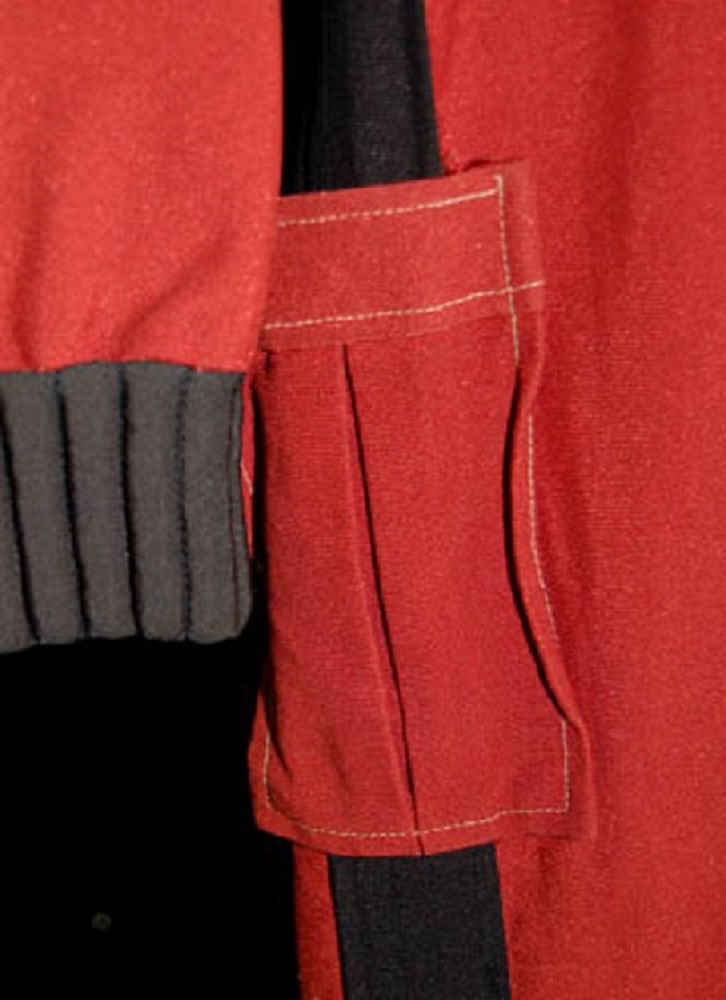
However, the outer topstitching was decorative and didn’t actually fasten the pocket to the jumpsuit.
Instead, it was sewn to the jumpsuit a bit inside the topstitching, presenting the illusion of a pocket mysteriously “floating” along the pant leg.
TWOK-era enlisted jumpsuit auction photo
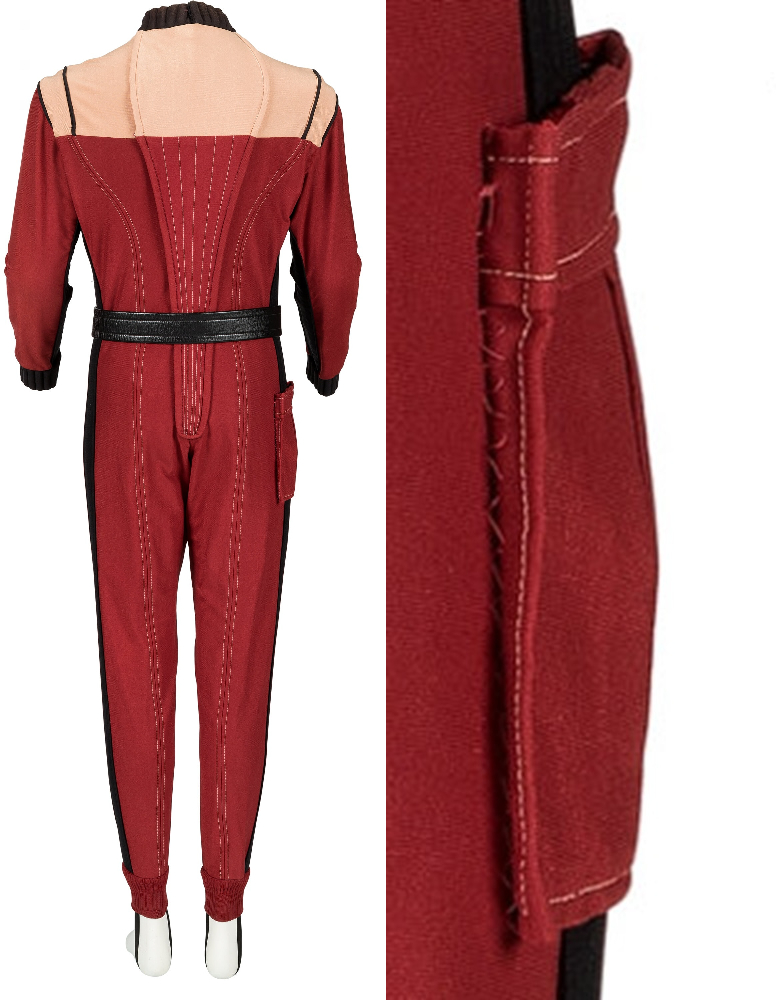
At least some of the pockets were machine-sewn to the jumpsuit inside the allowances, but I don’t know how the original wardrobe team managed that.
One of my theories was that the sides of the pocket were sewn to the pant legs before the side seams were sewn closed, but the black side stripe was continuous down the side of the jumpsuit with no break in the stitching; since the side seams needed to be closed before the black stripe could be added, and the pocket was added over the stripe, that ruled out my theory.
Regardless, it looks like this particular pocket was hand-sewn to the jumpsuit:
TWOK-era enlisted jumpsuit auction photo
Lower Pant legs
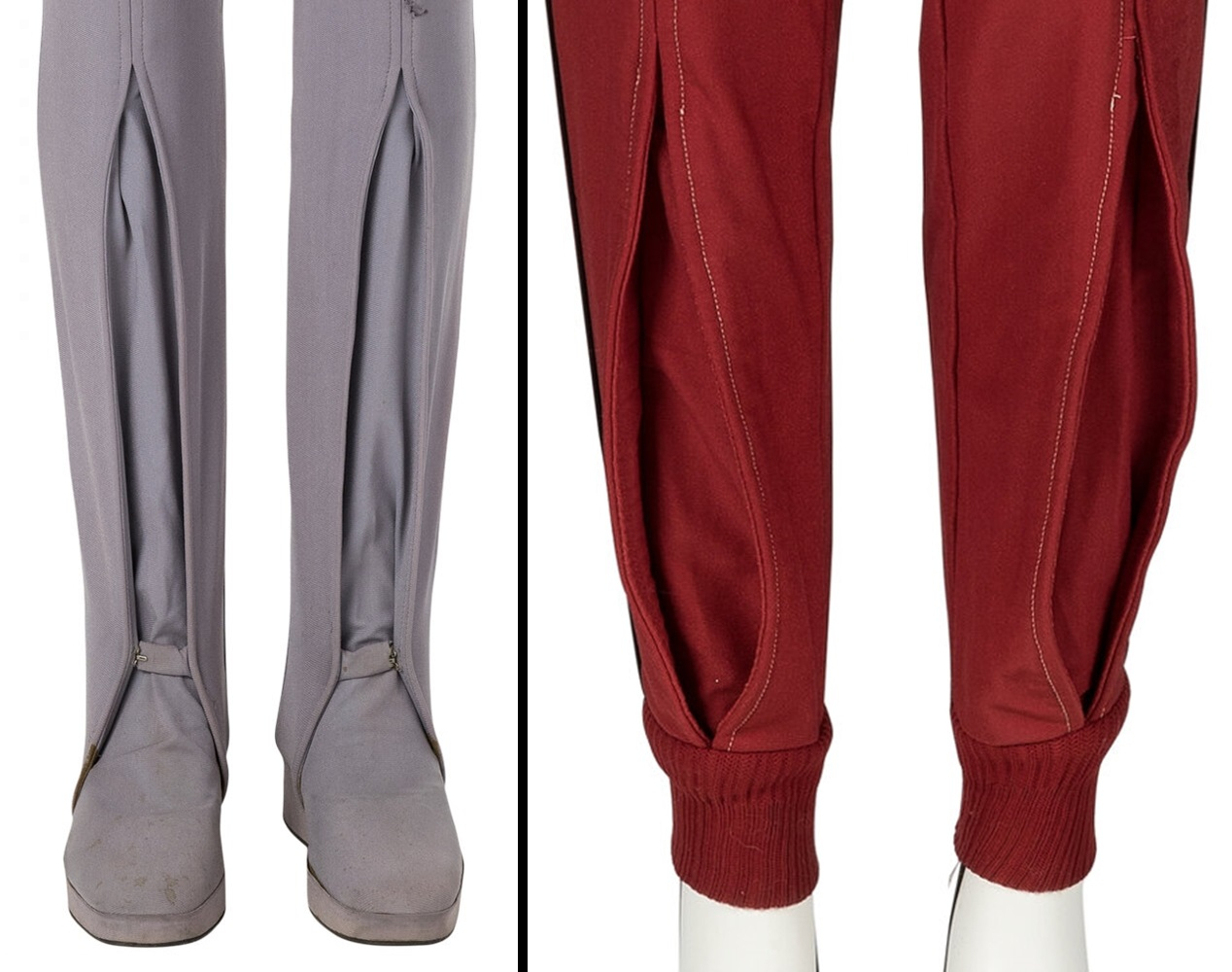
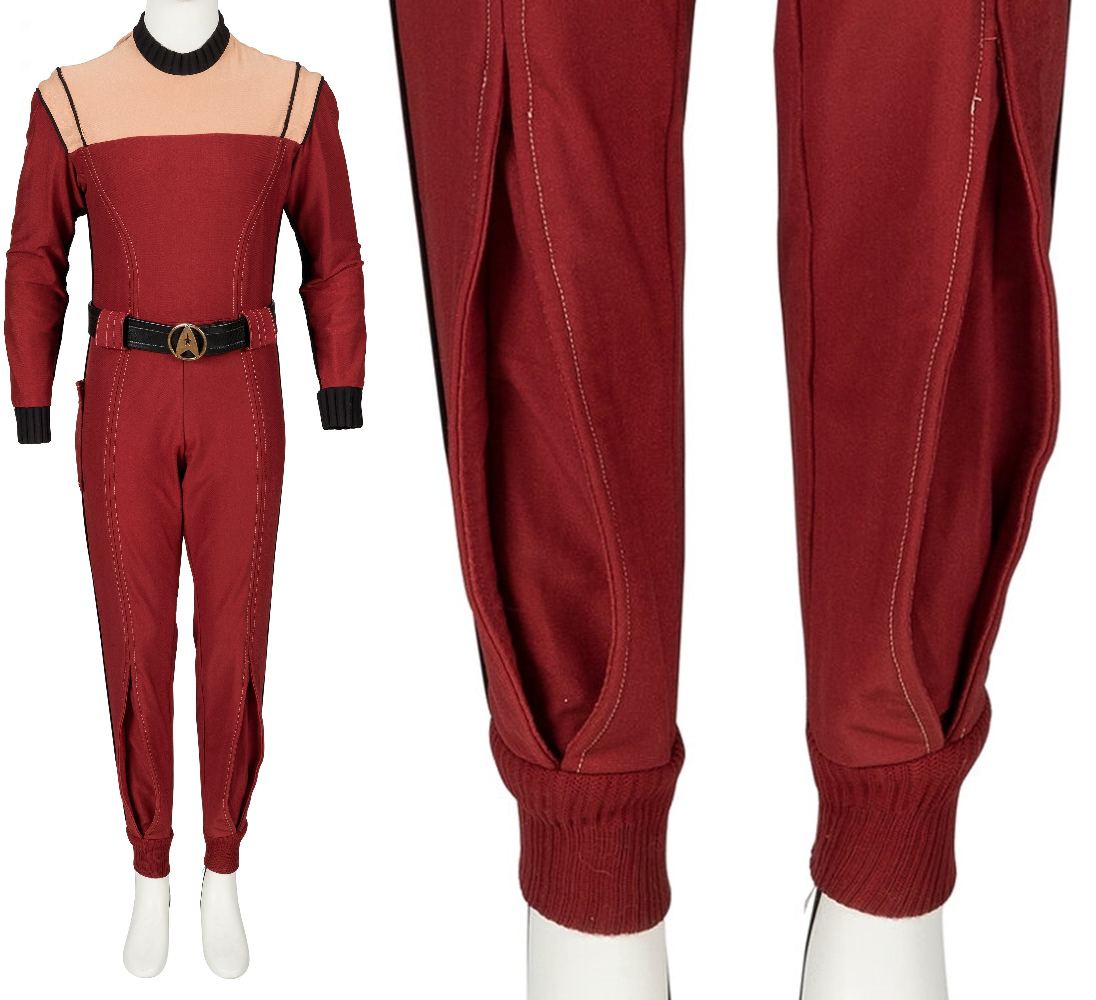
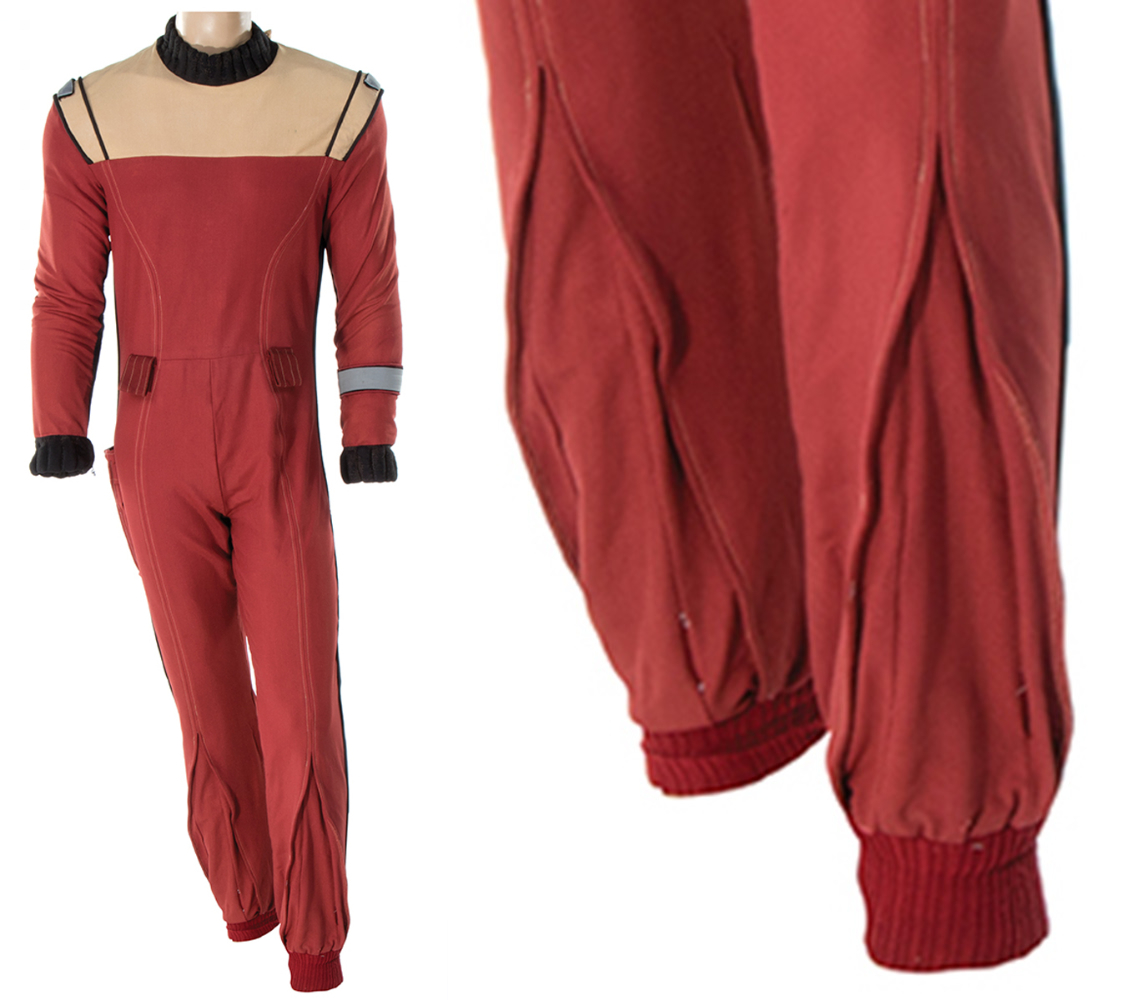
Another detail these jumpsuits inherited from their TMP predecessors was on the lower front of the pant legs; the side front seams opened into what I reluctantly refer to as an inverted box pleat, even though that term isn’t entirely accurate.
(Technically, a “gusset” was inserted into the bottom of the seam, which allowed it to expand.)
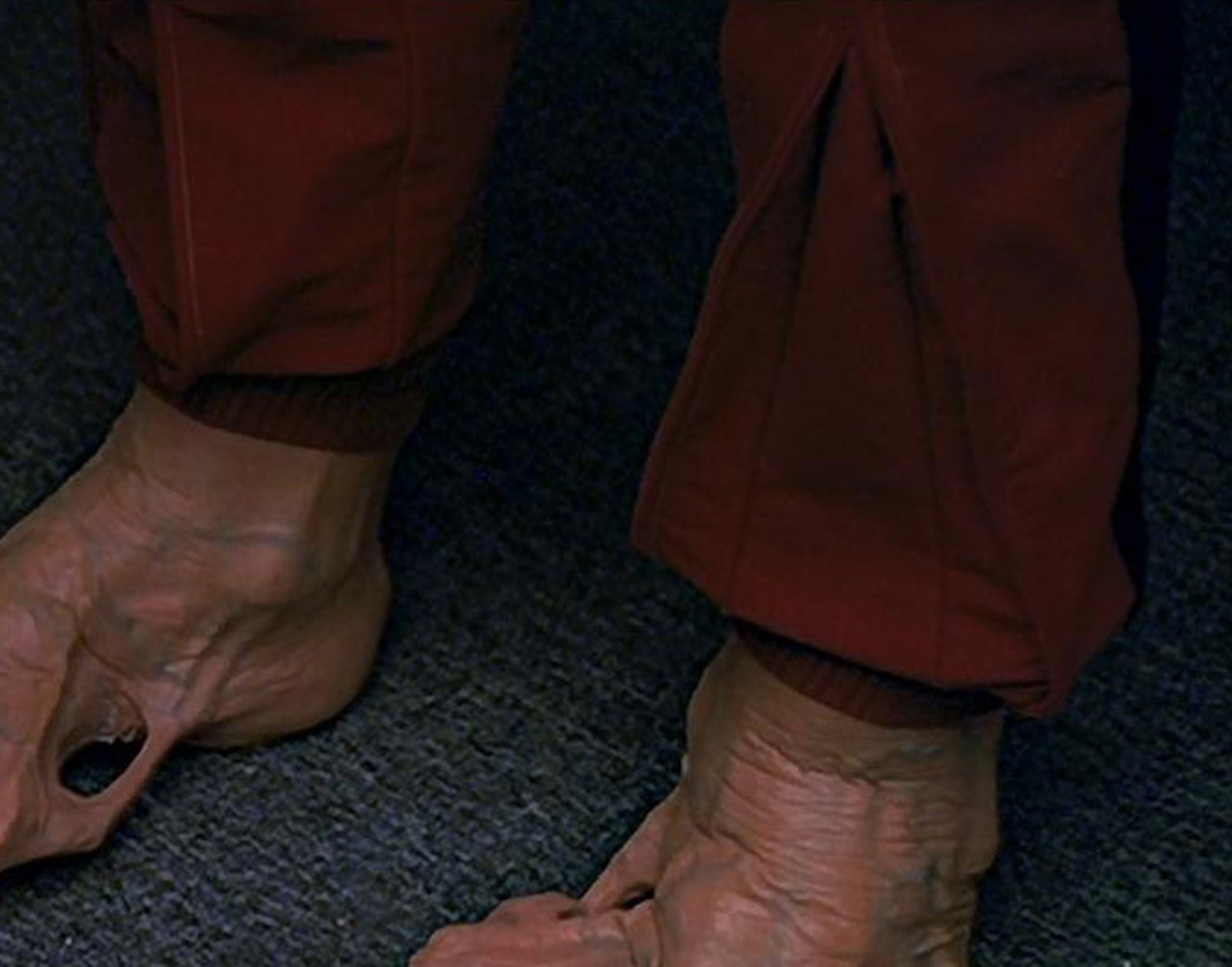
On some jumpsuits these pleats were closed at the bottom like they were on the TMP uniforms (left), but on others they were pulled open (right) – probably an attempt to widen the pant leg and achieve a “bell-bottom” effect similar to the officers’ trousers.
Of all the original uniforms I could find reference photos of, approximately 2/3 of them were pulled open (such as Crewman Dax’s uniform – see right) and approximately 1/3 of them were closed.
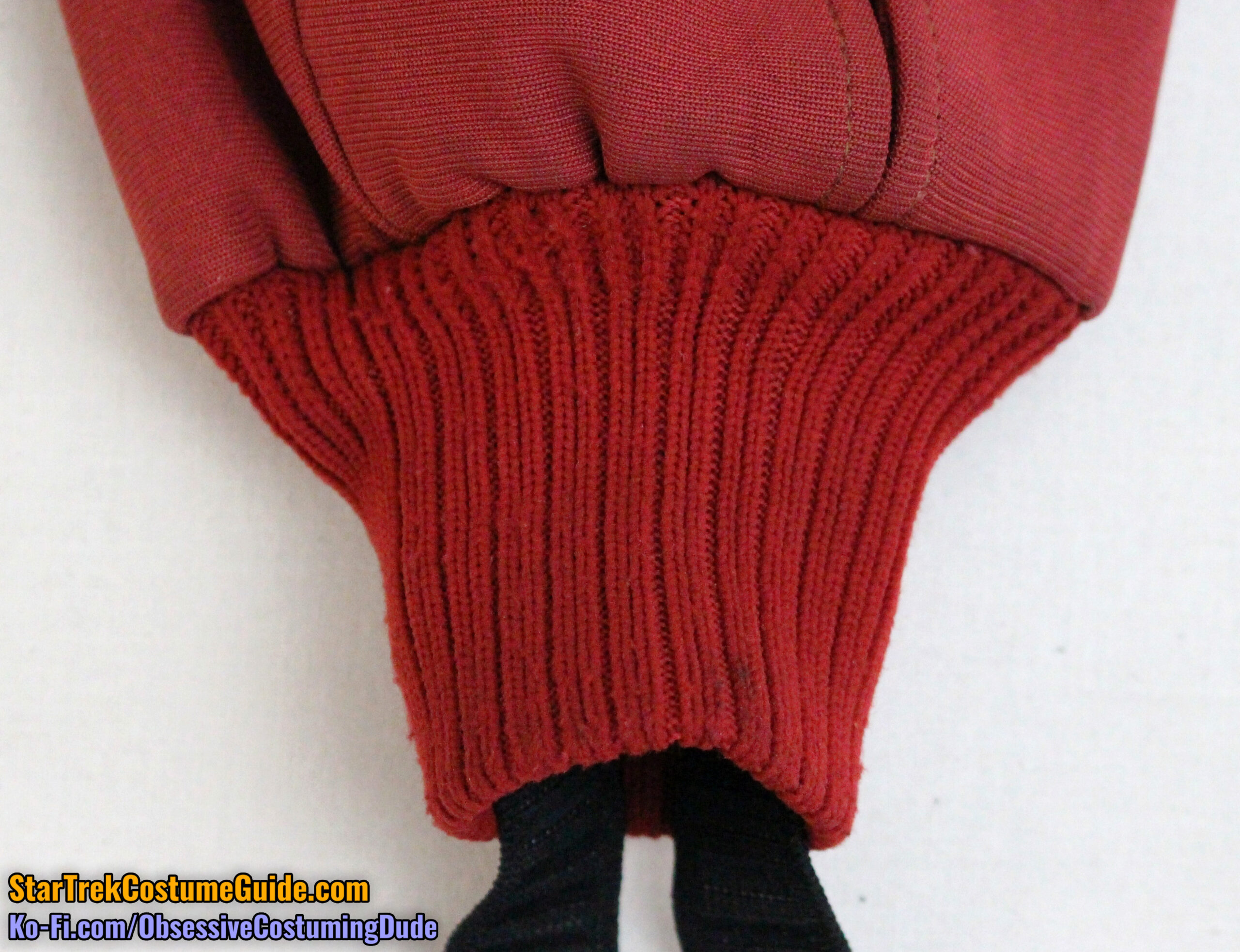
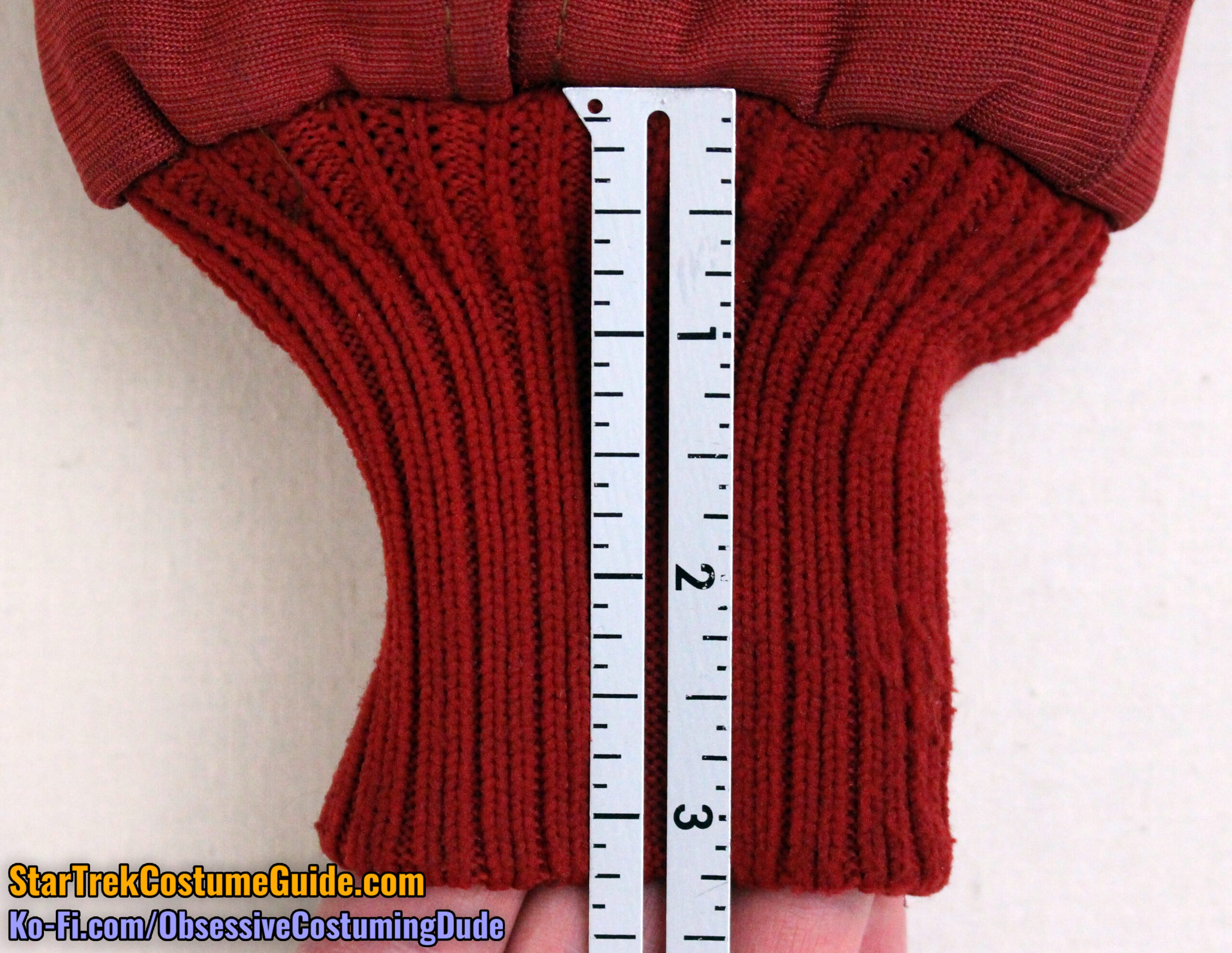
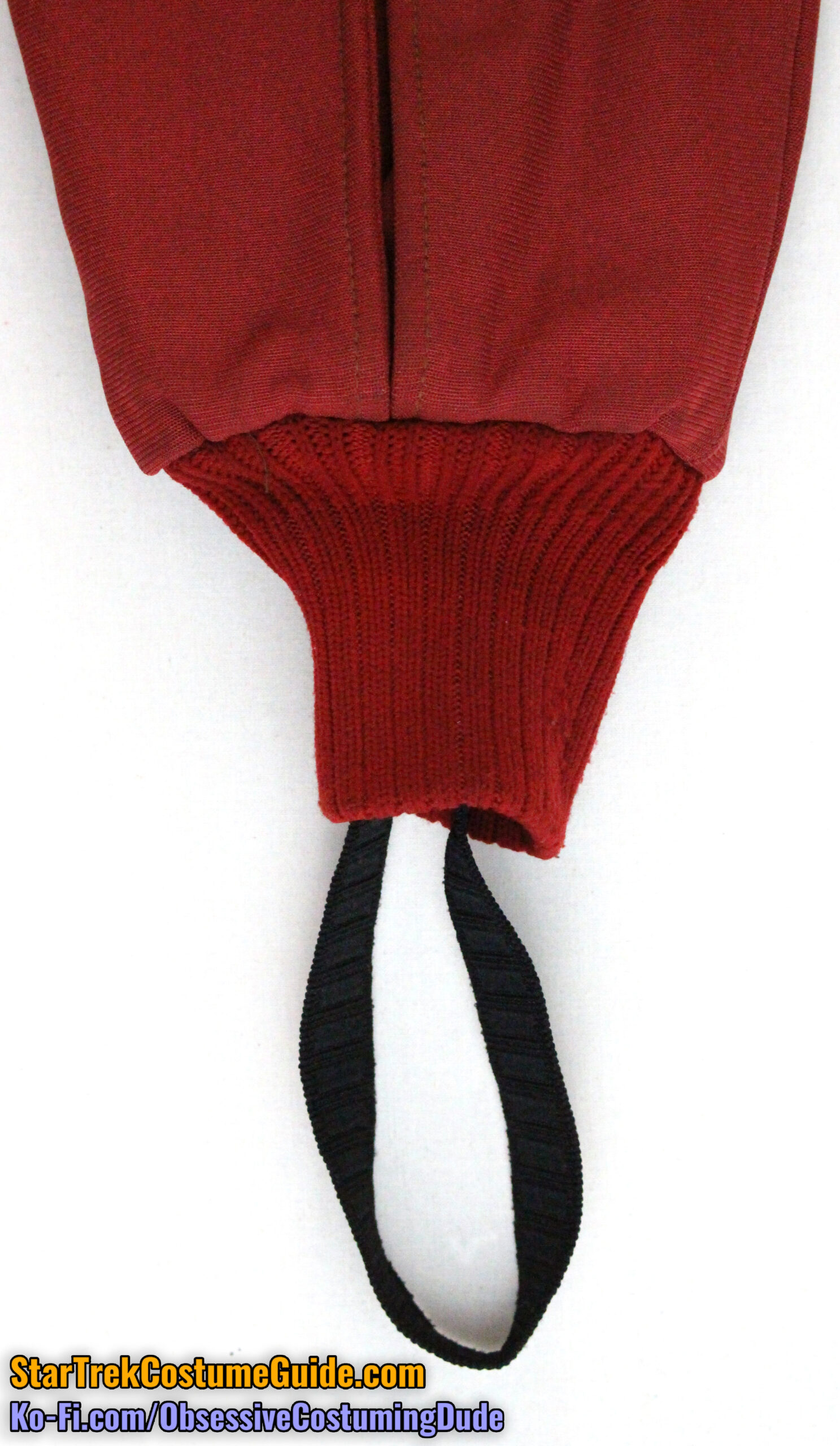
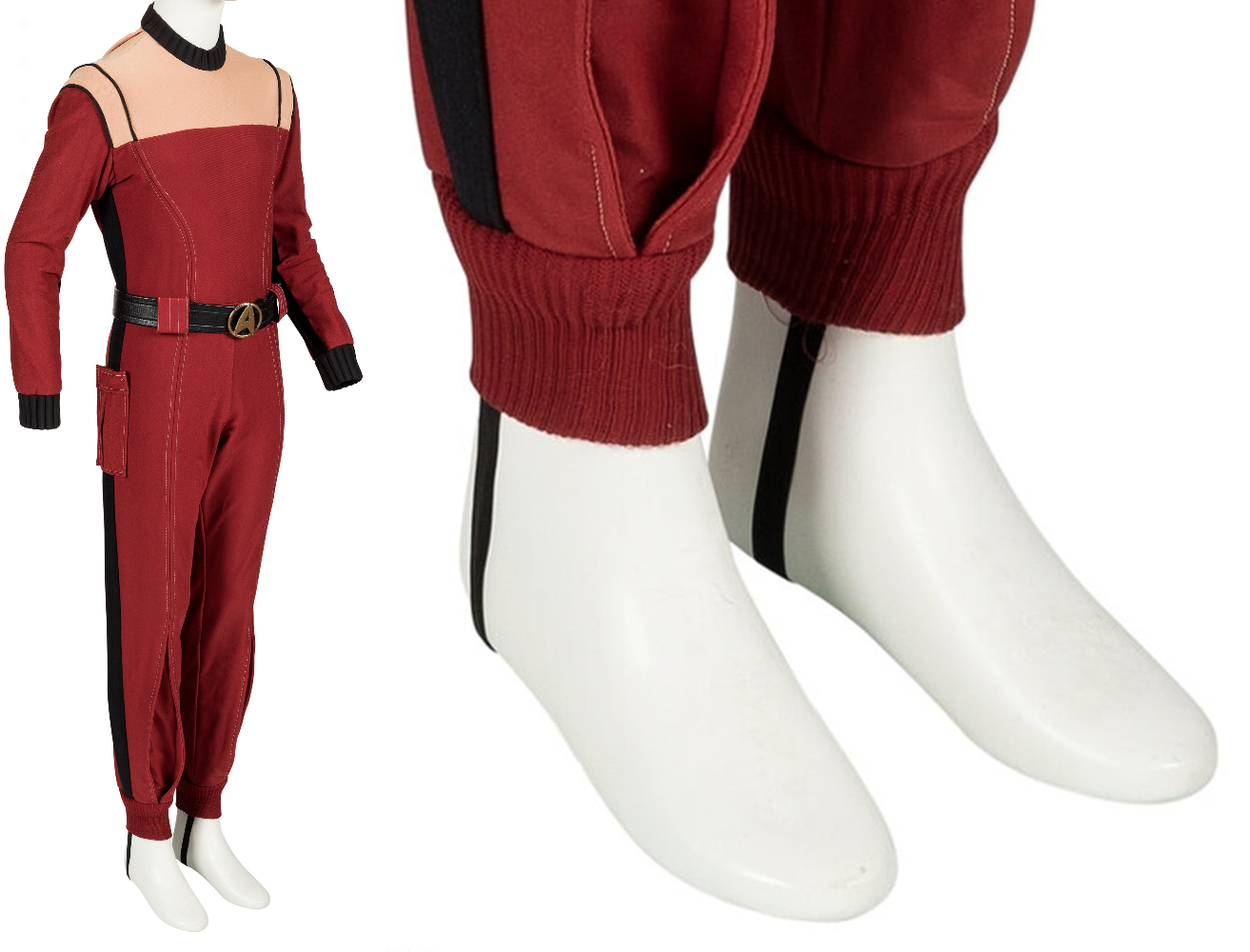
At the bottom of the pant legs, heavy red knit cuffs were added to elasticize the lower pang leg fullness.
On the screen-used enlisted jumpsuit I examined, this cuff was 3 ¼” tall.
Many enlisted jumpsuits had elastic “stirrups” on the lower pant legs, which were sewn to the hem/cuff allowances on the underside of the cuff.
TWOK-era enlisted jumpsuit auction photo
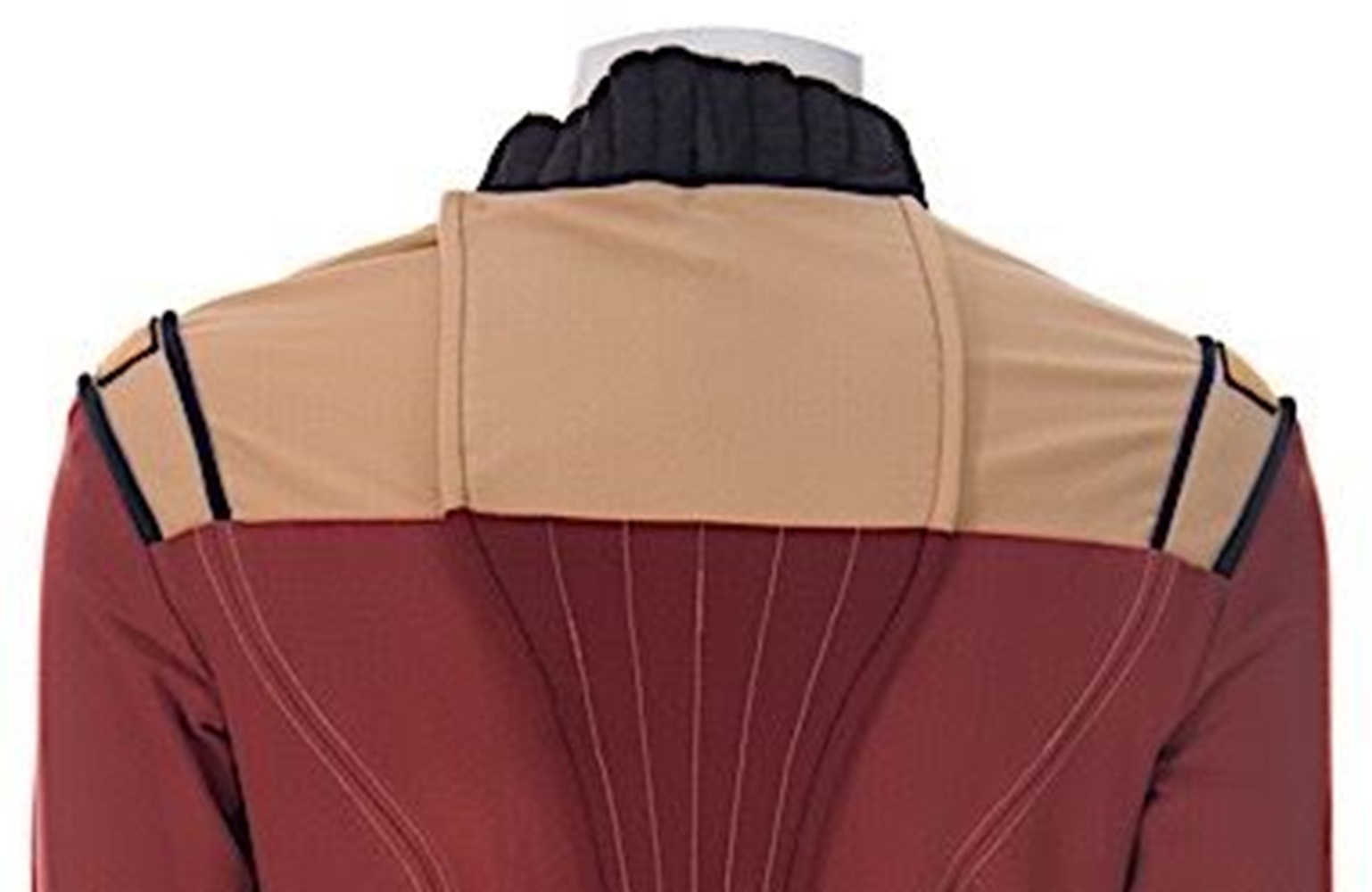
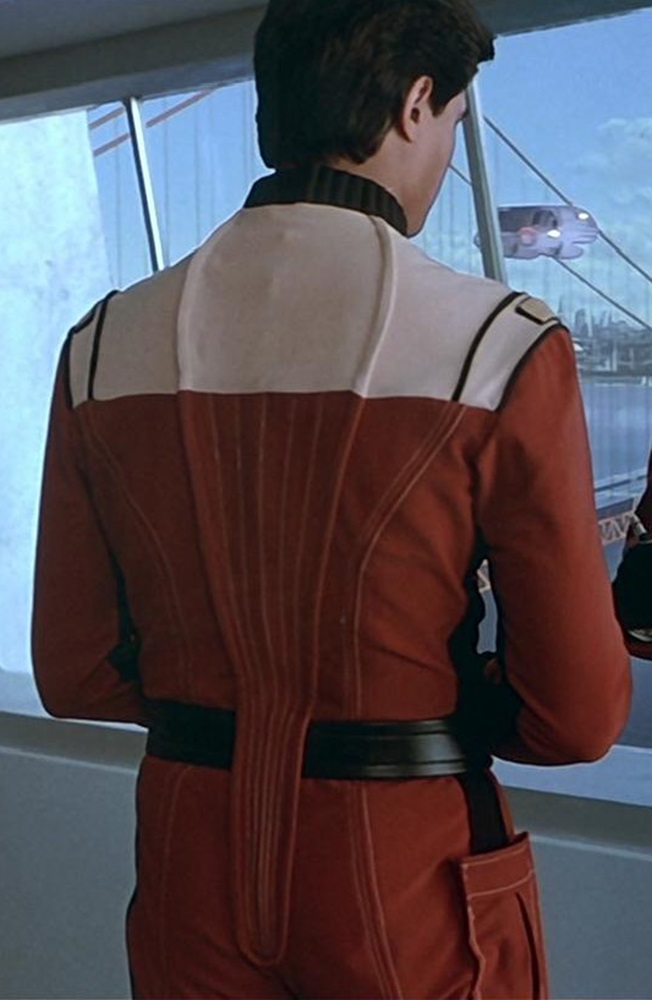
Center Back Panel
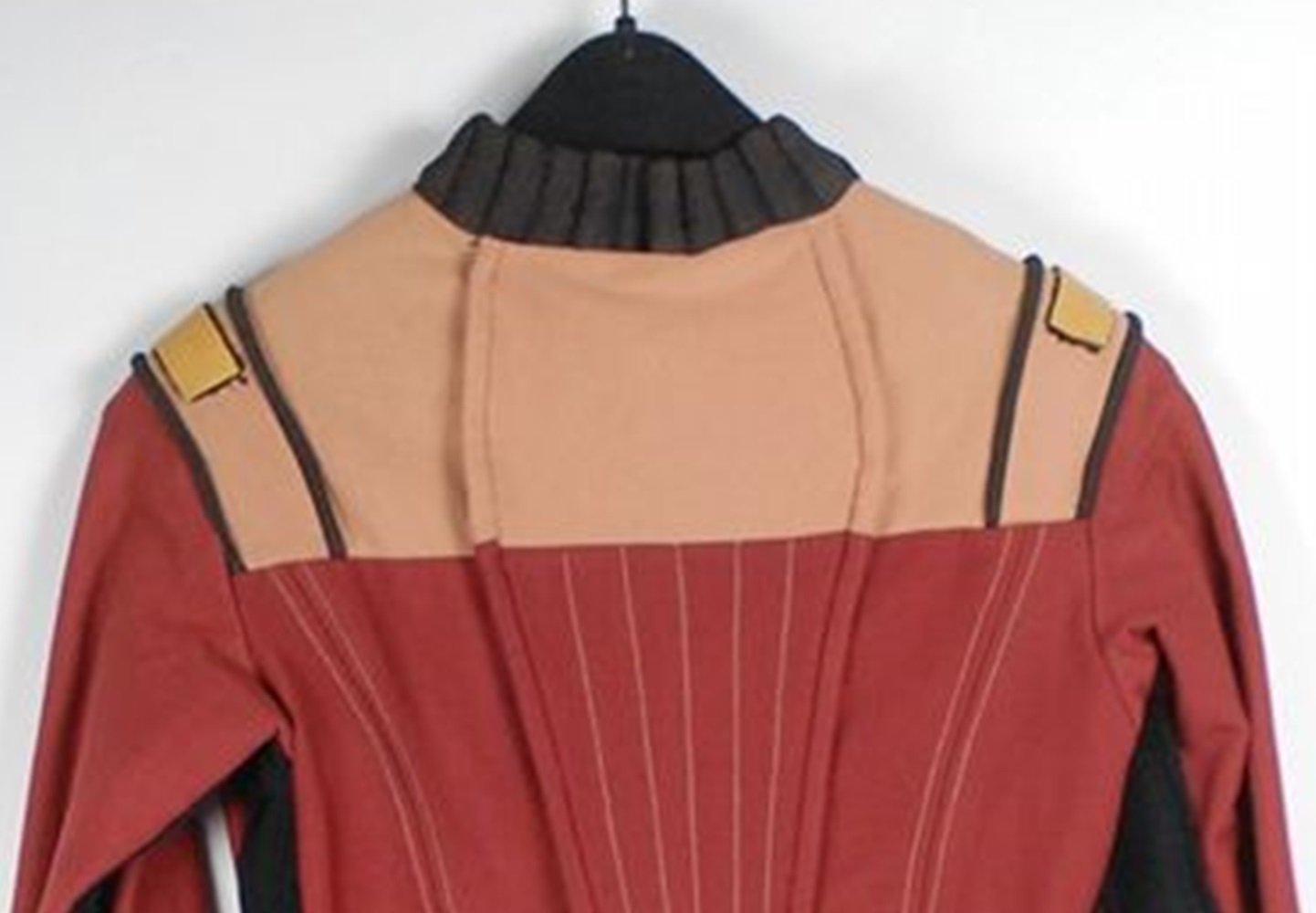
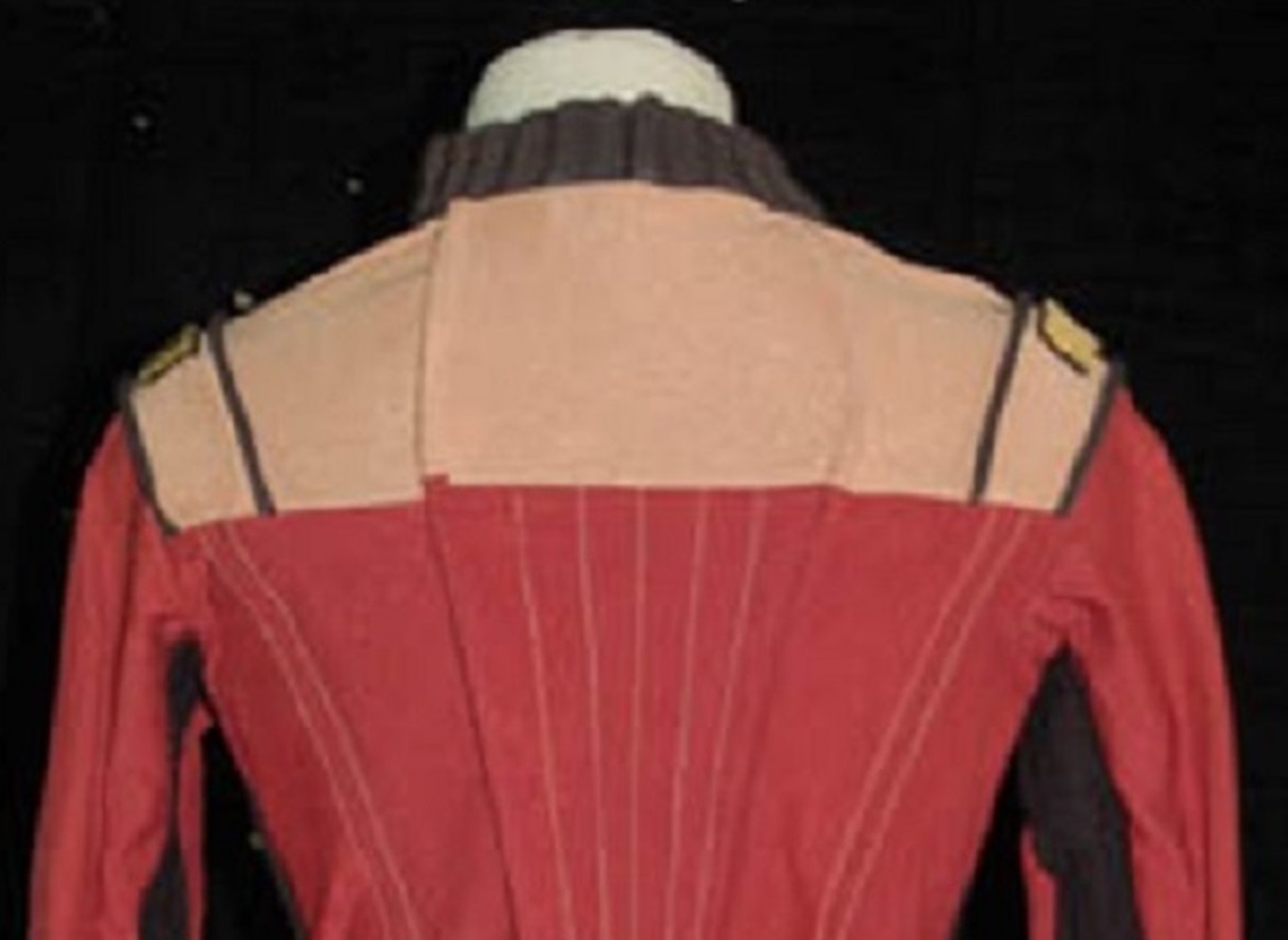
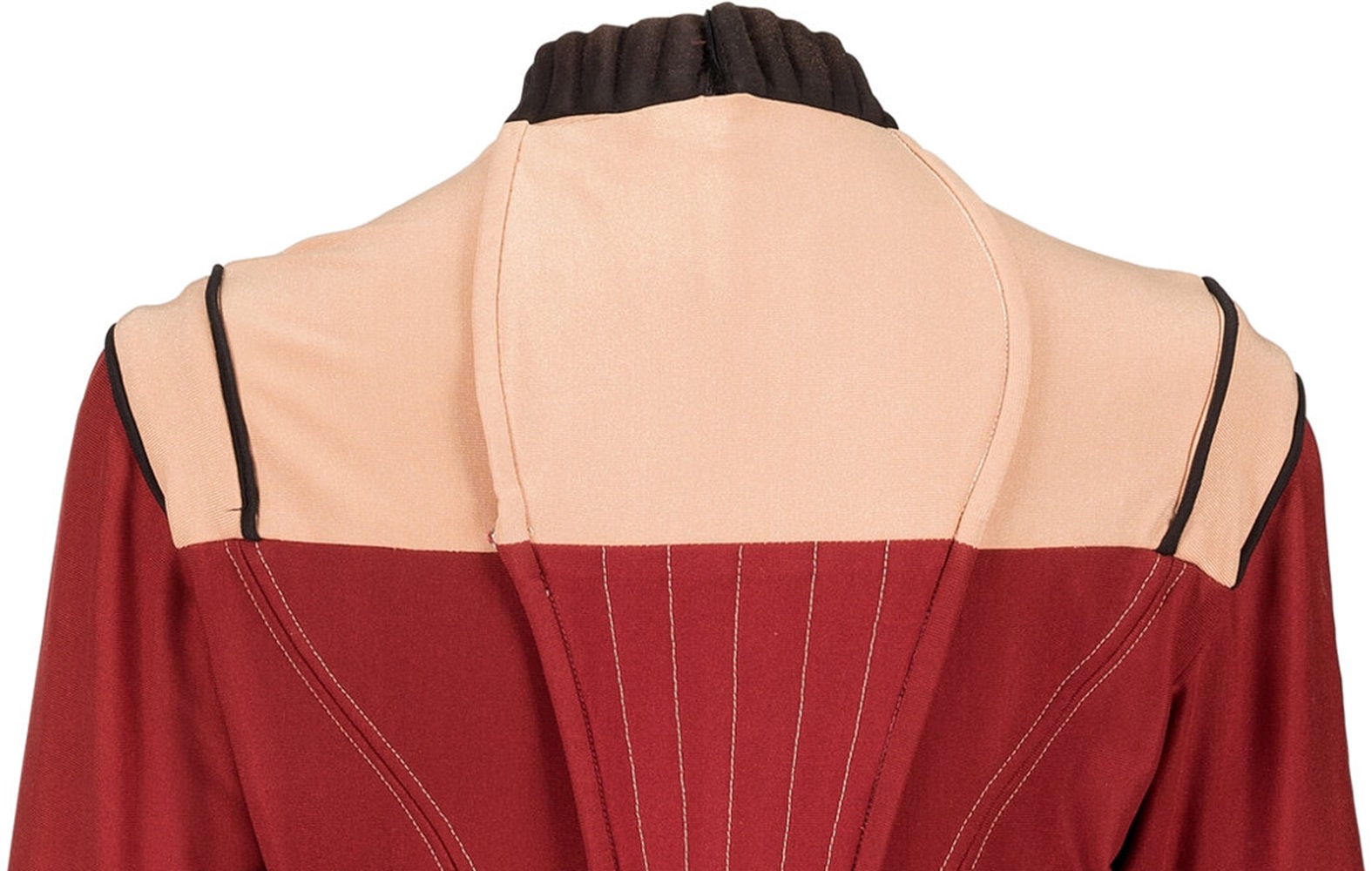
On the back of the jumpsuit was a decorative panel, which added visual interest while also hiding the zipper.
(One of the recurring themes in Robert Fletcher’s TWOK-era uniforms was a geometric shape on the back, usually waist-level, that was topstitched and/or quilted.)
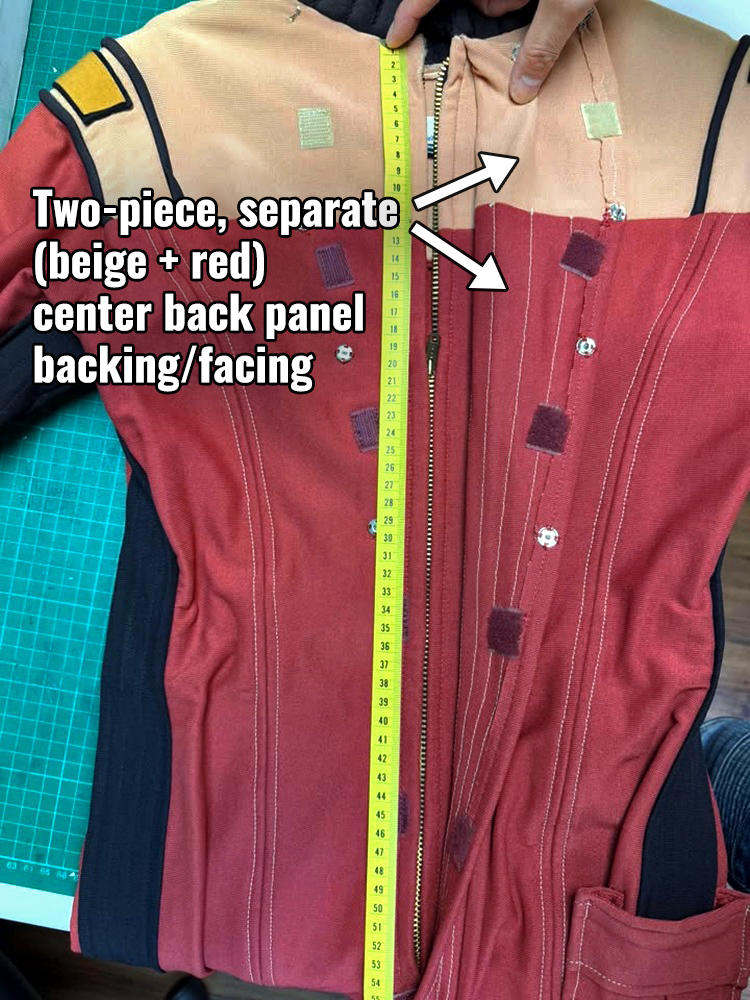
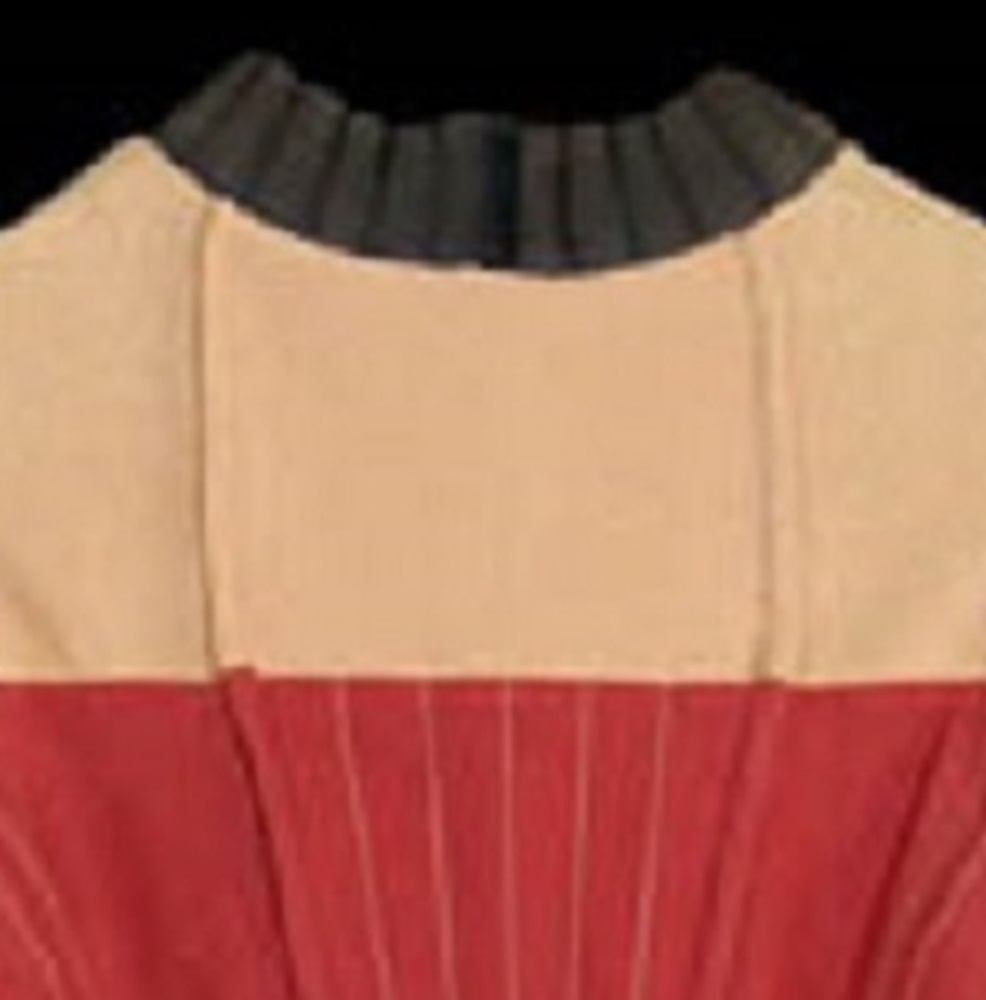
This panel was two pieces; it had its own beige yoke and red body, and its yoke/body seam was flush with the corresponding seam on the jumpsuit.
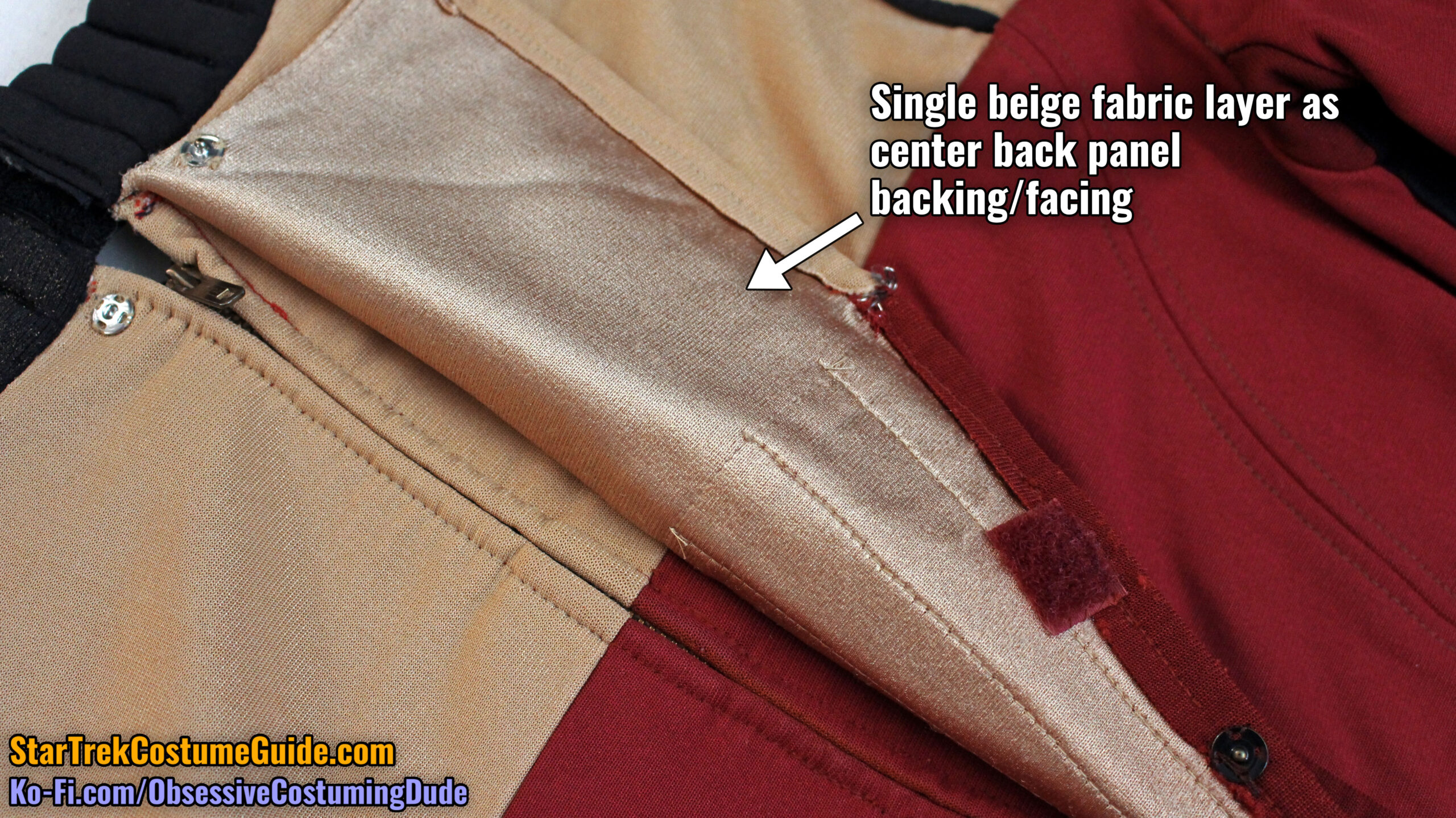
This panel was two layers thick; on the underside was a backing/facing layer.
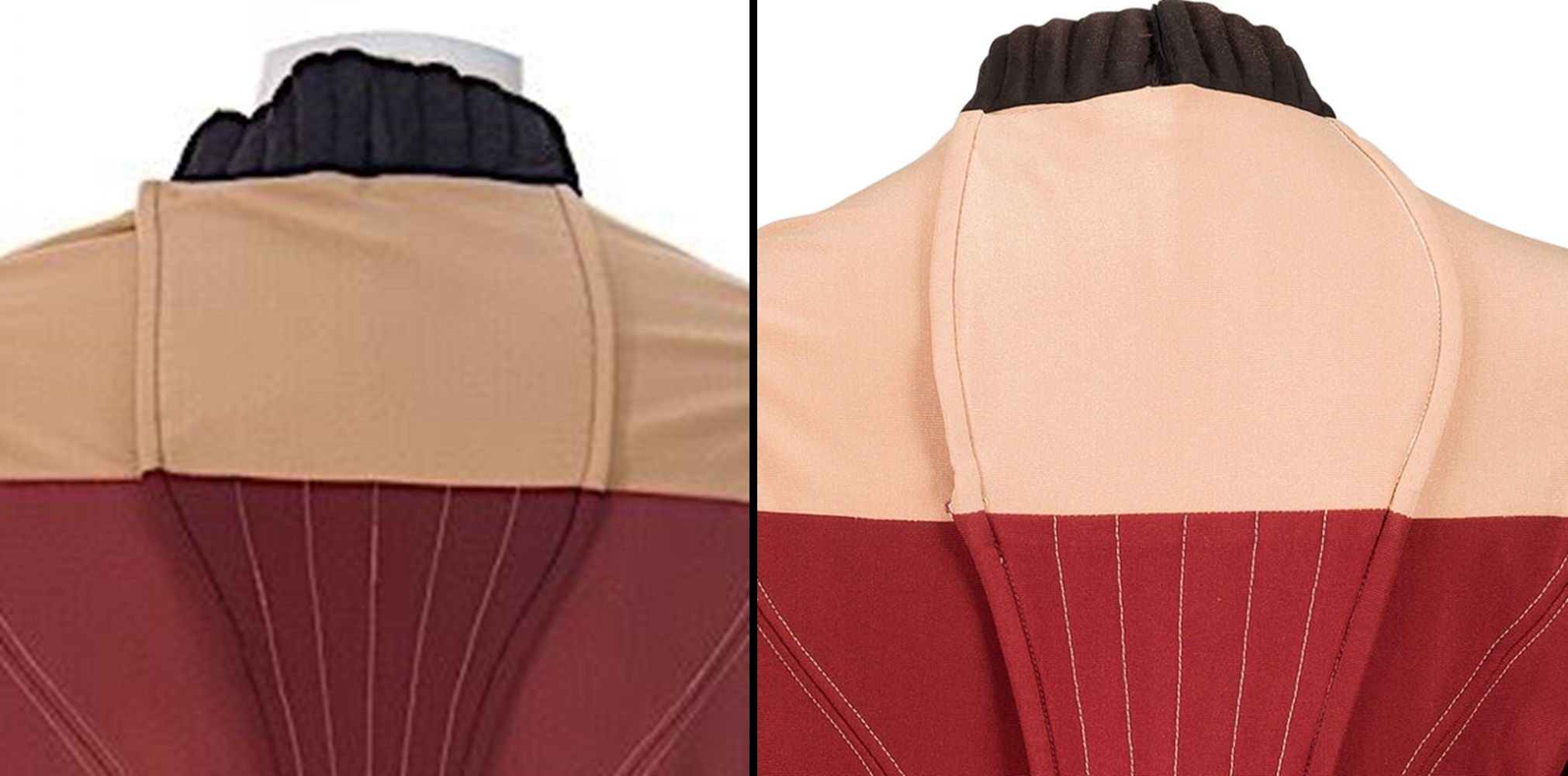
On the screen-used enlisted jumpsuit I examined, the backing/facing was one solid piece of beige spandex, but Kevin from “Starbase 375 Logistics” kindly shared some photos of another screen-used enlisted jumpsuit he’s been able to study, and it had separate yoke/body panels seamed together just like the shell layers did.
Photo by Kevin at “Starbase 375 Logistics”
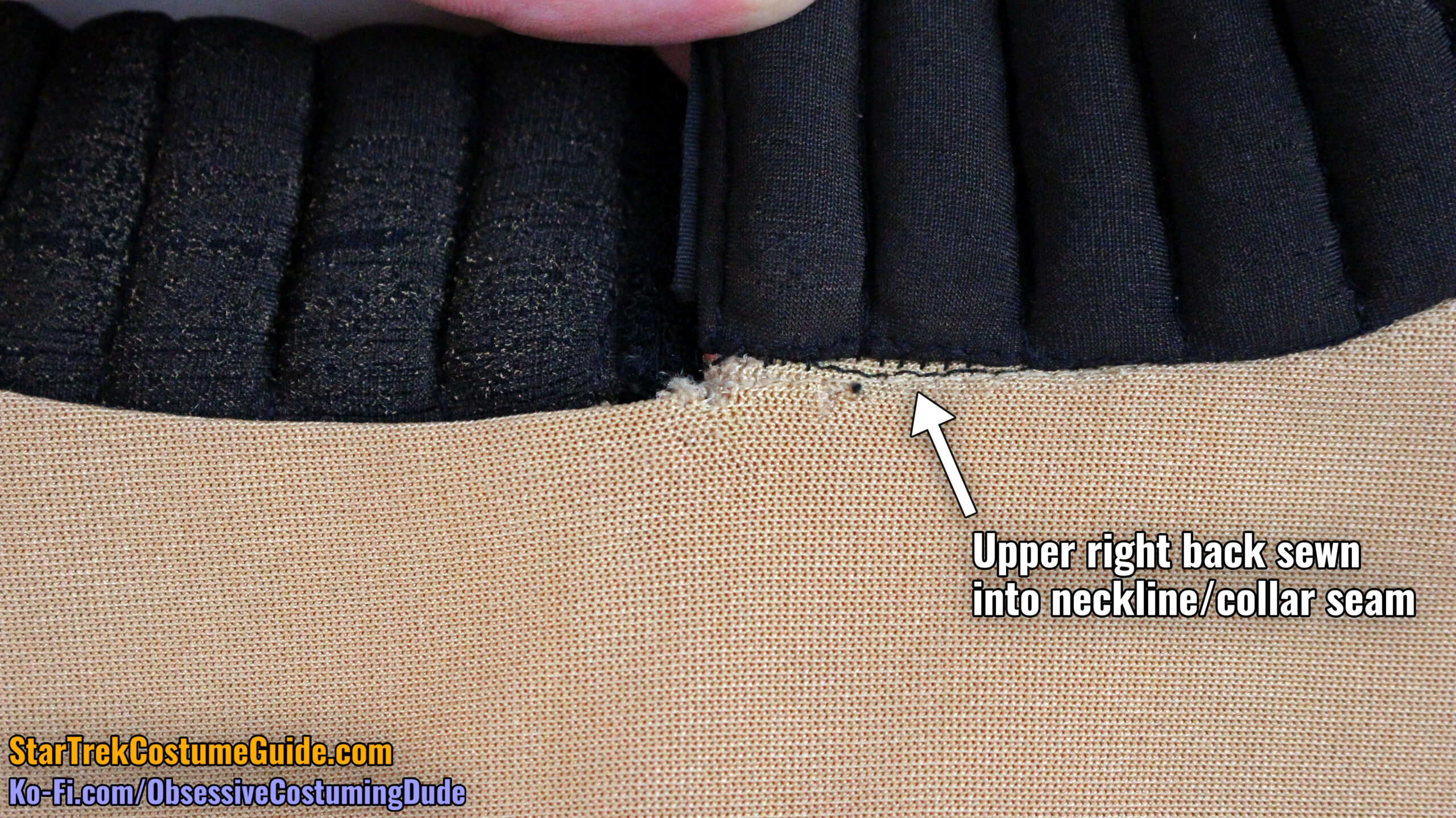
On the upper right back, the panel was sewn into the neckline/collar seam.
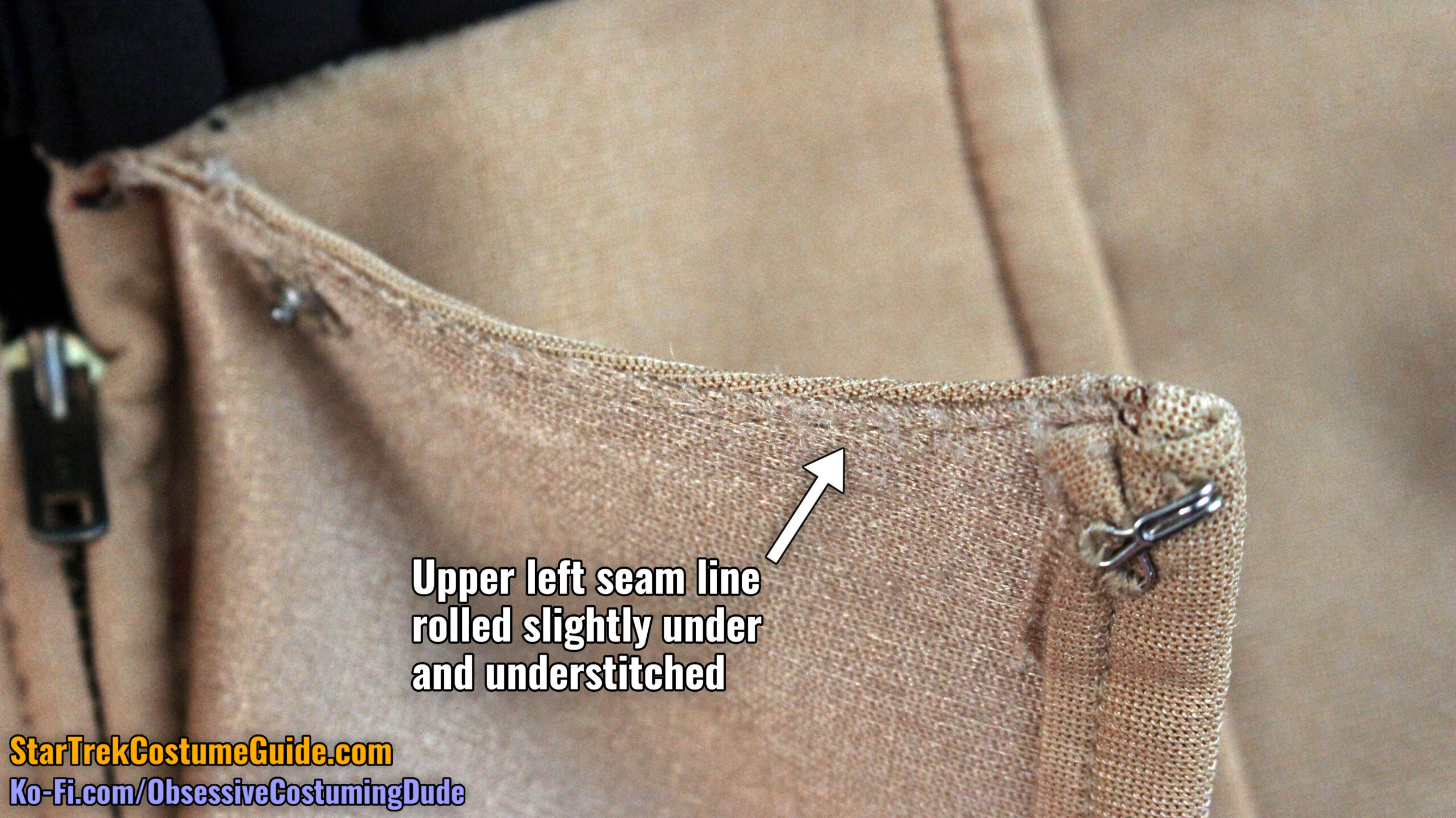
On the upper left back, the panel and facing were sewn closed; the seam was slightly rolled under, and the facing was understitched close to the seam.
There were two inconsistent details in regard to these back panels.
First, sometimes the upper, outer edges nicely aligned at the shoulder/neckline/collar seams.
(This is my preference.)
On many jumpsuits, though, the panel didn’t quite reach the shoulder seam.
On some, it didn’t reach anywhere near the shoulder seams.
TWOK-era enlisted jumpsuit auction photos
Regardless of how the upper right back of the panel aligned (or rather, didn’t align), it seems like the upper left back corners never quite reached the shoulder seams.
The other inconsistency was the contours of the upper edges; on some there was a noticeable curve from the yoke seam up to the neckline:
On others, the outer edges of the panel yoke were almost straight.
TWOK-era enlisted jumpsuit auction photo
These upper panel contours often varied on the same jumpsuit, too.
The right side was more likely to be curved, while the left side was likely to be straighter; this often resulted in some strange asymmetry.
TWOK-era enlisted jumpsuit auction photos
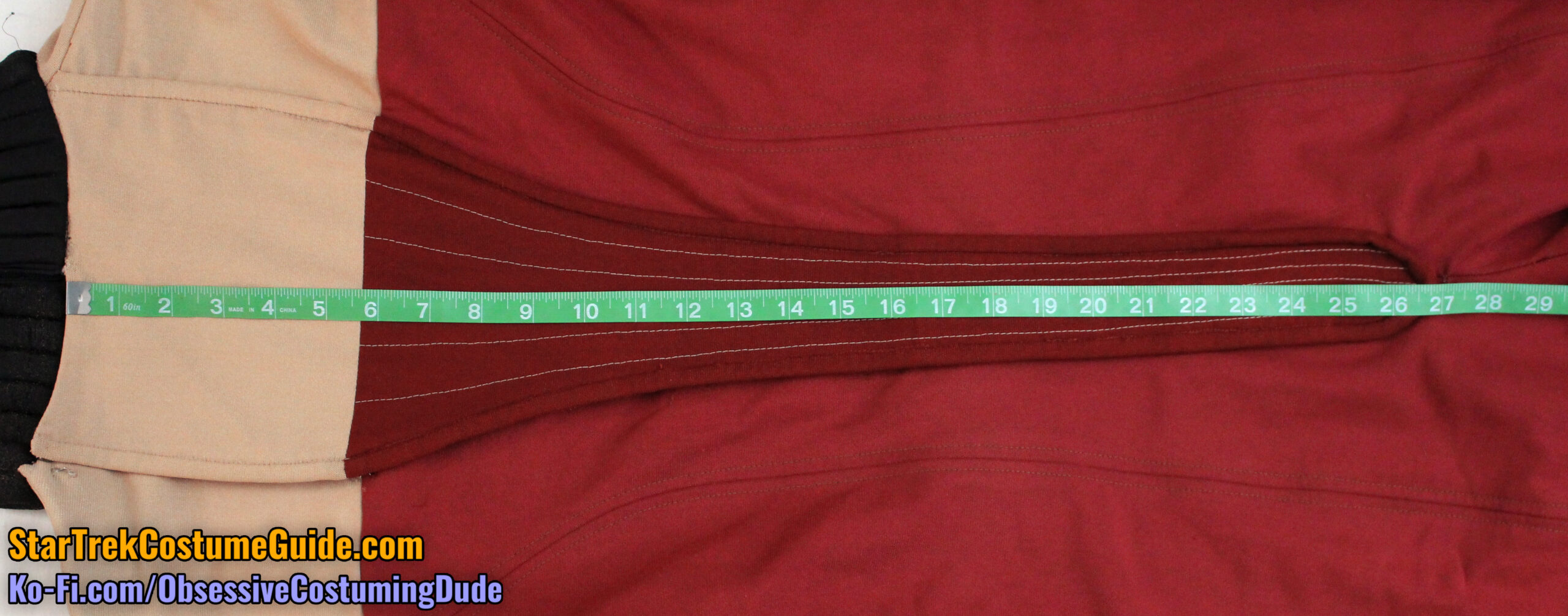
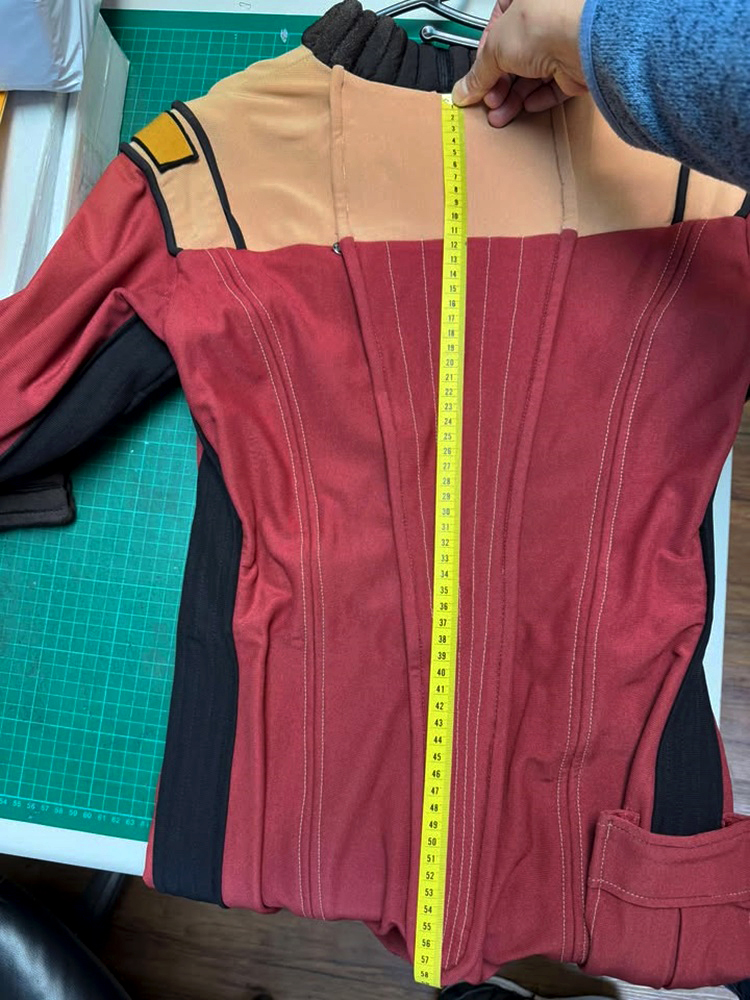
On the men’s screen-used enlisted jumpsuit I examined, the back panel was 27” tall, measured from the neckline to the lower edge at the center back.
However, on the women’s screen-used enlisted jumpsuit Kevin at SB375L studied, the back panel was 59cm, or approximately 23 ¼” tall.
In lieu of any evidence to the contrary, I believe these to have been standard (or at least approximately standard) for each gender.
Photo by Kevin at “Starbase 375 Logistics”
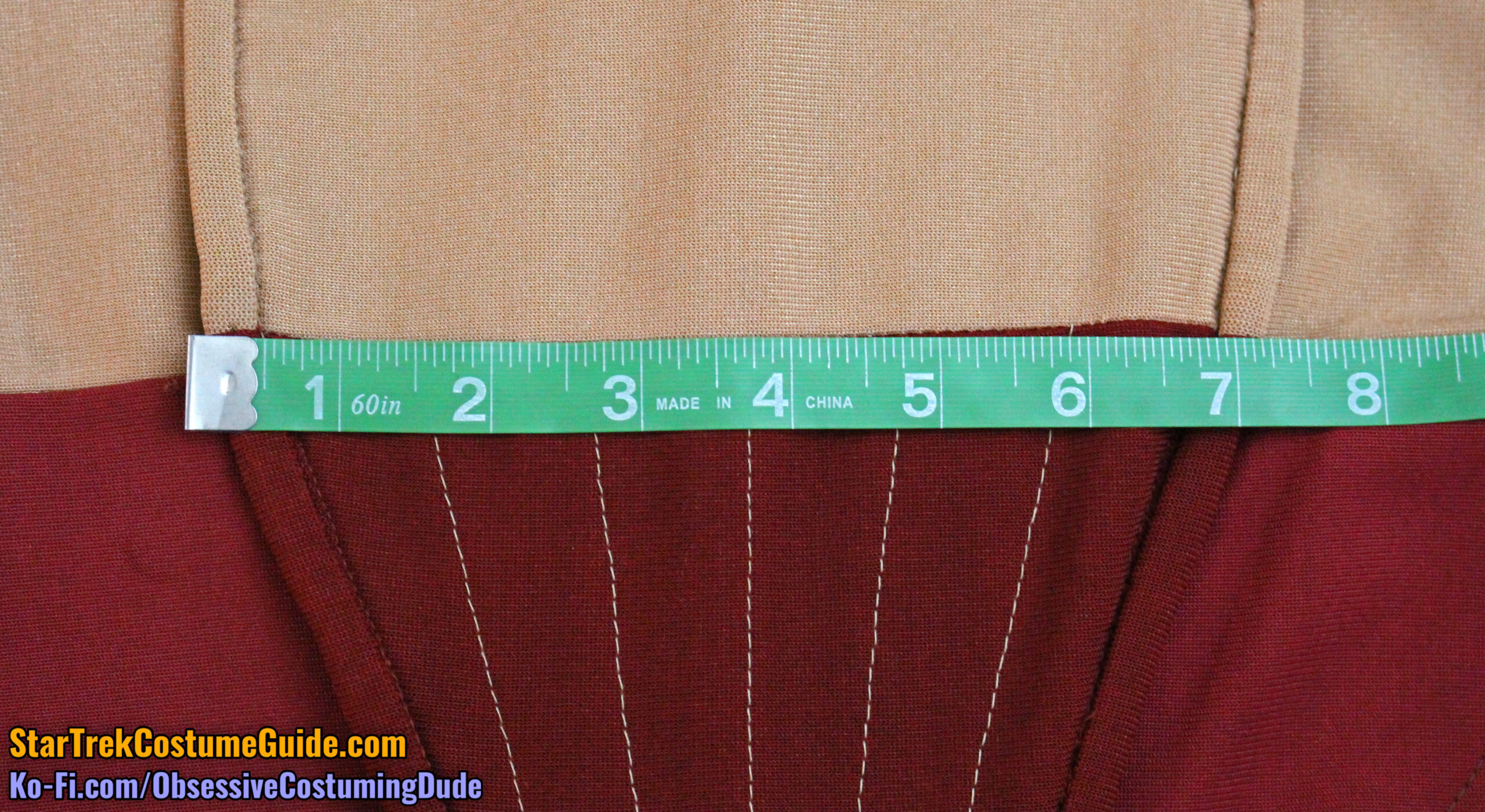
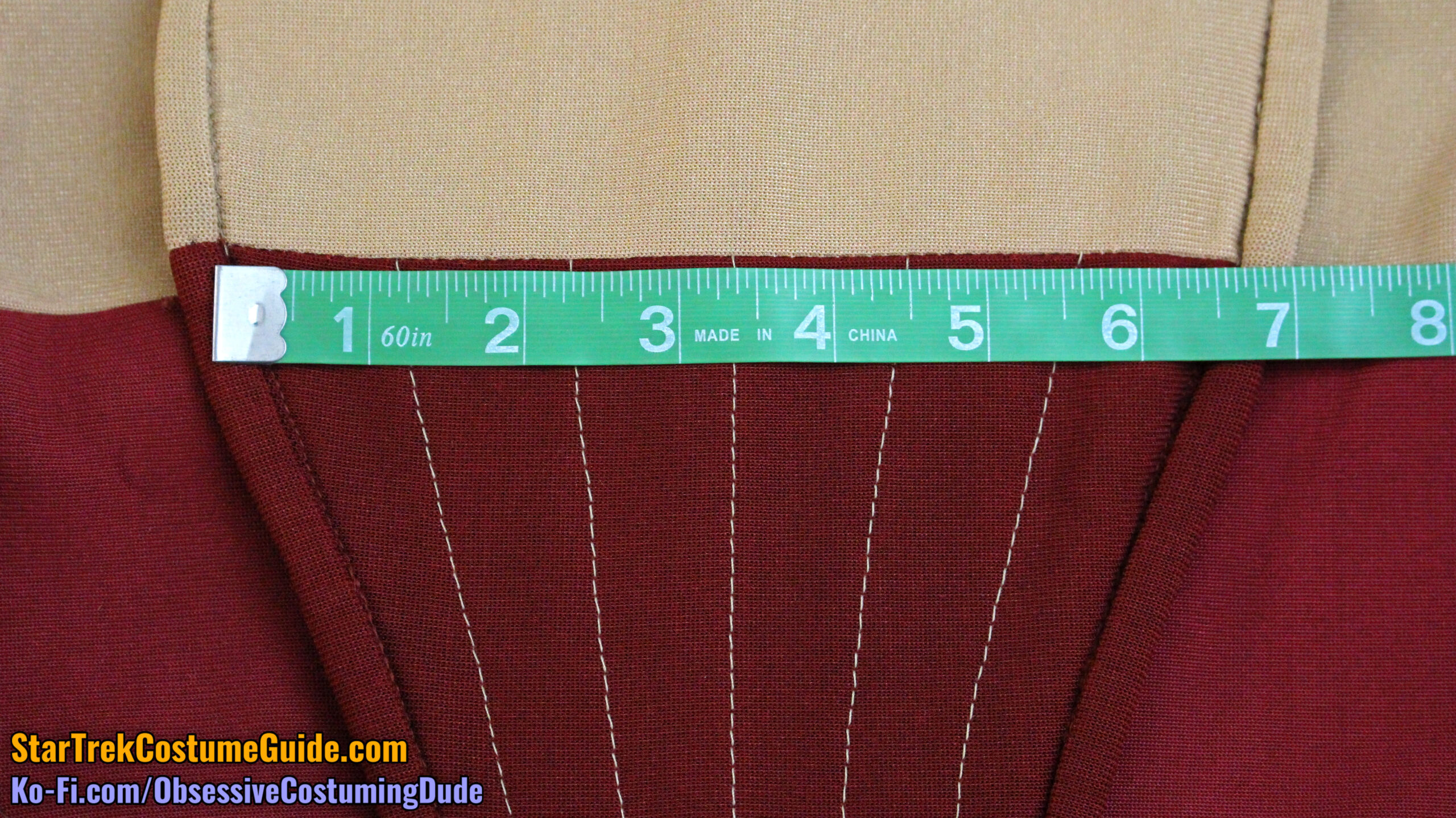
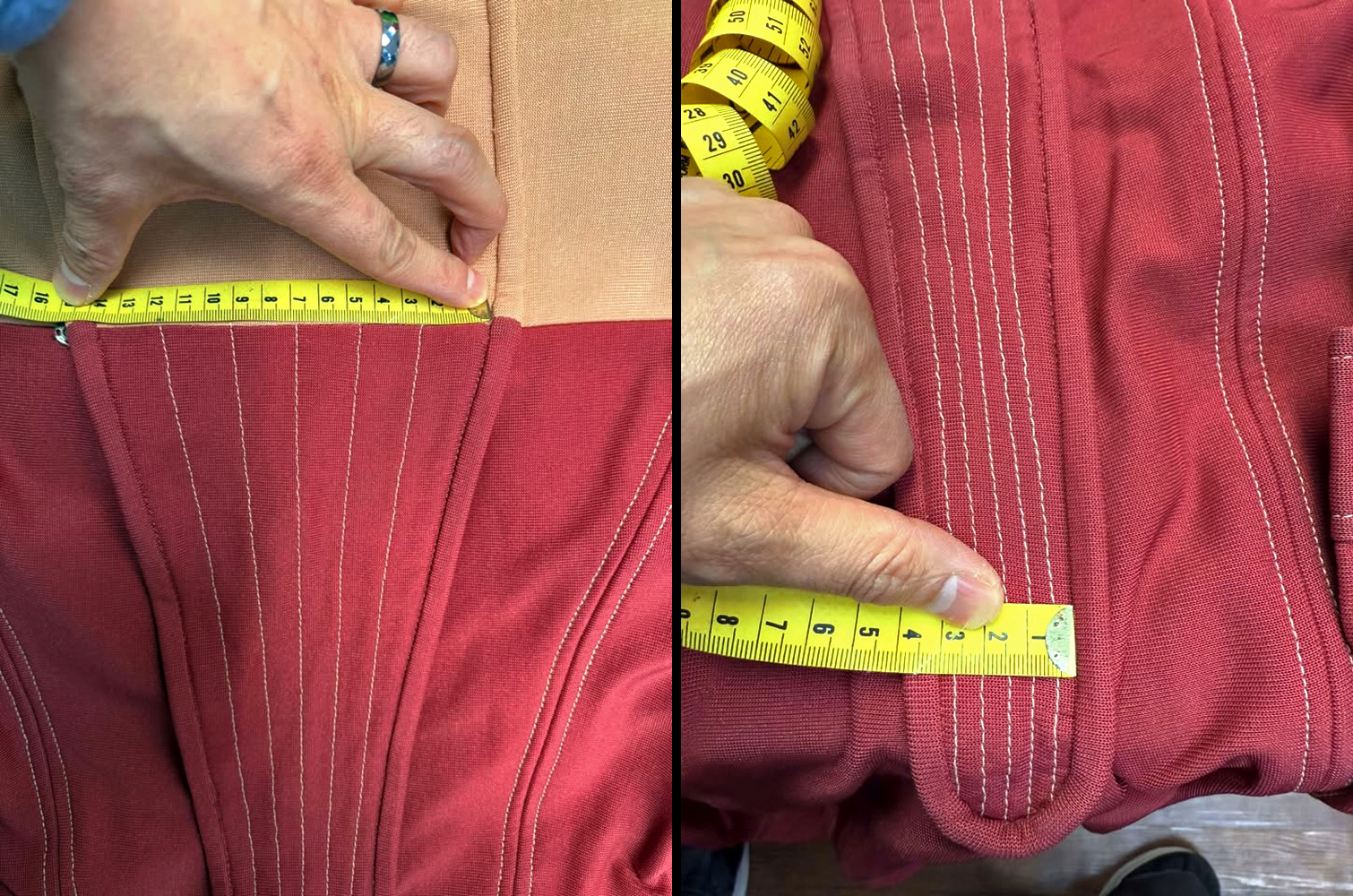
On the screen-used men’s jumpsuit I examined, the back panel was about 7 ¼” wide at the yoke/body seam.
It was about 6 ⅝” wide not including the binding, with five rows of topstitching space approximately 1 ⅛” apart at the seam line.
The panel itself narrowed to about 2 ½” wide at the bottom, and the topstitches narrowed to slightly over ¼” apart.
However, on the screen-used women’s enlisted jumpsuit Kevin studied, the back panel was only about 13.7cm (just under 5 ½”) wide at the seam, not including the binding, and the stitches were about 2.3cm (about ⅞”) apart.
The panel narrowed to 3cm (about 1 ⅛”), not including the binding, and the topstitches tapered down to about 3/16” apart.
Photos by Kevin at “Starbase 375 Logistics”
Again in lieu of any evidence to the contrary, I believe these to have been standard panel/stitching proportions for each gender.
The outer edges of the panel were bound with the same beige and red jumbo spandex as the panel itself.
The binding was cut on the straight grain, not the bias, so even though the spandex would cooperate around most of the panel’s gentle curves, it did not want to lie flat along tighter curve at the bottom.
The panel was fastened to the jumpsuit by a “stitch-in-the-ditch” on the right side, along the edge of the binding – although an opening was left at waist-level for the belt.
Closure System
The enlisted jumpsuit closure system was somewhat involved.
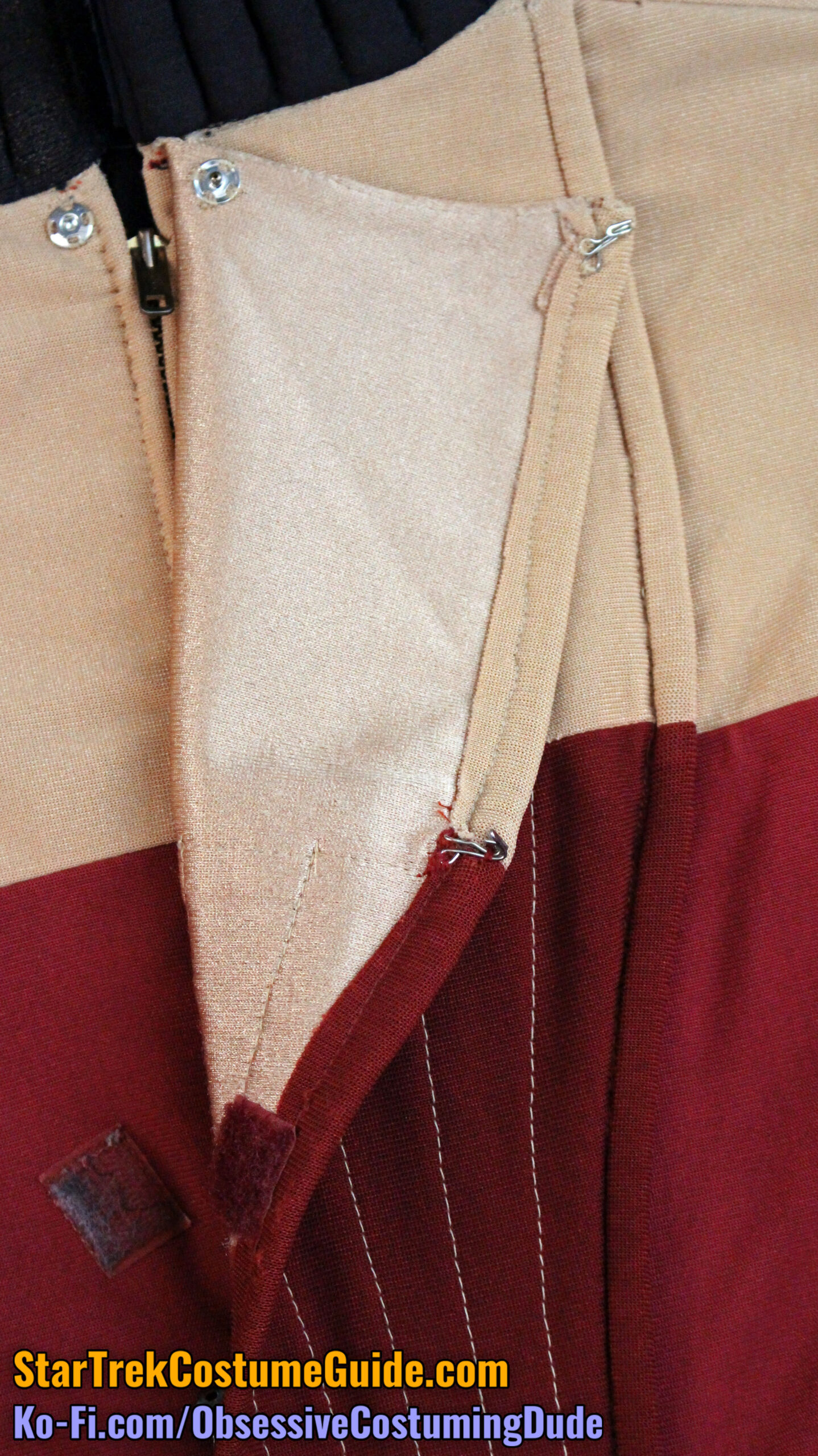
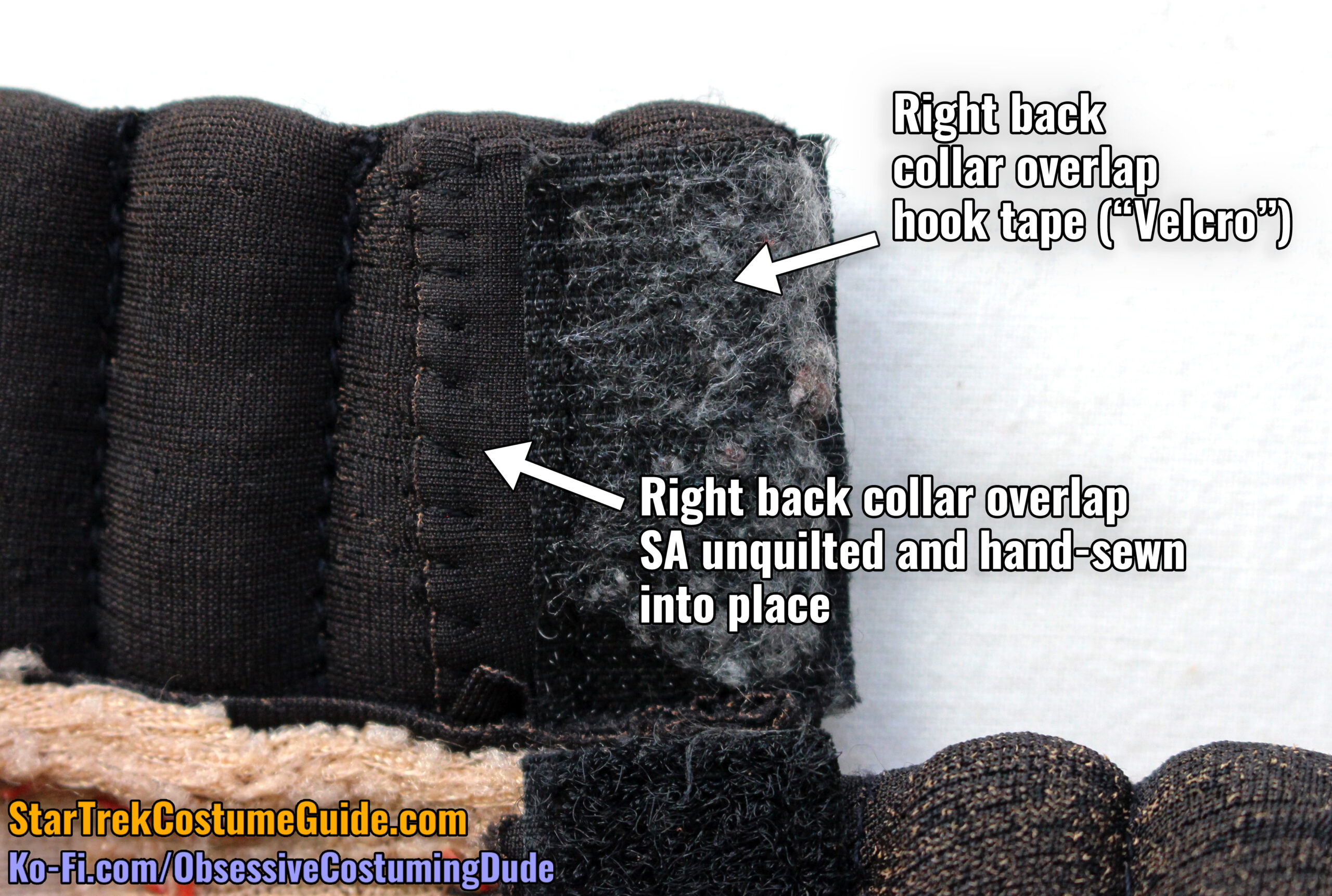
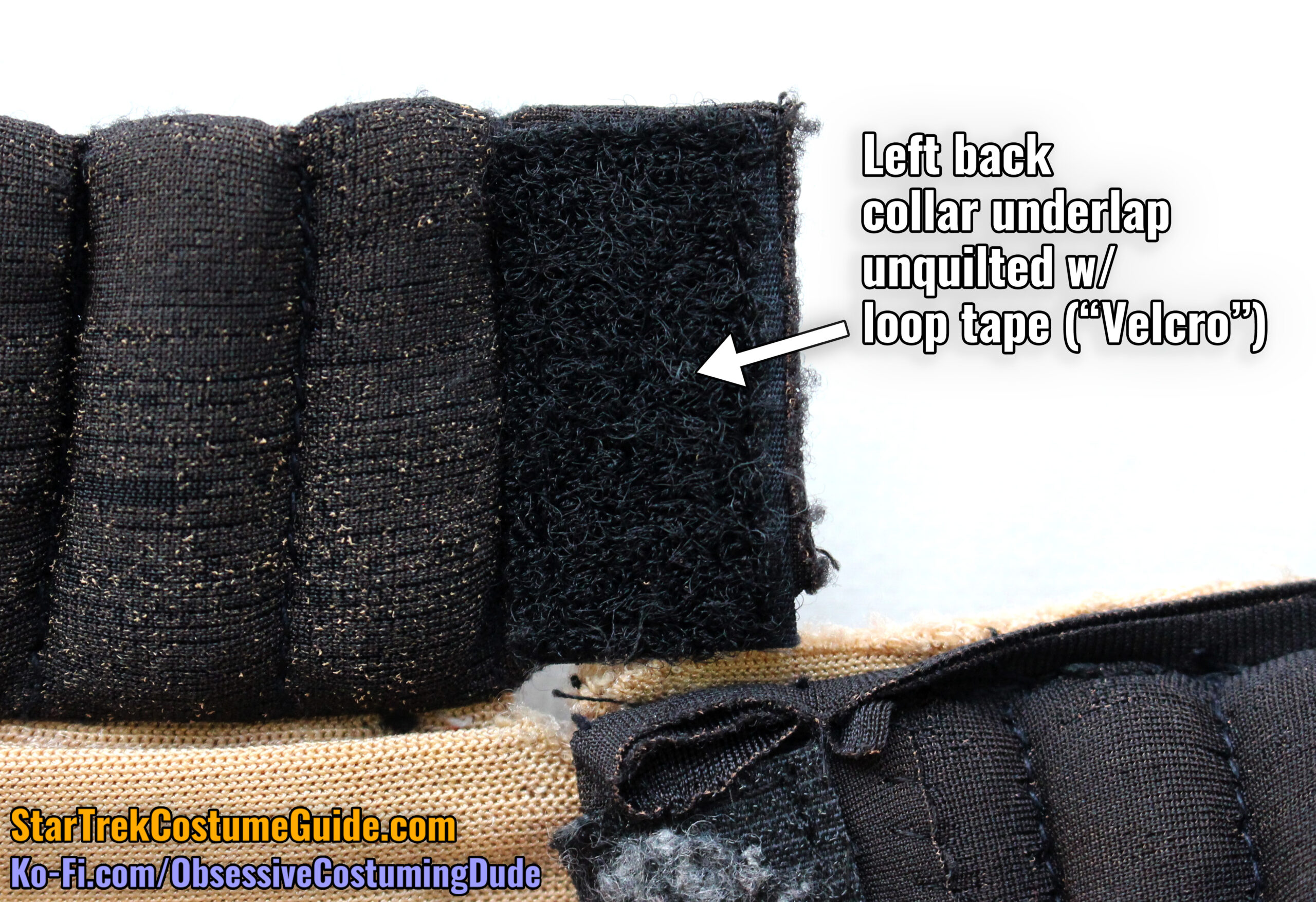
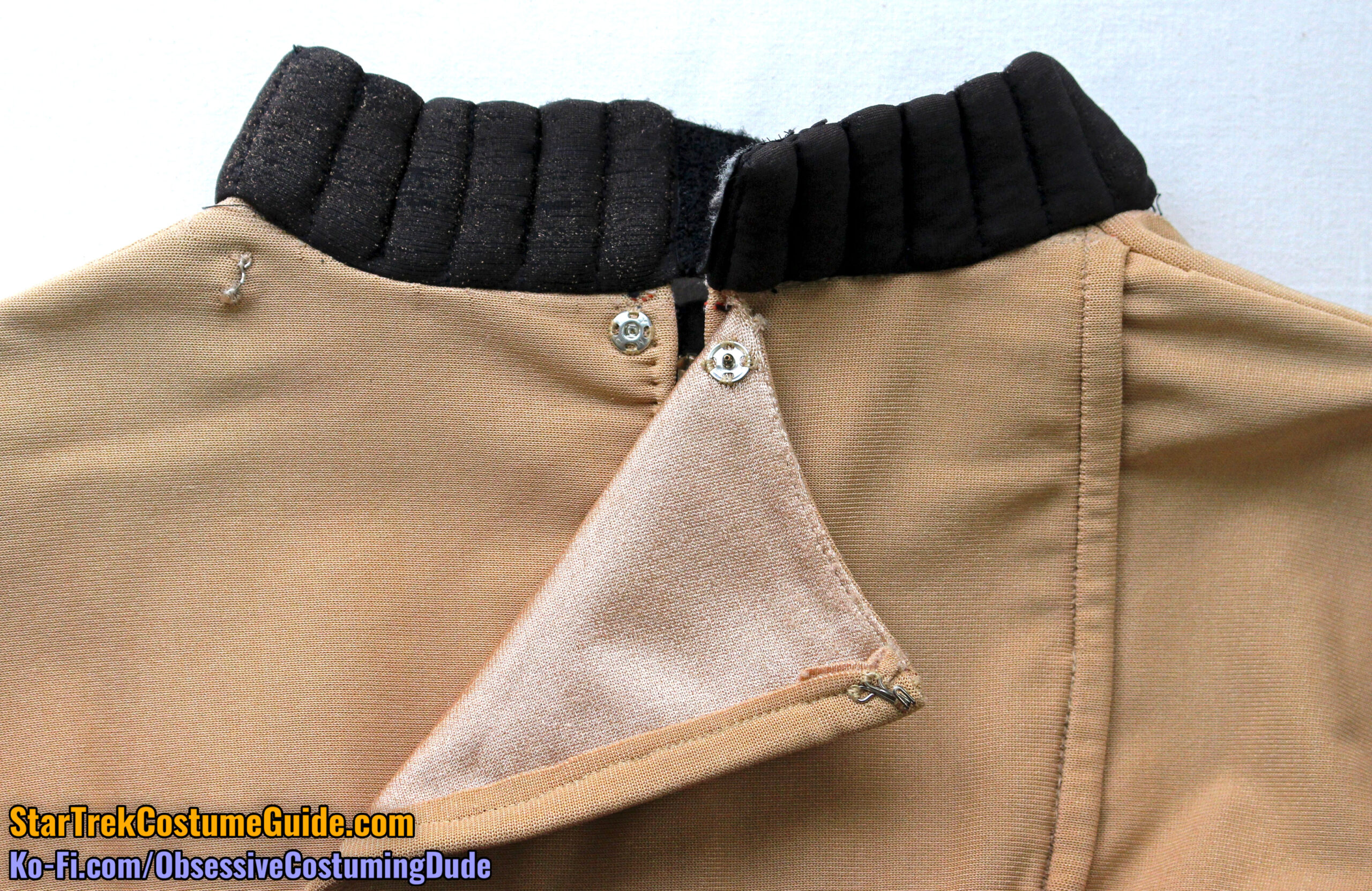
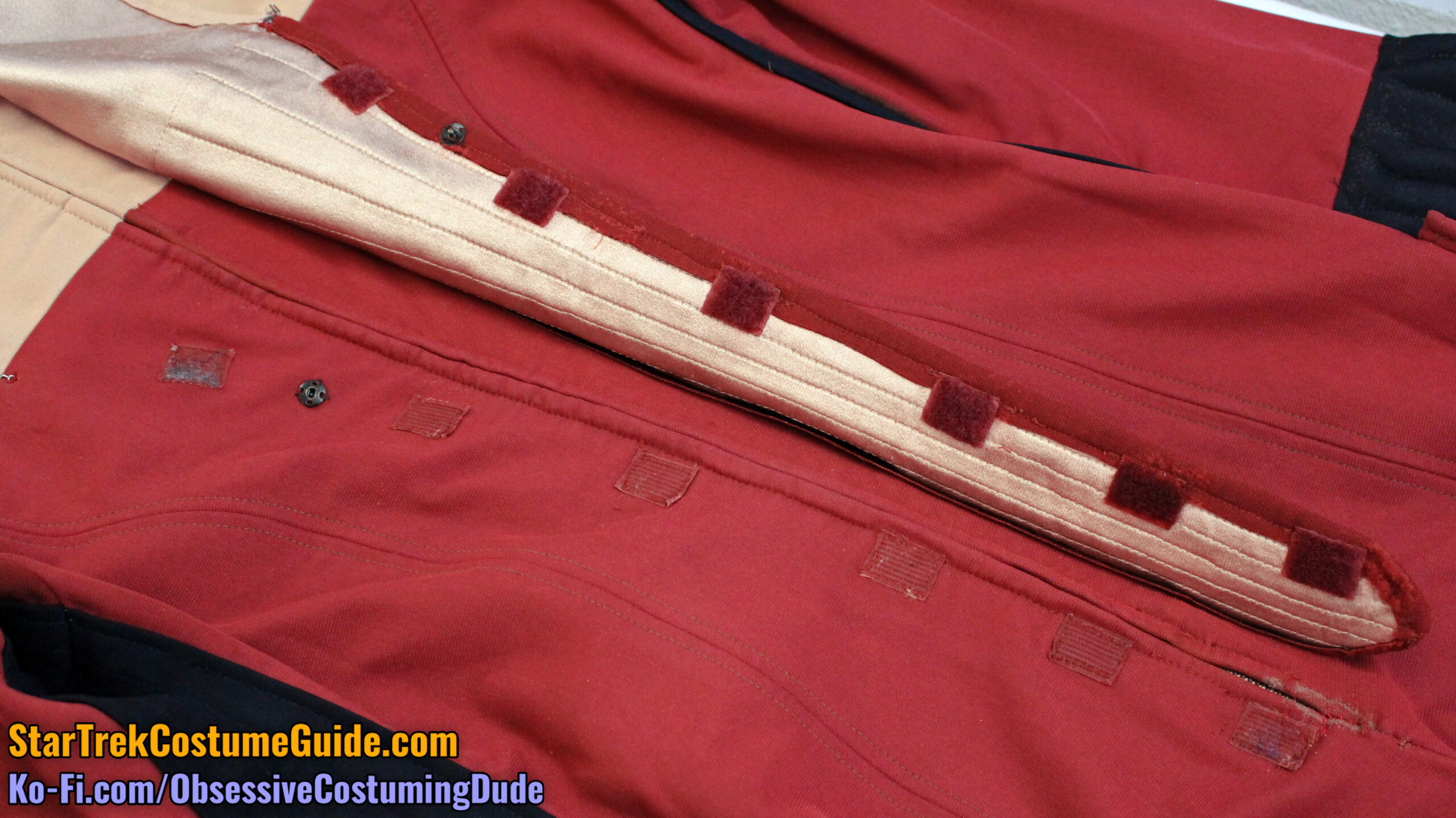
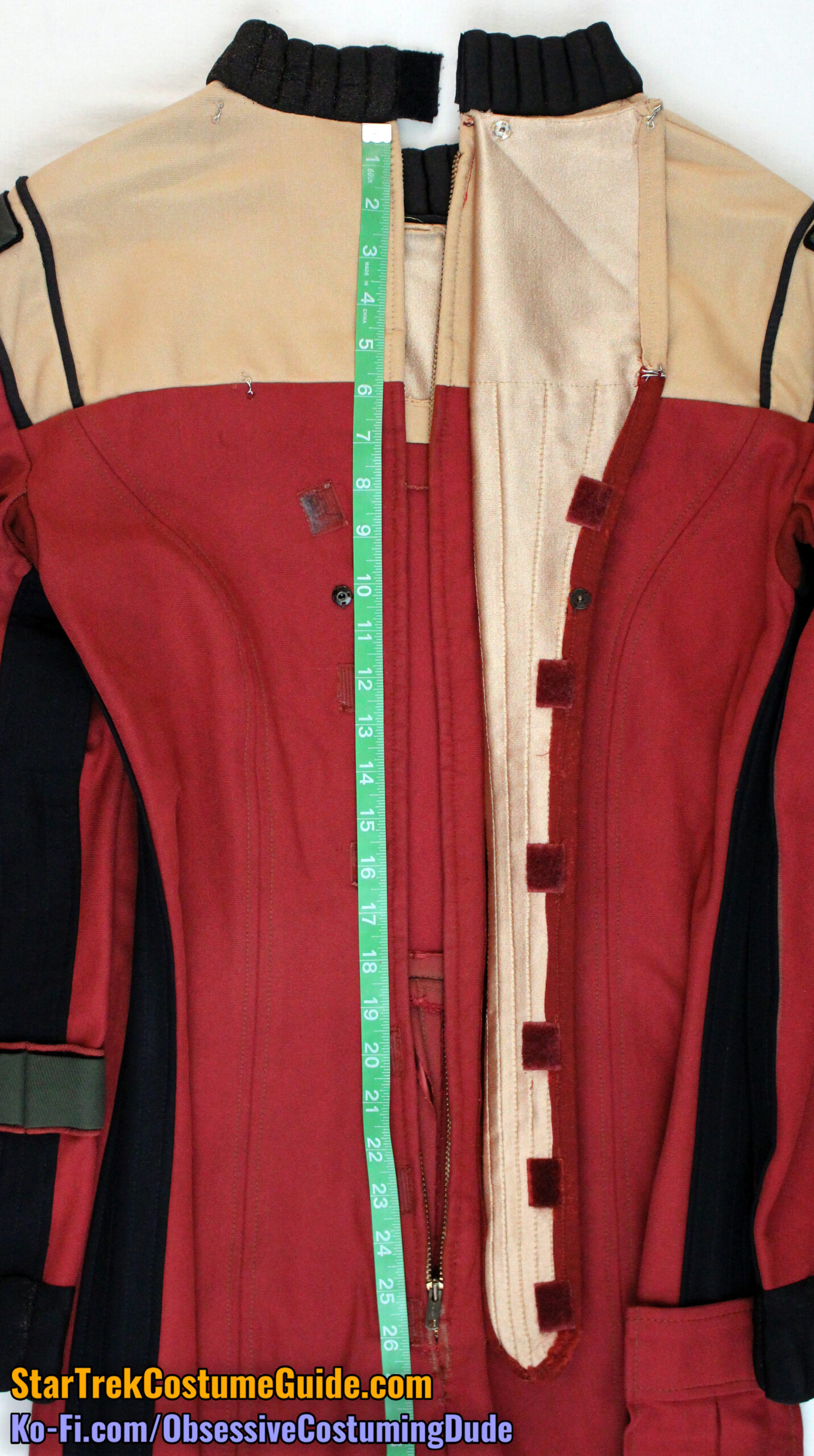
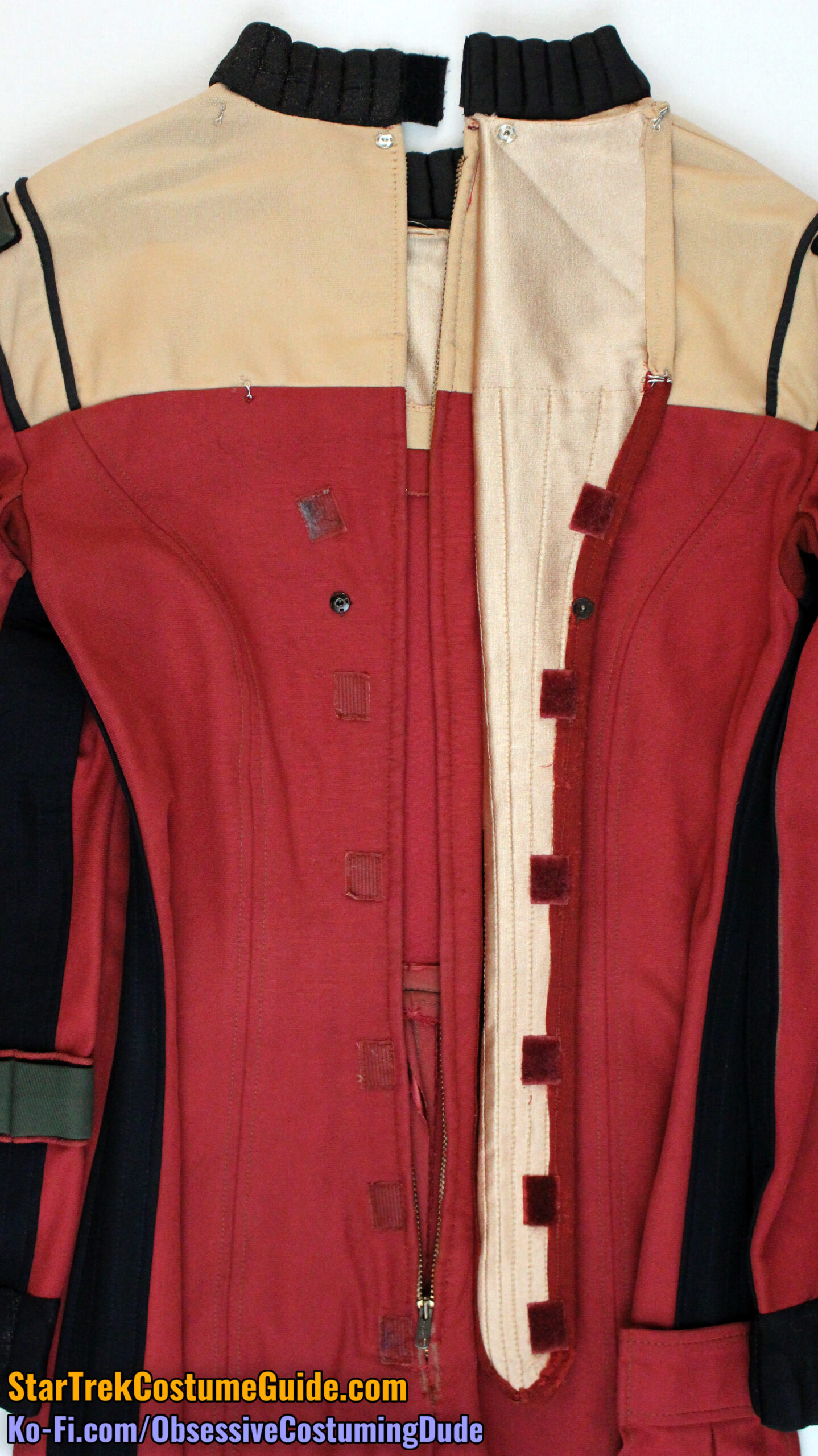
The right back of the collar overlapped the left, and this was fastened closed with black hook-and-loop tape (aka “Velcro”).
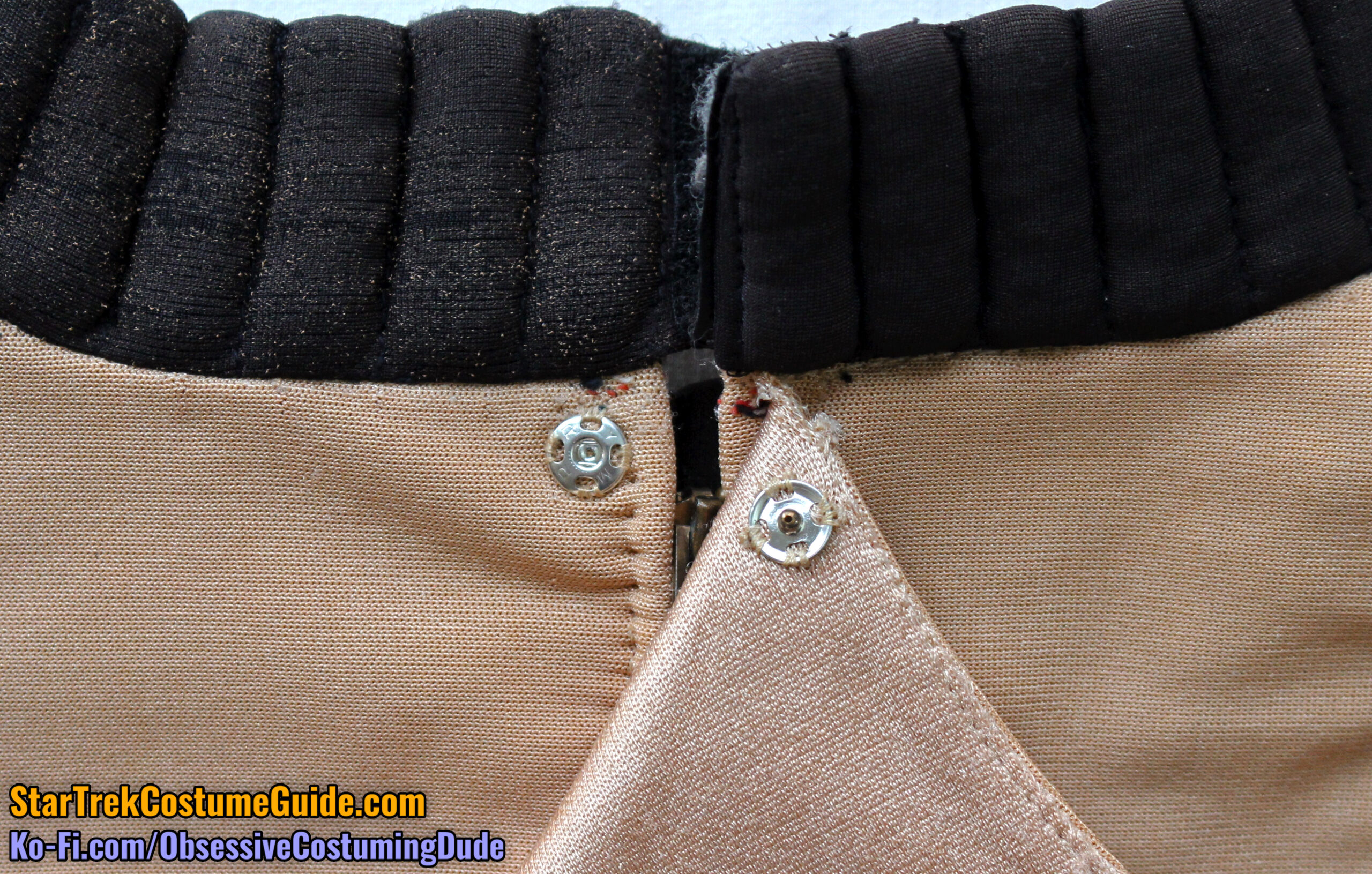
Directly underneath the collar was a small silver snap.
On the upper left corner of the back panel was a hook-and-eye closure.
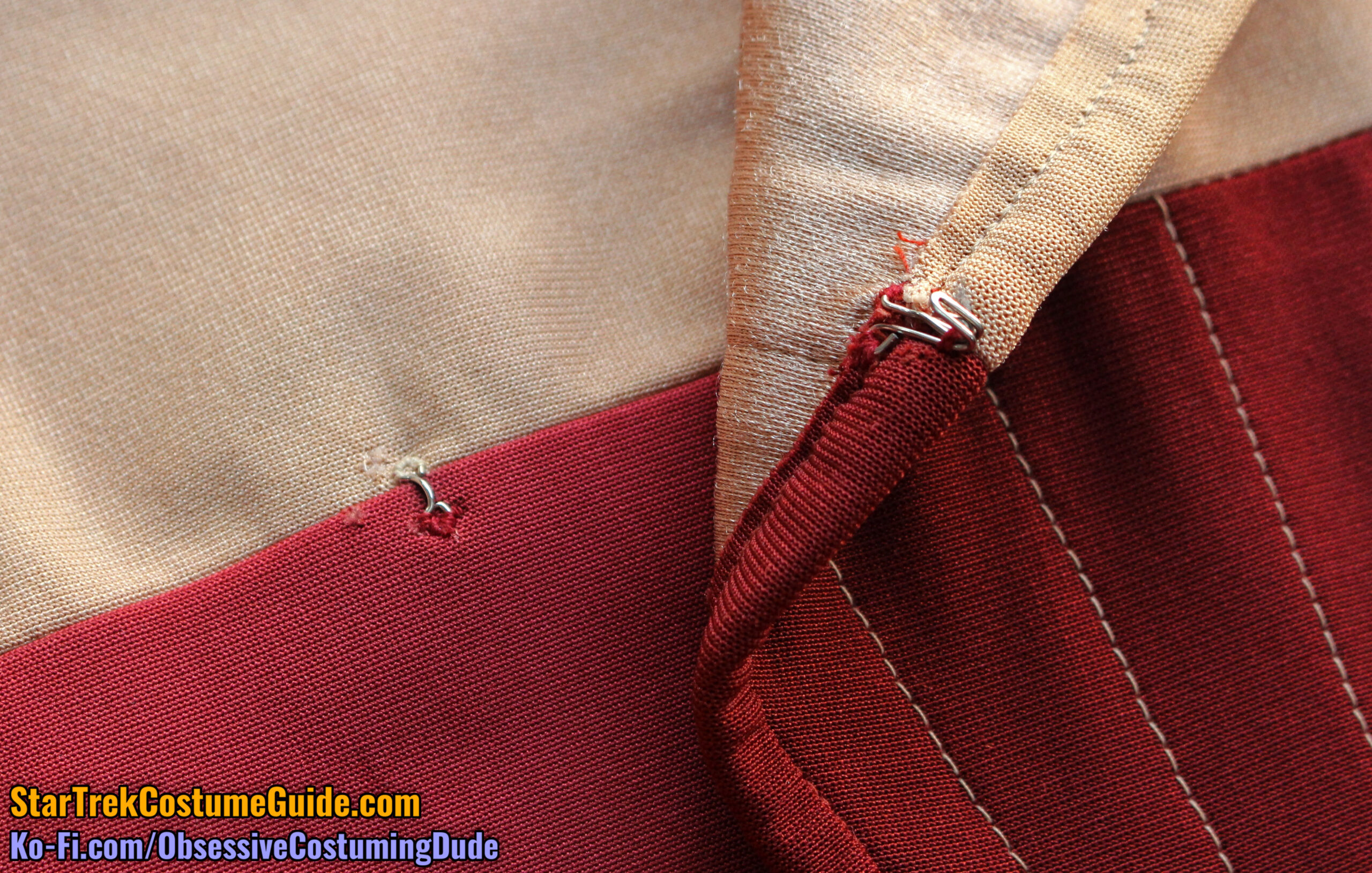
There was another hook-and-eye closure at the yoke/body seam.
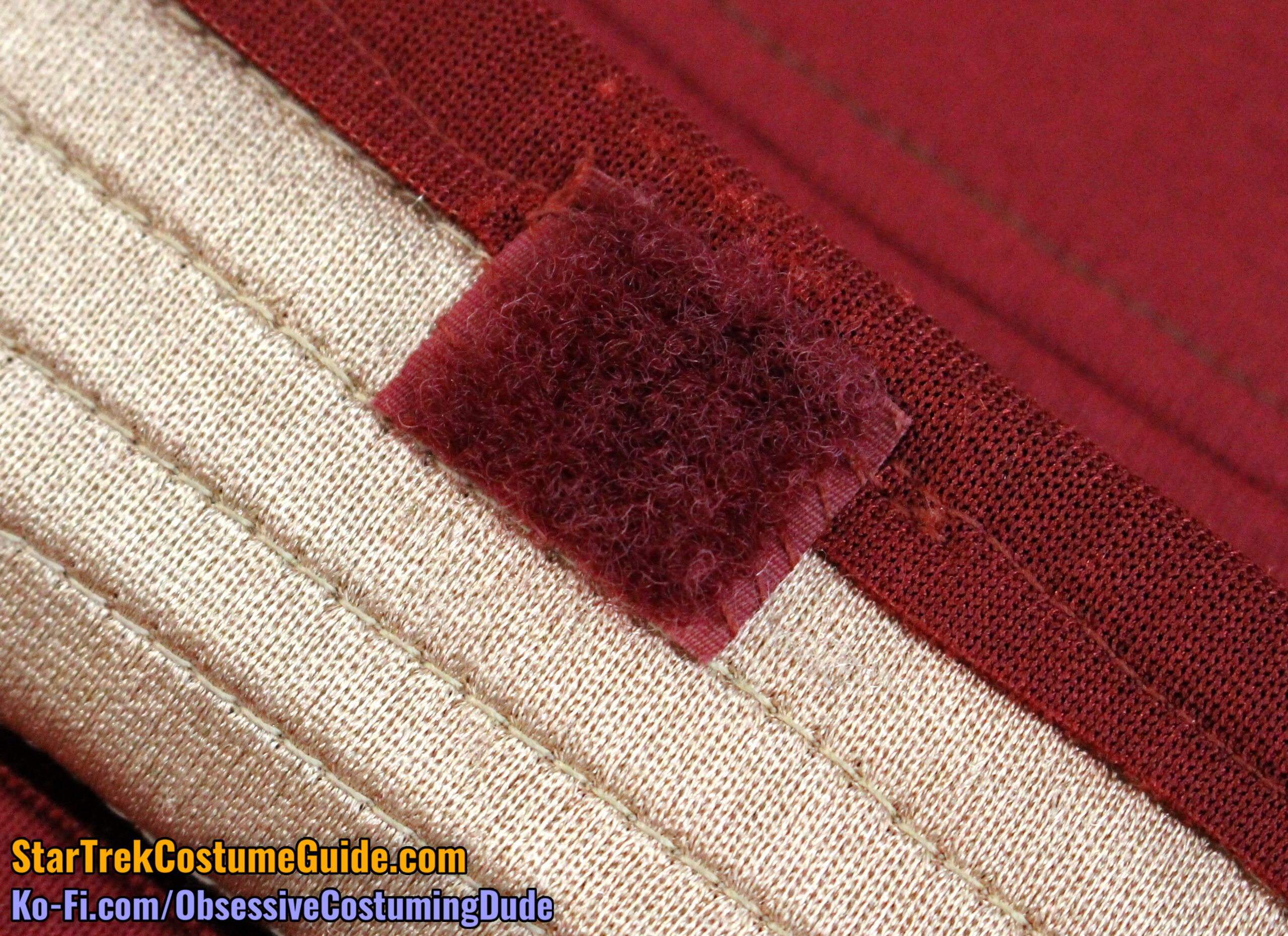
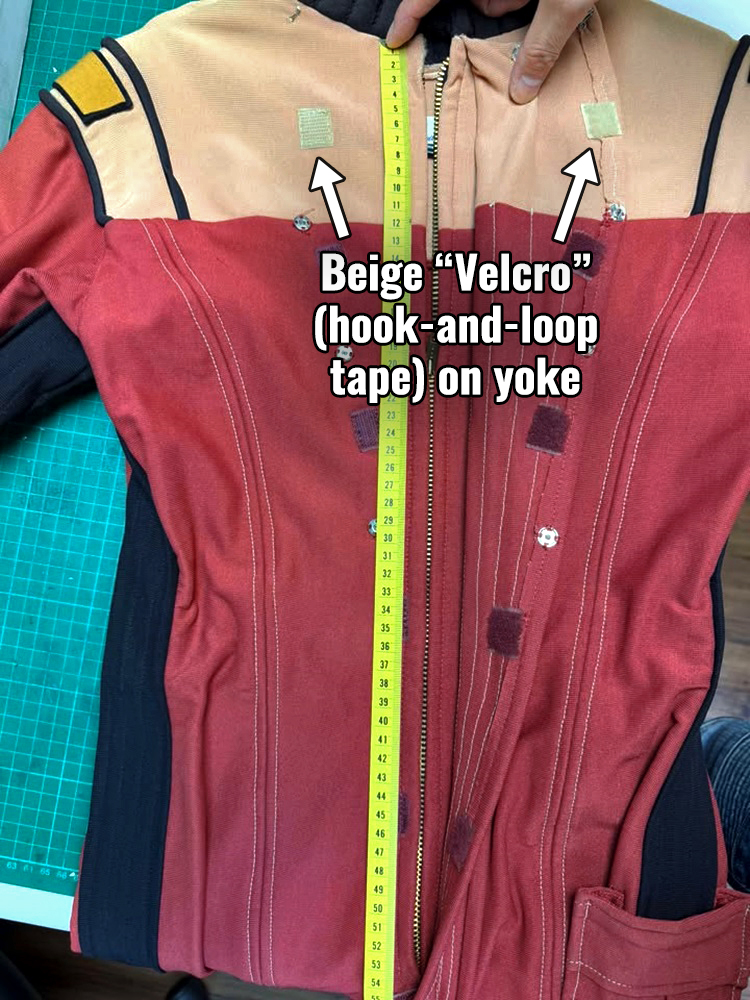
Beneath that were a half-dozen small rectangles of hook-and-loop tape (“Velcro”) along the left edge of the back panel. The uppermost few patches of “Velcro” were about 4” apart, and the lower ones were slightly closer, about 3” apart.
There was also a small black snap between the two uppermost patches of Velcro.
On the back panel these small rectangles were hand-sewn through the facing and binding layers so the stitching wouldn’t be visible on the outside of the panel, but on the jumpsuit body they were machine-sewn into pace.
On the screen-used enlisted jumpsuit Kevin examined, there was also a small patch of beige “Velcro” at the edge of the back panel yoke.
Instead of a hook-and-eye closure at the yoke/body seam, there was a small silver snap, and beneath that there were at least a couple other snaps between the “Velcro” patches.
In this case, I doubt it was a gender standard; I find it more likely that minutiae like this may have been left to the discretion of the individual making it.
Photo by Kevin at “Starbase 375 Logistics”
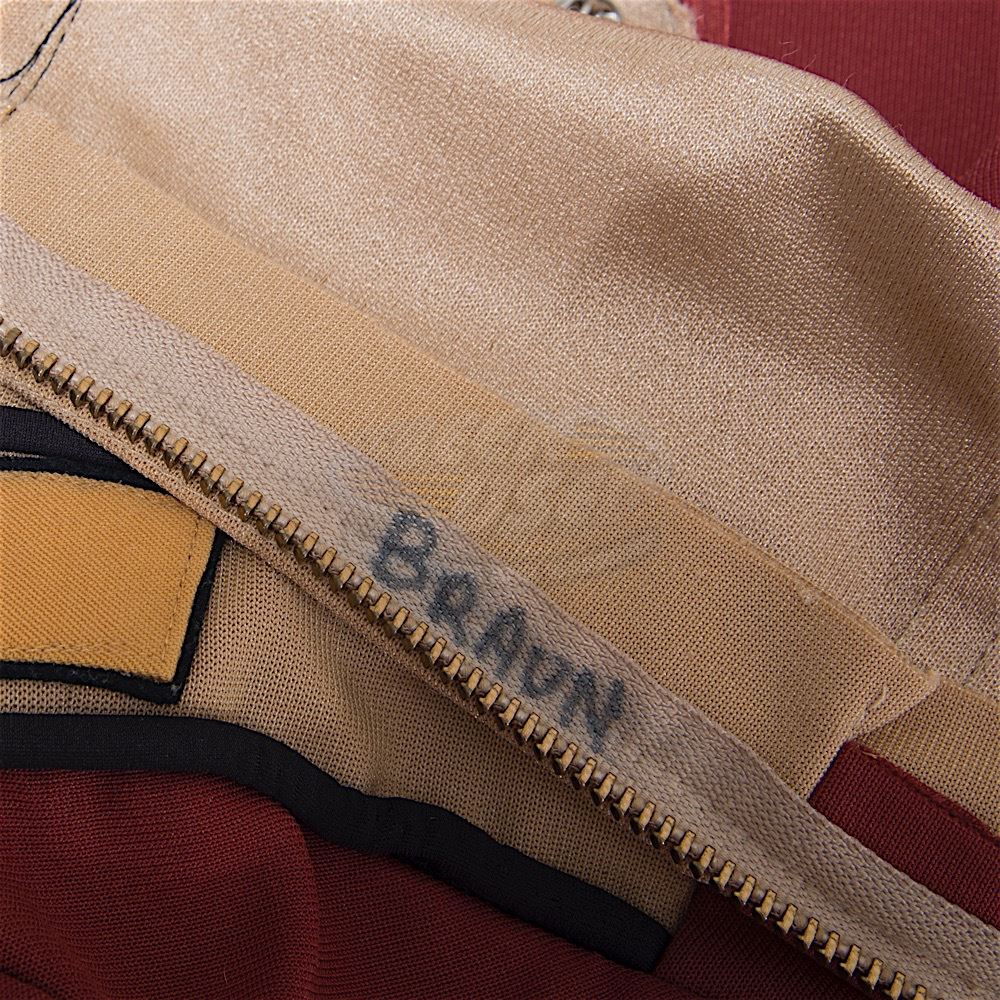
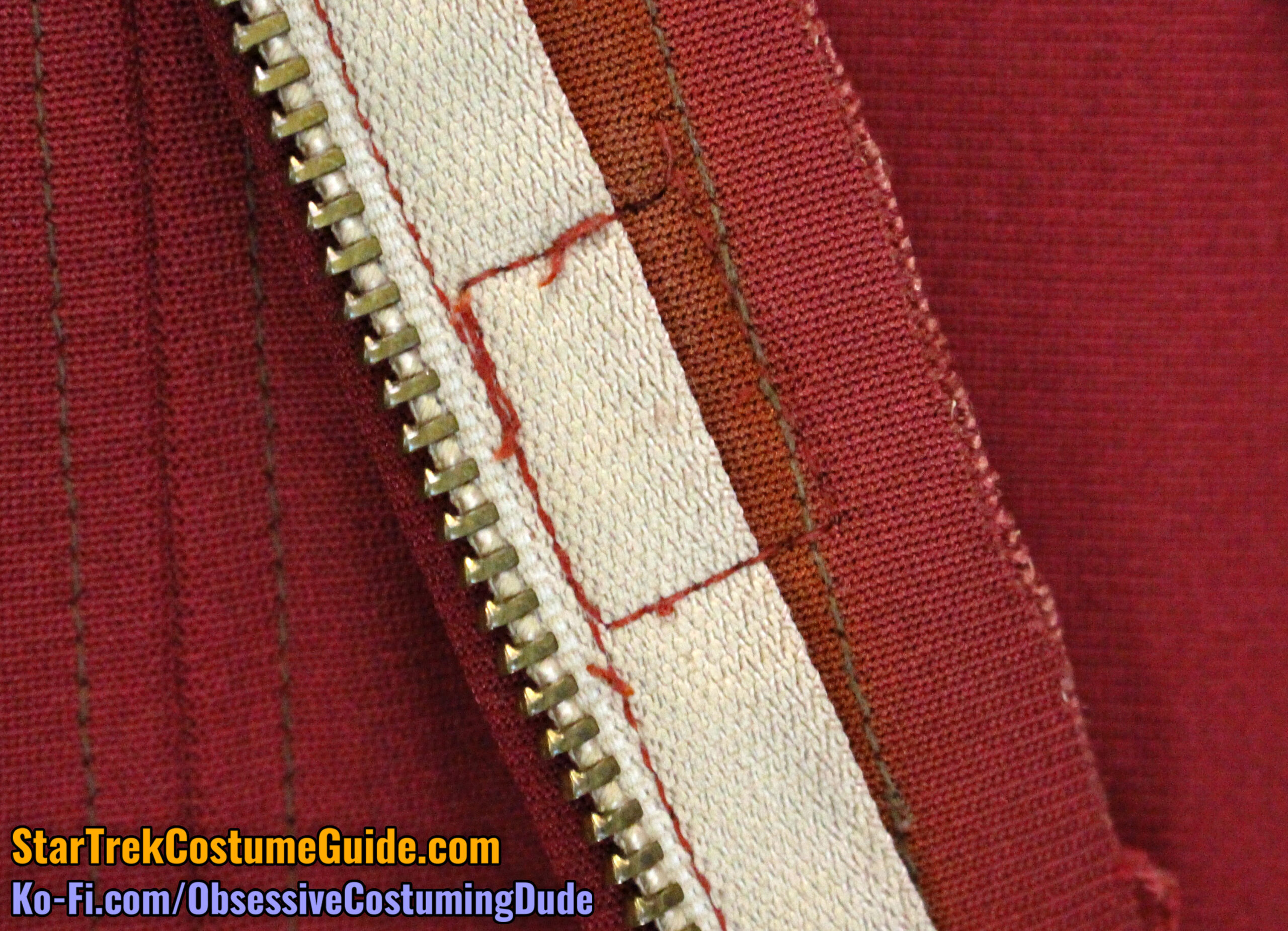
The TMP “Class D” jumpsuits closed up the back via an invisible zipper, but the TWOK enlisted jumpsuits closed via a standard metal zipper.
In this case it wouldn’t have really mattered which type of zipper was used since it was entirely covered by the back panel, so I find it curious that when modifying these for TWOK, the wardrobe team went to the time and effort of replacing the invisible zippers with the standard metal ones.
On the screen-used men’s enlisted jumpsuit I examined, this zipper was about 26” long, although on the screen-used women’s jumpsuit Kevin examined, the zipper was only about 54cm (21 ¼”) long.
Here’s what the back of the jumpsuit looks like with all the closures undone.
On both of the aforementioned jumpsuits, as well as the two pictured below, the center back/zipper allowances were fairly large, about a full inch.
TWOK-era enlisted jumpsuit auction photos
Rank Insignia
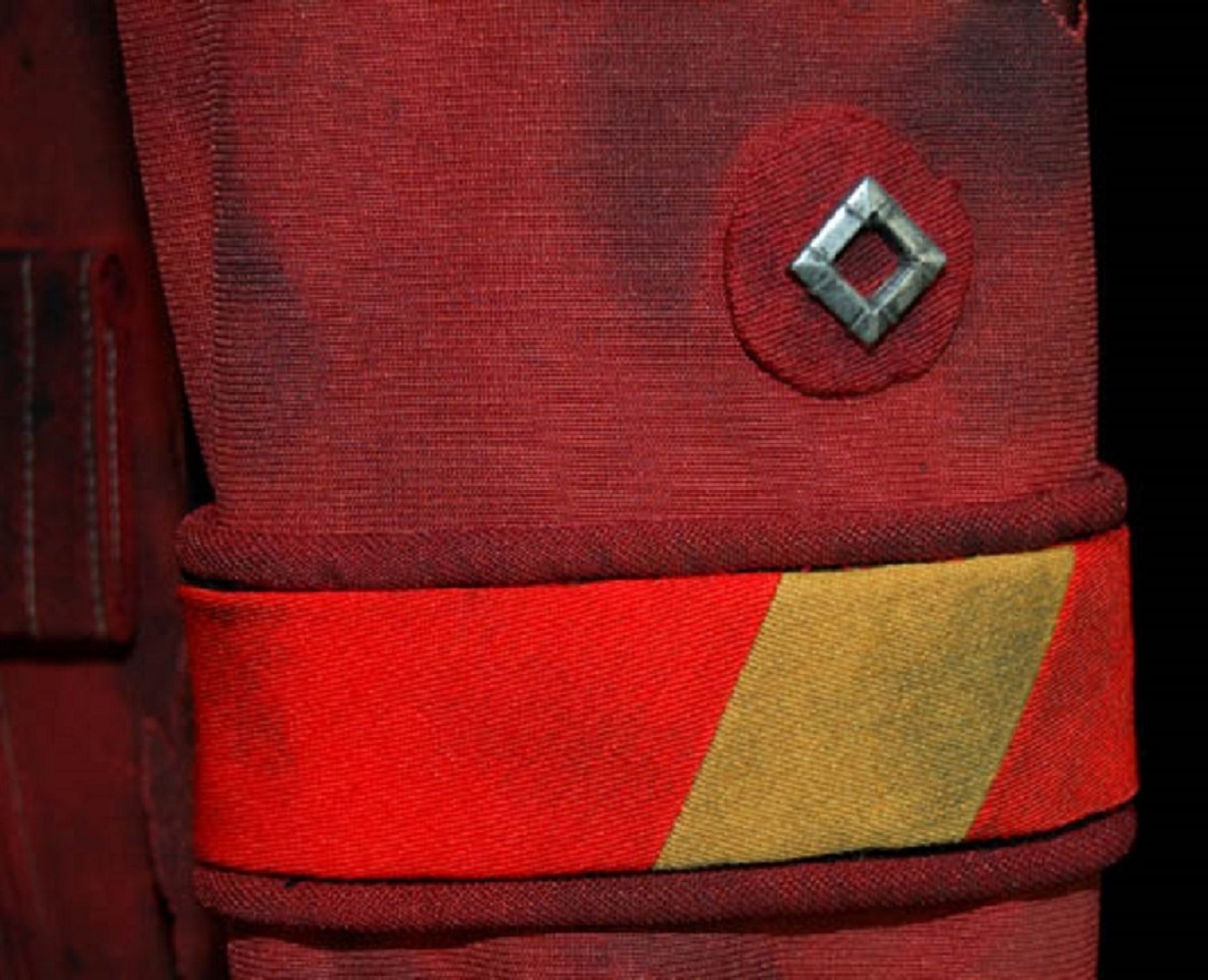
The wearer’s rank and division were indicated on the lower left sleeve, just like on the “monster maroon” jackets and many other uniforms of the era.
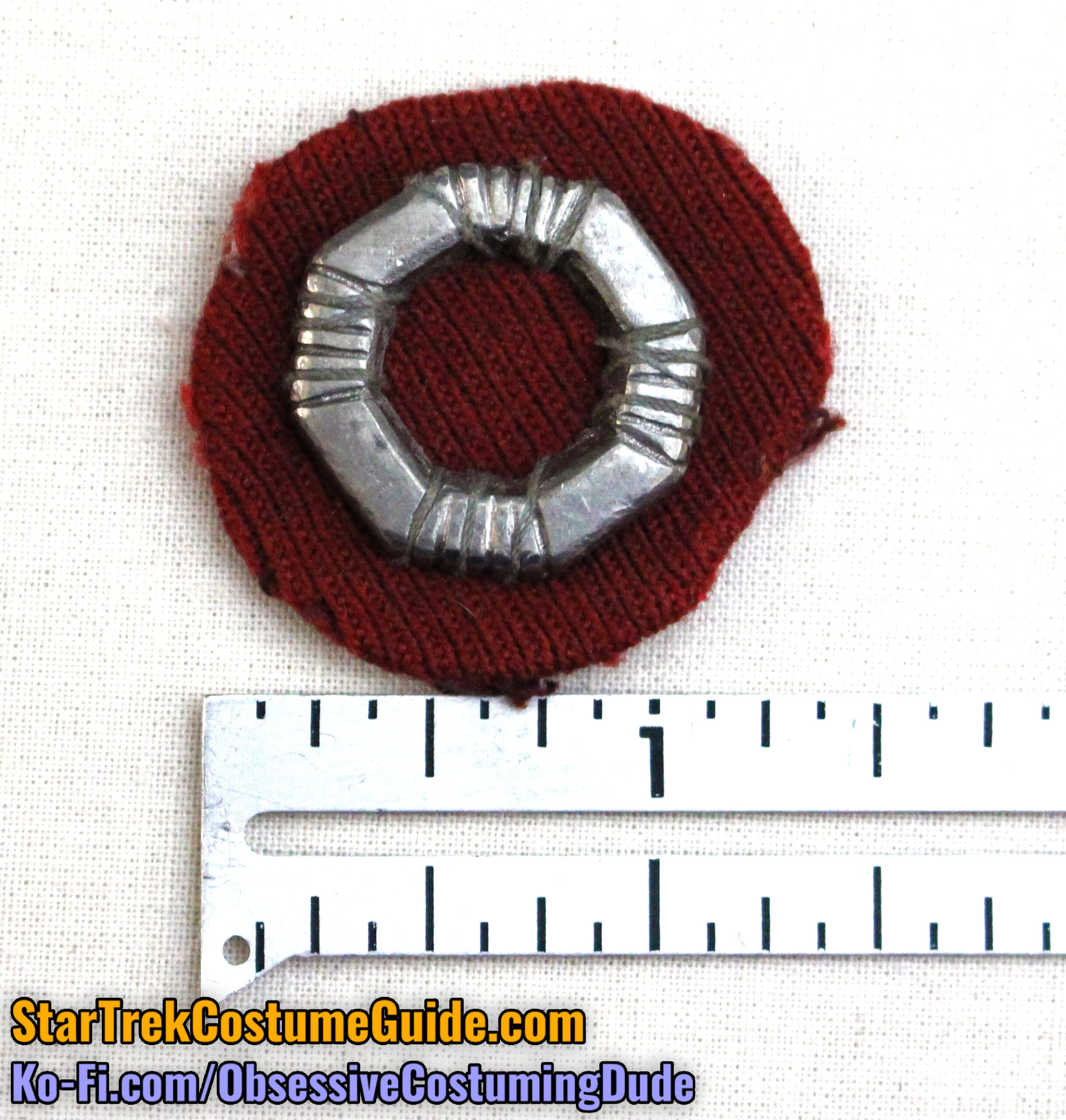
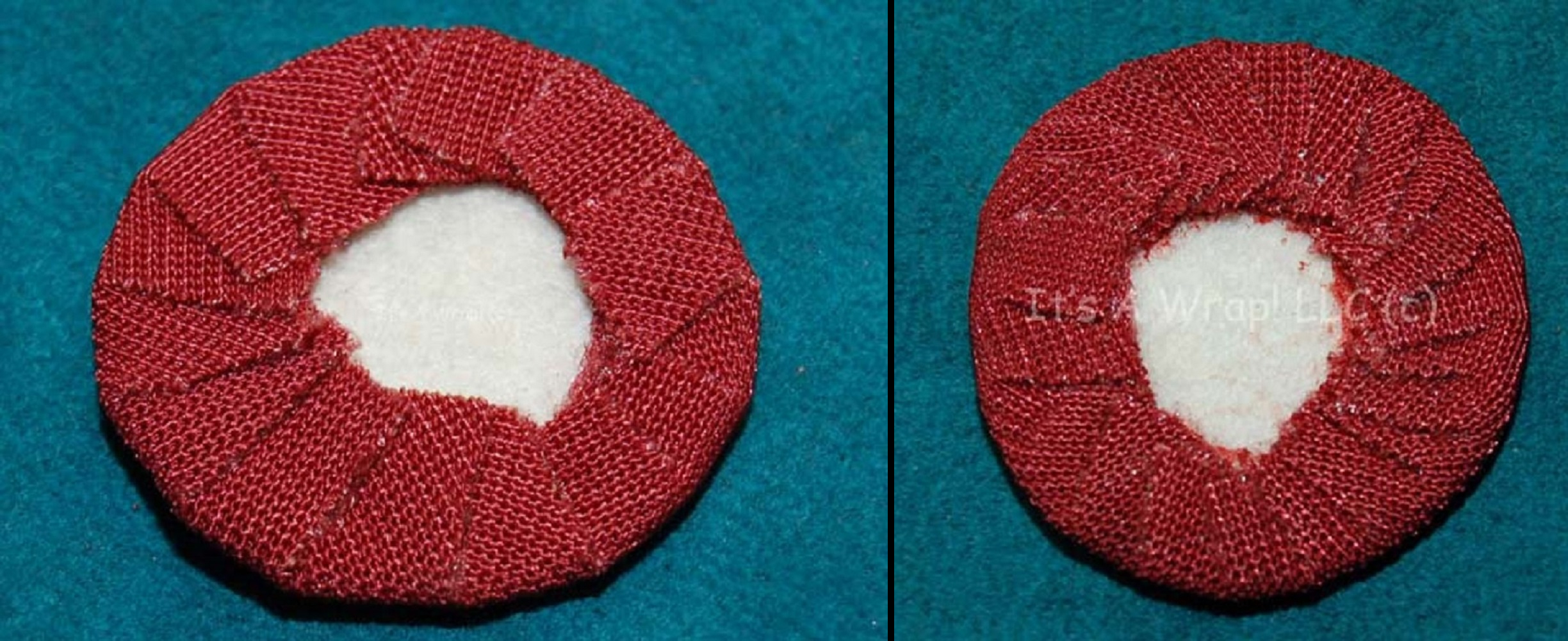
The rank mounts (also called “rank beds” and “rank pillows”) were circular and made from the same red spandex as the jumpsuit body.
TWOK-era enlisted jumpsuit auction photos
However, some wool rank mounts (intended for use on the officers’ “monster maroon” jackets) did sometimes accidentally make their way onto the enlisted jumpsuits.
TWOK-era enlisted jumpsuit auction photos
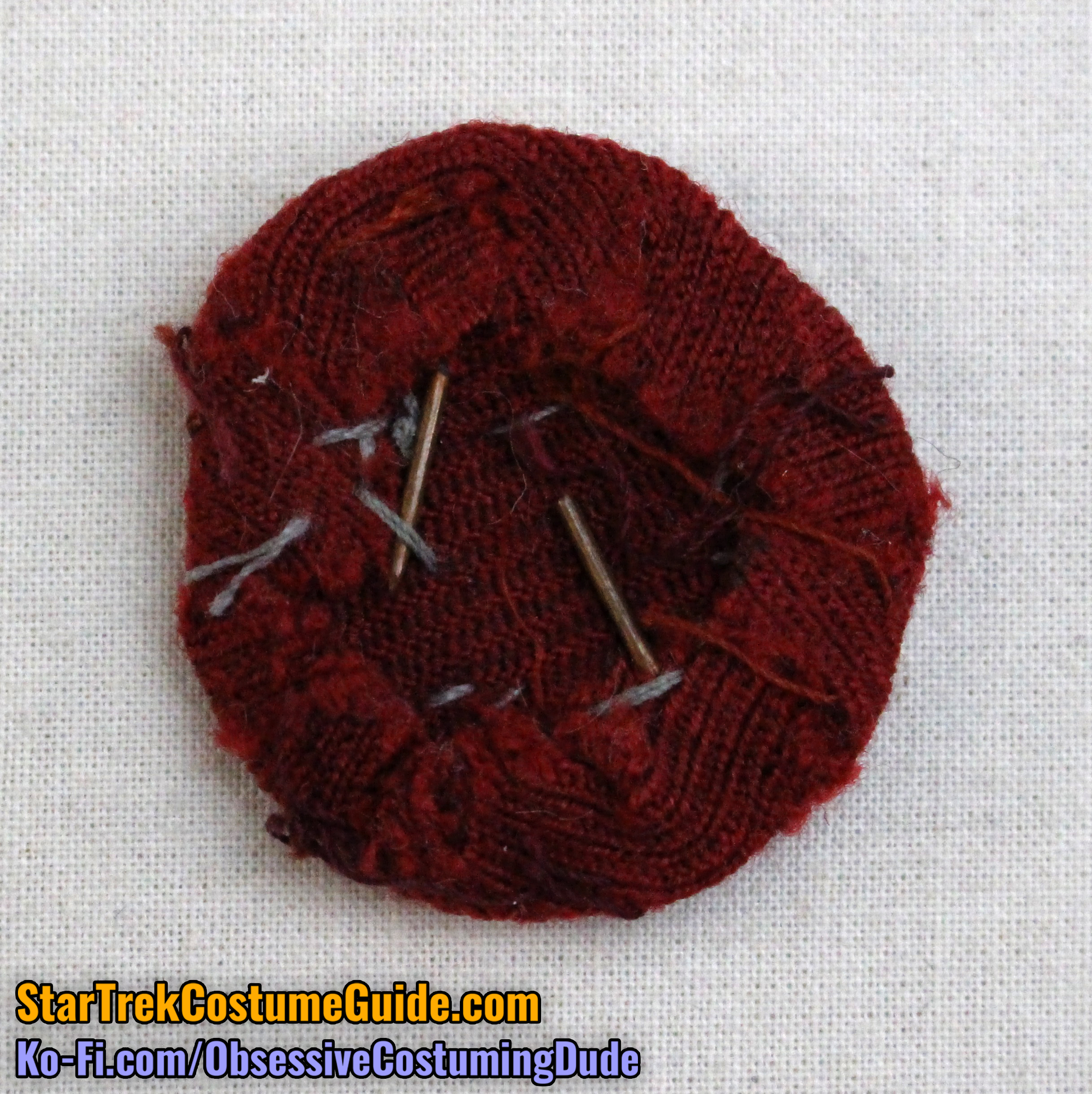
The rank mount on the screen-used enlisted jumpsuit I examined was wool cavalry twill, and it measured about 1 ⅜” in diameter (although it was a pretty uneven circle).
For what it’s worth, most auction listings for these mention the diameter being 1 ½”.
These were usually backed with a layer of felt (or possibly flannel) like the officers’ were; the allowances were turned under a little at a time and glued into place.
TWOK-era enlisted jumpsuit auction photos
The one I studied had no felt backing; it was just the single layer of wool.
The allowances may have been hand-sewn into place instead of glued; it was difficult to tell for sure since the edges of the wool fabric had unraveled.
Also note the hand-stitching that anchored the rank insignia into place, in the previous and following photos:
TWOK-era enlisted jumpsuit auction photos
Not all of them had this additional hand-sewing, though.
TWOK-era enlisted jumpsuit auction photos
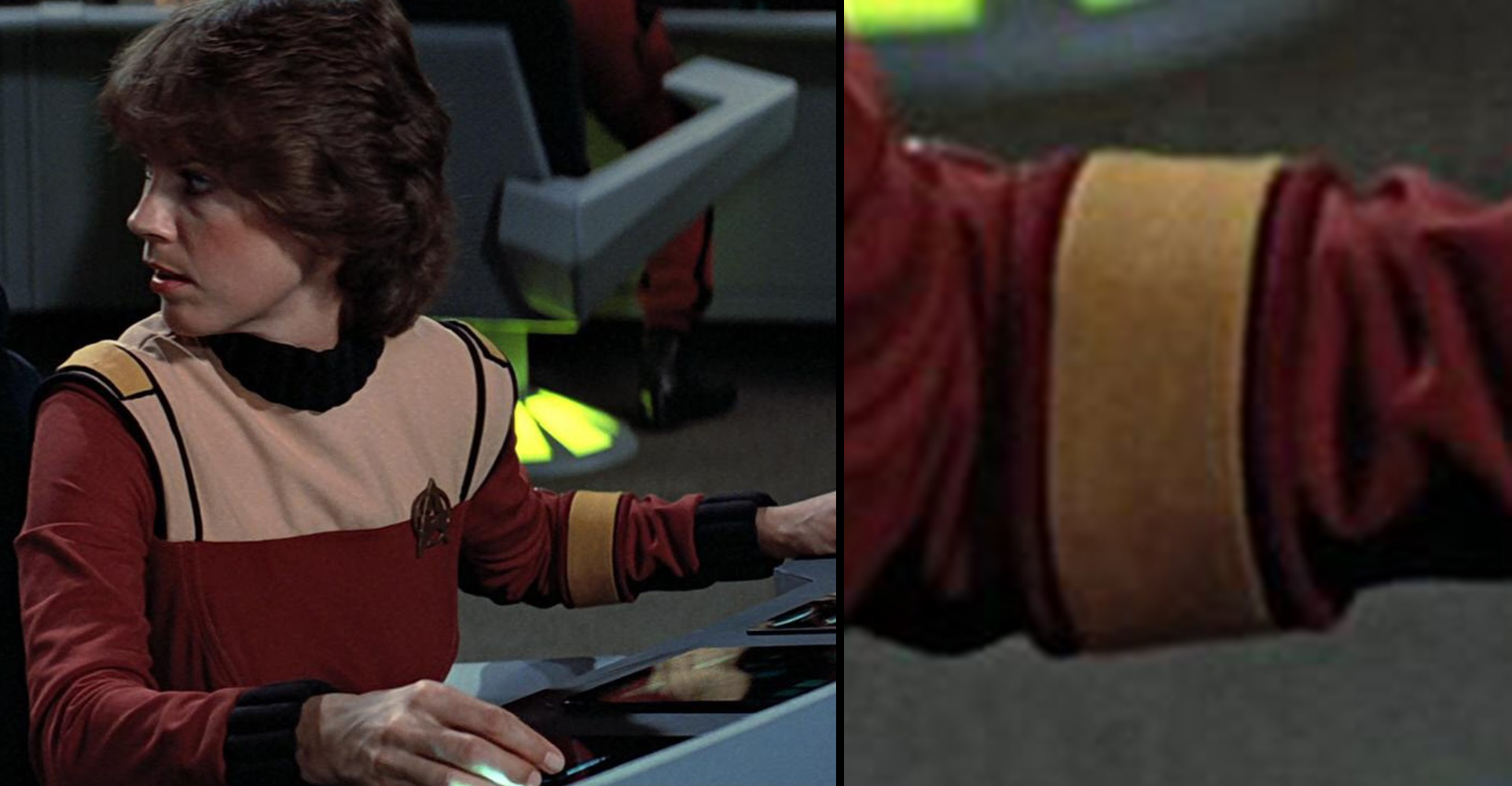
Left Division Sleeve Band
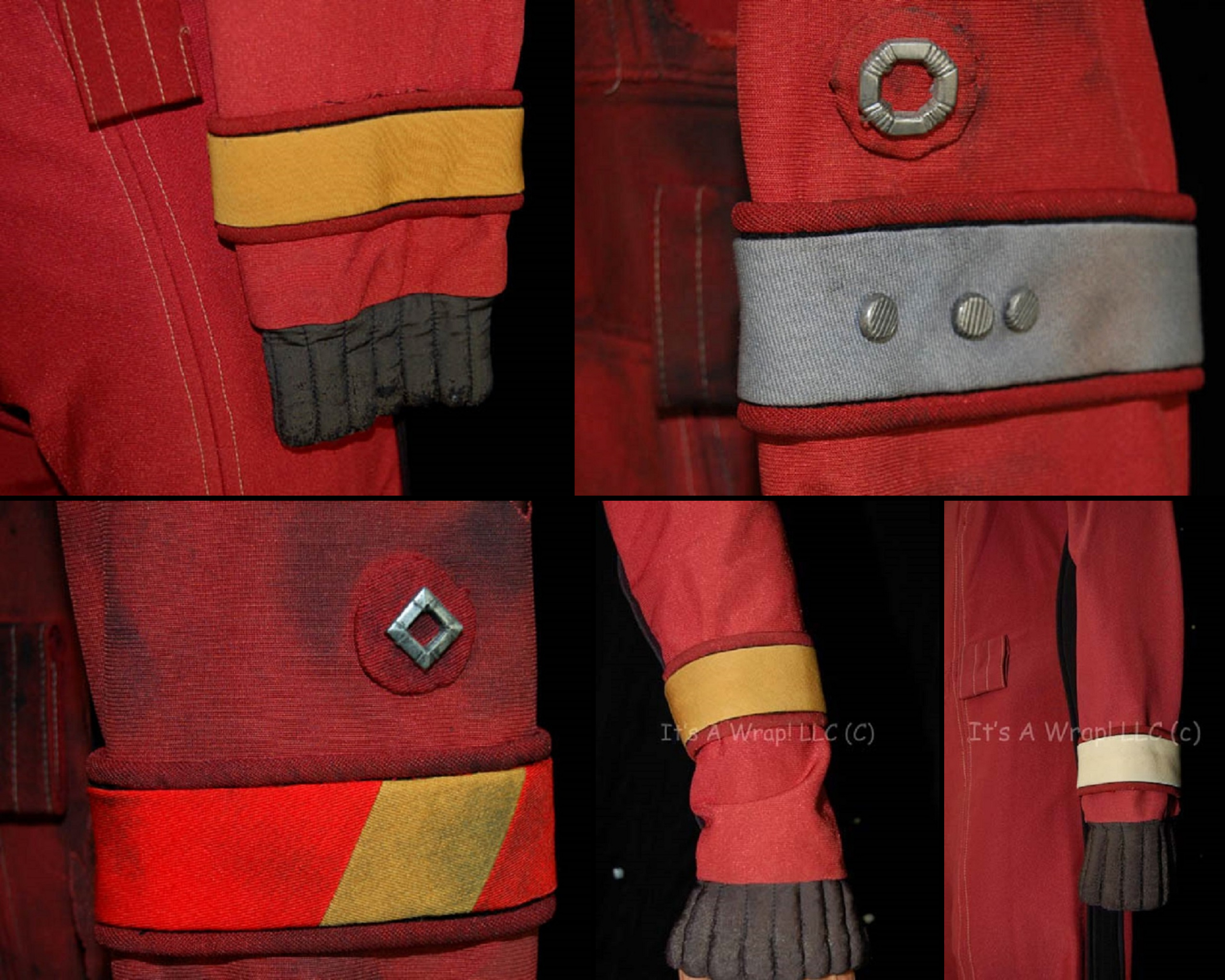
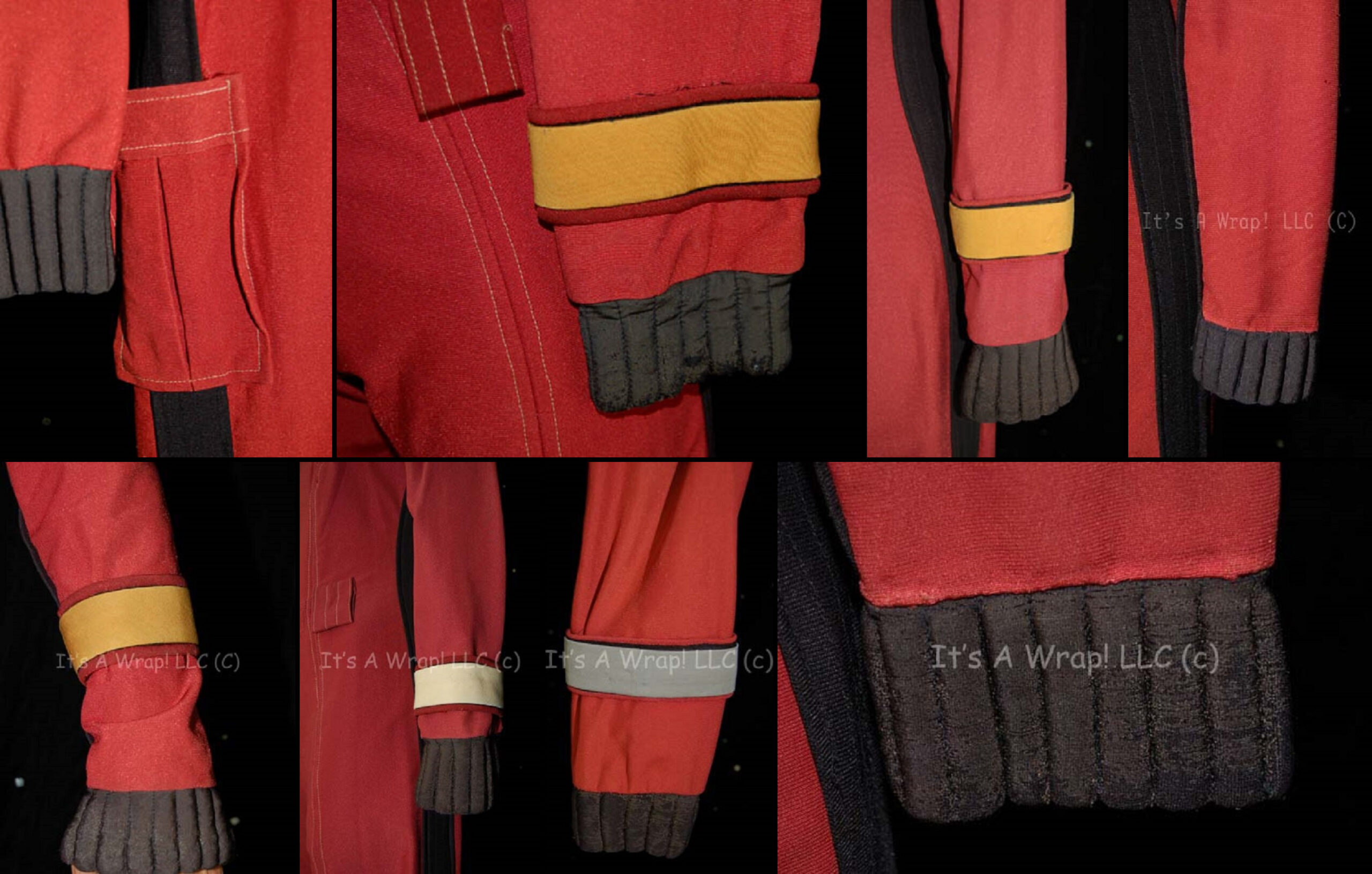
Beneath the rank insignia was a division-colored sleeve band, which was again common on many of the uniforms from this era.
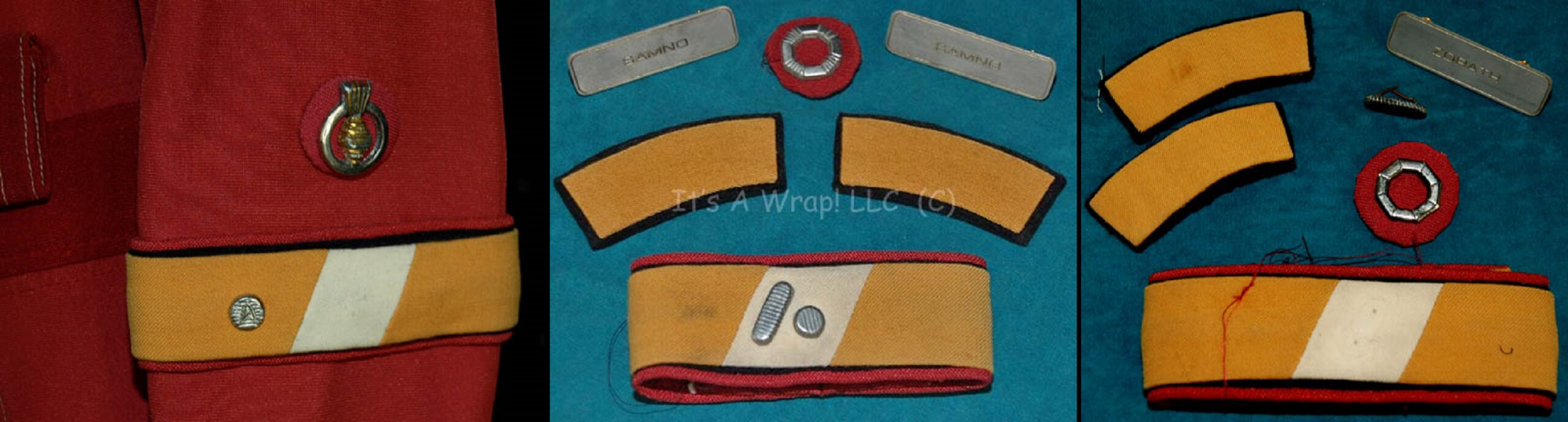
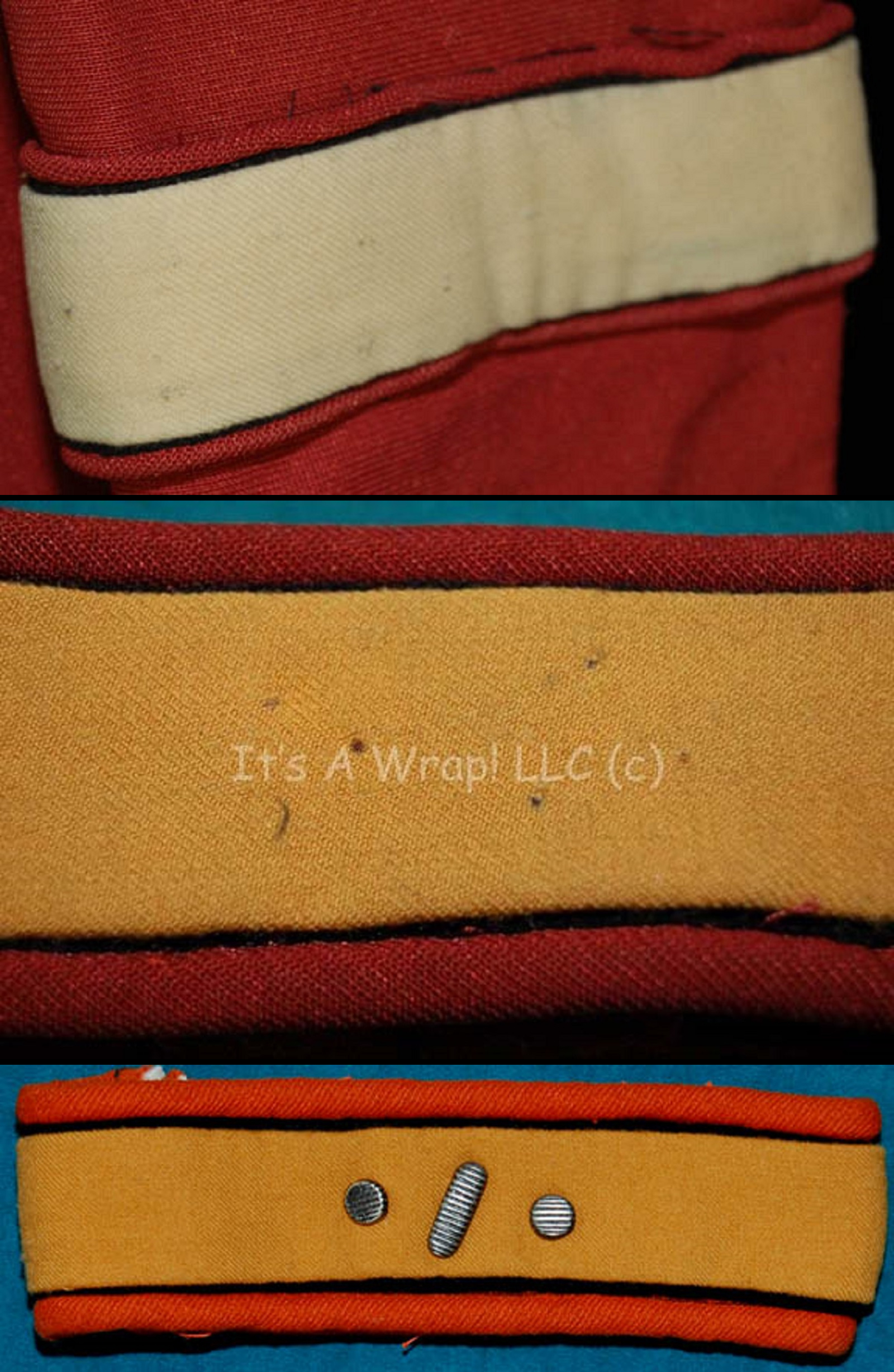
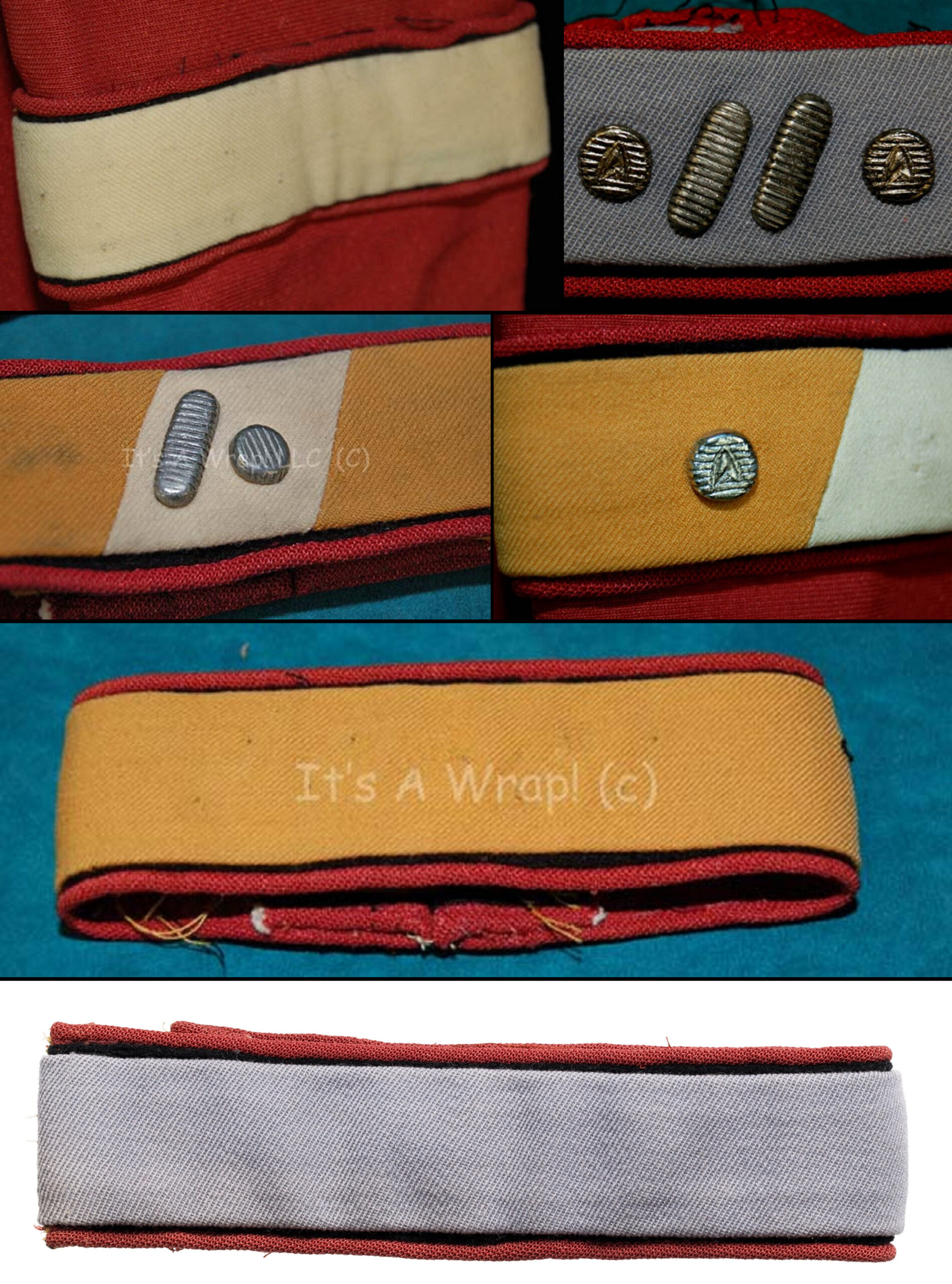
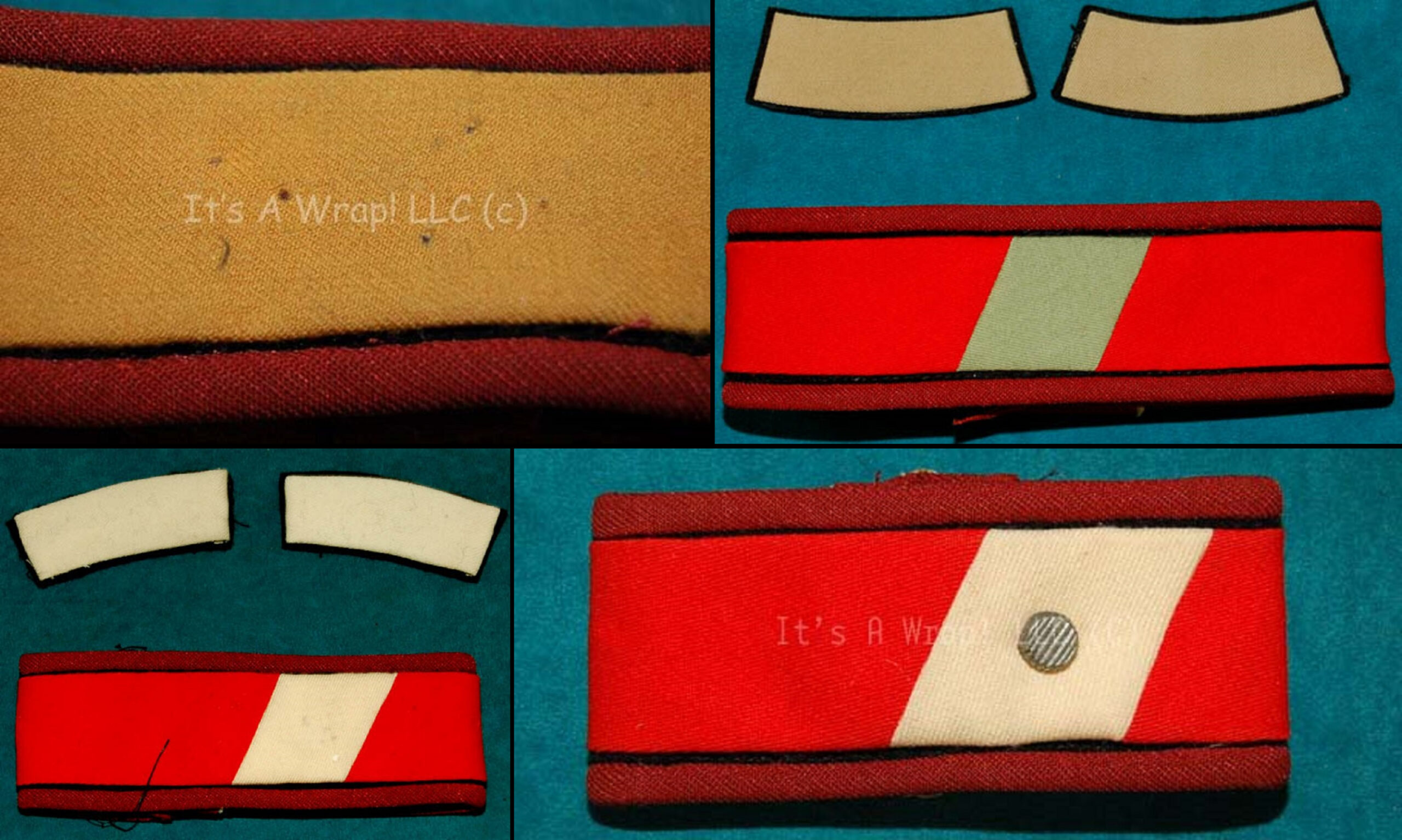
In most cases these were a solid color, but in his notes, Fletcher mentioned that department heads had the option of wearing a contrasting stripe on their sleeves – either their division color with a diagonal command white stripe, or a command white sleeve band with a stripe in their division color.
It seems that enlisted crew members in leadership or managerial positions had a similar option, although I only ever saw it exercised in engineering gold with a command white stripe.
TWOK-era enlisted jumpsuit auction photos
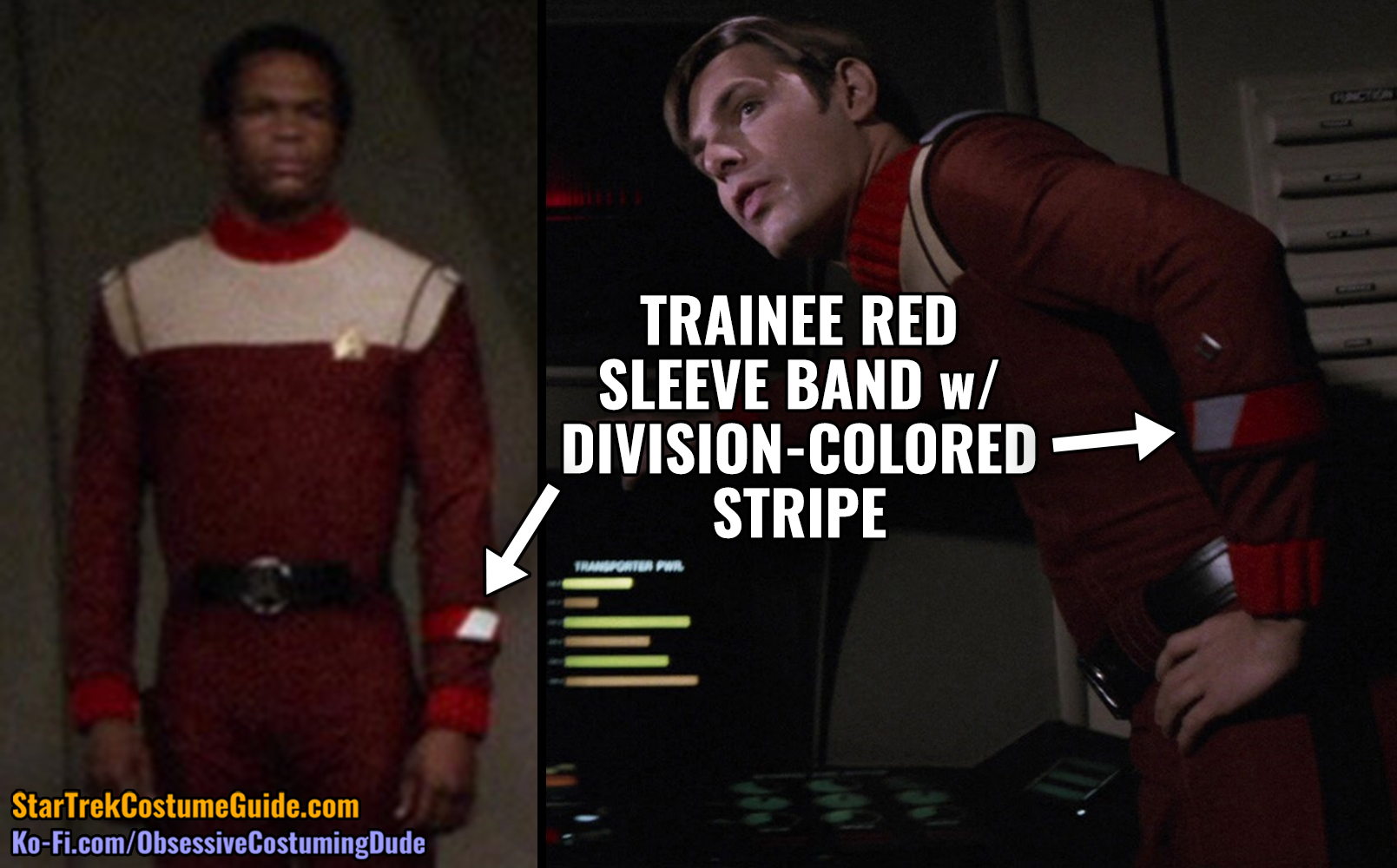
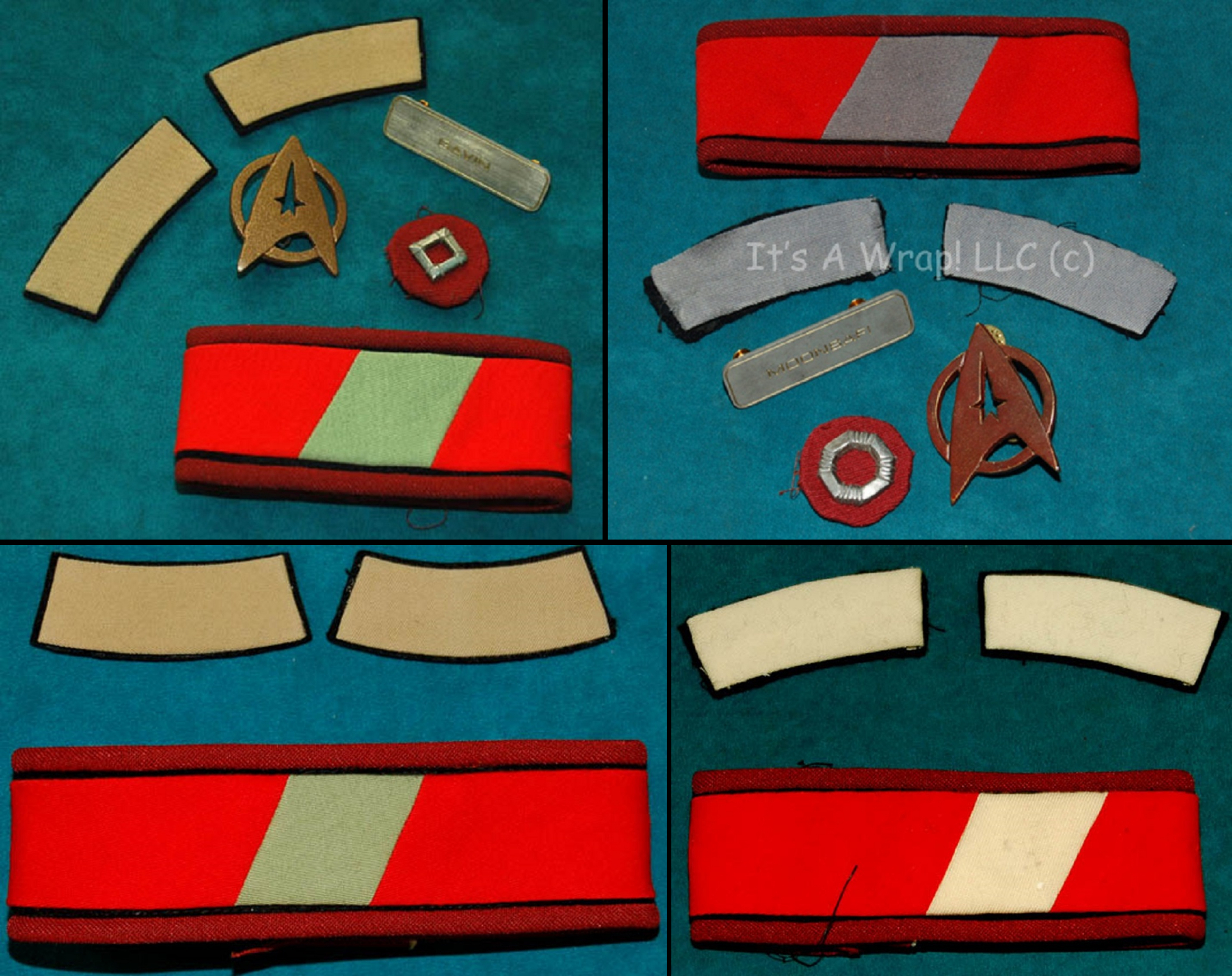
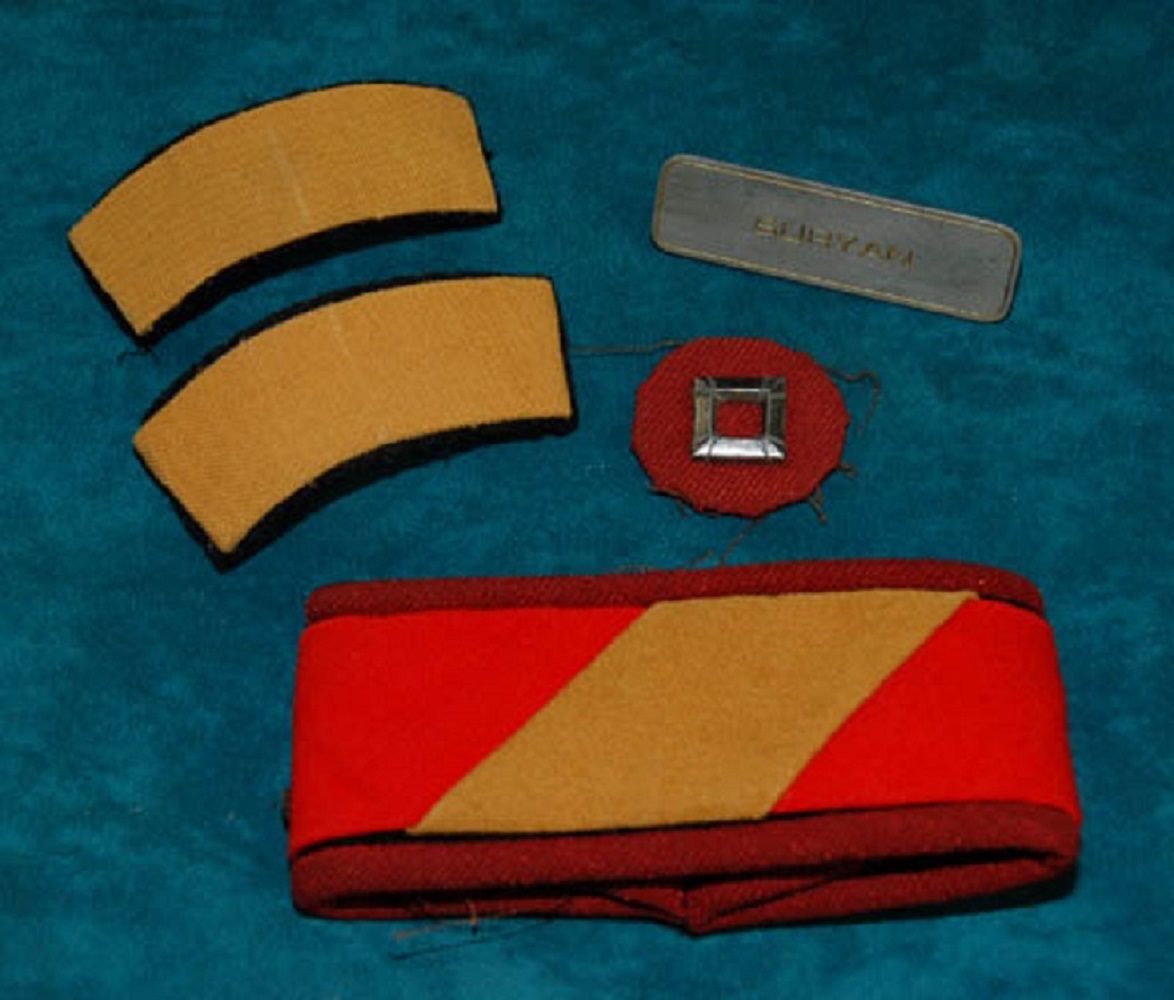
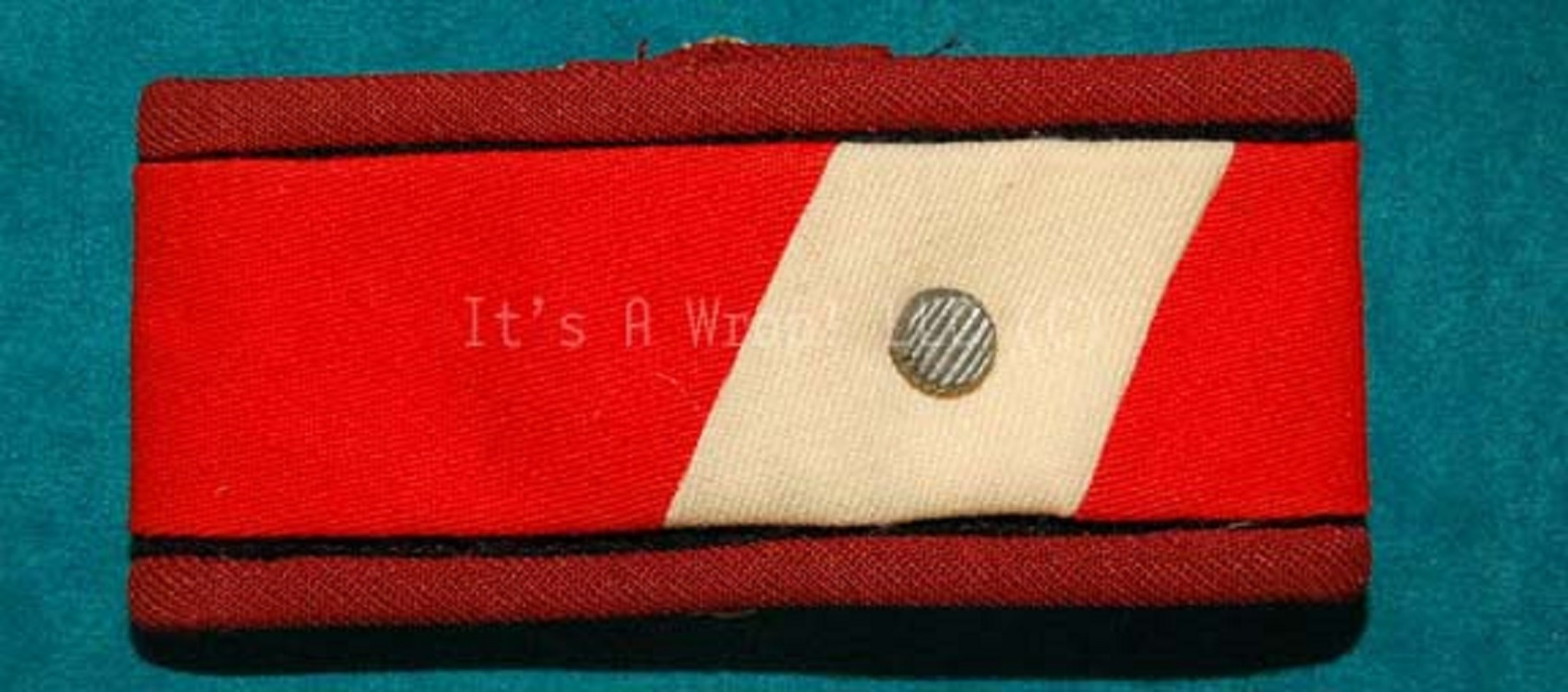
Like the cadets, trainees wore sleeve bands with division-colored slashes.
TWOK-era enlisted jumpsuit auction photos
Ordinarily the width and angle of the stripes looked pretty consistent, but this particular stripe was noticeably wider and more sharply angled for some reason.
TWOK-era enlisted jumpsuit auction photo
The division-colored fabrics were usually wool gabardine, although there doesn’t seem to have been much rhyme or reason as to the direction they were cut.
Some, like these, were cut on the crossgrain:
TWOK-era enlisted jumpsuit auction photos
Some were cut on the straight grain, though:
TWOK-era enlisted jumpsuit auction photos
Still others were cut on the bias; observe how when fabrics with a diagonal weave are cut on the bias, the weave winds up being almost vertical.
TWOK-era enlisted jumpsuit auction photos
Some were cut on the opposite bias; observe the opposite effect, that the diagonal weave becomes almost horizontal.
TWOK-era enlisted jumpsuit auction photos
The sleeve bands with slashes (trainee and department heads) were cut in different orientations in relation to each other, as well.
This band had both cut on the crossgrain:
TWOK-era enlisted jumpsuit auction photo
These had the two colors cut on opposite biases:
TWOK-era enlisted jumpsuit auction photos
(I’ve also seen similar variations – and others – on the officers’ sleeve bands.)
The division-colored bands were hand-sewn to a layer of black felt.
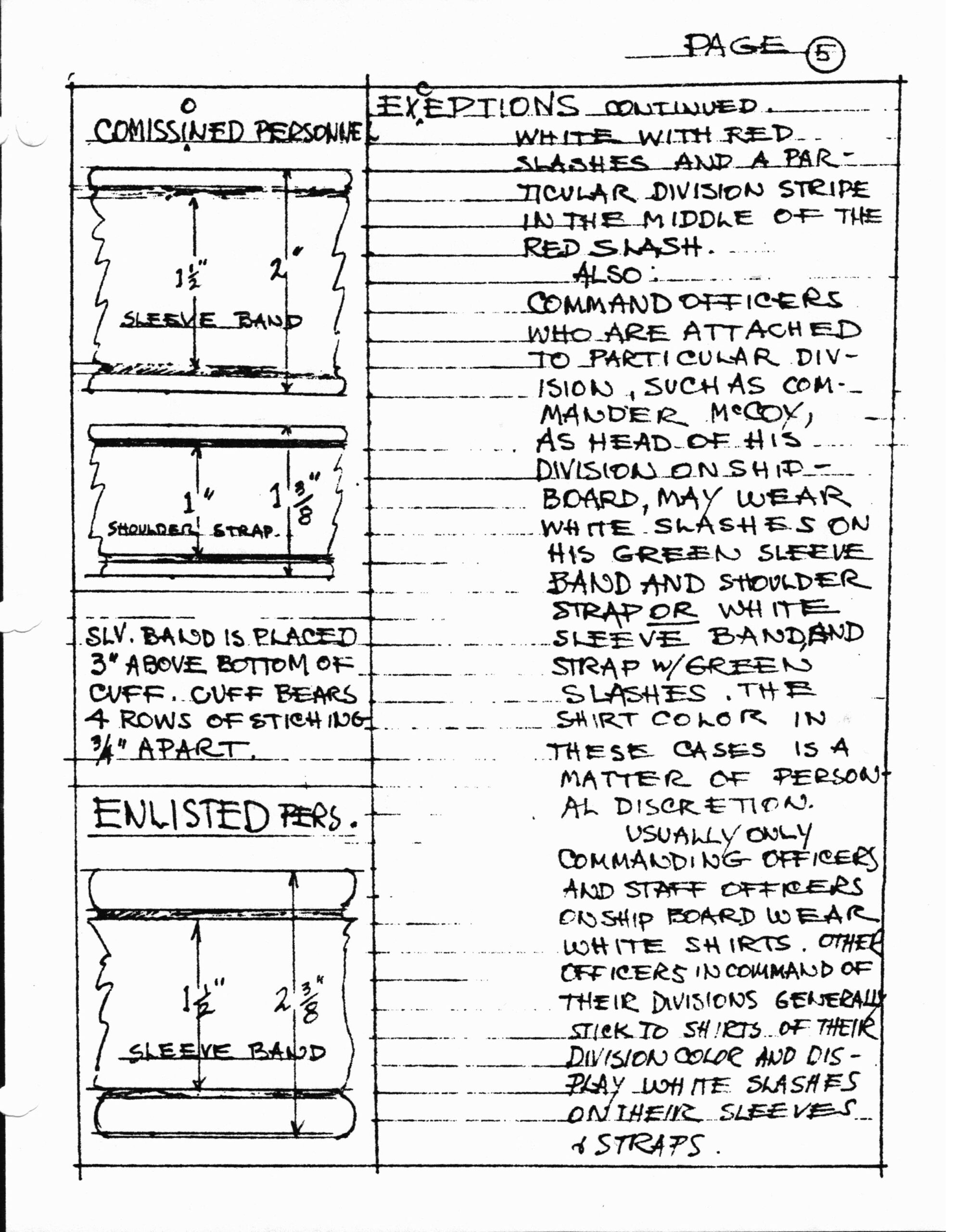
In his notes, Fletcher specified that the enlisted sleeve band should be 2 ⅜” tall, with a 1 ½” sleeve band.
Allowing for a 1/16” sliver of black felt above and below the division-colored wool, that would mean the piping along the upper and lower edges of the band assembly were intended to ⅜” in diameter – much bigger than any we ever saw.
If we allow for ⅛” of black felt above and below the wool (which was more than we usually saw), that would mean the piping was intended to be about ¼”, which is more akin to what we saw.
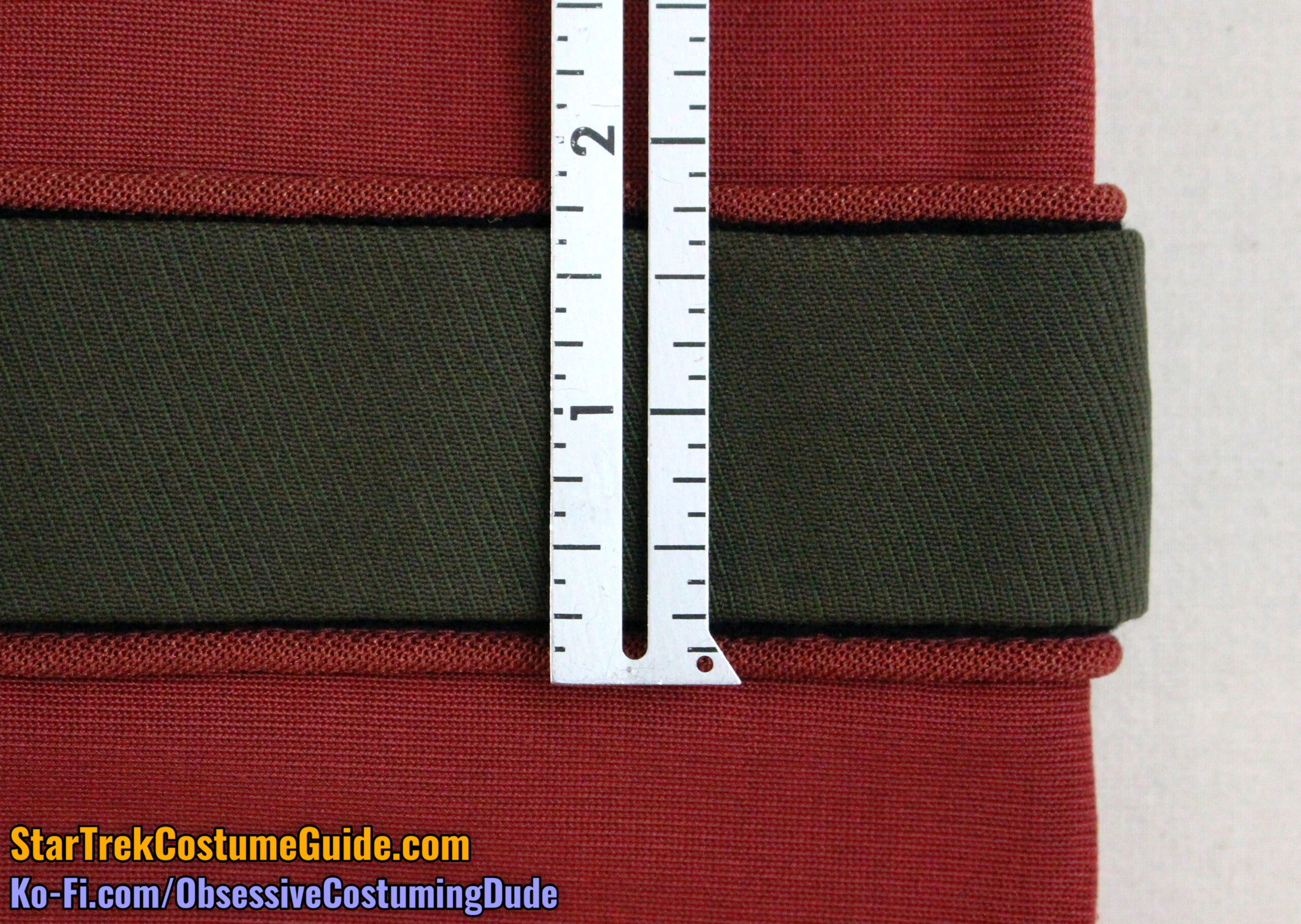
However, the sleeve band on the screen-used enlisted jumpsuit I studied was unusual in two ways:
First, the division-colored fabric was actually jumbo spandex, rather than wool gabardine! To date, this is something I’ve never seen on any other uniform.
It was cut on a diagonal, but not the true bias – possibly to mimic the effect of wool gabardine’s diagonal weave?
And second, it was a little bit shorter than Fletcher specified in his notes, about 1 ⅞” tall instead of 2 ⅜”.
Also note the red piping on the upper and lower edges was only about half of what he’d drawn, about 3/16” in diameter instead of ⅜”.
This narrower piping can be seen on some of the other screen-used sleeve bands:
TWOK-era enlisted jumpsuit auction photos
However, in many cases the piping was noticeably thicker, closer to what Fletcher depicted in his notes:
TWOK-era enlisted jumpsuit auction photos
In most cases, these lengths of piping were bias-cut cut from the same red jumbo spandex as the jumpsuit body, wrapped around cord, and edge-stitched into place along the edges of the black felt.
TWOK-era enlisted jumpsuit auction photos
In some cases, though, the piping was cut from the darker red spandex used for most of the belt loops and many of the back panels.
TWOK-era enlisted jumpsuit auction photos
I don’t think there was any rhyme or reason to which red was used; I believe it was most likely a case of using whichever fabric was handy at the time.
The sleeve band assembly wasn’t sewn into the sleeve seam; indeed it couldn’t have been, since the black stripe actually covered this seam.
Instead, the sleeve band assembly was fitted to the sleeve, sewn closed, and the allowances pressed open on the underside.
TWOK-era enlisted jumpsuit auction photo
Then the sleeve band assembly was hand-sewn to the sleeve along the undersides of the outer red piping.
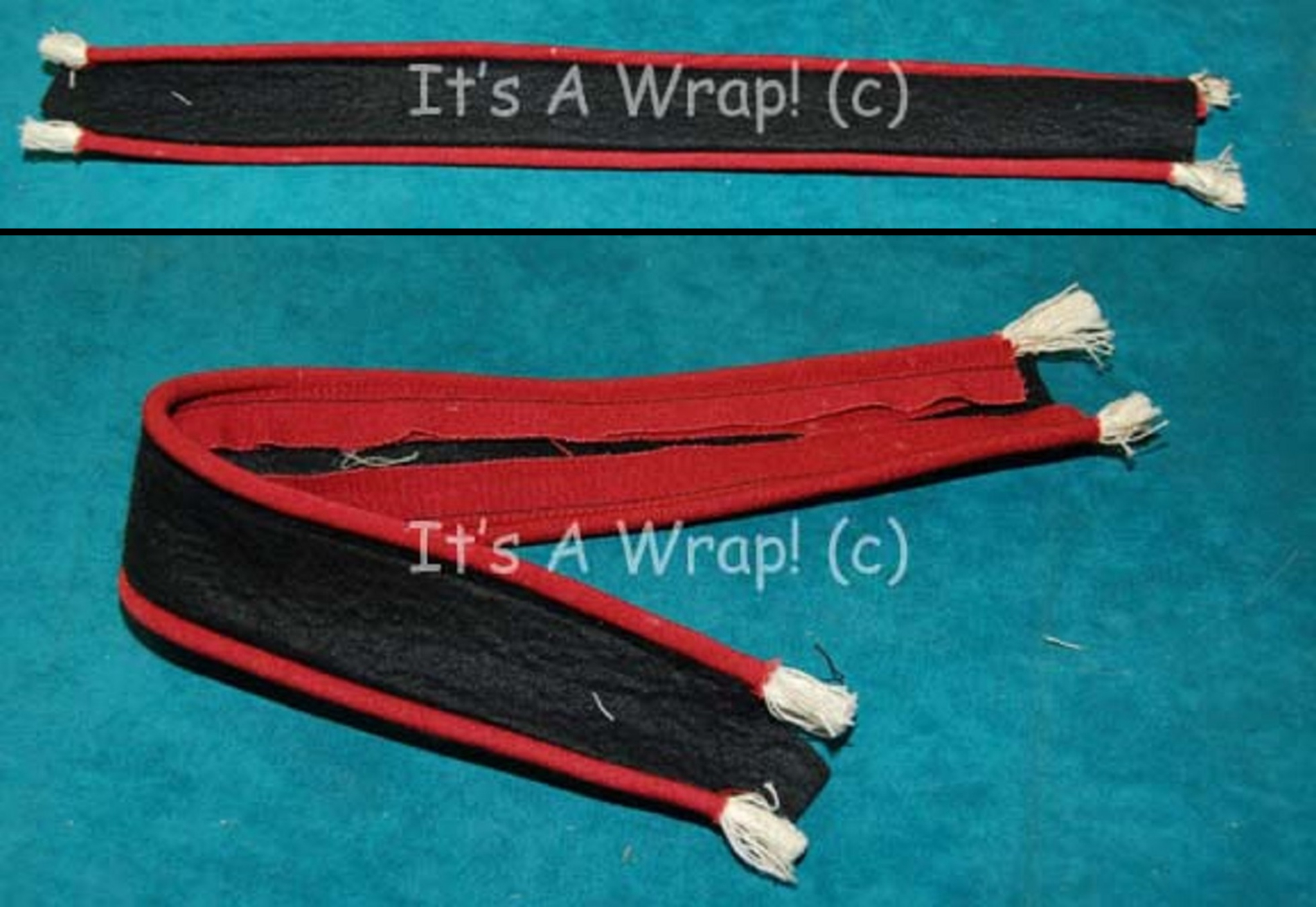
Here’s a look at the sleeve when it’s inside-out:
"Pips and Squeaks"
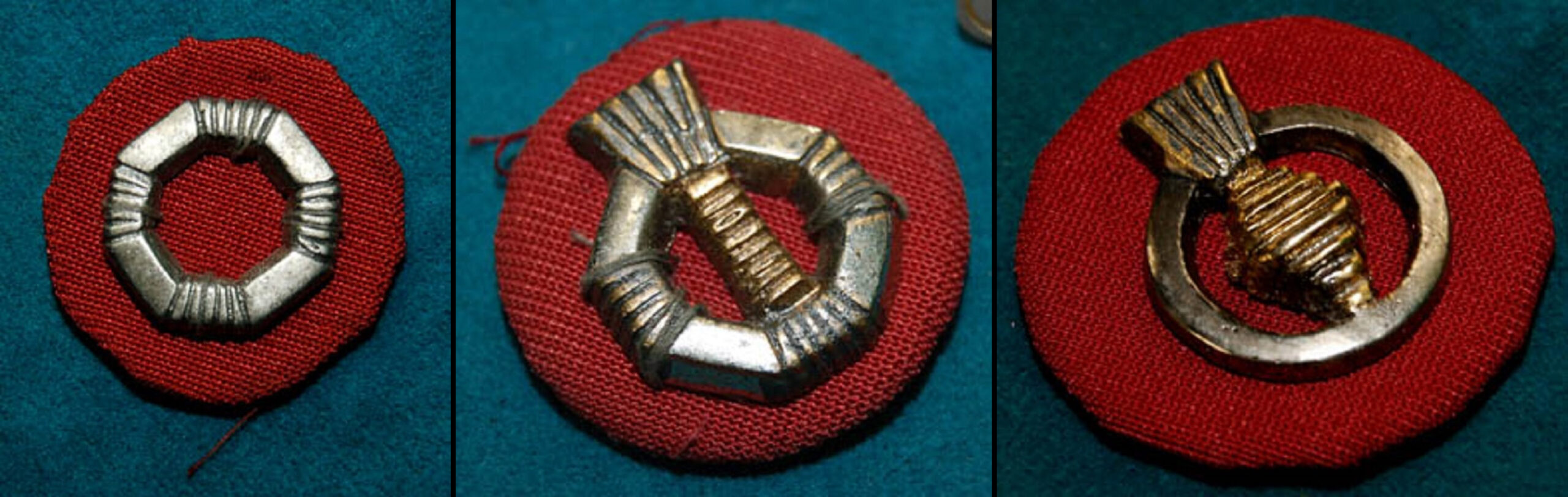
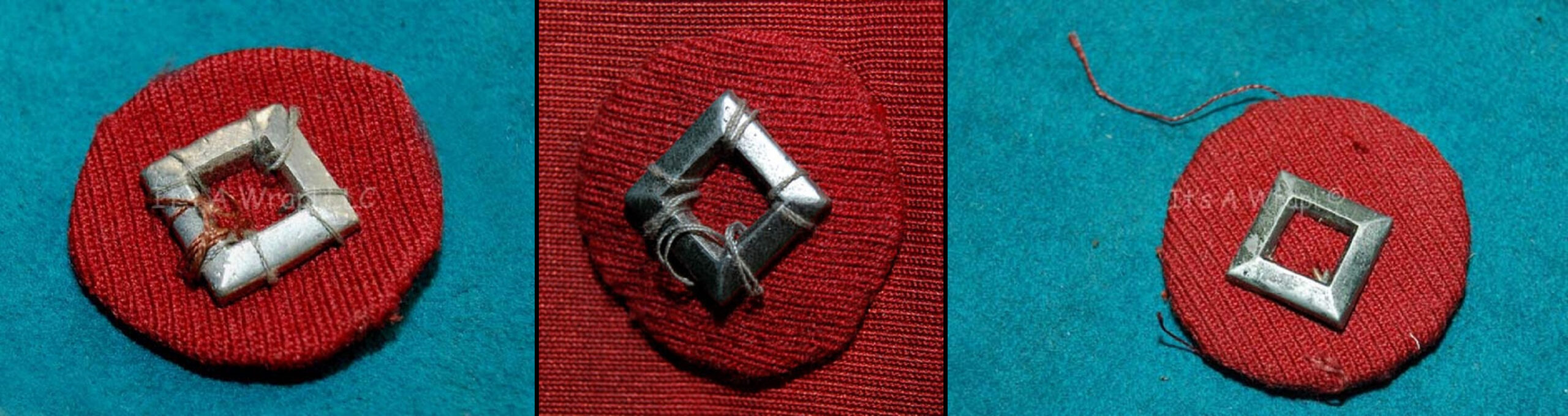
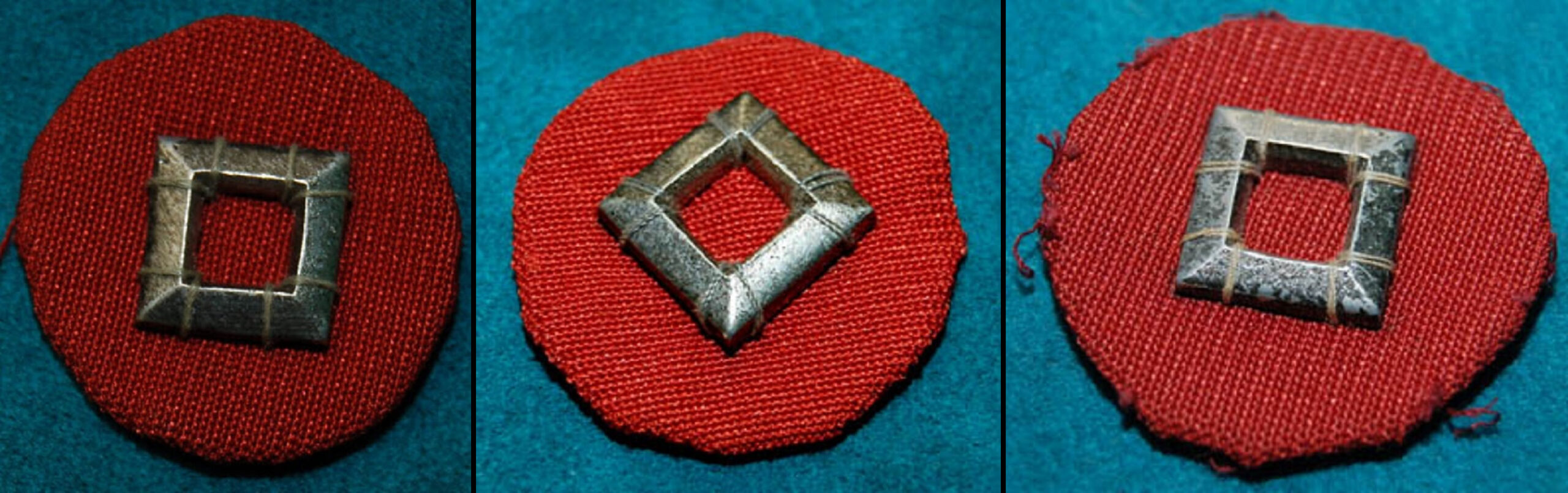
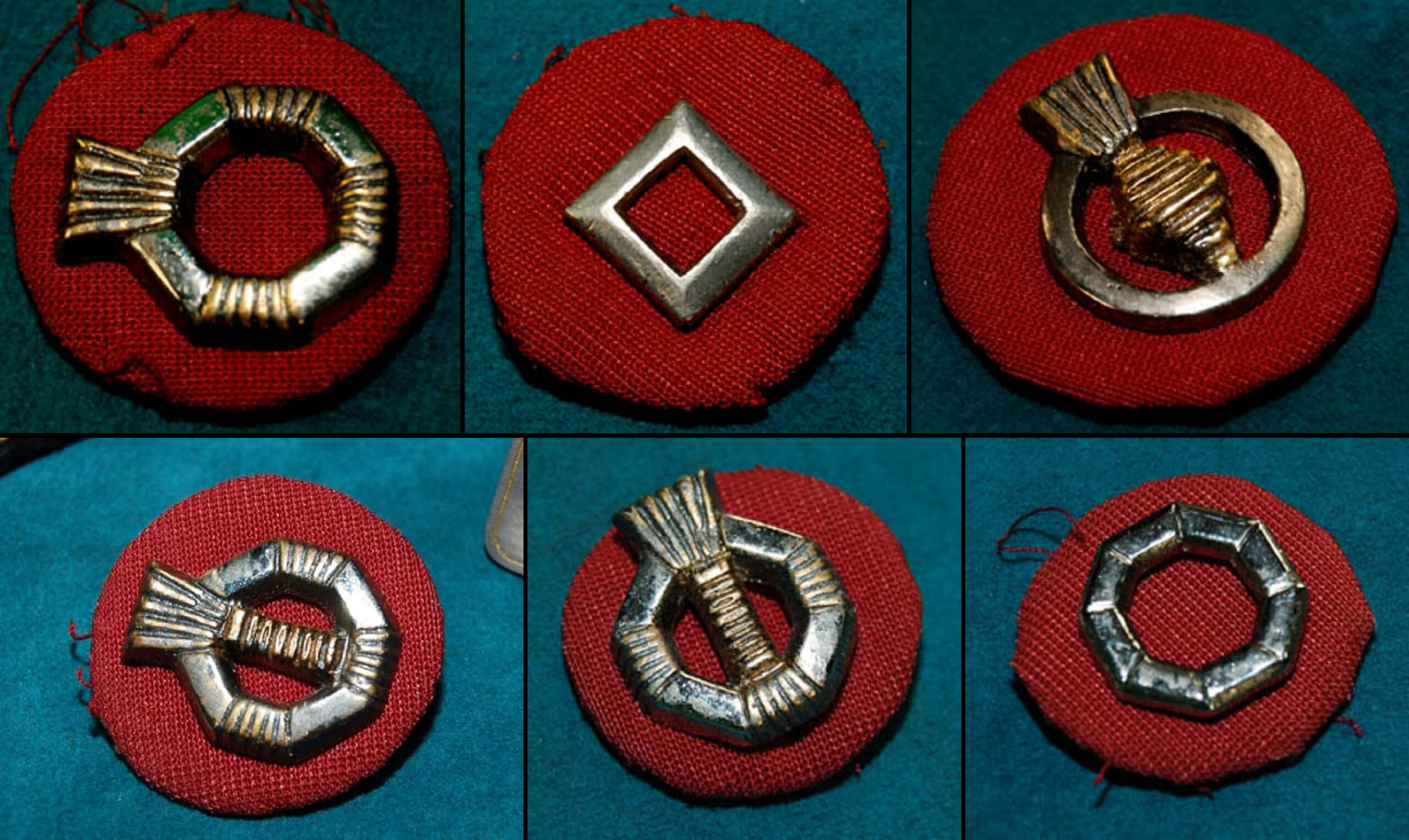
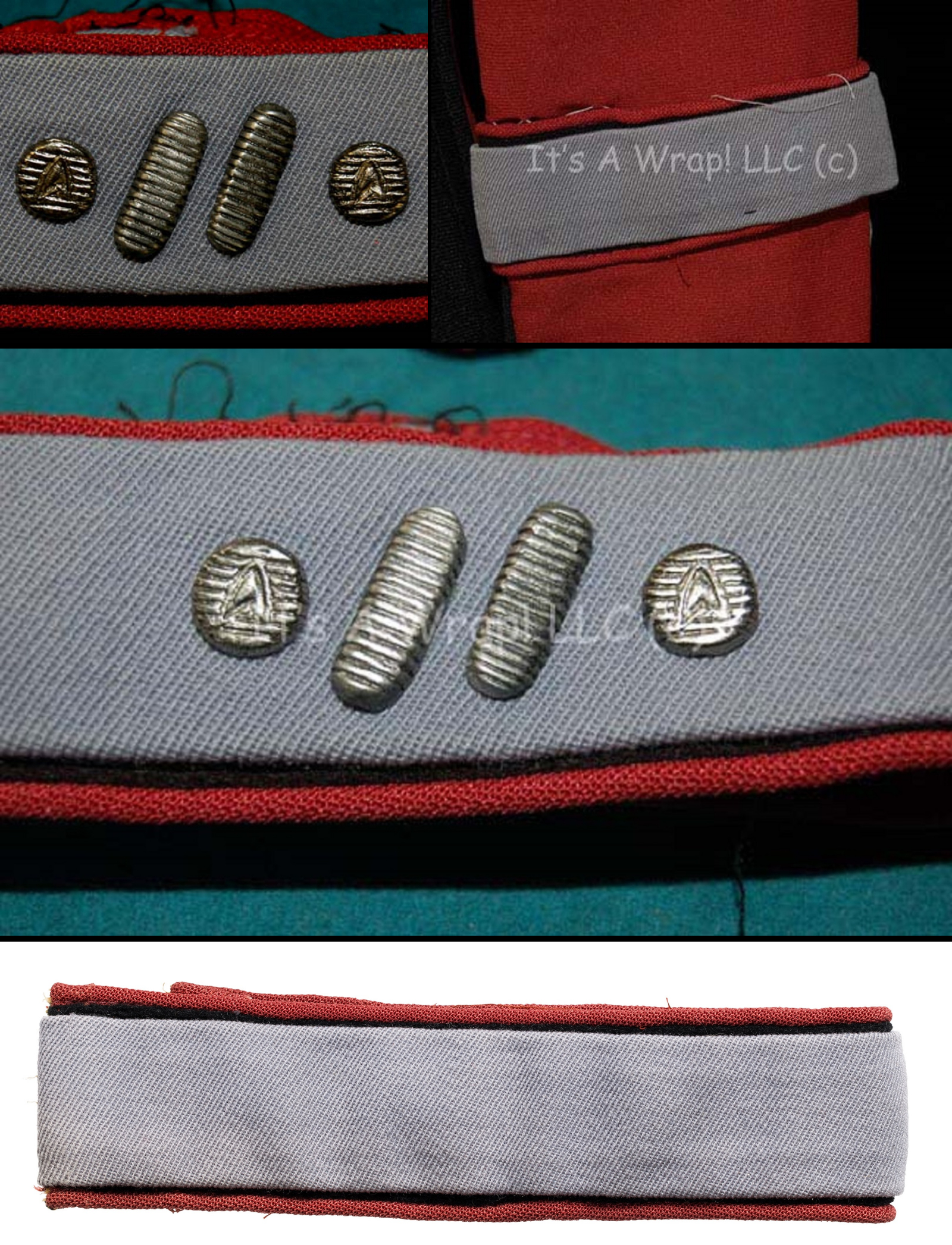
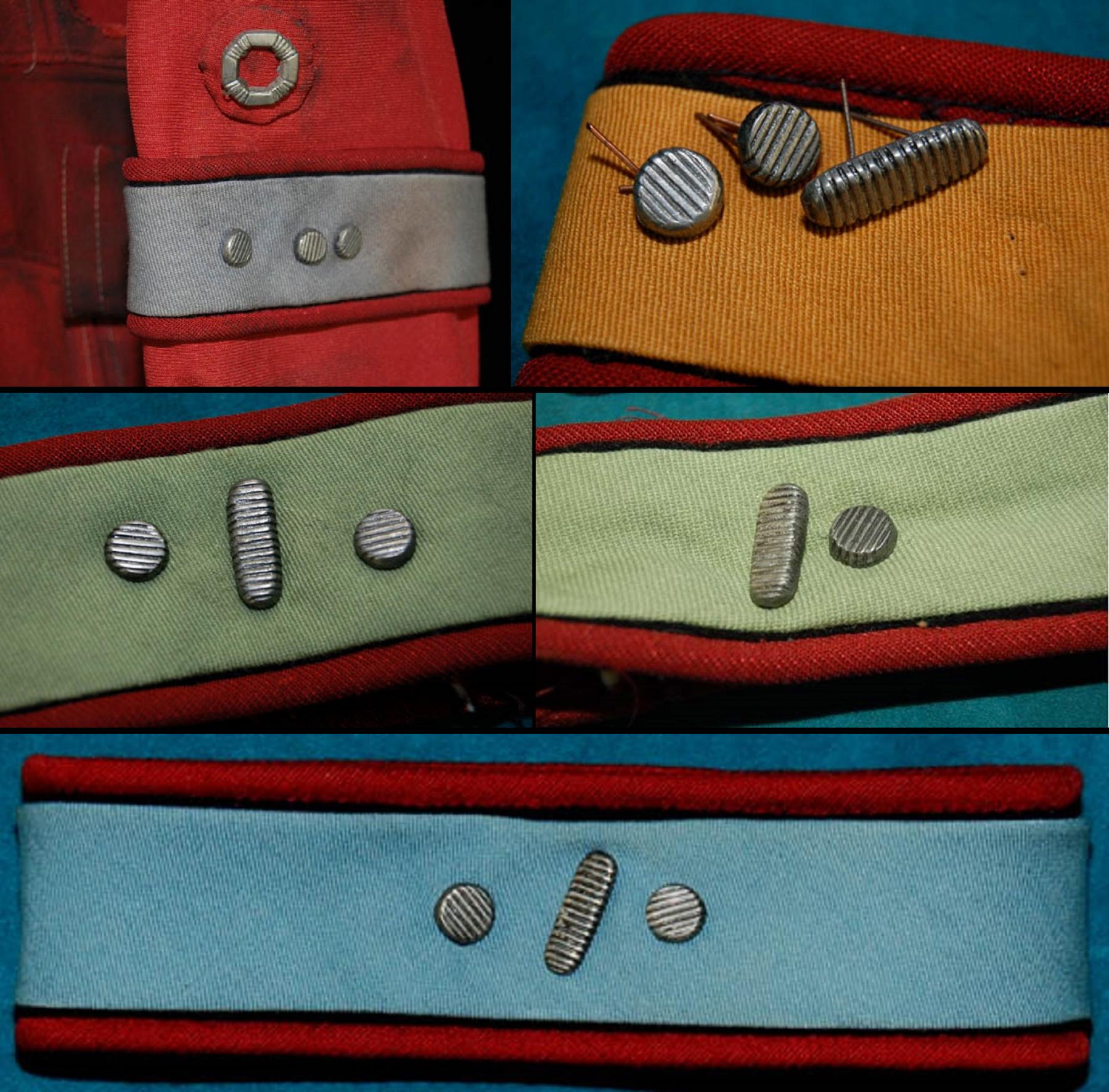
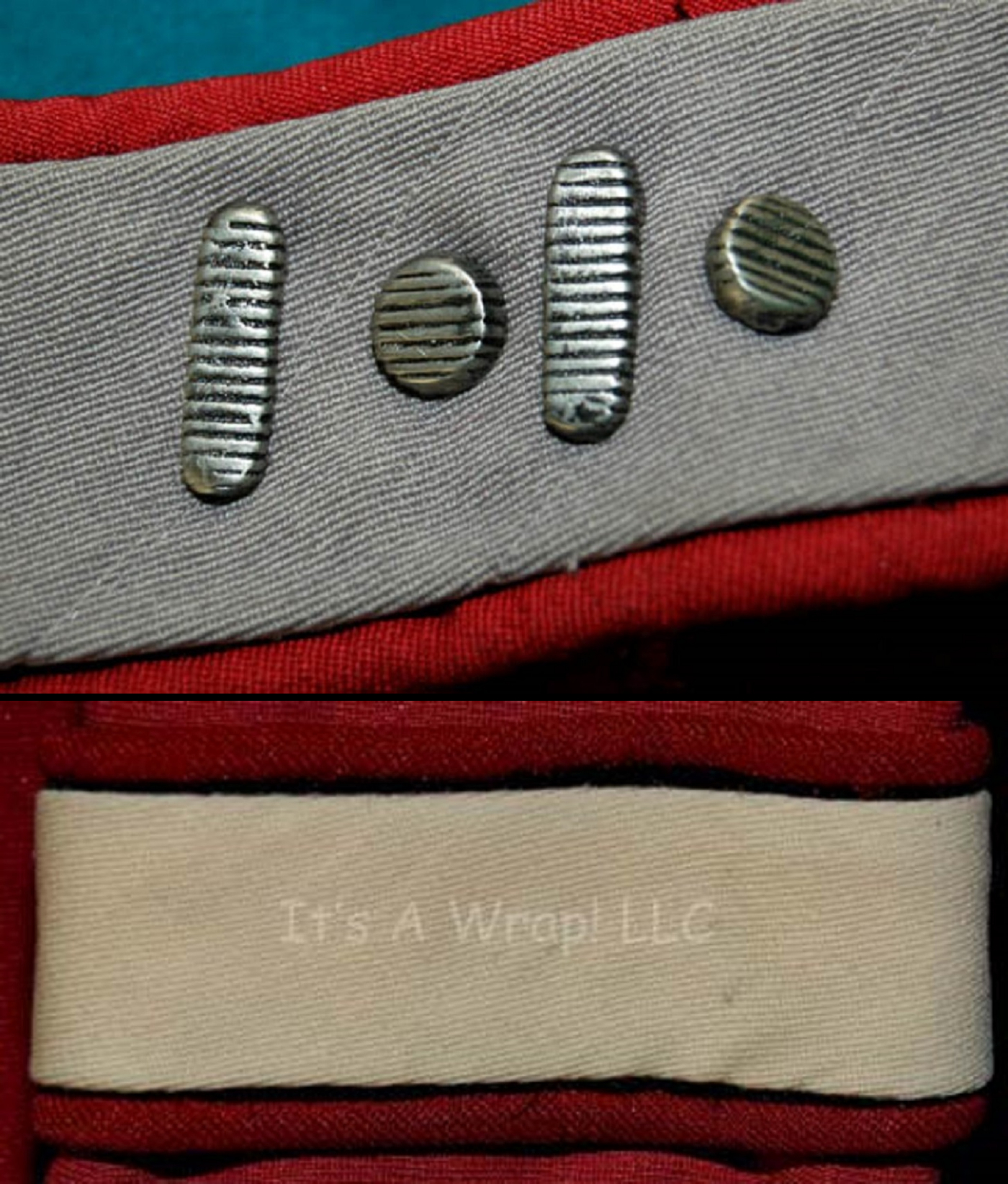
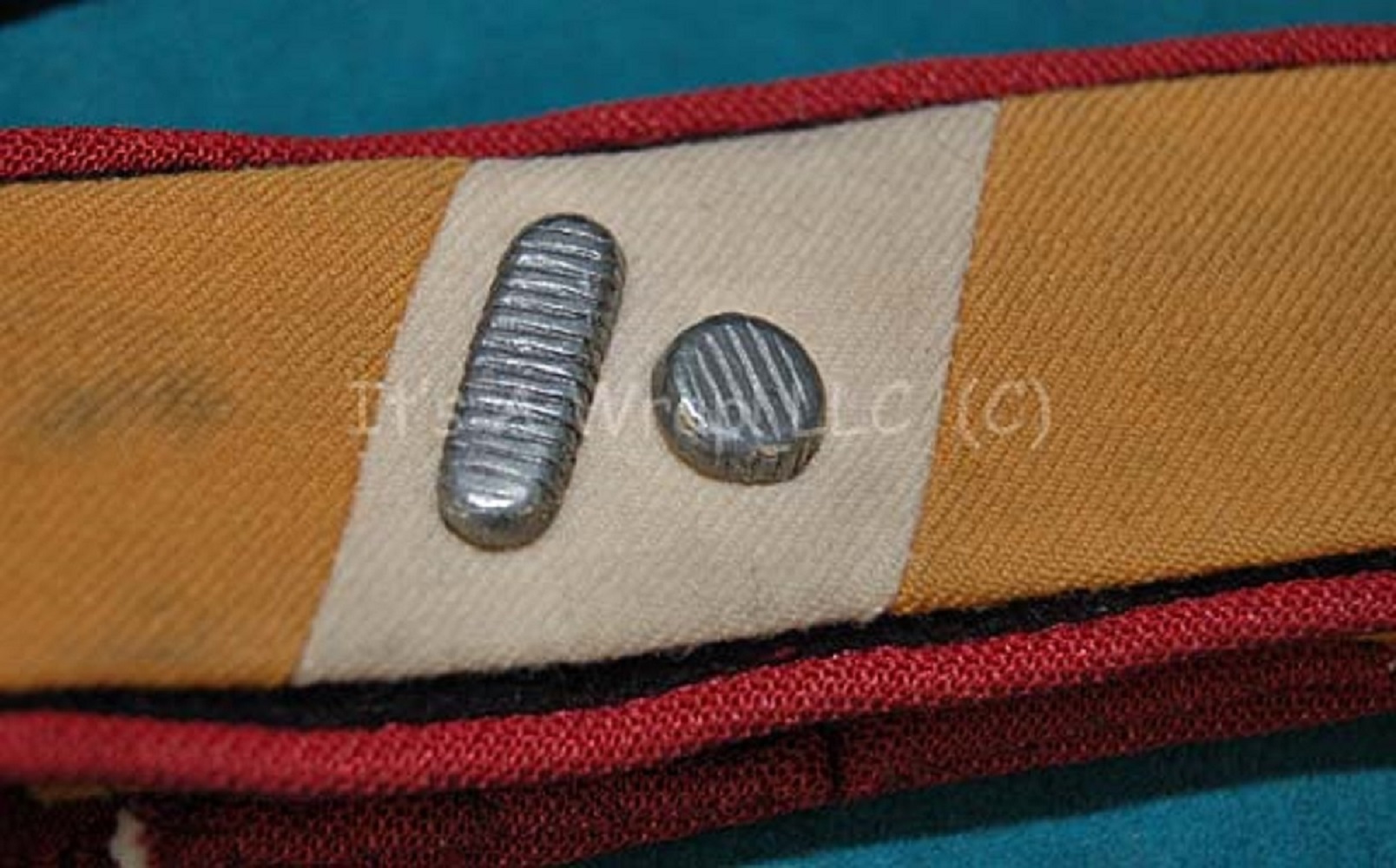
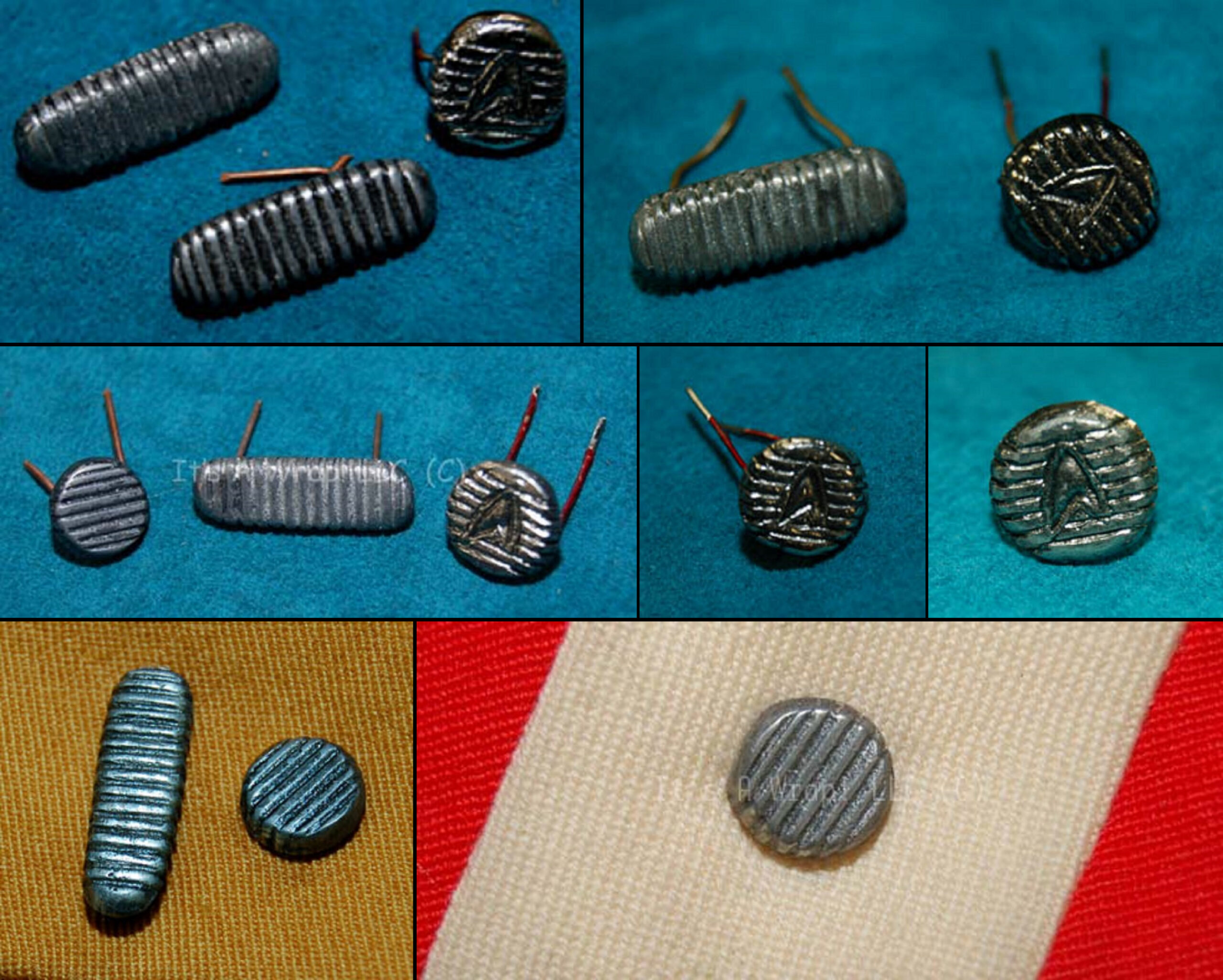
Crew members also wore a variety of small pins on their lower left sleeve bands, which Fletcher called “pips and squeaks.”
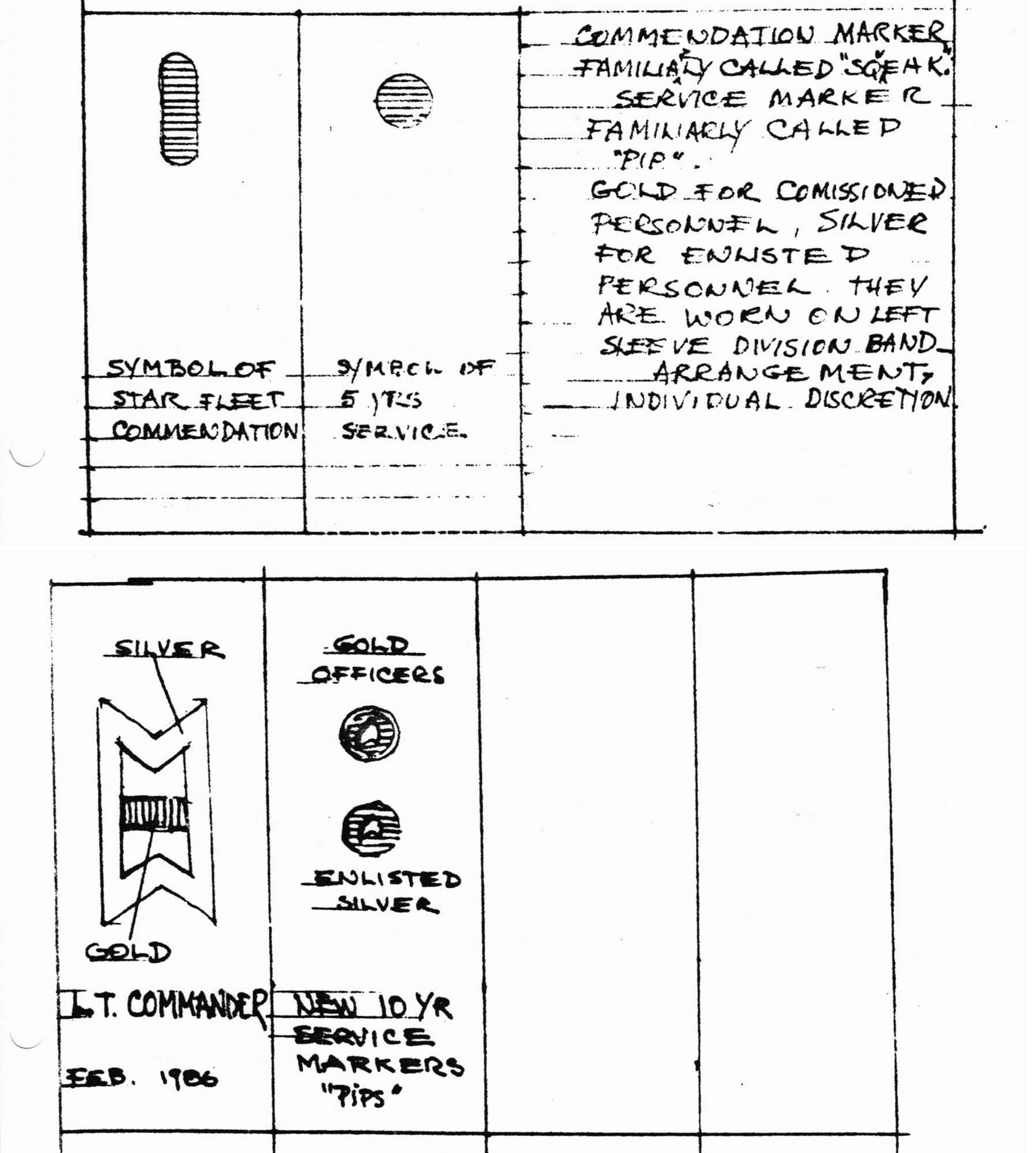
Here are Fletcher’s notes on these:
As you can see, the round ones were called “pips” and showed how long the wearer had served in Starfleet. Plain ones indicated 5 years, and he later added a variation with the Starfleet delta on it that indicated 10 years.
The longer pins were called “squeaks” and were commendations – although specifically for what is anyone’s guess.
Physically, these seem to have been identical for officers and enlisted crew, except for the color; officers wore gold, and enlisted crew wore silver.
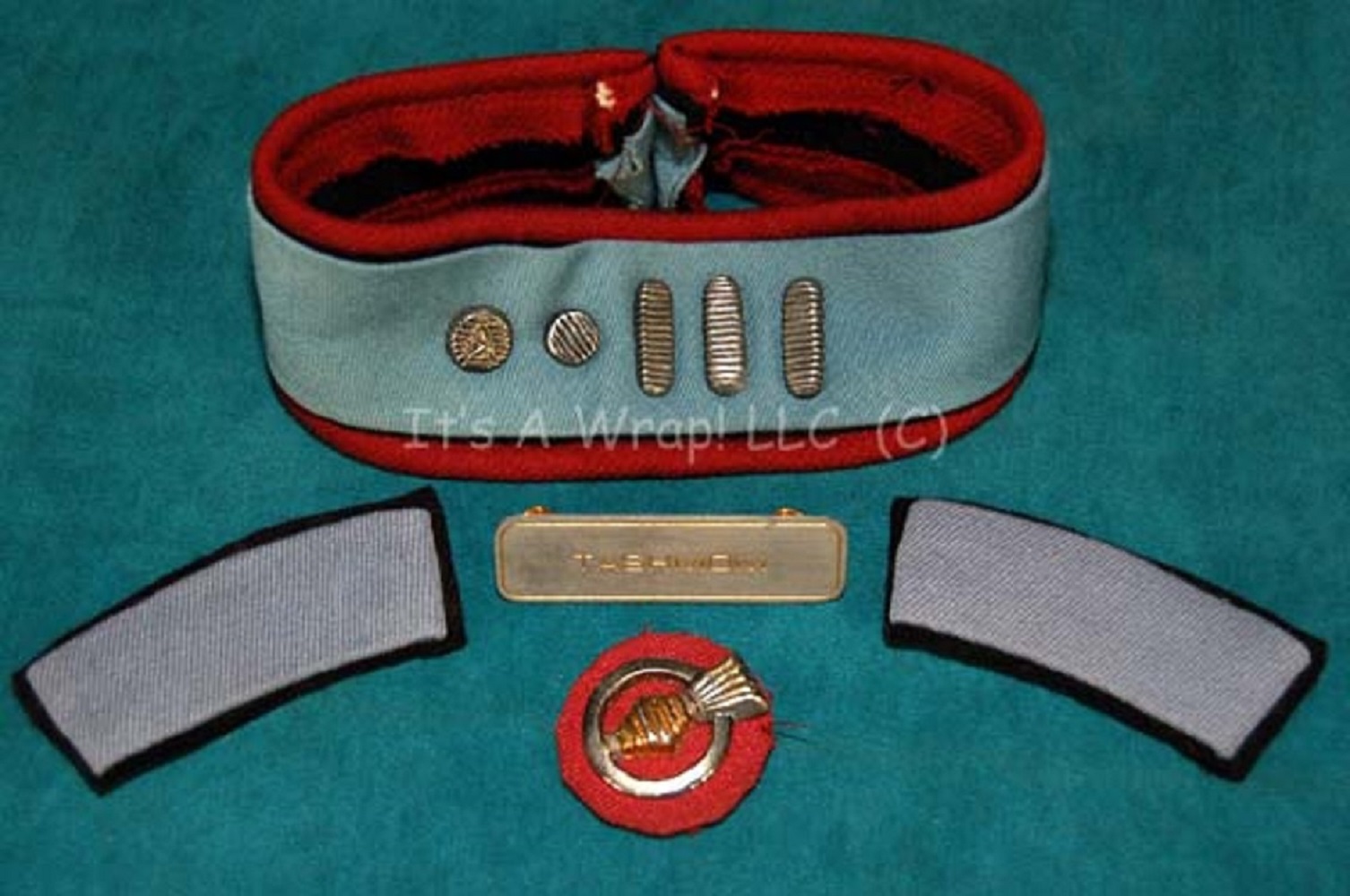
Here are some close-up auction photos of these “pips and squeaks,” which can also be seen on many of the previous sleeve band photos.
TWOK-era enlisted jumpsuit auction photos
Sleeve Cuffs
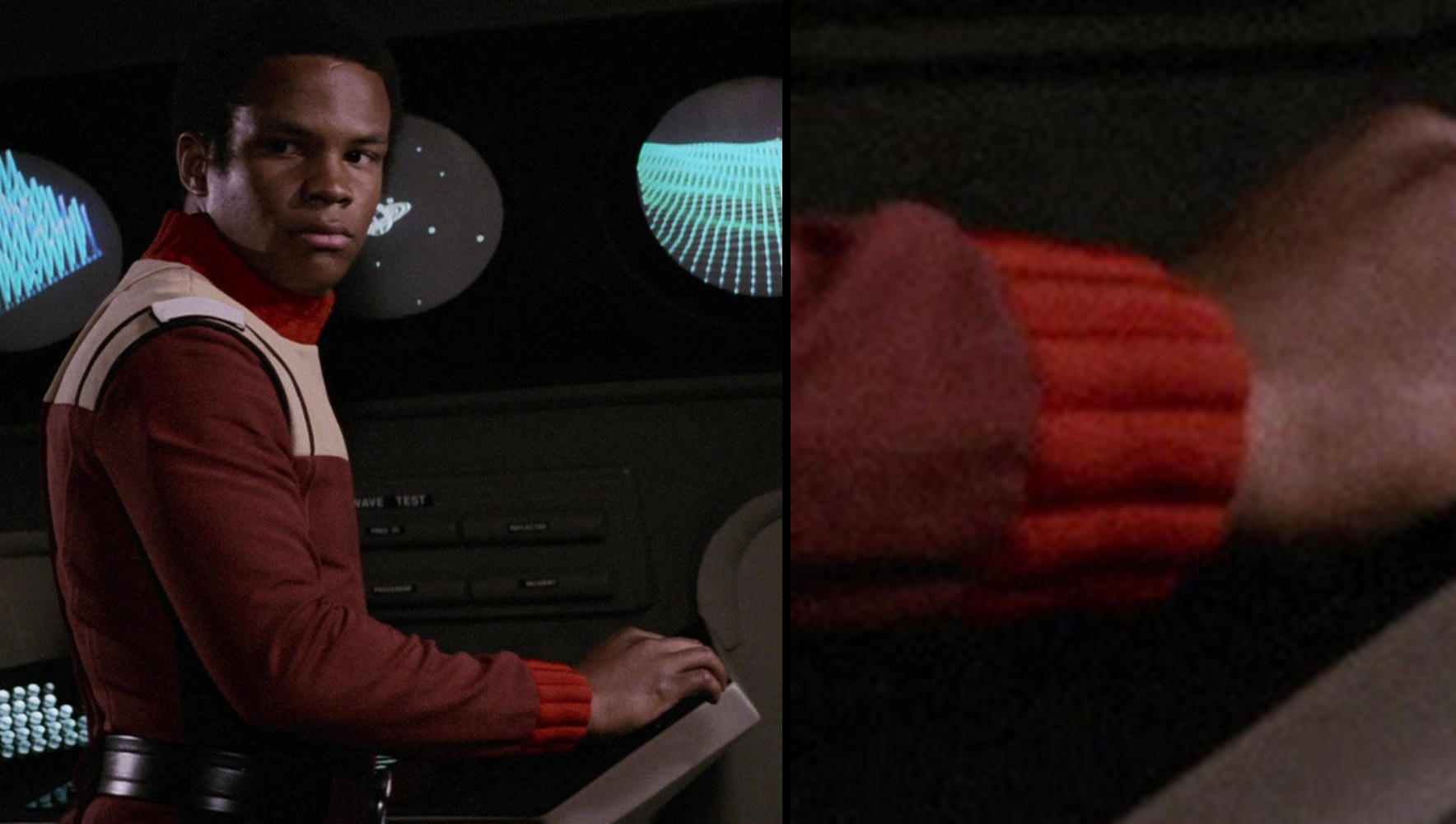
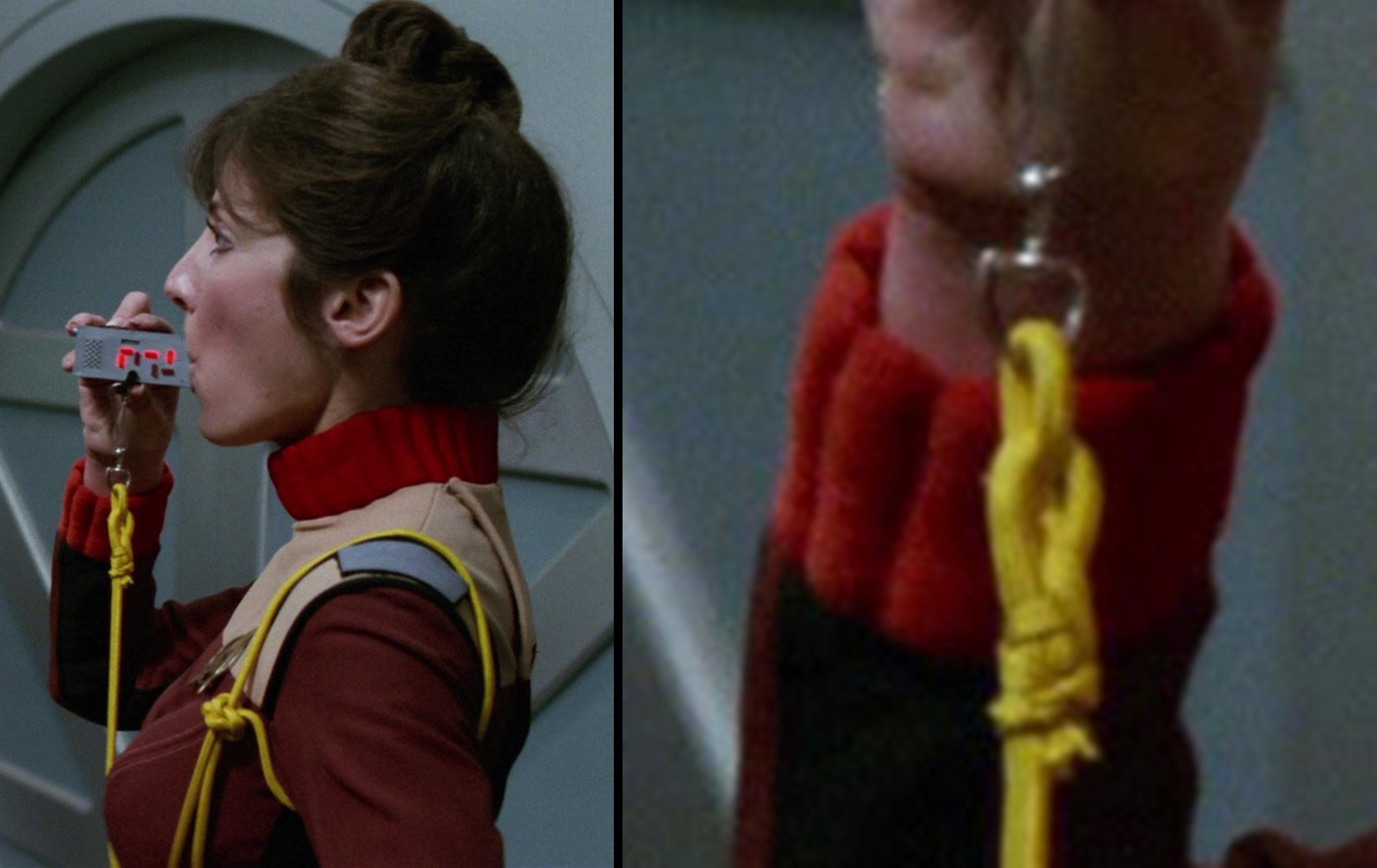
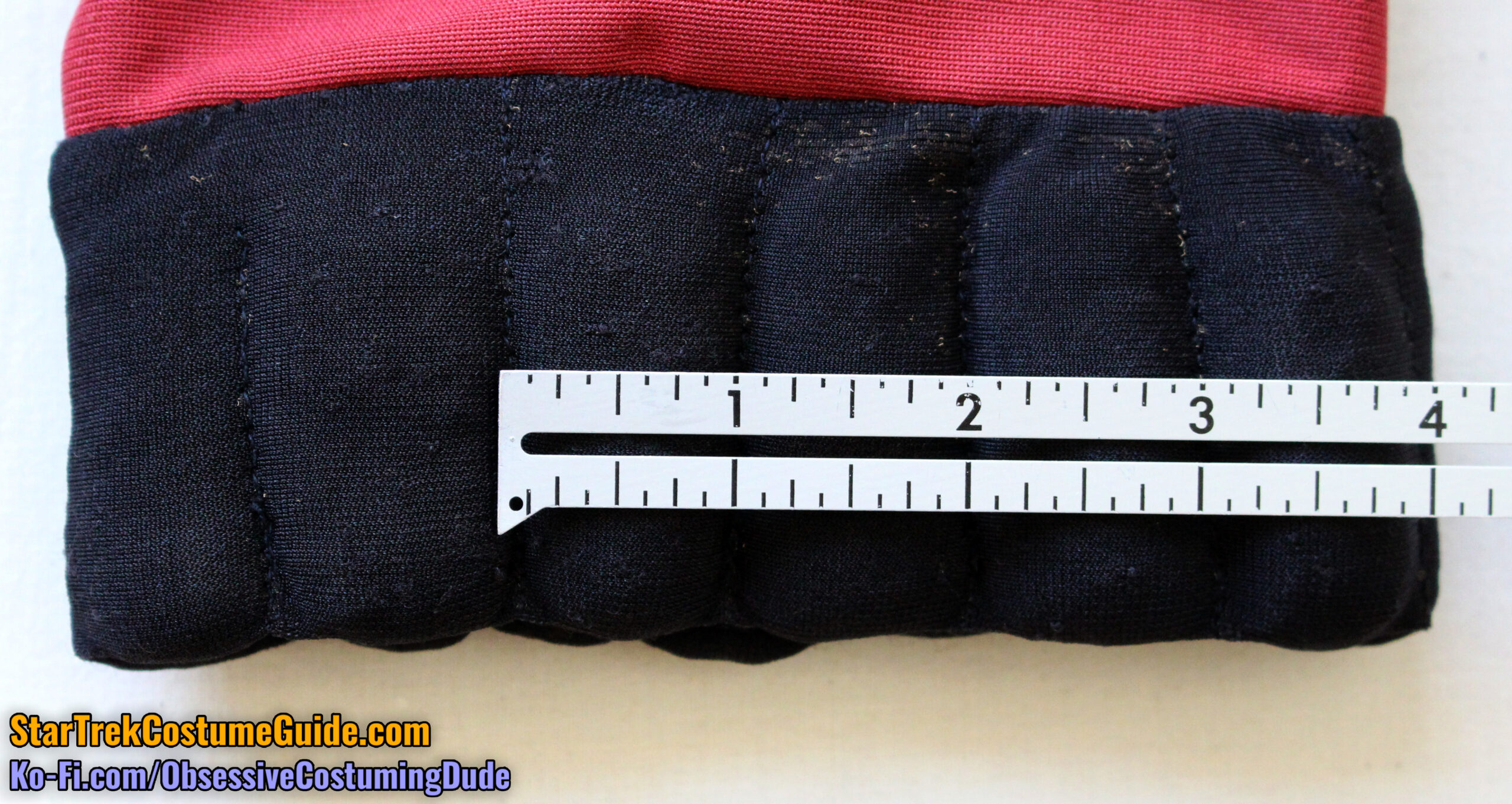
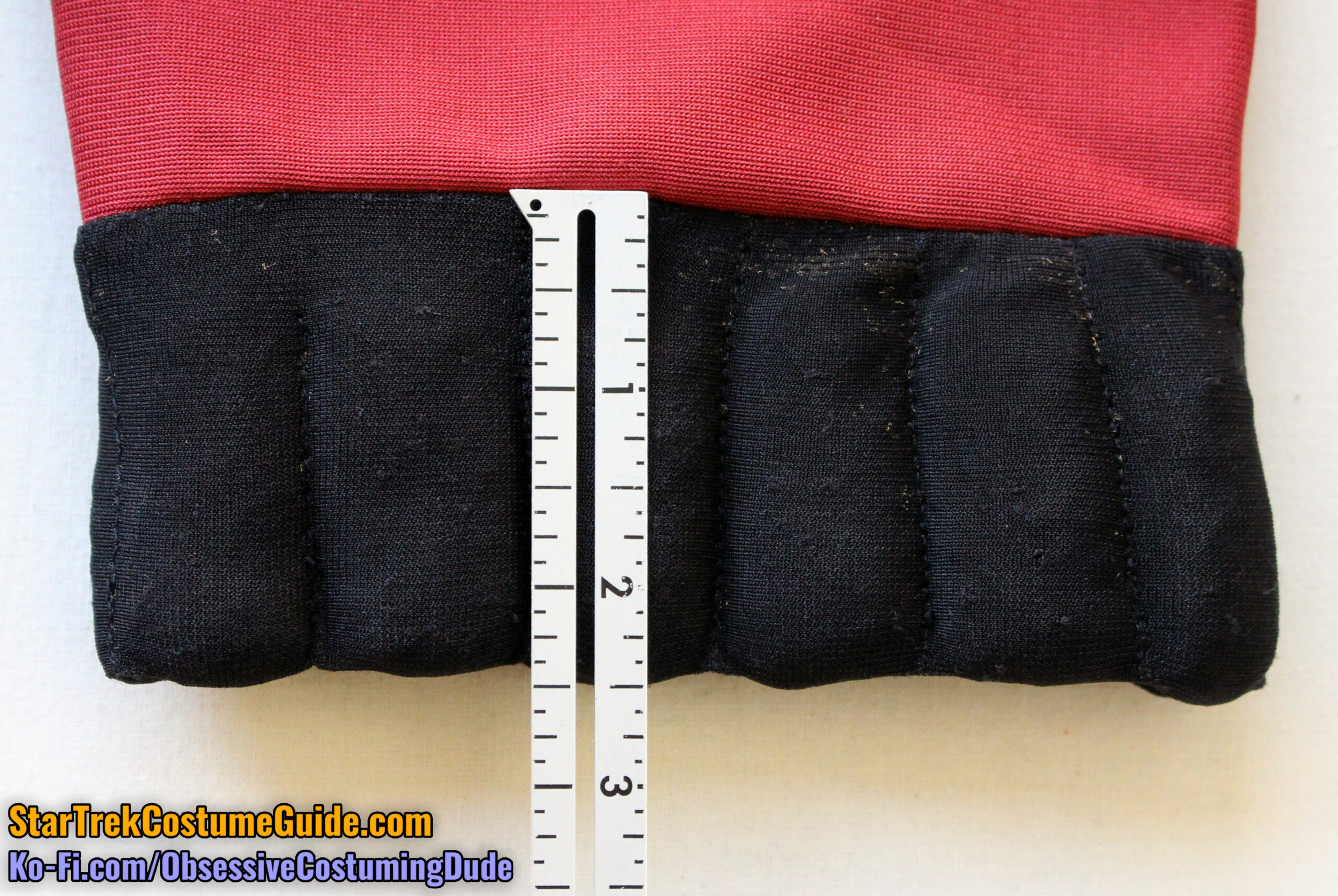
Like the collars, the sleeve cuffs were made from a lightweight spandex, and they were similarly trapunto-quilted.
Unlike the collars, though, the cuffs seem to have been much more consistent; the cuffs all looked about the same size, and in nearly all cases the cuffs were quilted in approximately ½” increments.
Here are some auction photos for additional reference:
TWOK-era enlisted jumpsuit auction photos
The trainees’ sleeve cuffs looked consistent, too:
TWOK-era enlisted jumpsuit auction photos
The one exception to these that I’ve come across is actually the screen-used enlisted jumpsuit I examined; it not only had huge sleeve cuffs (easily wide enough for me to fit both of my large hands into!), but the cuffs were quilted in much wider, 1” increments.
For what it’s worth, the cuffs on this jumpsuit were 2 ½” tall.
Chest Badge
Now that we’ve discussed the jumpsuit itself in detail, we can move onto some of the other attachments and accessories.
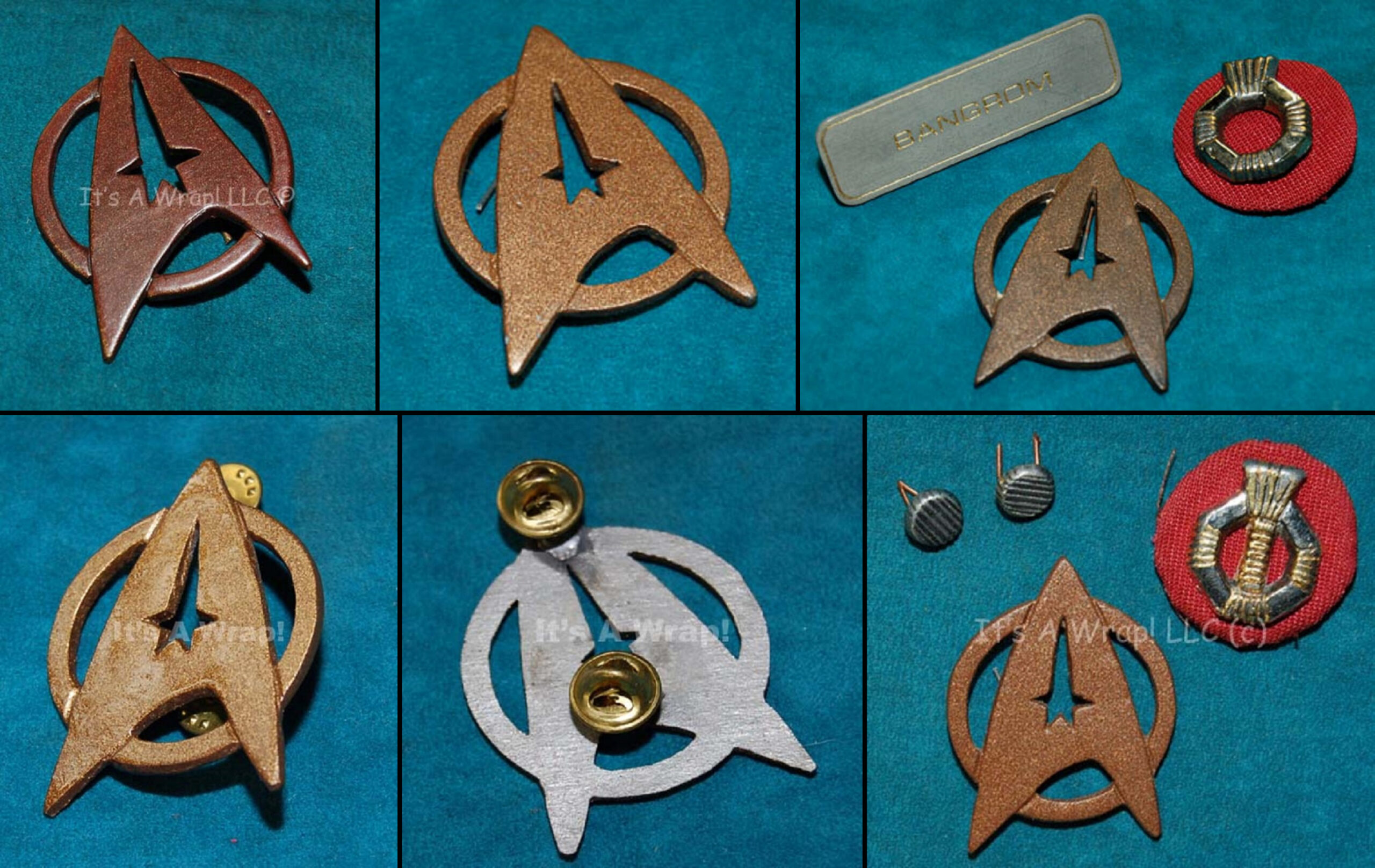
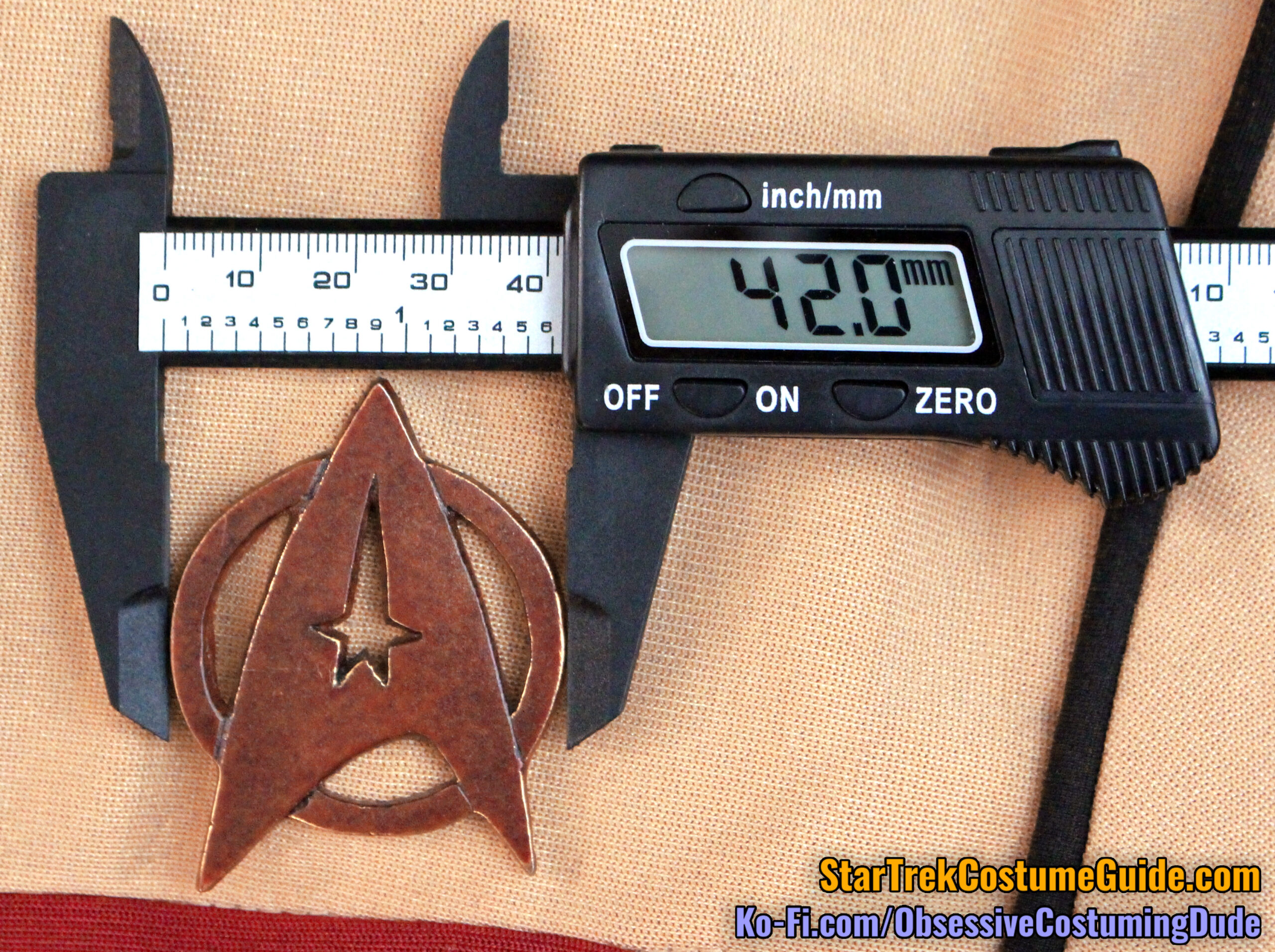
A metal chest badge the shape of the Starfleet “delta” (similar to the officer’s, minus the oblong backing) was worn on the upper left chest, vertically centered over the yoke/body seam.
Here are some auction photos of these badges, which were surprisingly darker in-person than how they looked in the movies.
TWOK-era enlisted jumpsuit auction photos
For more detailed photos of a screen-used badge, check out my screen-used enlisted jumpsuit examination.
Name Tag
In ST6, a name tag was added to the wearer’s upper right chest, which was also vertically centered over the jumpsuit’s yoke/body seam.
These name tags continued to be used in the Generations prologue.
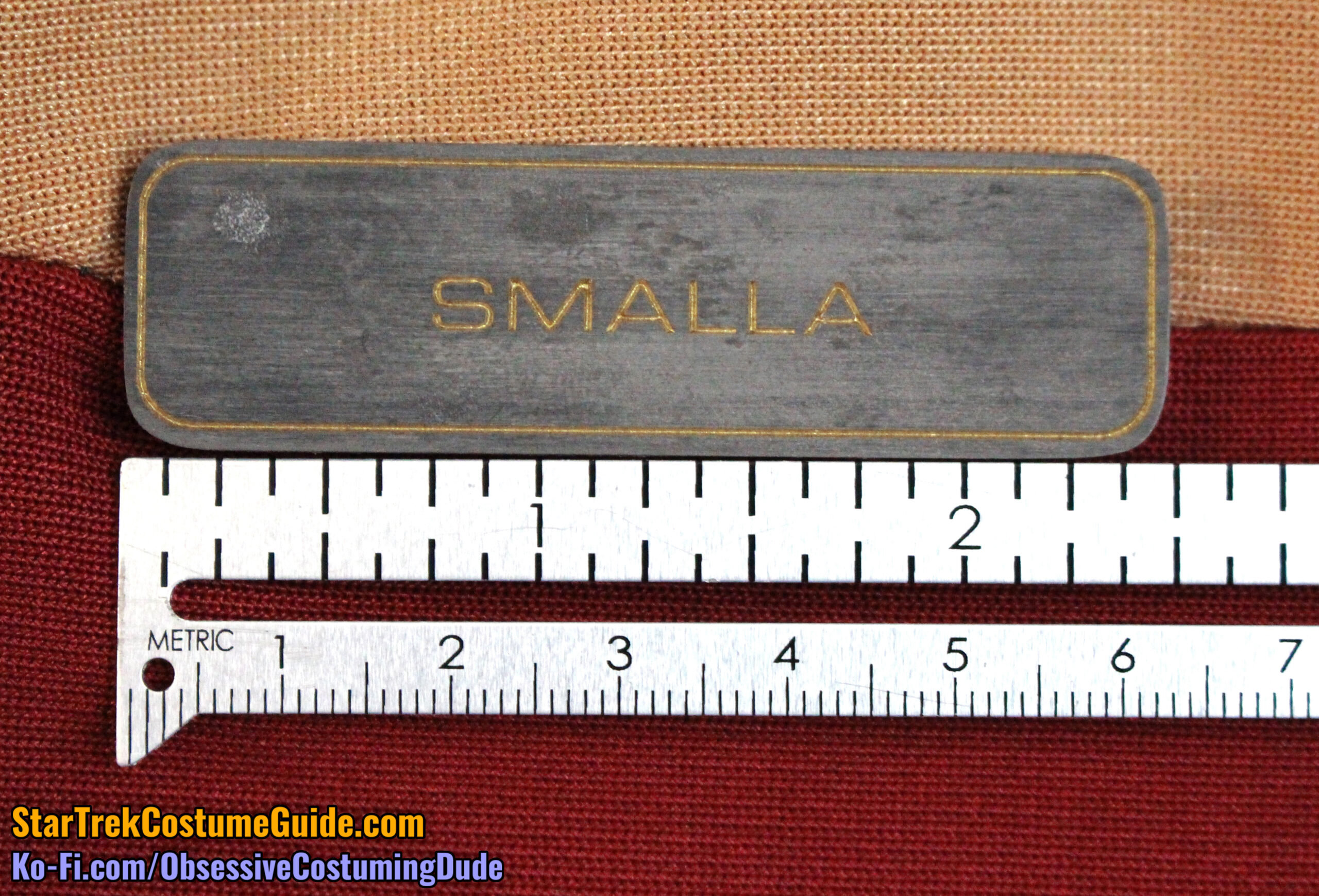
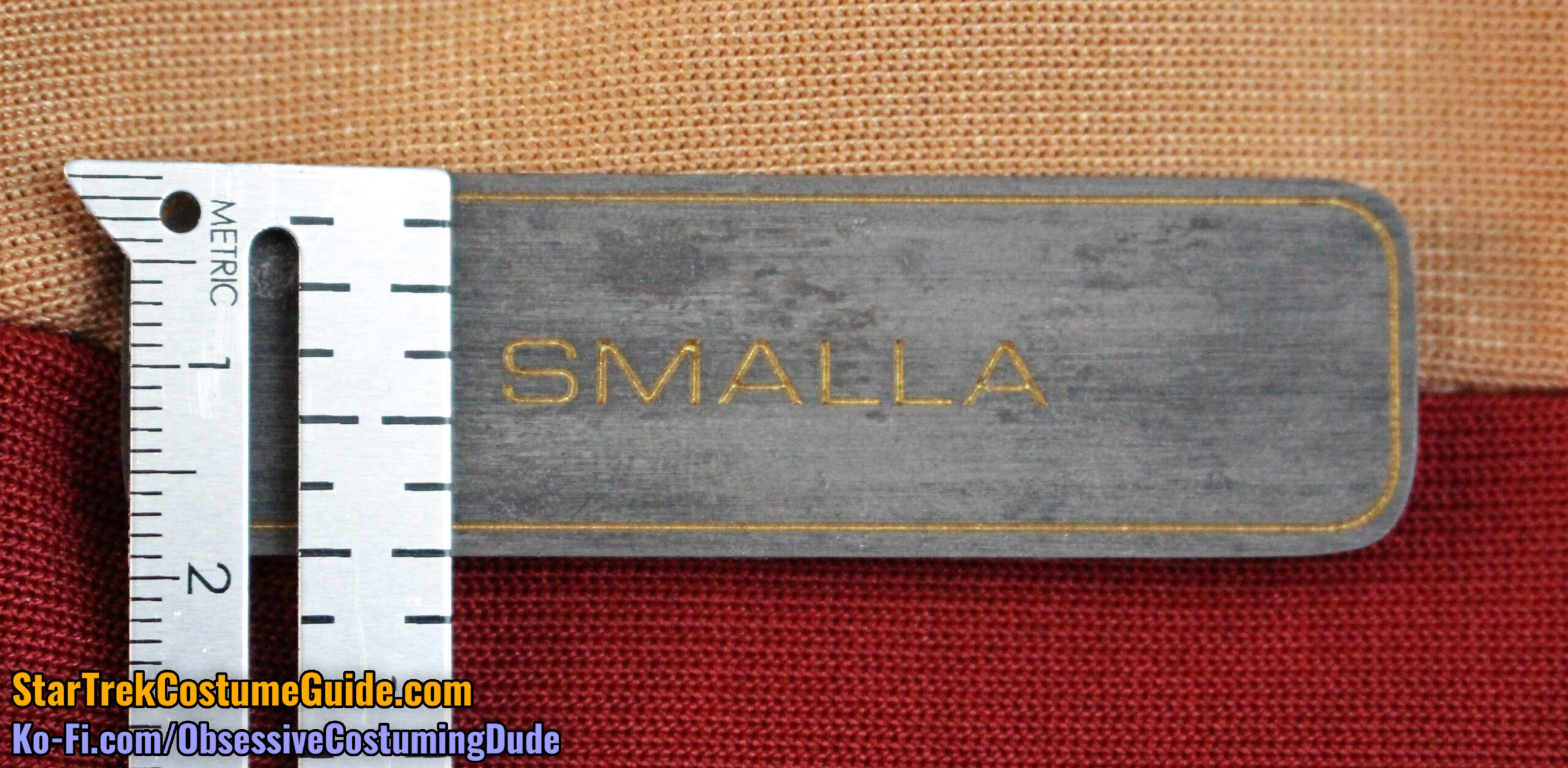
These name tags were dark gray, with the wearer’s name and a narrow border near the edge embossed in gold.
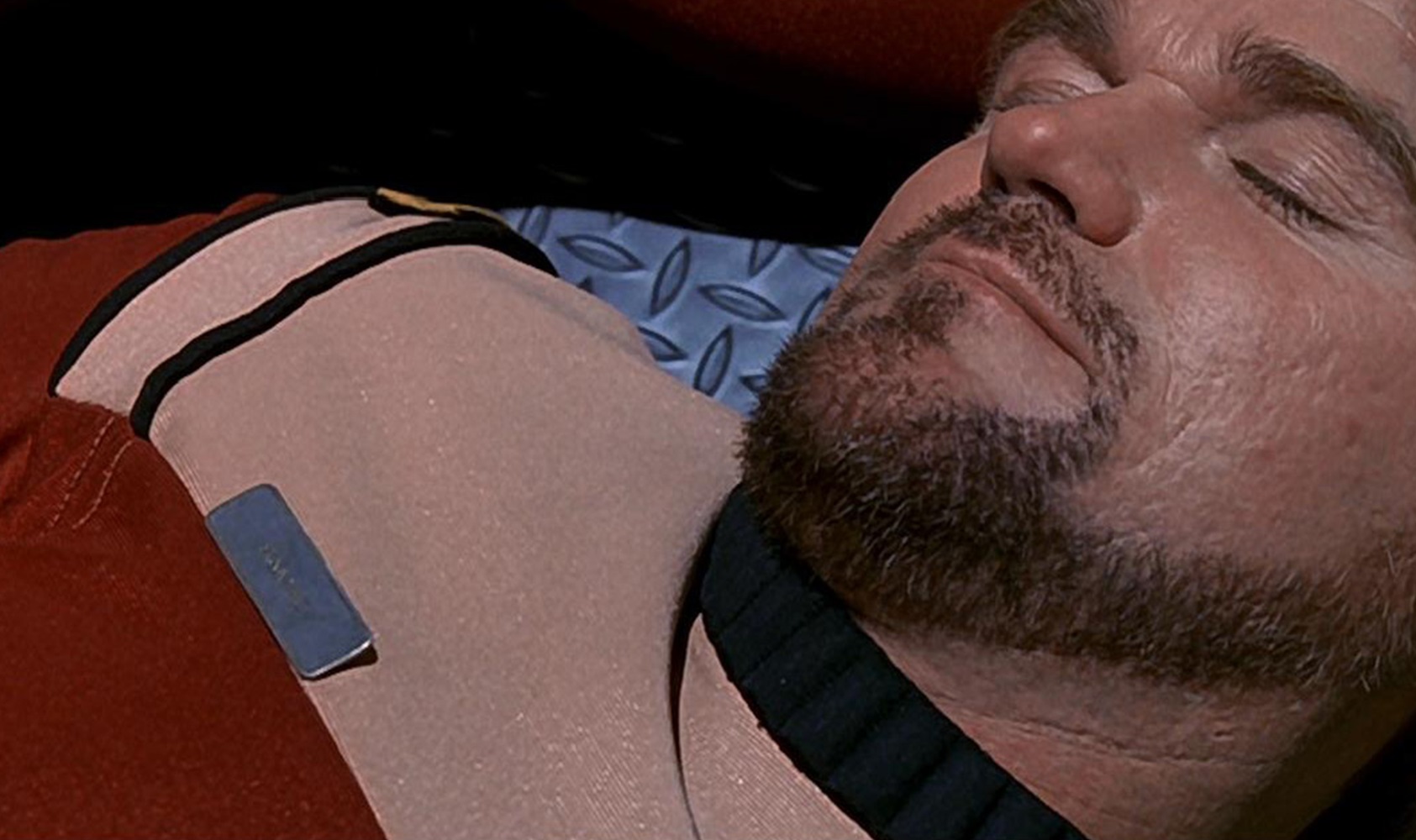
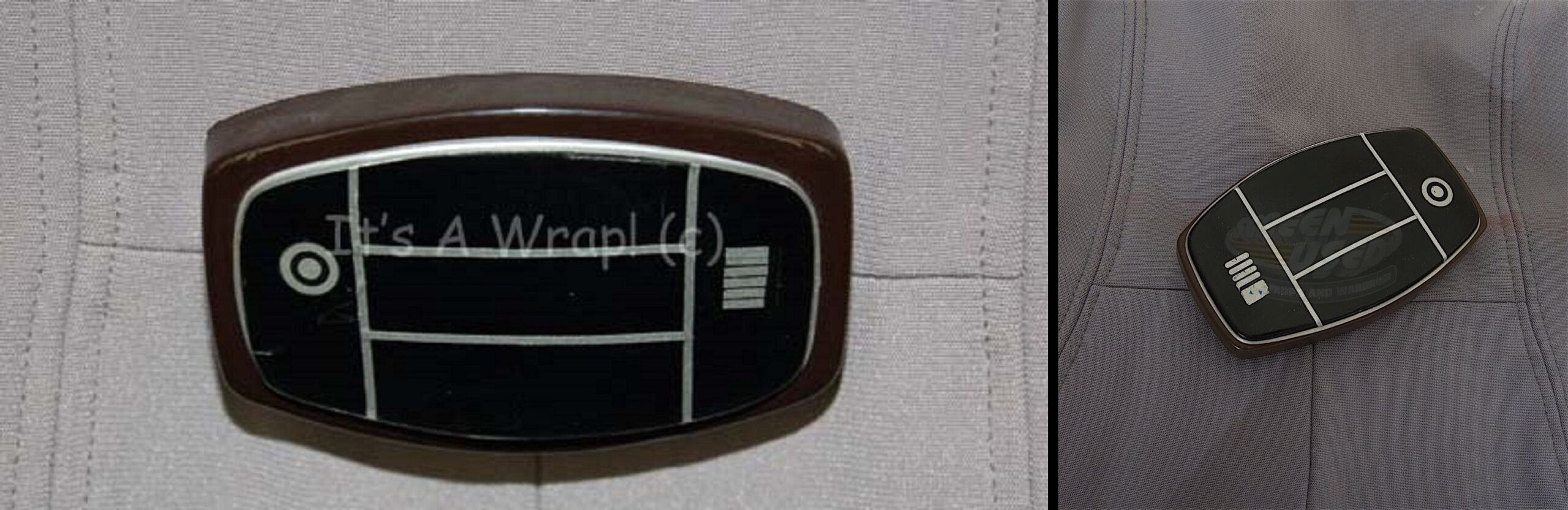
The name tag on the screen-used enlisted jumpsuit I examined was approximately 2 ½” wide by ¾” tall.
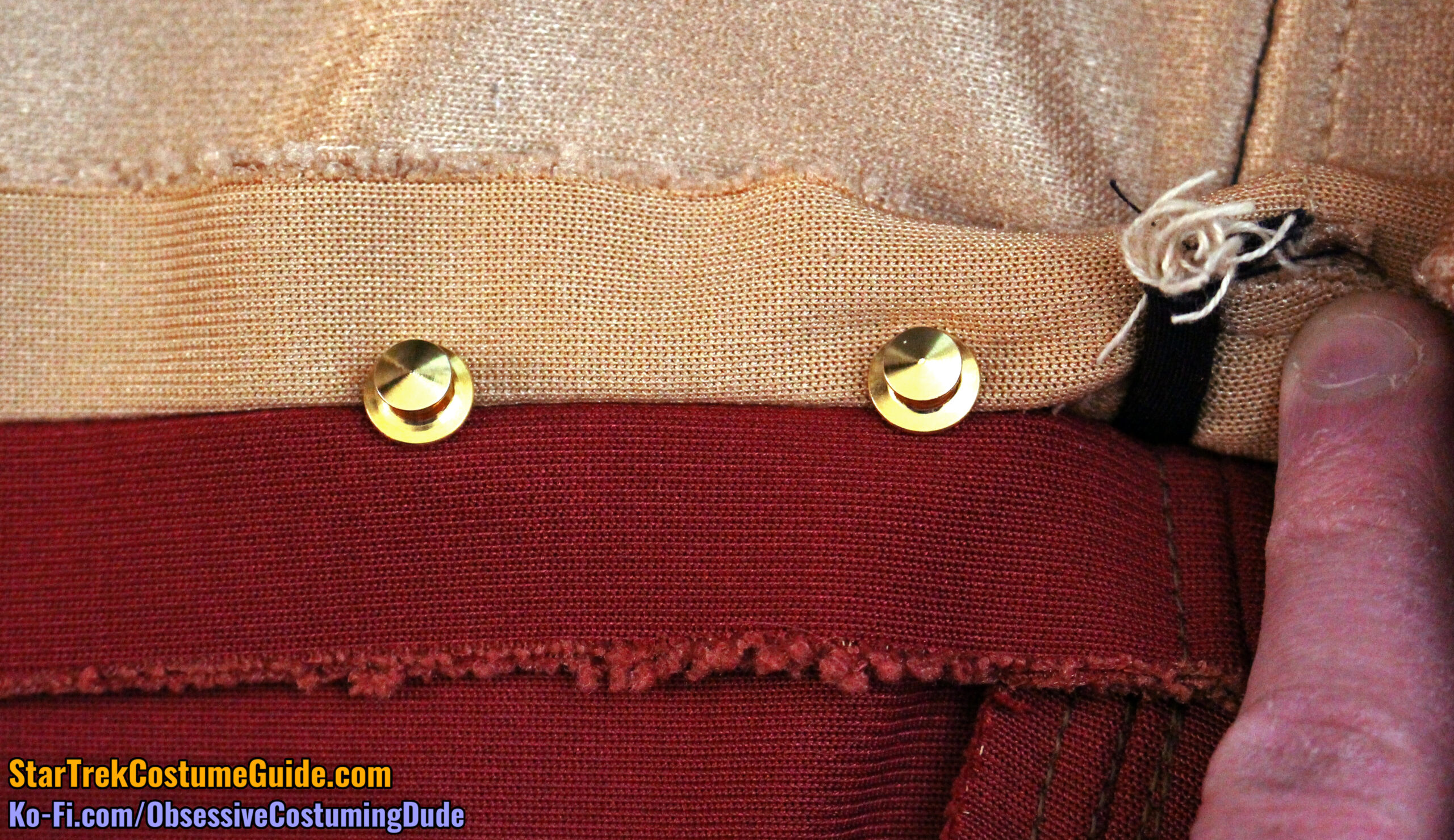
These were attached to the jumpsuit by two clutch pins on the back.
Boots
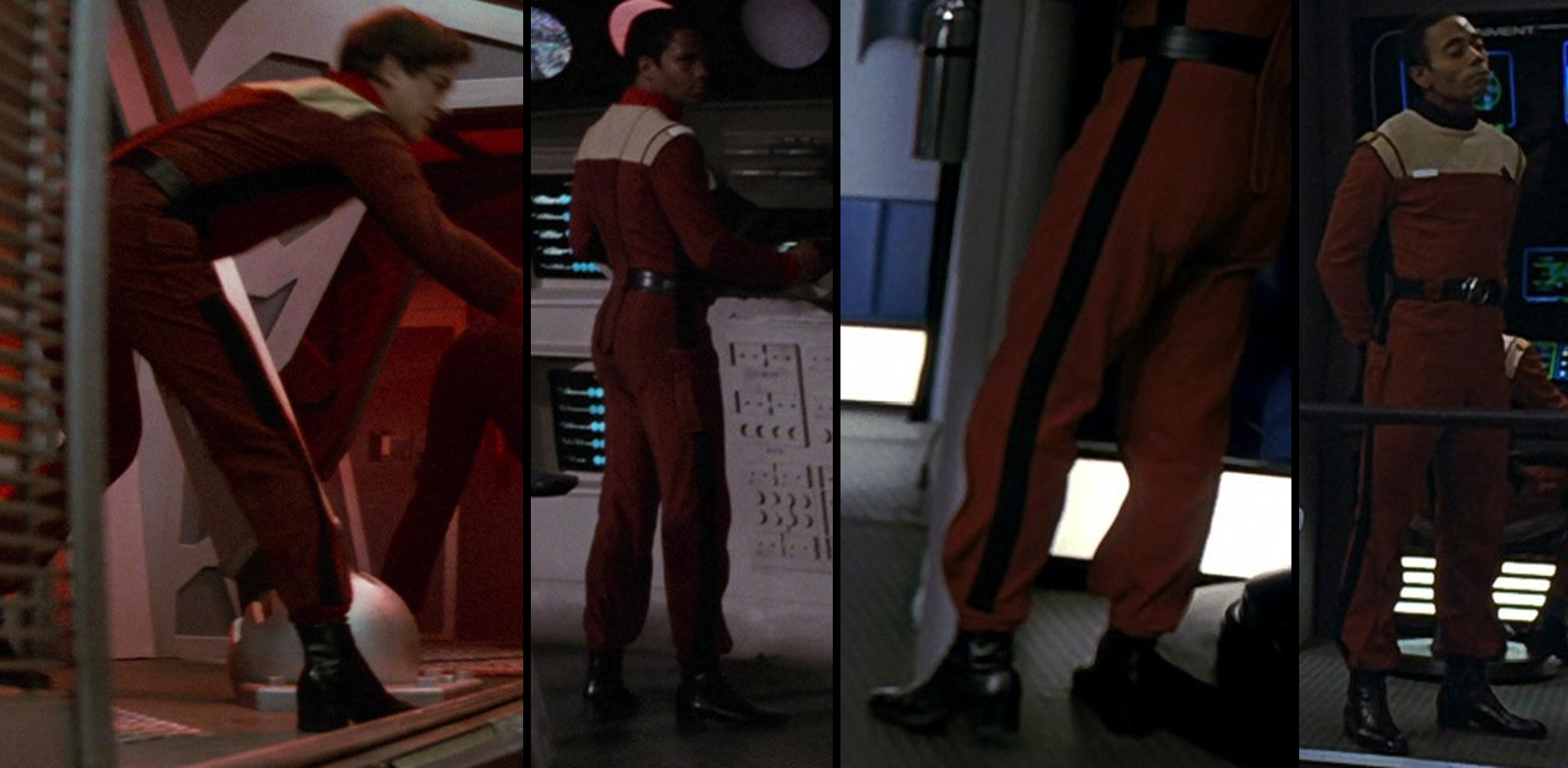
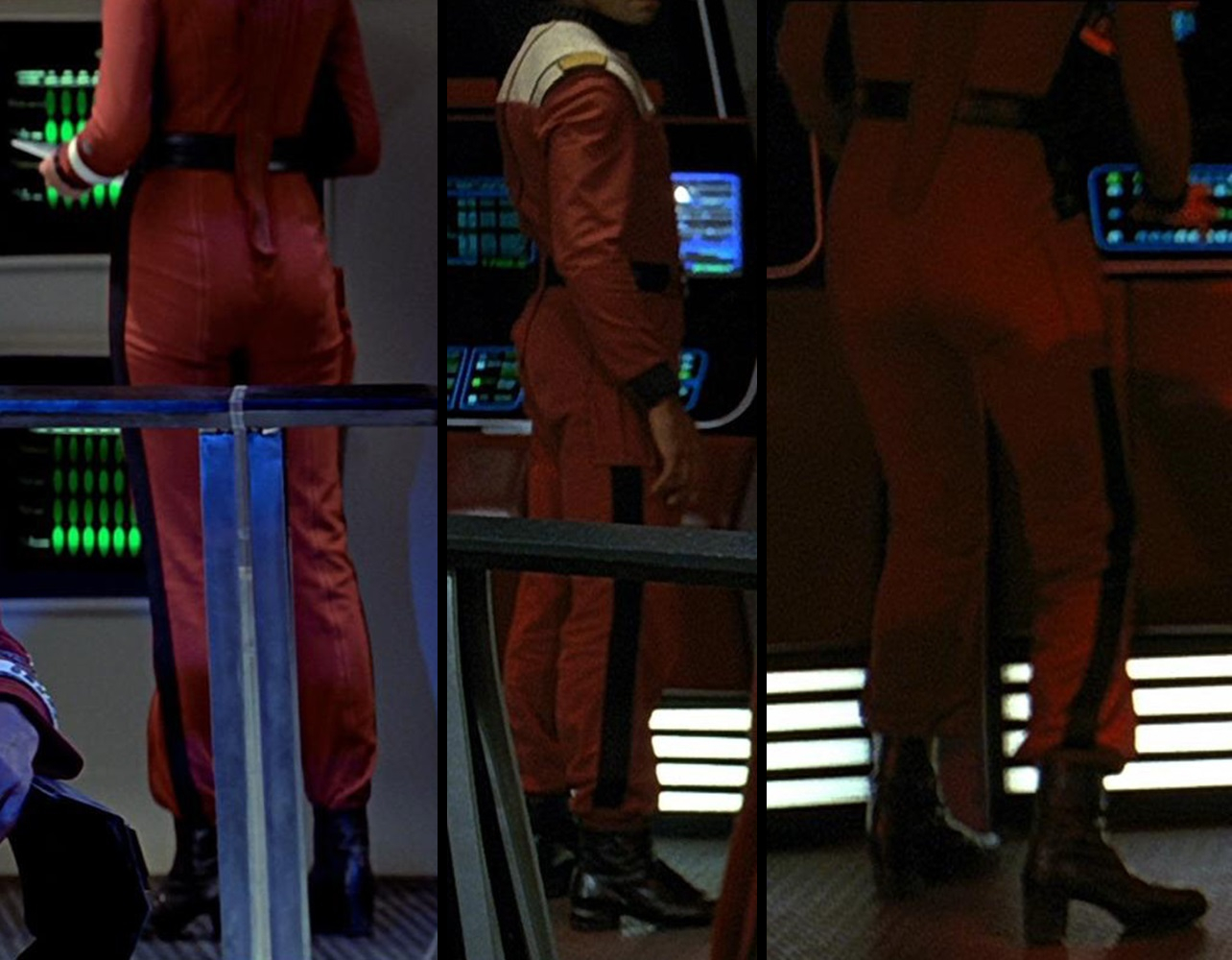
The enlisted jumpsuits were worn with black ankle boots.
Some of these boots had some major heels!
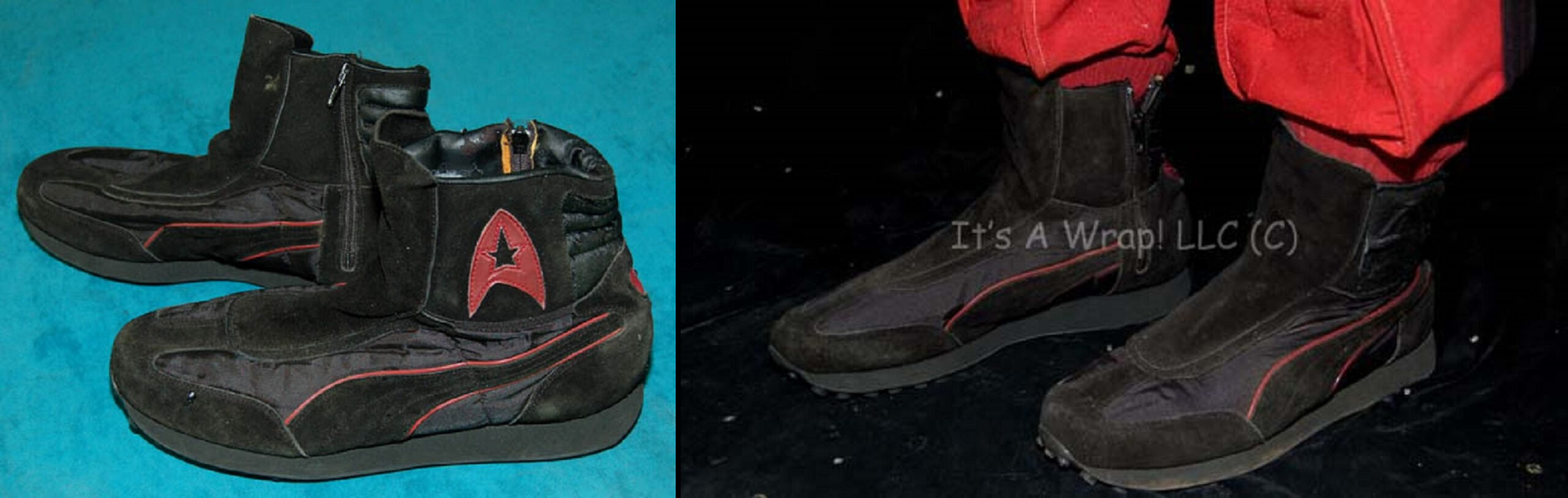
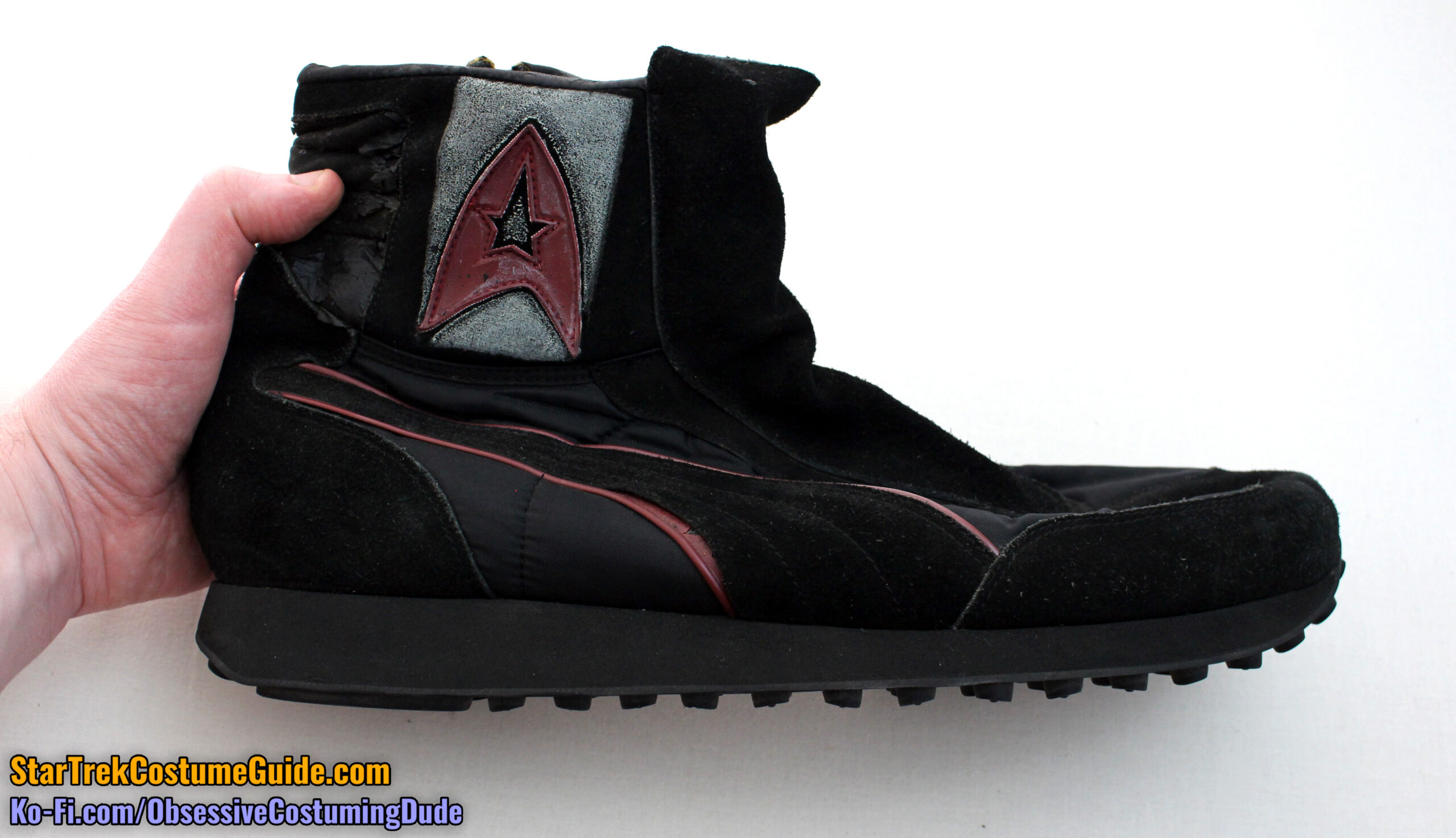
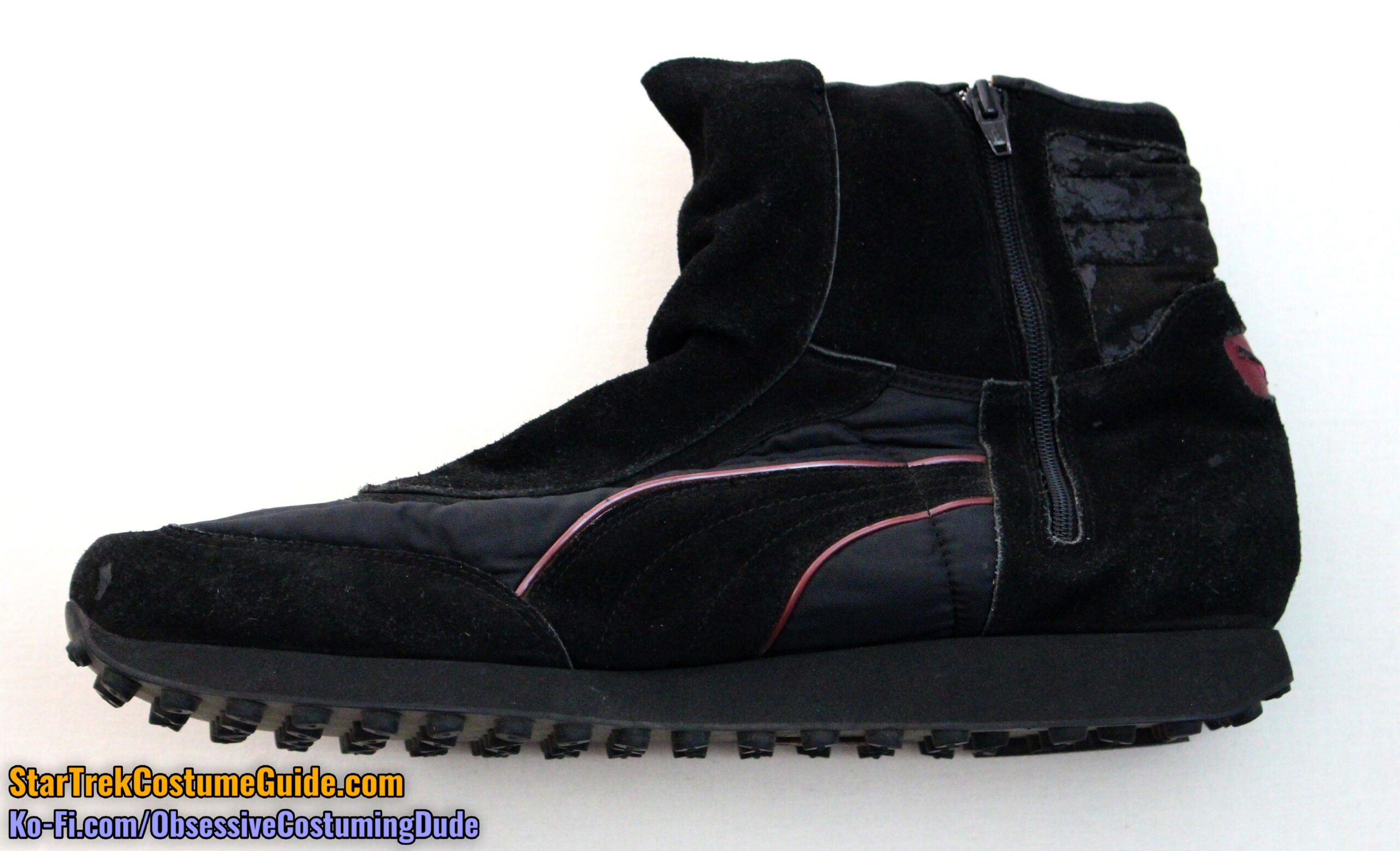
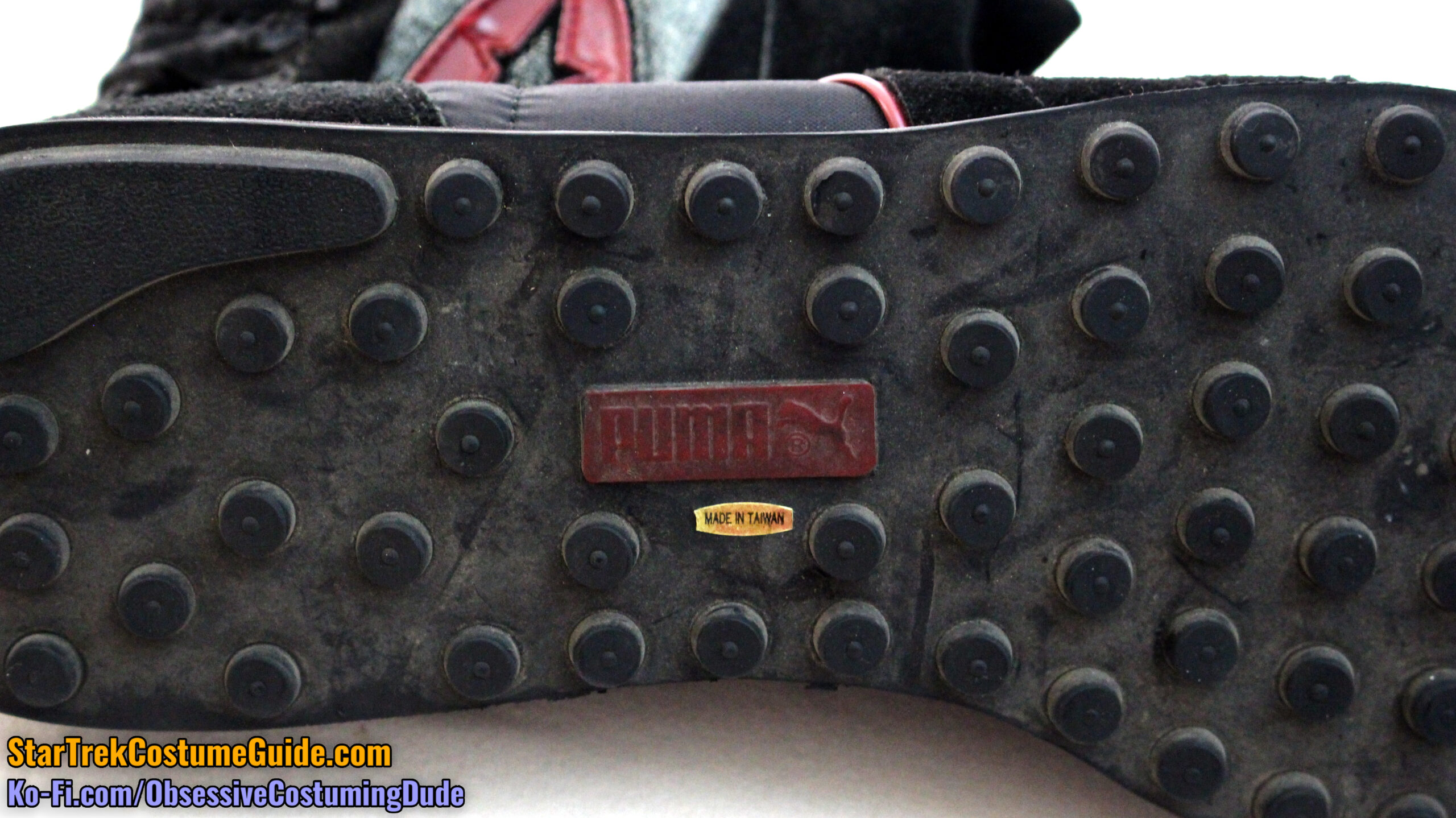
There were also these shoes, which were production-made (or rather, modified), but I don’t think they ever wound up being used in the movies.
TWOK enlisted jumpsuit auction photos
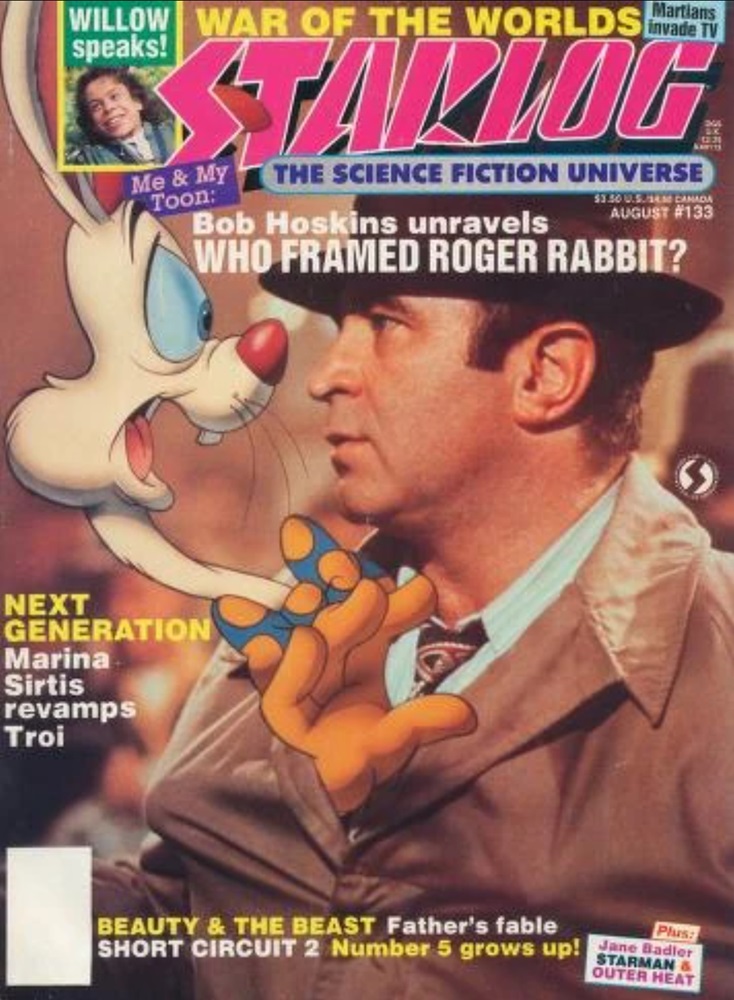
In Starlog issue #143, there was an article by James Brooks entitled, “The Admiral’s New Clothes,” in which Robert Fletcher told the story of these:
“It started out with the idea to clothe the whole crew with these new boots.
“I submitted some designs to Puma, and they said, ‘Oh, yeah – we can do that based on one of our existing designs. We’ll modify it.’
“We said, ‘Fine, we need eighty-five pairs and we need them by a certain date.’
“The date came and went past, and we had to start filming, so there were no shoes. We went ahead with [the plain black] boots we had from the past films.
“Then, toward shooting’s end, the new boots showed up. Not the full allotment. They were high-top sneakers in black and burgundy with the [Starfleet] insignia on the side. But there was no way to use them.”