As a preface to my TWOK-era costuming resources, I thought it would be interesting to take a broader look at the overall uniform paradigm of the movies, as established by costume designer Robert Fletcher and carried forward by his successors.
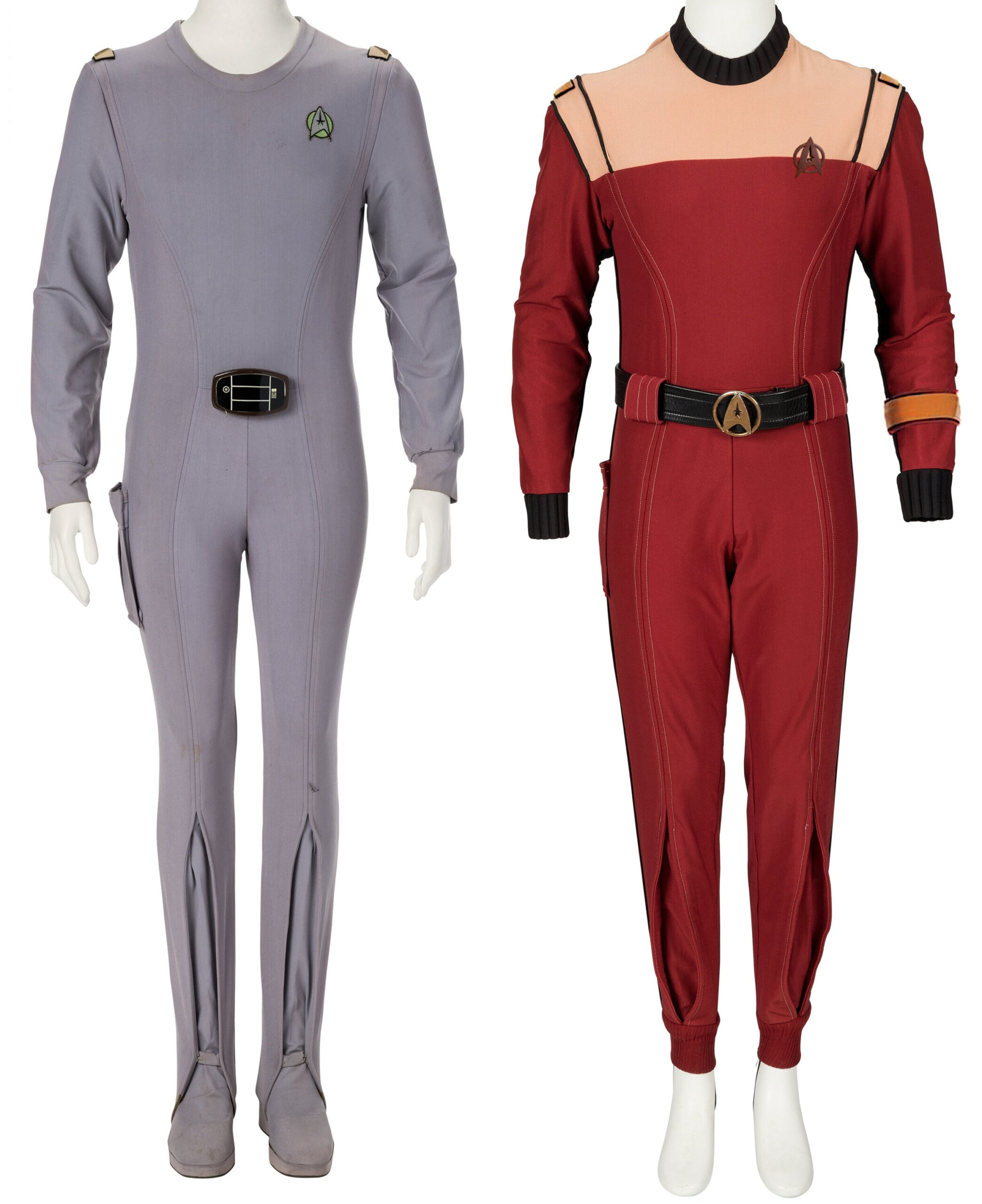
On the surface, the uniforms for The Wrath of Khan were a major visual shift from those seen in The Motion Picture.
These uniforms were, in fact, only one facet of an overall different creative direction chosen for the sequel, which permeated practically every aspect of the movie.
Nautical Adventure
In the words of the filmmakers and production team themselves:
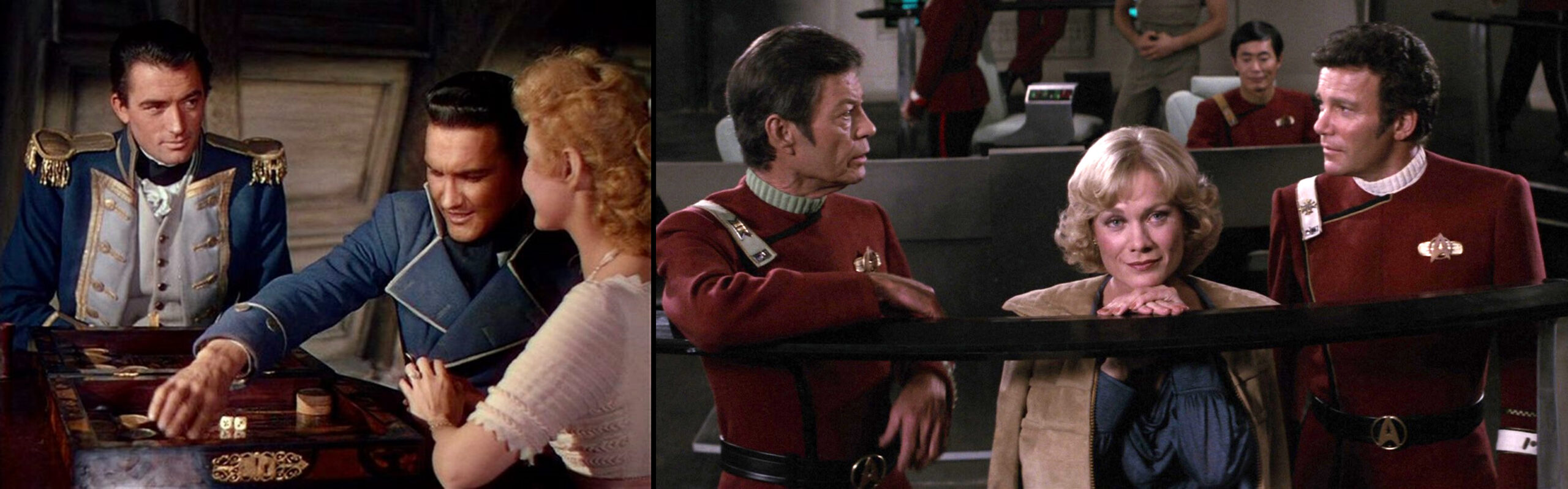
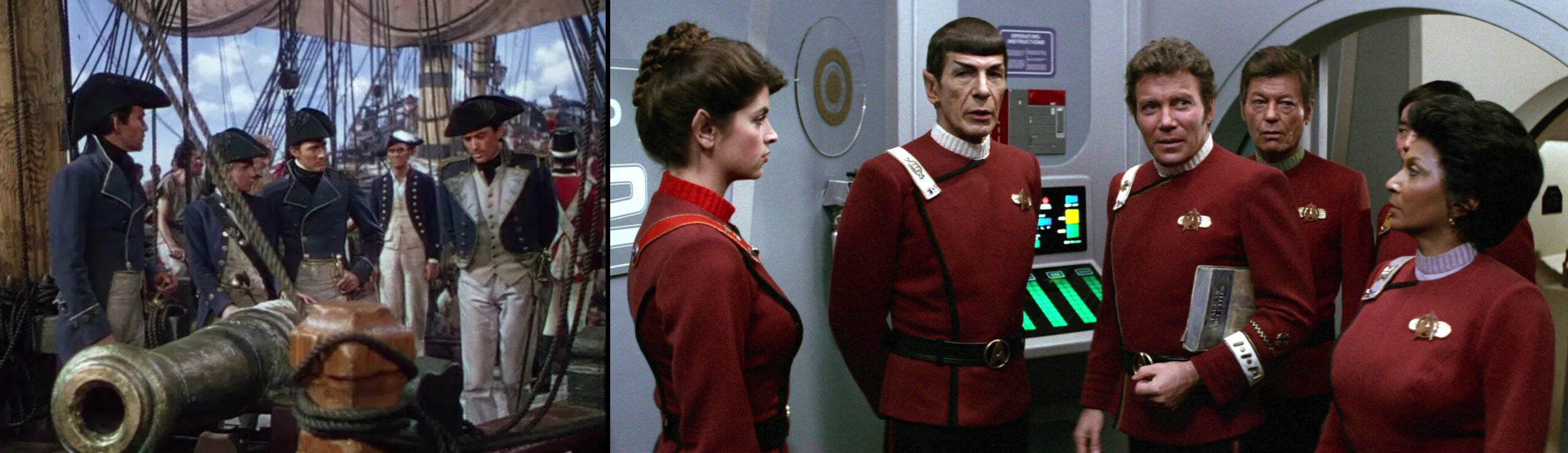
“I related to [the television series] when I suddenly began to think of it as the adventures of Captain Horatio Hornblower in outer space. Once I got that, I thought, ‘Okay, so this is about the Navy. This is about gunboat diplomacy.’ And I grew up loving those books, and so I redesigned the uniforms, or caused them to be redesigned, and I made them more militaristic.”
– Nicholas Meyer, TWOK Blu-Ray audio commentary (approximately 26:00)
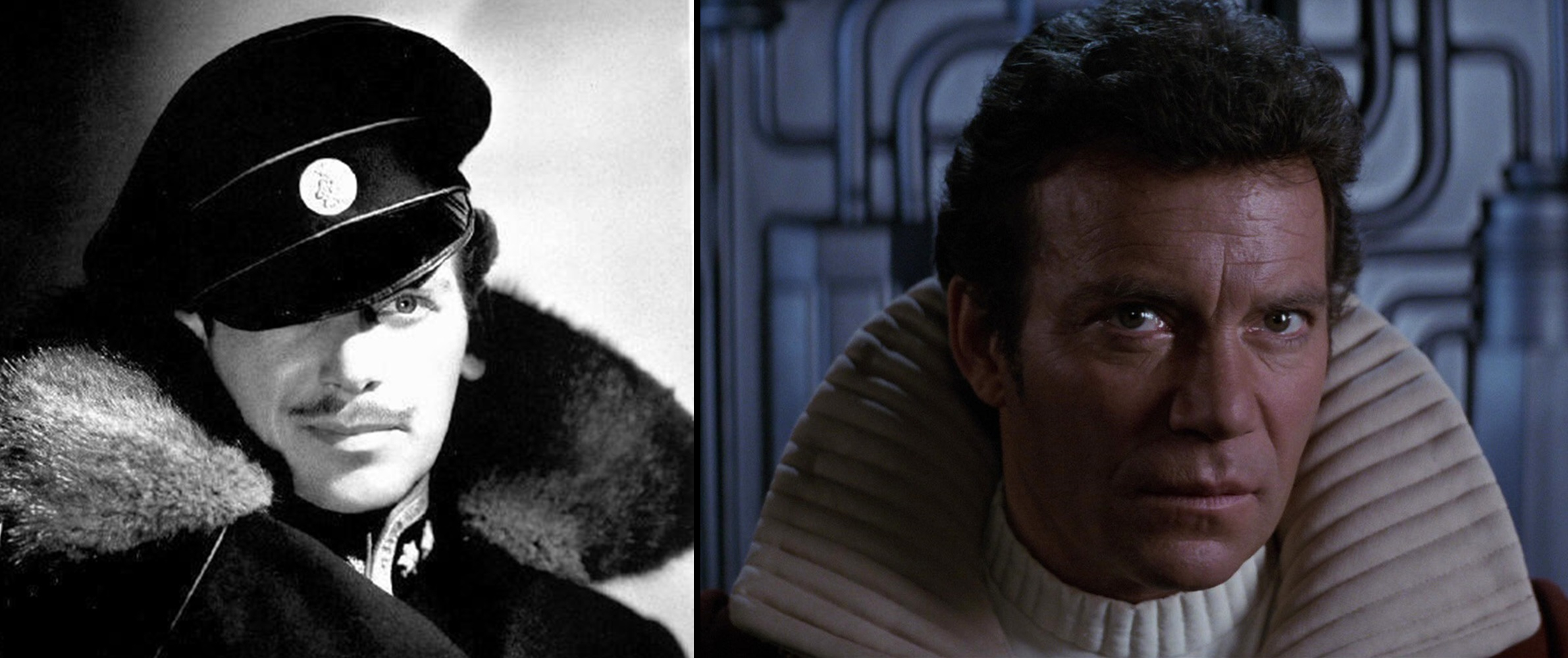
“I said I’d really like to stretch the nautical analogy. It should be like The Prisoner of Zenda, or Captain Horatio Hornblower in outer space. I made everyone on the set watch the movie version of Hornblower. And it was interesting because when I first spoke to Bill Shatner about that, he said, ‘That was also Gene Roddenbery’s original take on Star Trek.”
“I decided that this was going to be ‘Hornblower’ in outer space, so I said, ‘Okay, if this is going to be the Navy, let’s have them look like the Navy; they shouldn’t be walking around in pajamas,’ which seemed to me to be what the uniforms in the first movie and the TV show looked like.
“When you’re dealing with me, I think, you’re dealing with a very flat-footed, Earthbound sensibility, and, if I didn’t understand why they were wearing something, then I just wanted to do it in a way that made sense to me.”
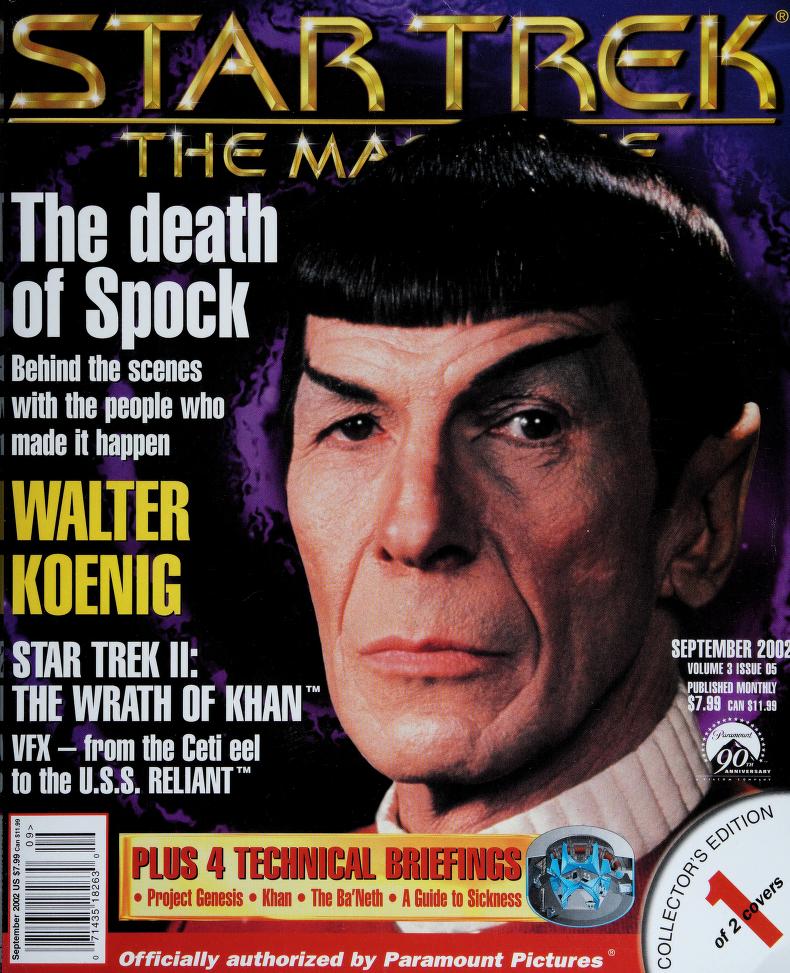
– Nicholas Meyer, Star Trek: The Magazine (September 2002), “Star Trek Costumes”
“[The uniforms] in the last movie weren’t military enough to suit me. Roddenberry always contended that the Federation is not a military organization. Yet [the crew] always behaved as if it were. They have ranks, they have military courtesy, and Kirk is definitely in command on his ship.”
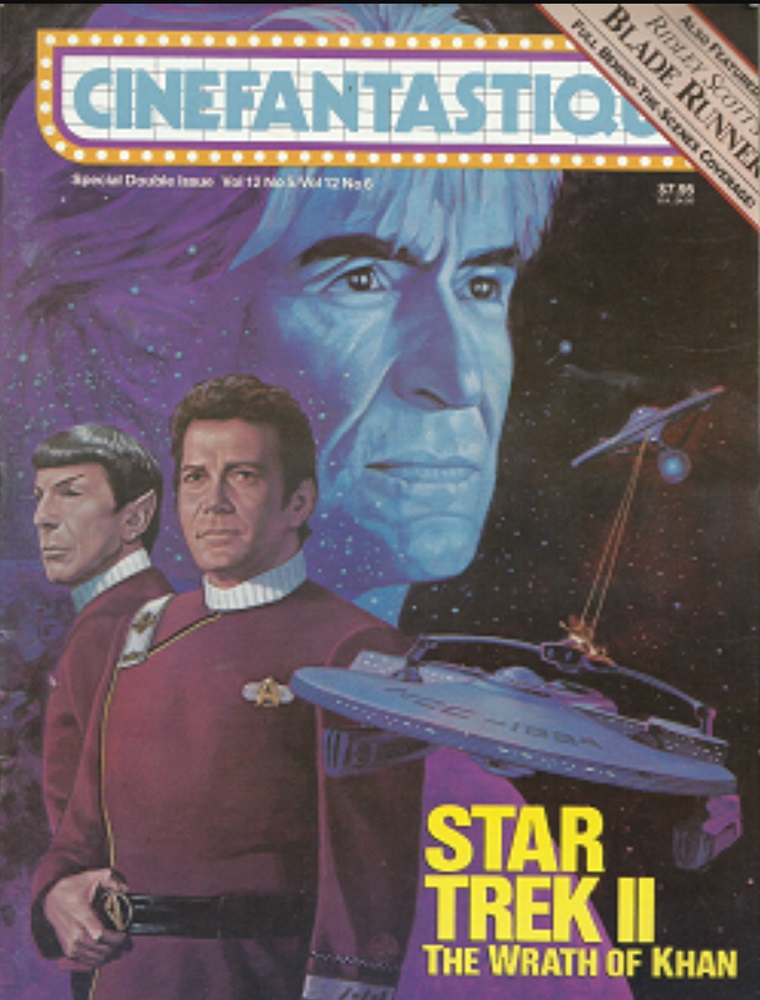
– Robert Fletcher, Cinefantastique volume 12, number 5/6 (July 1982), “Star Trek: The Wrath of Khan”
The key points of interest here are Captain Hornblower, The Prisoner of Zenda, and the desire for the uniforms to be more militaristic, in keeping with the “nautical adventure” tone.
"Space Opera"
Another idea that informed the redesigned TWOK uniforms was the concept of “space opera,” popularized by the then-concurrent Star Wars trilogy.
“Nick Meyer was a very intellectual man who was extremely fond of opera, and he knew that I had designed a number of operas. Operas tend to be very full-blown, and non-realistic, and melodramatic, and so on and so forth … and I think that’s very true of The Wrath of Khan. Except that nobody sang.”
– Robert Fletcher, TWOK Blu-Ray special feature, “Designing Khan”
Color Palette
The other major aspect of the uniforms to be revamped was the overall color palette:
“… [The Motion Picture] ended up looking as if it had been shot through gauze, and it took on a very sterile look. For me, that flew in the face of the vivid oversaturated color and unrestrained exuberance of the original series.
“The best Star Trek adventures, as conceived, written, and photographed, couldn’t help but come across as very alive, colorful, vibrant experiences.”
– Harve Bennett, producer
“Star Trek: The Motion Picture was none of these things. It was muted, bland, shot in pastels, with crewmen in pale gray uniforms …”
“Nick wanted something a little warmer, more military, less … modernistic, or whatever word you might apply to the design of the first one. I went off to my tent and made new sketches, which were red, and in a lot of different pieces, with many more emblems and badges.”
– Robert Fletcher, TWOK Blu-Ray special feature, “Designing Khan”
“The colors I wanted for the film are what I call corrupt colors – a shade off from a pure color. The uniform jackets aren’t quite red … everything is an ‘ish’ color. Maroonish red. Brownish green. Purplish black. They’re not colors you see today, so in a subtle way, they indicate another time.”
– Robert Fletcher, Cinefantastique volume 12, number 5/6 (July 1982), “Star Trek: The Wrath of Khan”
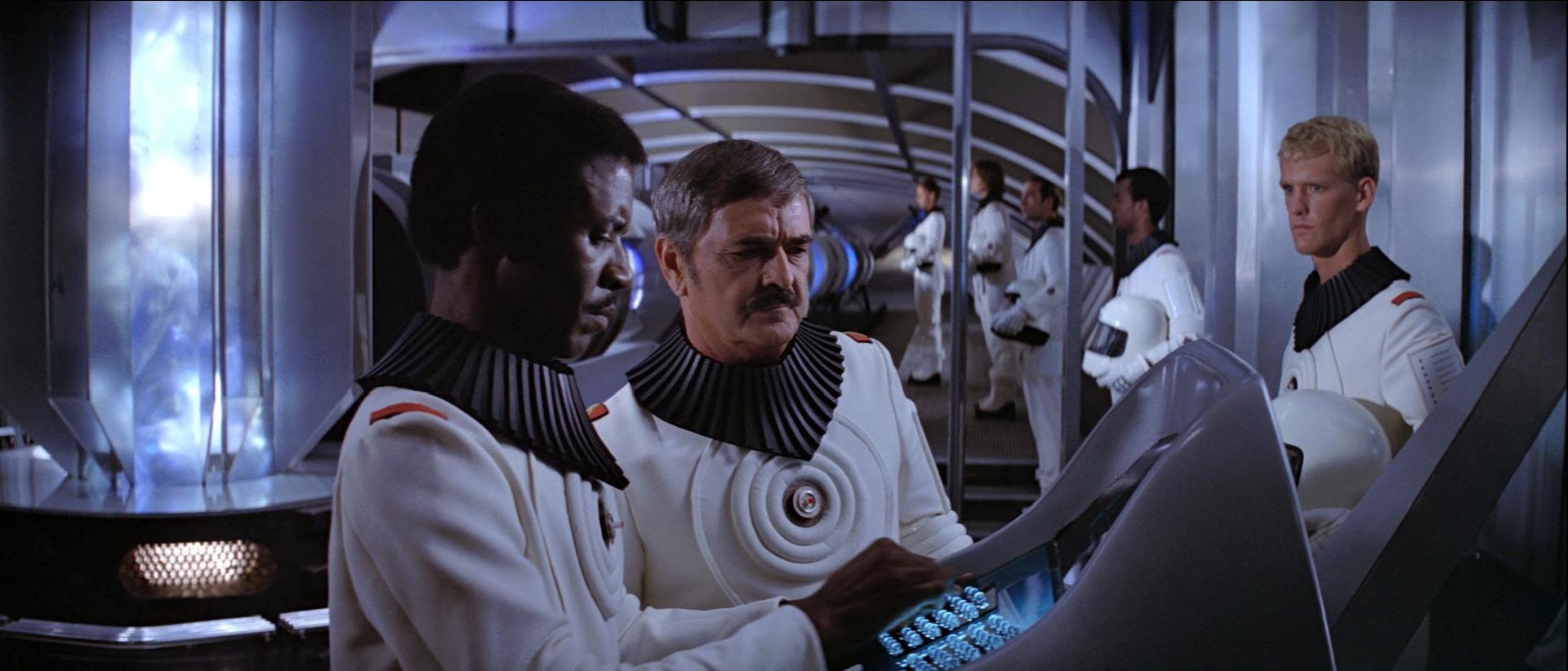
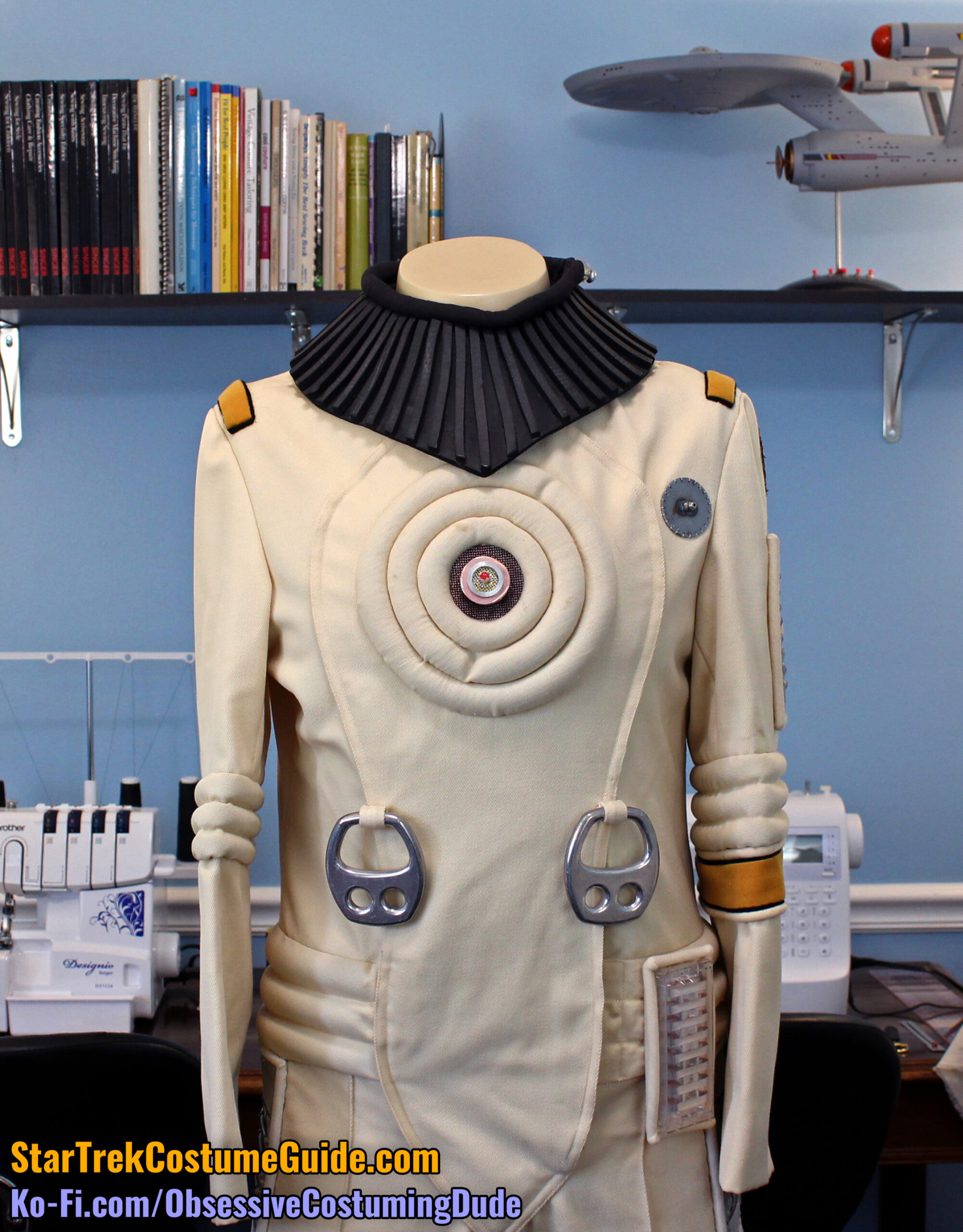
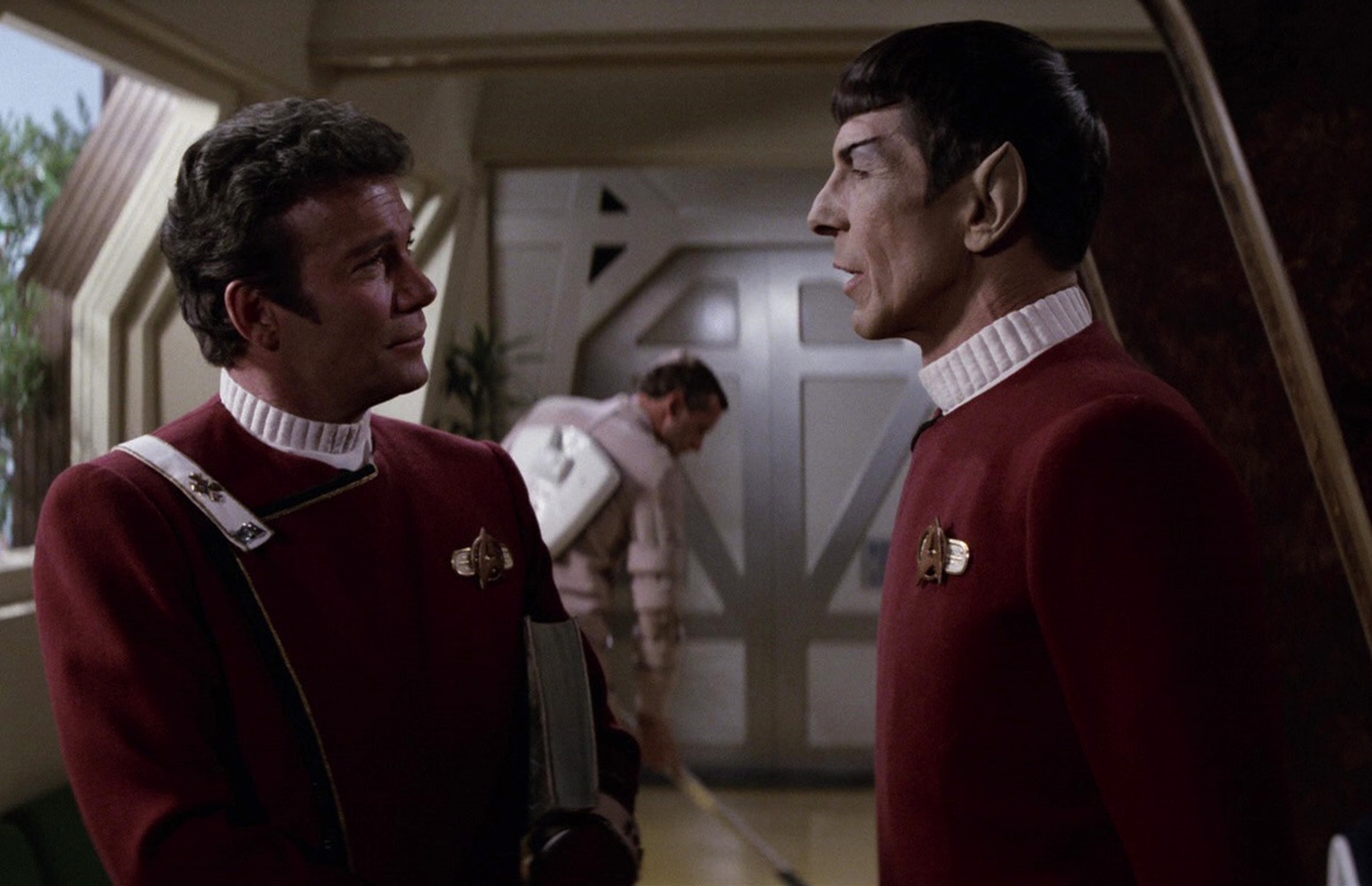
I find it interesting that despite the criticism of the first movie’s costumes, many of the TMP uniforms were reused in TWOK and the following movies – and nobody seemed to mind, or even notice.
What’s amazing to me is that Fletcher and his team managed to achieve an almost entirely new uniform aesthetic befitting the “nautical adventure” theme, while actually introducing very few new uniforms.
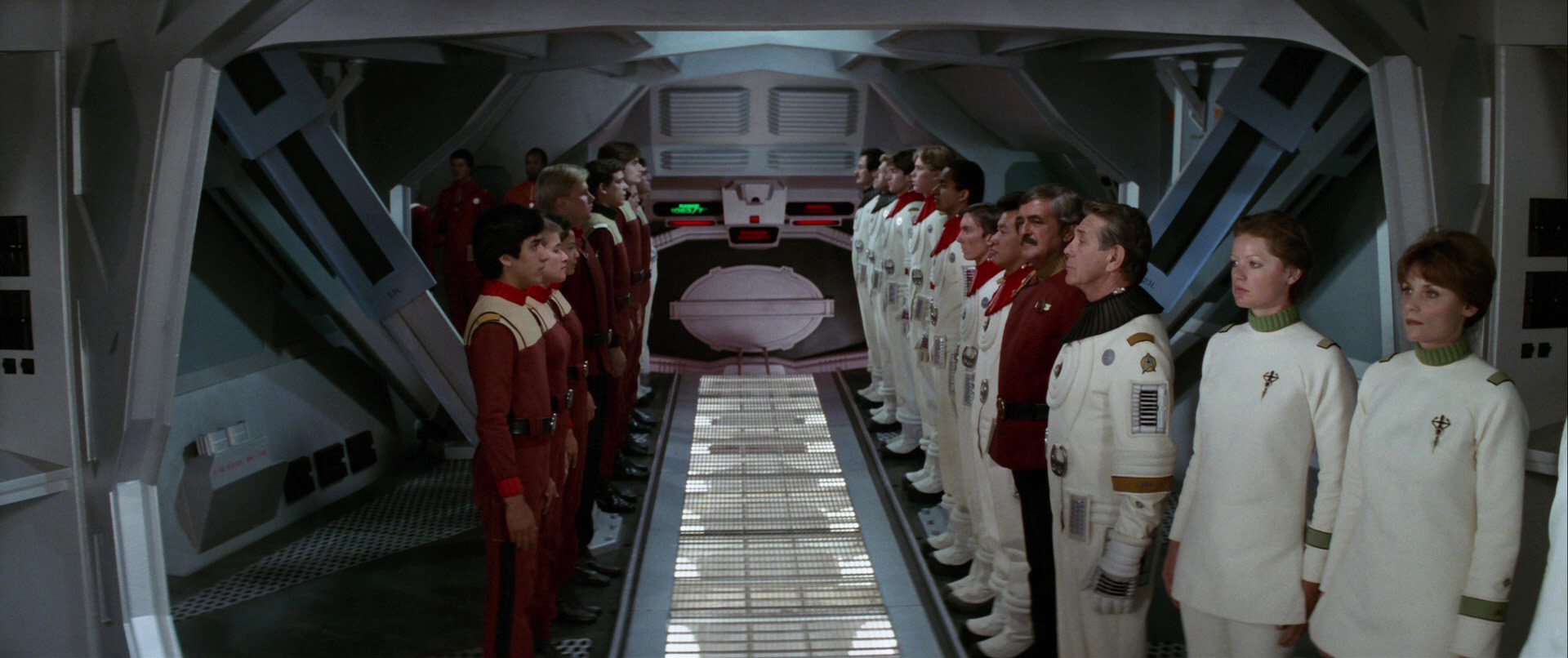
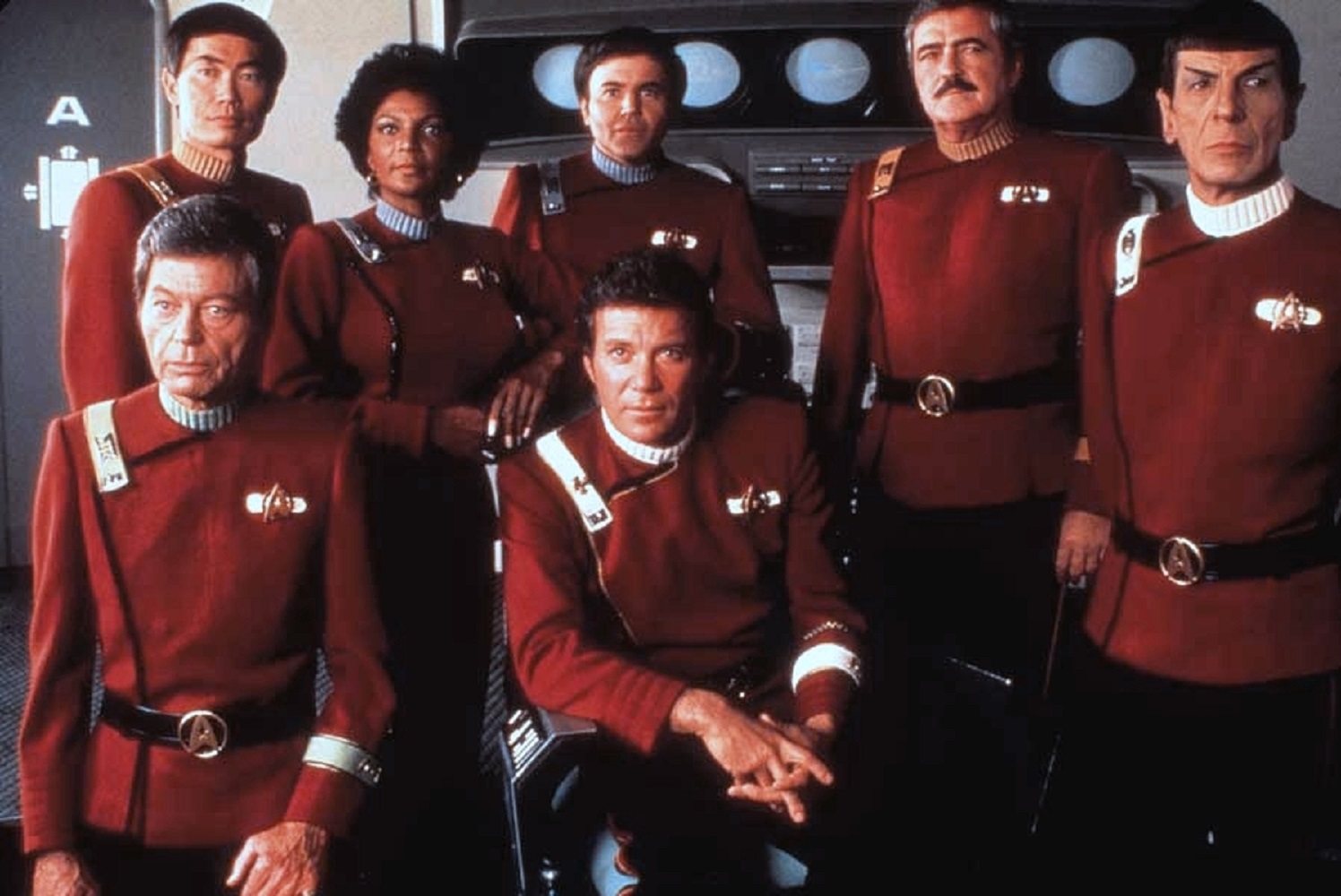
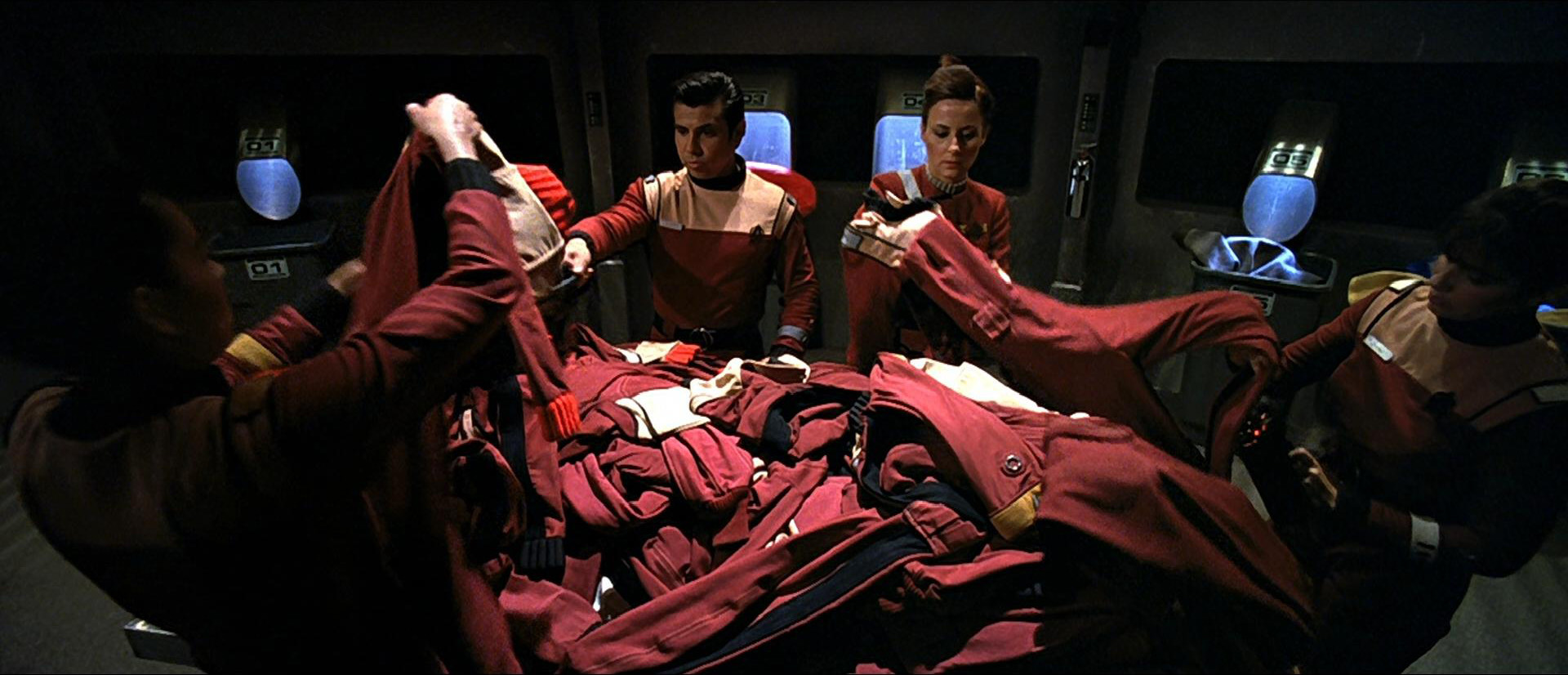
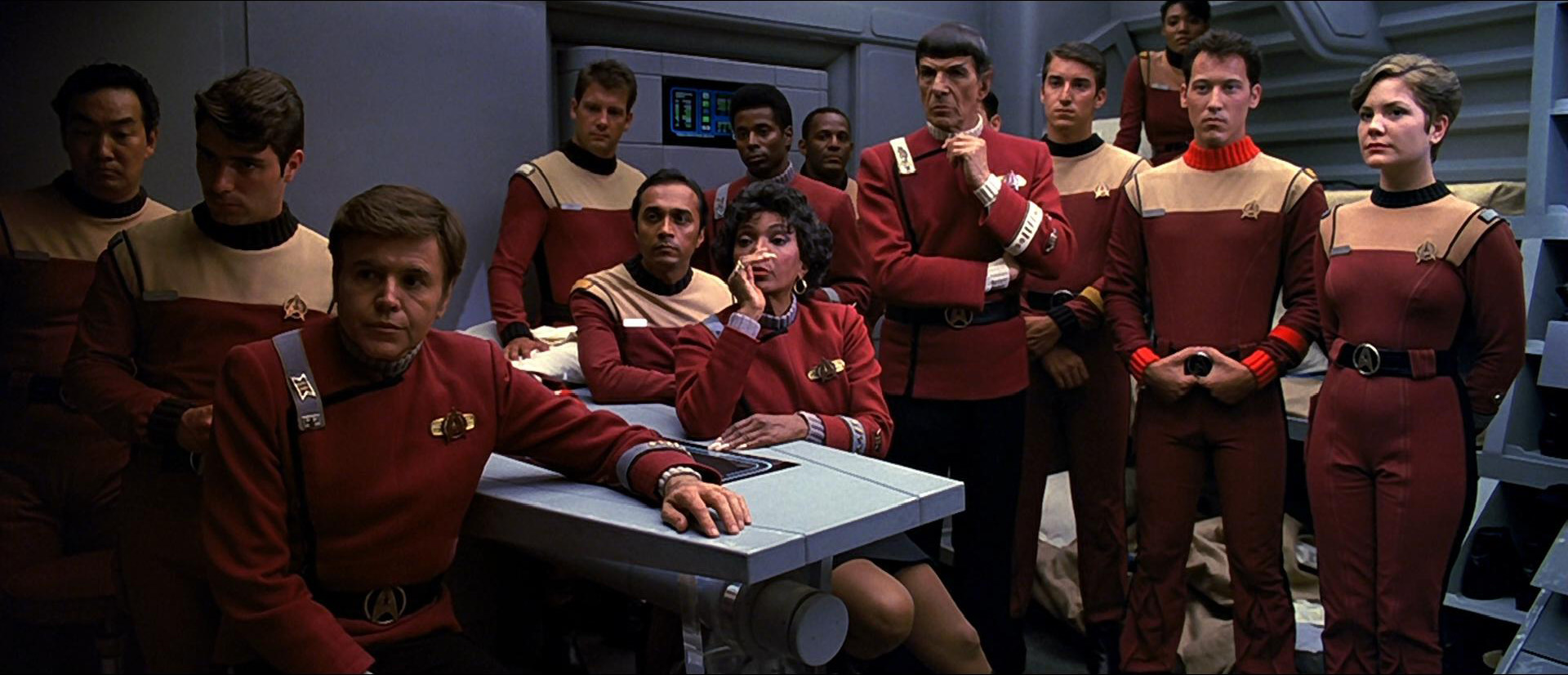
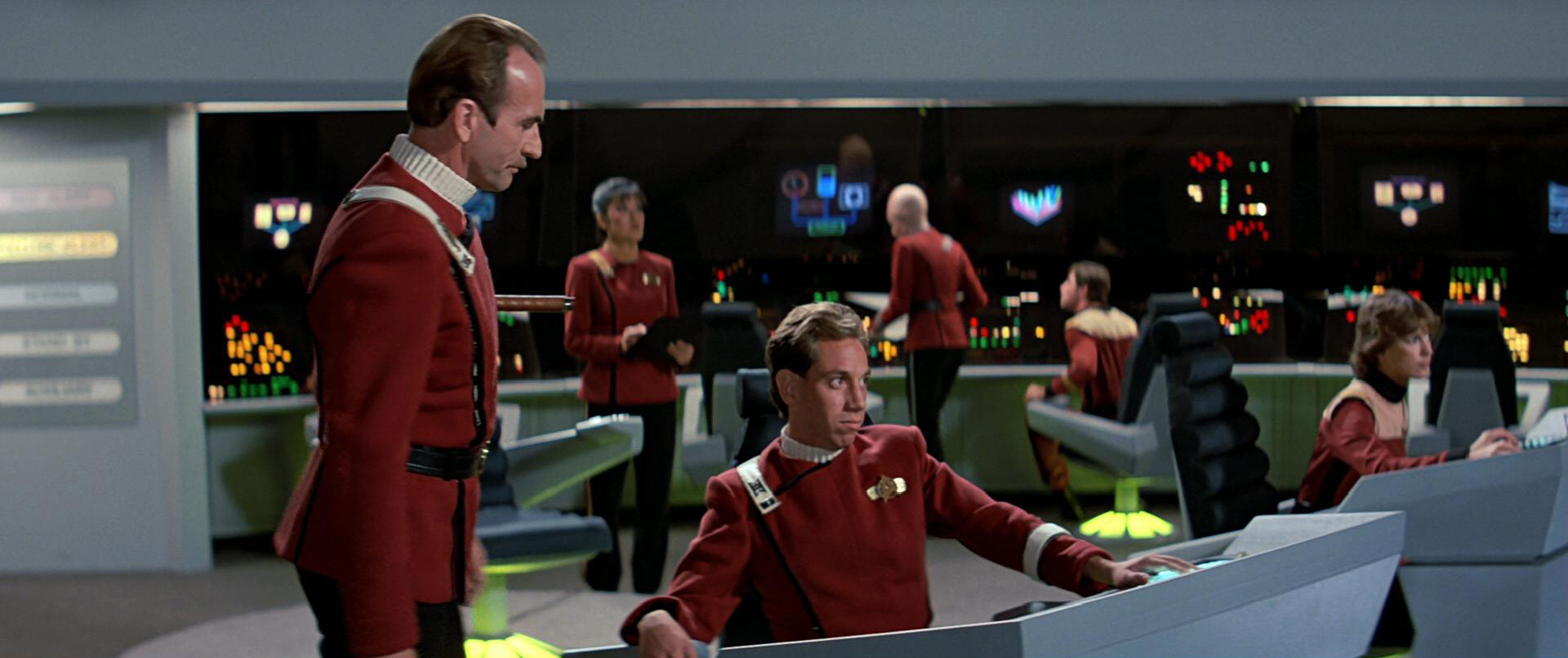
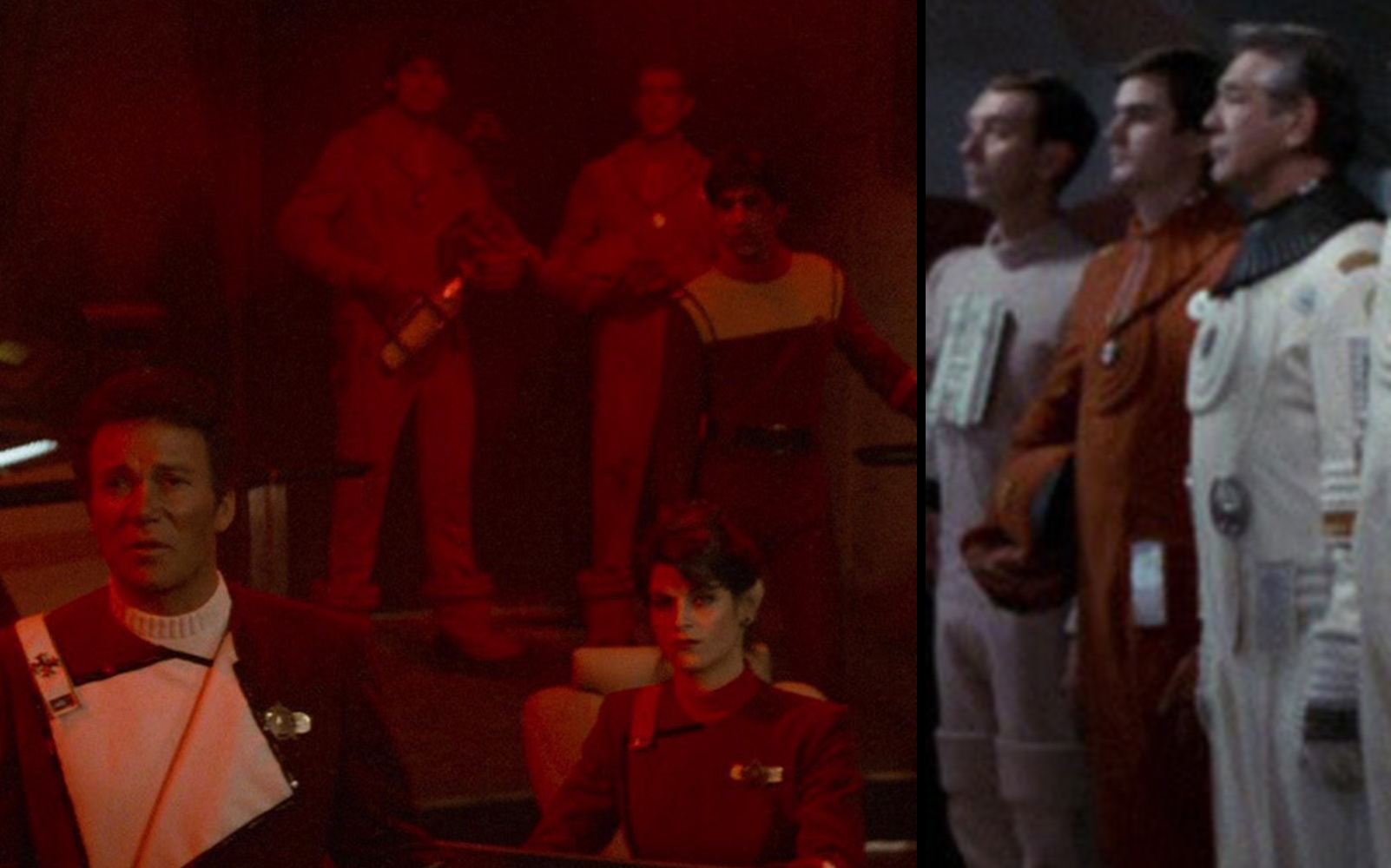
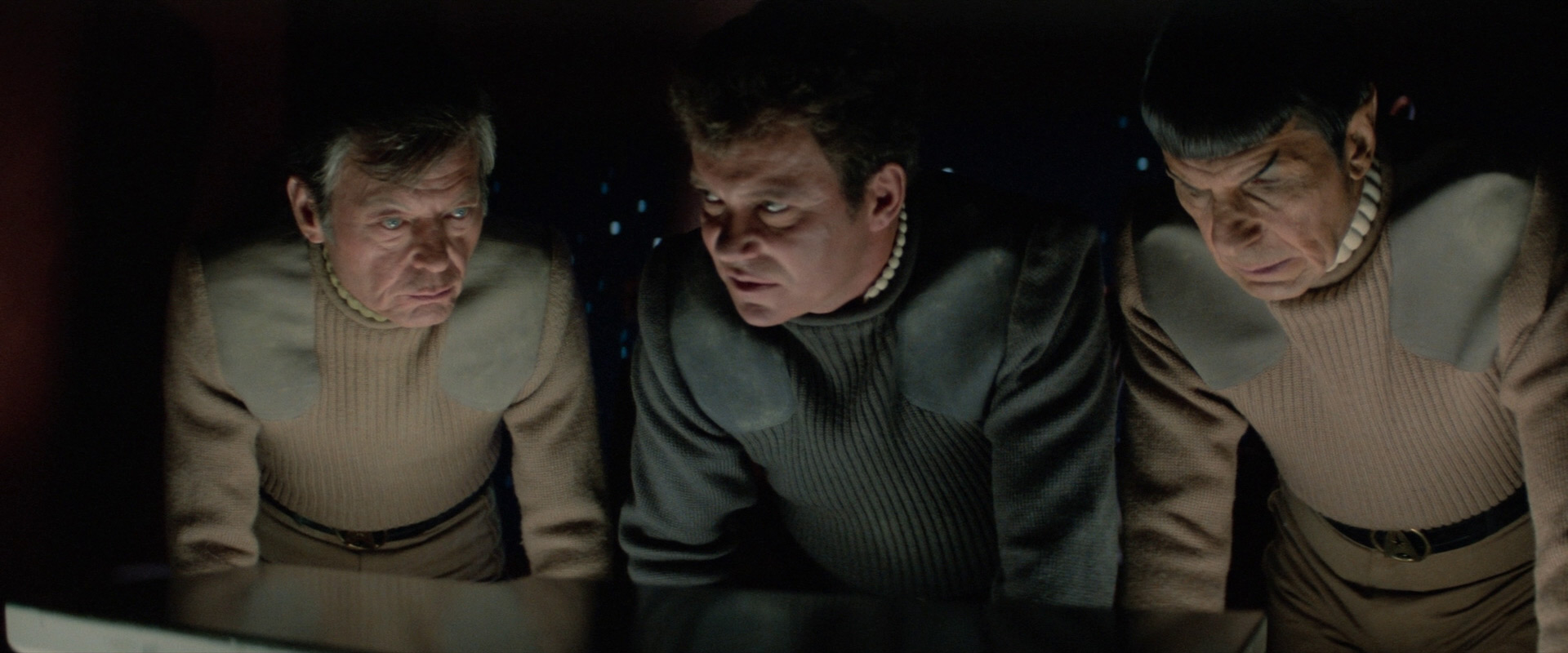
Nearly every uniform in this shot began its life in TMP
The Wrath of Khan’s comparatively tiny budget may have necessitated leaning heavily on the existing (and generally unloved) costumes from its predecessor, but effectively modifying them and re-presenting them in a new context that led to them becoming fan-favorites was simply a work of creative genius.
The TWOK-era uniform paradigm was even more complex than TMP, but through clever redesigns and clearer presentations, it’s actually easier to follow along and make sense of it all.
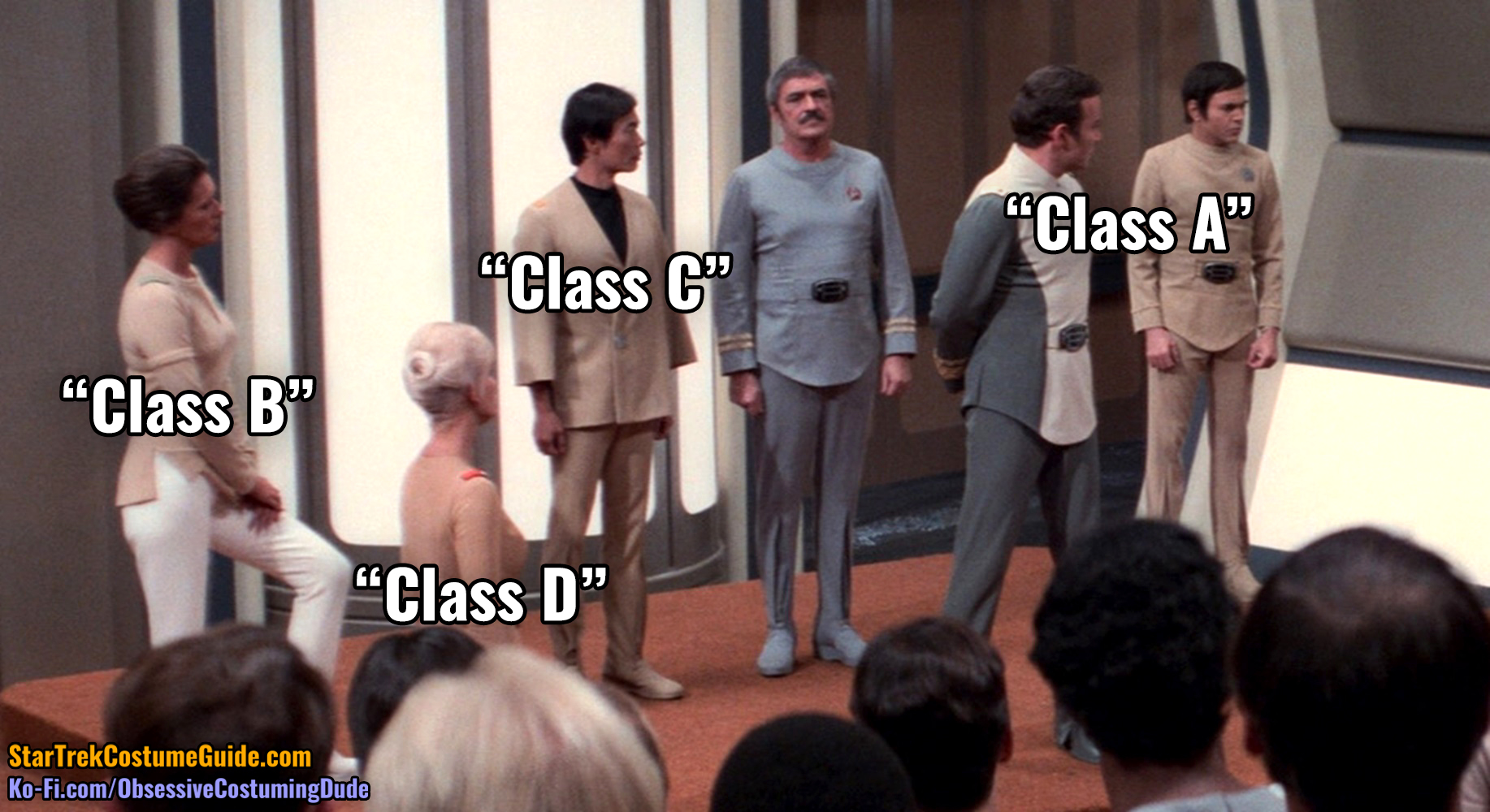
Instead of four uniform classes (each with multiple style and color variants) worn indiscriminately by all crew members, this was reduced to two primary uniforms: one for commissioned officers, and one for enlisted personnel.
There were still umpteen other uniforms and variants, but for the most part everything was more clearly defined.
So with all this in mind, let’s dive in!
DIVISION COLORS
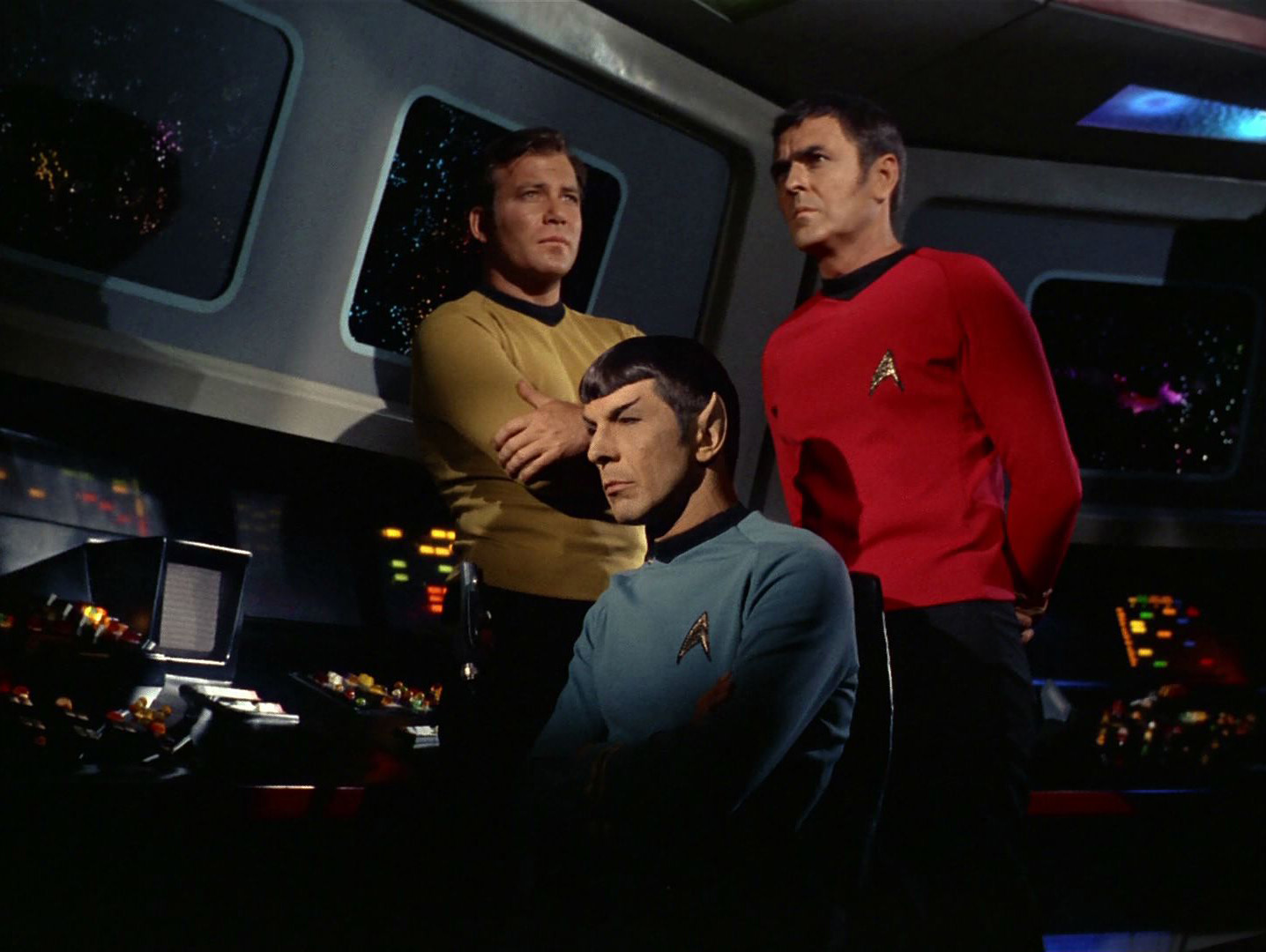
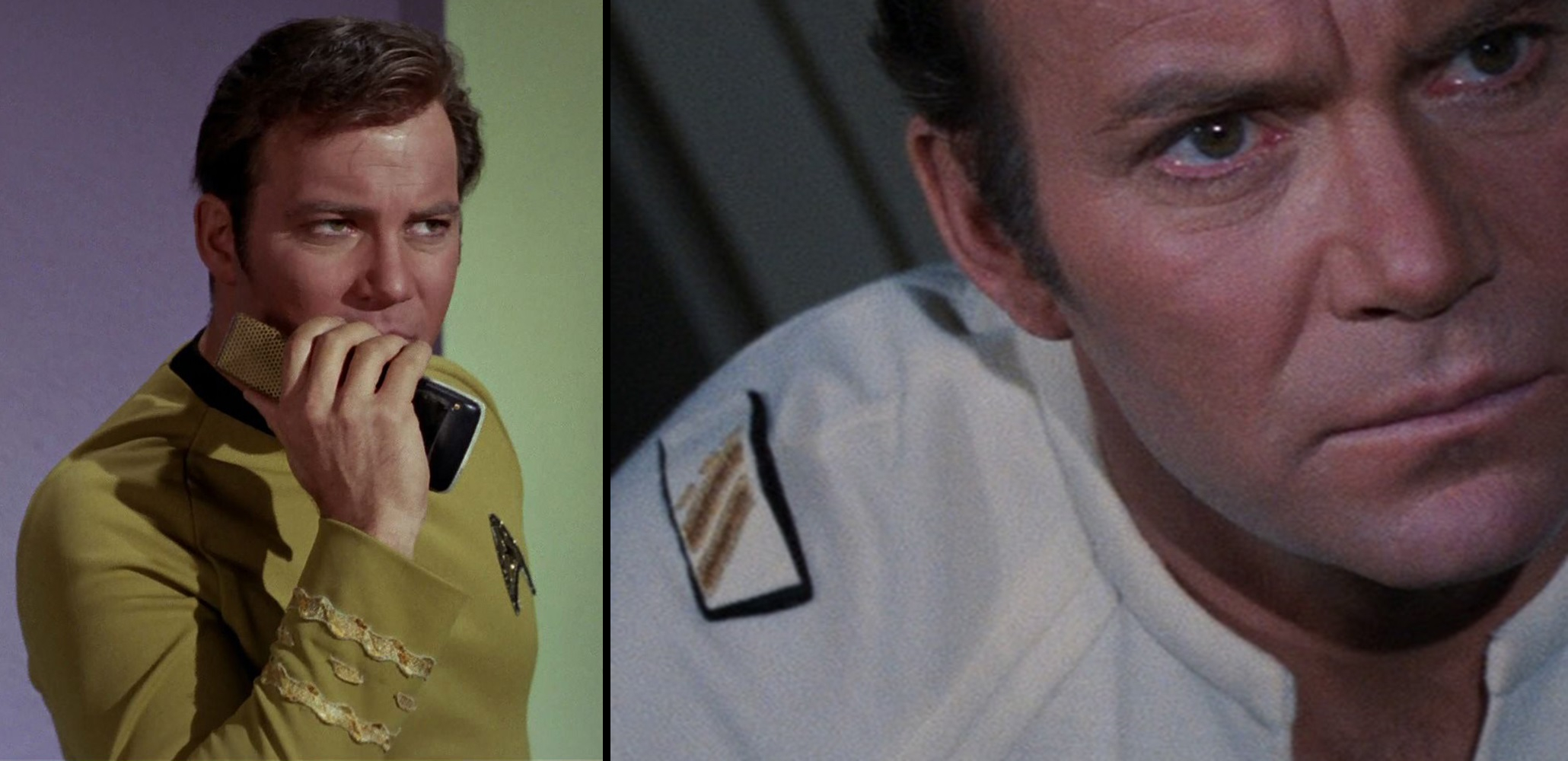
In The Original Series, costume designer William Ware Theiss had established three division colors.
TOS, 3x13 "Wink of an Eye"
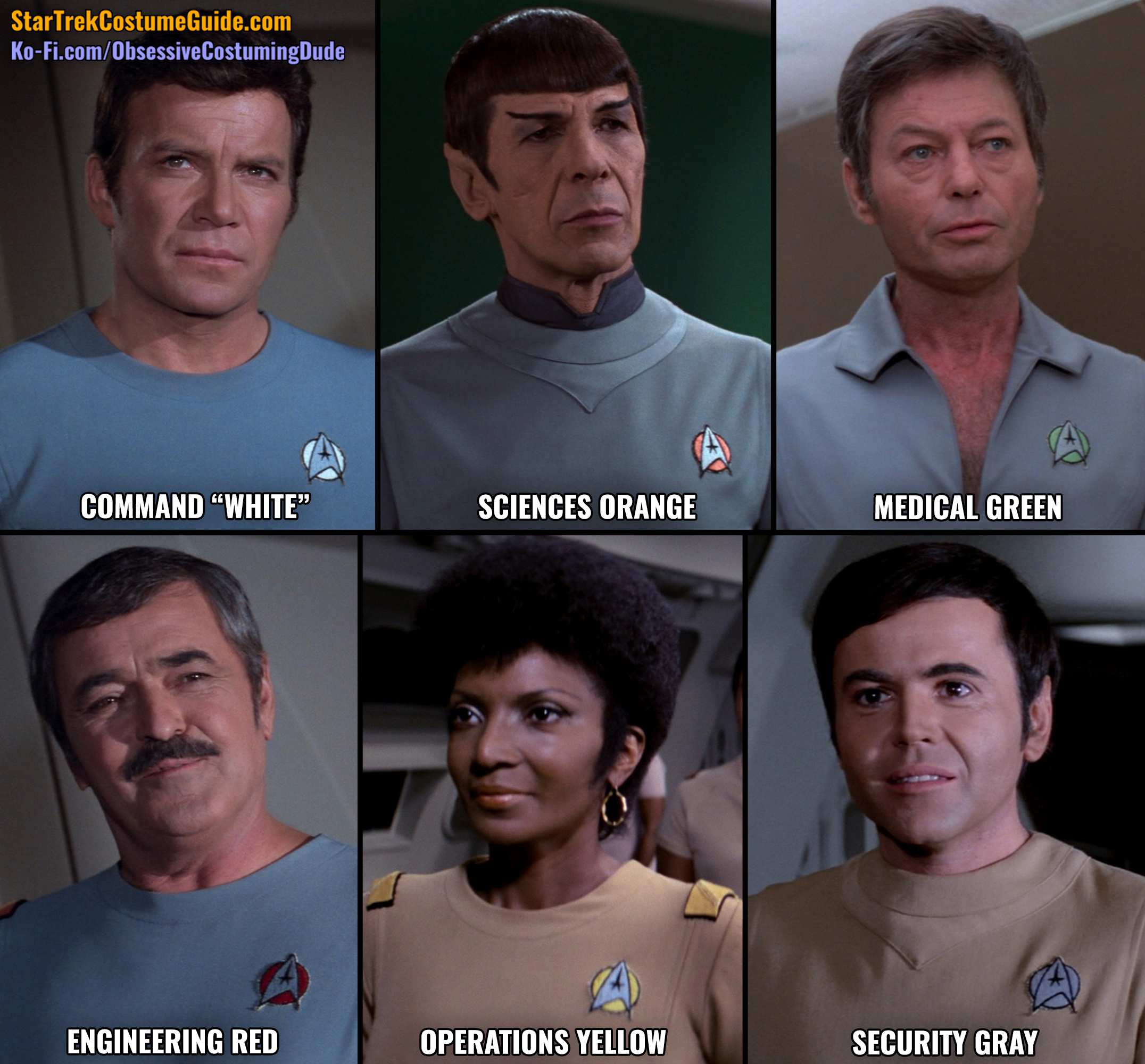
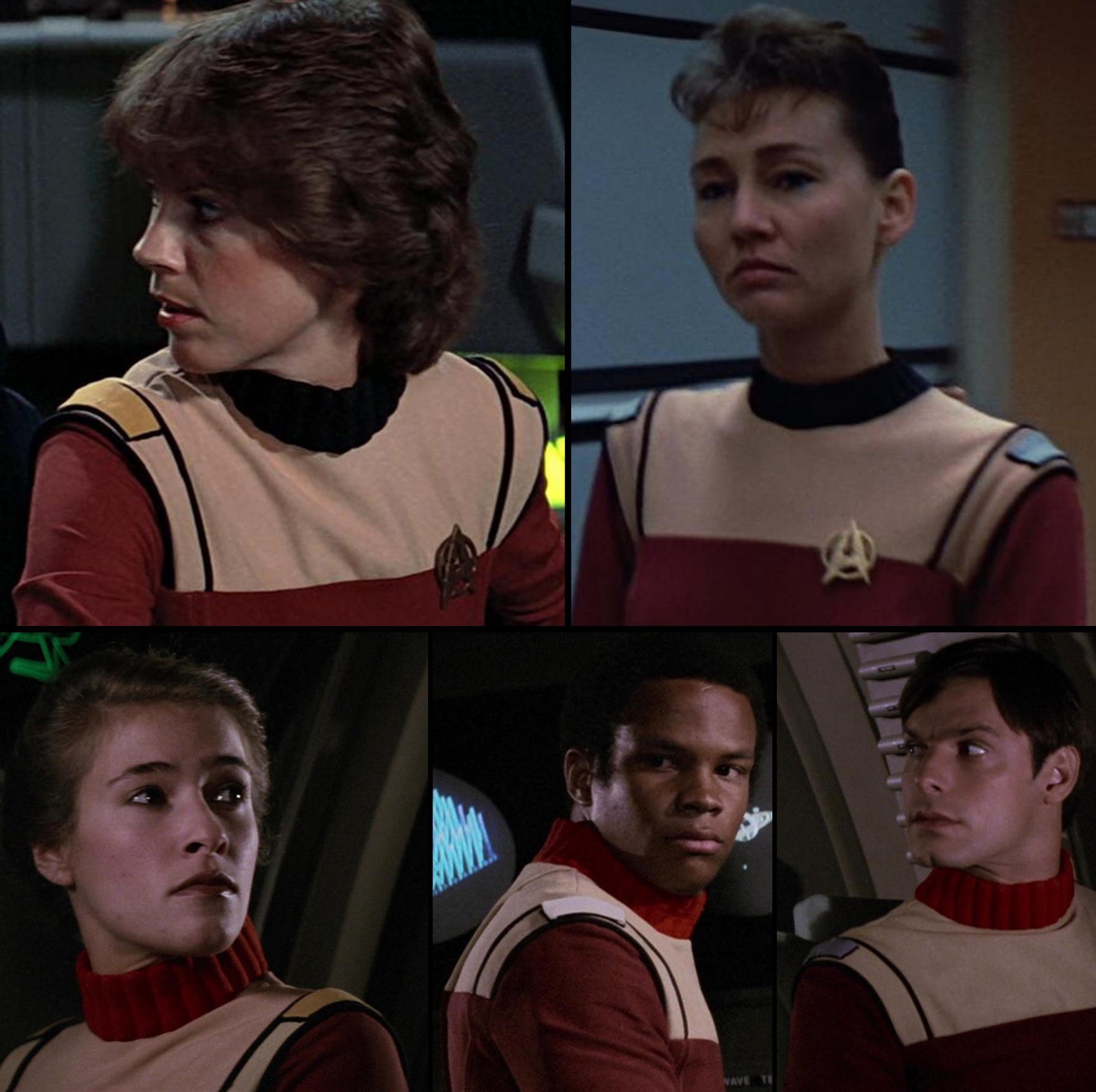
For The Motion Picture, Robert Fletcher expanded these to six colors, which were primarily shown by a small chest patch and/or shoulder tabs.
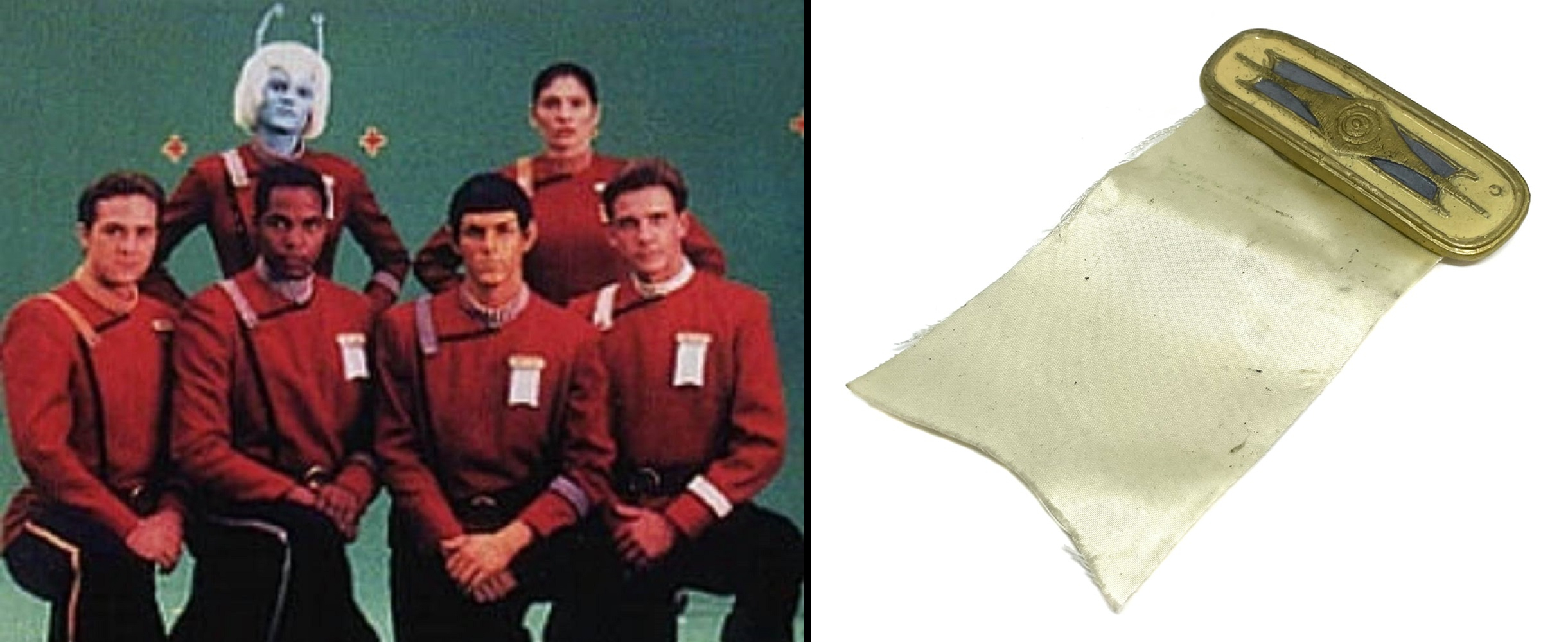
These included white for command (upper left), orange for sciences (upper middle), light green for medical (upper right), red for engineering (lower left), gold for operations (lower middle), and gray for security (lower right).
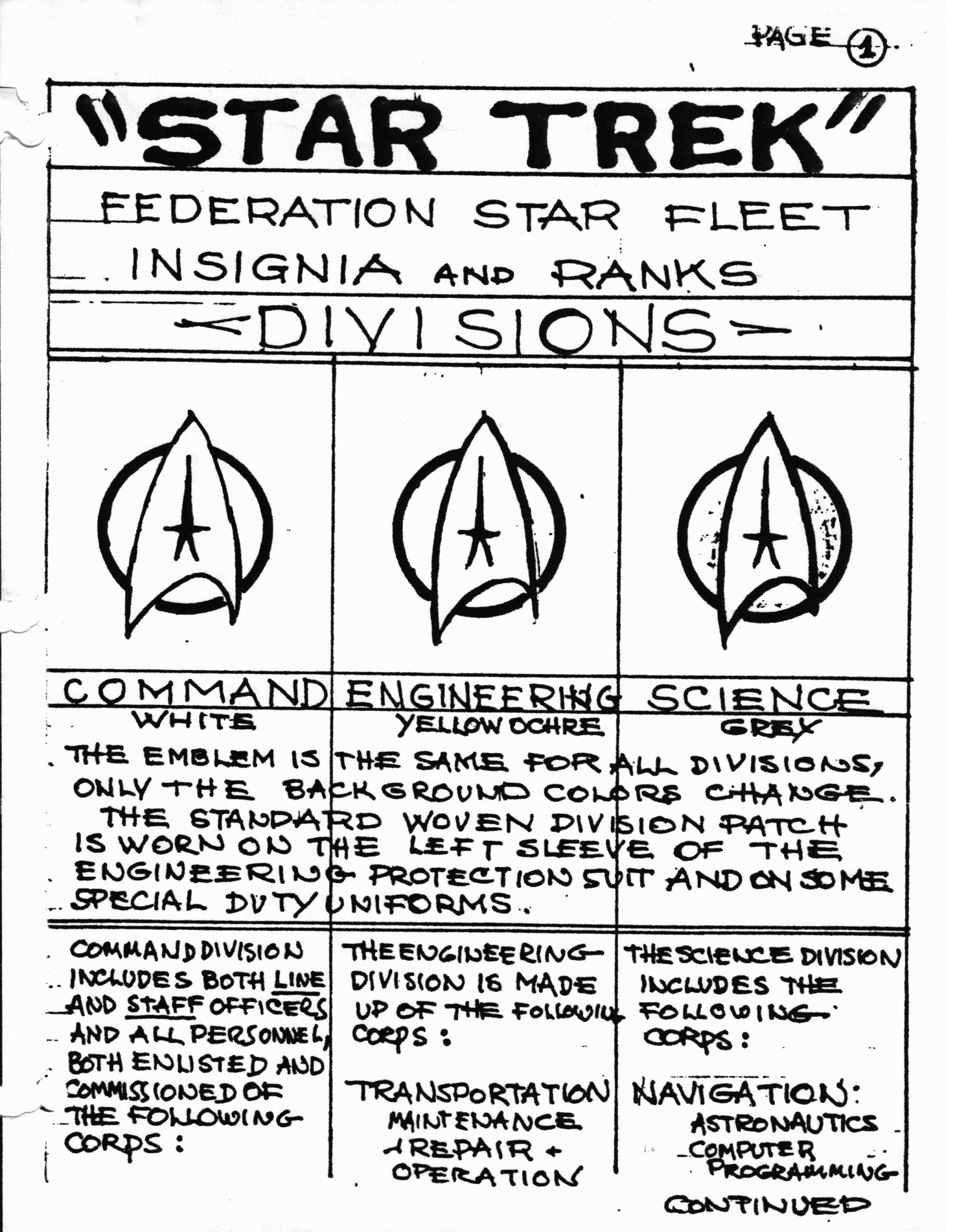
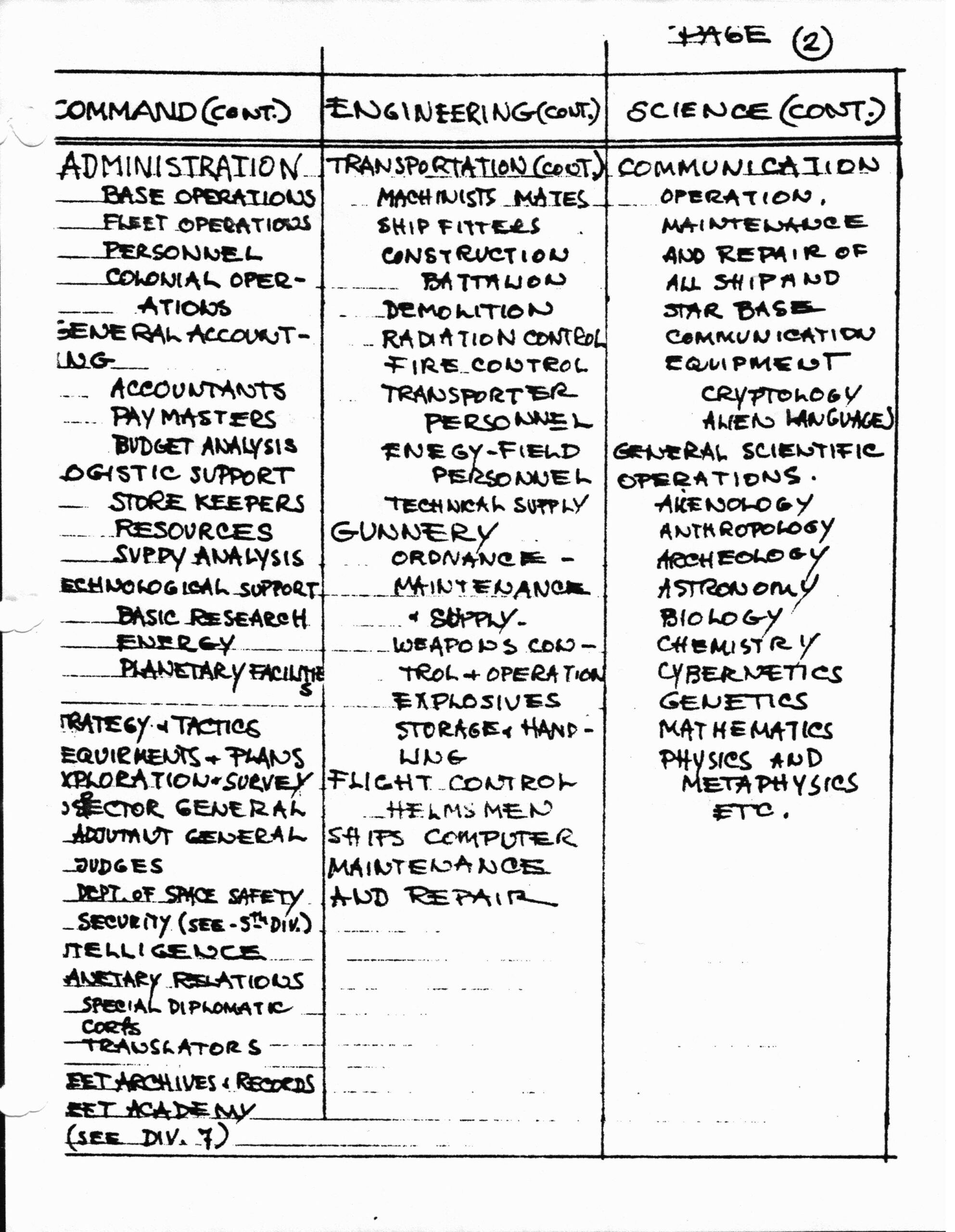
For The Wrath of Khan, he expanded this to include seven colors, and swapped a few.
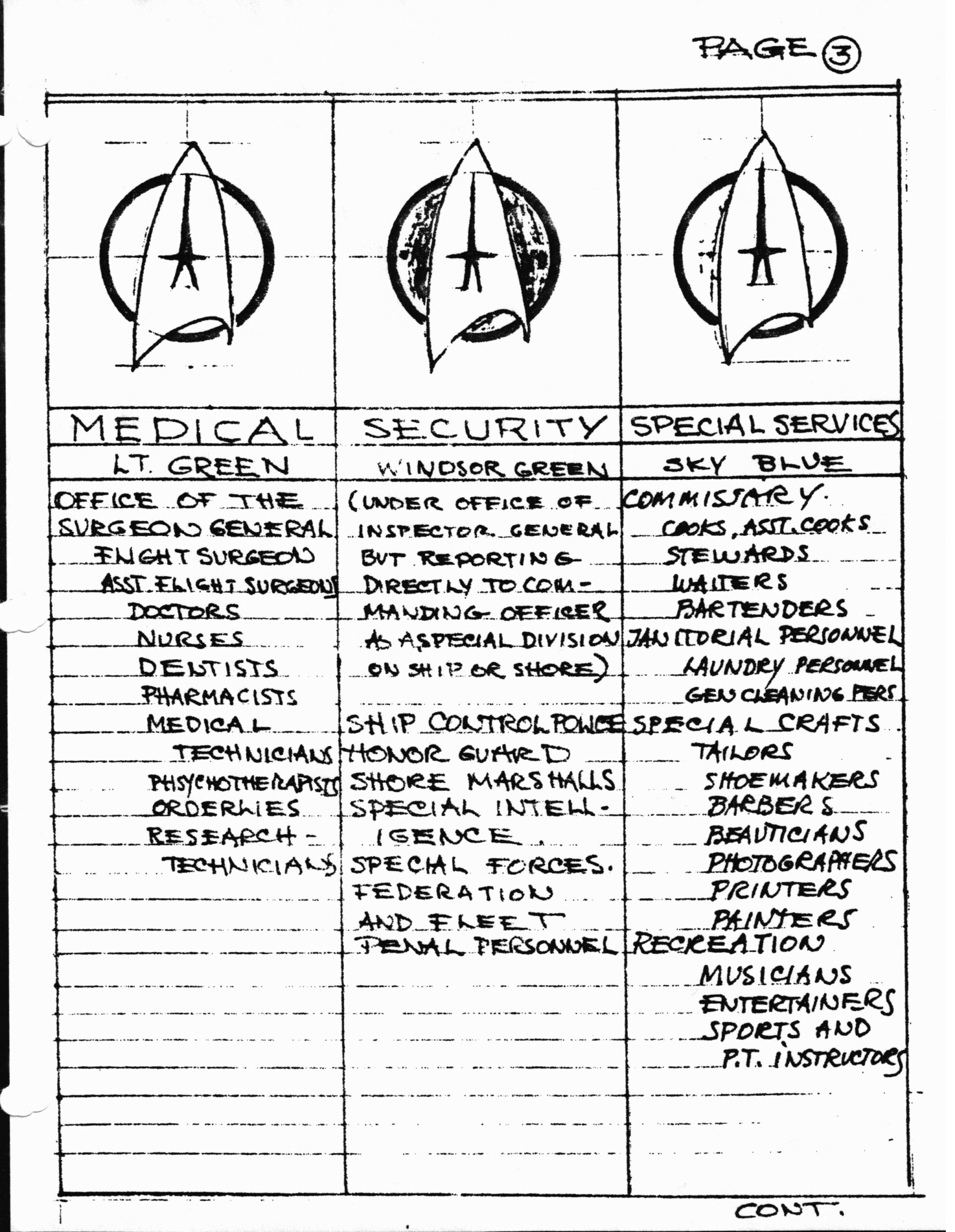
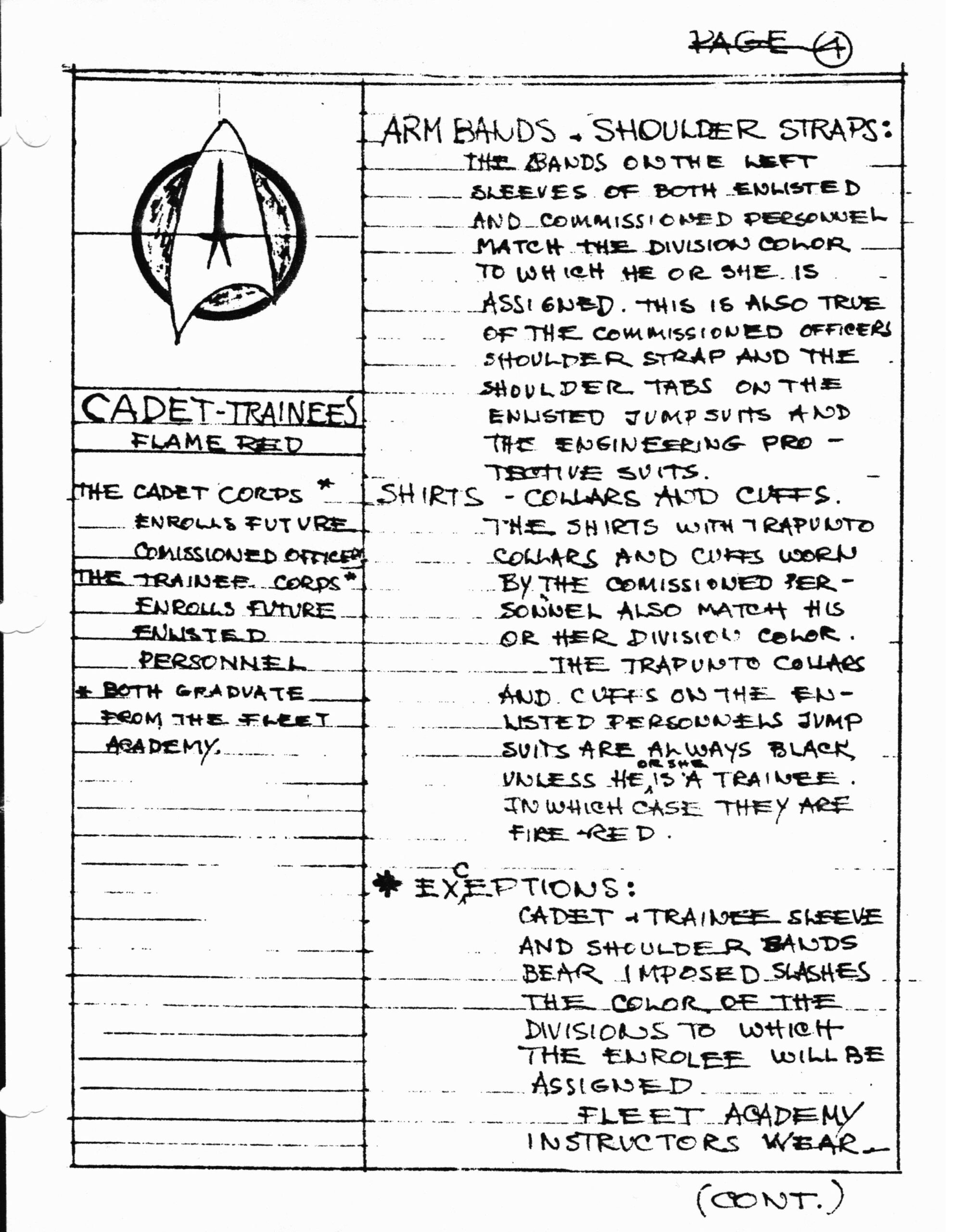
Here are his costuming notes on the TWOK-era division colors:
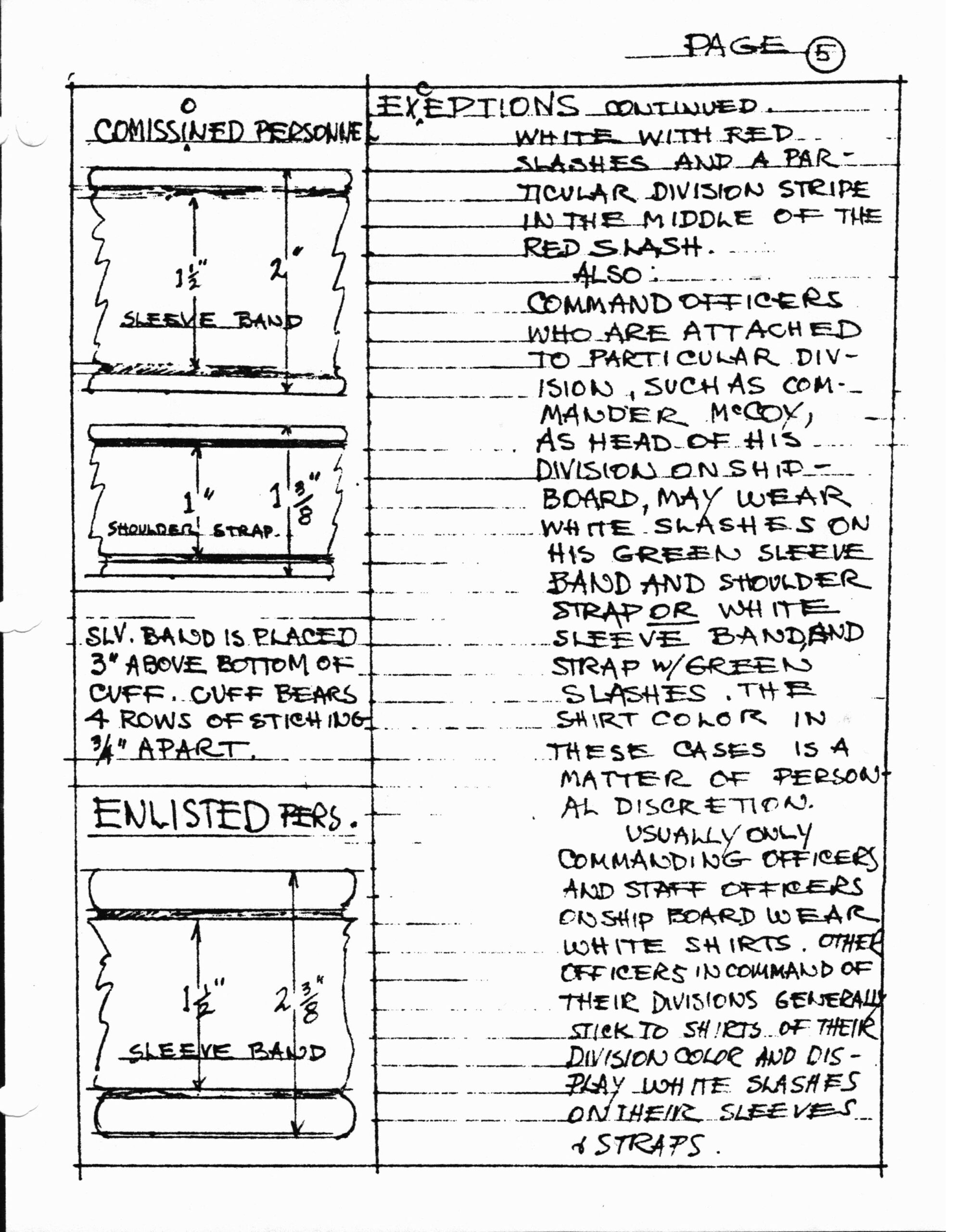
The wearer’s division was usually shown by a colored band on the lower left sleeve, as well as a right shoulder strap on the officer’s uniforms, and shoulder tabs on the enlisted crew’s.
Command White
“White” remained the color for command, which included flag officers and captains.
Flag officers
Captains
This also included enlisted crew members in leadership and/or management positions, although these were only seen on extras.
Enlisted crew
Medical Green
Light green remained the color for the medical division.
The other colors got shuffled around, though.
Engineering Gold
Engineering was changed from red to gold.
Gold also included helmsmen, although curiously this position was worn with operations gold (yellow) in TMP; apparently “helmsman” was recategorized from operations to engineering for TWOK.
Sciences Gray
Gray was also changed, from security in TMP to sciences in TWOK.
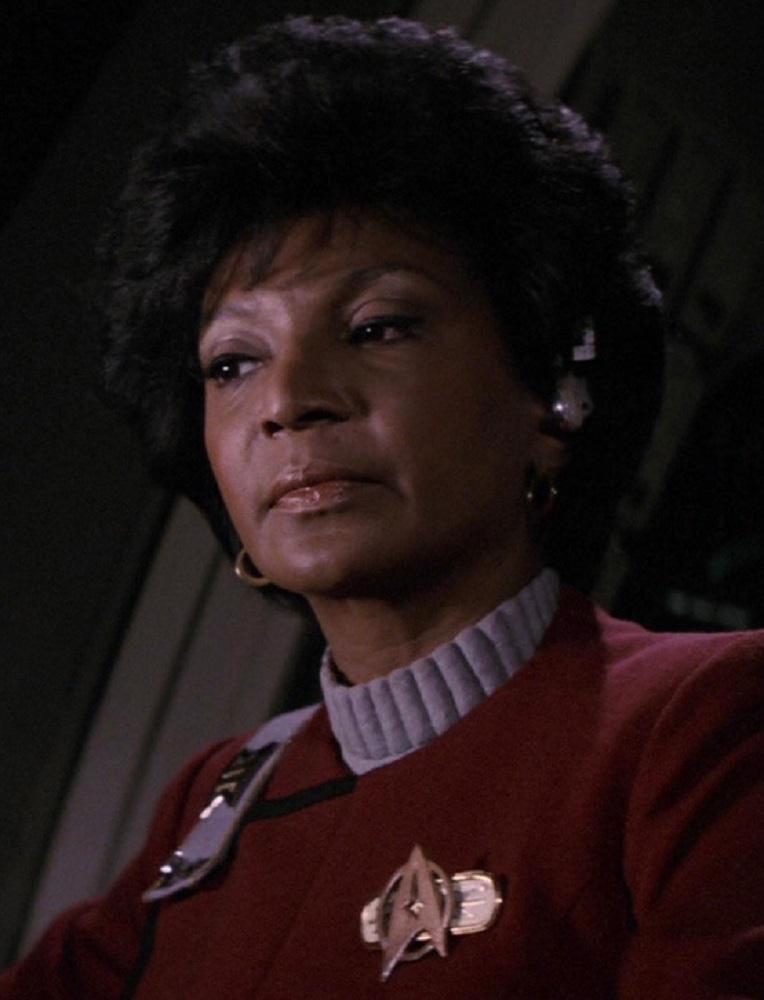
Apparently “communications” was also reassigned from operations in TMP (Uhura wore operations gold/yellow) to sciences in TWOK.
Security Green
Security was now represented by dark green.
Special Services Blue
Light blue was for “special services,” an important but seldom-seen color.
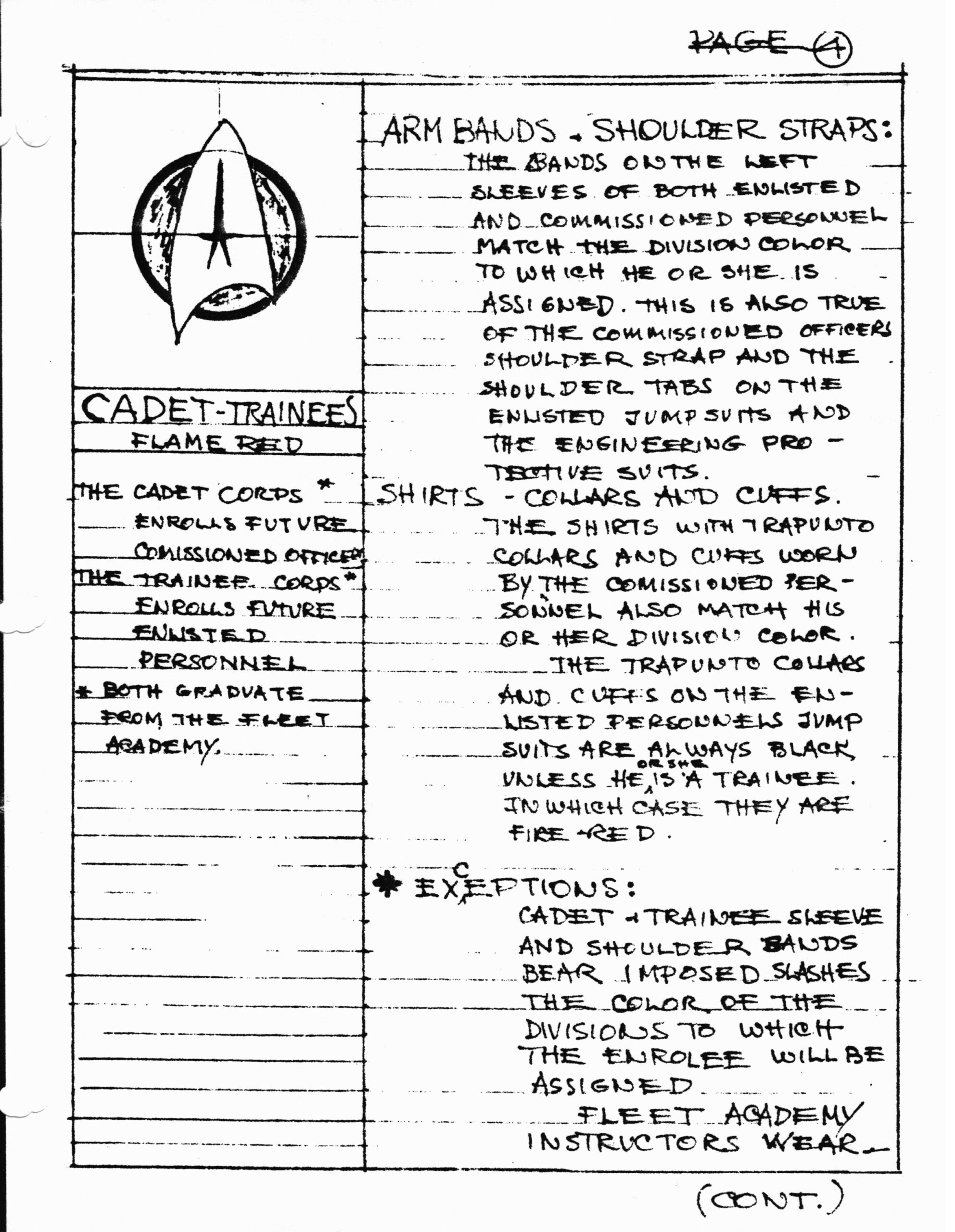
Cadet / Trainee Red
Red (specifically, “flame red”) was worn by cadets and trainees.
Fletcher made the distinction that cadets were officers-in-training, while trainees were to become enlisted crew members.
Cadets
Trainees
ST5 "Commando Blue"
And finally, an eighth color was added to the lineup not by Fletcher himself, but his successor Nilo Rodis-Jamero for Star Trek 5.
This dark blue color was exclusively worn by extras during the rescue sequence of that movie.
What it specifically represents is a source of fan speculation, but personally, I refer to this as “commando blue.”
Color Notes
I do want to quickly point out a couple things about these colors:
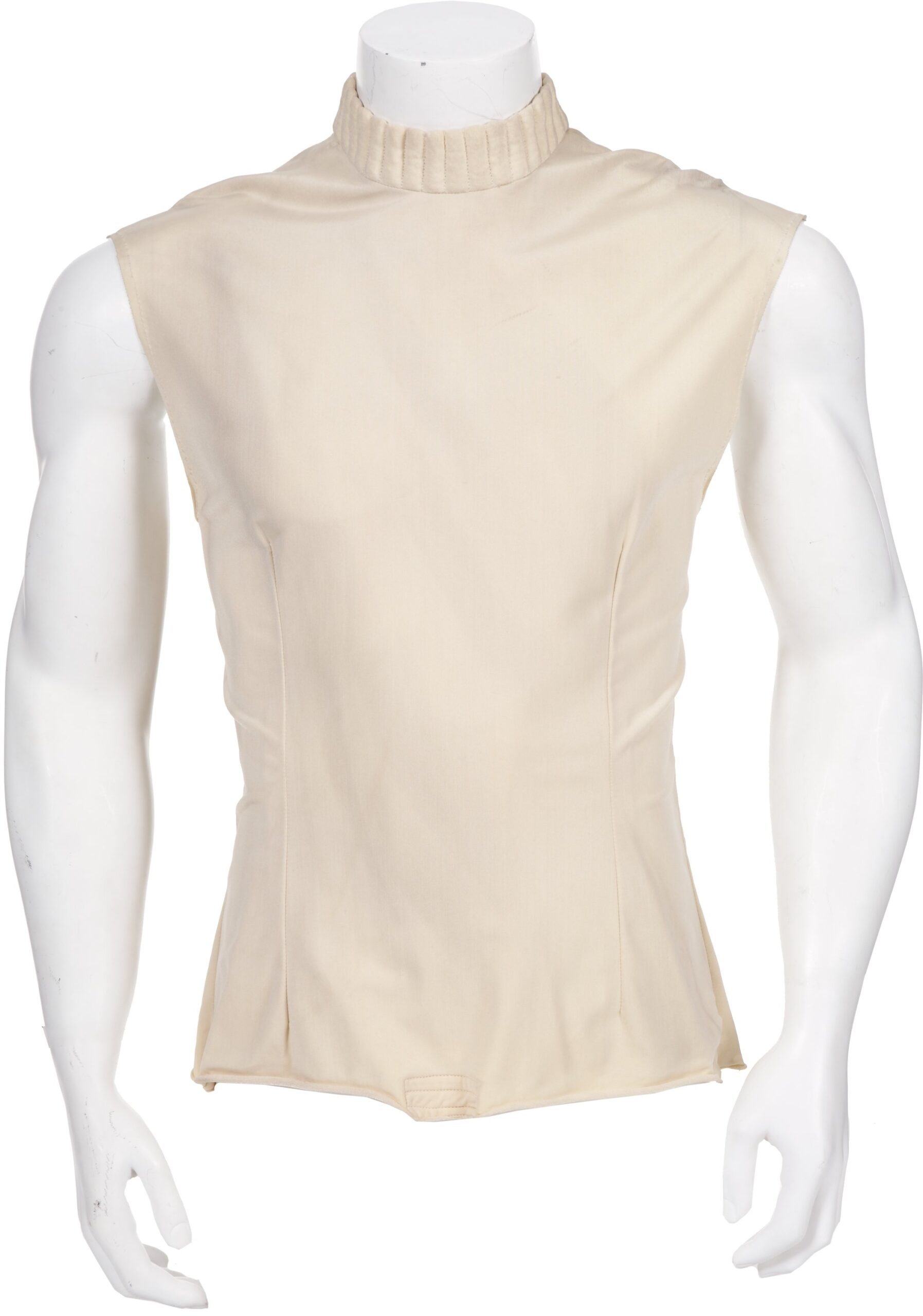
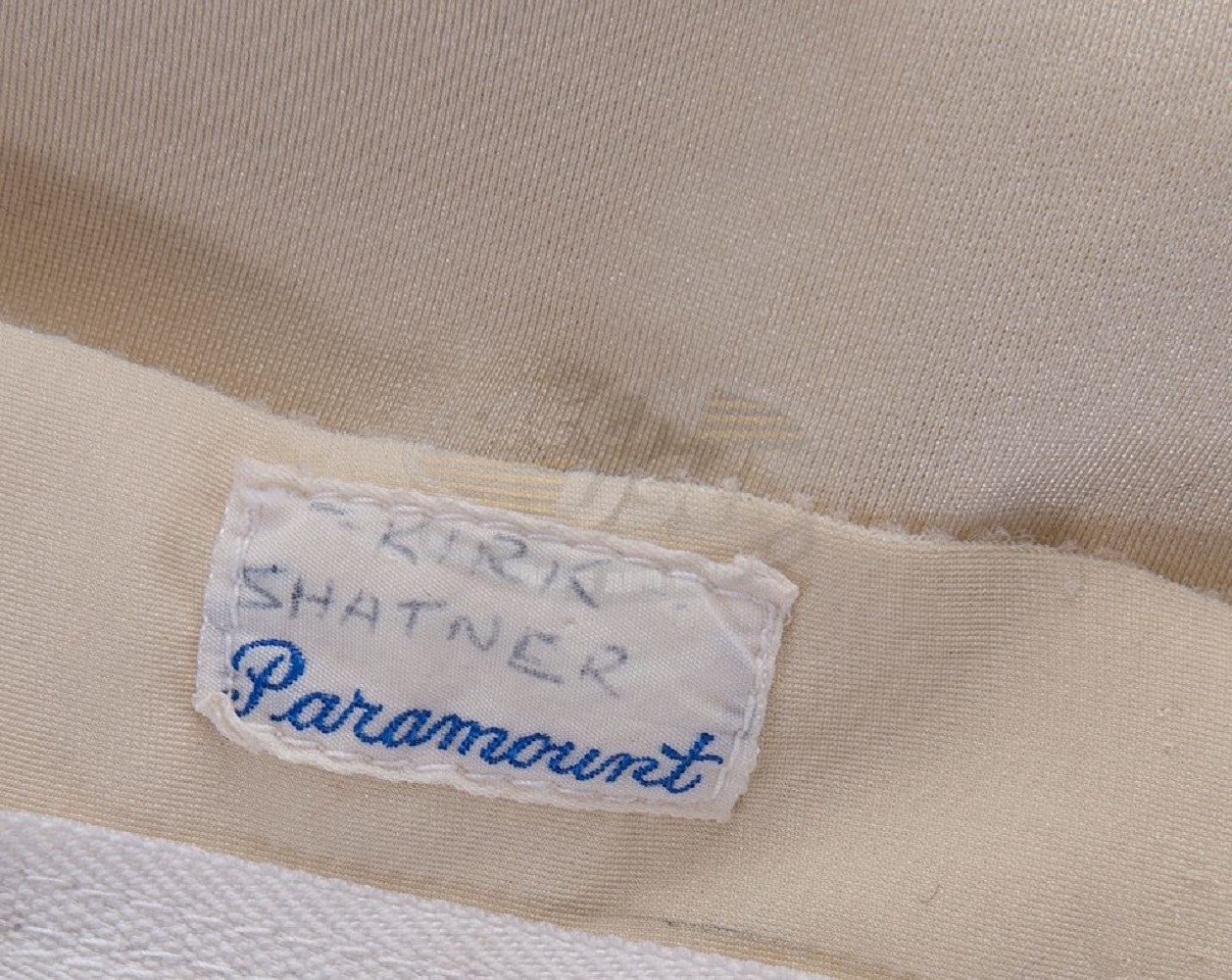
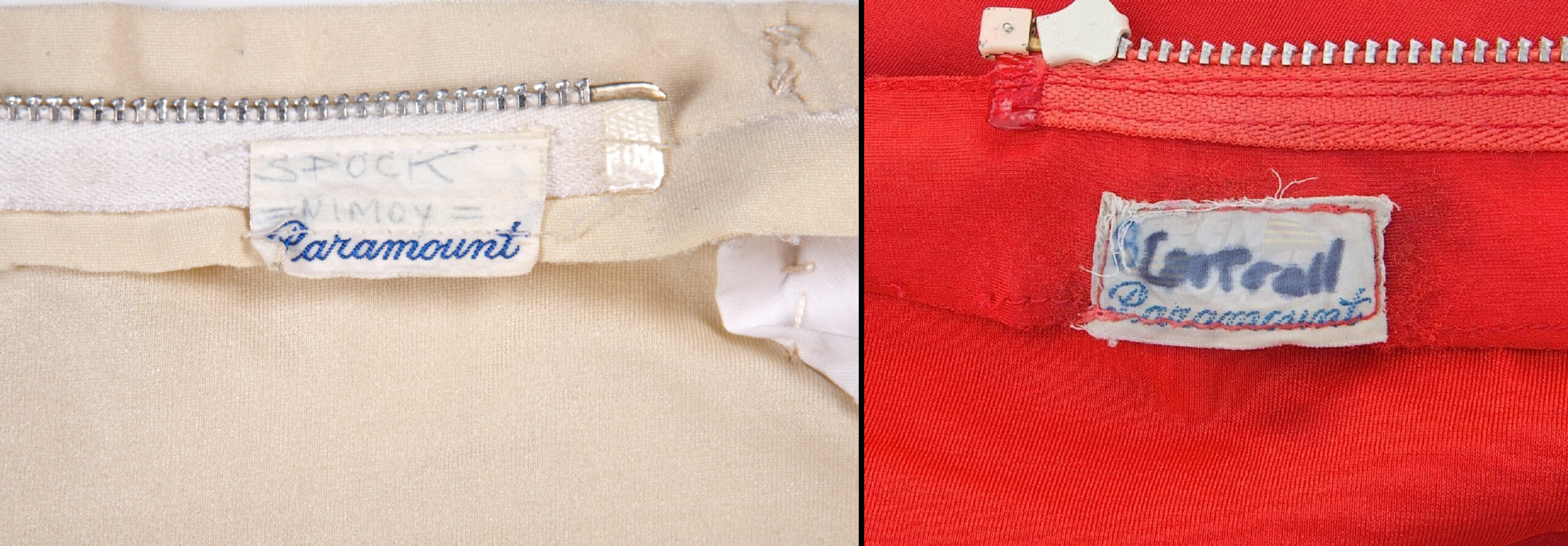
First, what we usually call “white” was, in fact, an off-white cream color that only looked white in the finished movies.
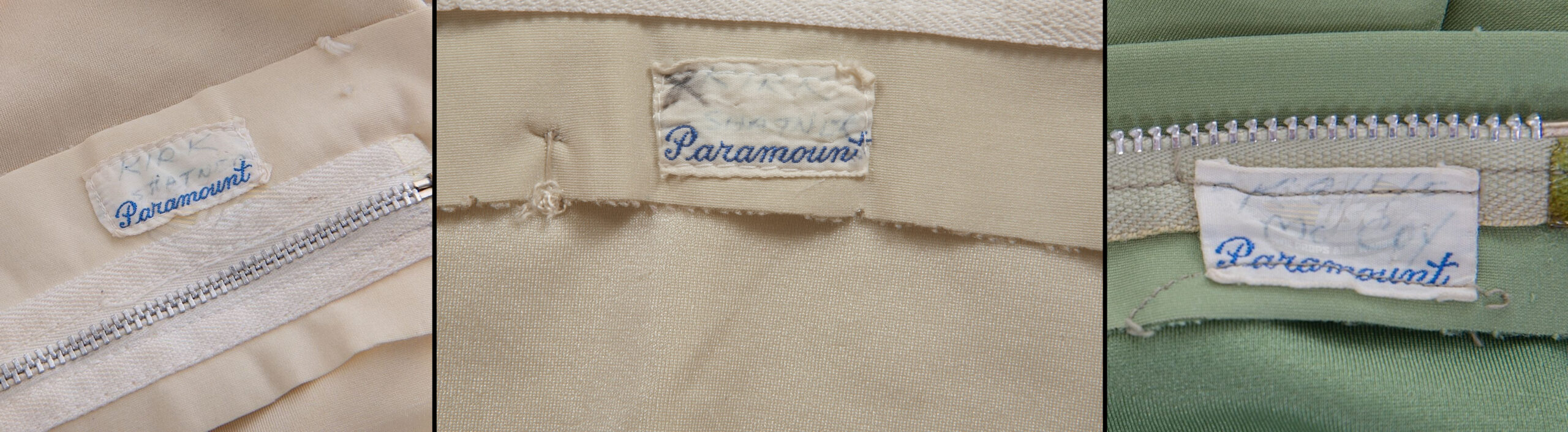
Screen-used Spock division shirt auction photo
Screen-used Kirk division shirt auction photo
I don’t want to go too far down this rabbit hole since this post is only intended to be an overview, but I think it’s important to also mention that some of the specific hues of these colors changed over the years.
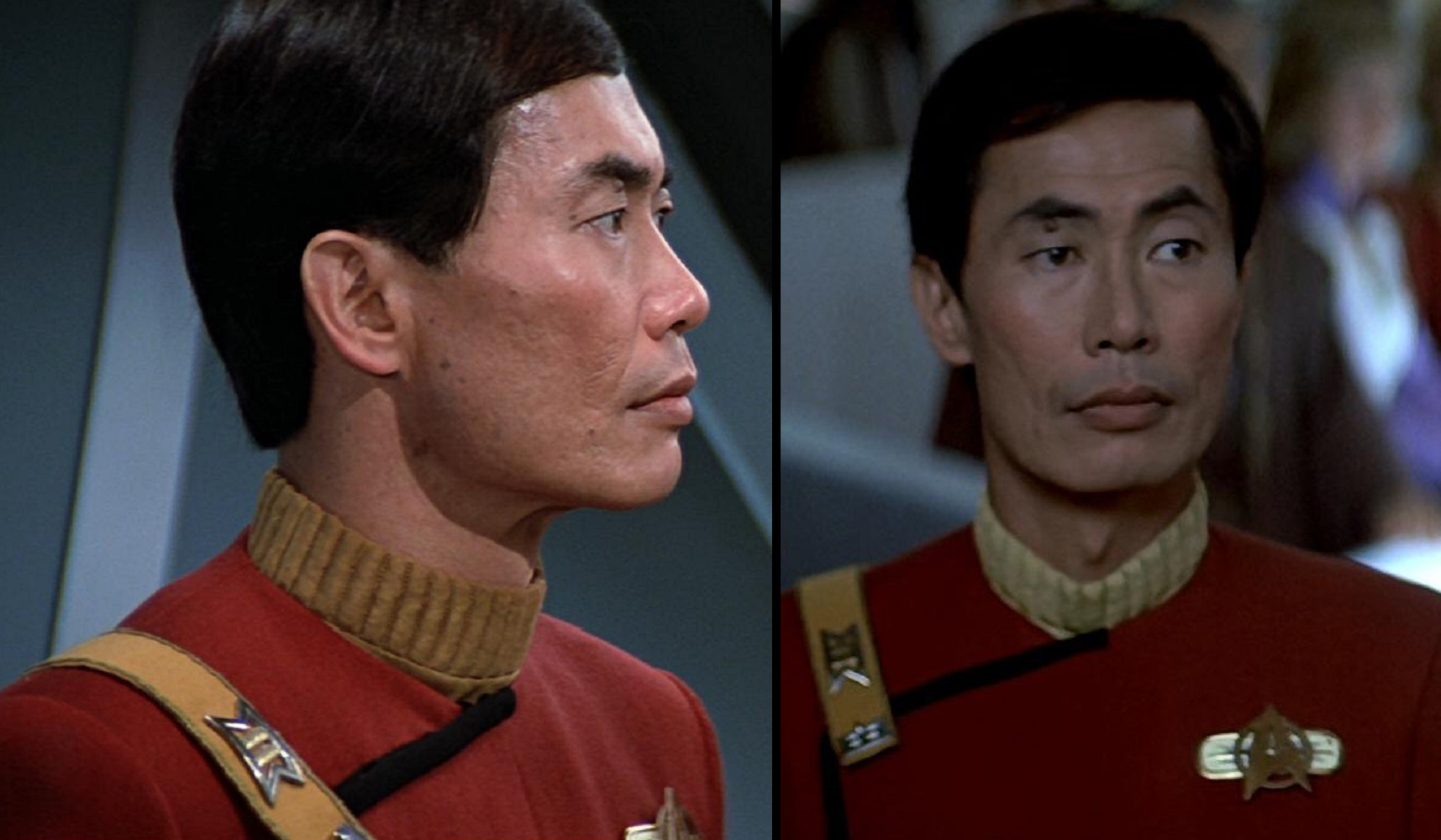
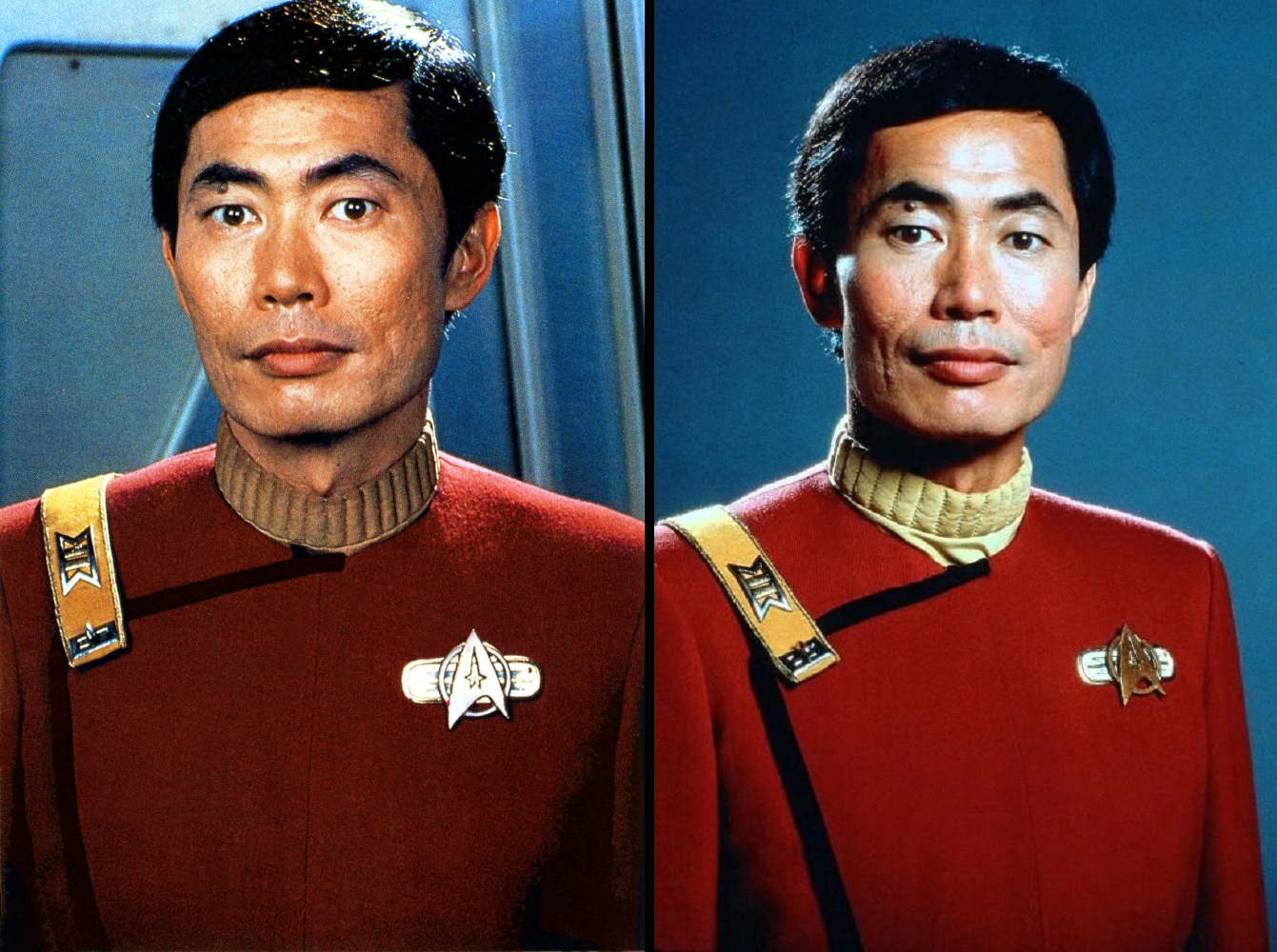
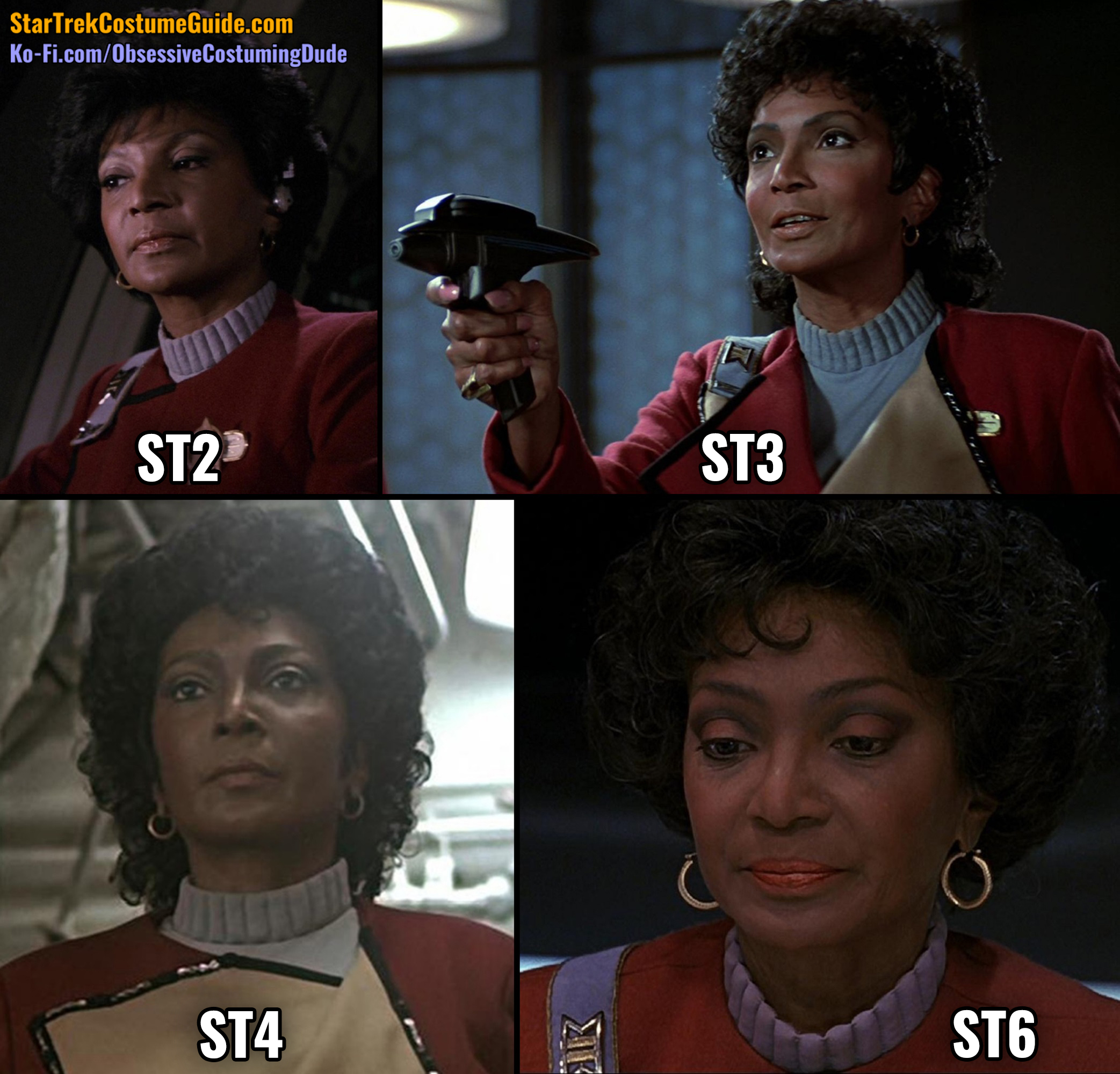
Perhaps most obviously, the engineering “gold” undershirts went from a dark, warm gold to a lighter daffodil-yellow color.
ST3 vs. ST4 gold colors
ST2 and ST4 publicity photos
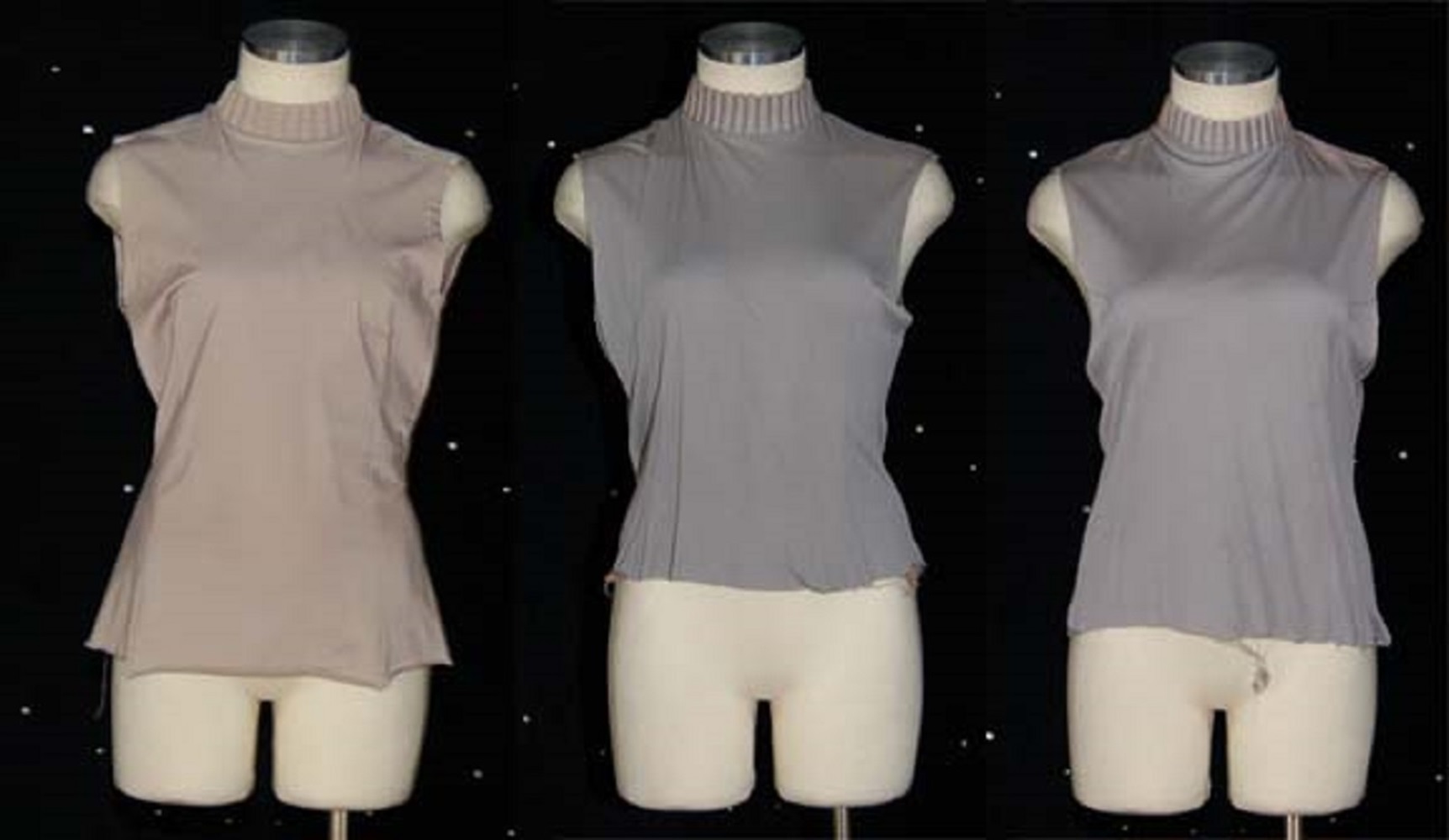
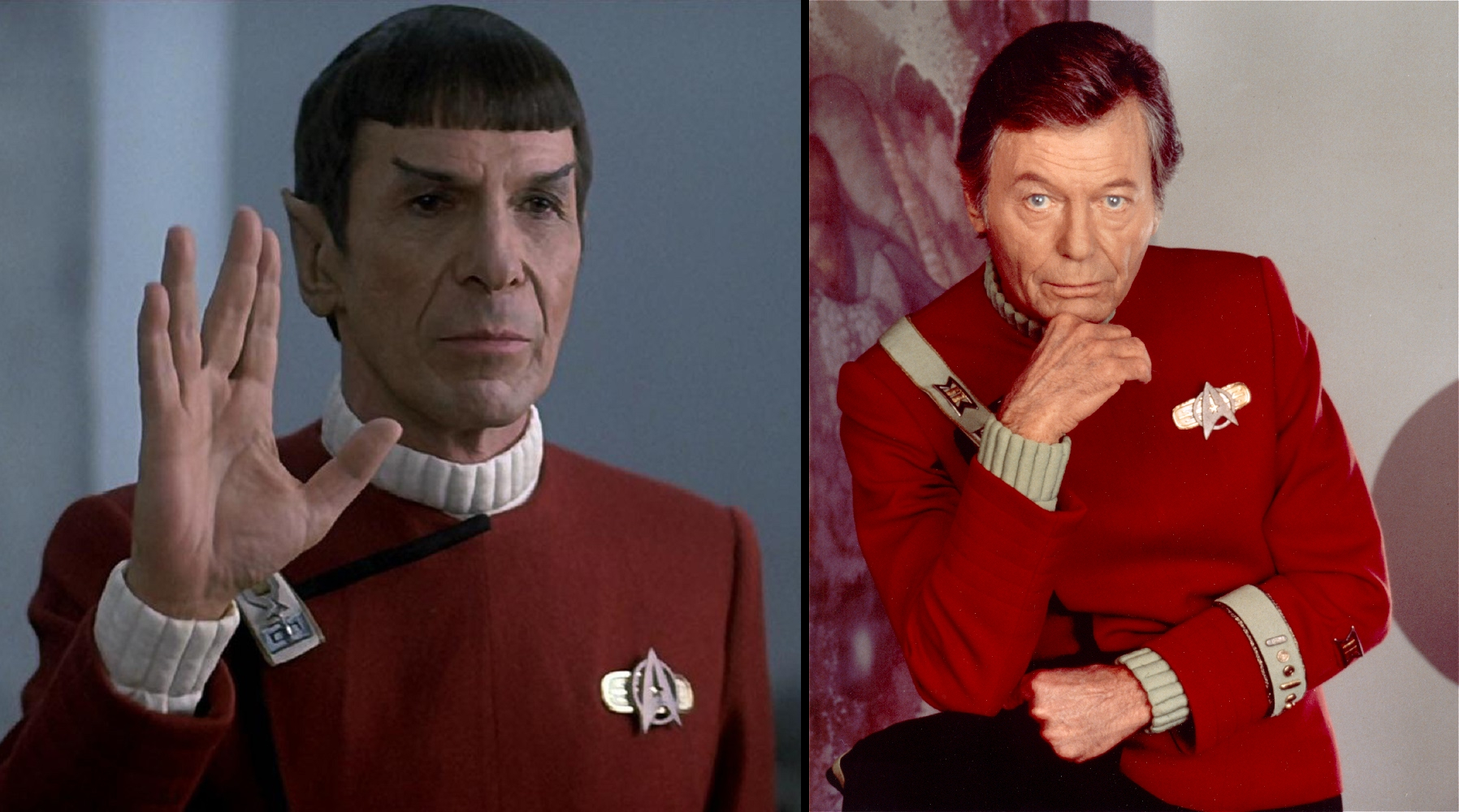
Sciences gray is a bit more subjective considering how differently the movies were lit (to say nothing of post-production color editing), but it looked faintly-warm-purple-gray in TWOK, bluish-gray in ST3, neutral gray in ST4, and purple-gray in ST6.
Here are three screen-used Uhura division shirts, which are clearly different colors:
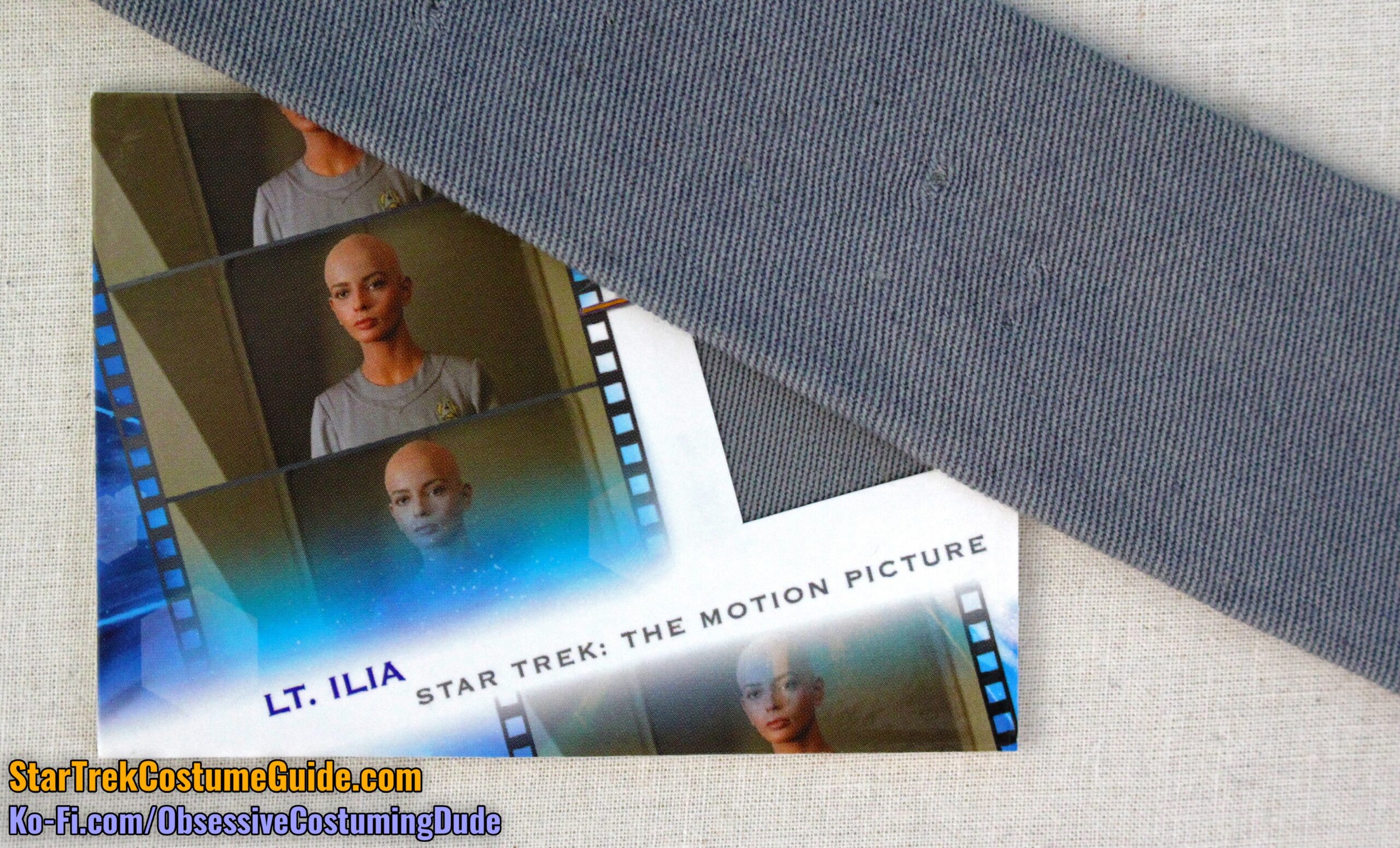
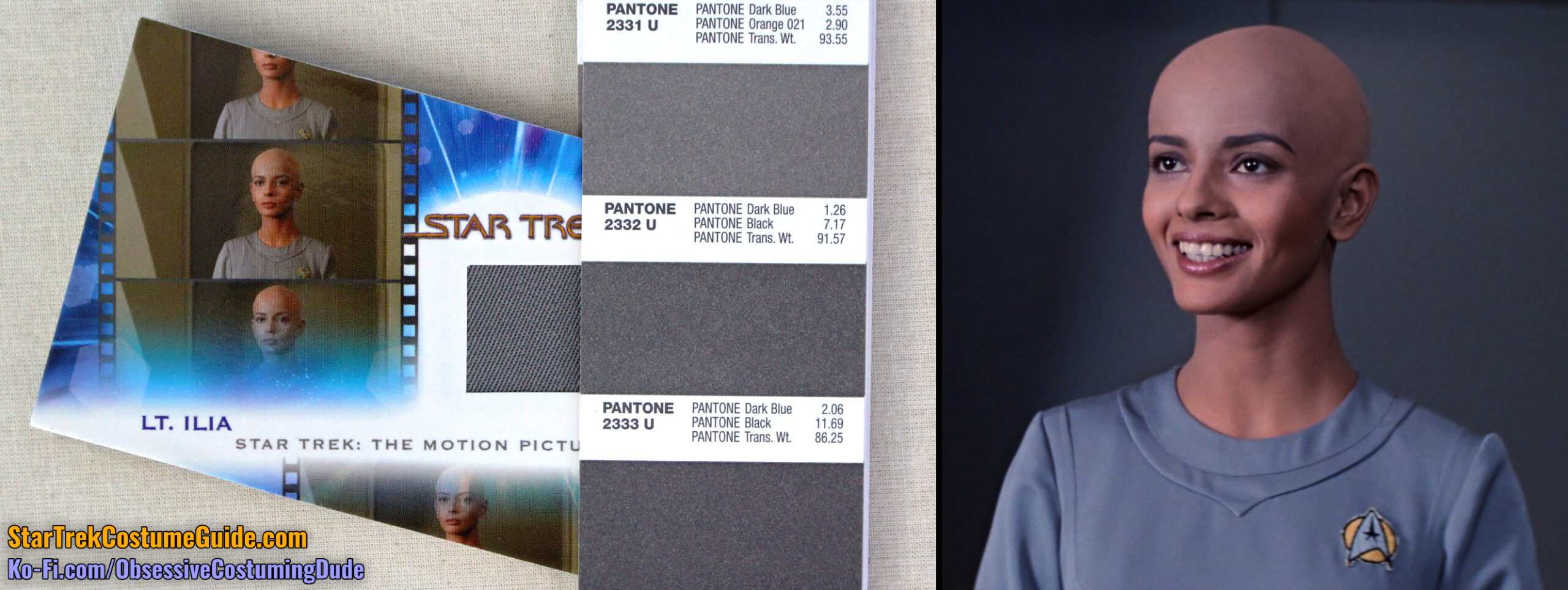
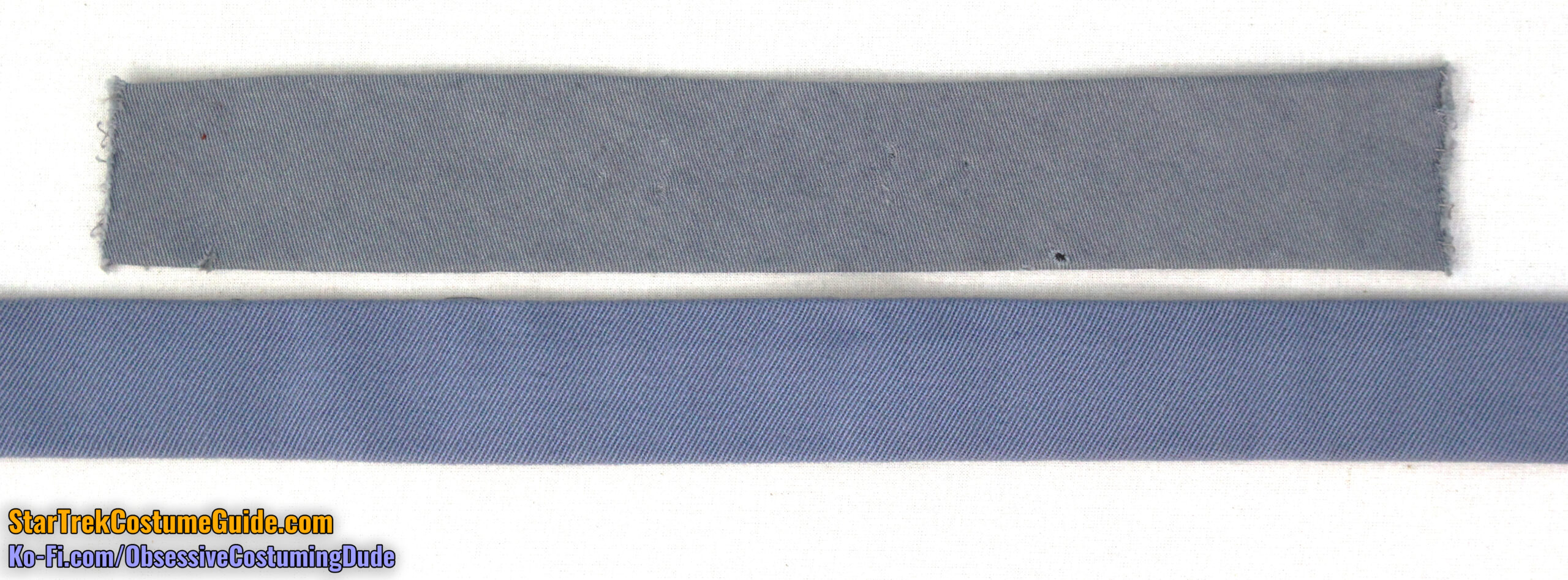
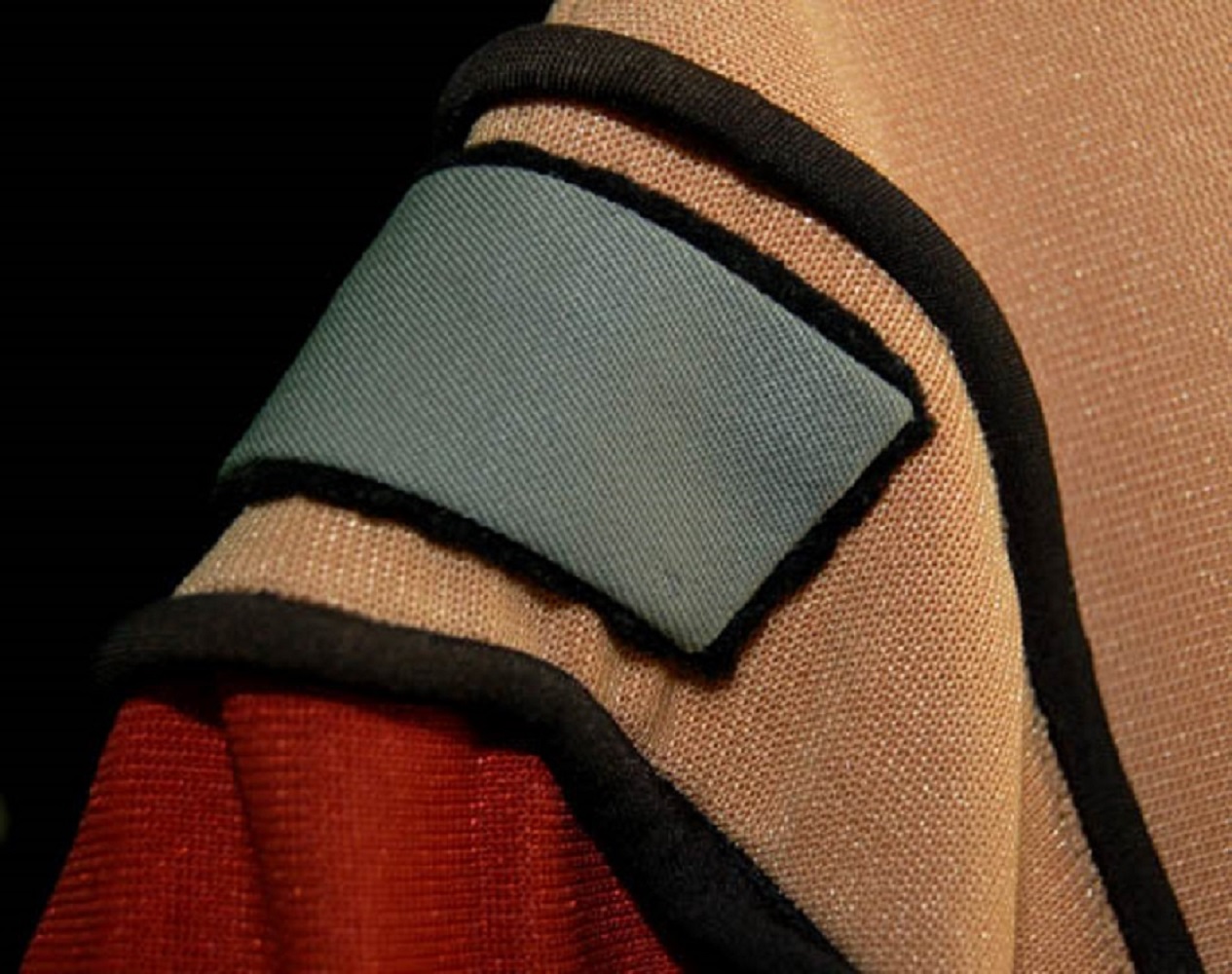
For what it’s worth, the screen-used sciences gray sleeve band I studied (and color-matched) was very close to the TMP gray:
It’s wild to me how blue these grays looked in the movies, compared to how absolutely neutral-gray the fabrics looks in-person. (We saw this effect with the TMP uniforms too.)
I think this is why many people believe the sciences gray was actually blue.
On the whole, I think the TWOK-era division color palette was very effective, with mostly distinct colors; there’s no confusing medical green with security green, or “special services” blue with “ST5 commando” blue.
However, if I were to offer any criticism, it would be that in a vacuum, the sciences gray and “special services” blue are perhaps too easily confused with each other.
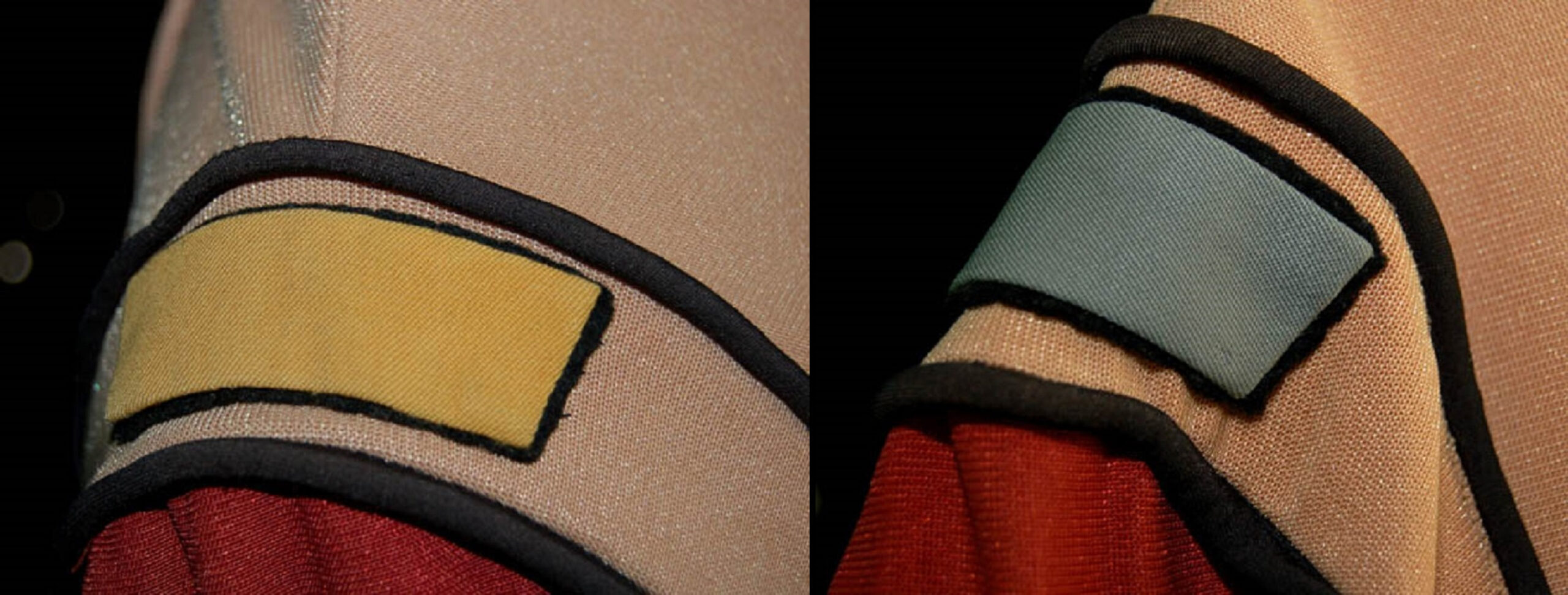
Side-by-side they’re easy enough to tell apart, though; here are two screen-used sleeve bands I was able to study and color-match, thanks to Jonathan Janes:
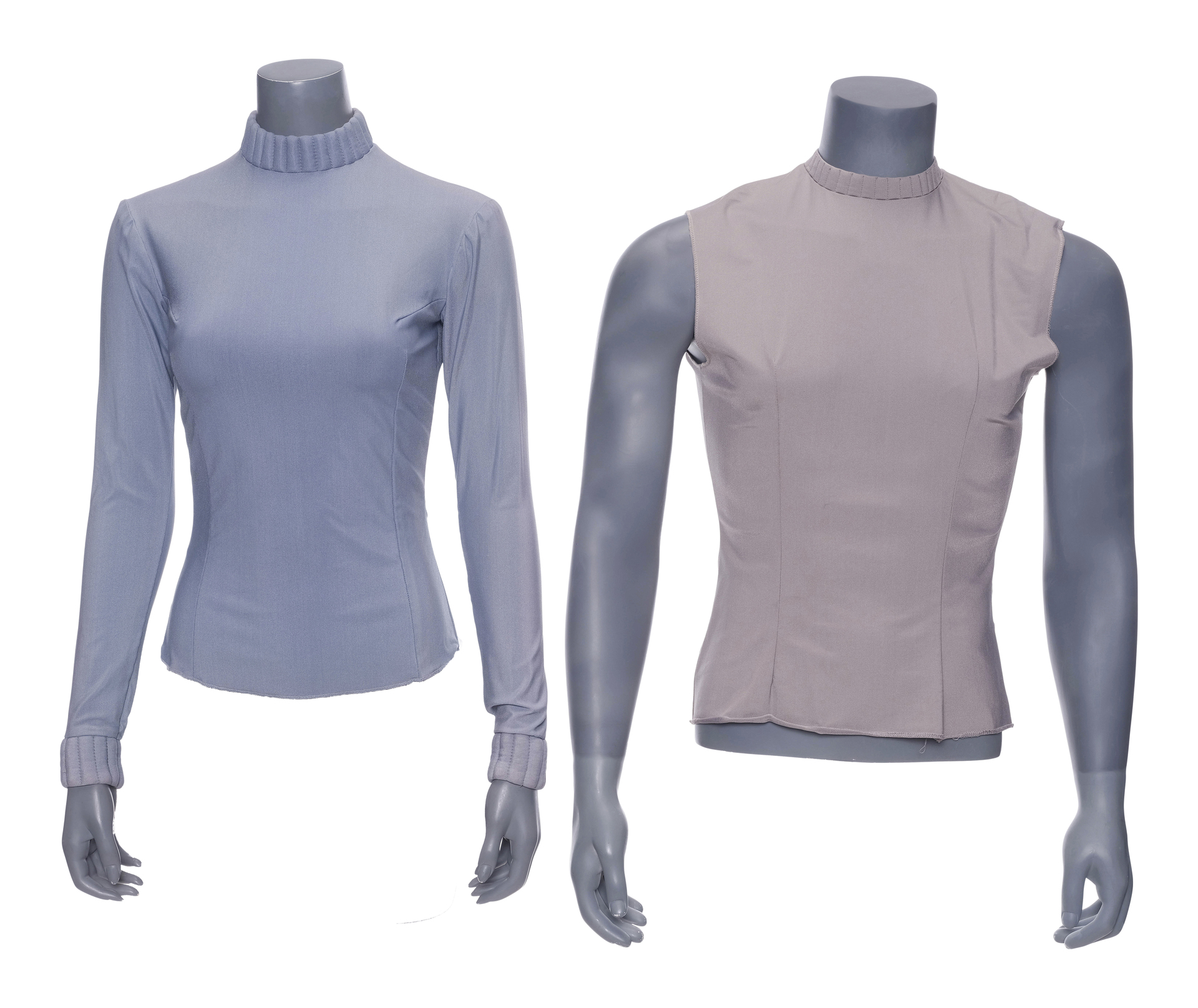
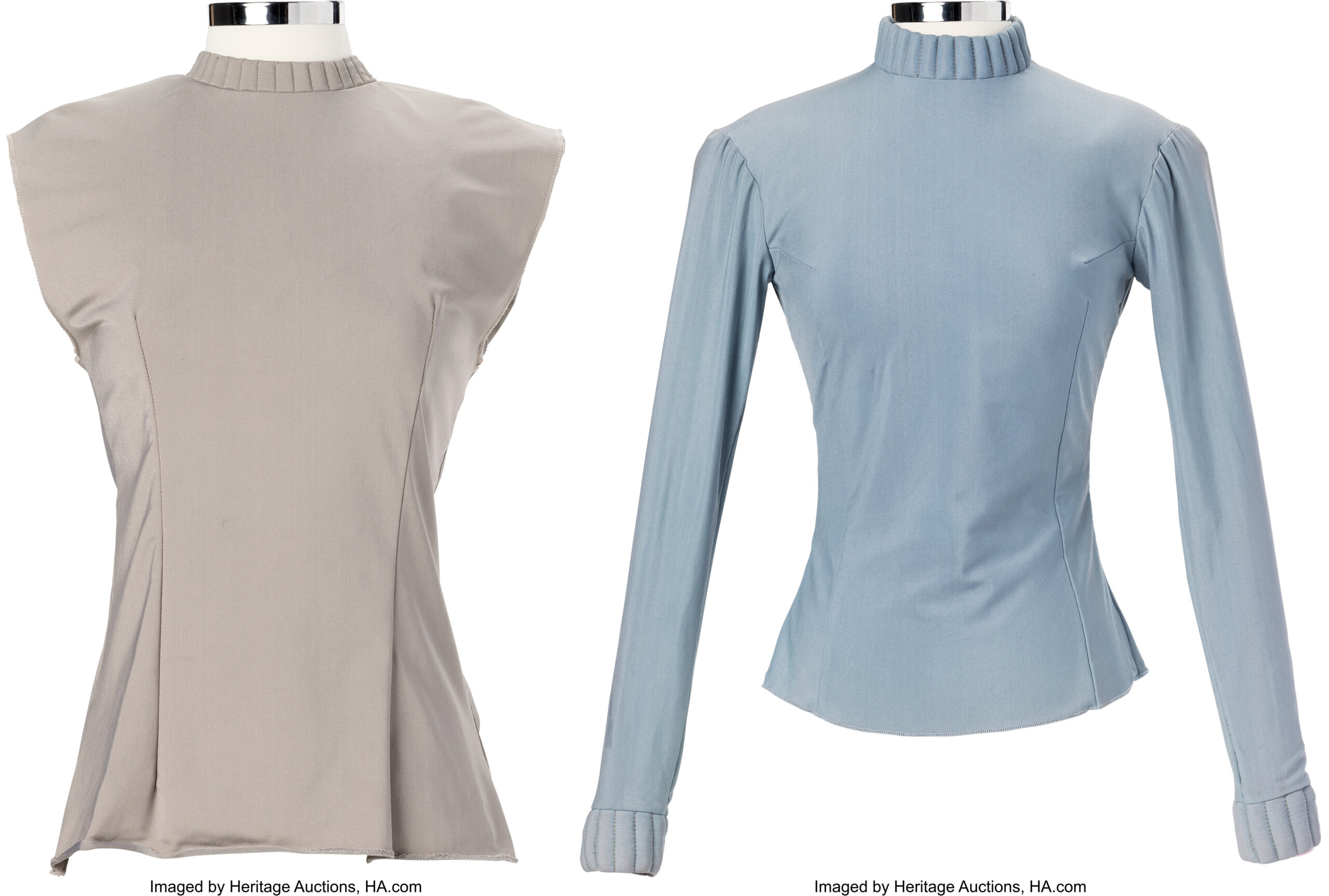
Here’s an auction photo of two screen-used division shirts, which I believe to be “special services” blue (left) and sciences gray (right):
And here’s another side-by-side of two unrelated shirts, in which the difference is even easier to see:
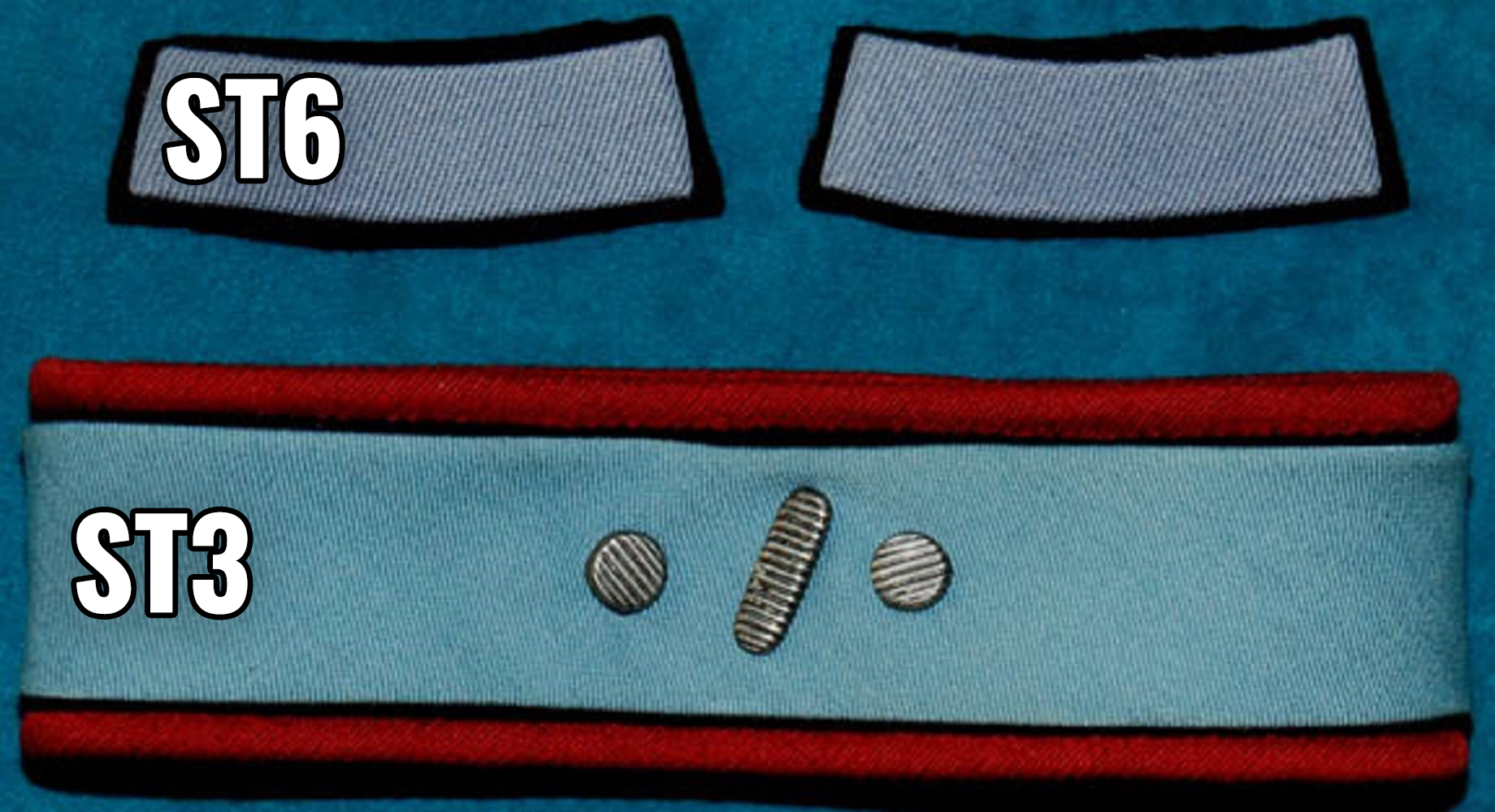
The “special services” blue color itself appears to have changed some, from a more turquoise-y blue in ST3 (sleeve band) to a more grayish-blue (shoulder tabs) in ST6:
The medical green looked pretty consistent to me across the movies:
Although paradoxically, the fabric color itself varied considerably:
But in a nutshell, those are the eight division colors of the era, and what they represent.
RANKING SYSTEM
The most visually complex element of the TWOK-era uniforms is probably the ranking system, along with the service pins … it’s really a lot of bling.
“When I first came in, there was no coherent schedule of ranks. You know, when you go into the Army, or the Air Force, or the Navy, you can buy a booklet – or find a booklet – that illustrates all of the known ranks, their various divisions, the way the Army or [the service] is organized, and the colors that are used, and so on and so forth.
“There was nothing really set about Star Trek … so I proceeded to write my own little manual, choosing the various symbols for the ranks and the badges, and it became a kind of game. It was fun to do.
“And … questions would come from [Trekkies] about, ‘What did this mean?’ and ‘What did that mean?’ so I invented it, [made] it up right away, as if it was something that had been handed down to me. Well it hadn’t been handed down to me. I simply made it up.
“Gene Roddenberry was much more of a dreamer, a theoretician; he didn’t like to get too closely connected to the nitty-gritty details about what anything means … in fact, he objected to too much militarism, and when I put more of it in, I don’t think he was particularly pleased. I was really doing it more for the directors than for him.”
– Robert Fletcher, TWOK Blu-Ray special feature, “Designing Khan”
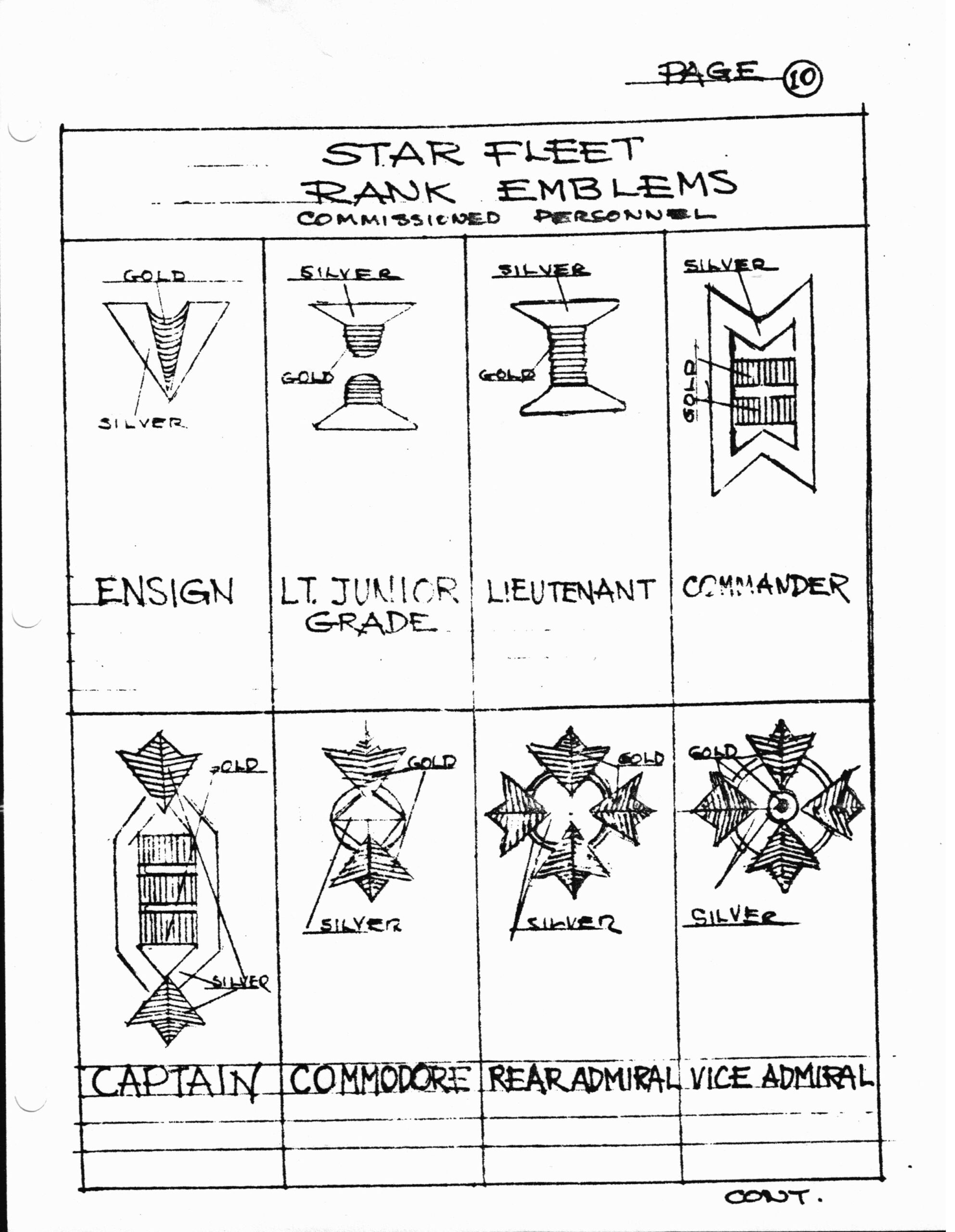
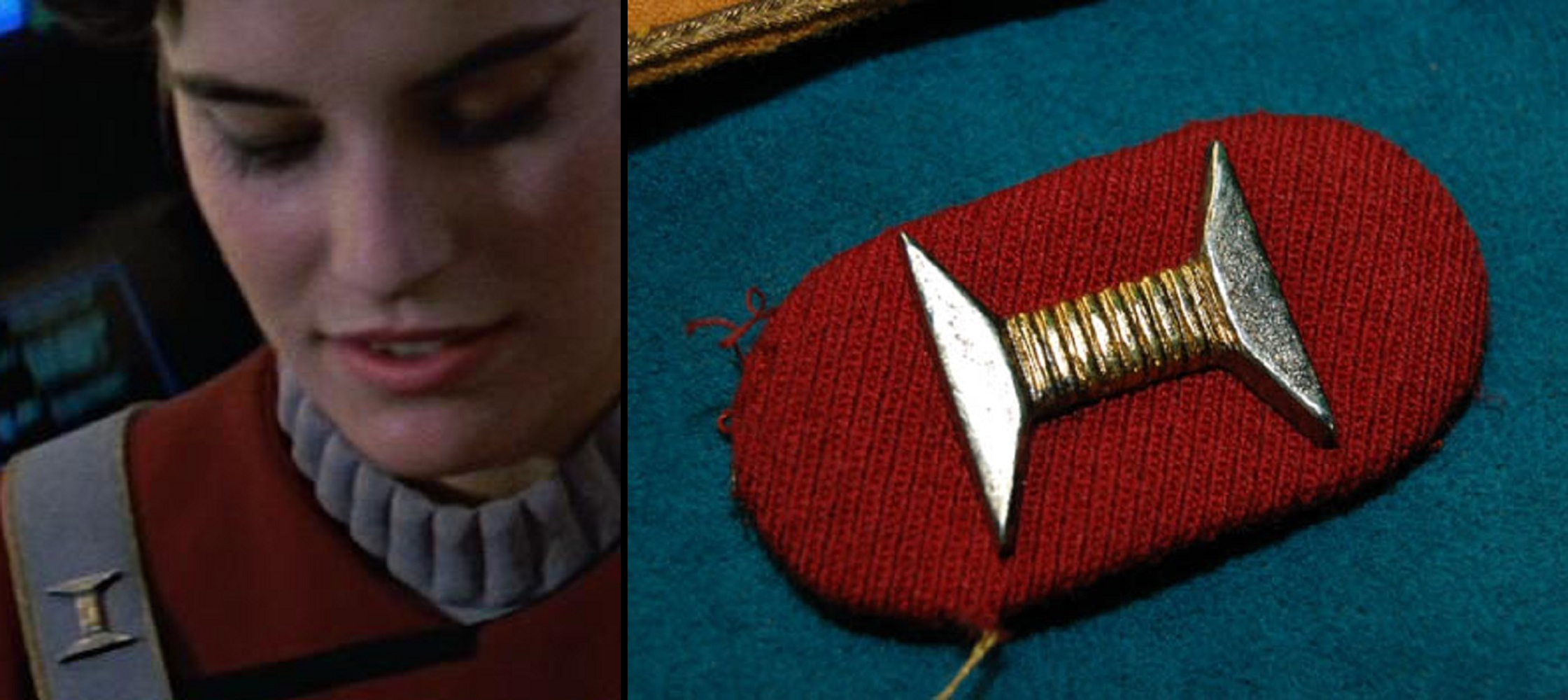
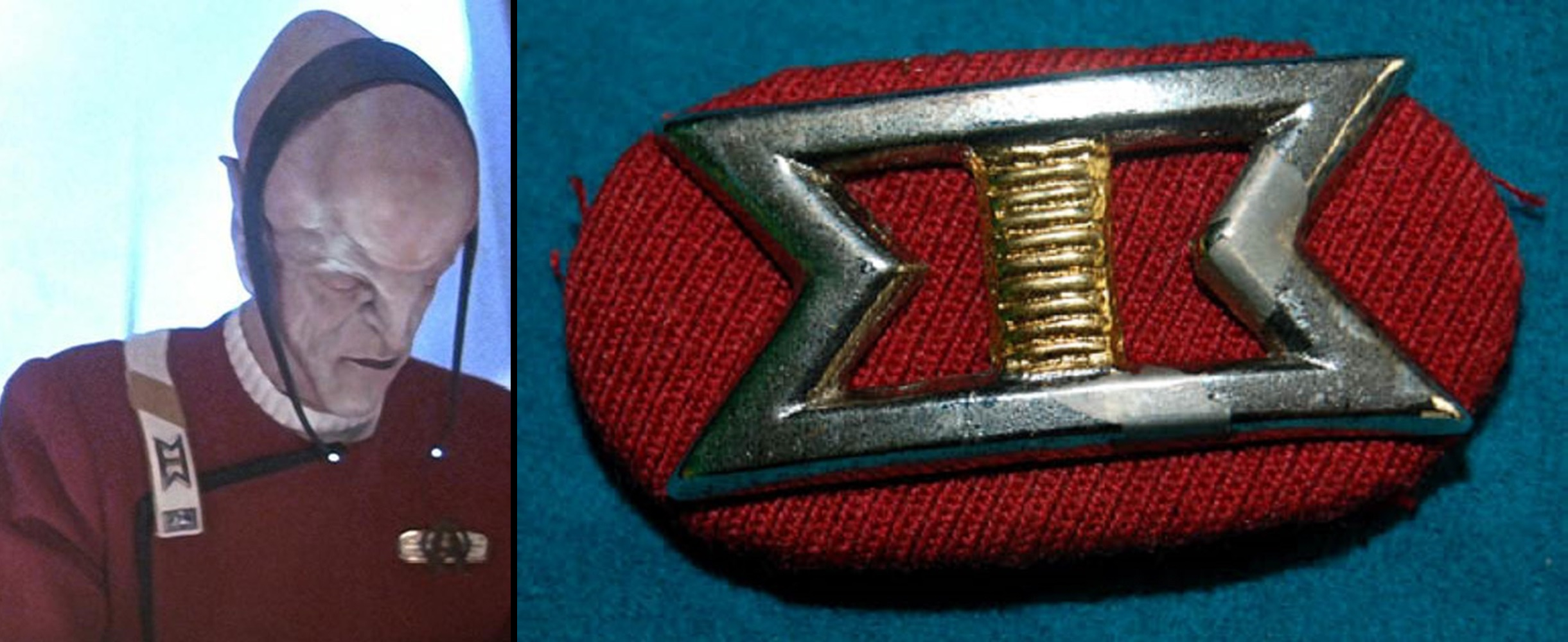
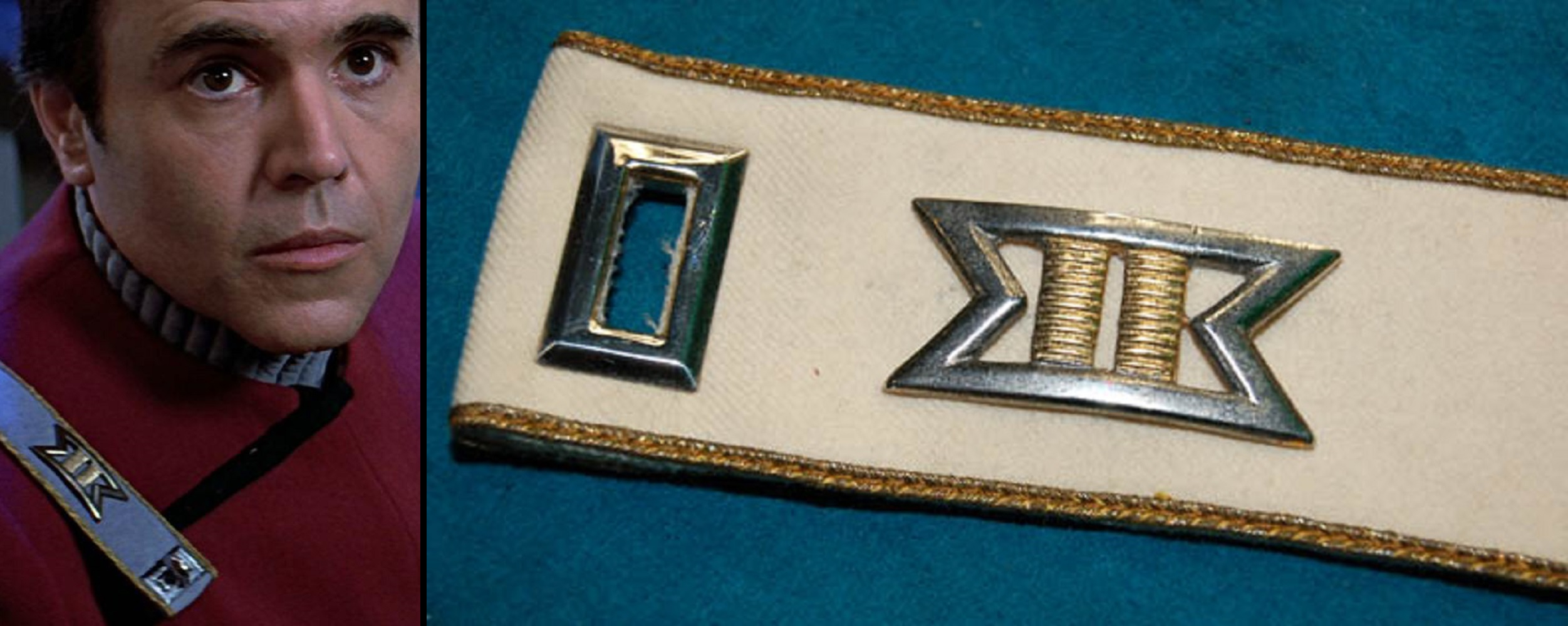
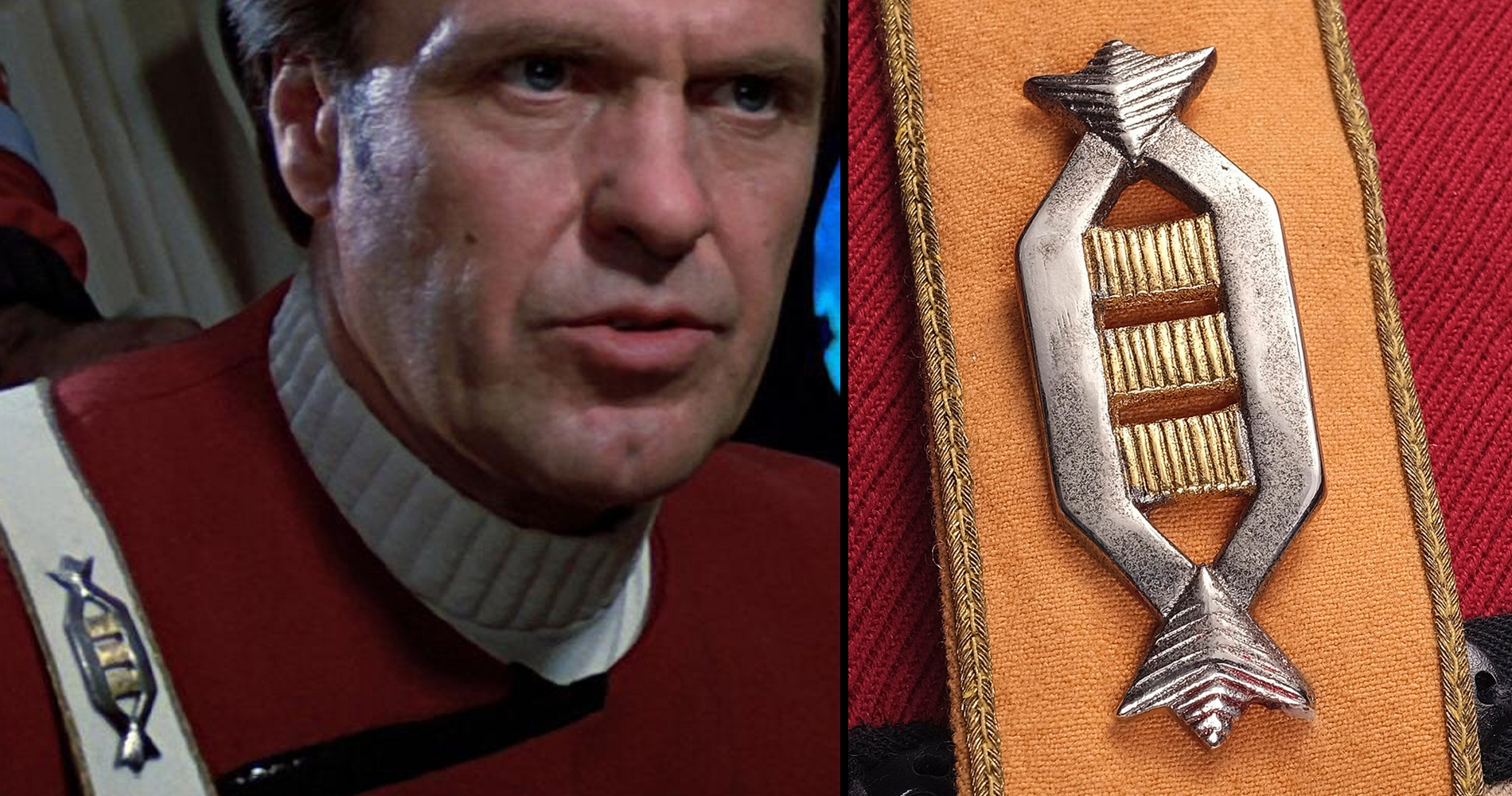
For The Wrath of Khan and the remainder of the era, Fletcher designed two sets of rank insignia: one for commissioned officers, and one for enlisted crew members.
Most uniforms had the wearer’s rank on the lower left sleeve, above the division band.
Officers also wore a second rank insignia on their upper right shoulder strap.
Officer Ranks
Here are his notes on the commissioned officer ranks:
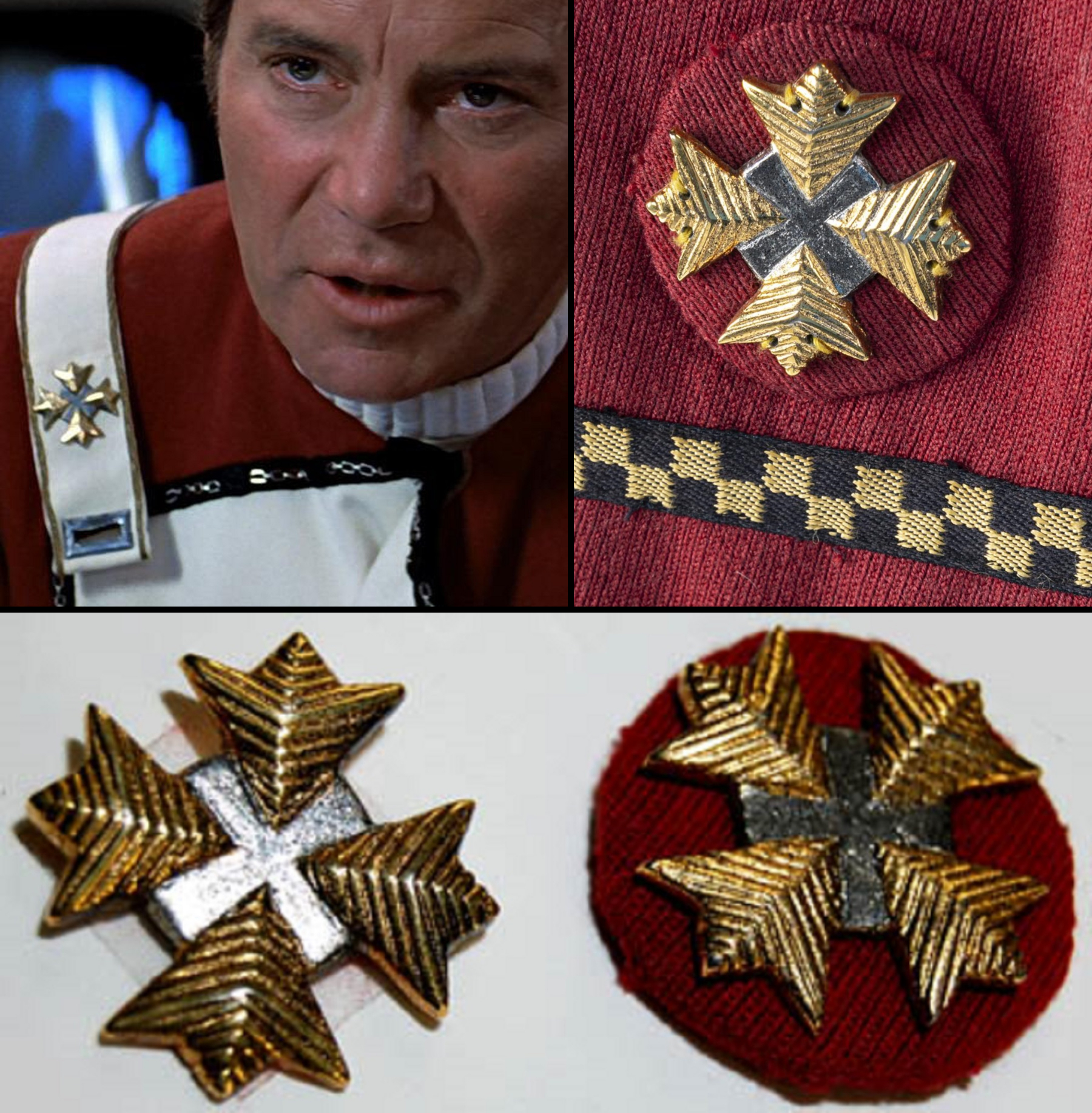
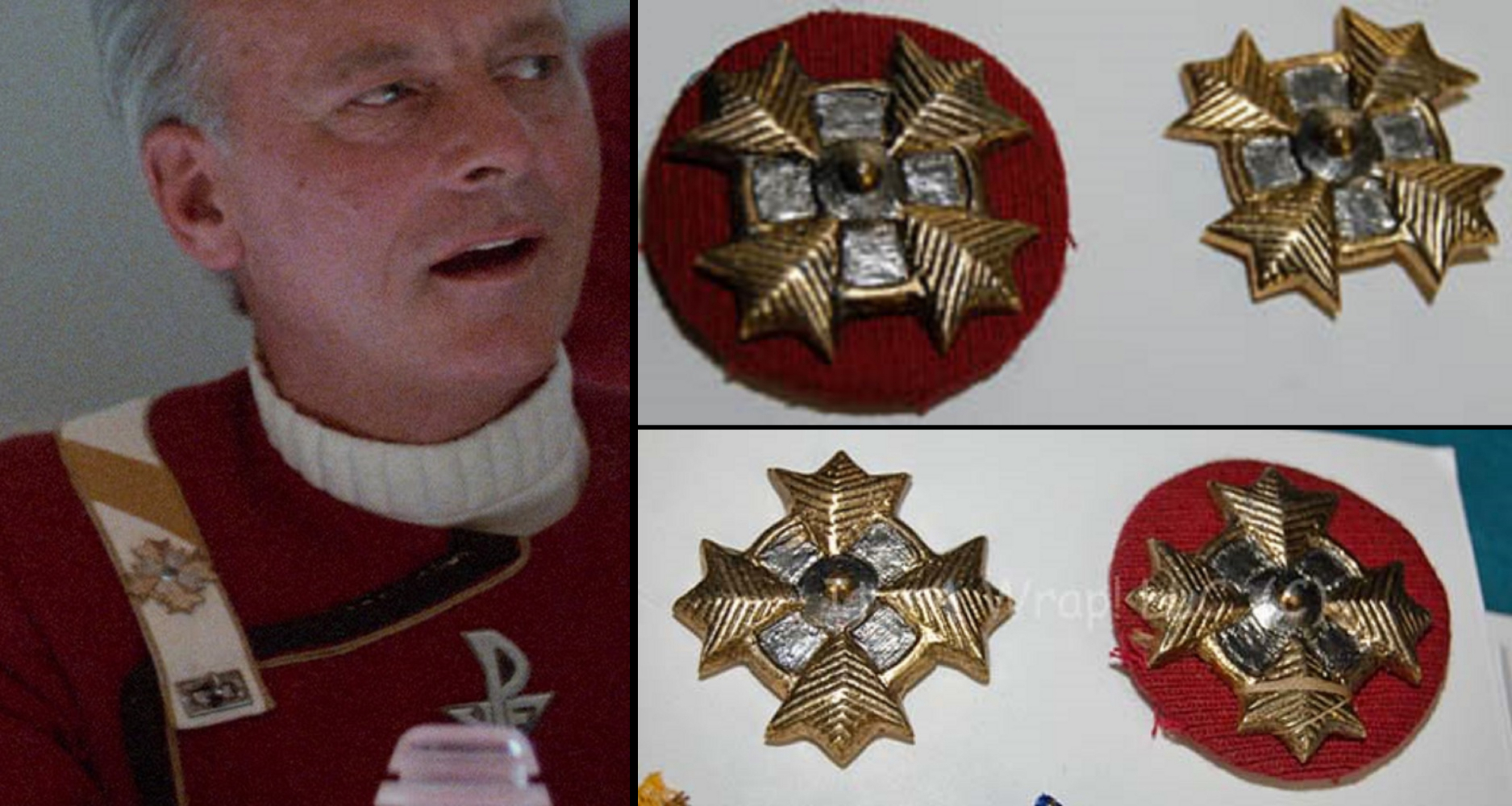
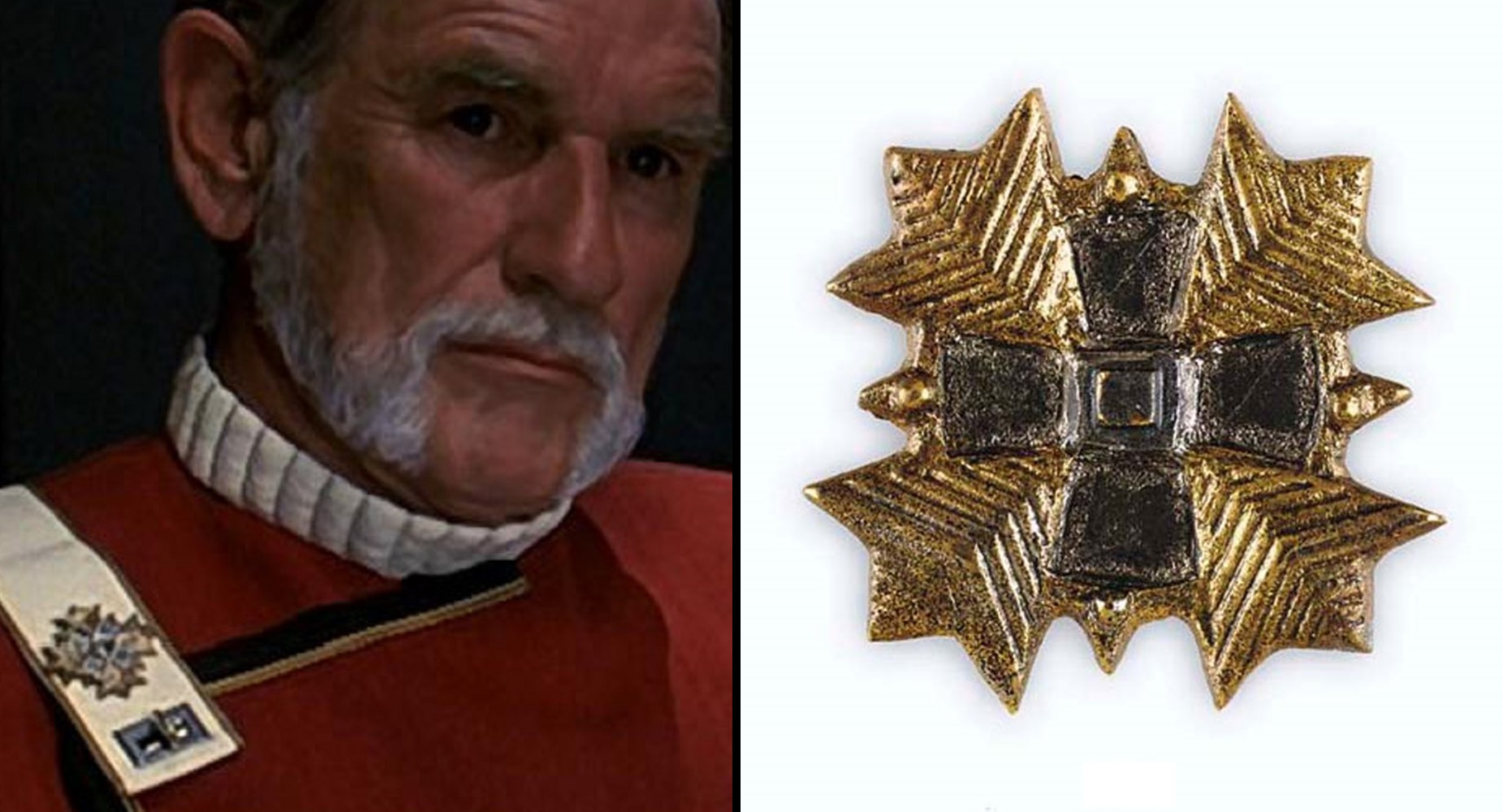
And here are some examples of the officer ranks in-use, along with some close-up auction photos.
Ensign:
Lieutenant, junior grade:
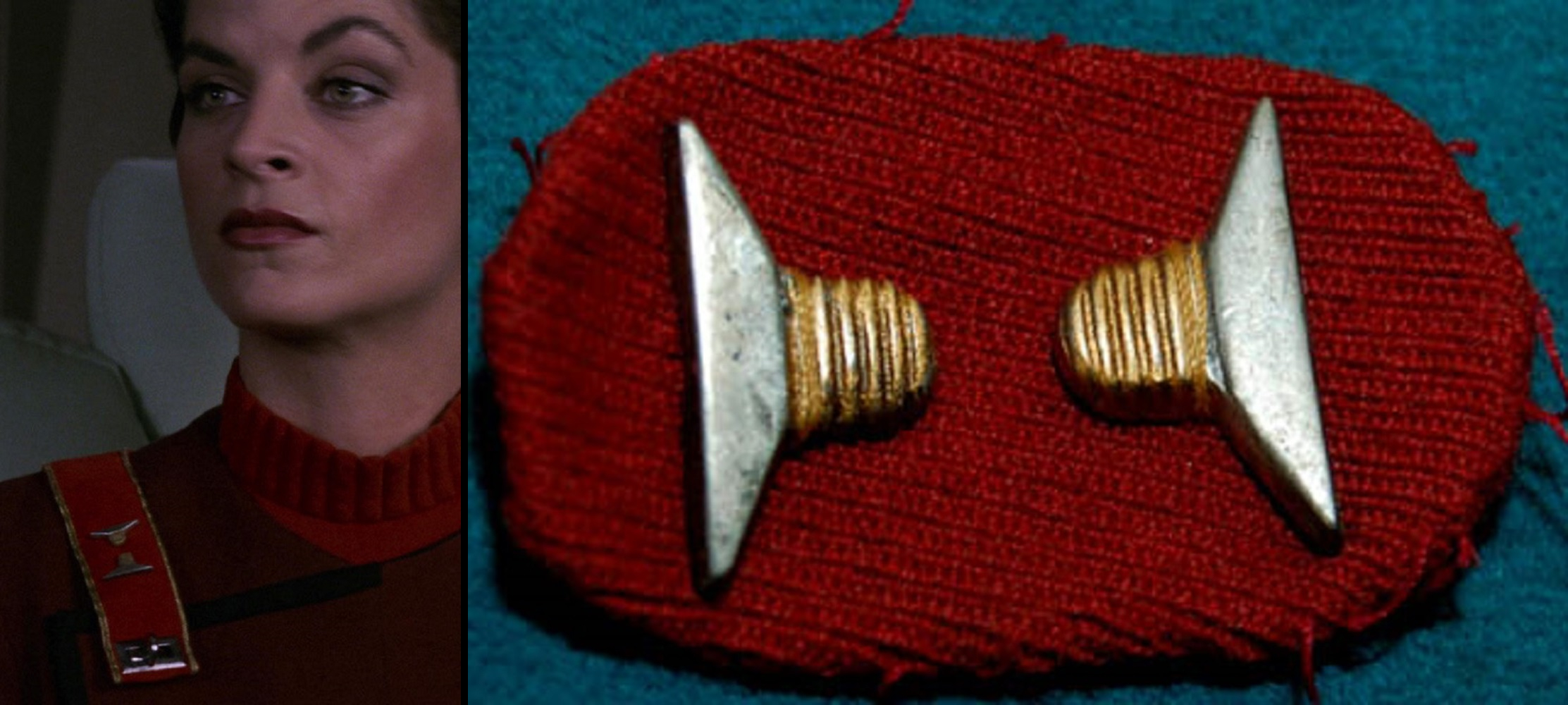
Lieutenant:
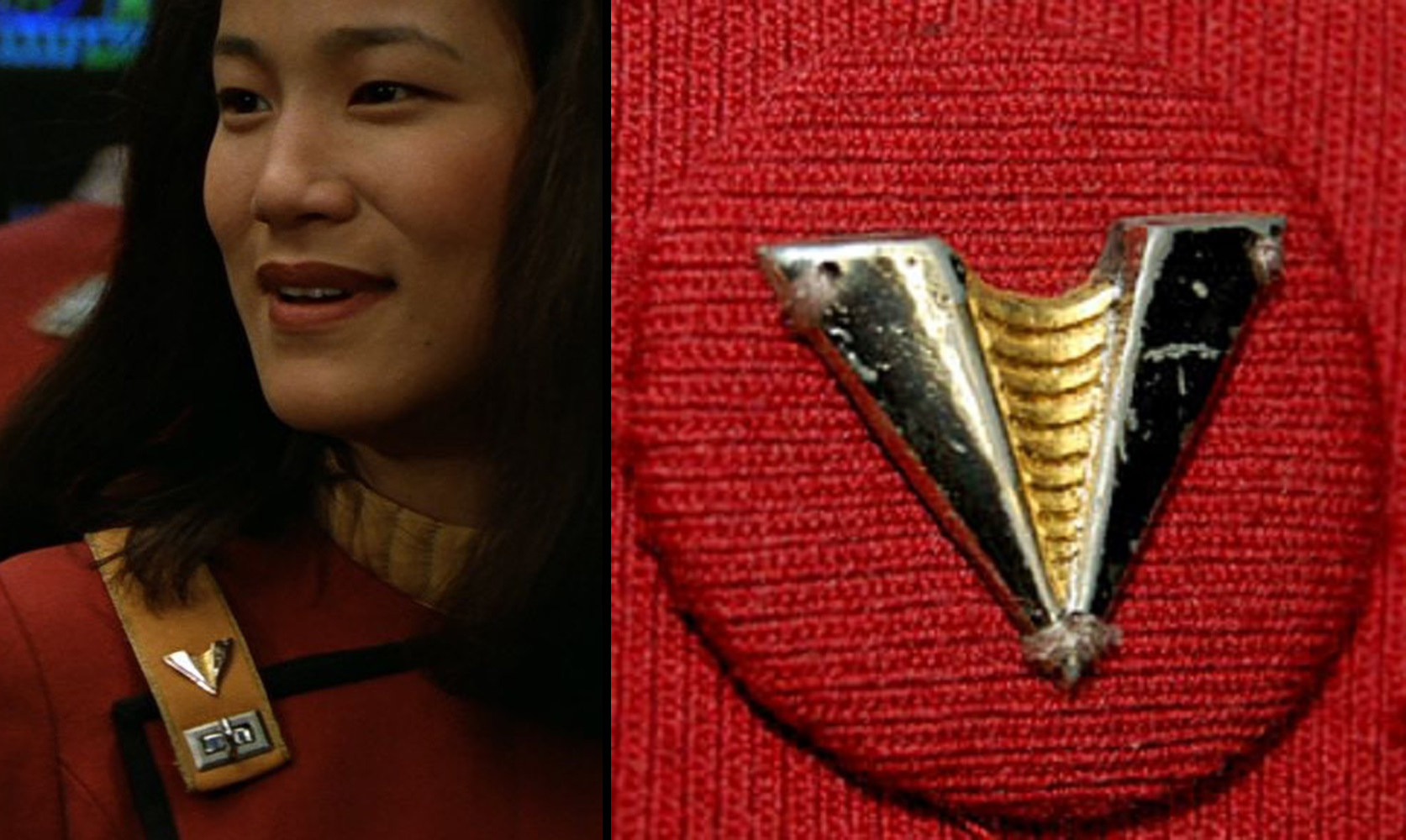
Lieutenant commander:
Commander:
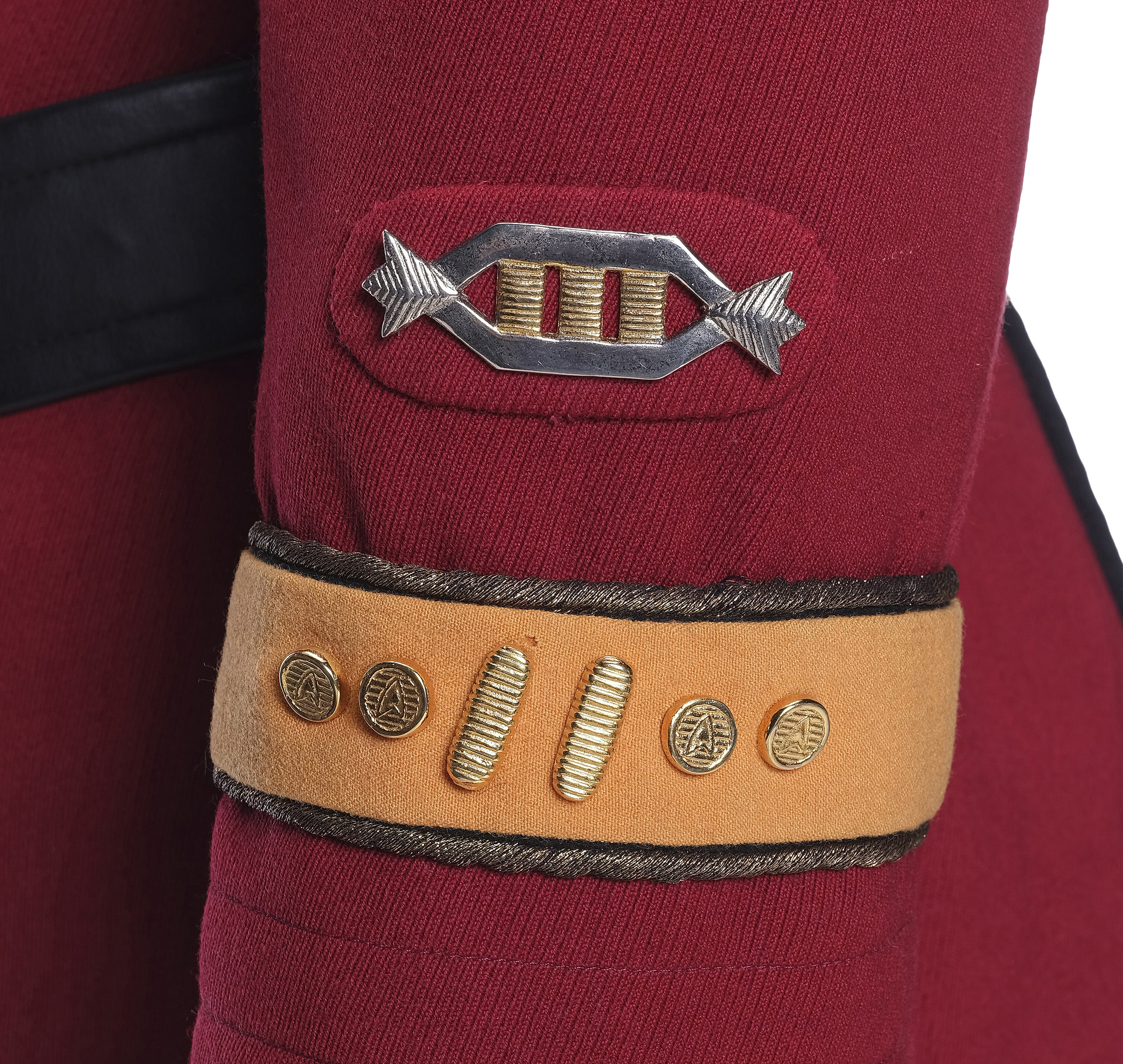
Captain:
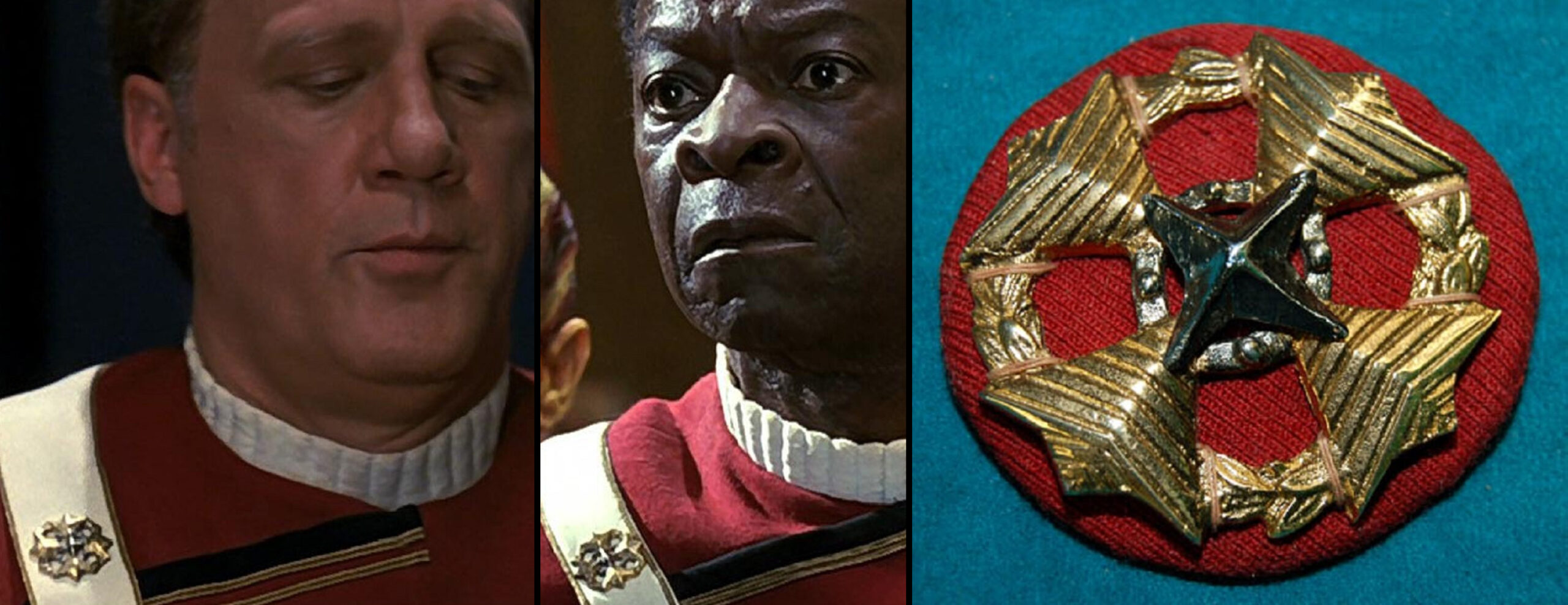
Commodore:
I don’t think we ever clearly saw a commodore on-screen, but at least a couple of these ranks were made … possibly used in the ST4 court-martial and/or ST6 Khitomer peace conference?
Rear admiral:
Vice admiral:
Admiral:
Admiral of the Fleet:
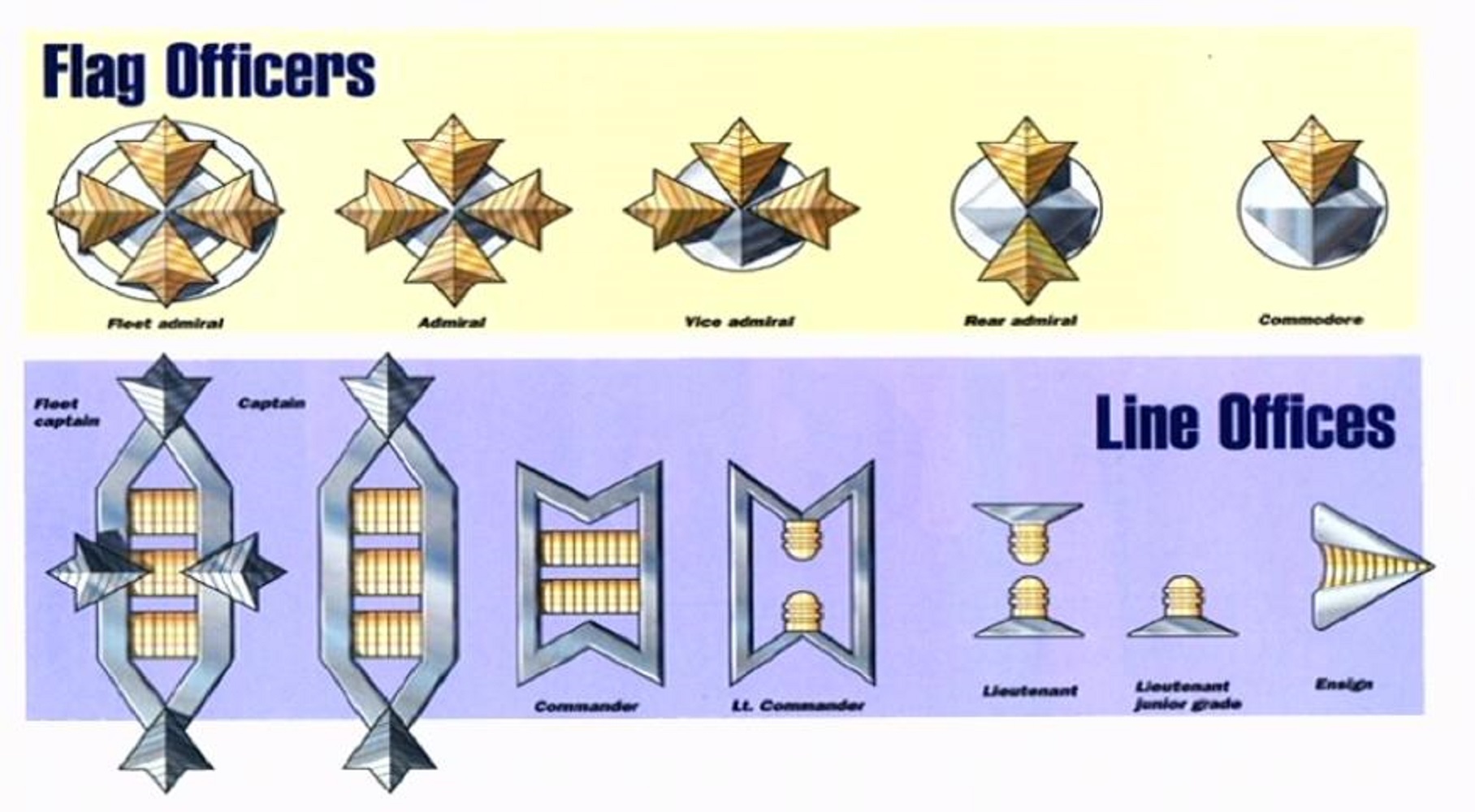
In the TWOK Blu-Ray special feature, “Designing Khan,” there’s a diagram of these ranks, but unfortunately nearly all of them are wrong in relation to what we actually saw in Fletcher’s notes and in the movies themselves:
Even though they’re “wrong,” personally I find these flag officer ranks easier to tell apart. To me the differences between the canon ones are too subtle for me to immediately identify; it takes sometimes takes me a few seconds to tell which is which.
Note that in this chart there’s also a “fleet captain,” which (as best I can tell) is purely apocryphal.
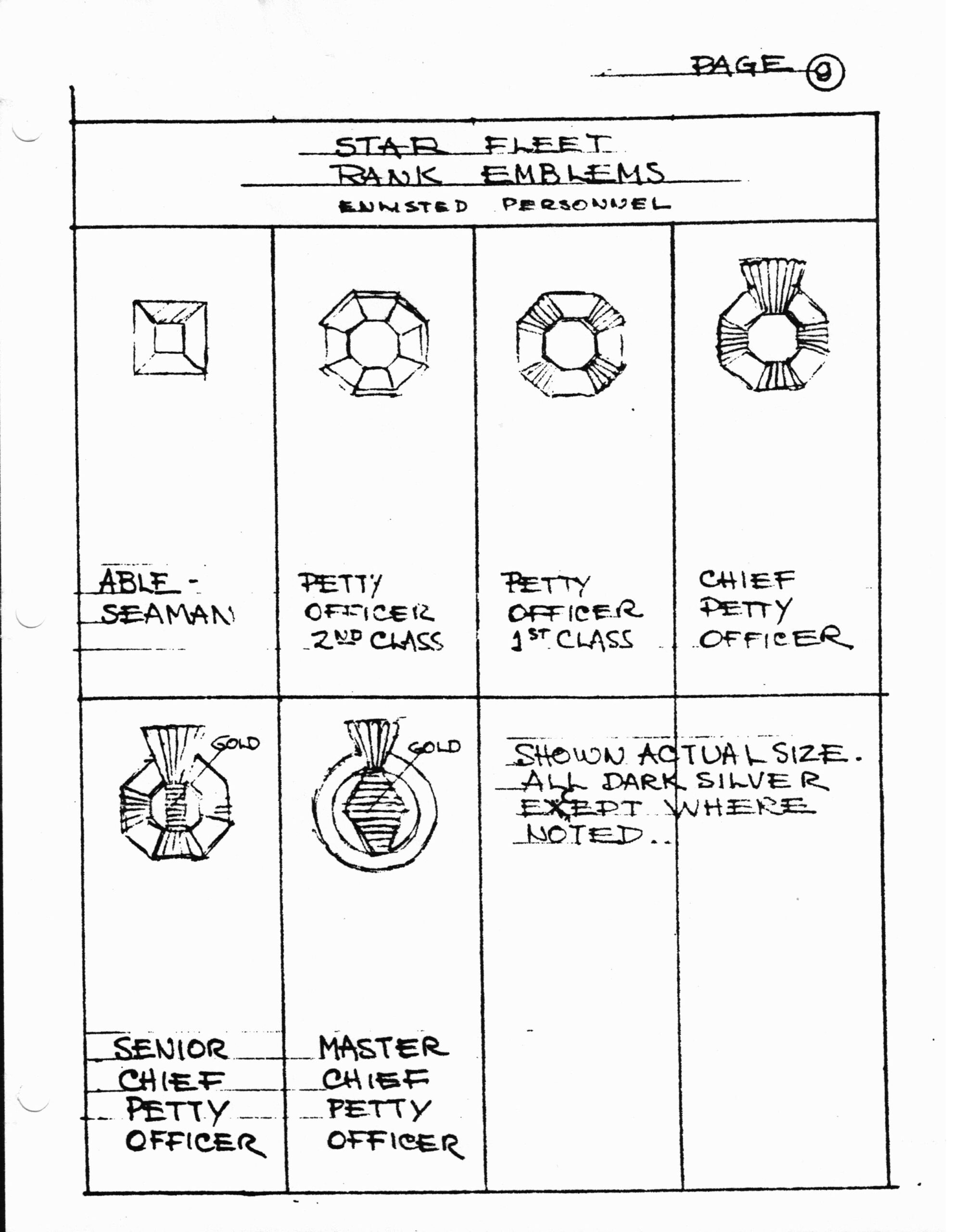
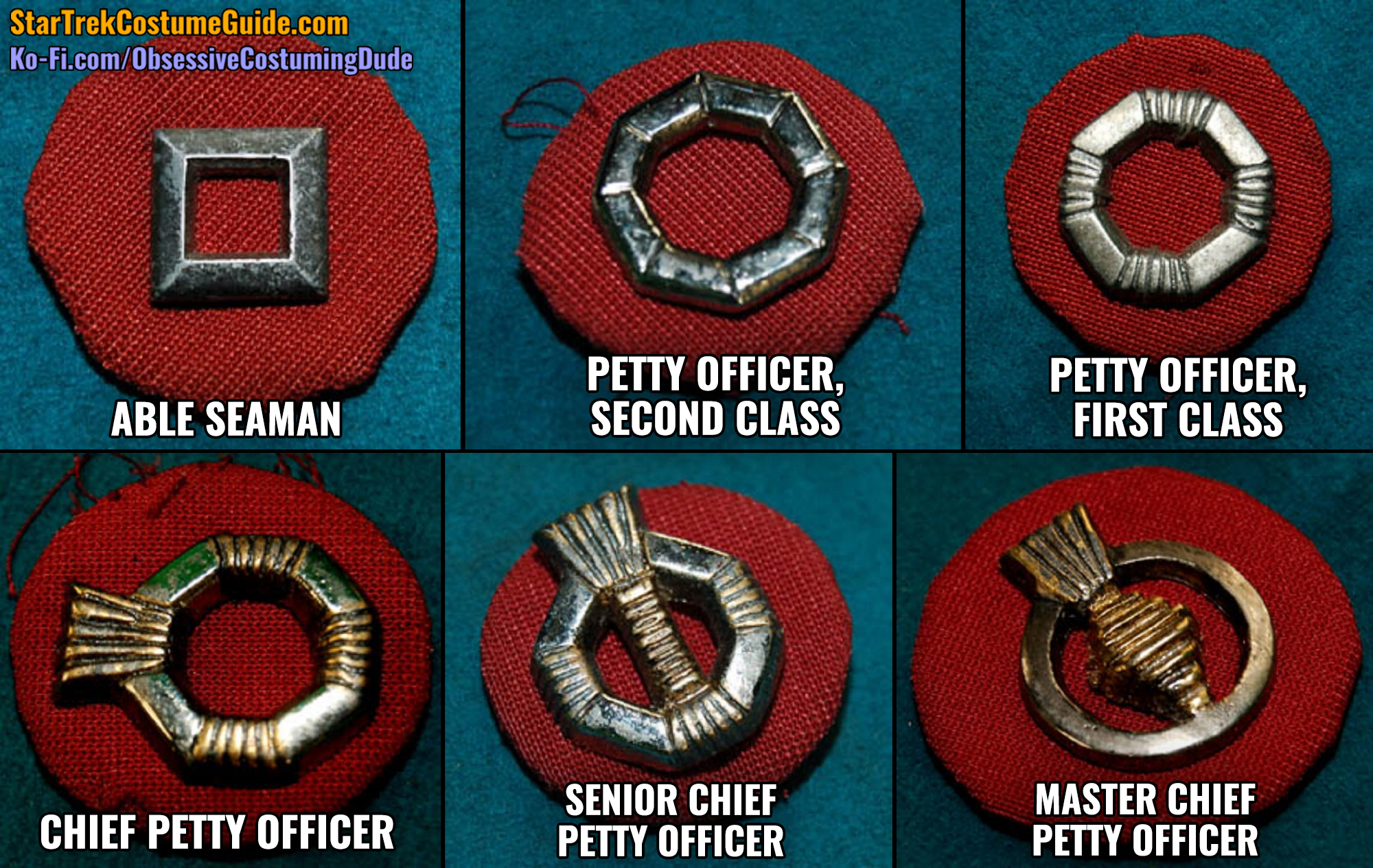
Enlisted Ranks
Enlisted crew members wore their rank insignia on their lower left sleeves as well, but they were seldom clearly visible in the movies.
Here are Fletcher’s notes on the enlisted rank insignia:
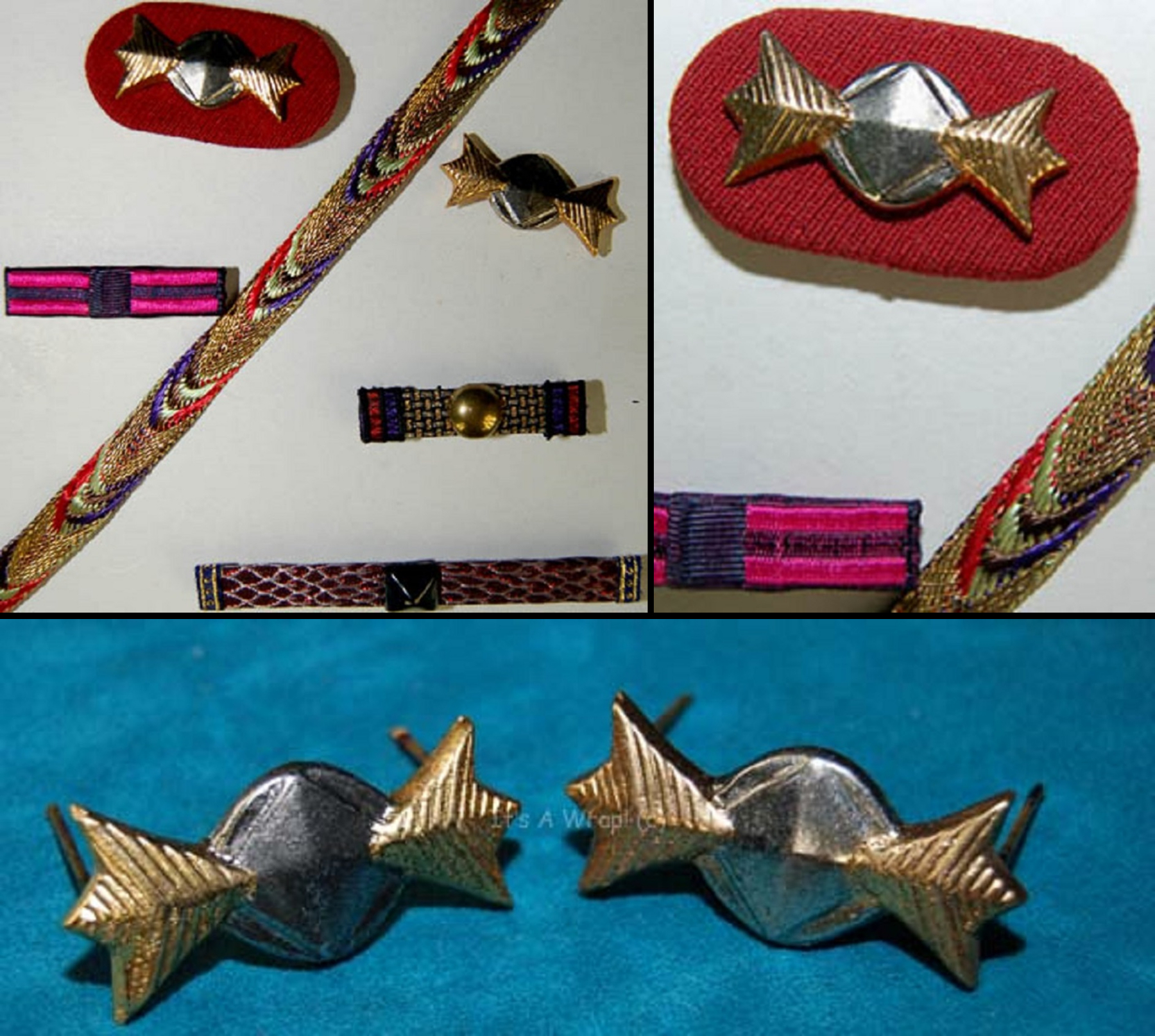
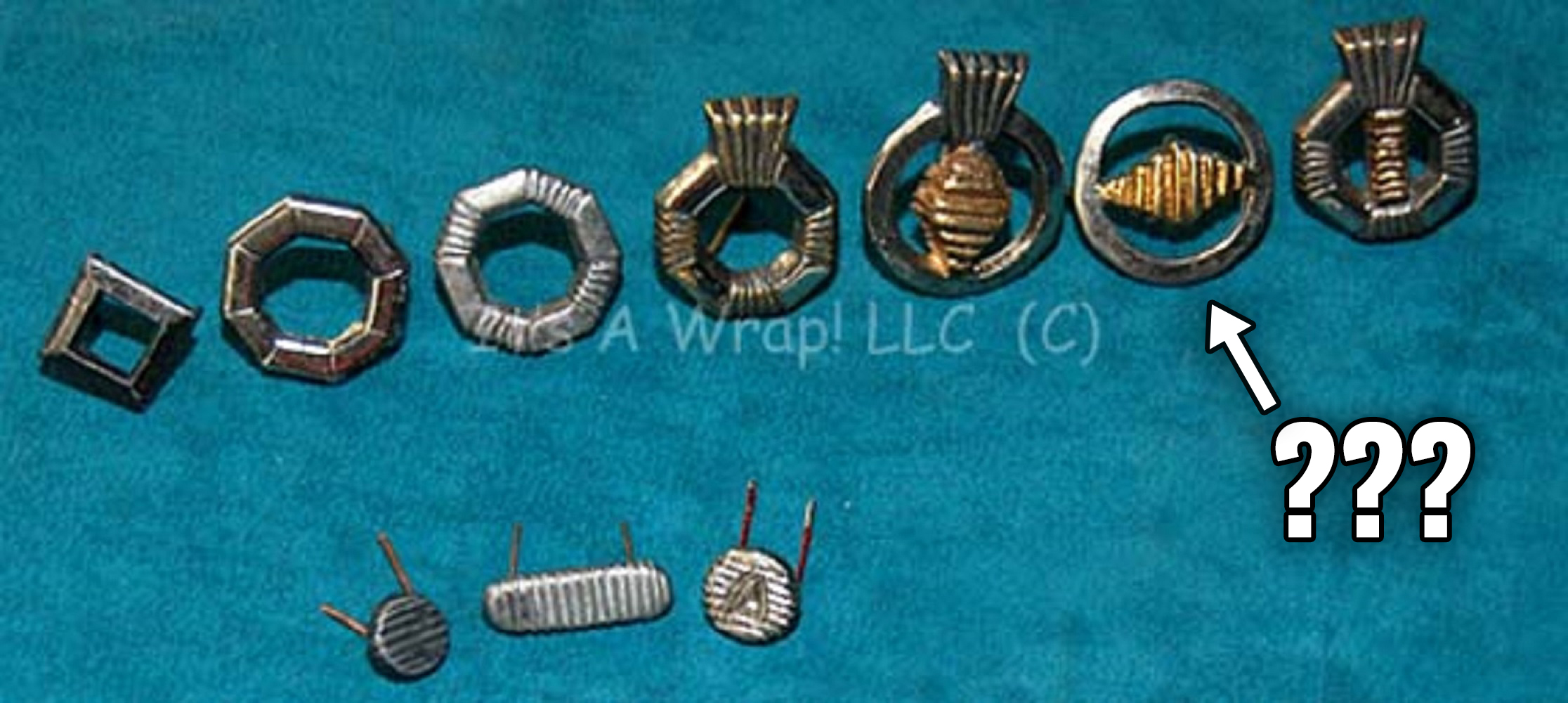
And here are some close-up auction photos of each:
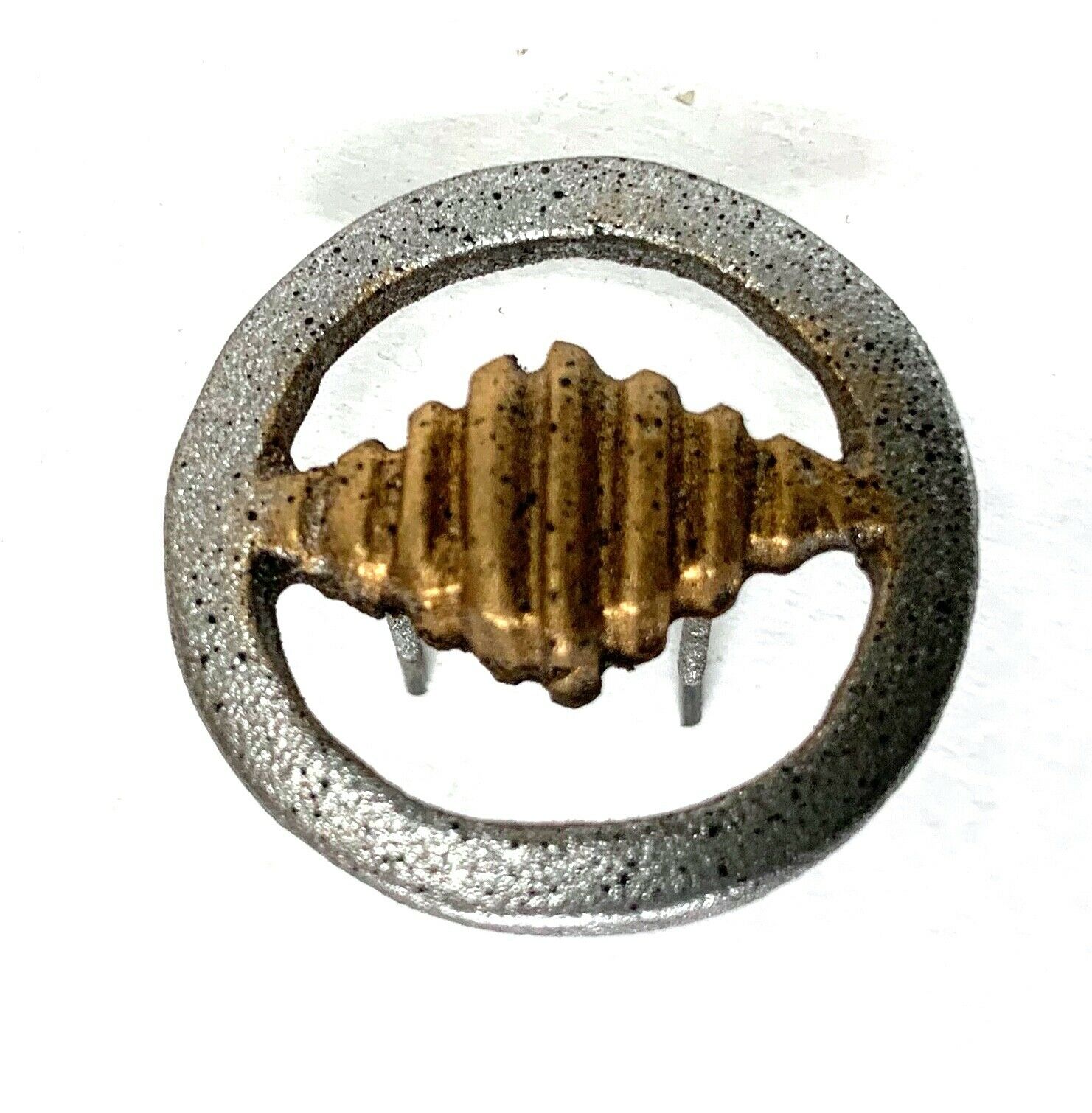
Curiously, this auction listing included a seventh item that was presumably also an enlisted rank insignia (second from right):
Whatever this was, it doesn’t seem to have been a “one-off,” because I found a second auction listing for another:
"Pips and Squeaks"
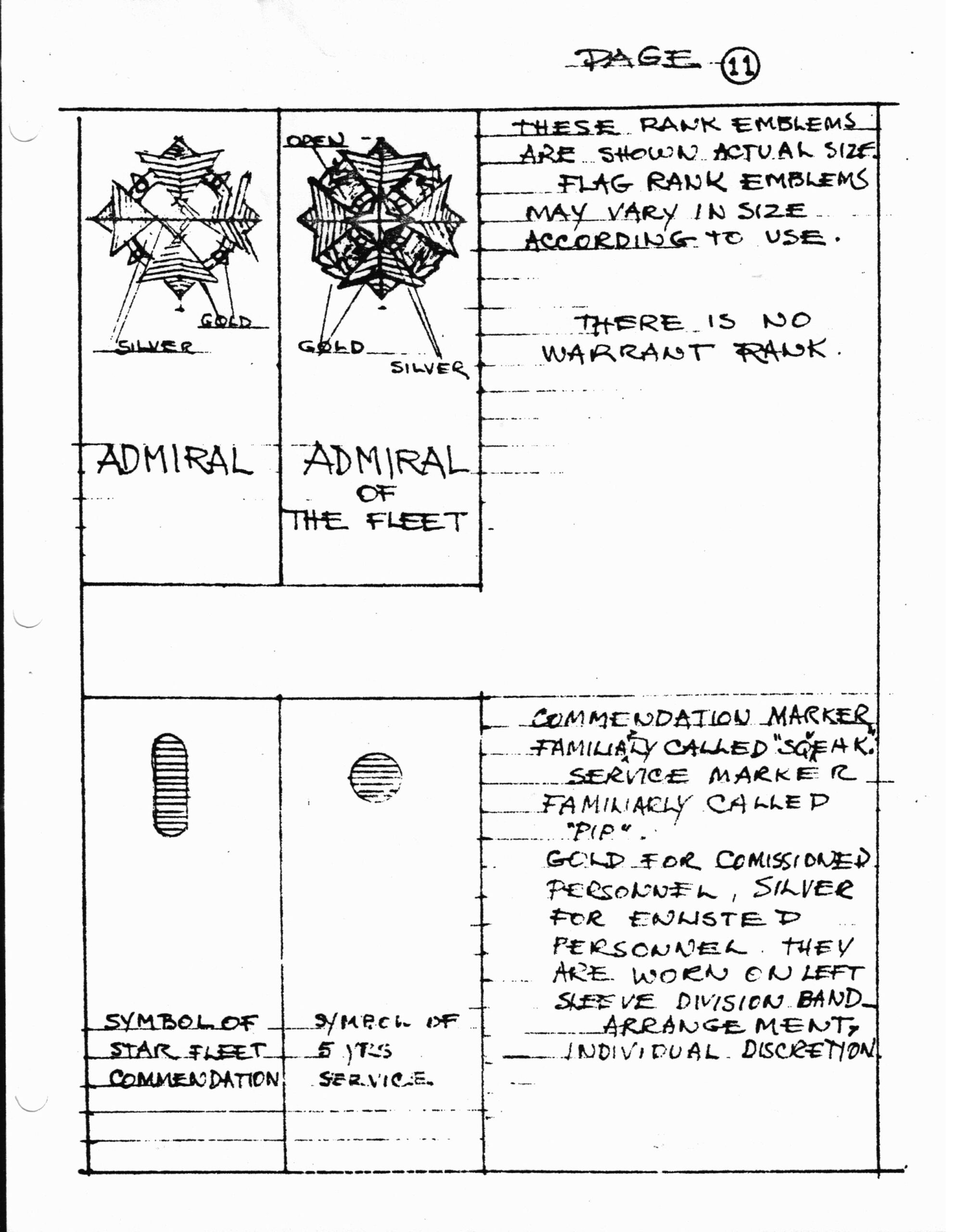
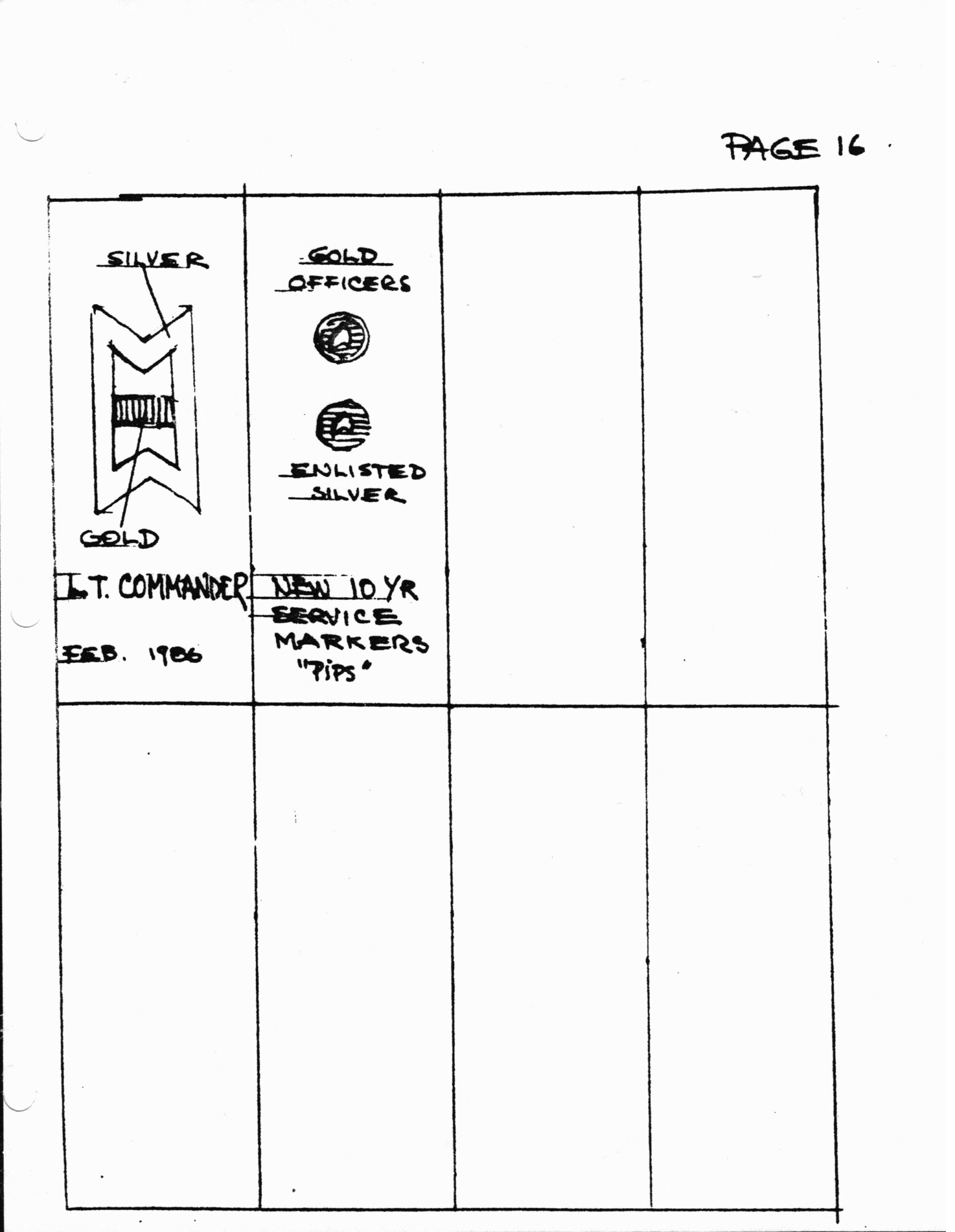
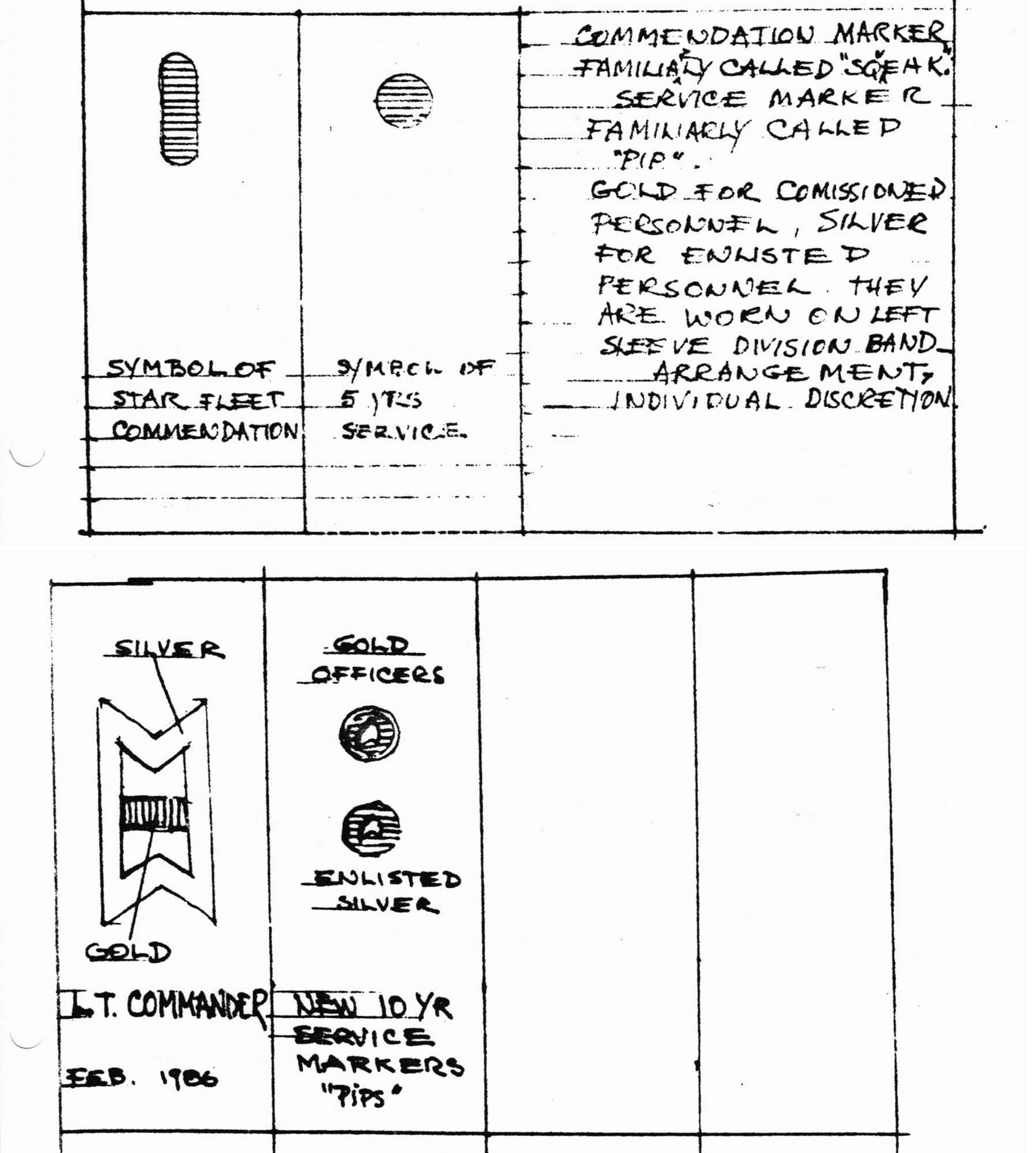
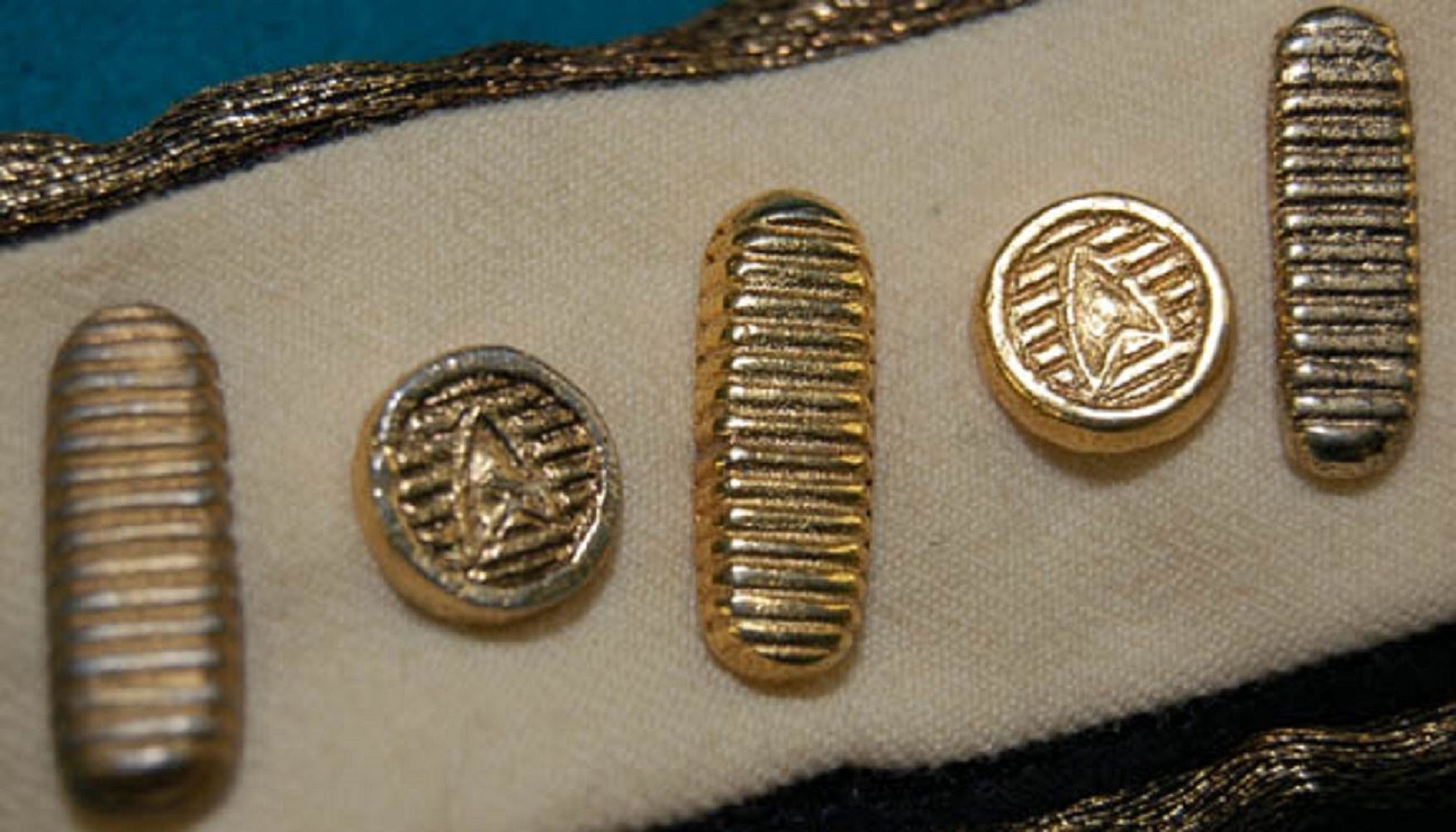
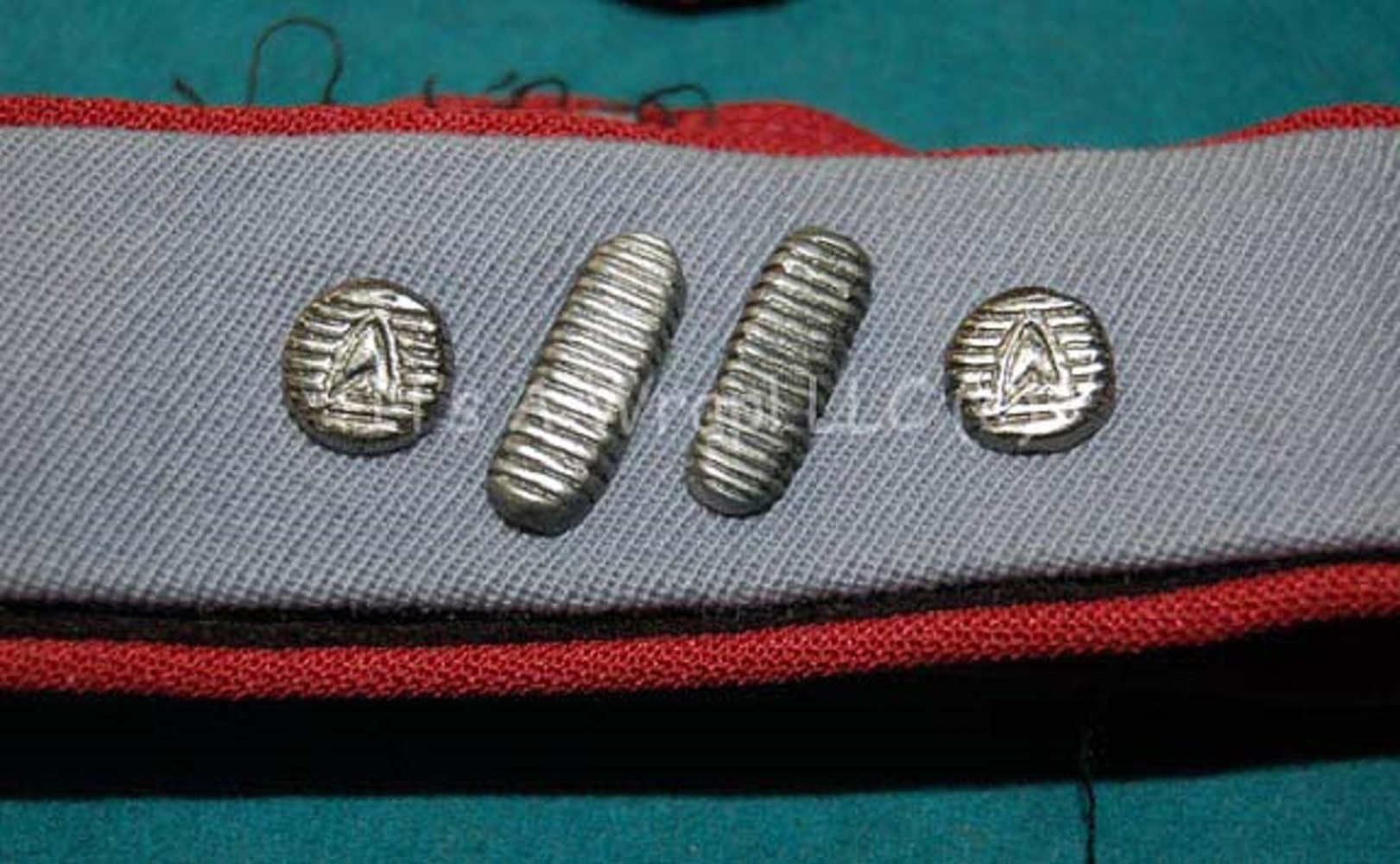
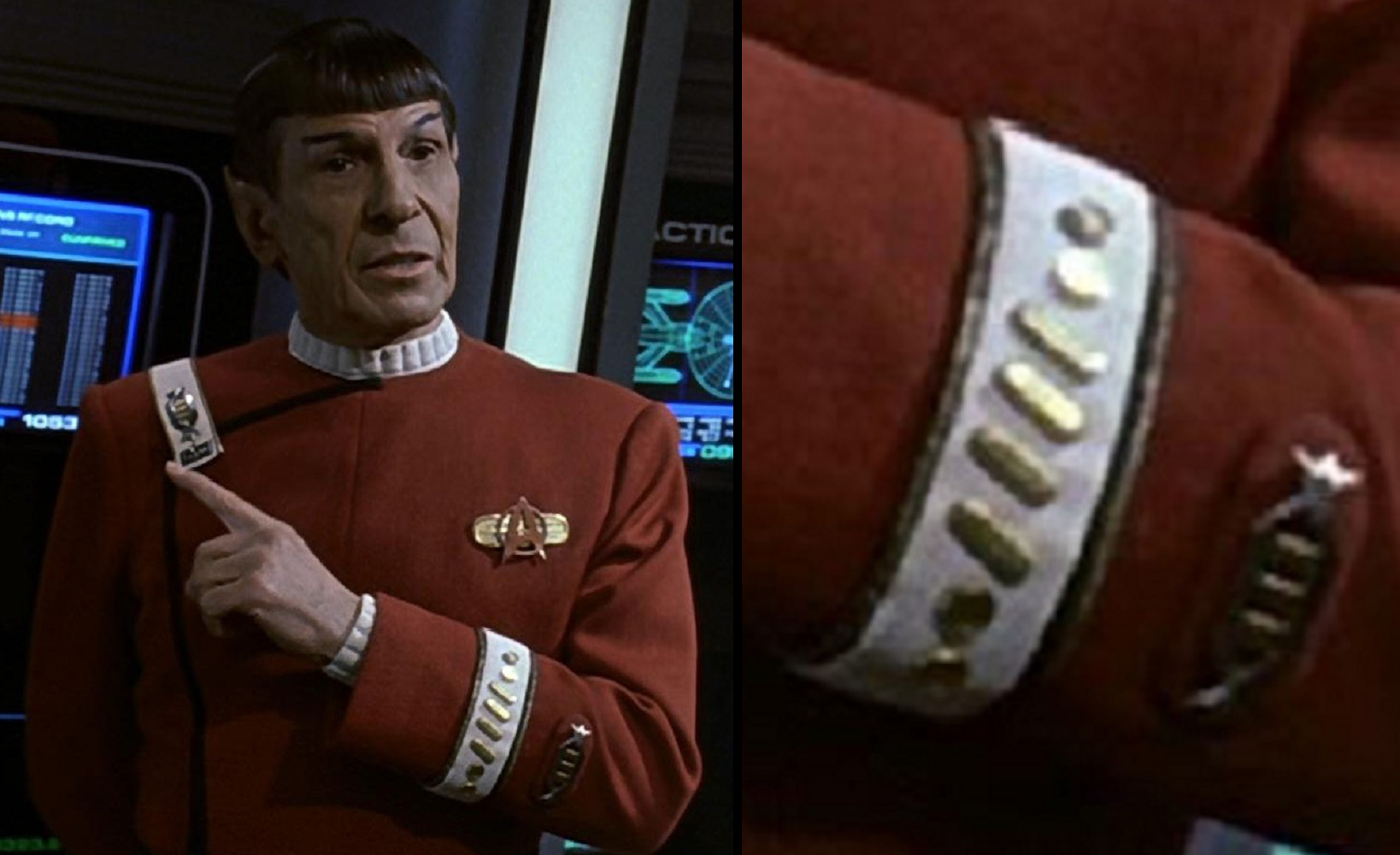
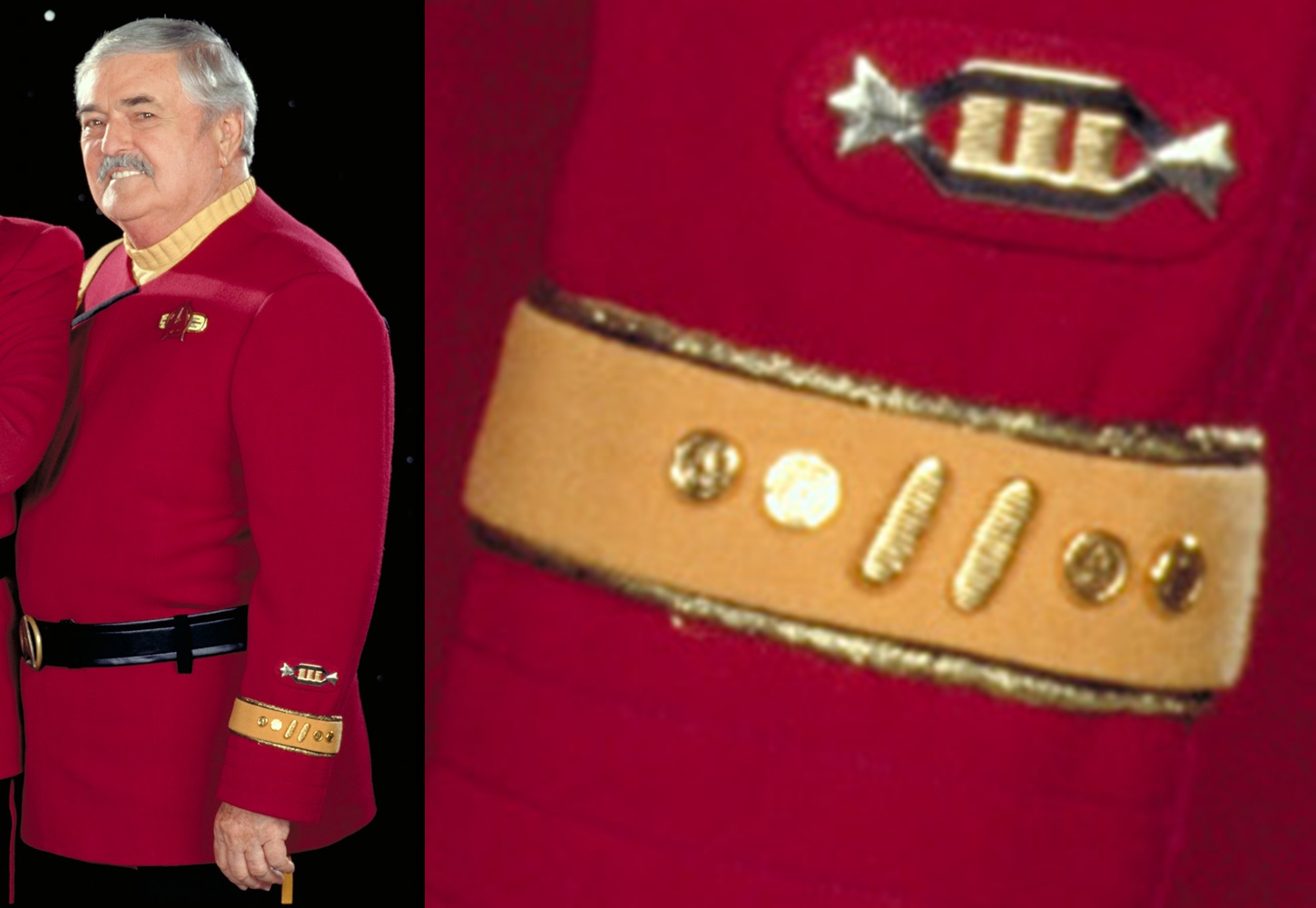
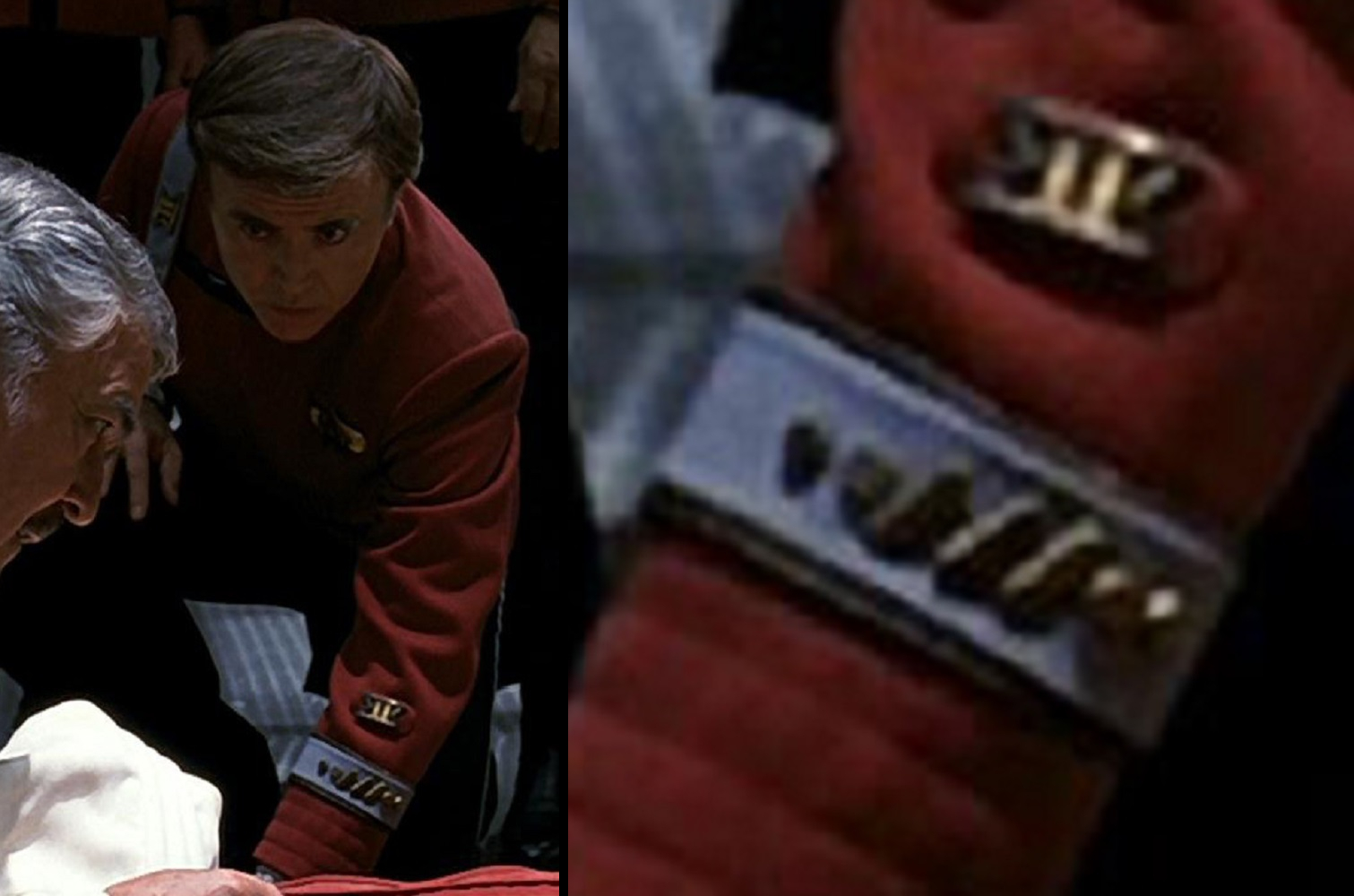
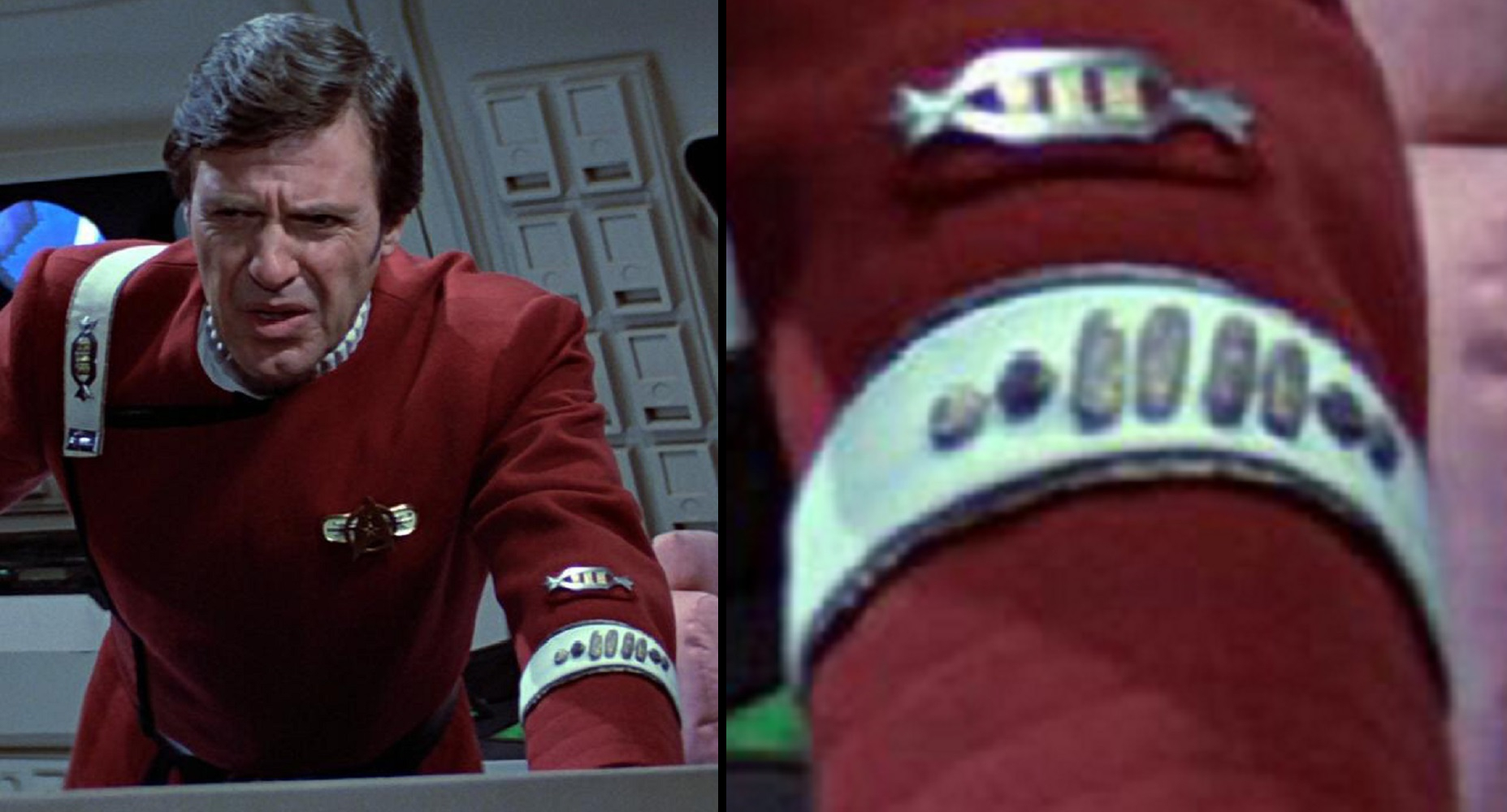
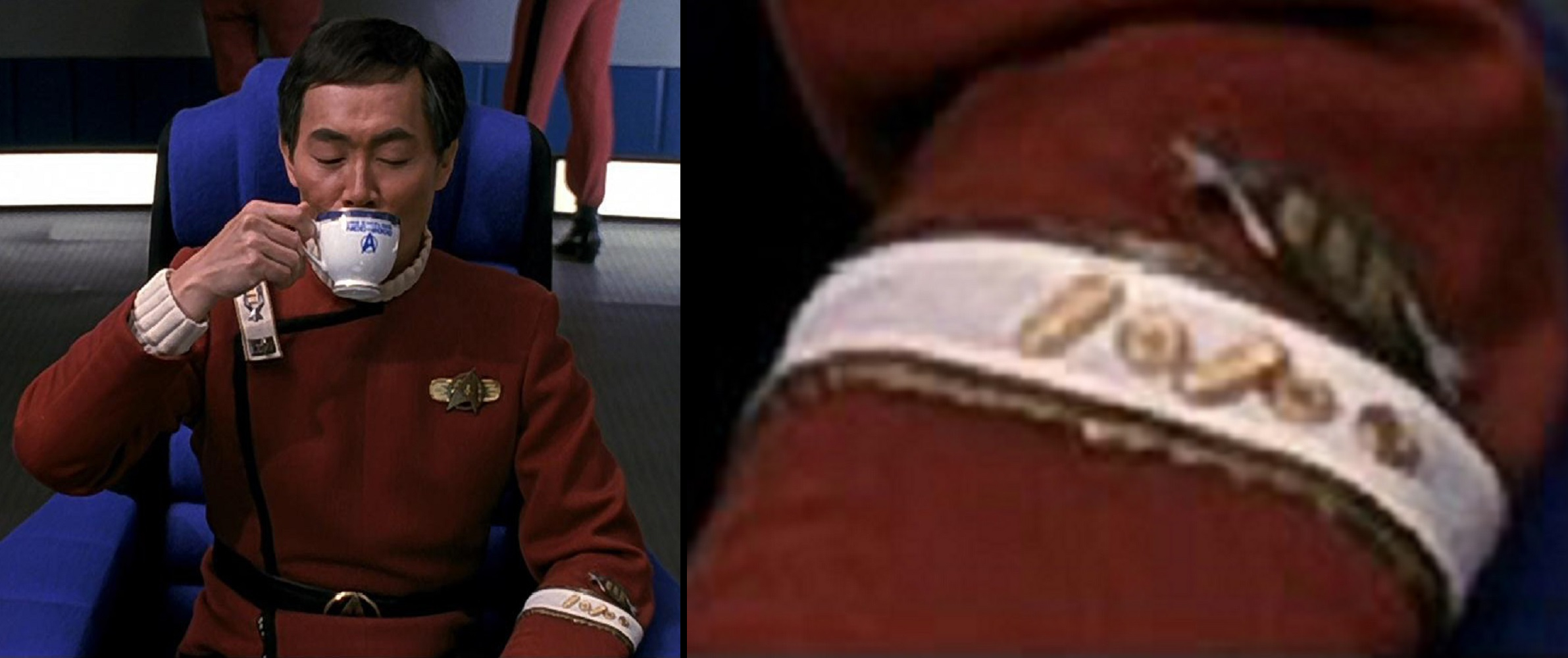
Starfleet personnel also wore a variety of small pins on their lower left sleeve bands, which Fletcher called “pips and squeaks.”
Here are Fletcher’s notes on these:
As you can see, the round ones were called “pips” and showed how long the wearer had served in Starfleet. Plain ones indicated 5 years, and he later added a variation with the Starfleet delta on it that indicated 10 years.
The longer pins were called “squeaks” and were commendations – although specifically for what is anyone’s guess.
Physically, these seem to have been identical for officers and enlisted crew, except for the color; officers wore gold, and enlisted crew wore silver.
Officer "pips and squeaks"
Enlisted "pips and squeaks"
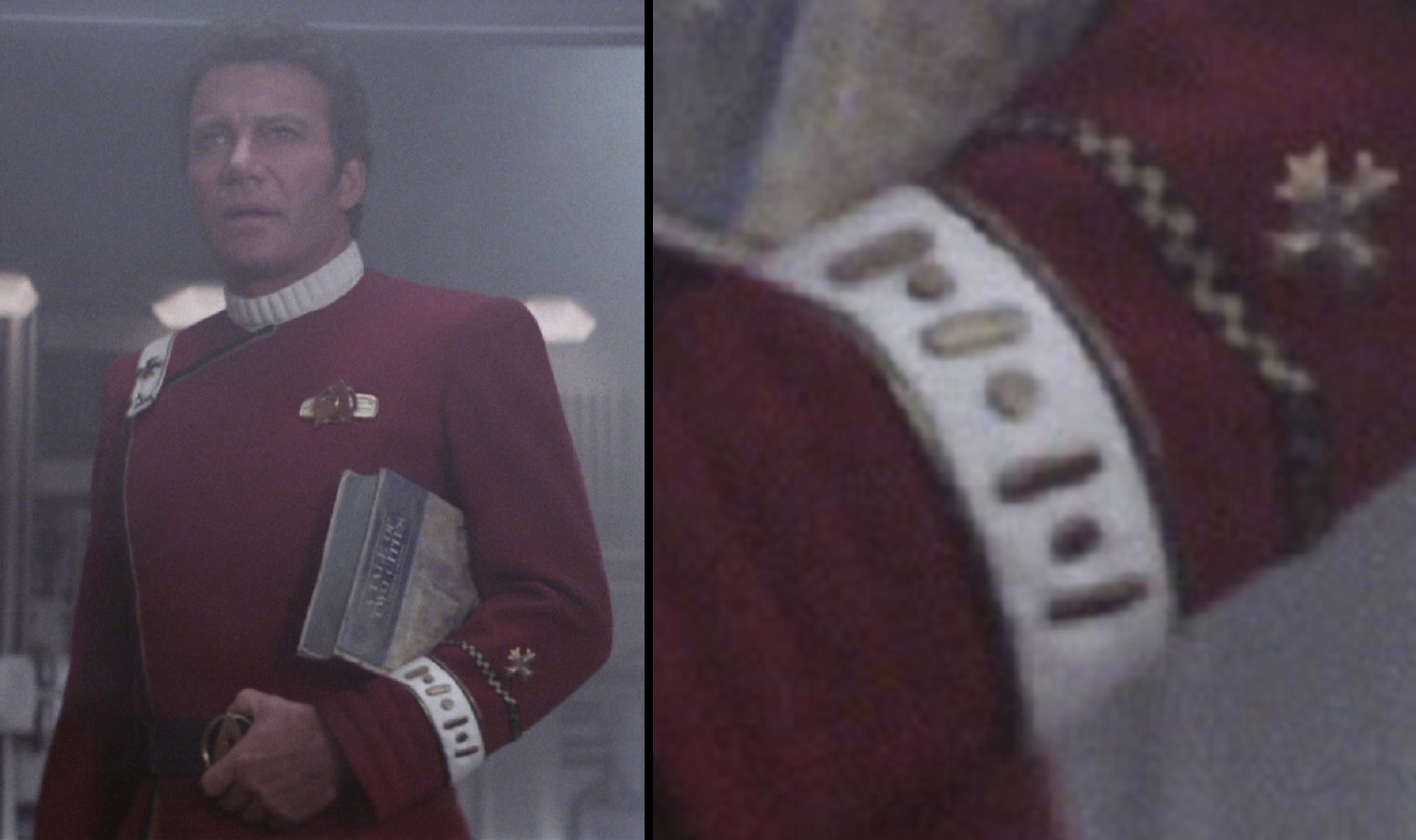
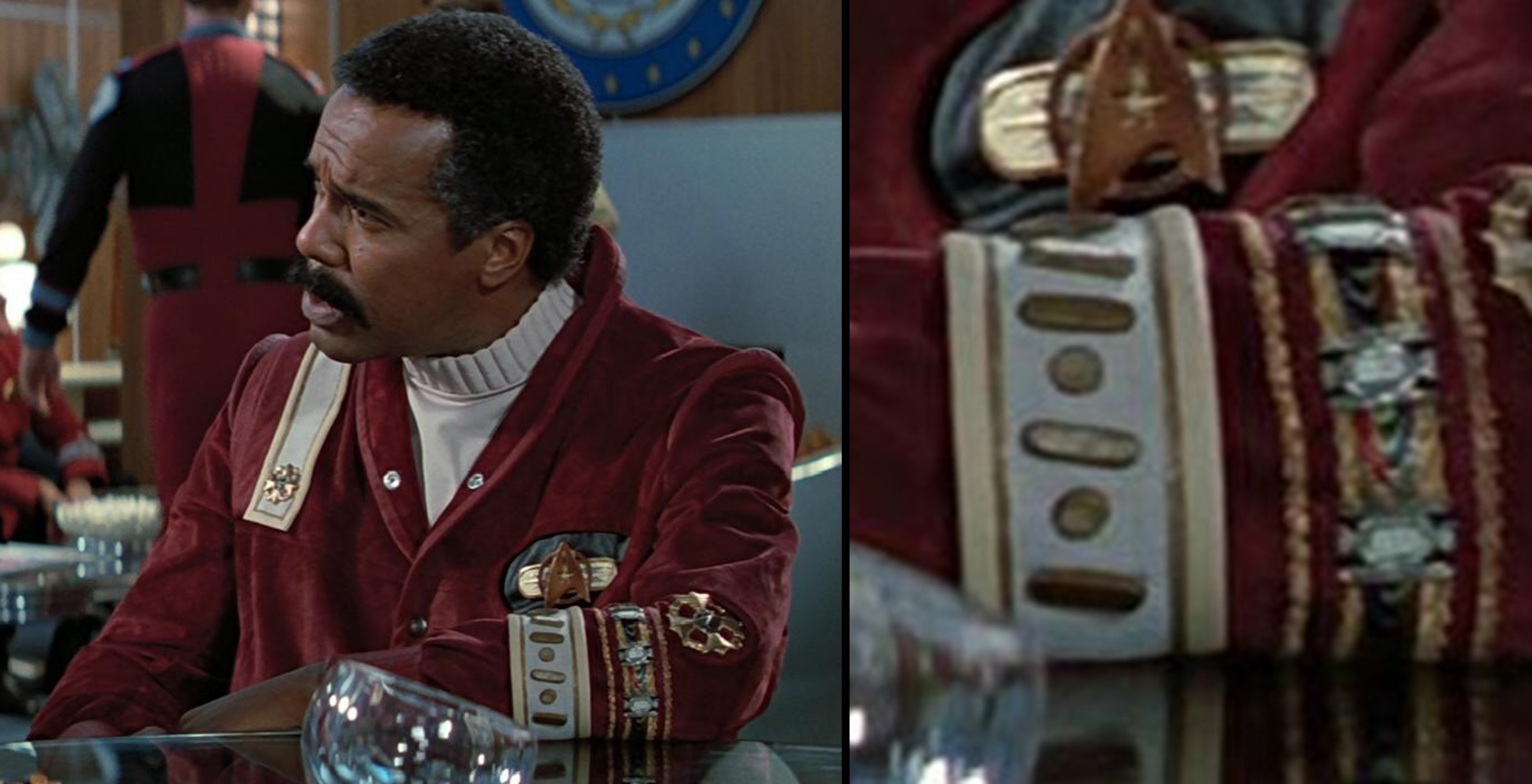
The specific number of these obviously depended on the character, and their arrangement appears to have been left to the wearer’s discretion.
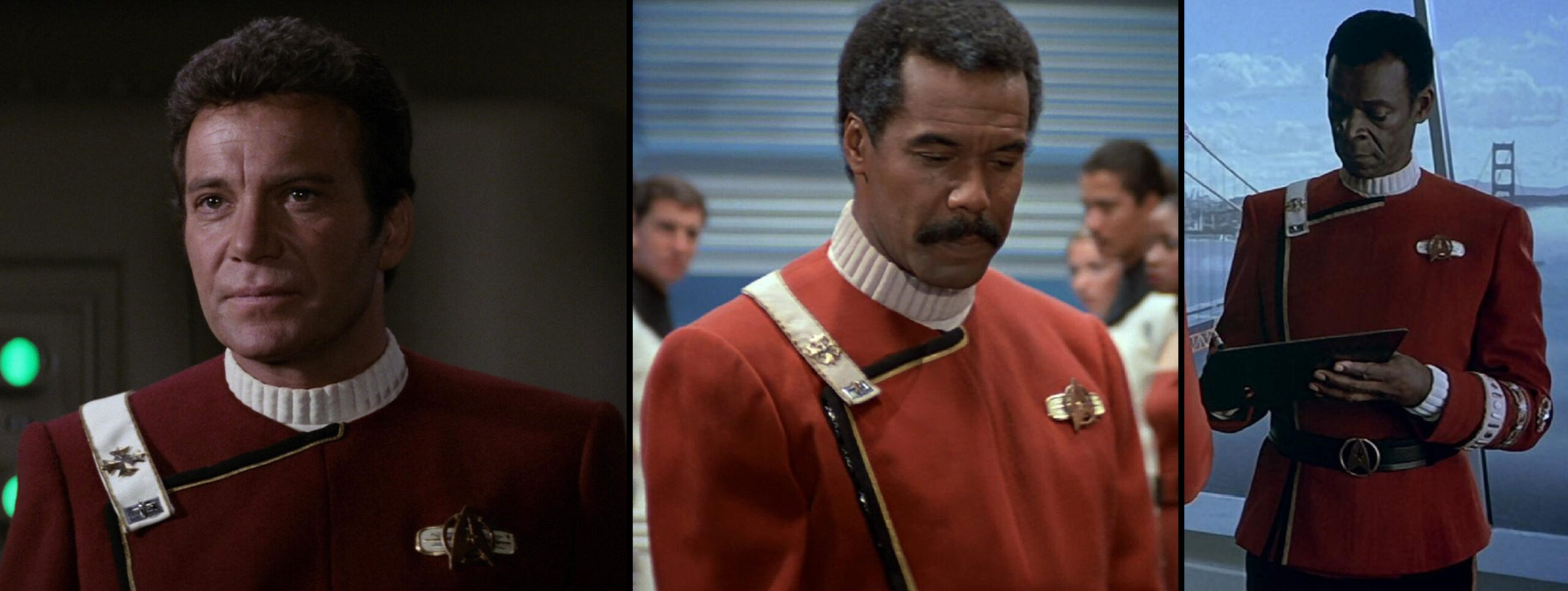
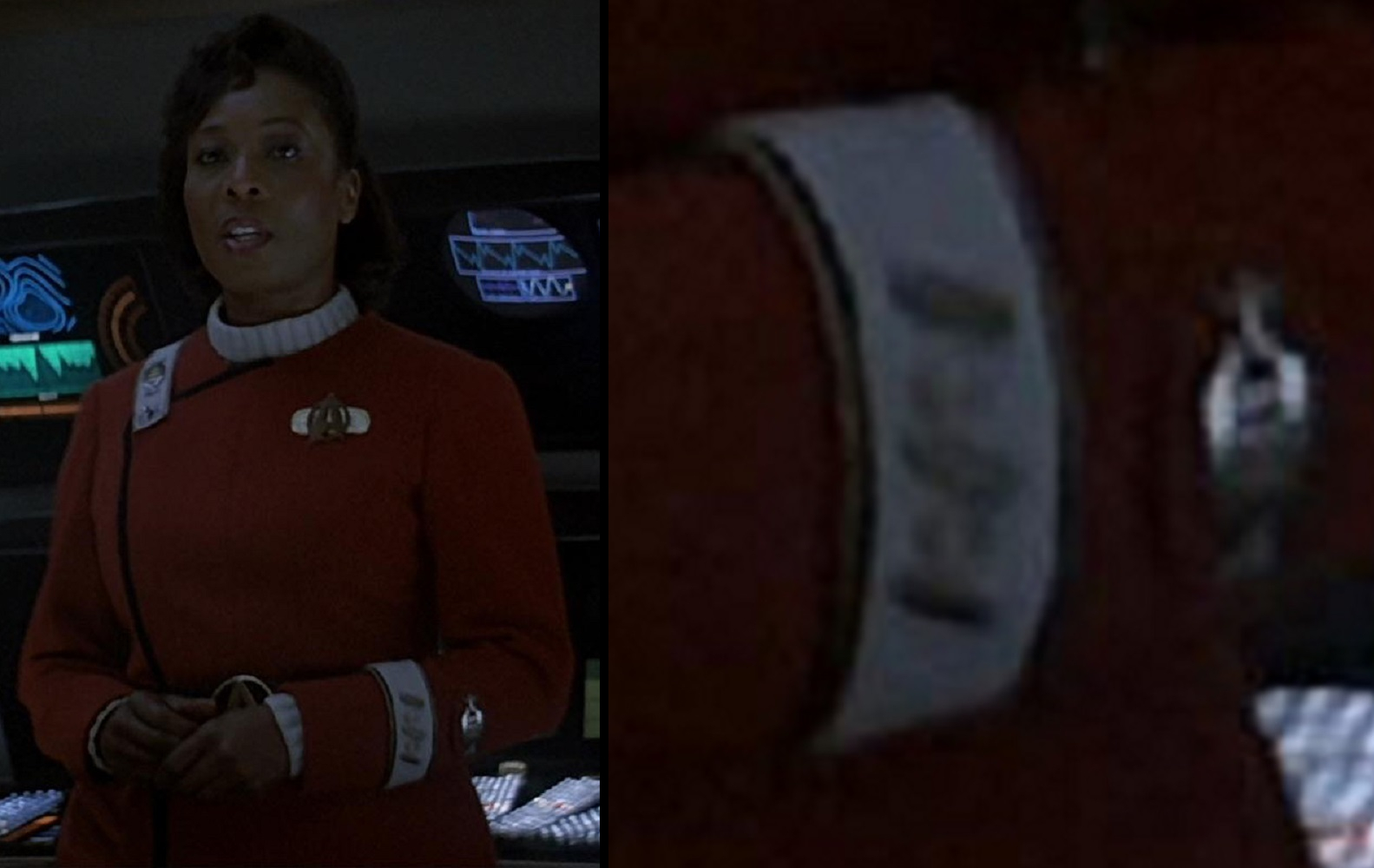
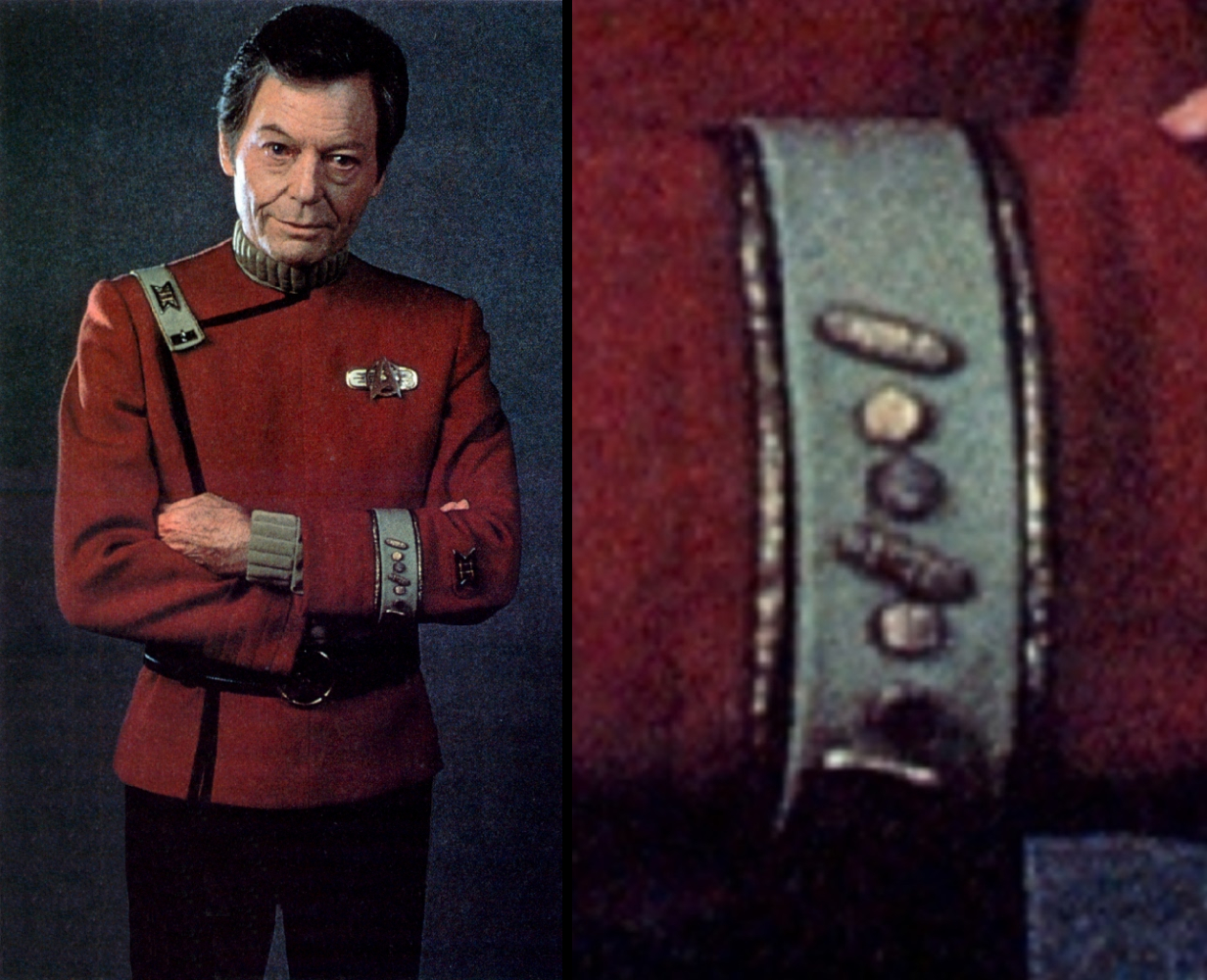
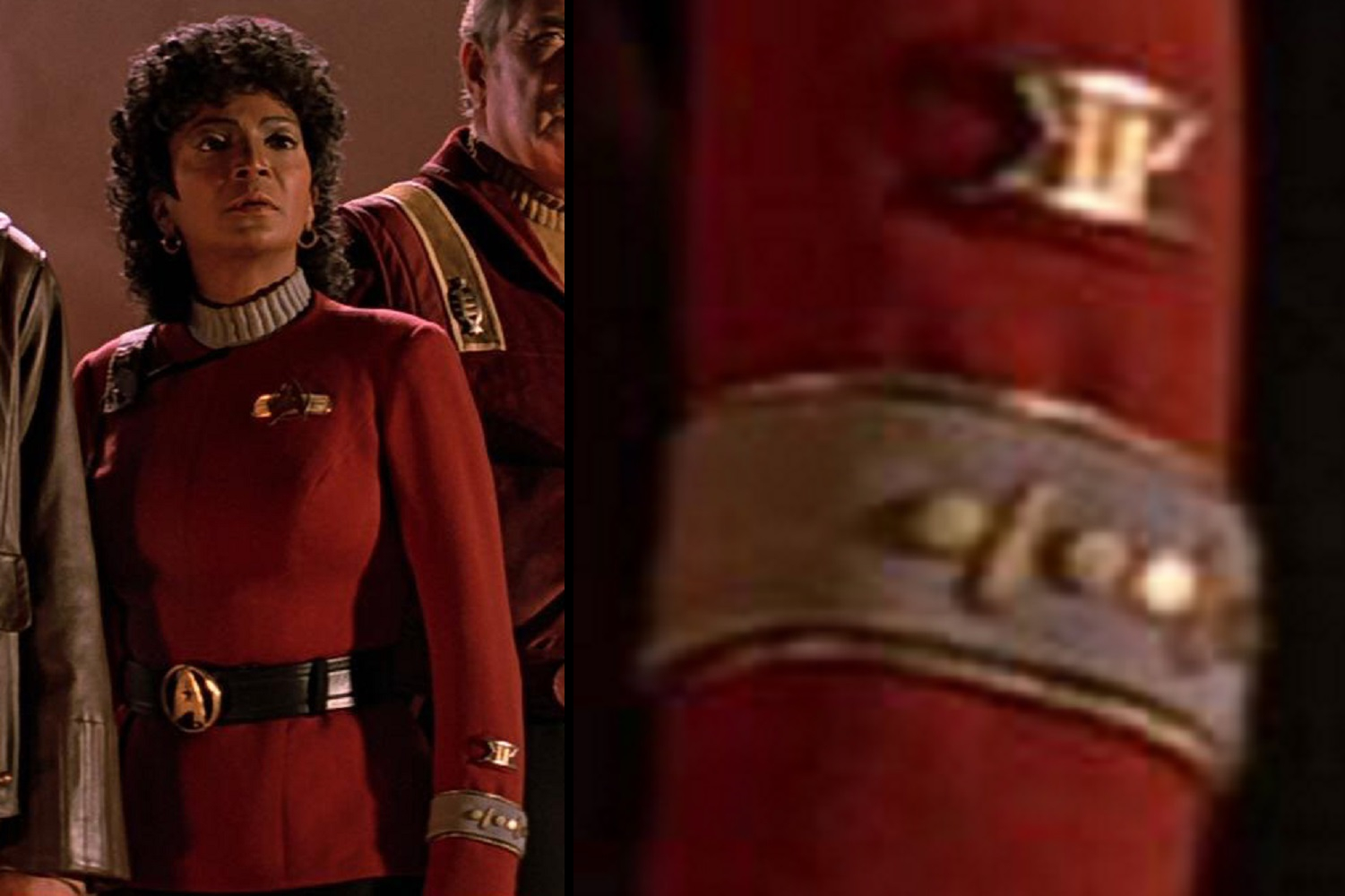
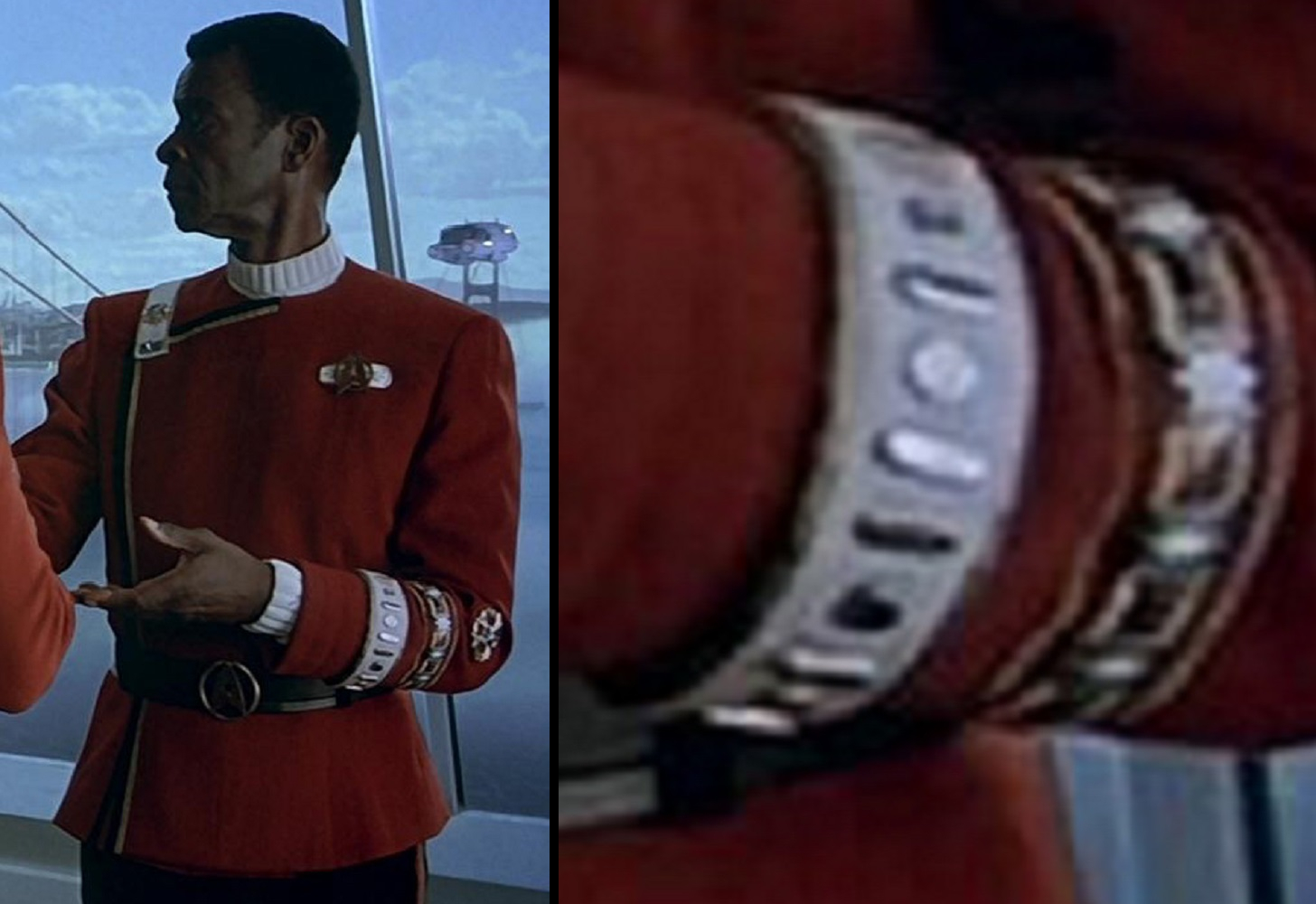
Admiral Kirk, Admiral Morrow, and the Saratoga captain alternated theirs:
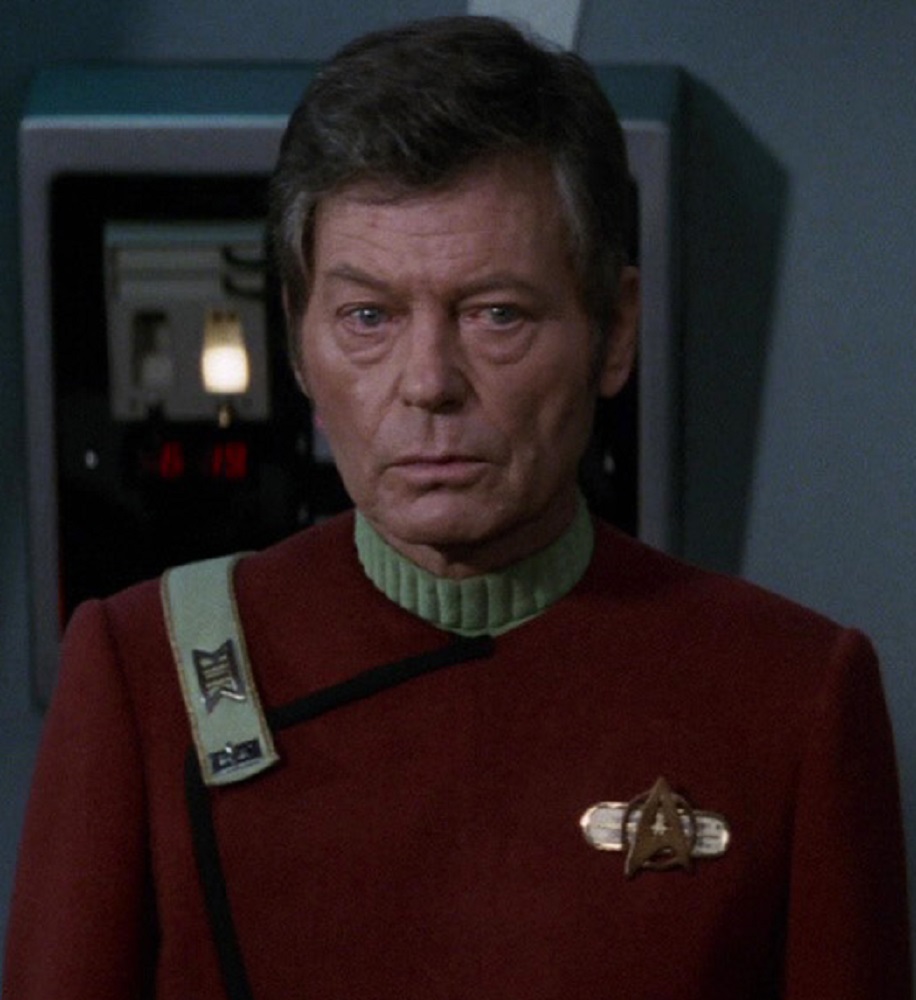
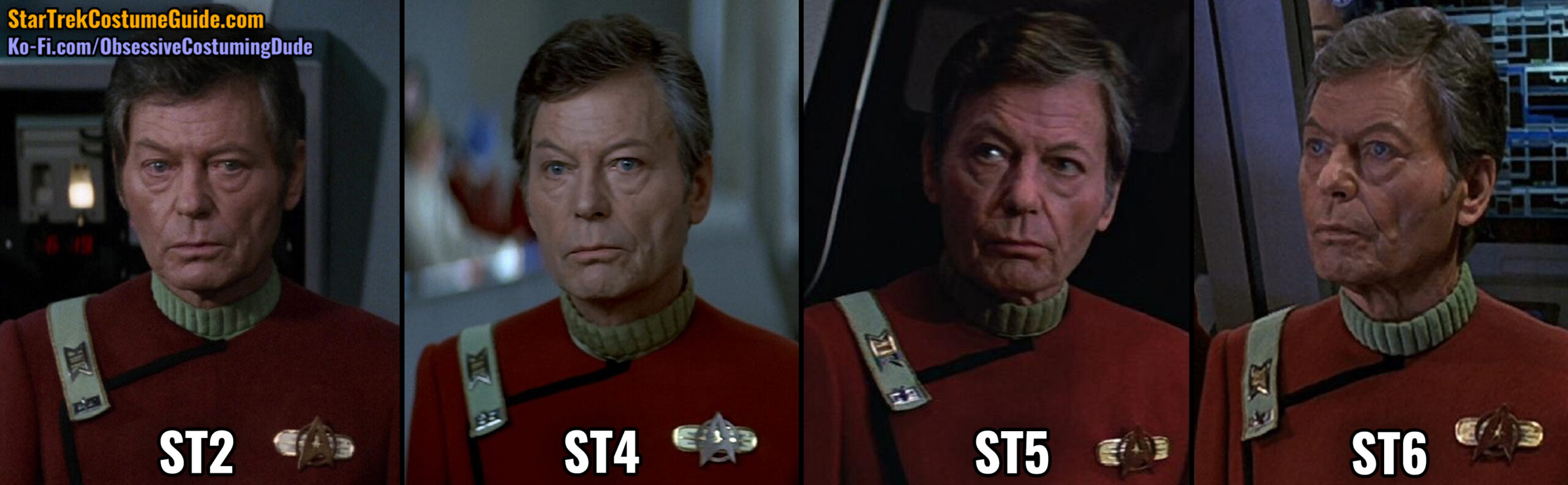
Dr. McCoy, Uhura, and Admiral Cartwright alternated theirs in a different pattern:
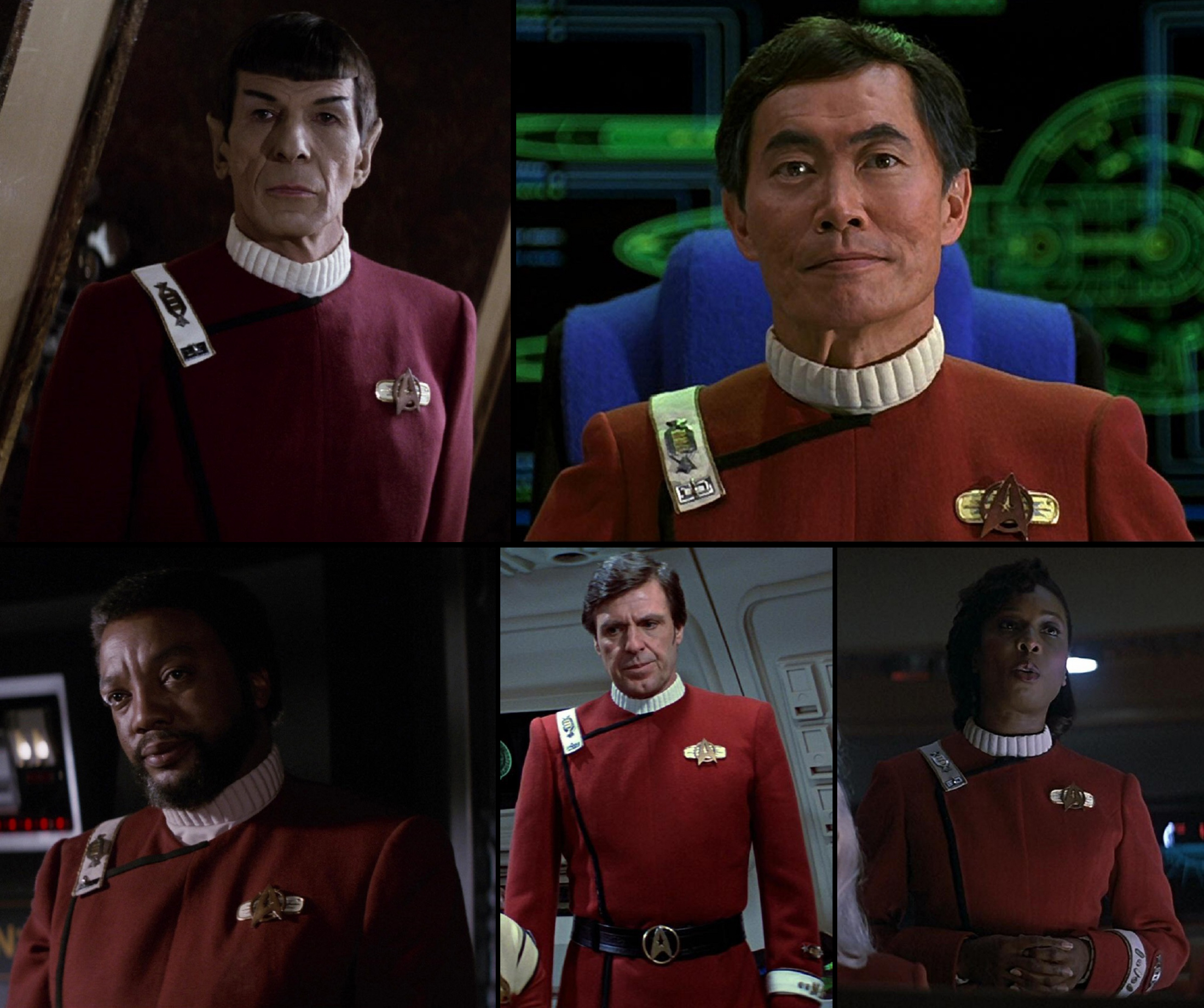
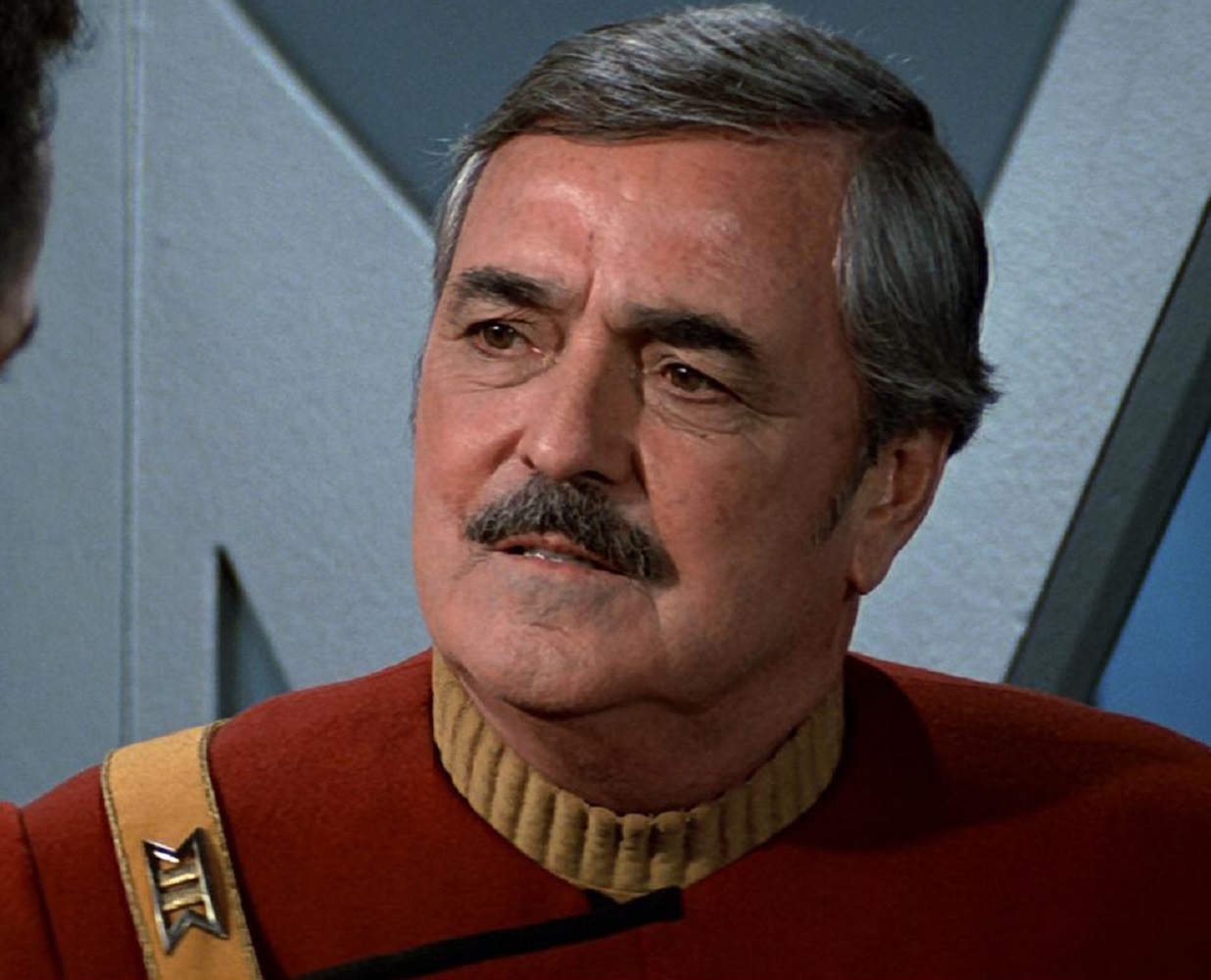
Spock, Scotty, Chekov, and Estaban arranged theirs symmetrically, with the “squeaks” centered and “pips” to the sides:
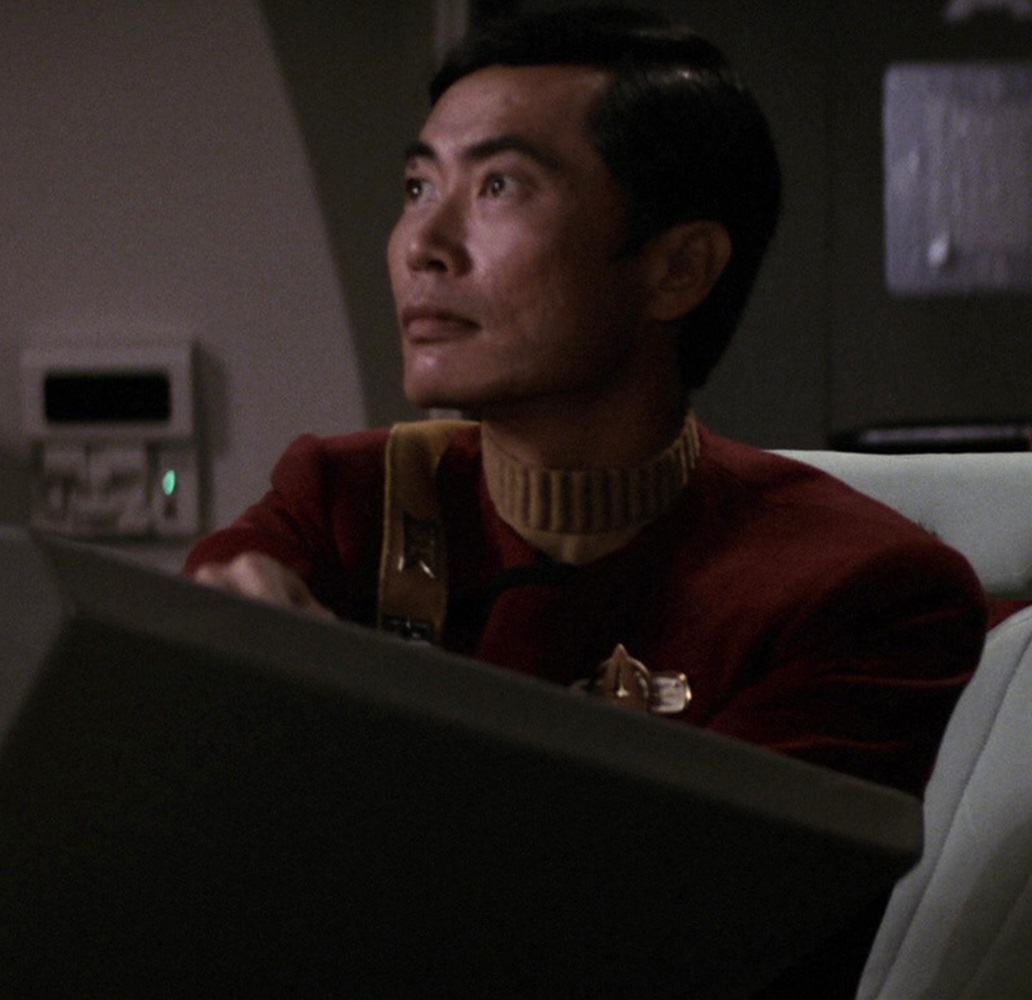
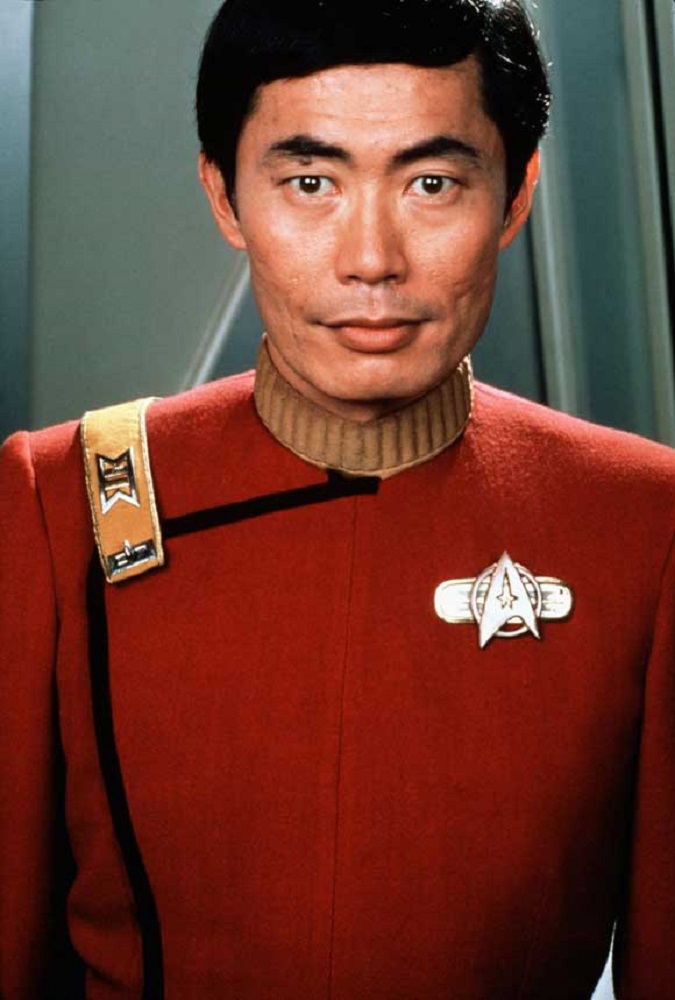
And Sulu arranged his asymmetrically:
OFFICER UNIFORMS (aka "Monster Maroons")
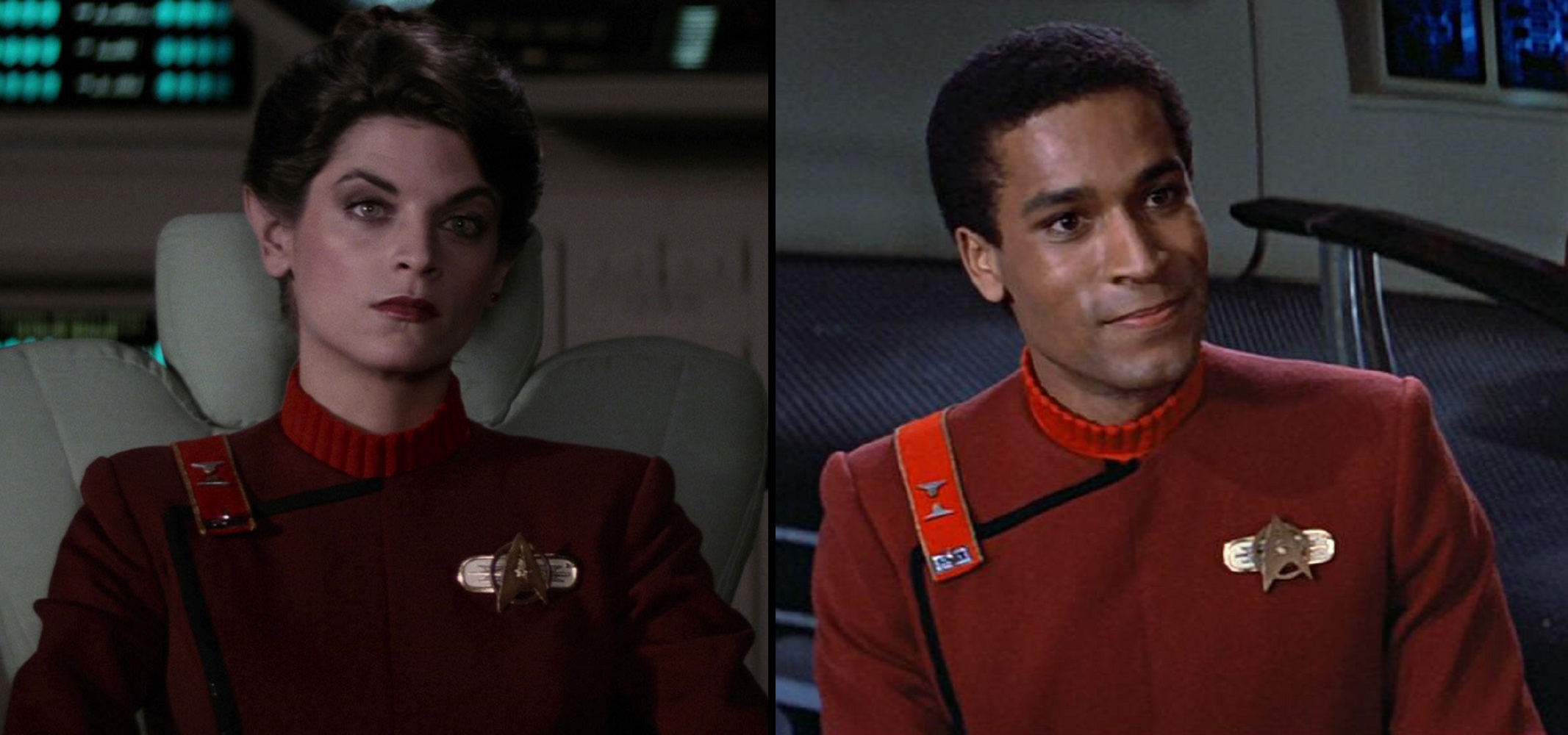
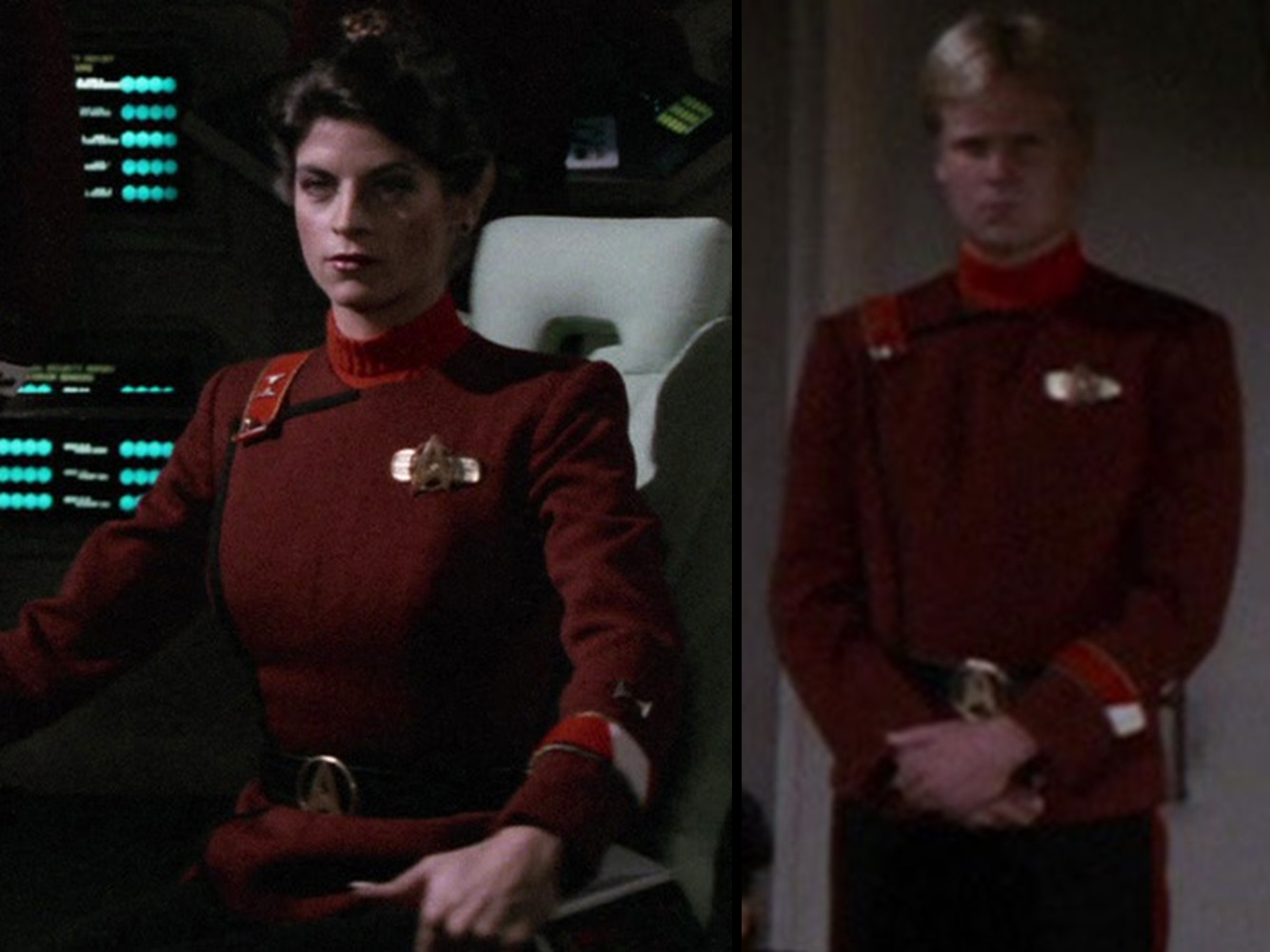
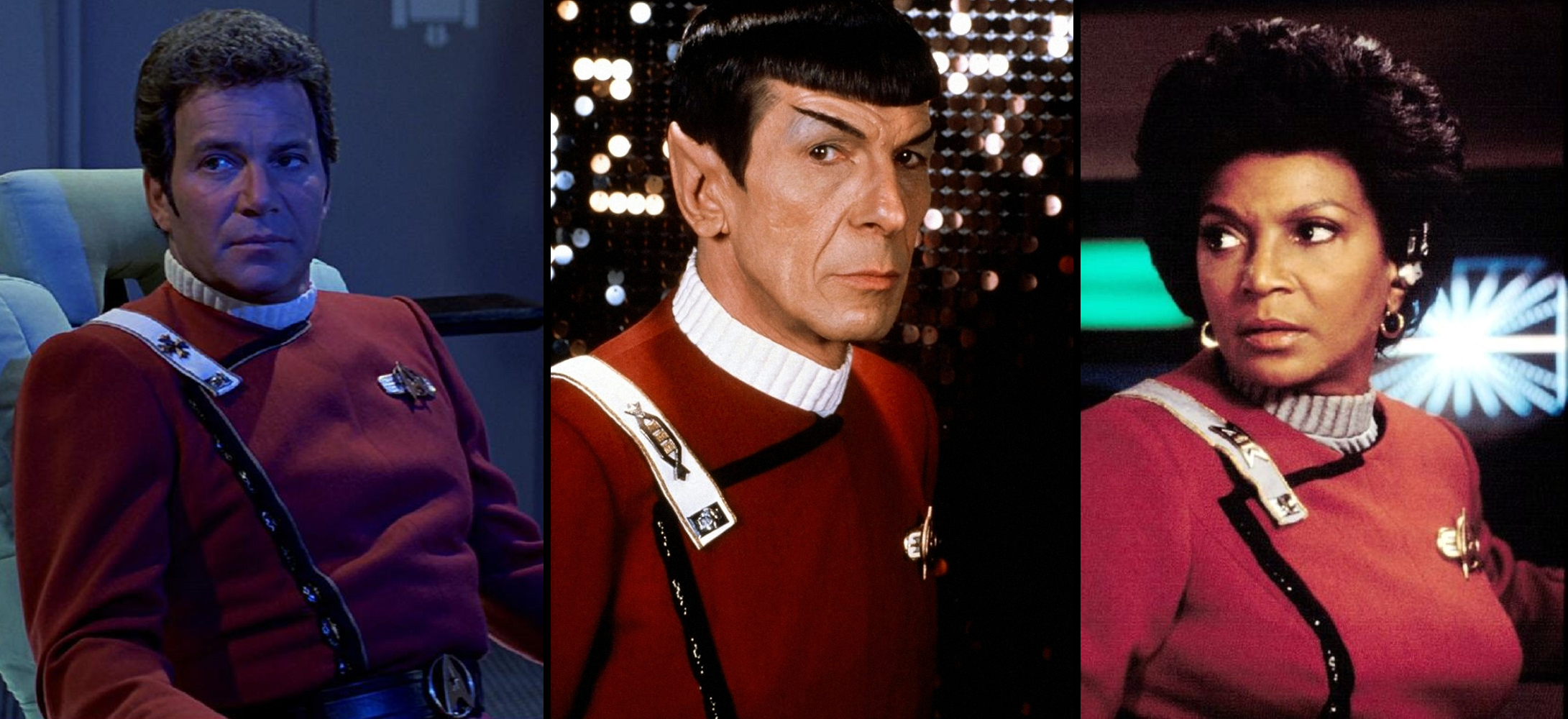
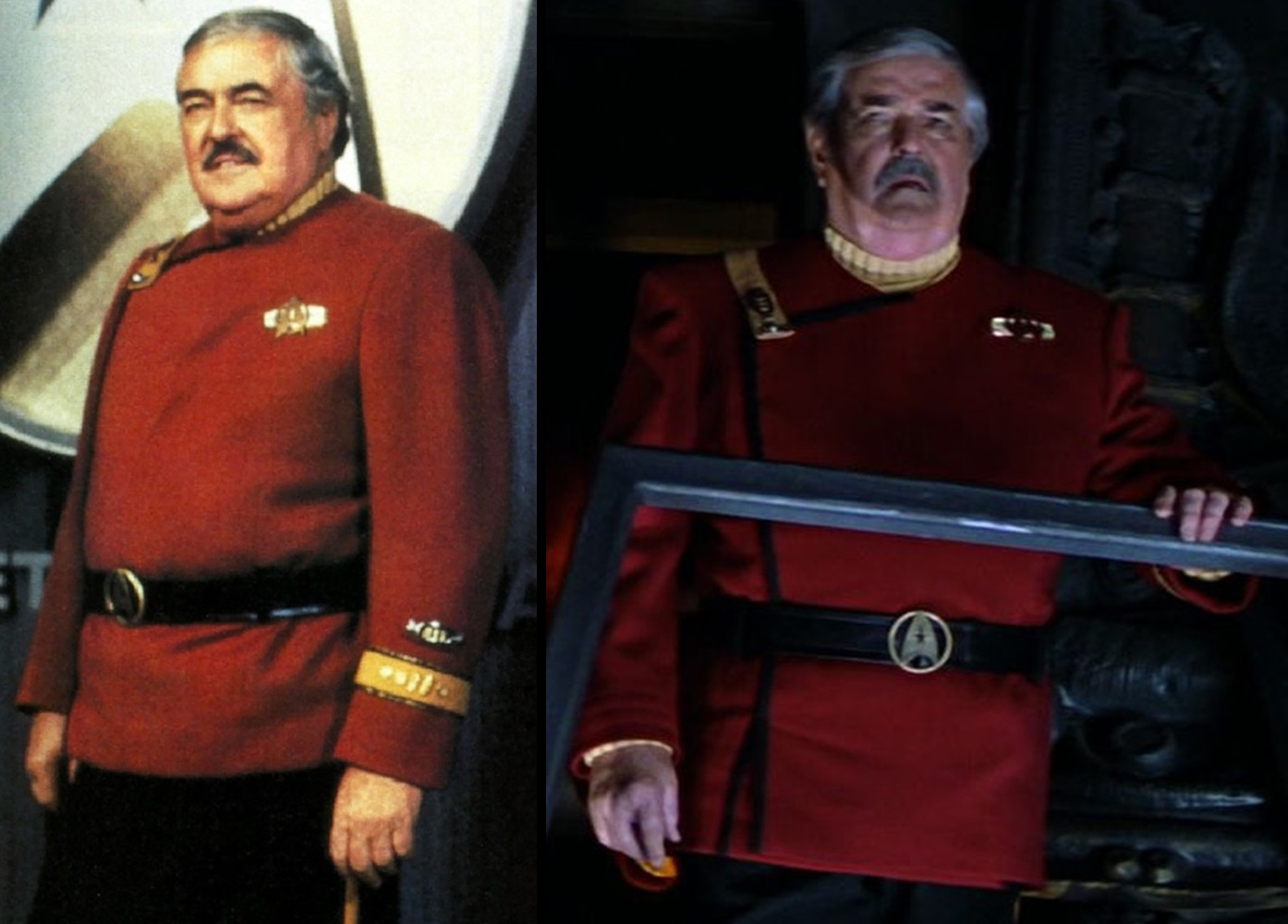
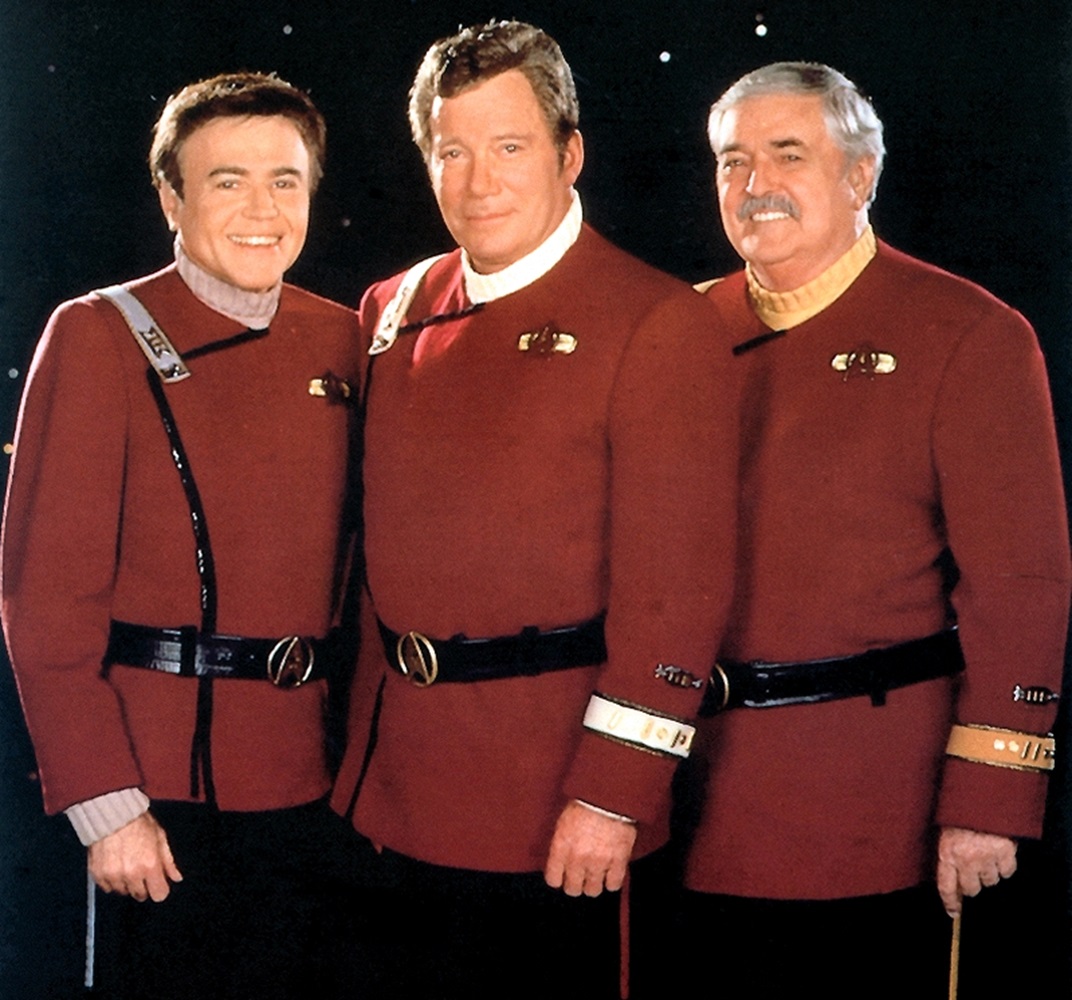
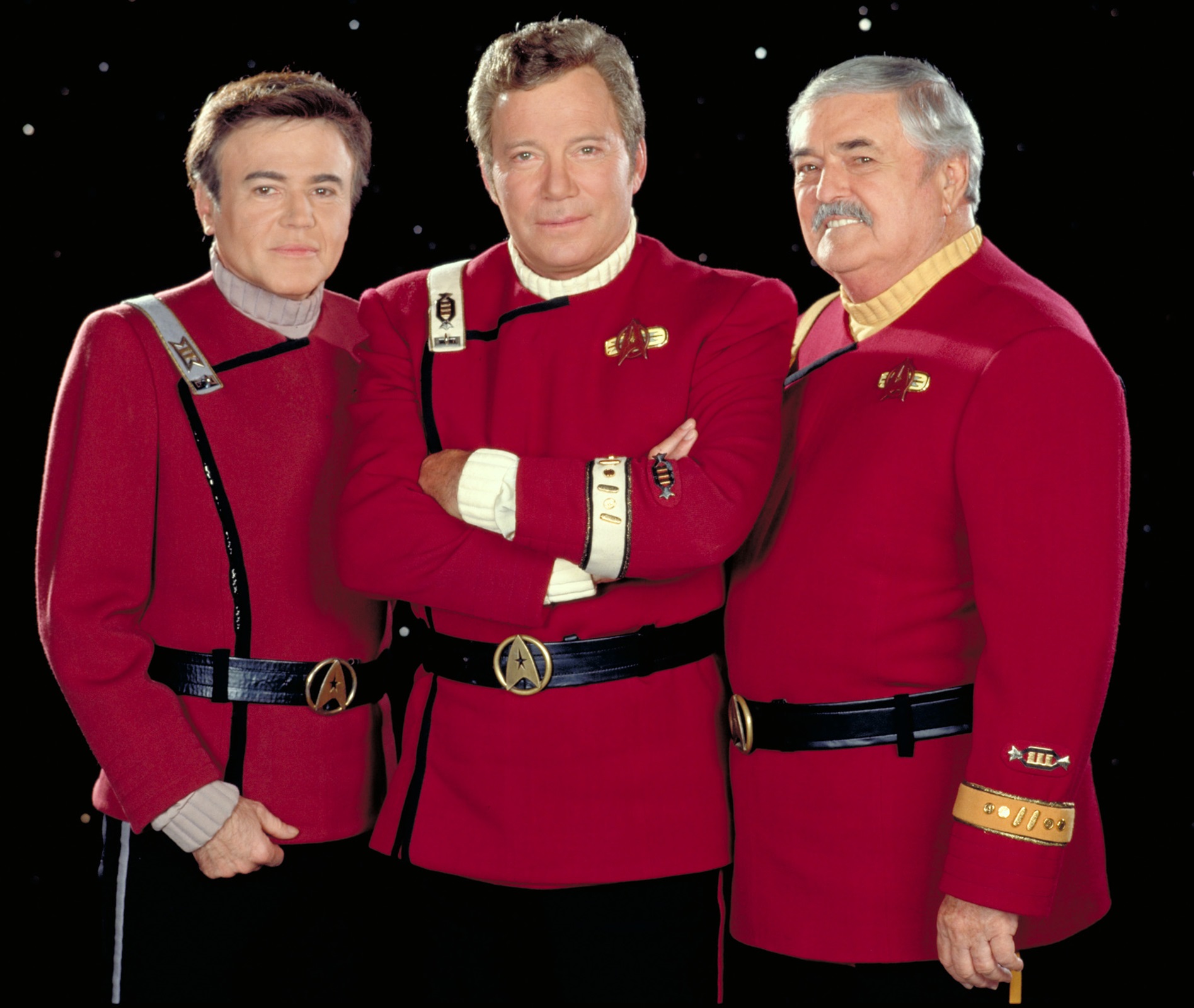
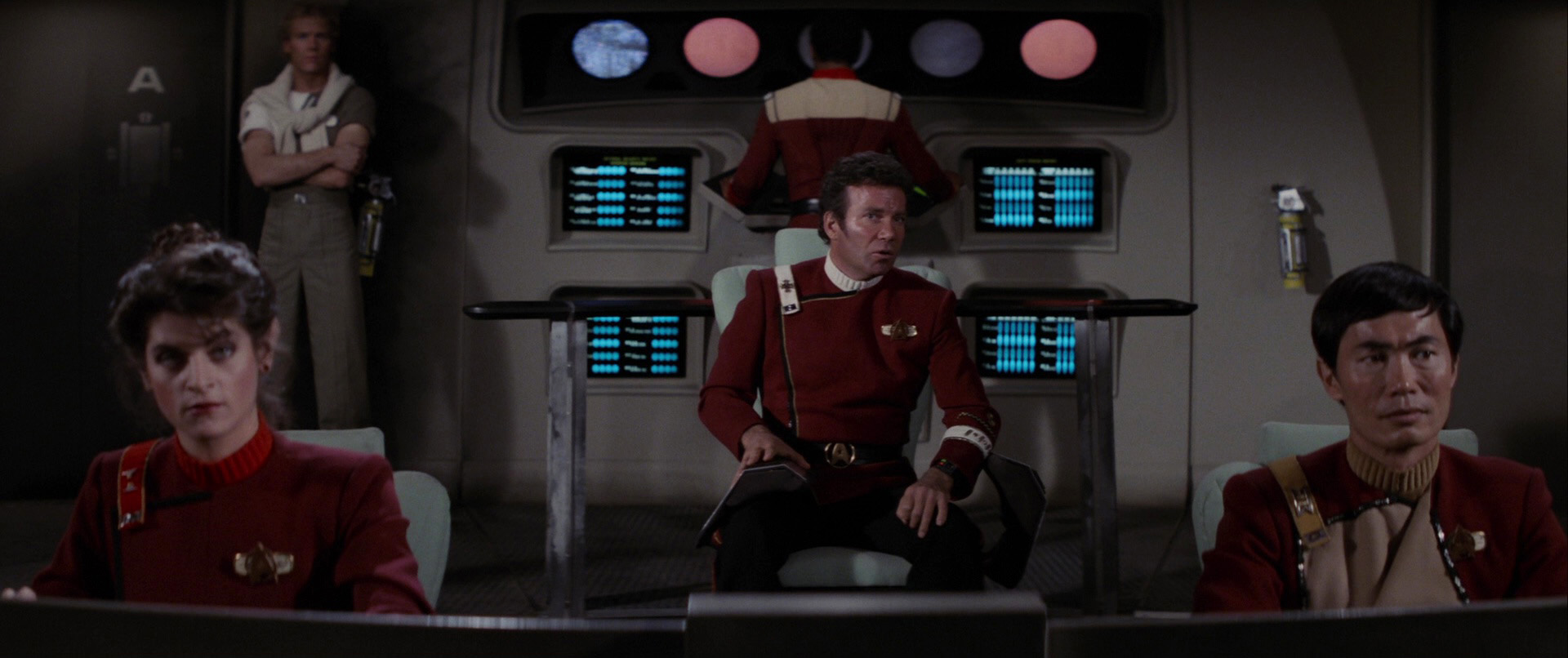
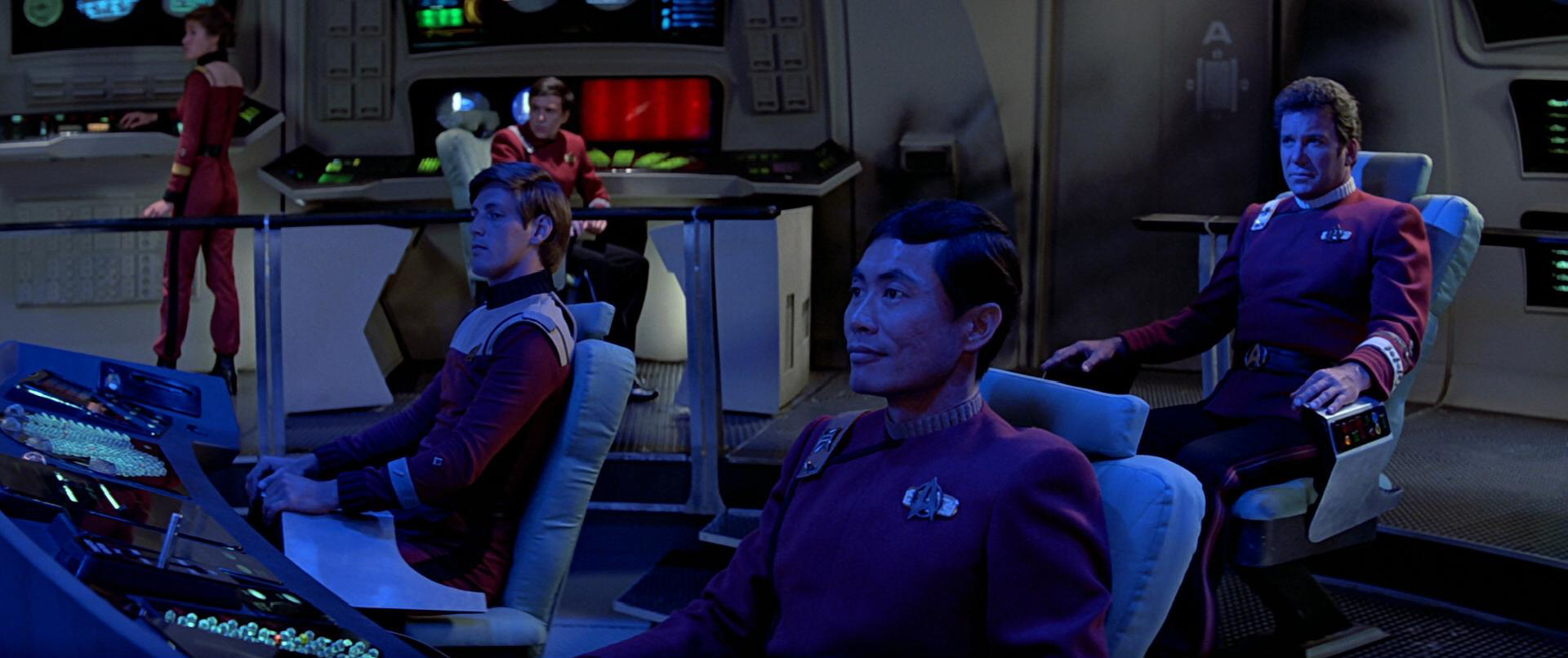
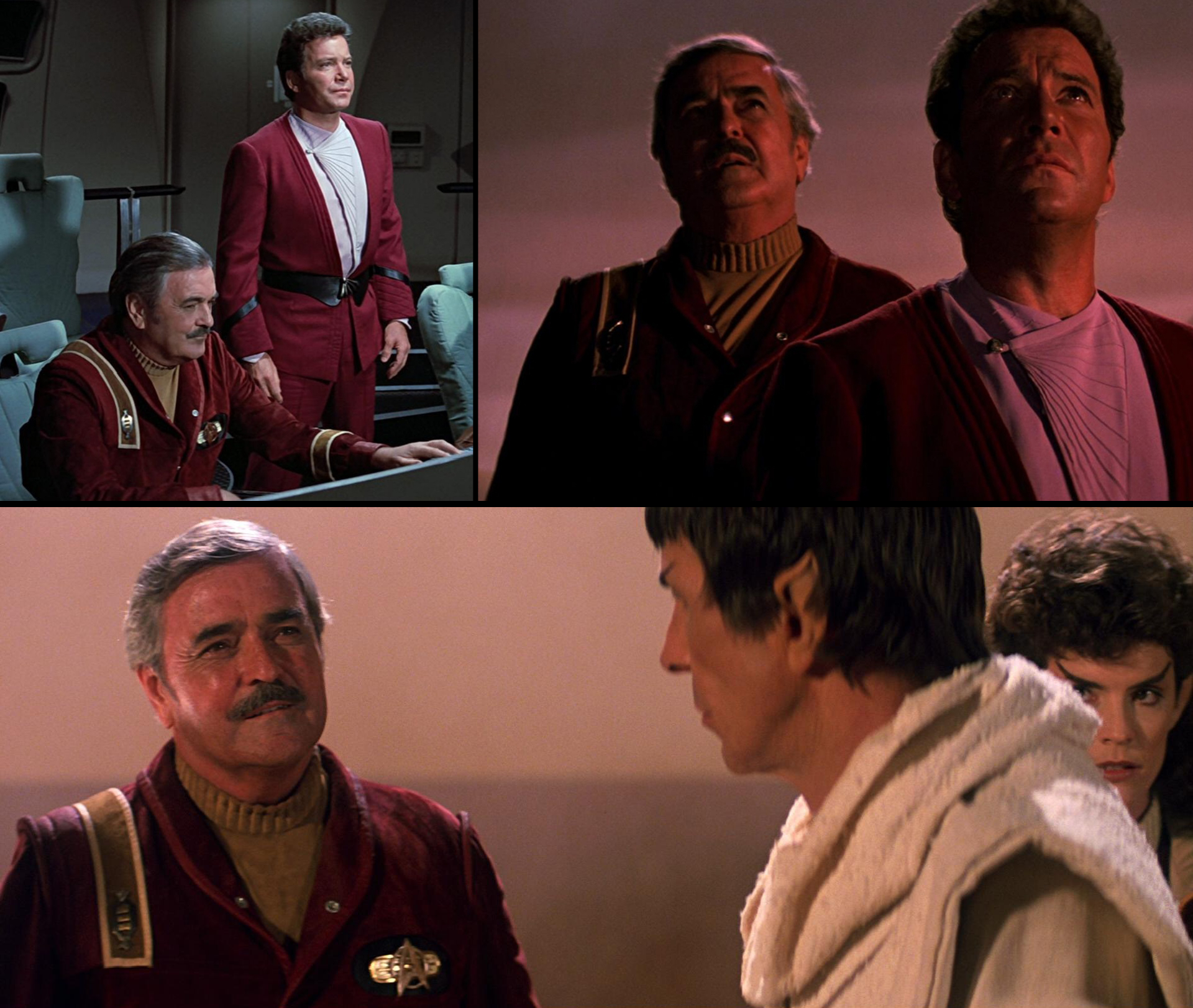
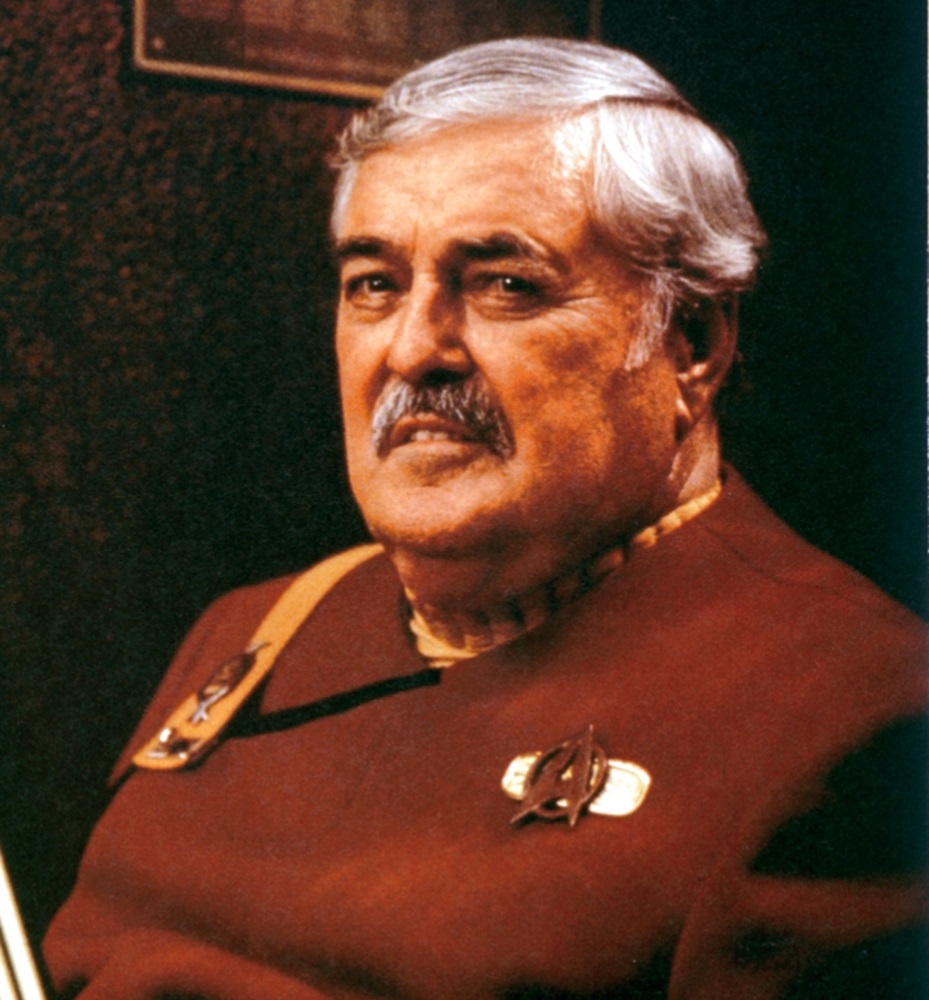
The primary new addition to the uniform lineup was for the main cast, which by default became the commissioned officer’s uniforms.
These were also worn by cadets.
Compared to many of the other movie-era uniforms, there were relatively few of these made, but they had such a strong presence (and were so darn cool) that they became fan-favorites, often referred to as the “monster maroons.”
Obviously these uniforms deserve their own “deep dive,” which I would love to do … but our purpose here is to take a broader view at how they fit into the larger whole.
Influences
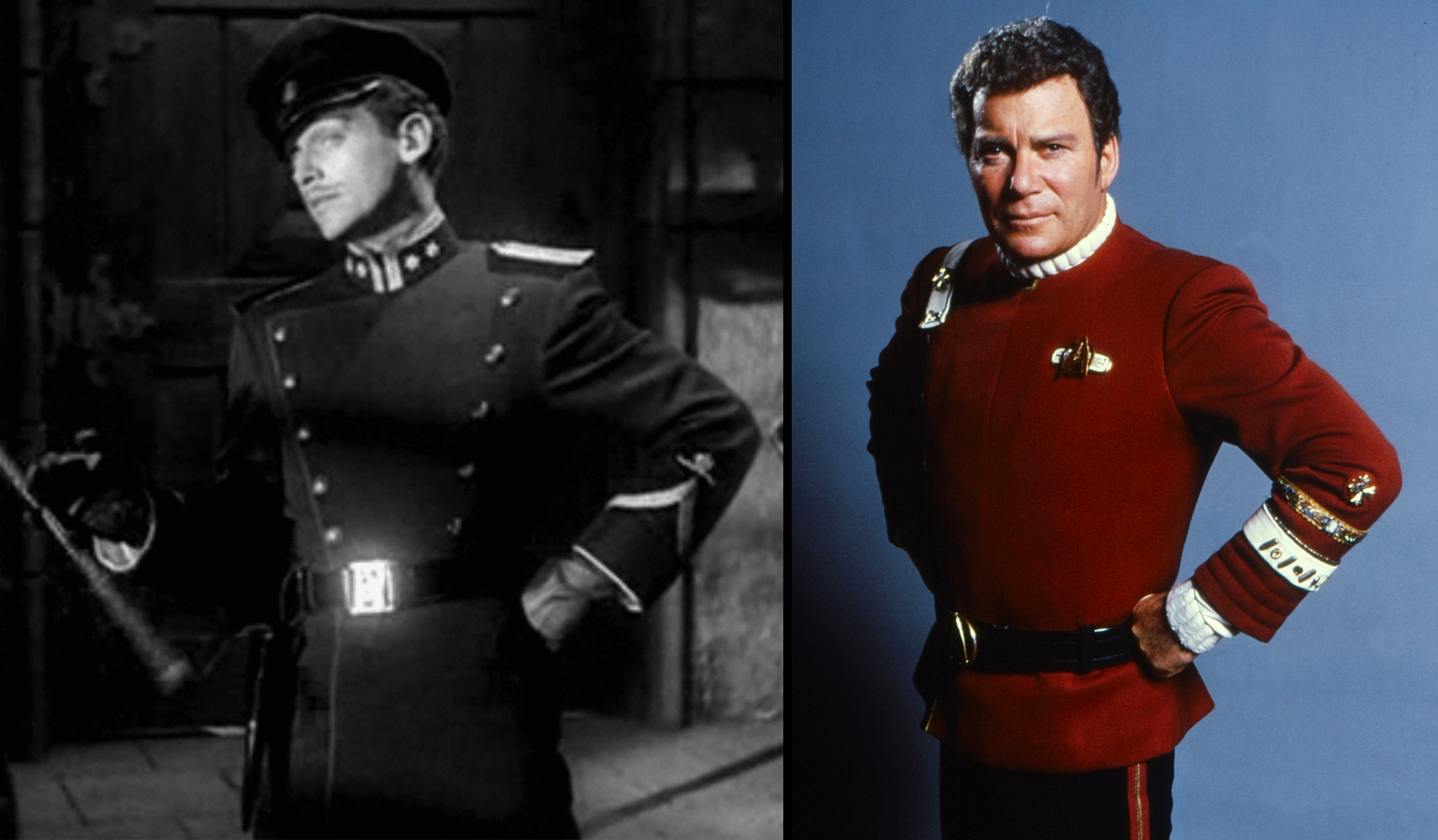
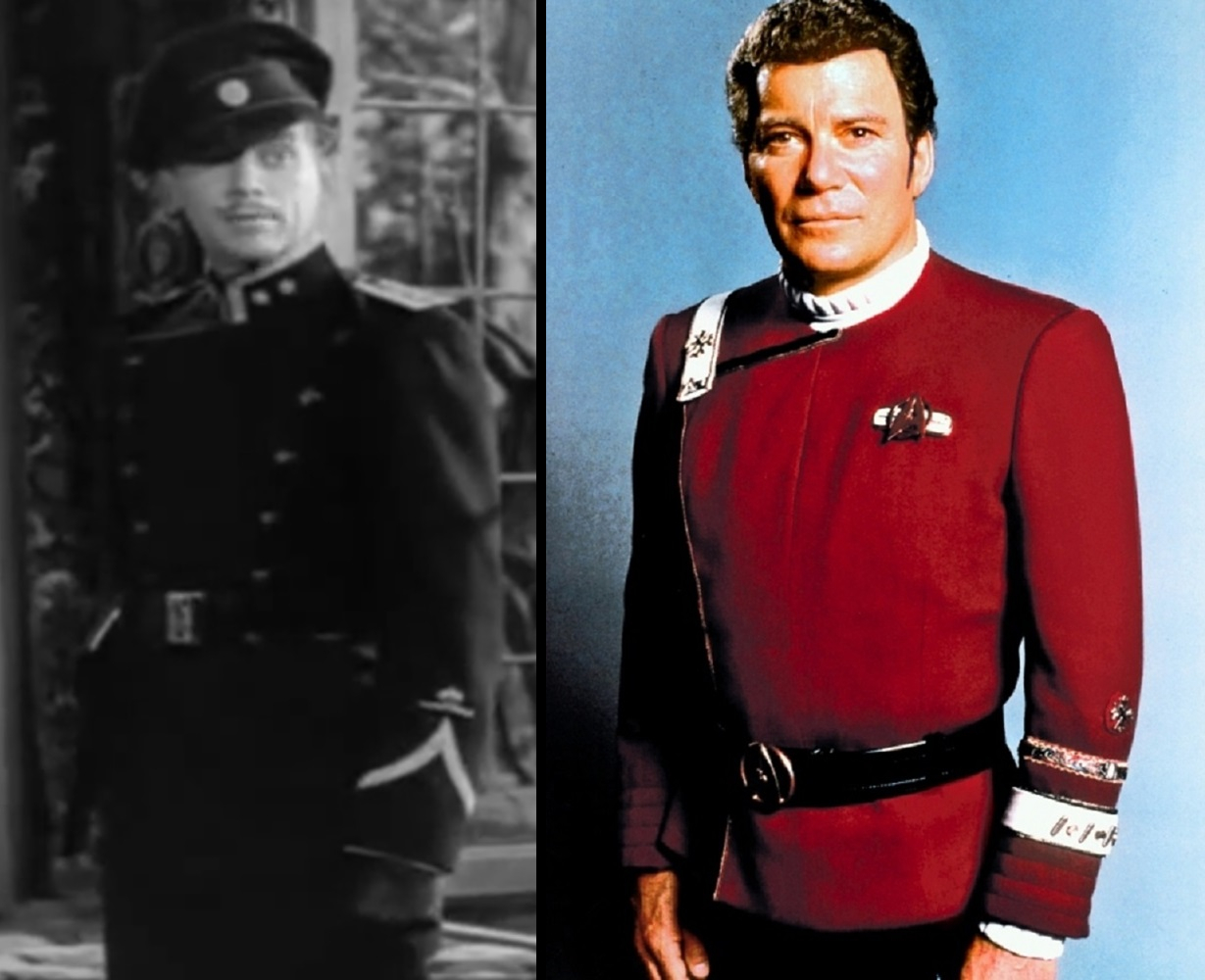
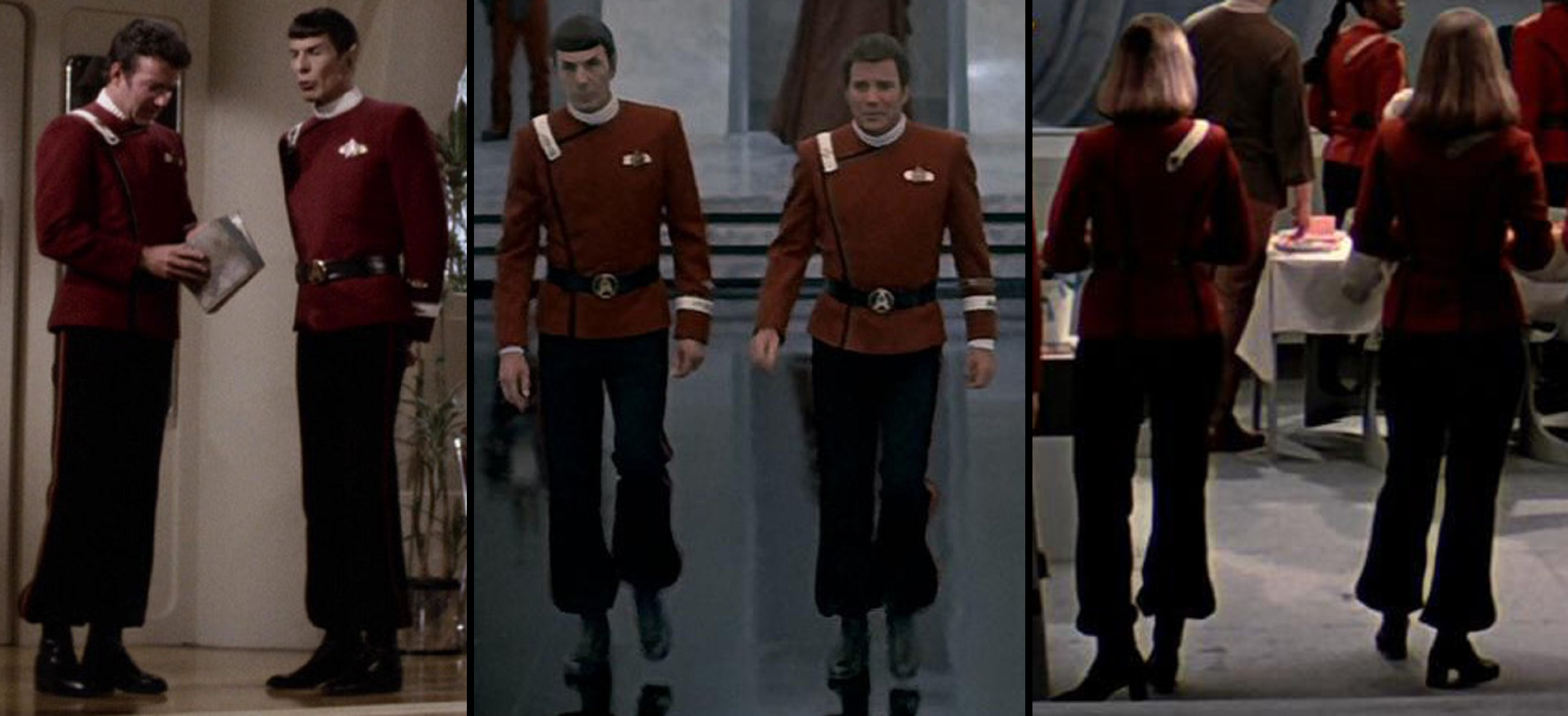
It’s with these uniforms that the aforementioned influences are most apparent.
The Prisoner of Zenda, for example:
And of course, Captain Hornblower:
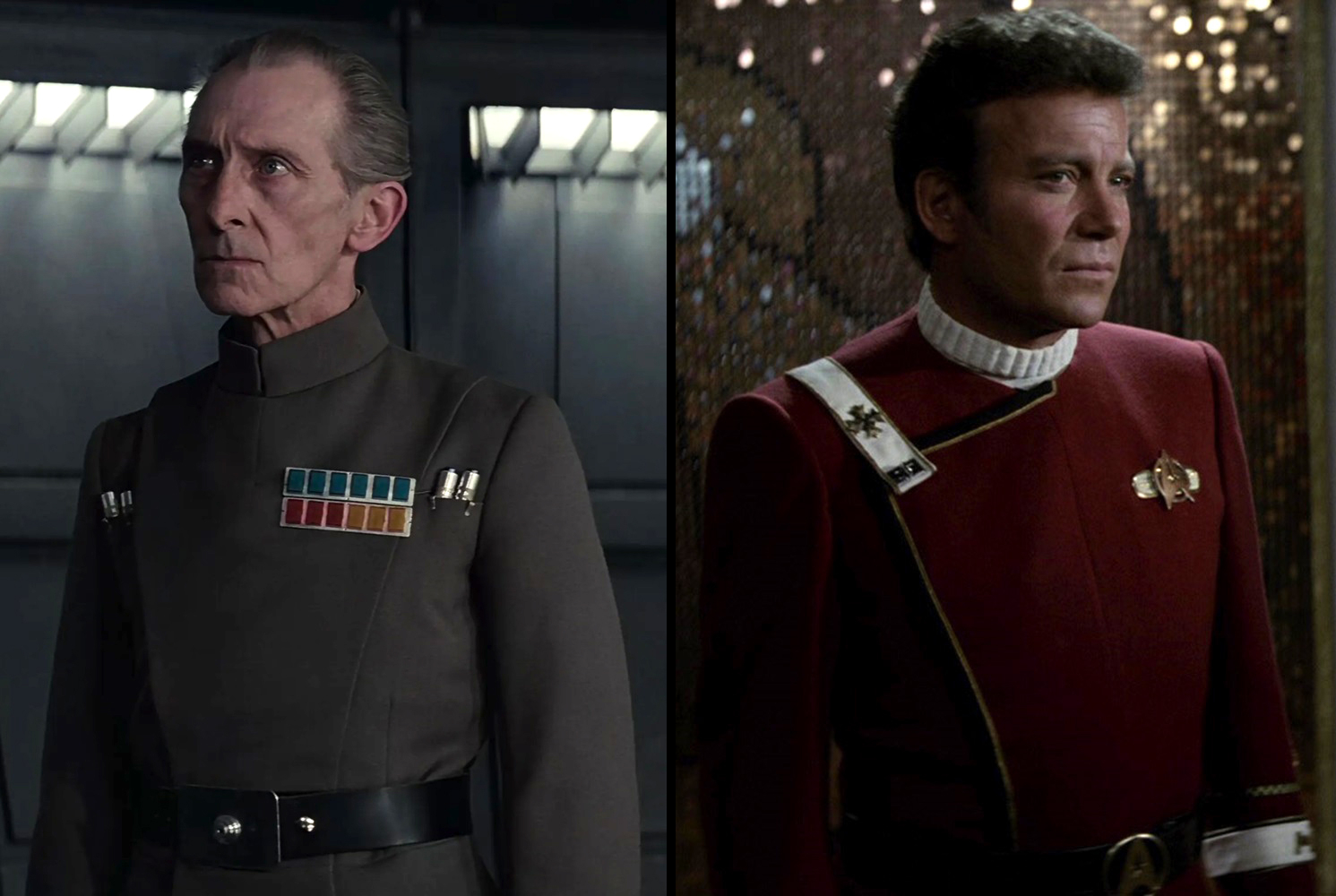
I daresay the Star Wars movies may have been somewhat influential as well:
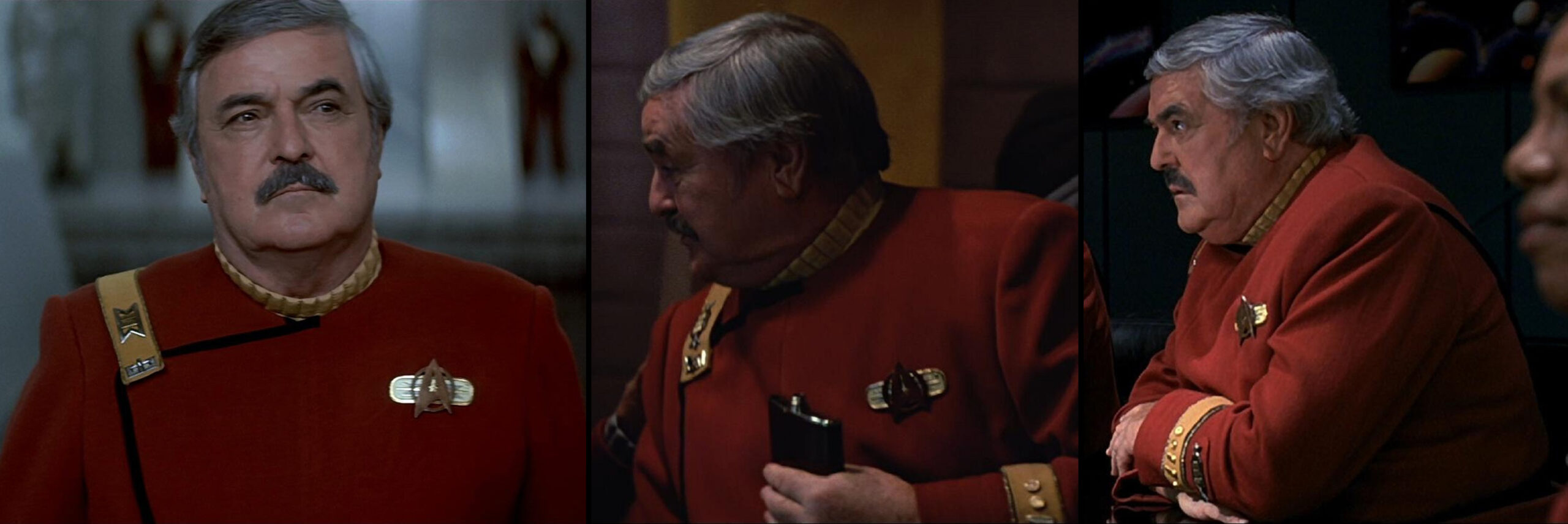
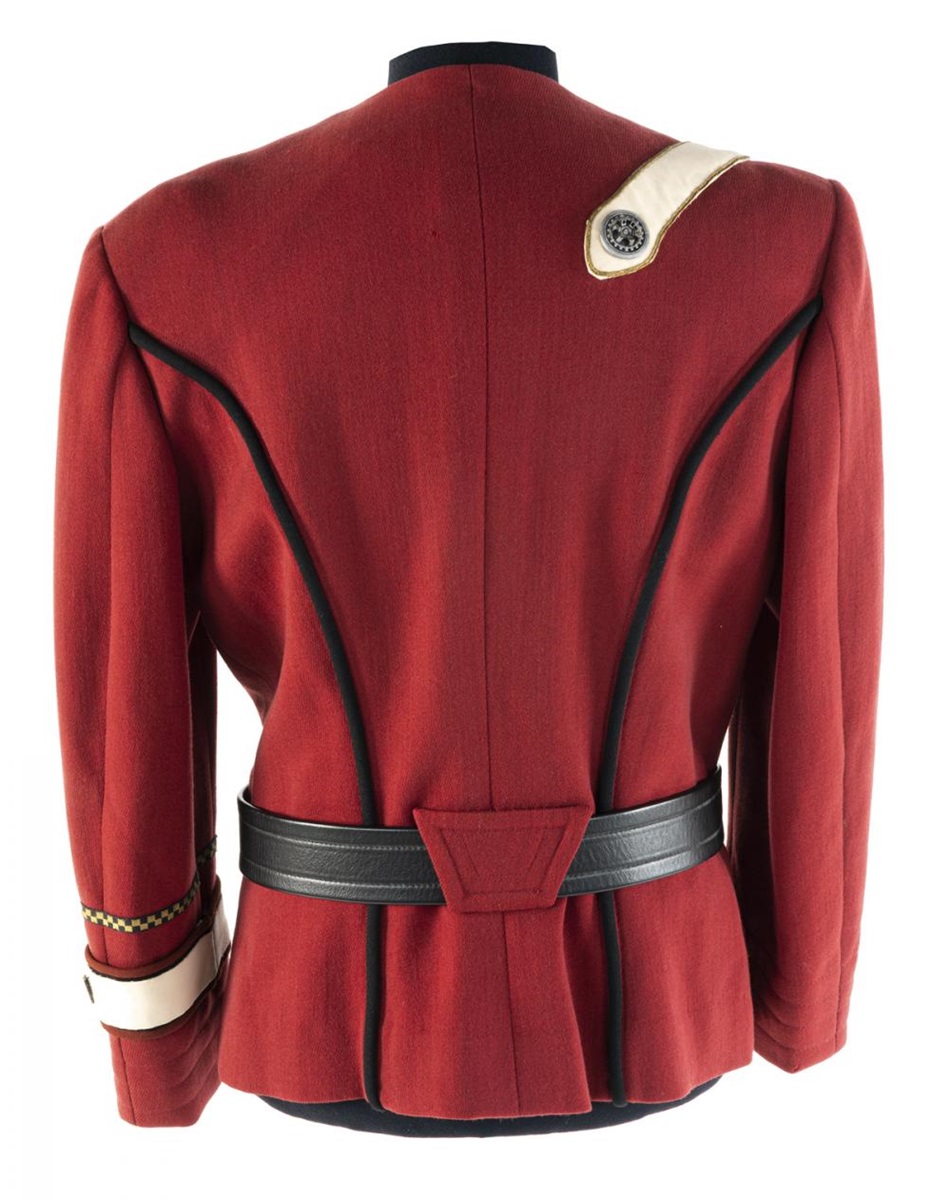
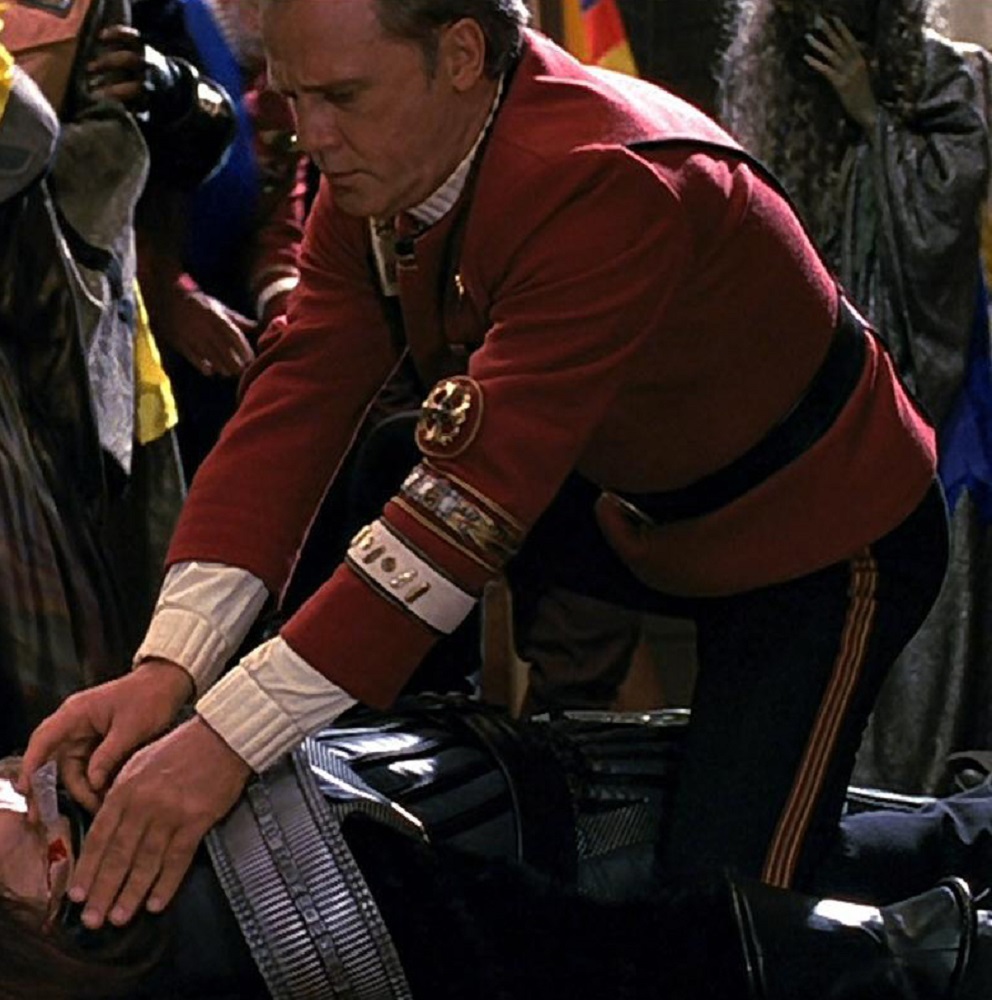
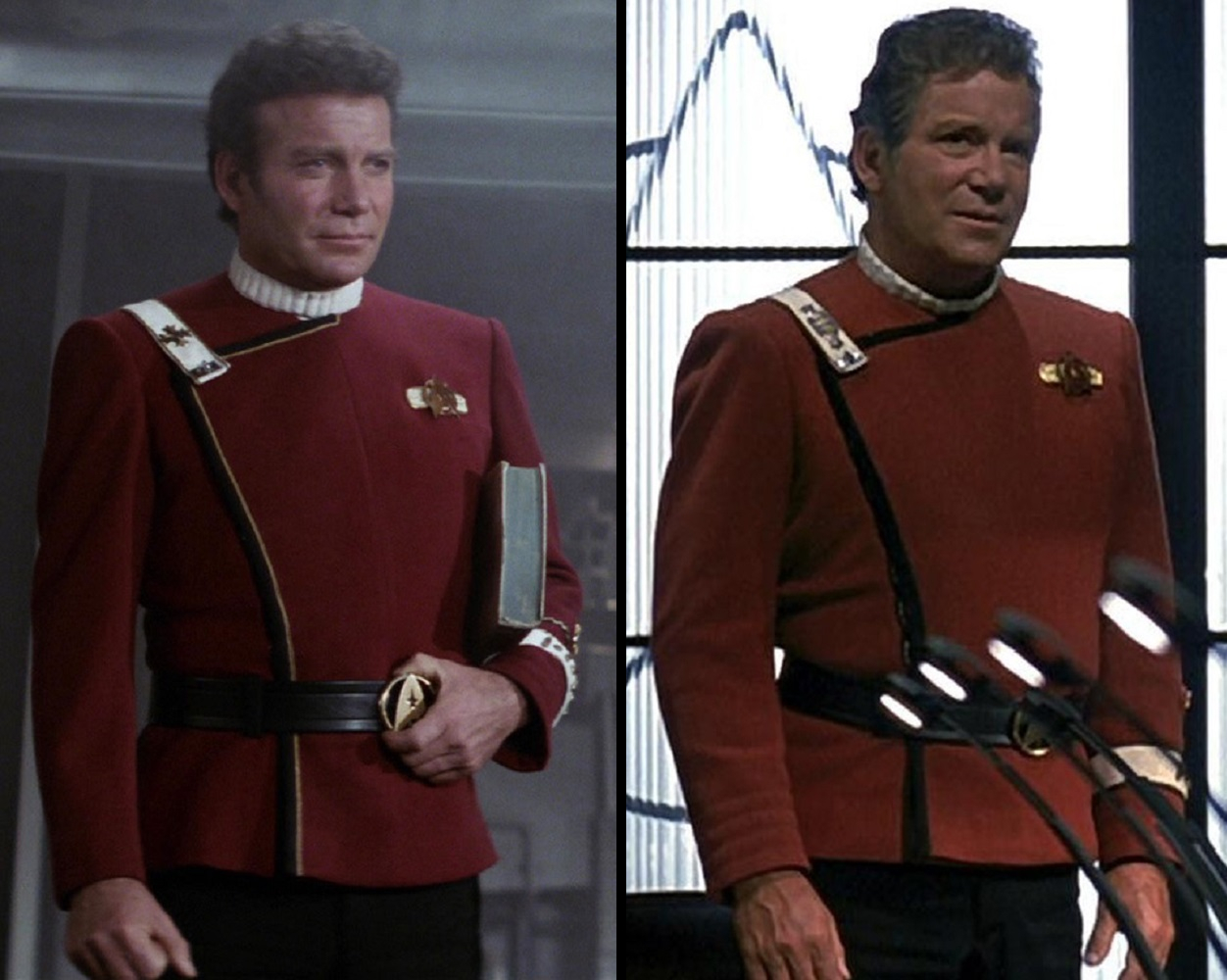
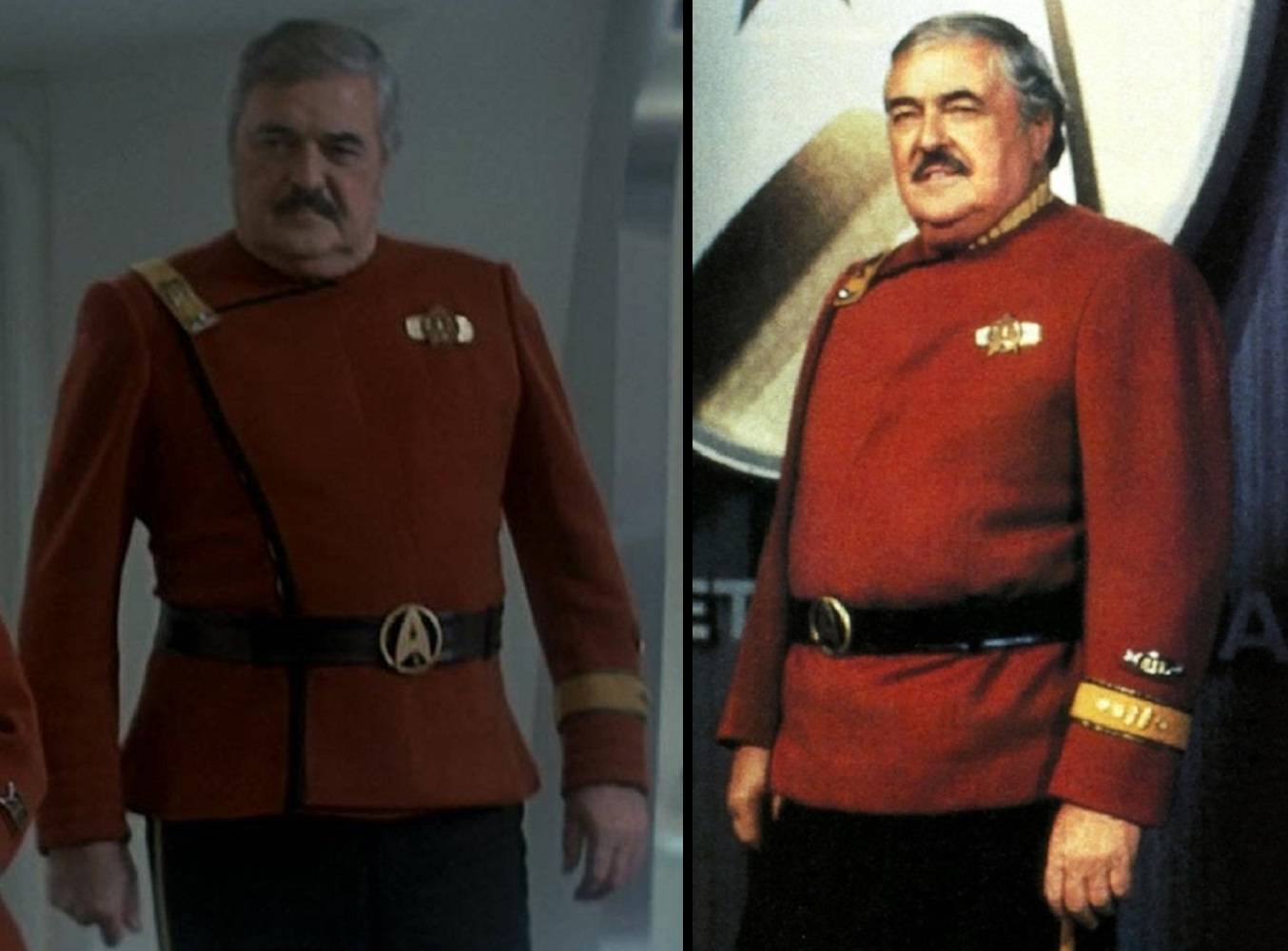
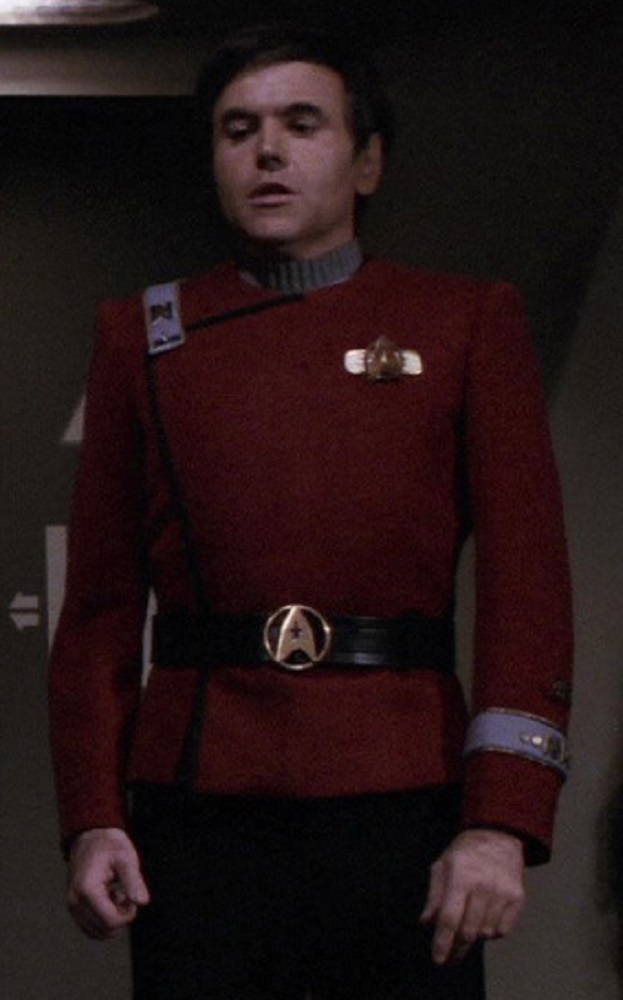
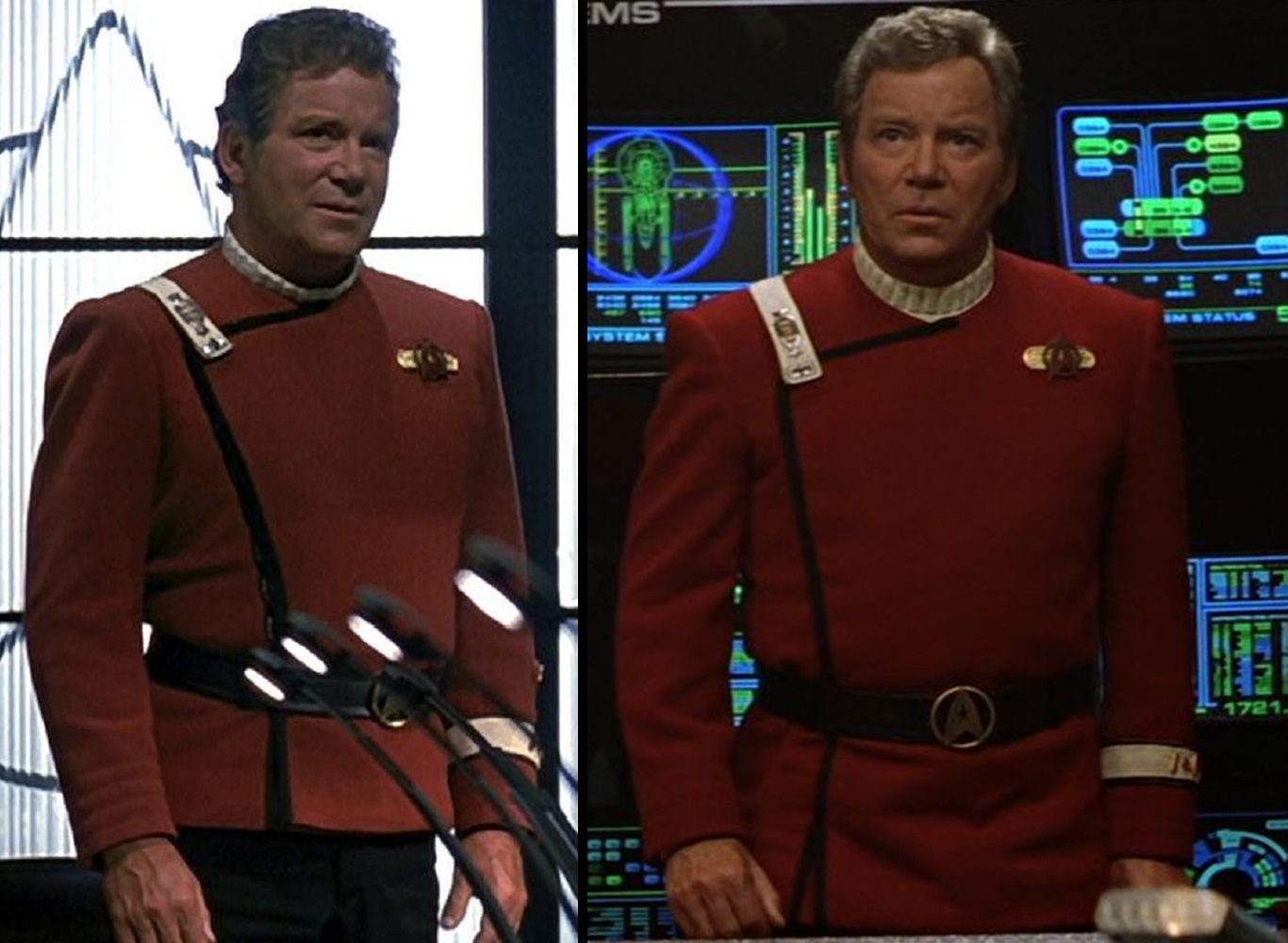
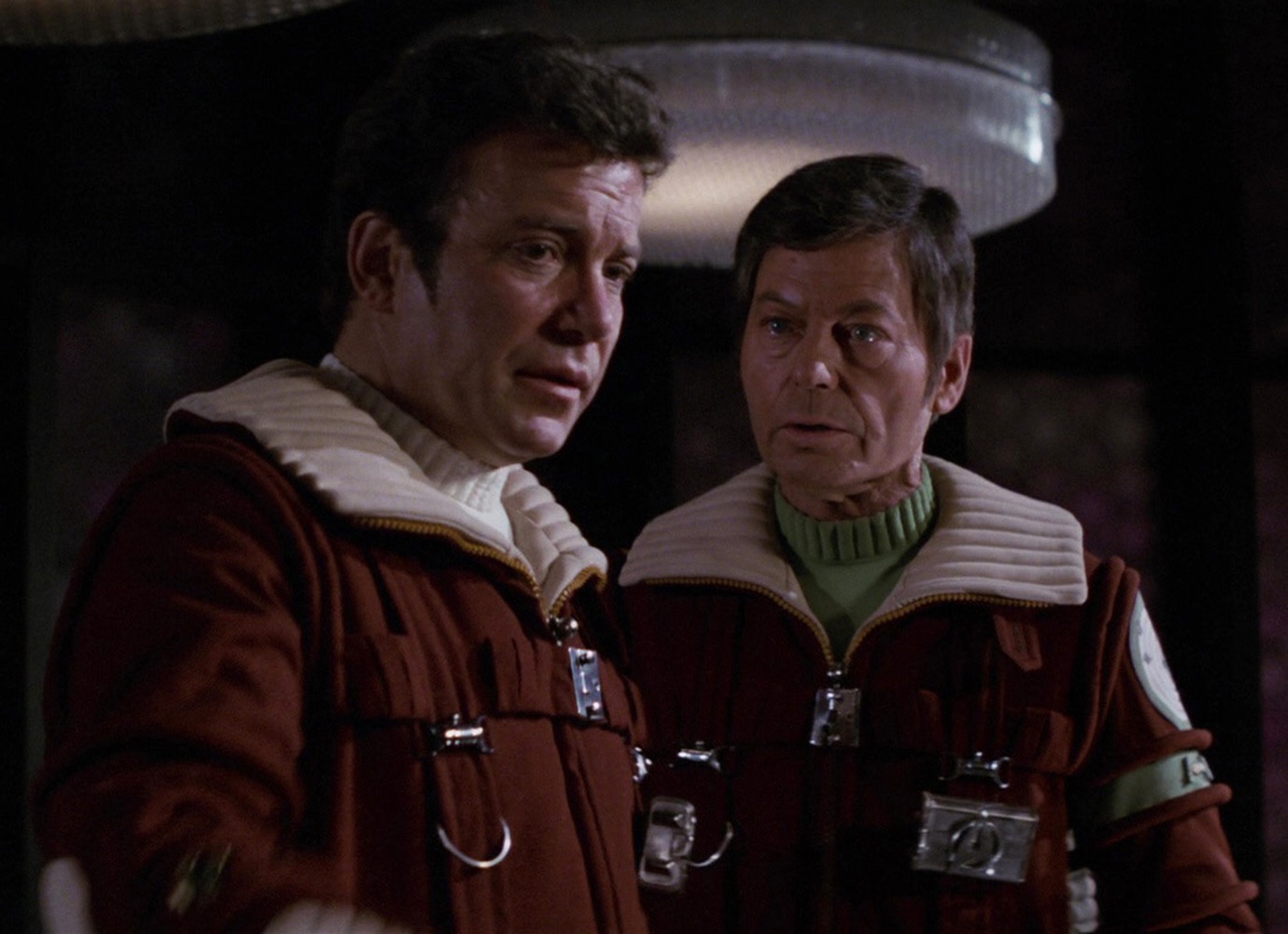
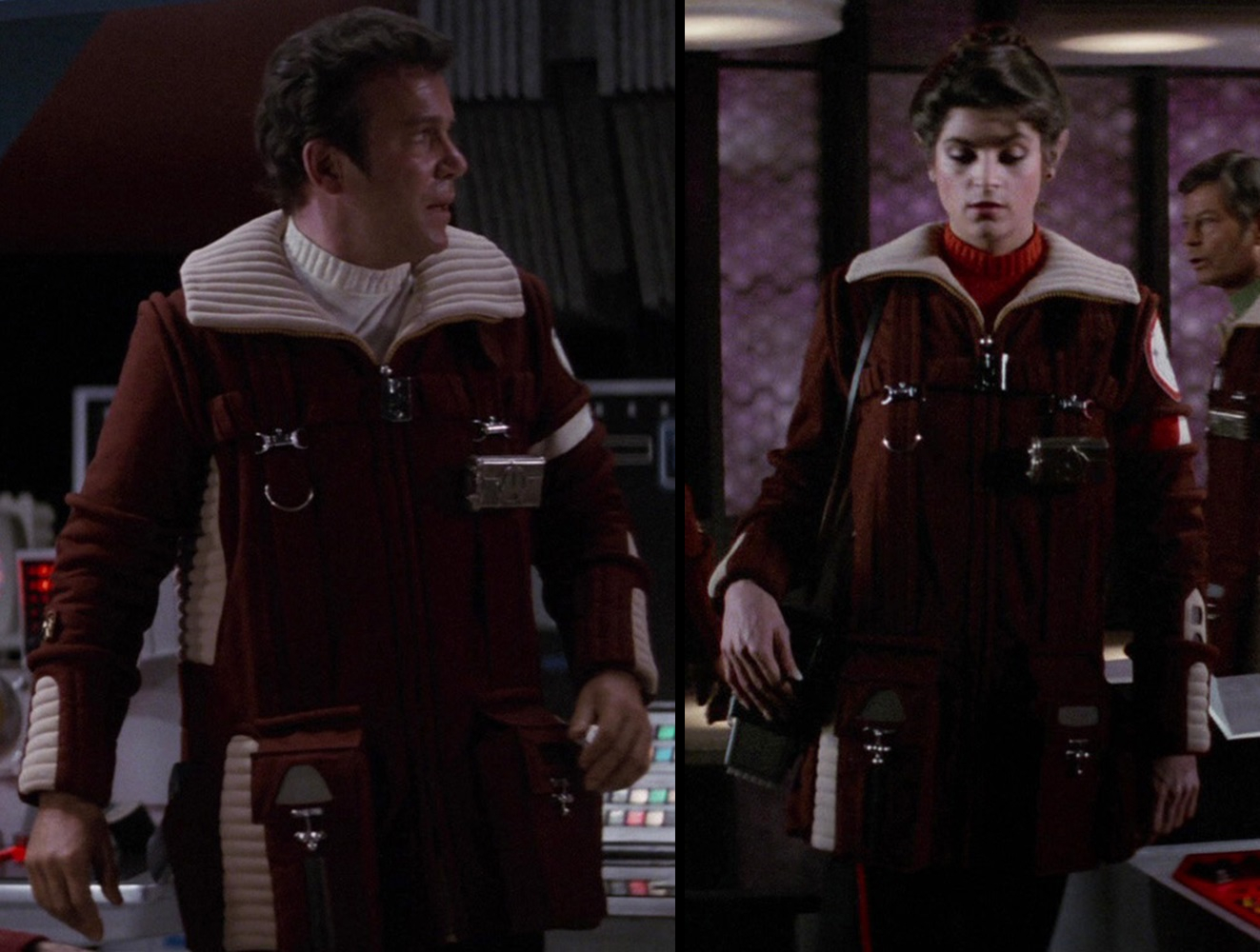
These were three-piece uniform ensembles: maroon wool jacket and black wool trousers, worn with division-colored undershirts made of lightweight spandex.
Jacket
The jacket fabric weave was seldom visible on-camera, even in remastered HD, but it was actually an interesting fabric called “cavalry twill” that has a distinct, strong diagonal weave.
(In his notes, Fletcher wrote that the jackets were “wool elastique.” The two fabrics are indeed very similar – to the point that the terms are often used interchangeably – but they are subtly different fabrics.)
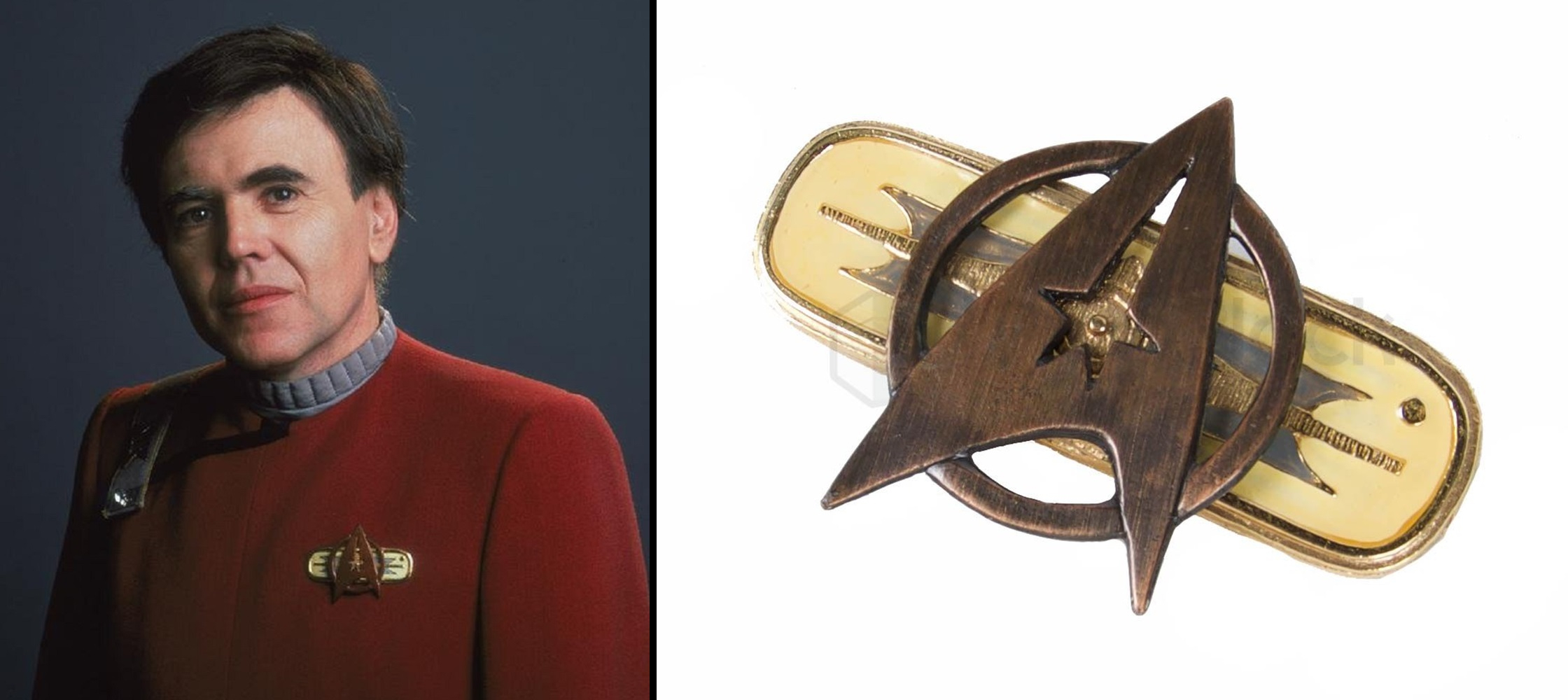
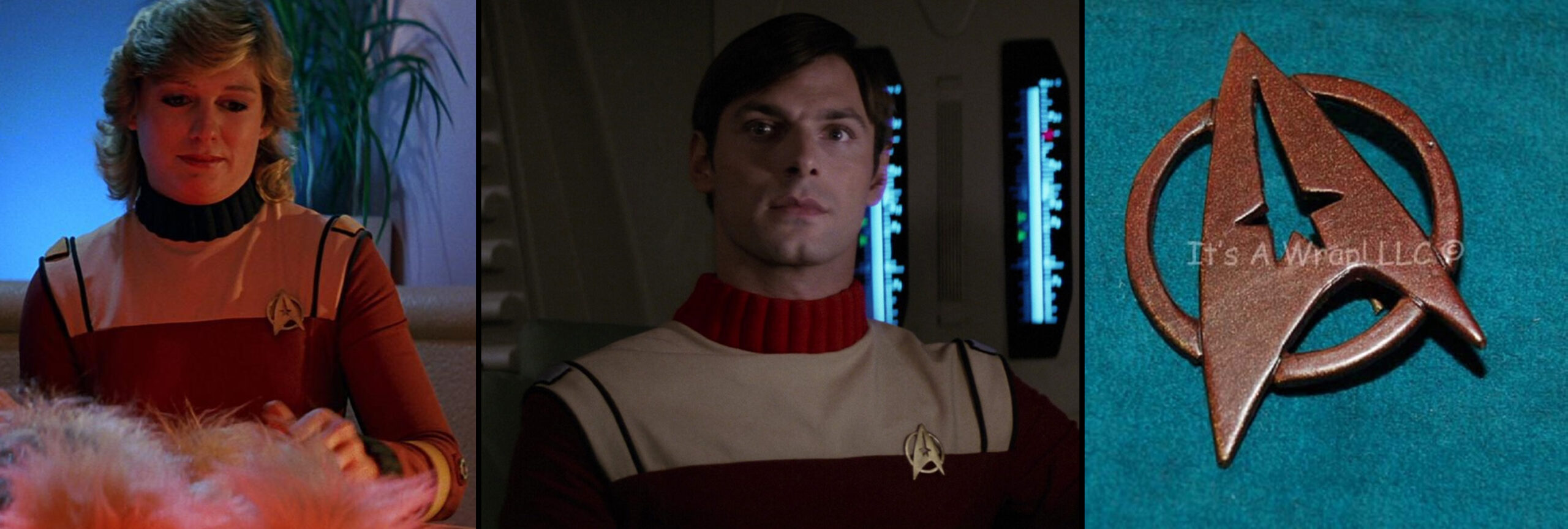
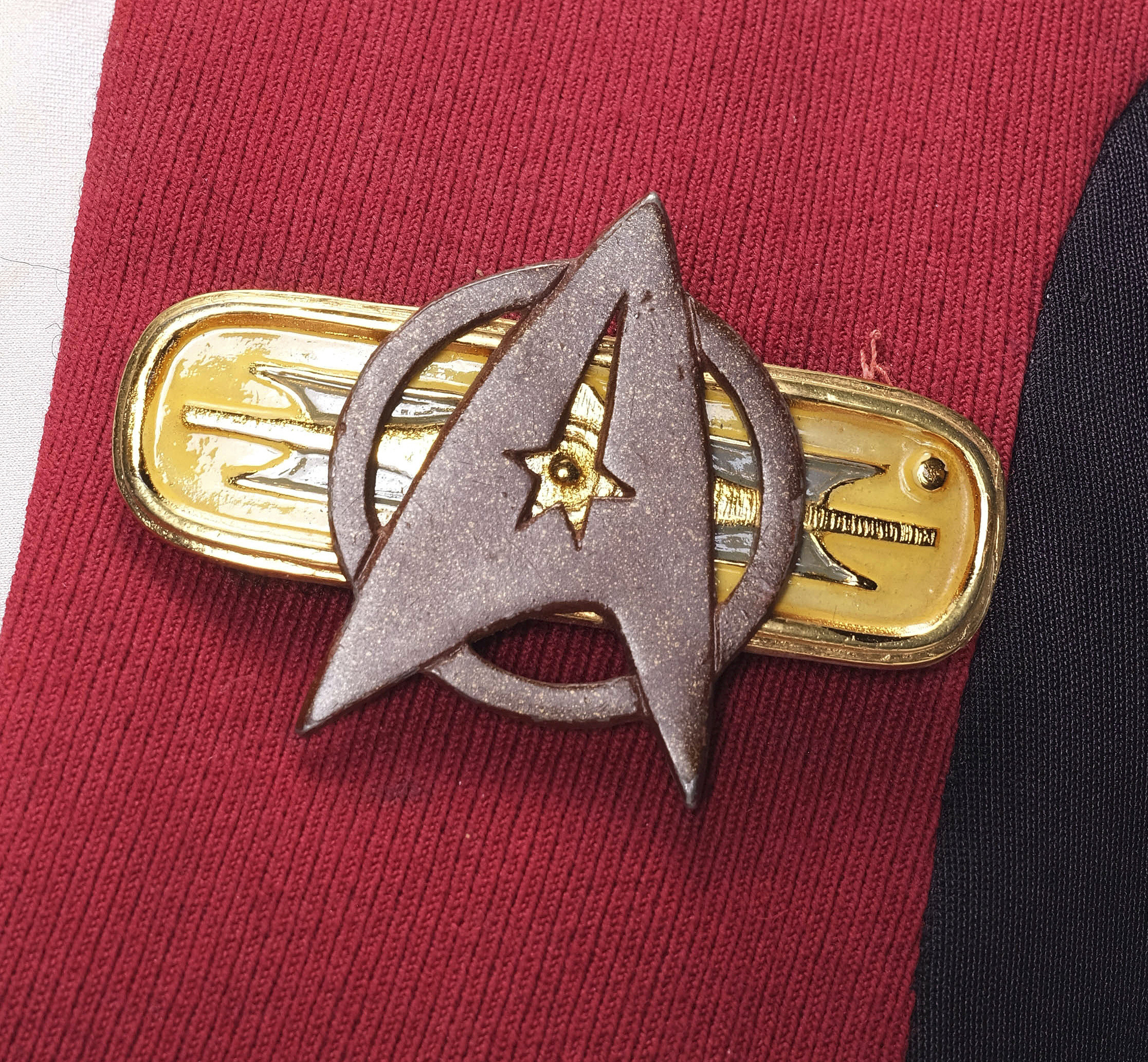
A metal badge was worn on the upper left chest, in the shape of the TMP-style Starfleet “delta” but with a new backing added.
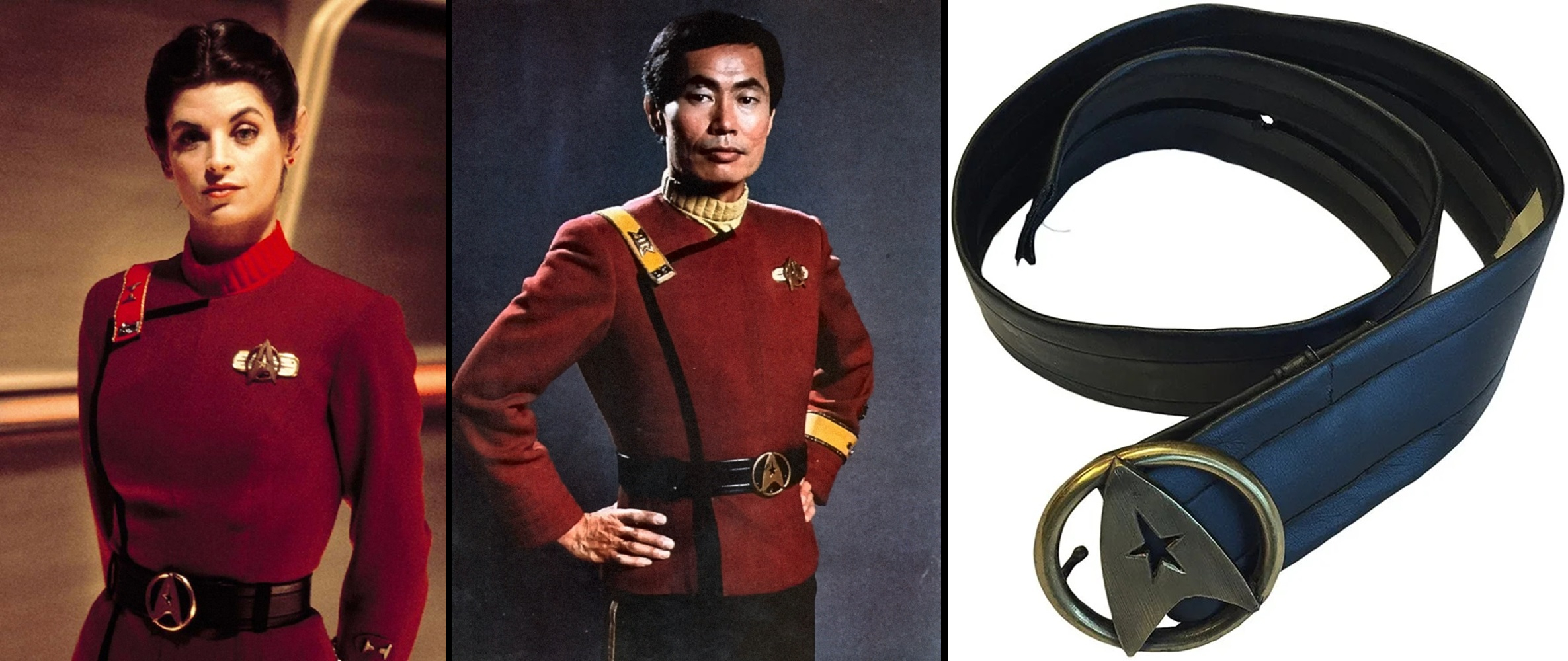
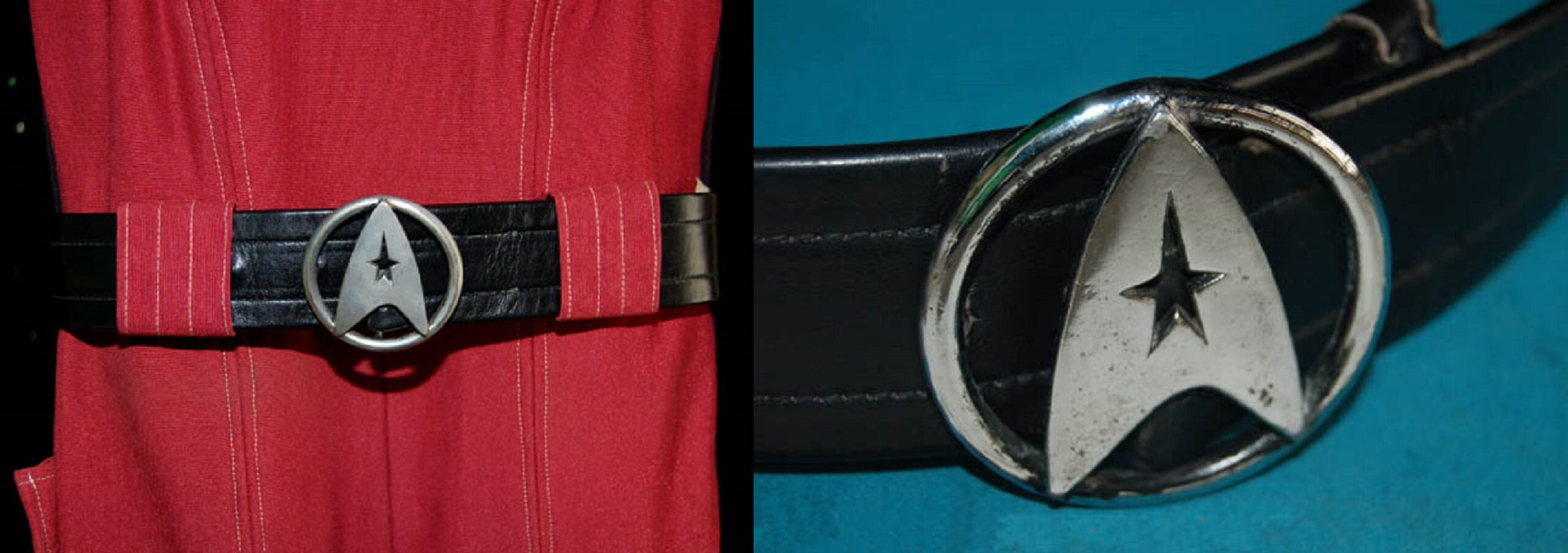
They were also worn with black leather belts, with the buckle being another metal bronze Starfleet “delta” enclosed in a large ring.
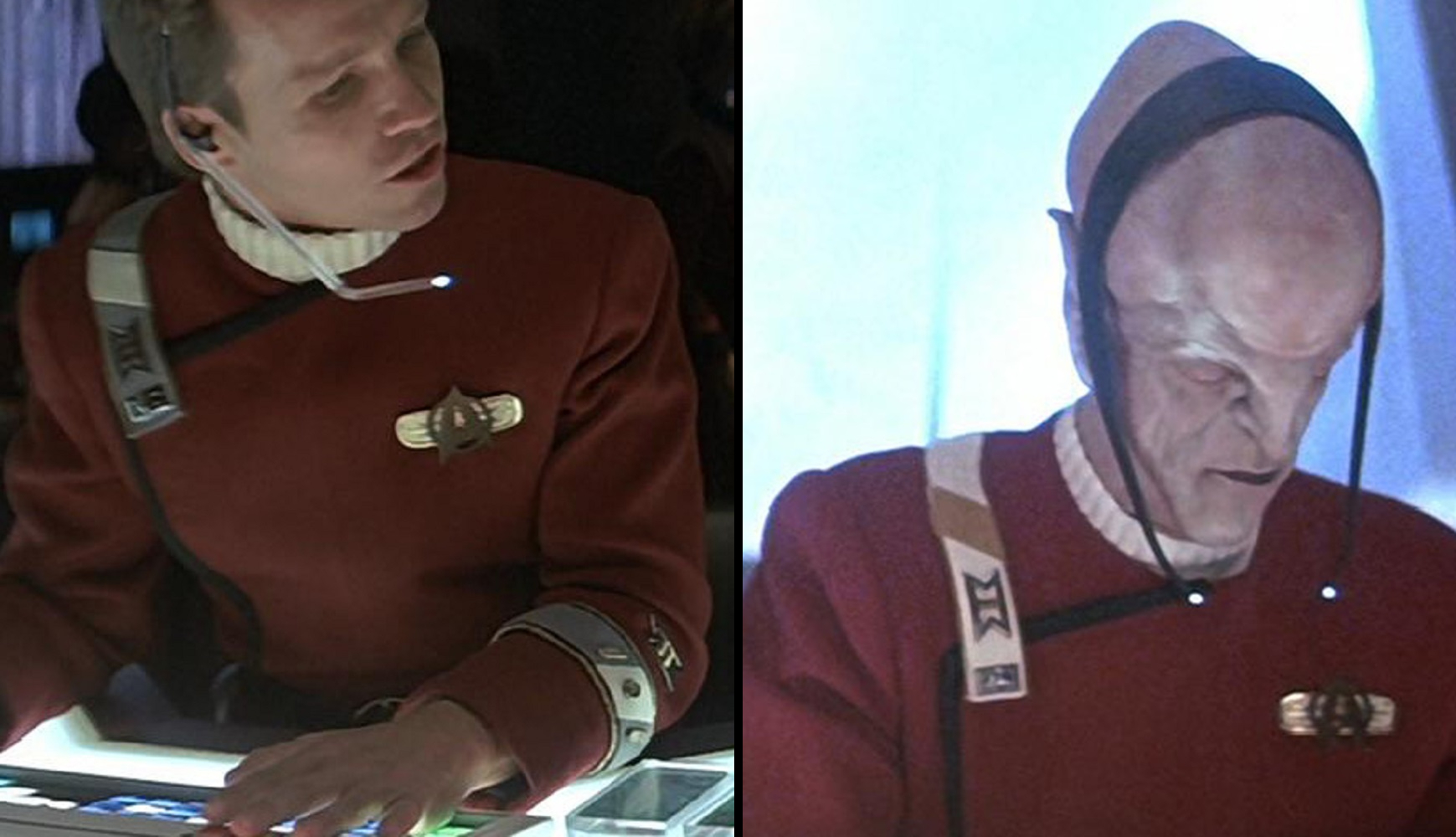
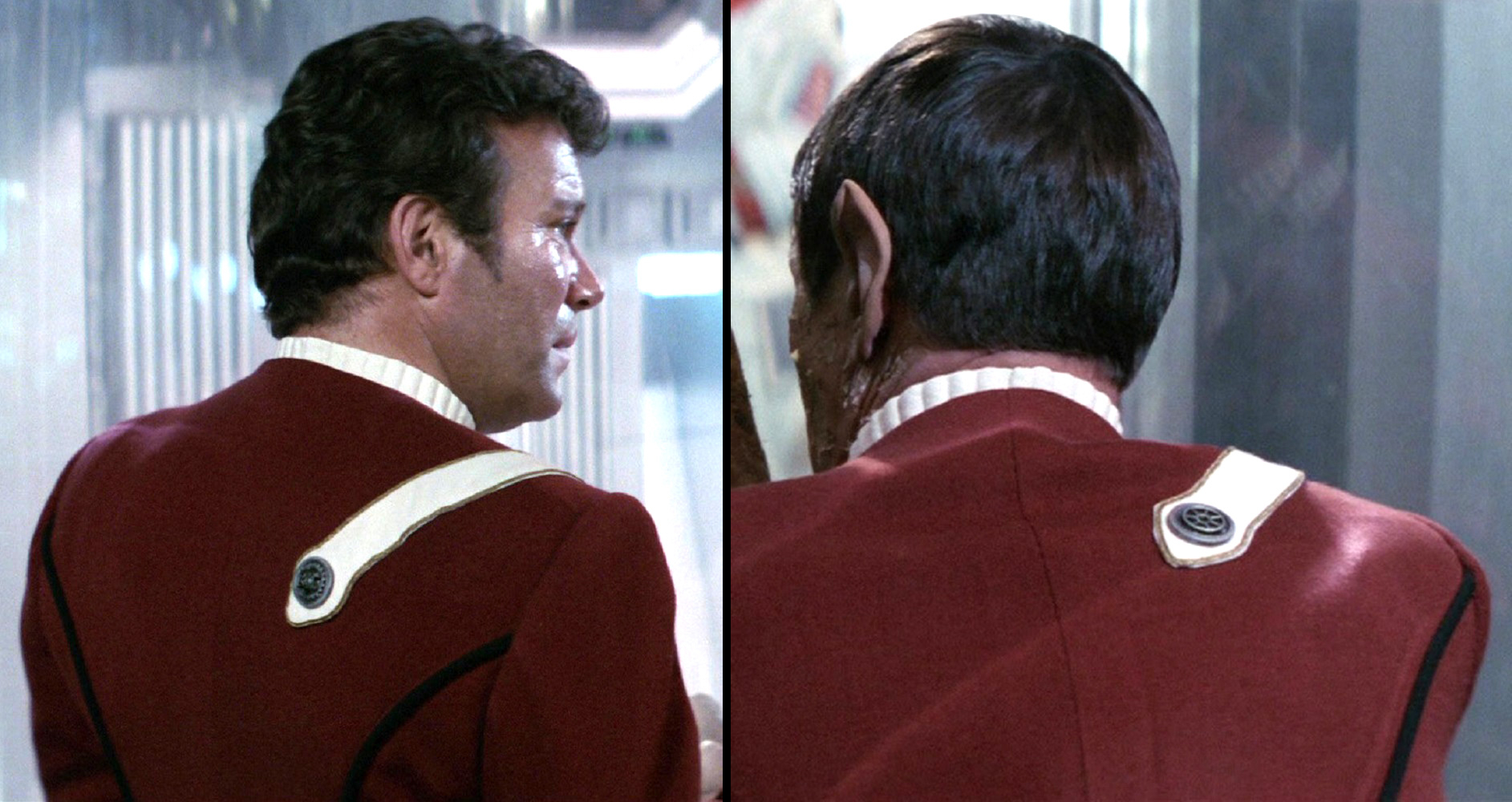
On the upper right of the jacket was a division-colored shoulder strap, which also featured the wearer’s rank insignia.
We’ve already discussed the division colors, but there were a couple variations Fletcher mentioned in his notes:
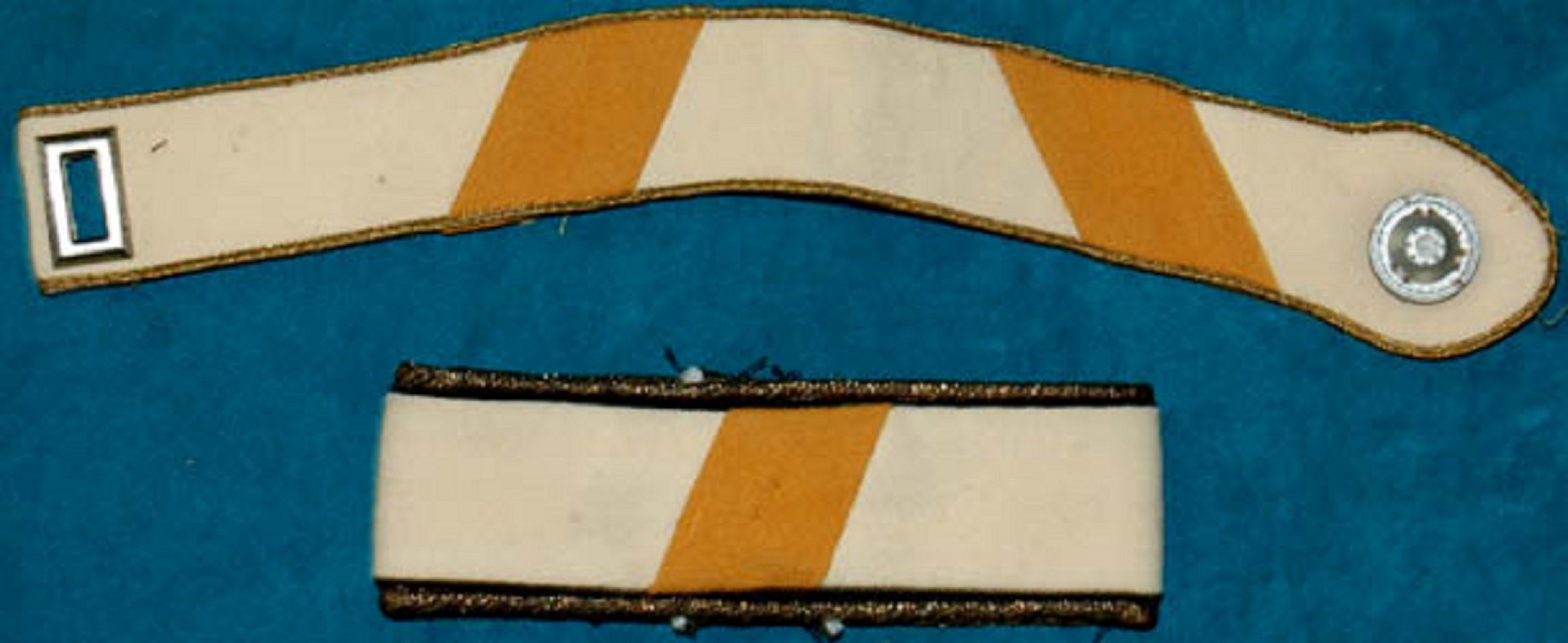
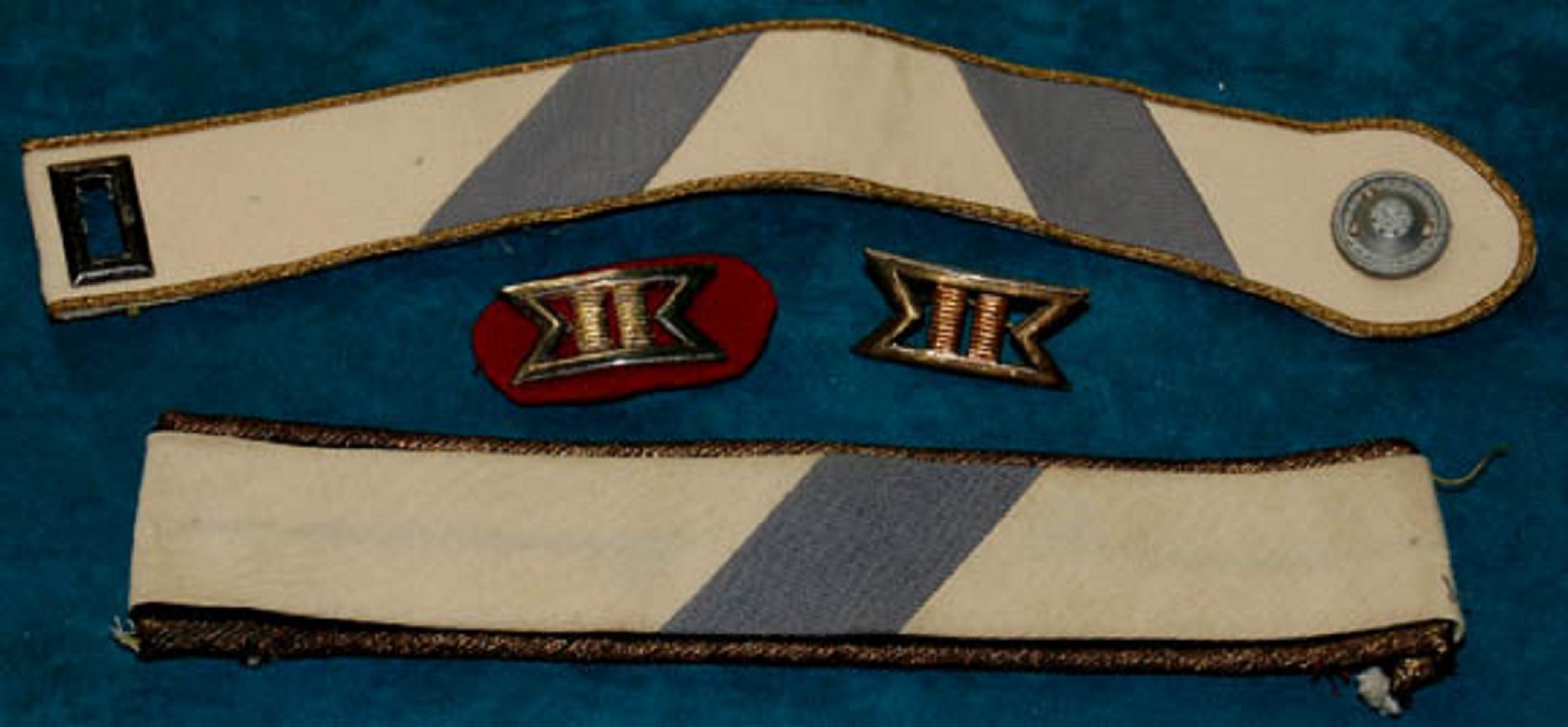
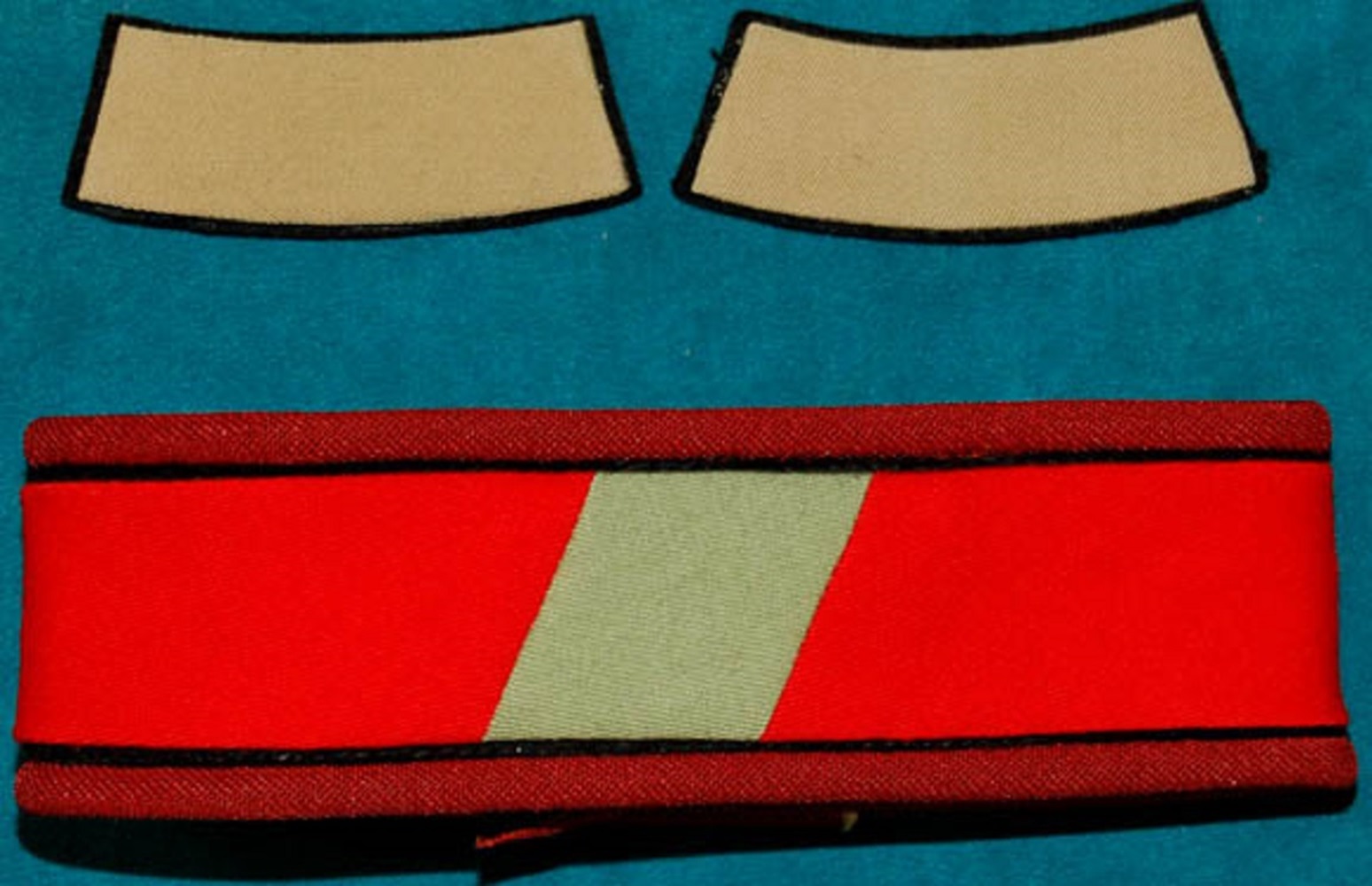
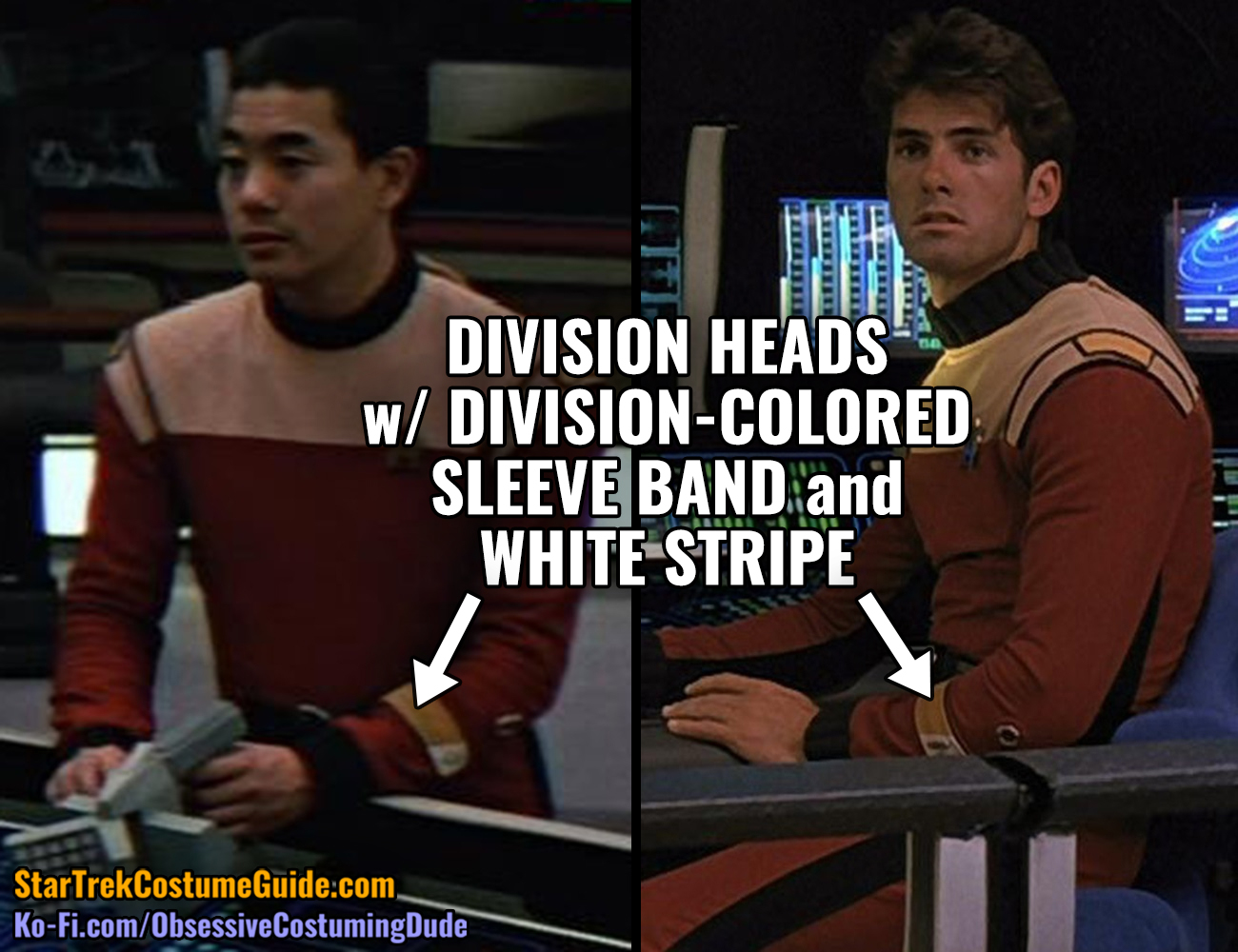
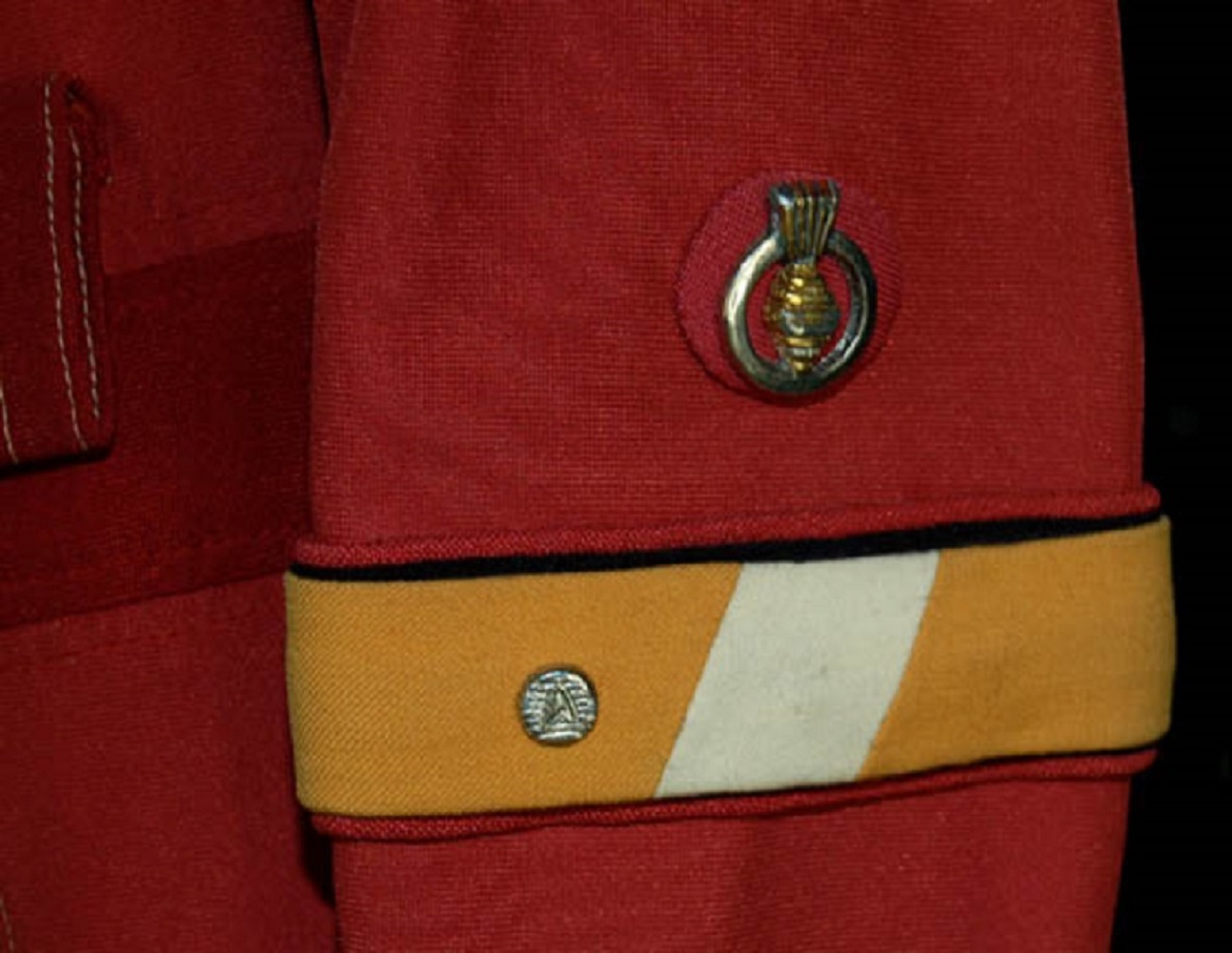
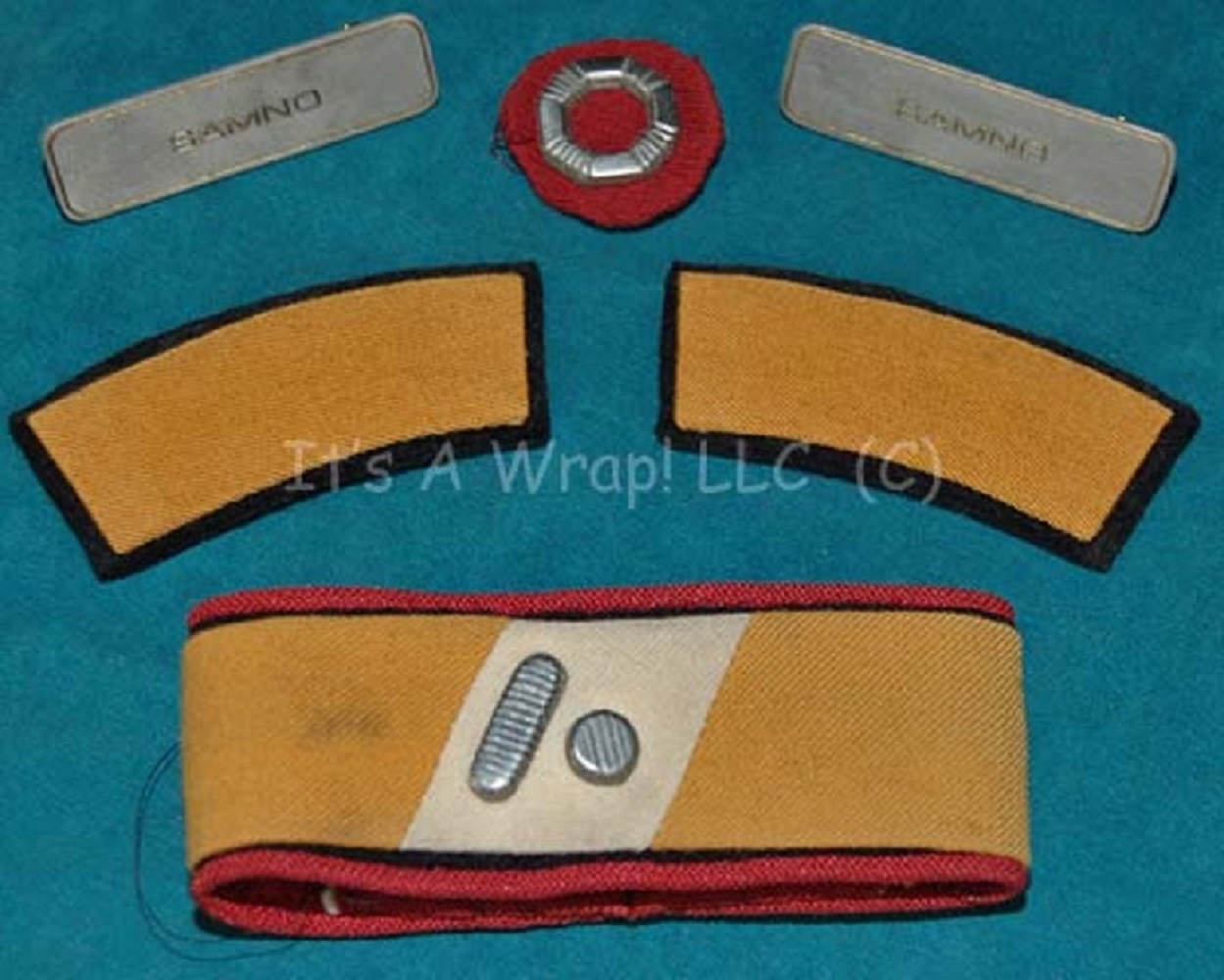
First, department heads had the option of wearing division-colored shoulder straps and sleeve bands with white stripes, or white shoulder straps and sleeve bands with division-colored stripes.
Here are some auction photos of these elements:
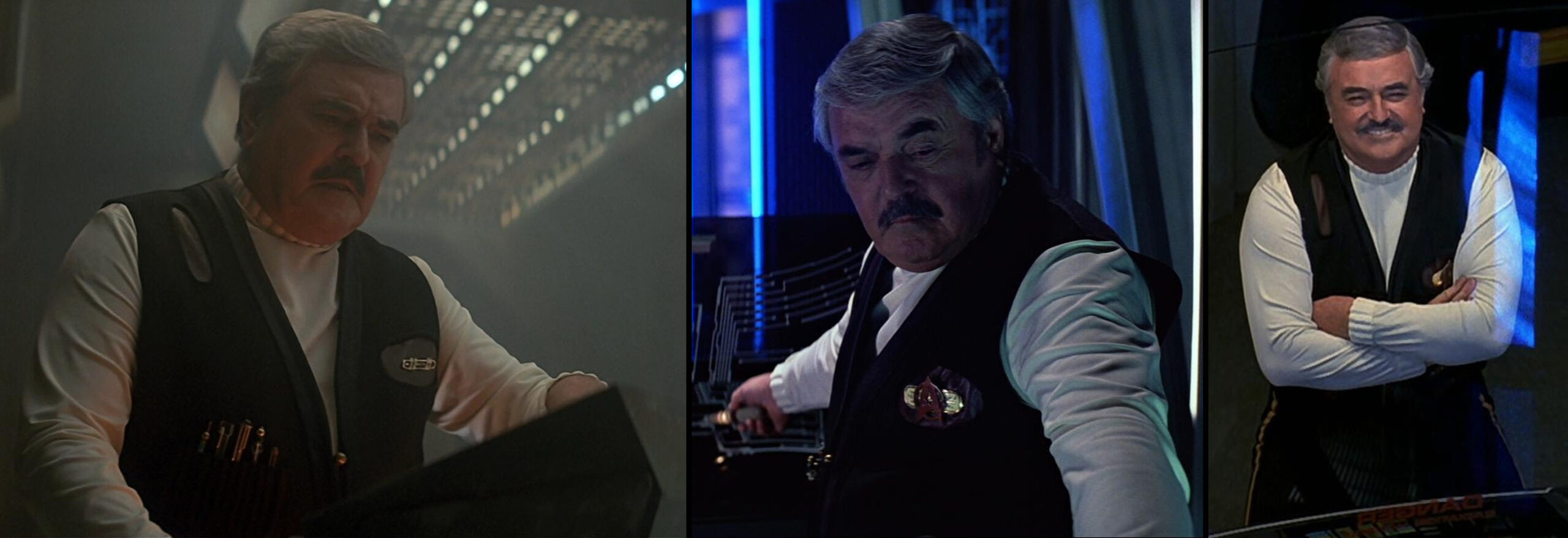
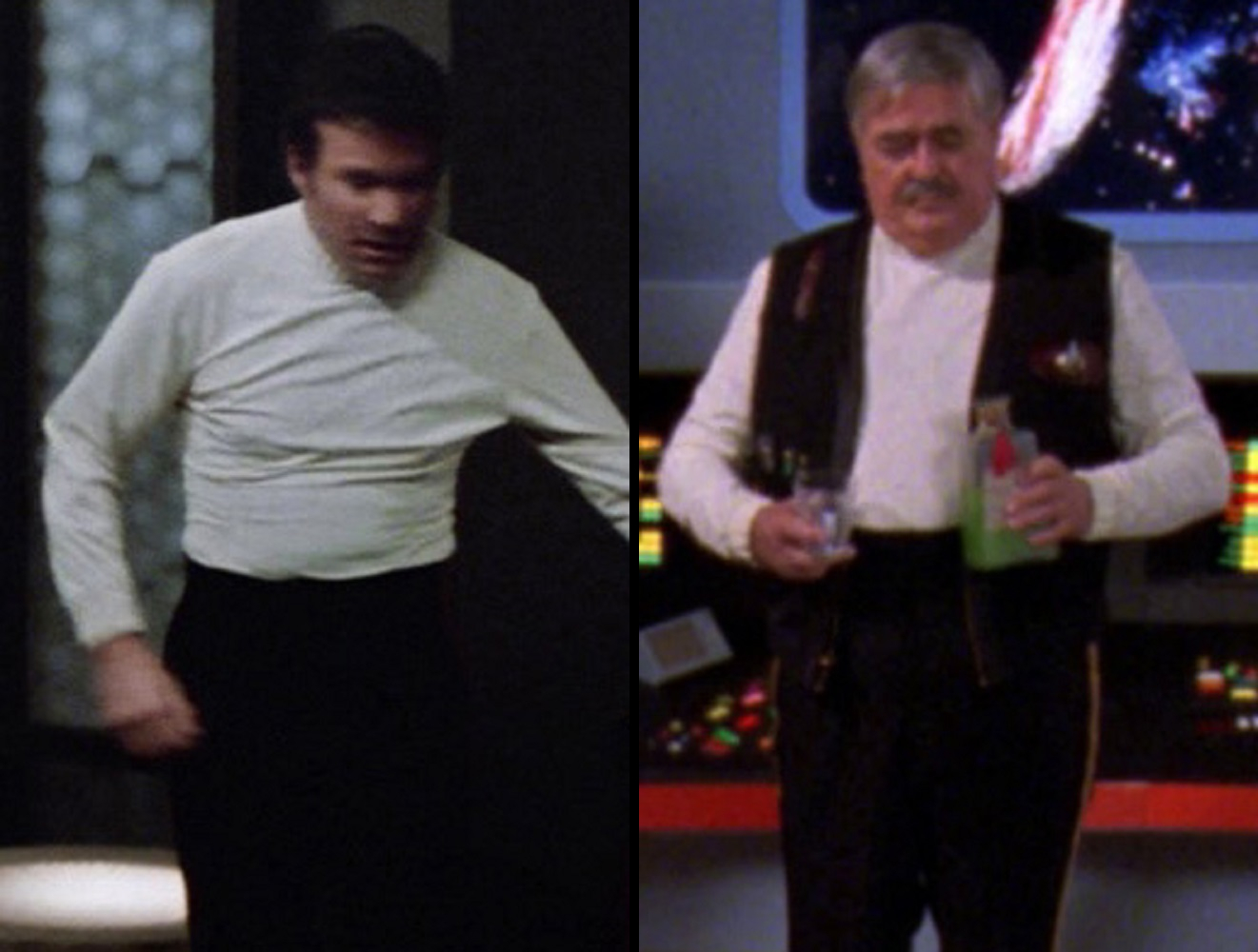
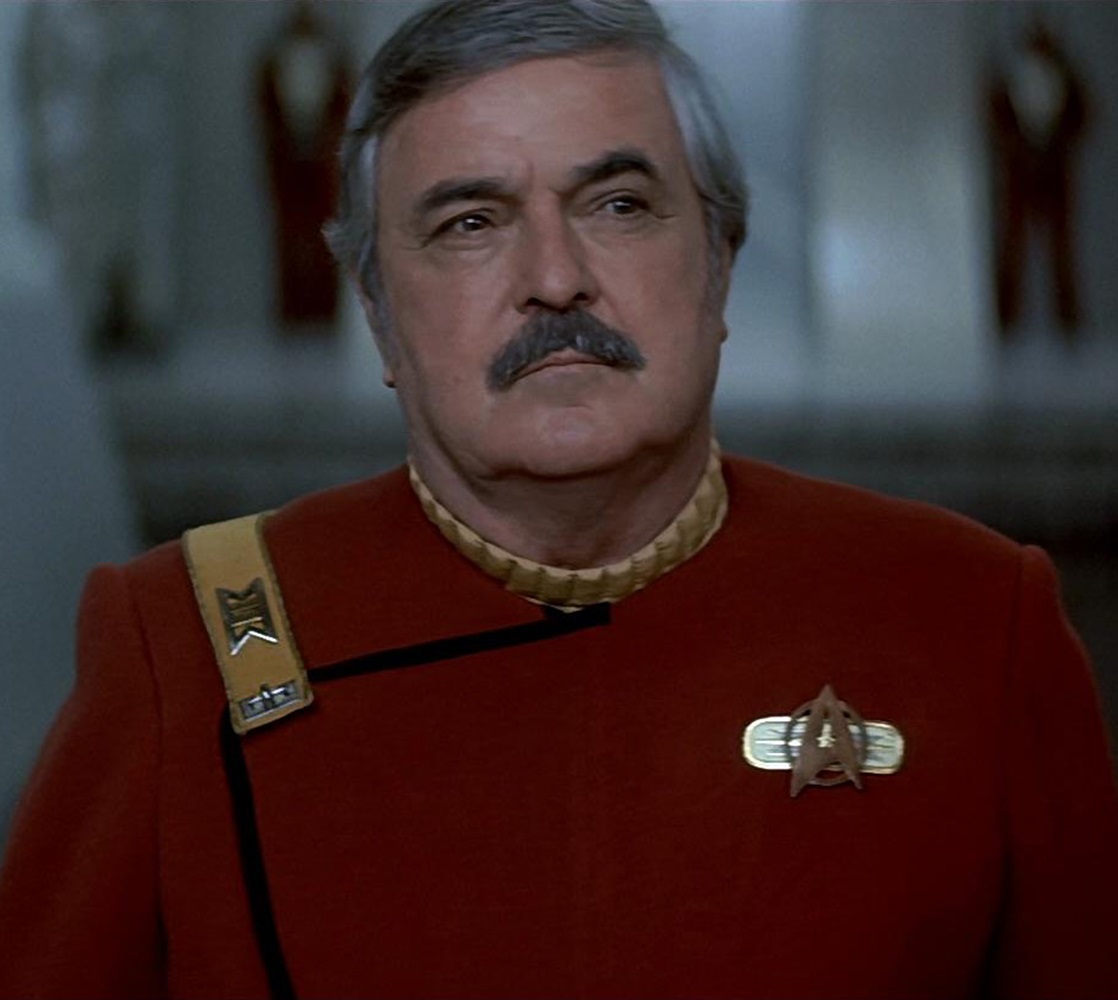
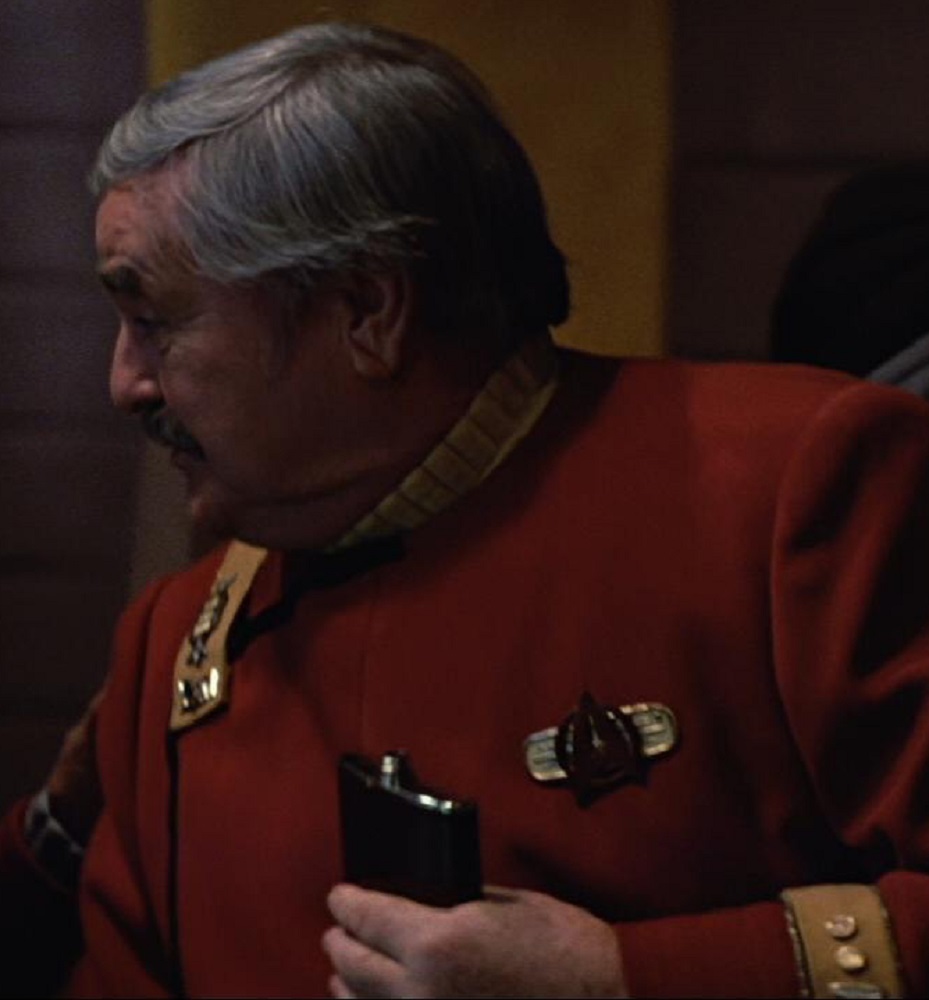
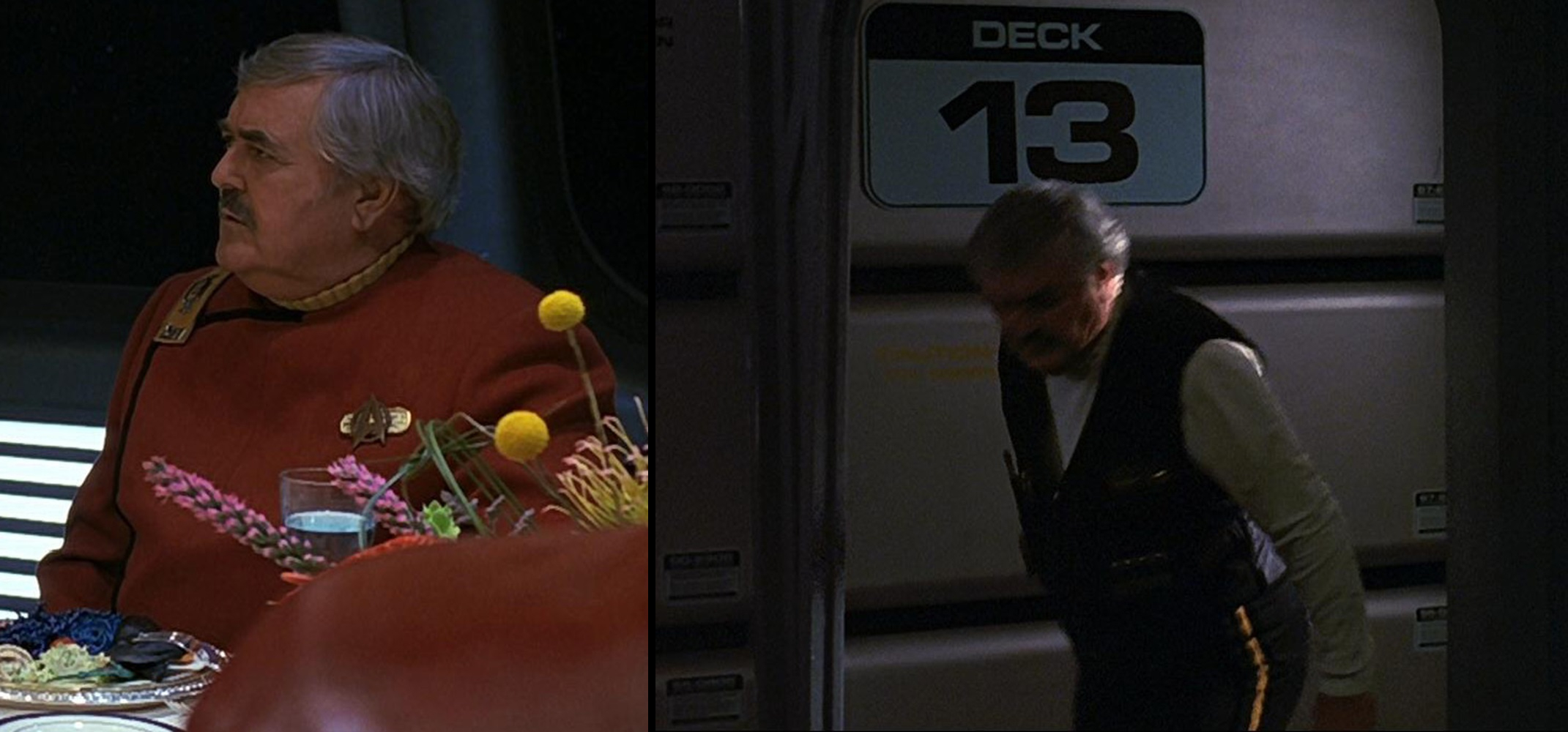
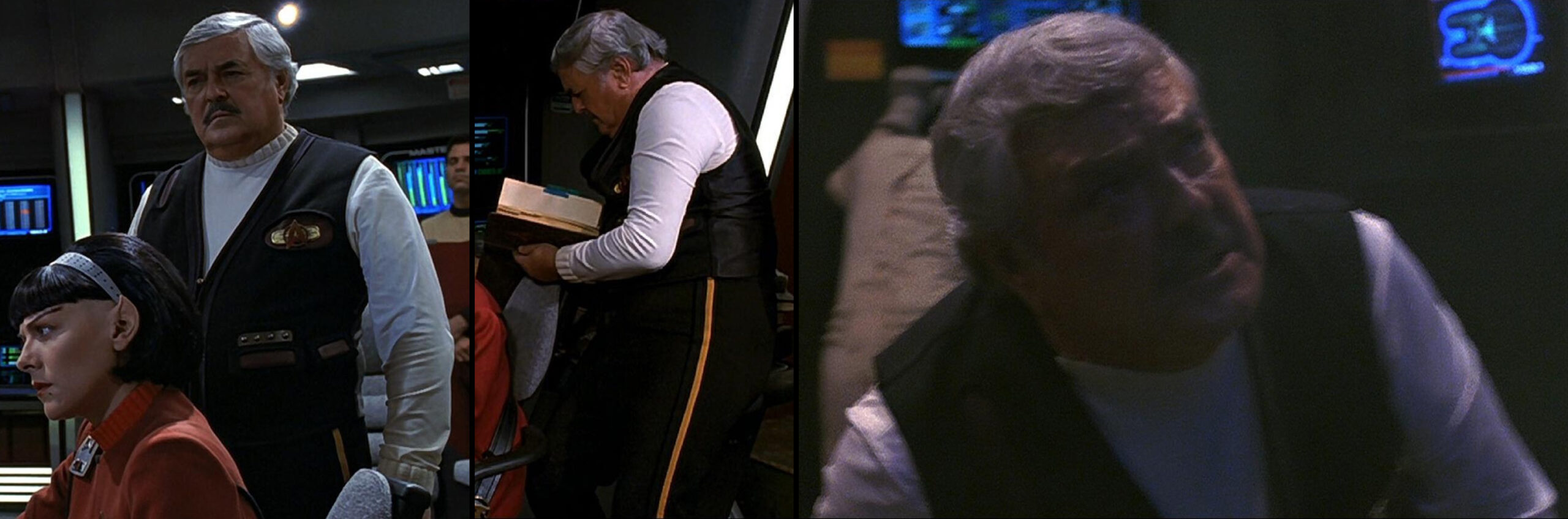
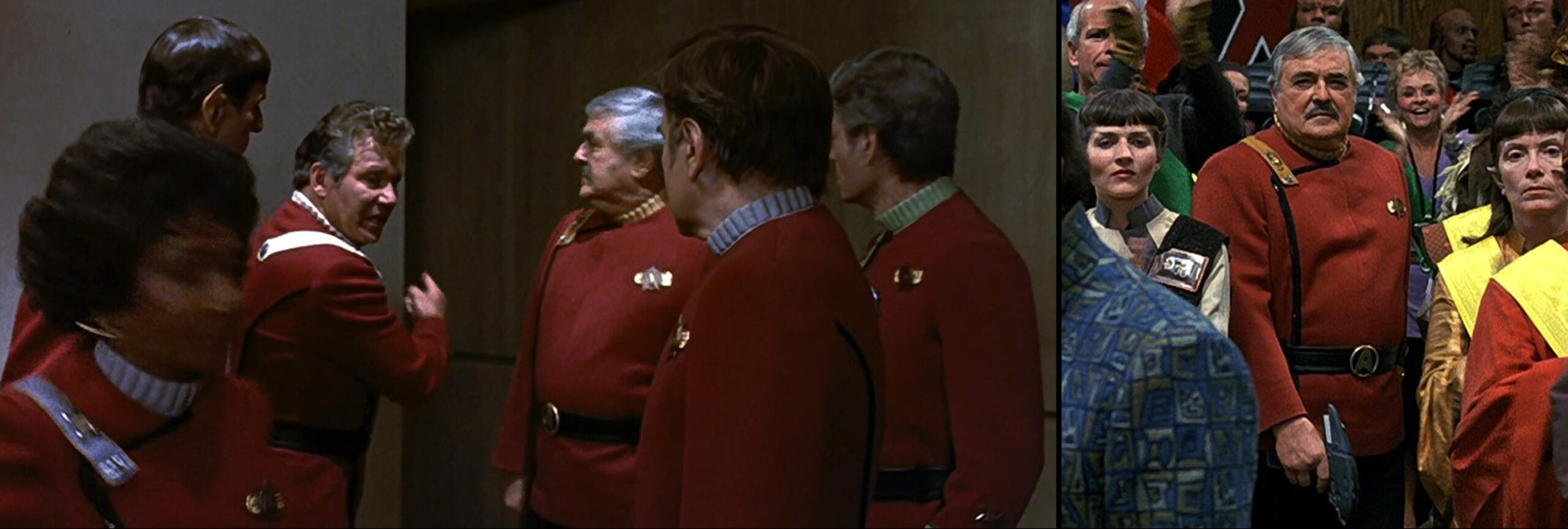
As “captain of engineering,” Scotty would have this option, but he exercised it differently; in ST4-6 he wore solid gold with his standard uniform, but he wore a command white division shirt with his engineering vest:
He wore an engineering gold division shirt with his “bomber jacket” in ST3, but he switched to command white for ST4.
Maybe it took a while for him to get used to the rank of captain?
According to his notes, Starfleet Academy instructors wore white straps/bands with red slashes.
And finally, cadets wore red shoulder straps and sleeve bands, but the sleeve bands also had slashes in their intended division color.
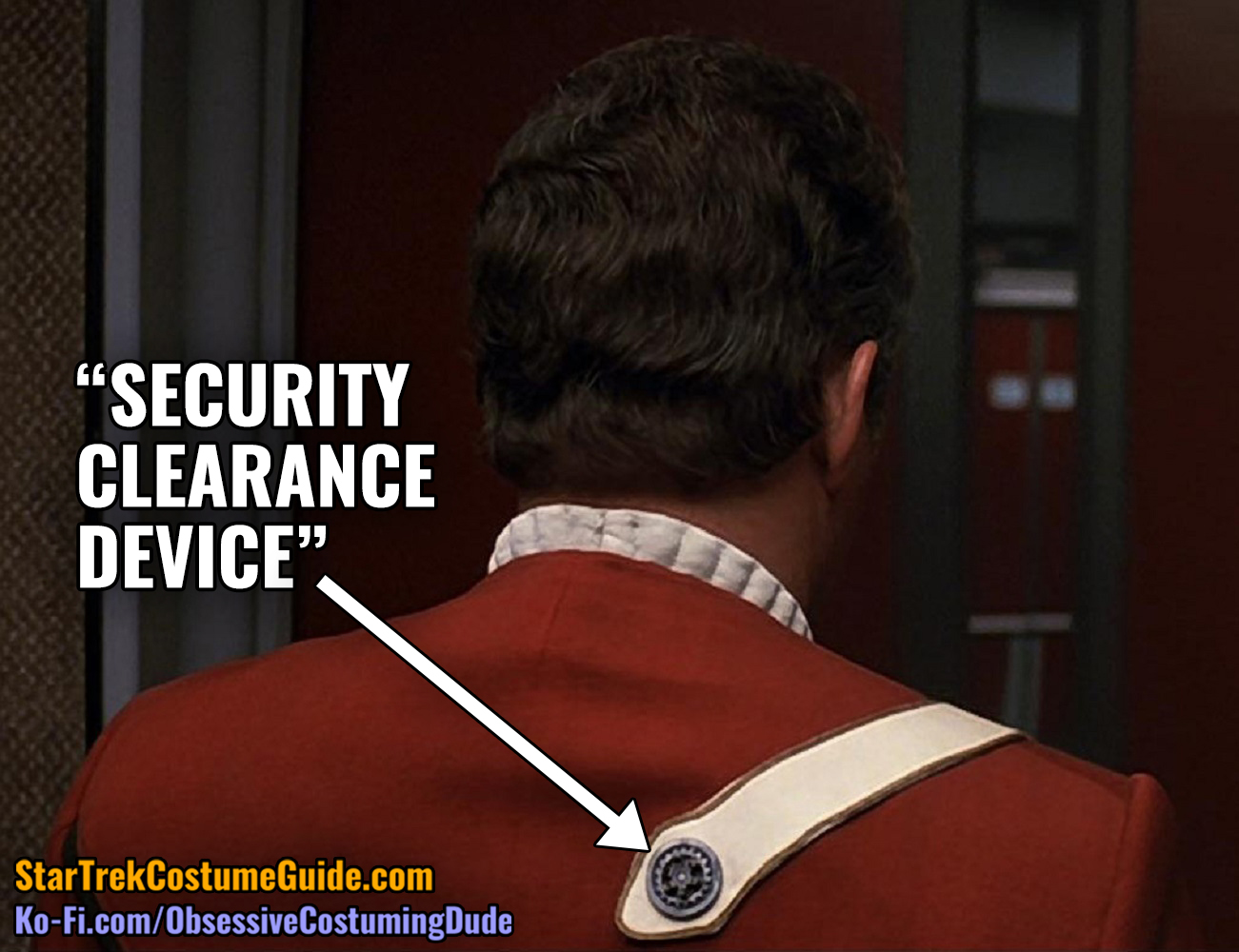
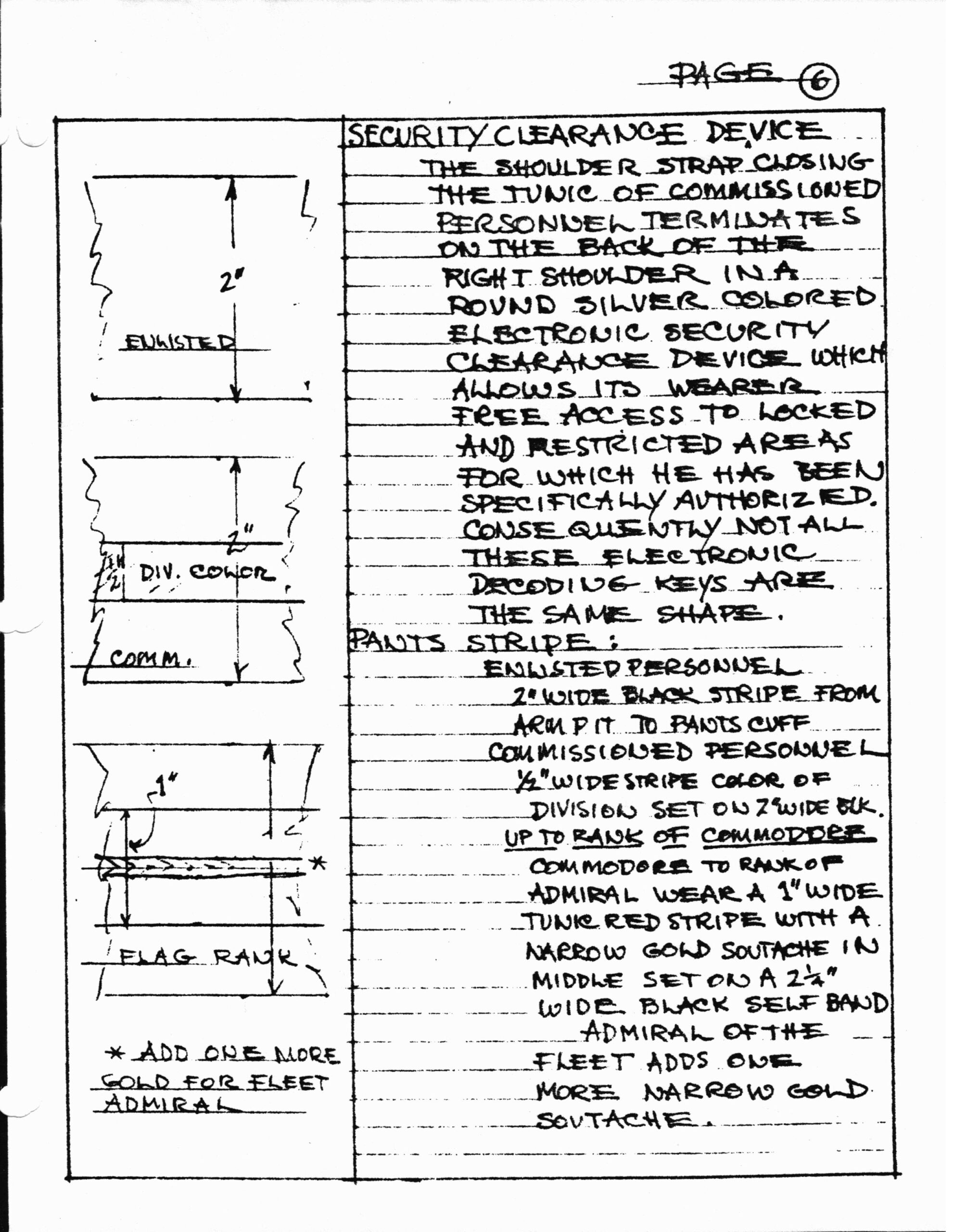
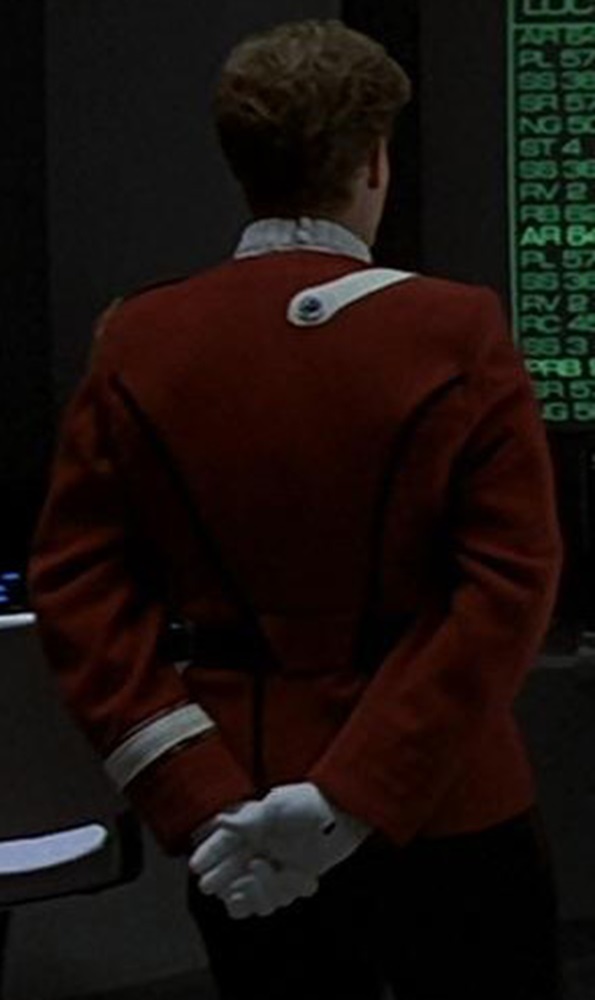
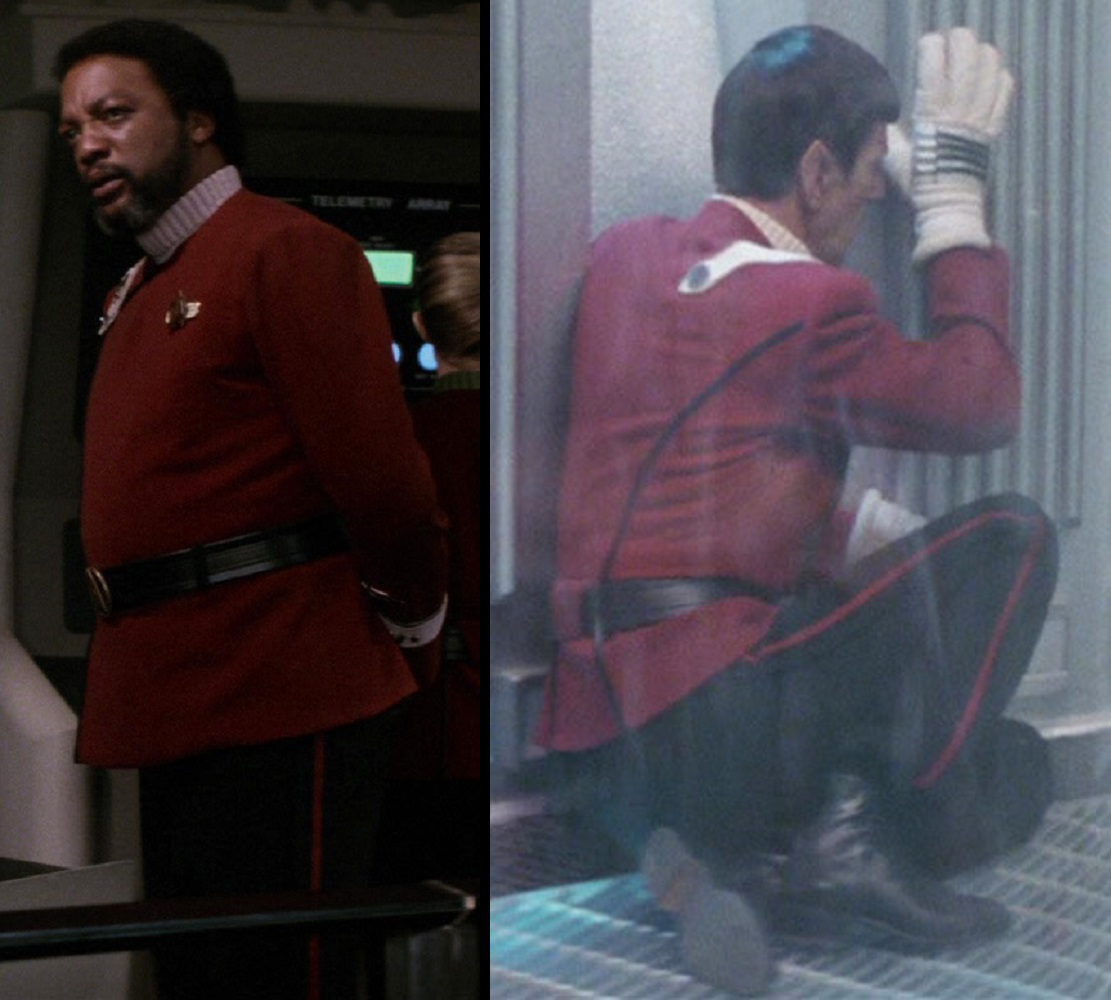
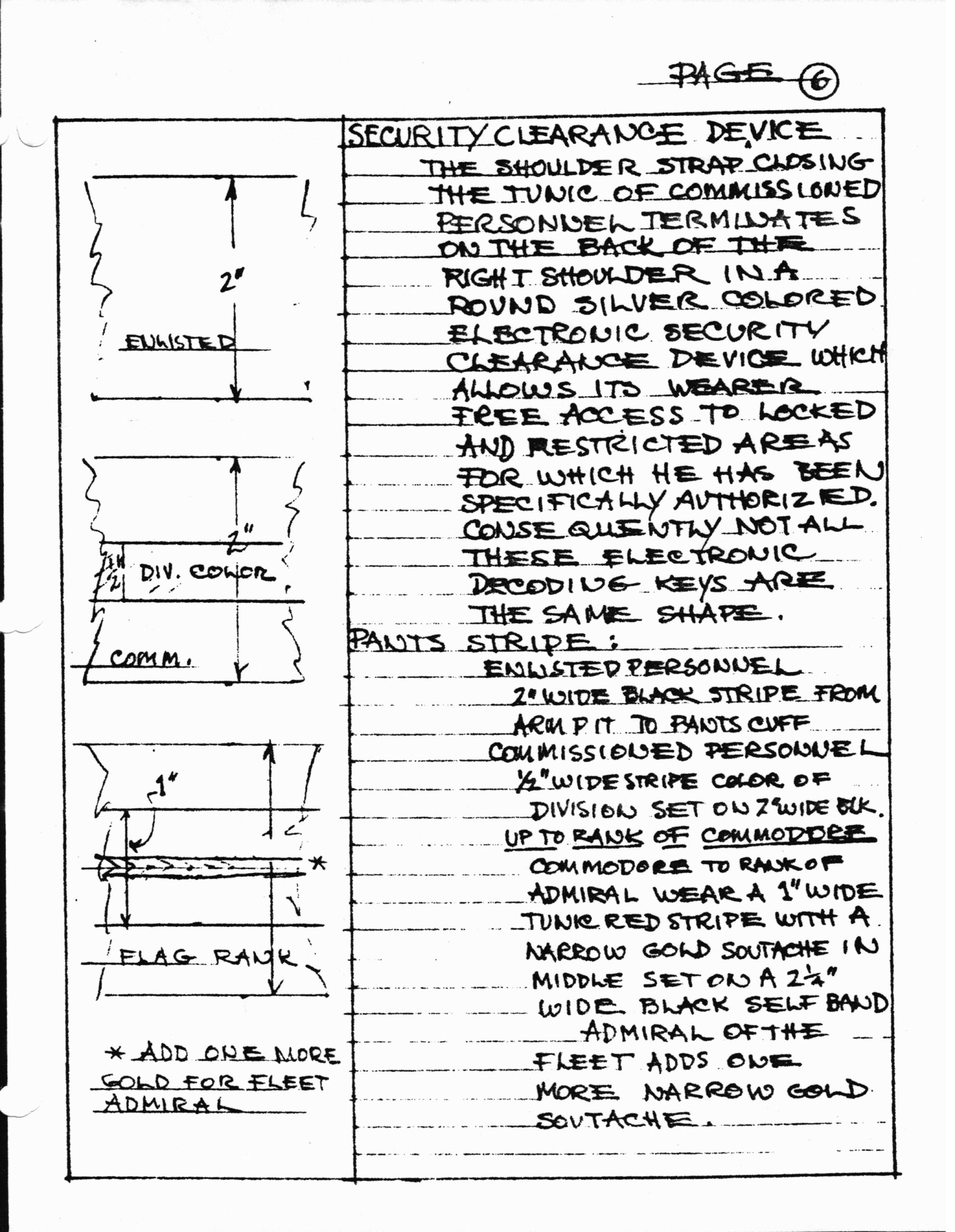
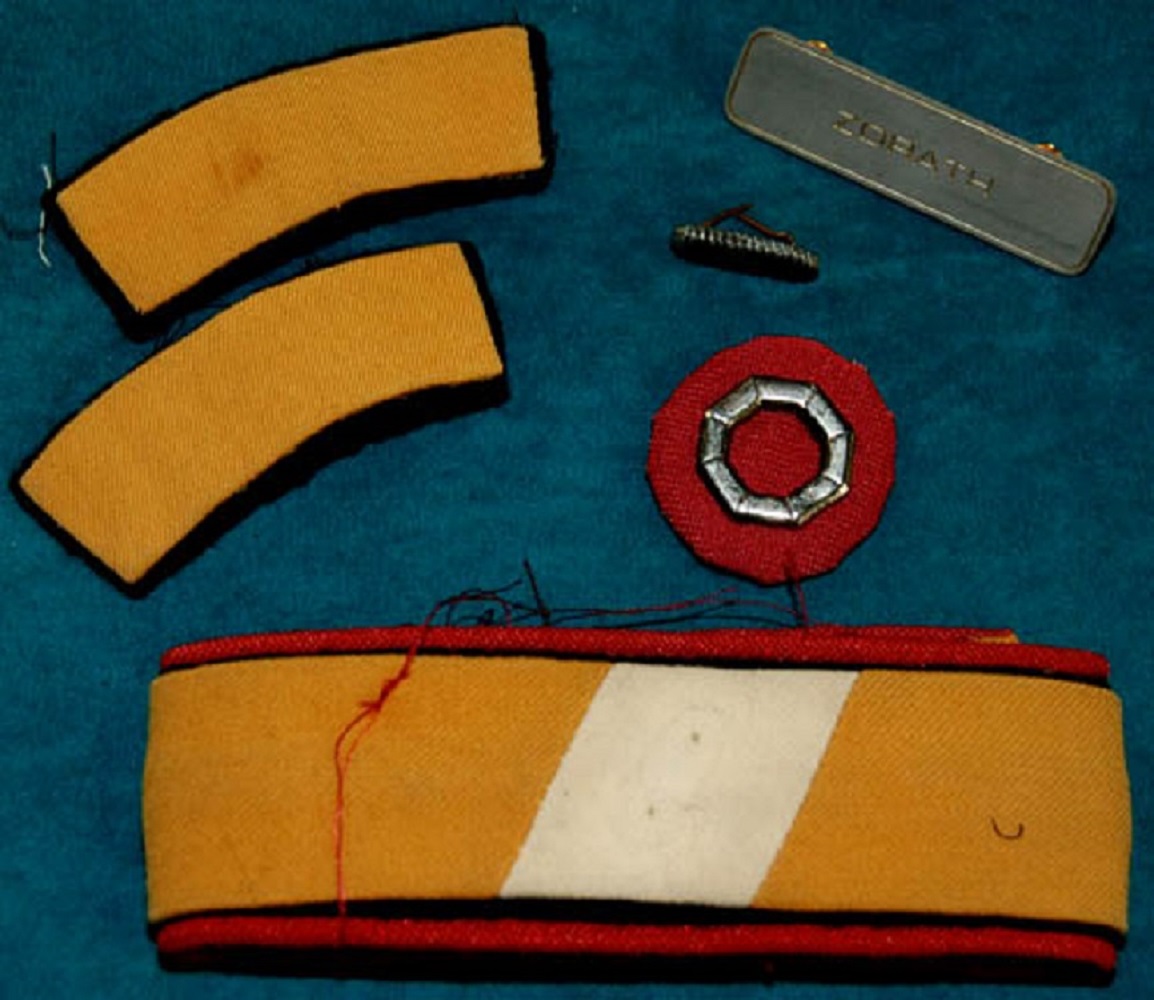
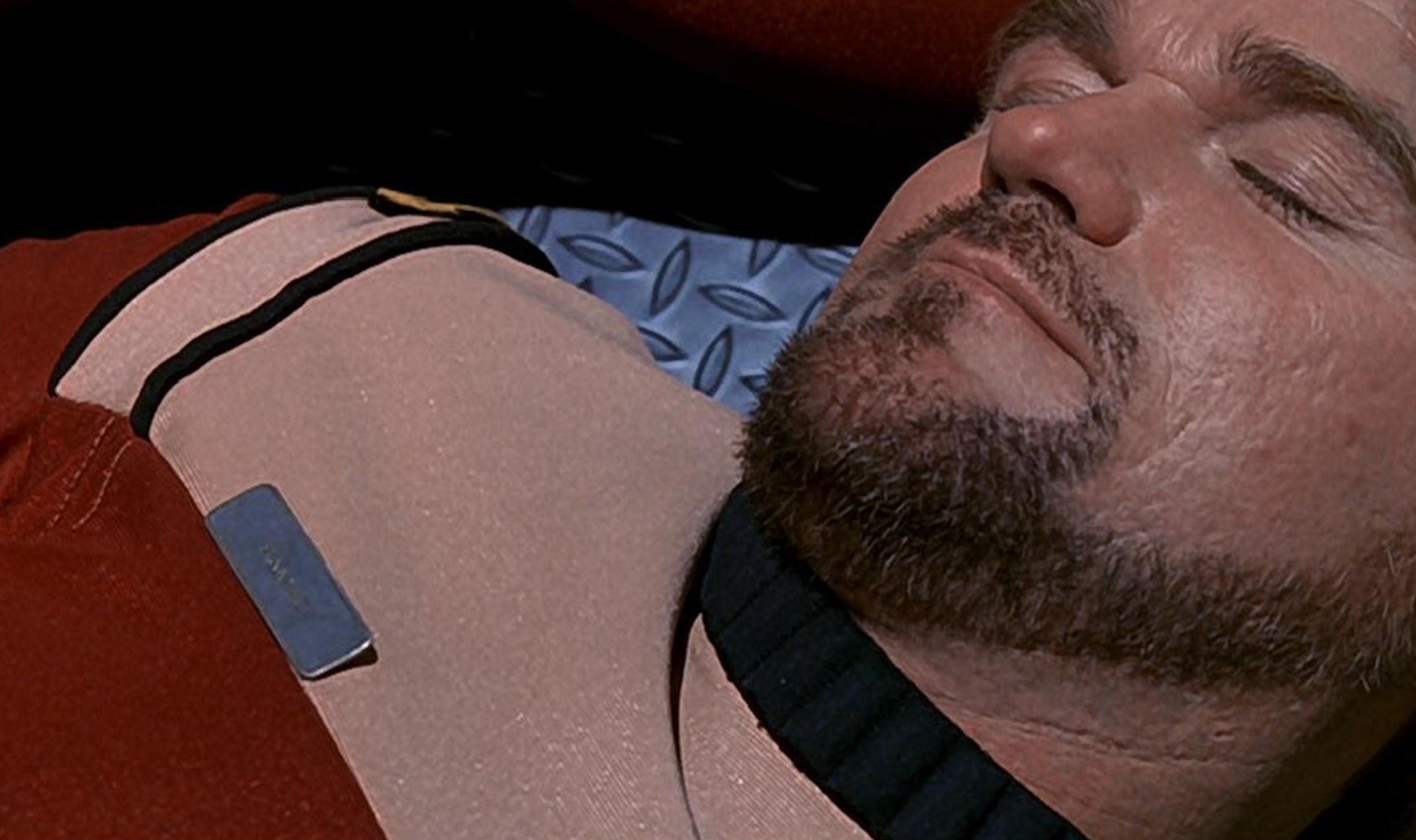
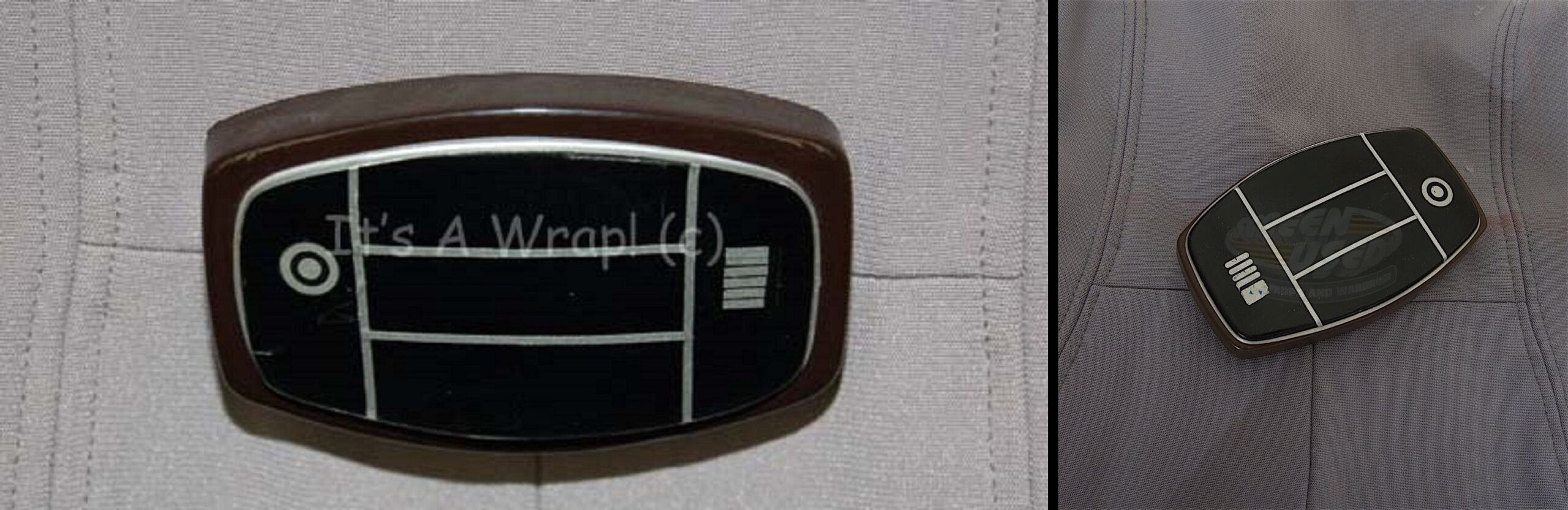
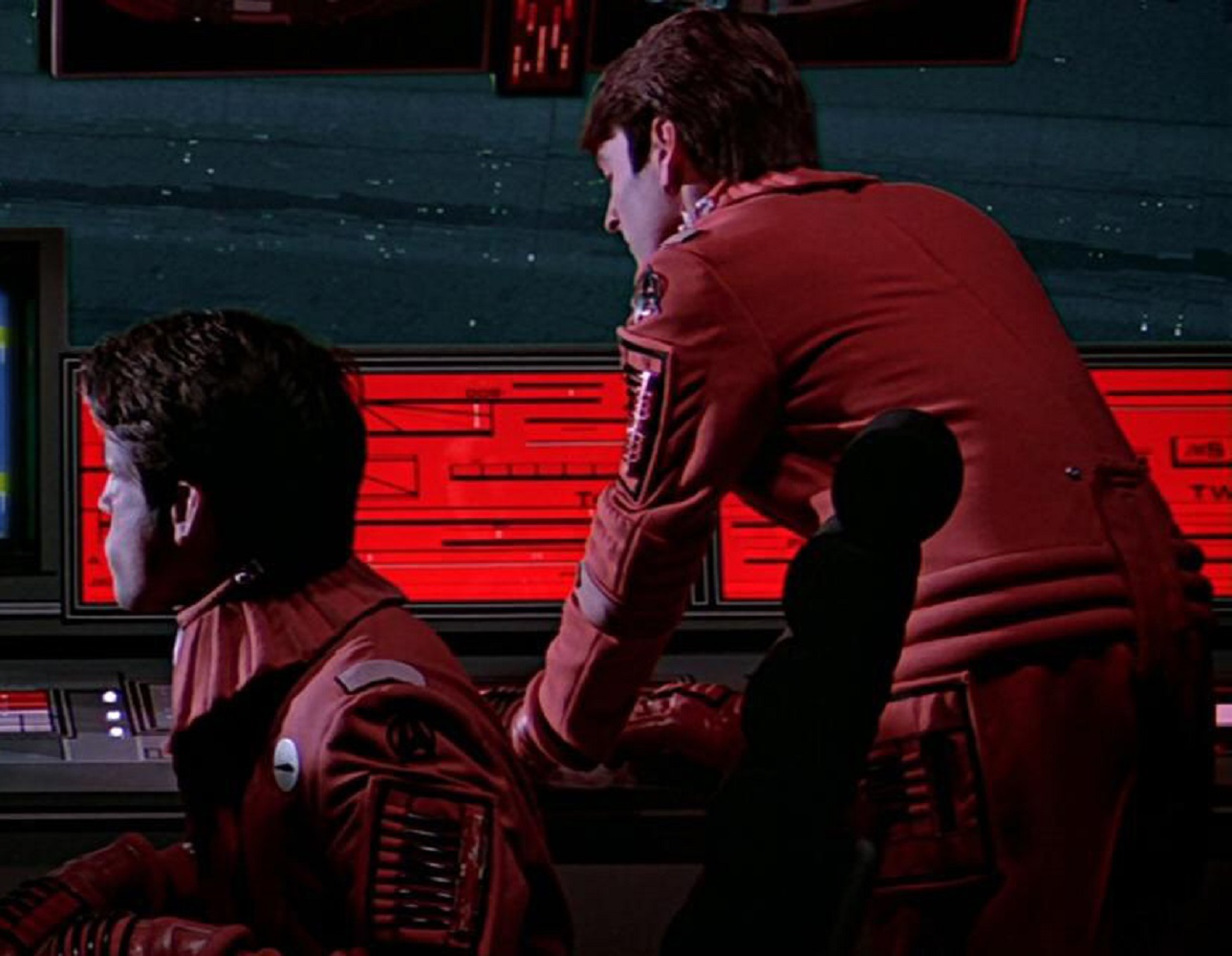
On the back of these shoulder straps was a small silver gizmo, which Fletcher referred to in his notes as a “security clearance device.”
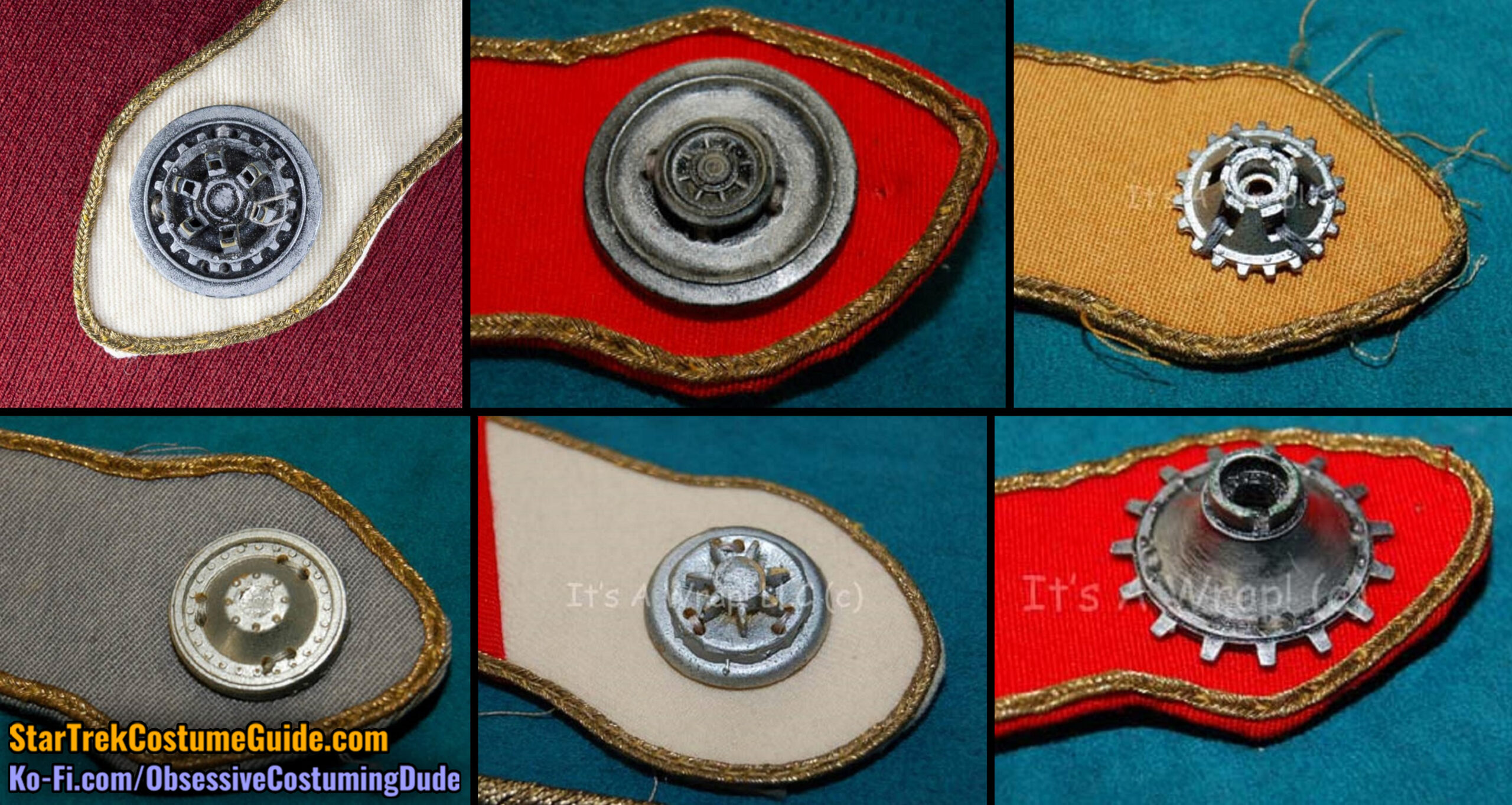
Its purpose, as Fletcher described it, “allows its wearer free access to locked and restricted areas for which he has been specifically authorized. Consequently not all these electronic decoding keys are the same shape.”
Here’s a closer look at some of the various devices used:
(There were probably others used as well, but these are just some of the ones I’ve seen.)
Their corresponding security levels, hierarchy, etc. weren’t defined in either the movies themselves or in Fletcher’s notes, so they’re left to our interpretations.
How they actually worked is also left to our imagination.
It could be a tracking device, ensuring the wearer doesn’t go anywhere they’re not authorized.
It could be a sort of 23rd-century keycard, prompting doors to open and/or forcefields to deactivate whenever the device is approaching.
Or it could be the equivalent of an electronic dog collar, zapping the wearer whenever they try to go somewhere they shouldn’t. (Probably not, though.)
And since these devices were only seen on the standard officers’ uniforms, how officers wearing other uniforms and enlisted personnel were supposed to get into restricted areas is (again) left to our imagination.
Regardless of how they worked or their intended associations, they definitely added some visual interest to the back of the uniform, which was something Fletcher excelled at doing.
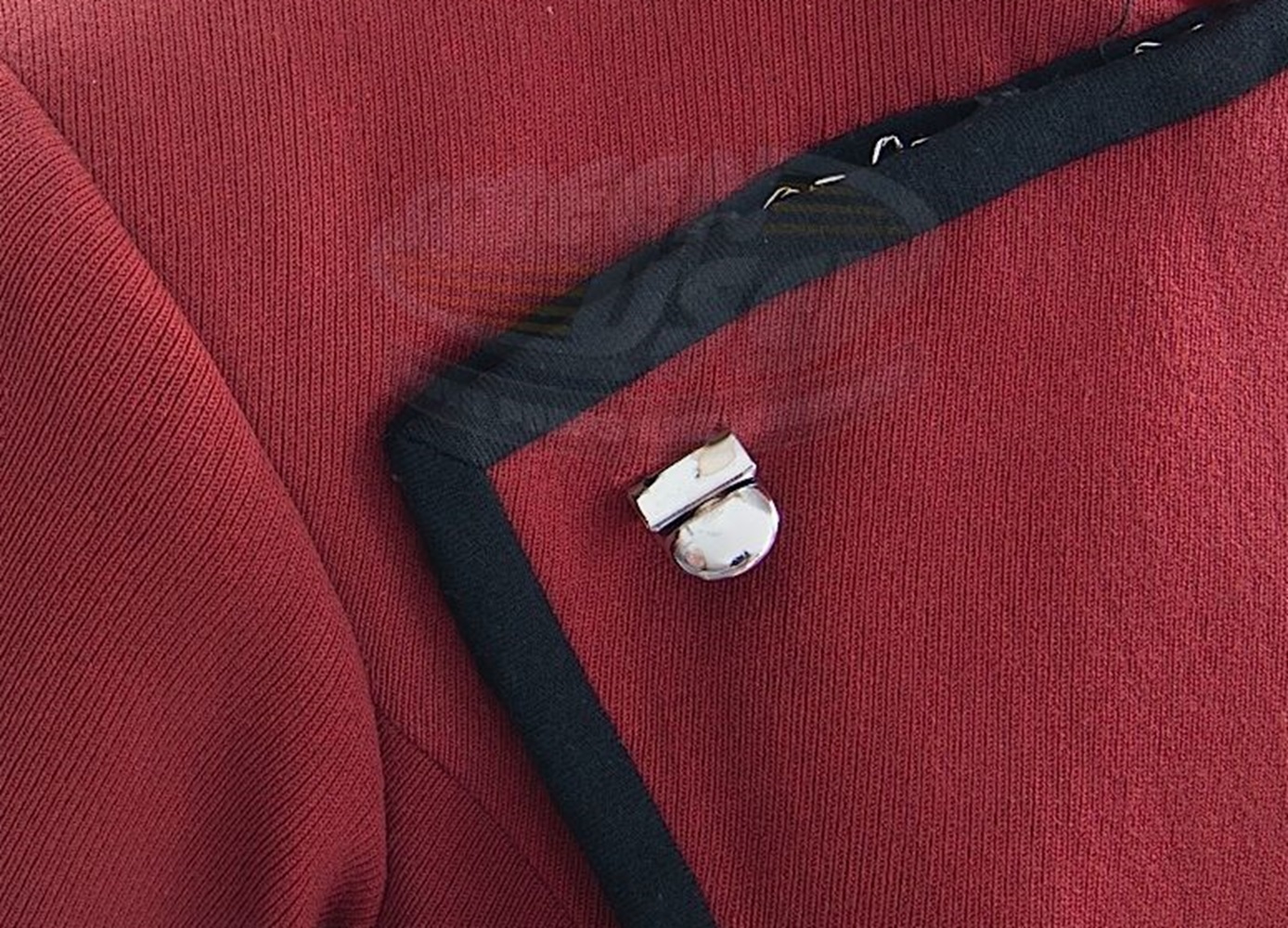
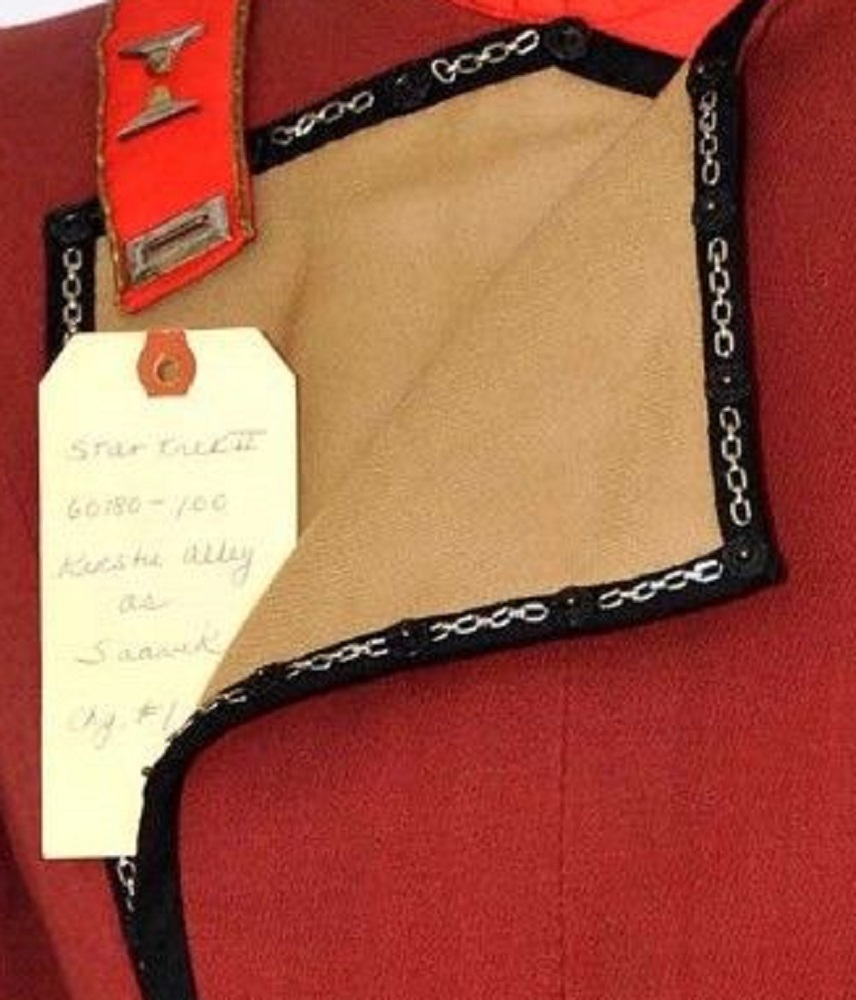
These jackets closed up the right front by a series of small black snaps.
In-between the snaps were decorative lengths of silver chain.
“In order to make it look less like plain old snaps, I found this sterling silver chain that looked strange. I ordered a reel of it and sewed it in the snaps to give it a feeling that it was perhaps a magnetic closing.”
– Robert Fletcher, Star Trek: The Magazine (September 2002), “Star Trek Costumes”
In my opinion, this was another stroke of brilliance on Fletcher’s part; even though the jackets were usually worn fully closed, hints of the chain could be seen sparkling from underneath, adding an element of charm and mystique to them.
When the jackets were worn with the “flap” undone, the area was definitely more visually interesting with the chain:
Unfortunately there wasn’t always enough chain for every uniform, particularly into the later movies and TV series; the upper area of the jacket didn’t look nearly as interesting without the chain.
He's really unhappy his jacket doesn't have chain
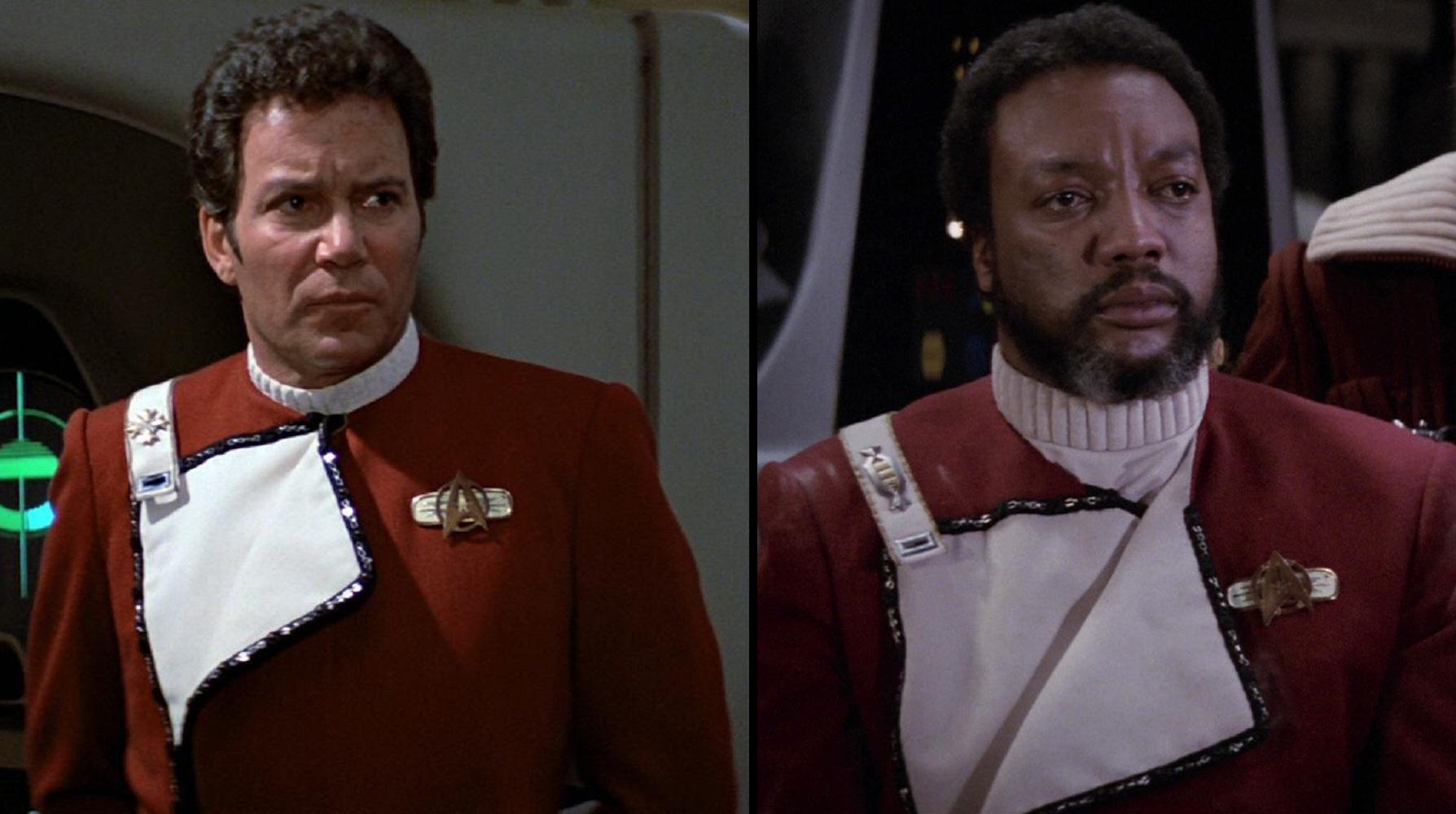
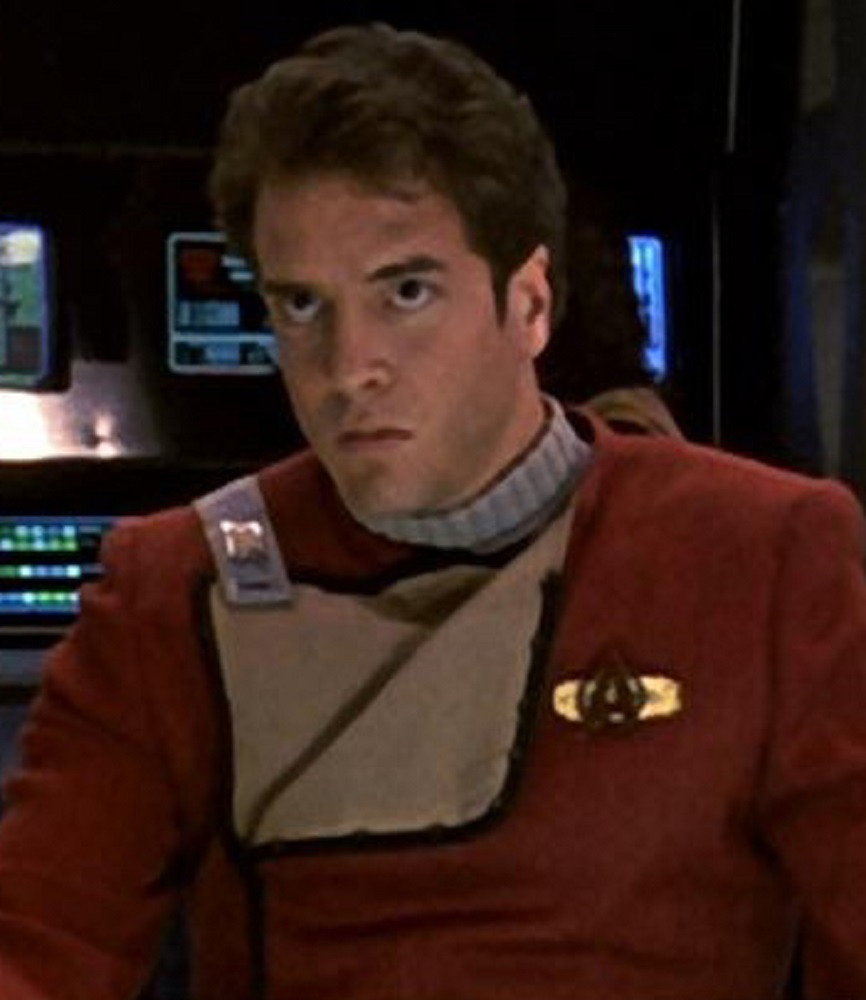
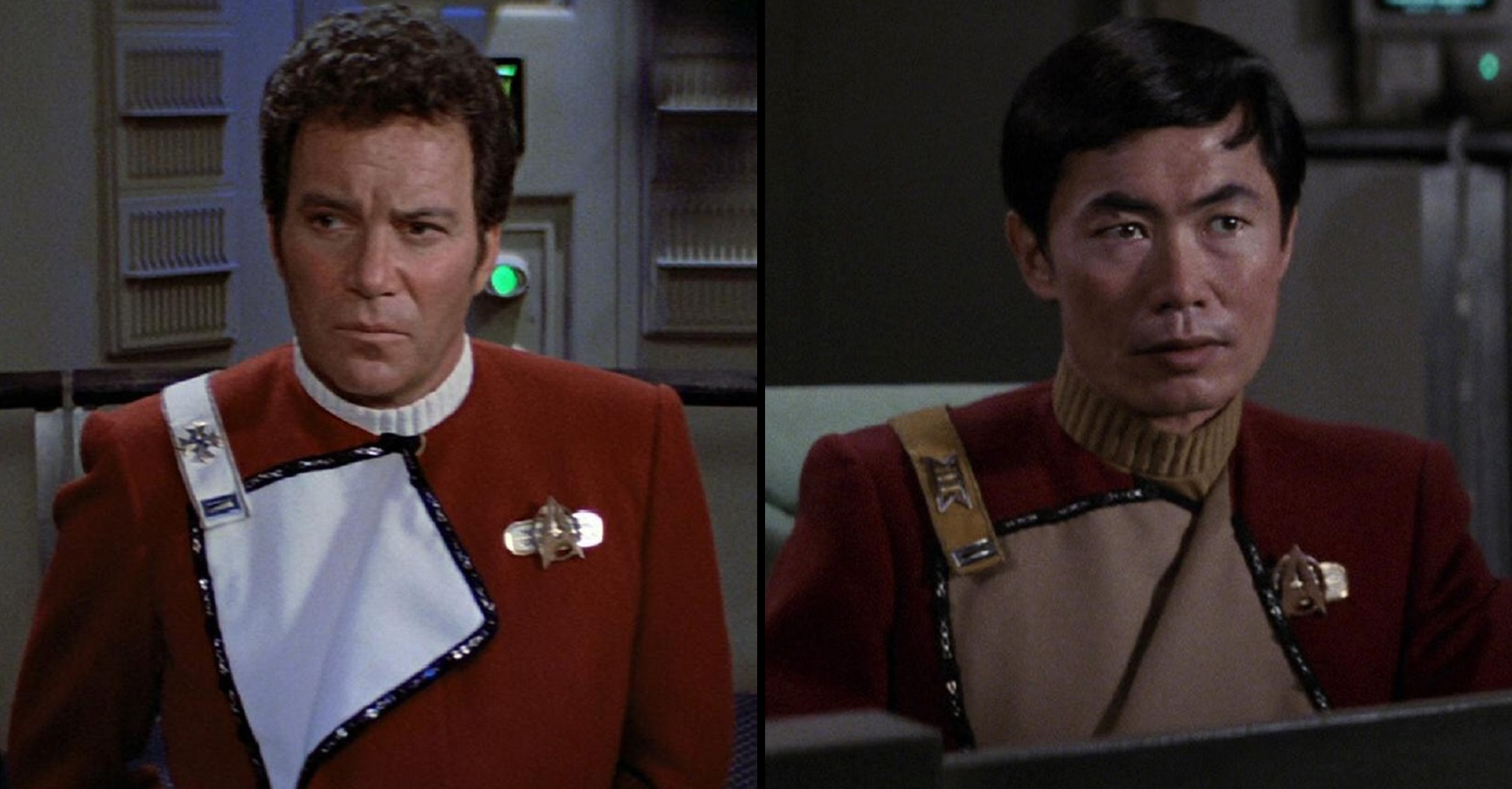
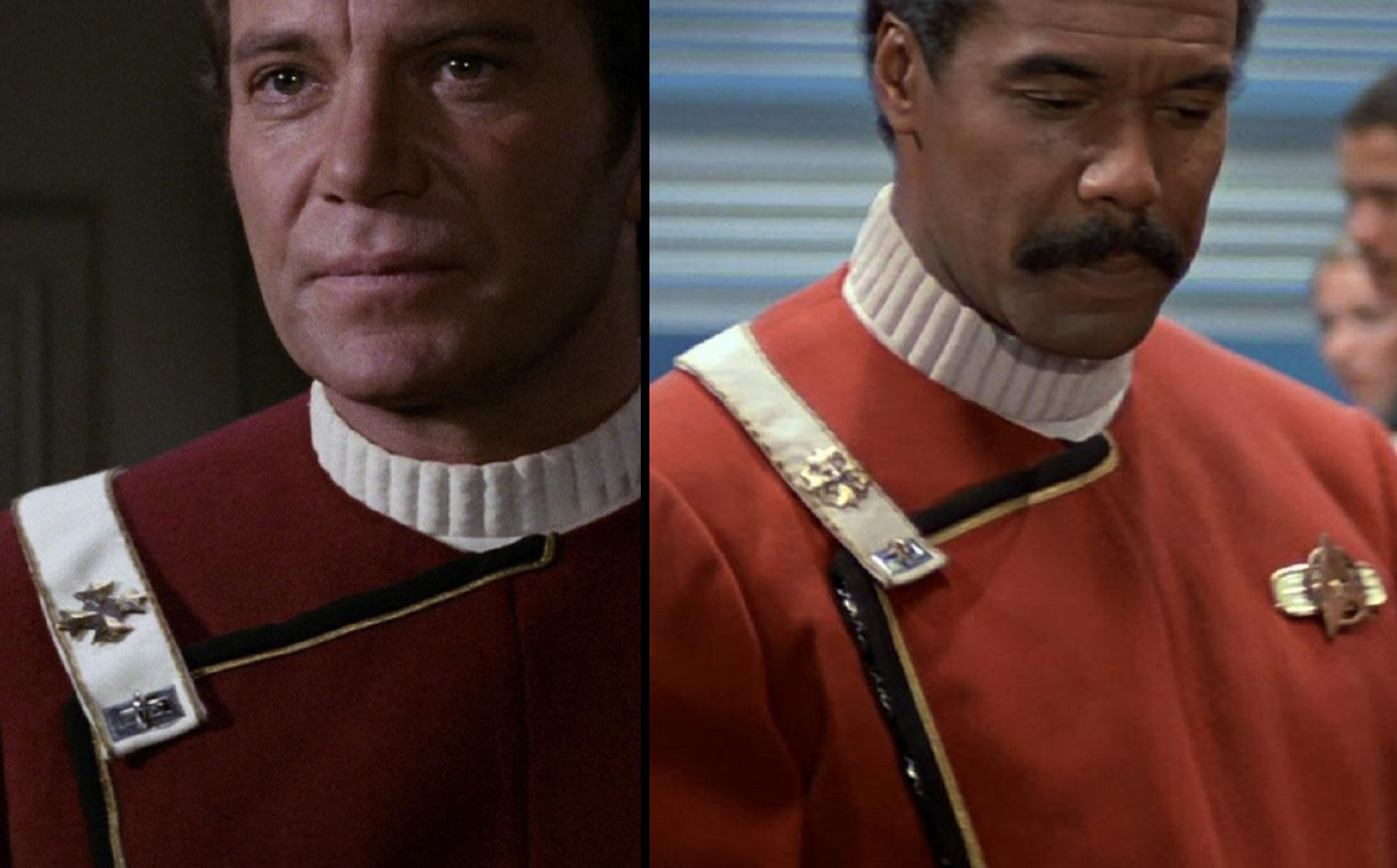
The jacket overlap was faced with a contrasting fabric; captains and flag officers had “white” flaps, while everyone else’s jackets had tan flaps.
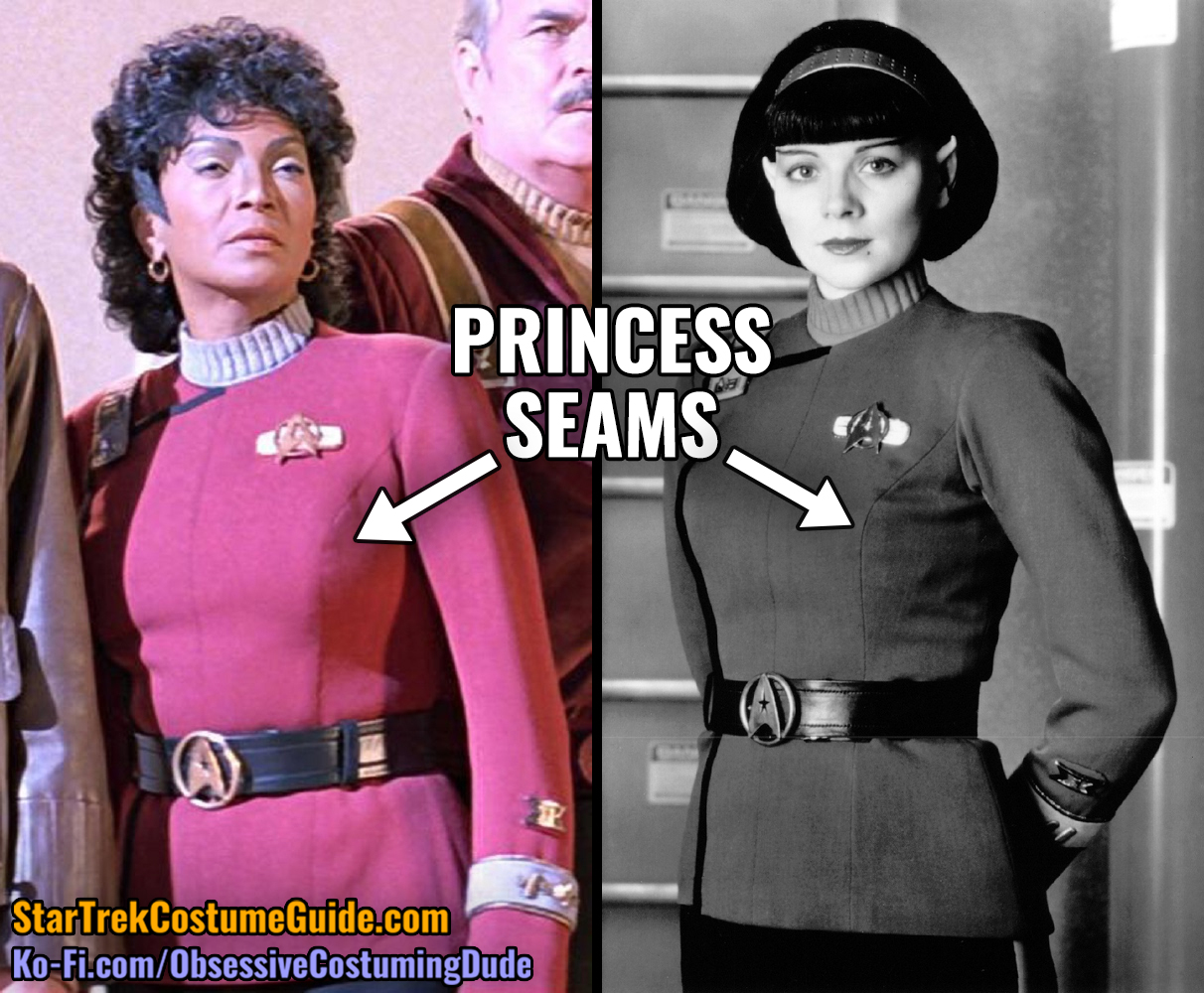
The women’s jackets had princess seams on the front:
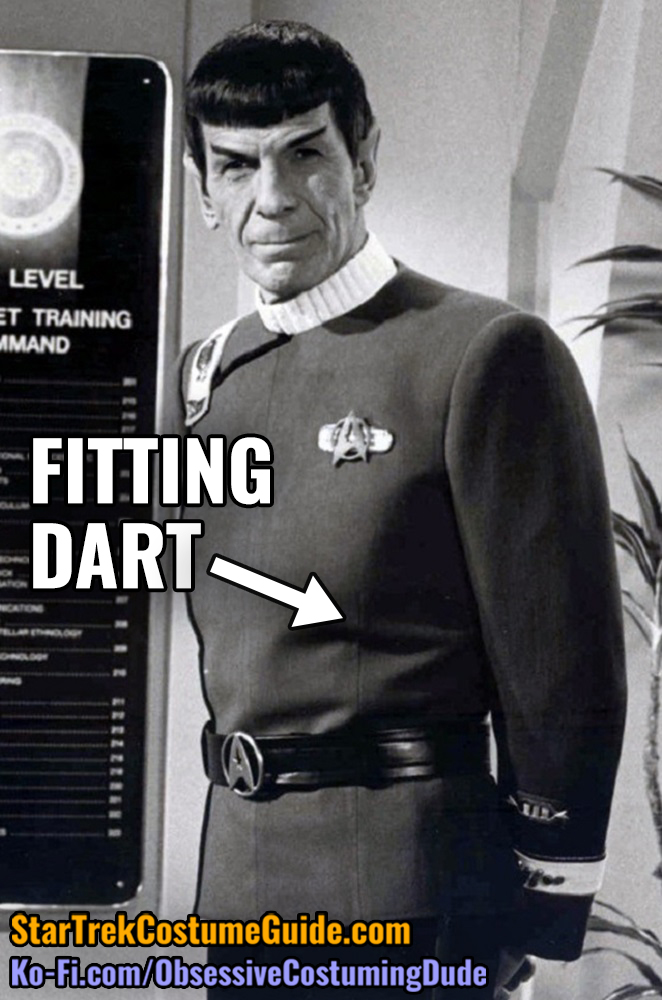
However, the men’s jackets had fitting darts beneath the chest.
Both the men’s and women’s jackets had princess seams along the side back, which were accented by black piping sewn into the seams.
Jacket Variations and Variants
With all that in mind, there were several variations of these jackets.
Standard officers’ jackets (ensign up to captain) had plain black trim along the right overlap.
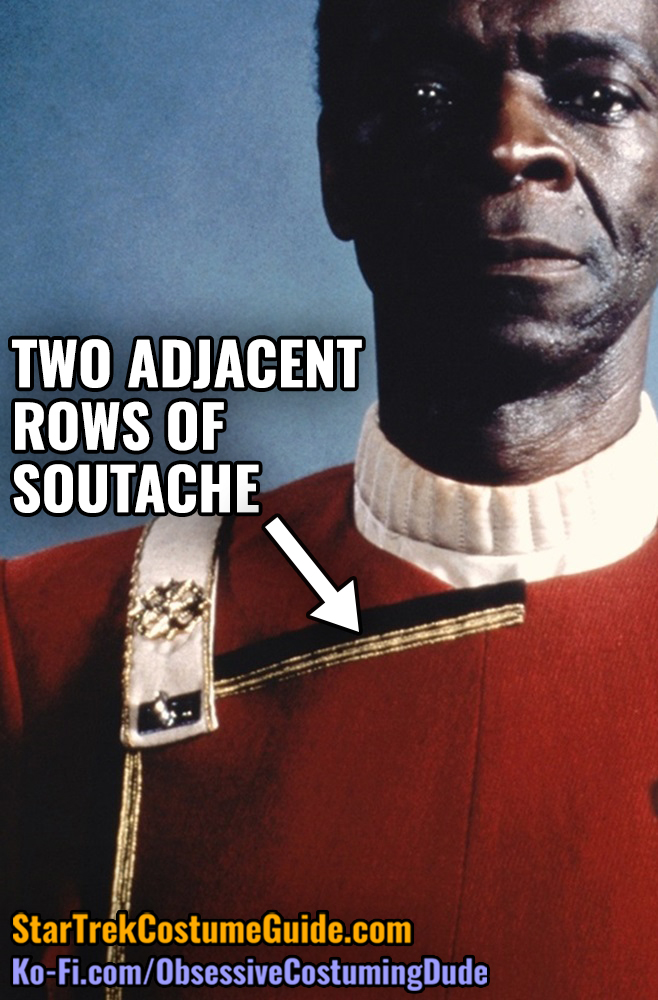
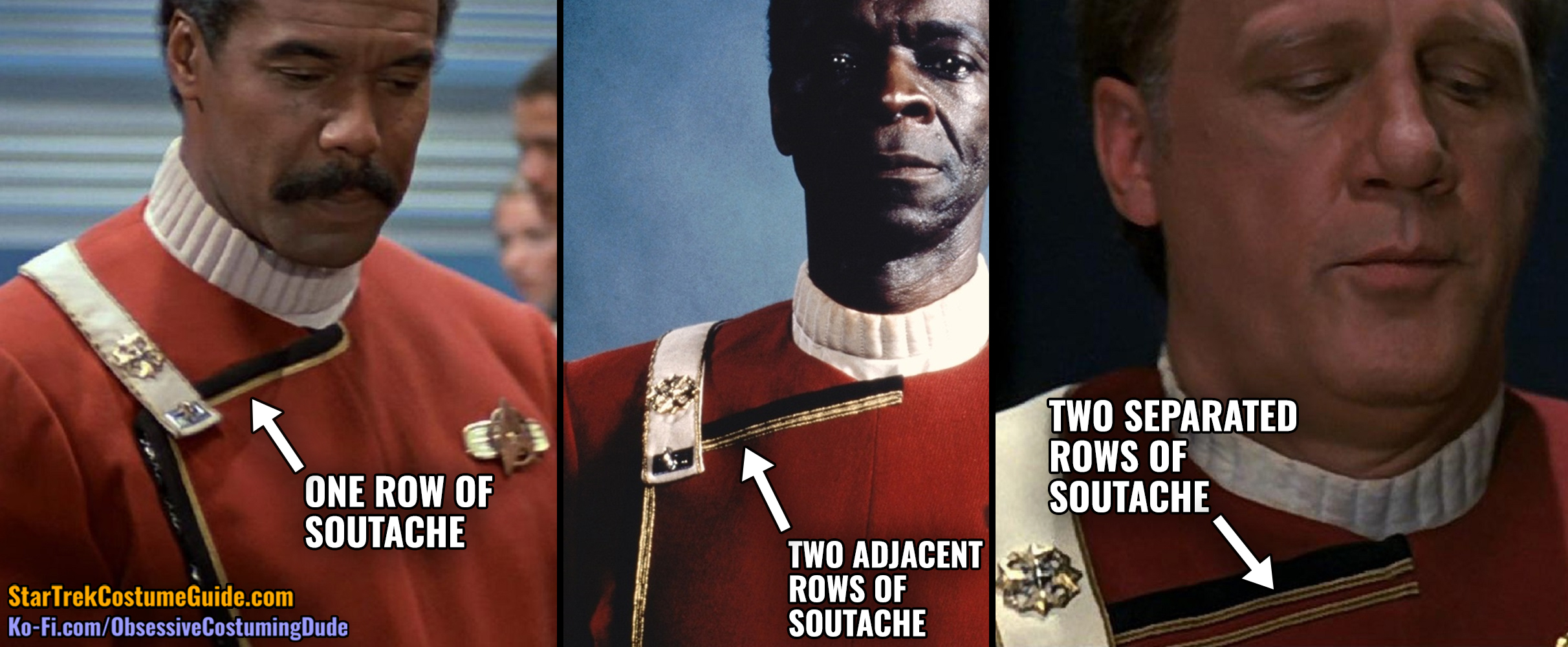
However, flag officers’ jackets had gold soutache accenting the edge of the black trim.
Fletcher made no distinction between the specific admiral ranks in relation to the soutache, but there were a few variations that are open to interpretation.
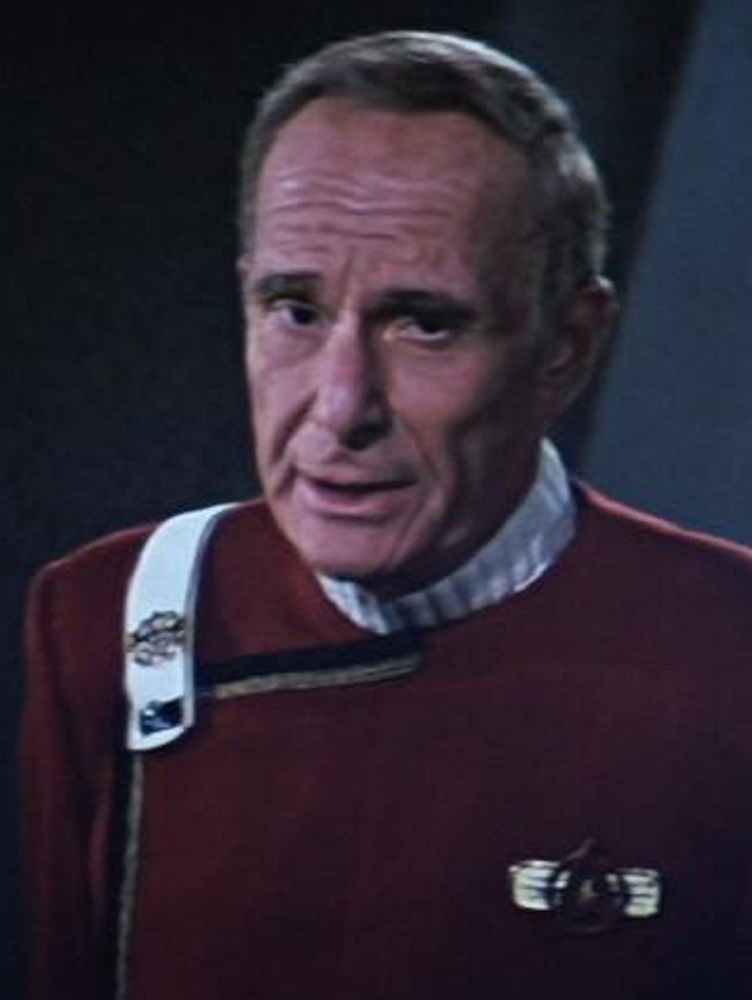
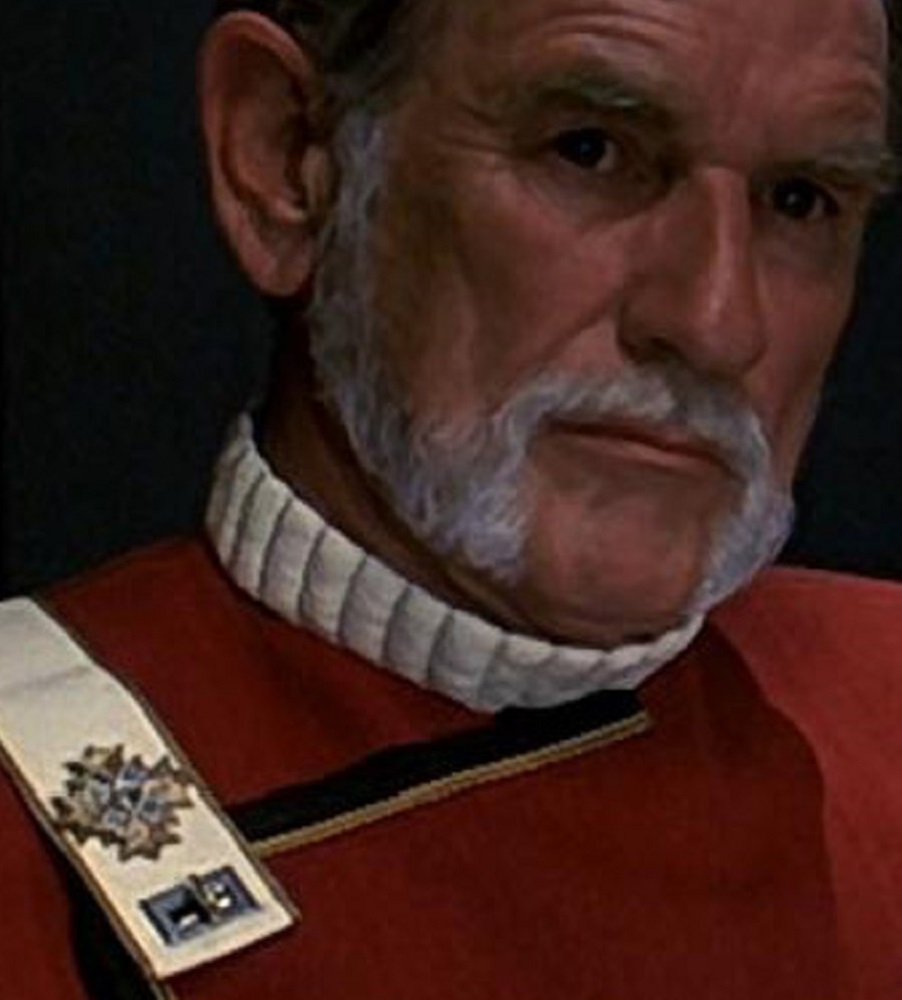
At first, in ST2 and ST3, it looks like all admiral jackets just had the one narrow band of gold soutache:
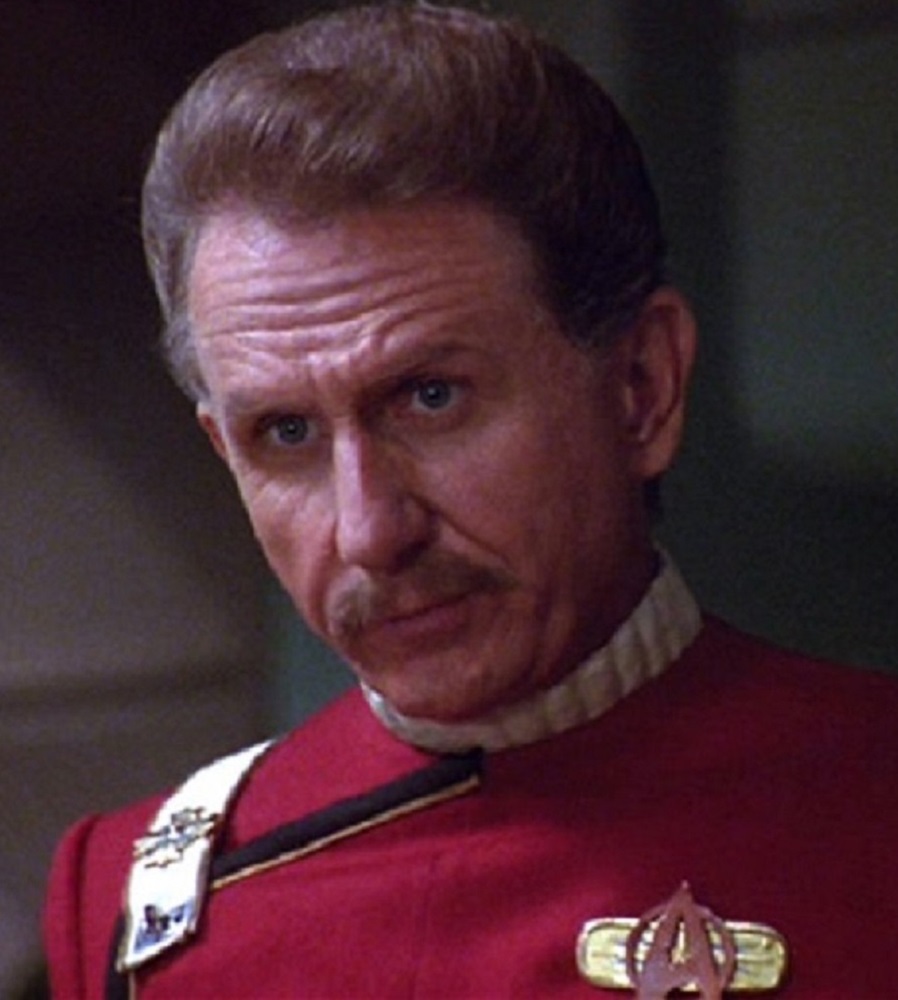
In ST4, Admiral Cartwright (who carried the same rank as Admiral Morrow in ST3) had two adjacent rows of gold soutache on his jacket:
Same thing for Harve Bennett’s cameo in ST5, although I think he was just wearing Admiral Cartwright’s jacket from ST4.
Then in ST6 things really got confusing.
We saw a full admiral wearing a jacket with only row of soutache, which I guess was fine.
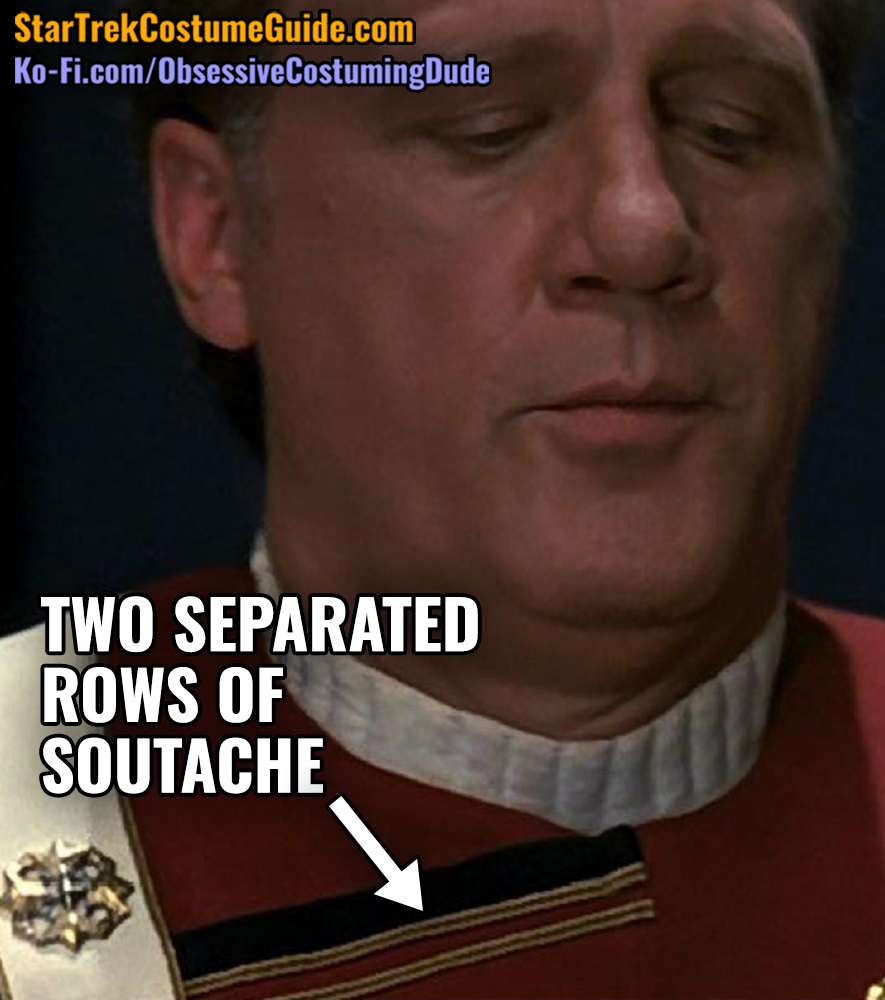
Then we saw another “Admiral of the Fleet” (aka “Fleet Admiral?”), the same rank as Admirals Morrow and Cartwright, with two rows of soutache slightly separated.
One might naturally conclude this was a distinction for the Starfleet C-in-C, but Admiral Morrow’s uniform didn’t have the second band in ST3.
And of course there was the whole “Colonel” thing, which I honestly think was just a mistake … and whether or not it’s even in the movie depends on which version you’re watching.
So I think we can safely surmise that Commodore (unseen), Rear Admiral, Vice Admiral, Admiral, and Colonel (grr) all had one band of soutache.
But we saw one band of soutache on Fleet Admiral Morrow, two adjacent bands of soutache on Fleet Admiral Cartwright, and two separated bands of soutache on Fleet Admiral Smillie.
At least two of those three were Starfleet C-in-C at the time. (In the ST4 novelization Admiral Cartwright was C-in-C, but it’s up to you whether or not to accept that as canon.)
Like I said, this is apparently open to interpretation; mine is that Fletcher’s original intent was for all admirals to have one band of soutache, then things started going off the rails a bit from ST4 onward.
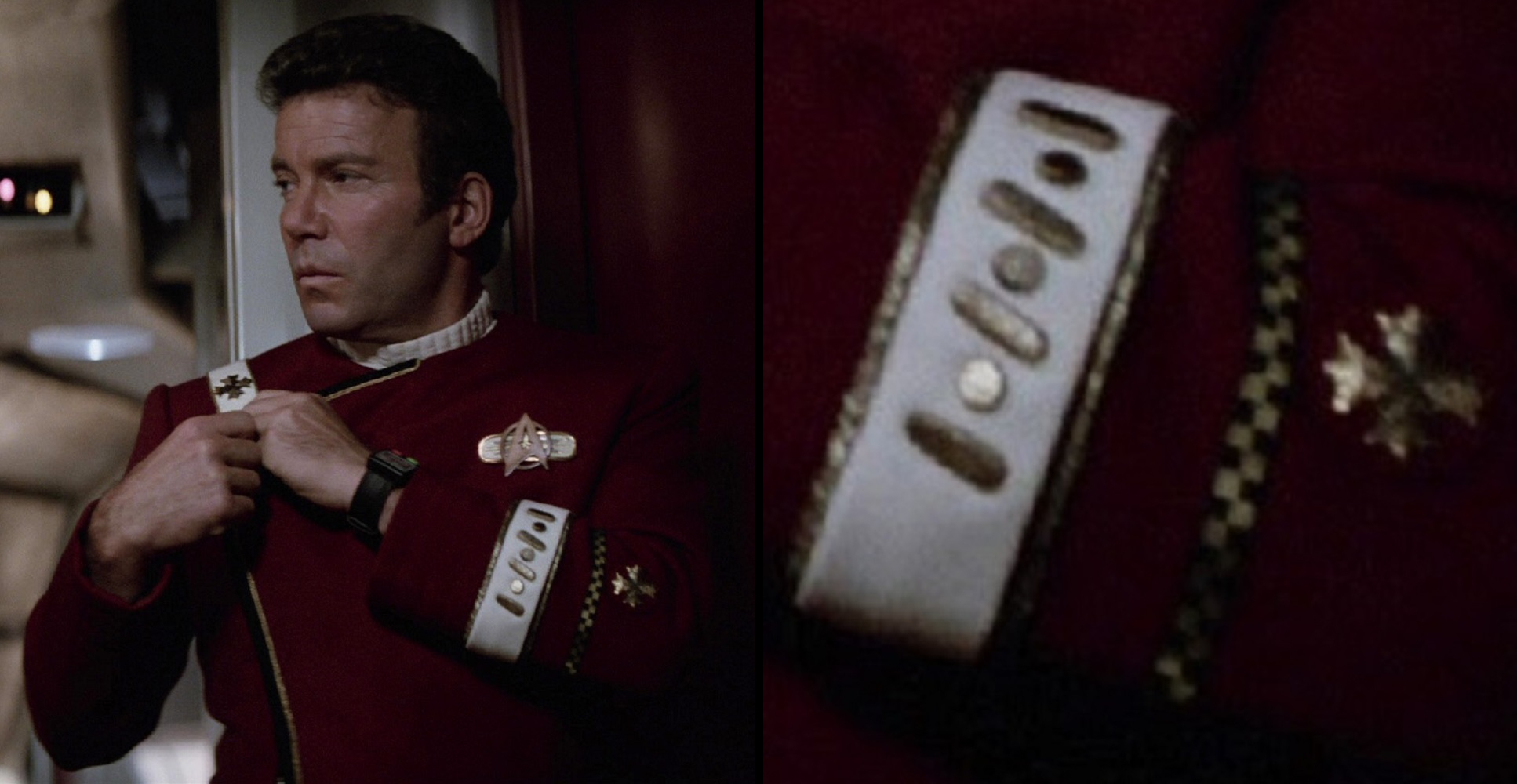
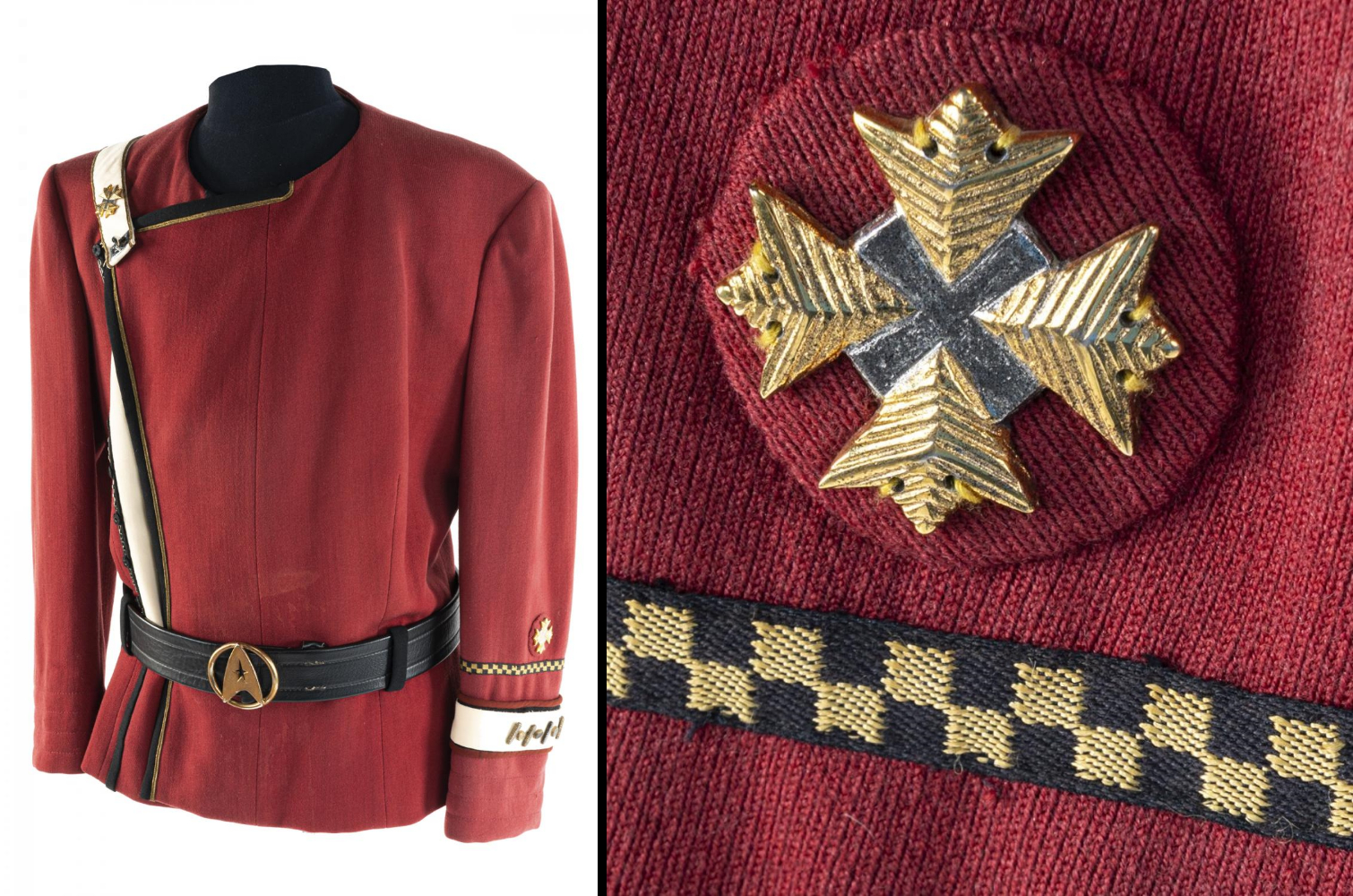
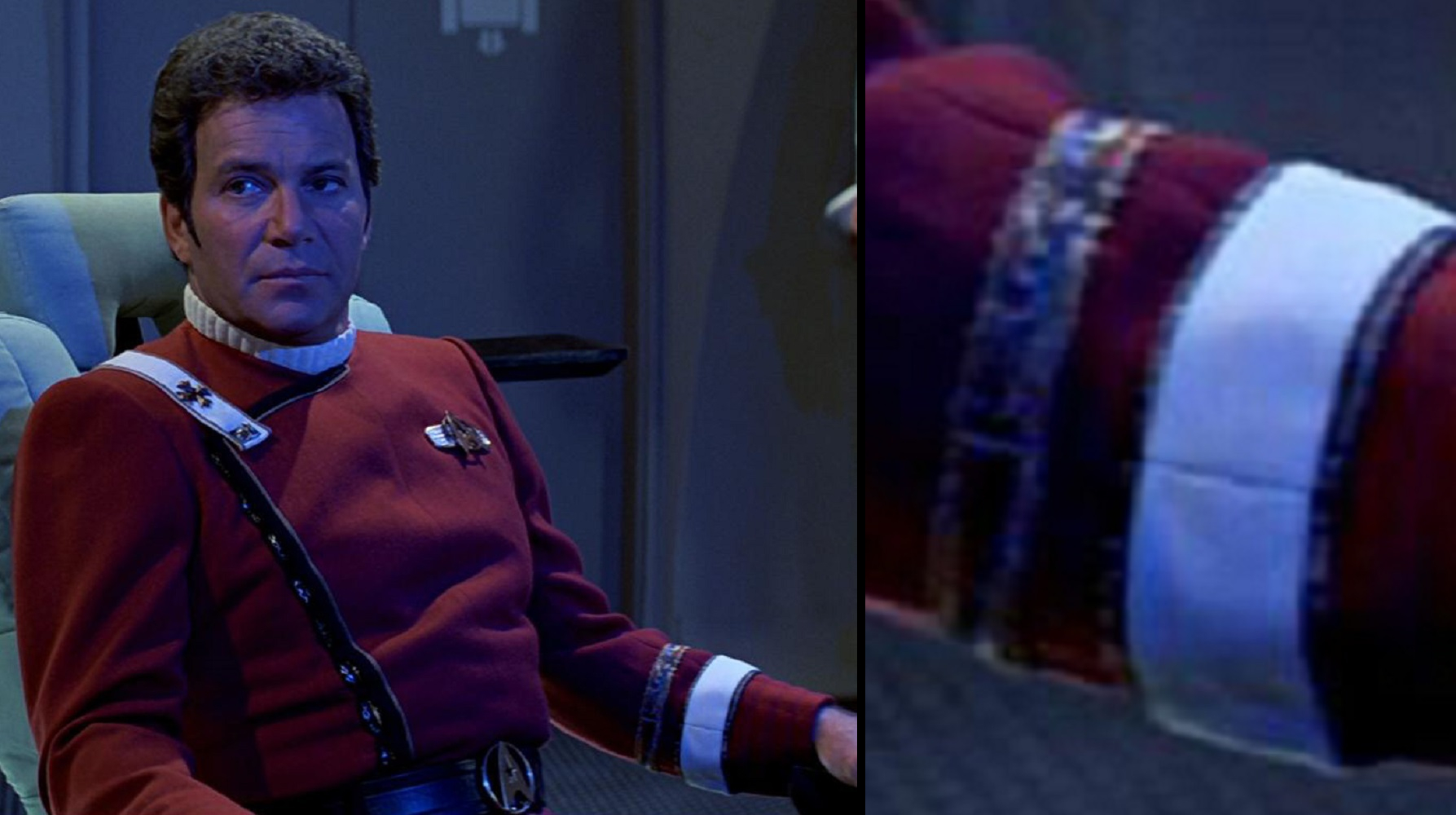
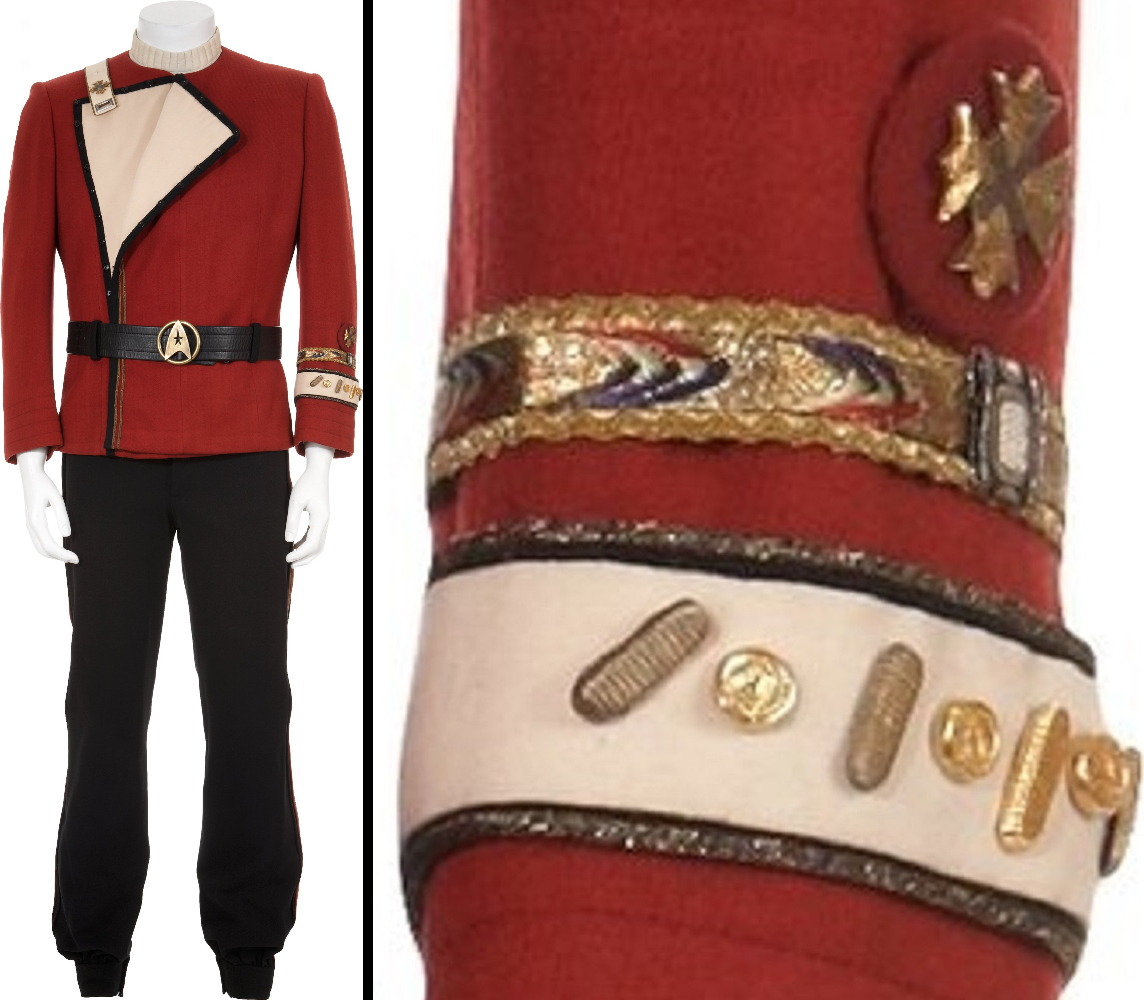
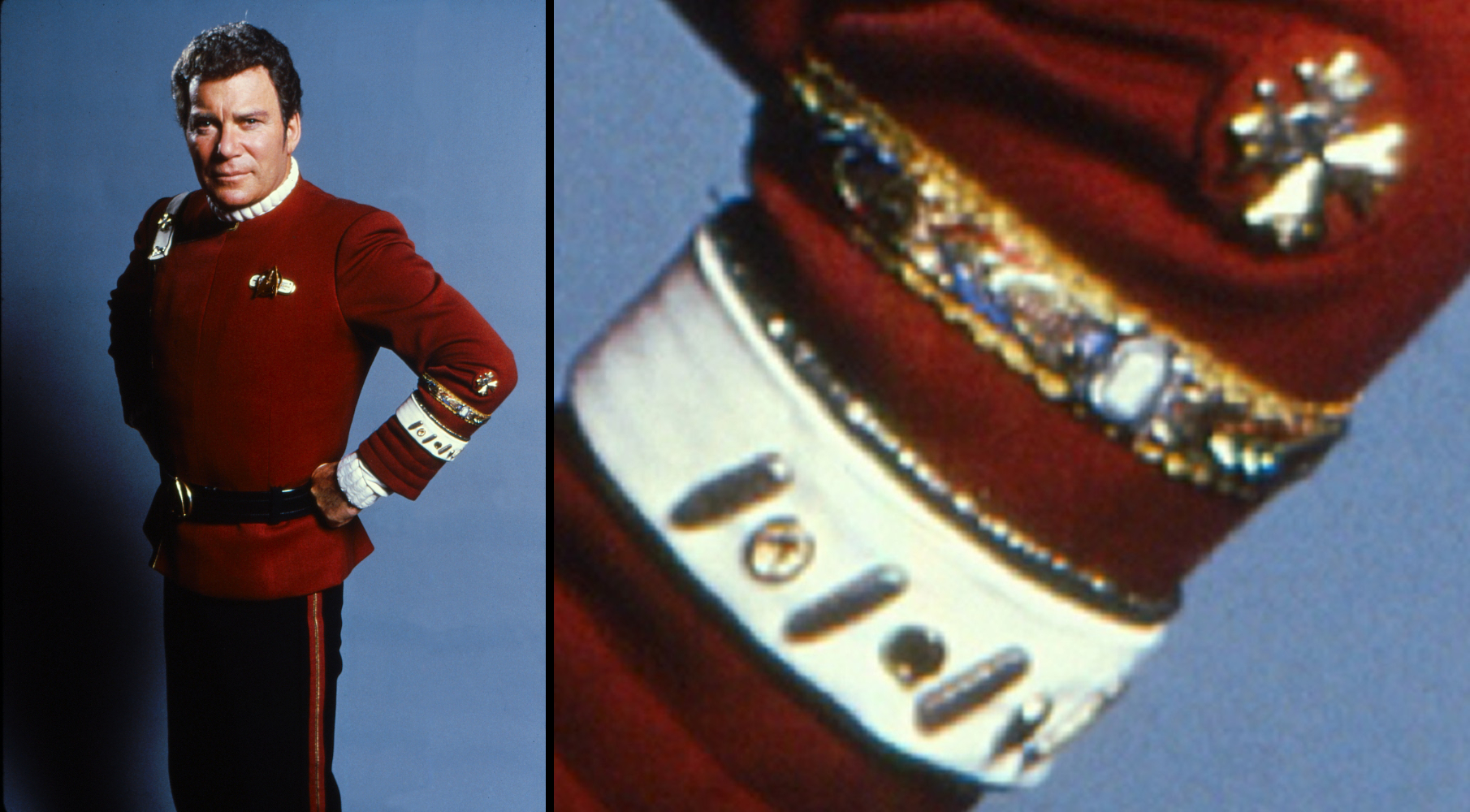
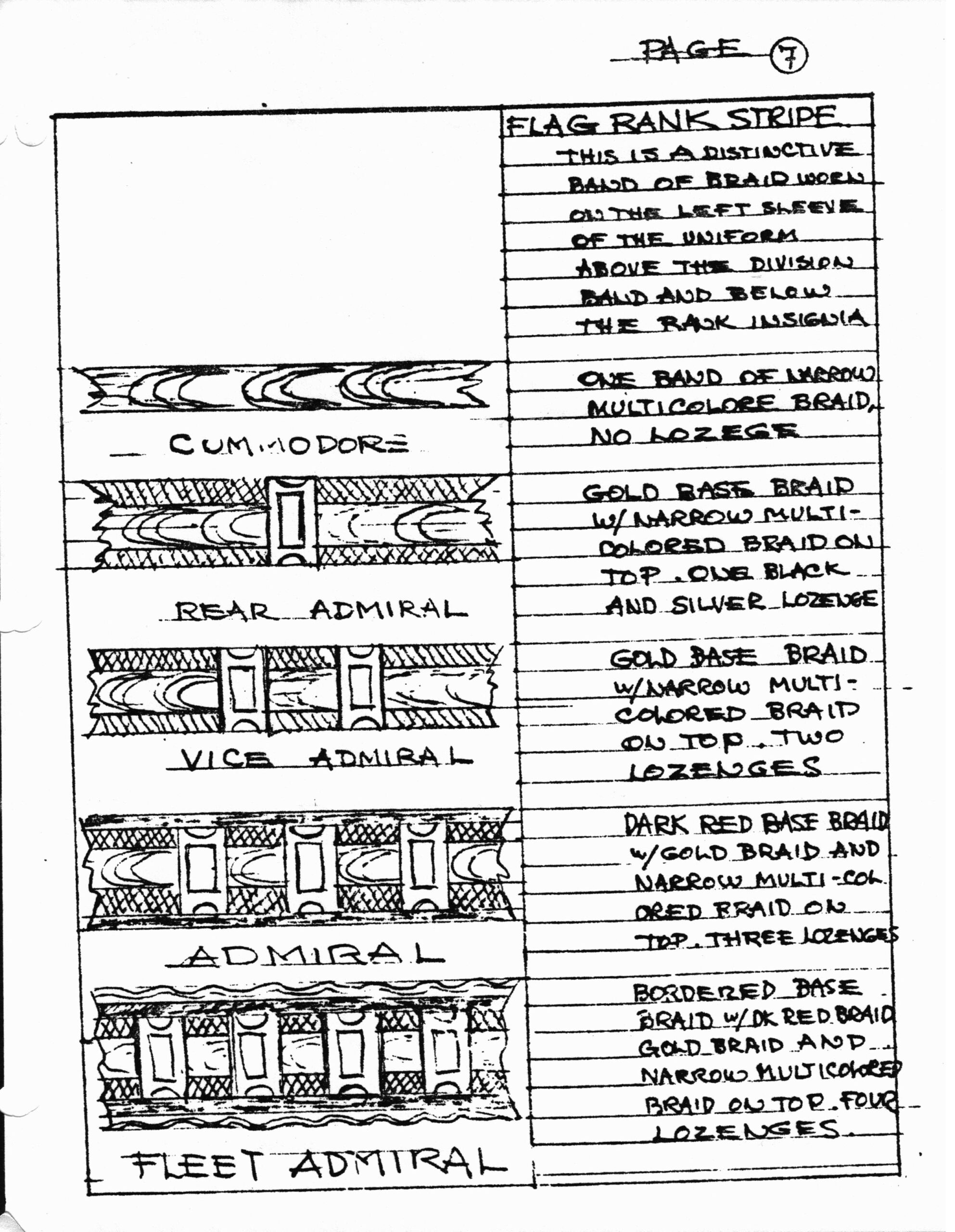
Flag officers also wore a distinctive braid on their lower left sleeves, in-between their sleeve bands and rank insignia.
In The Wrath of Khan, this was a narrow band of black/gold checkered trim:
However, from ST3 onward, this was changed to a more ornate, colorful trim:
Here are Fletcher’s notes on the admiral sleeve braid from ST3 onward:
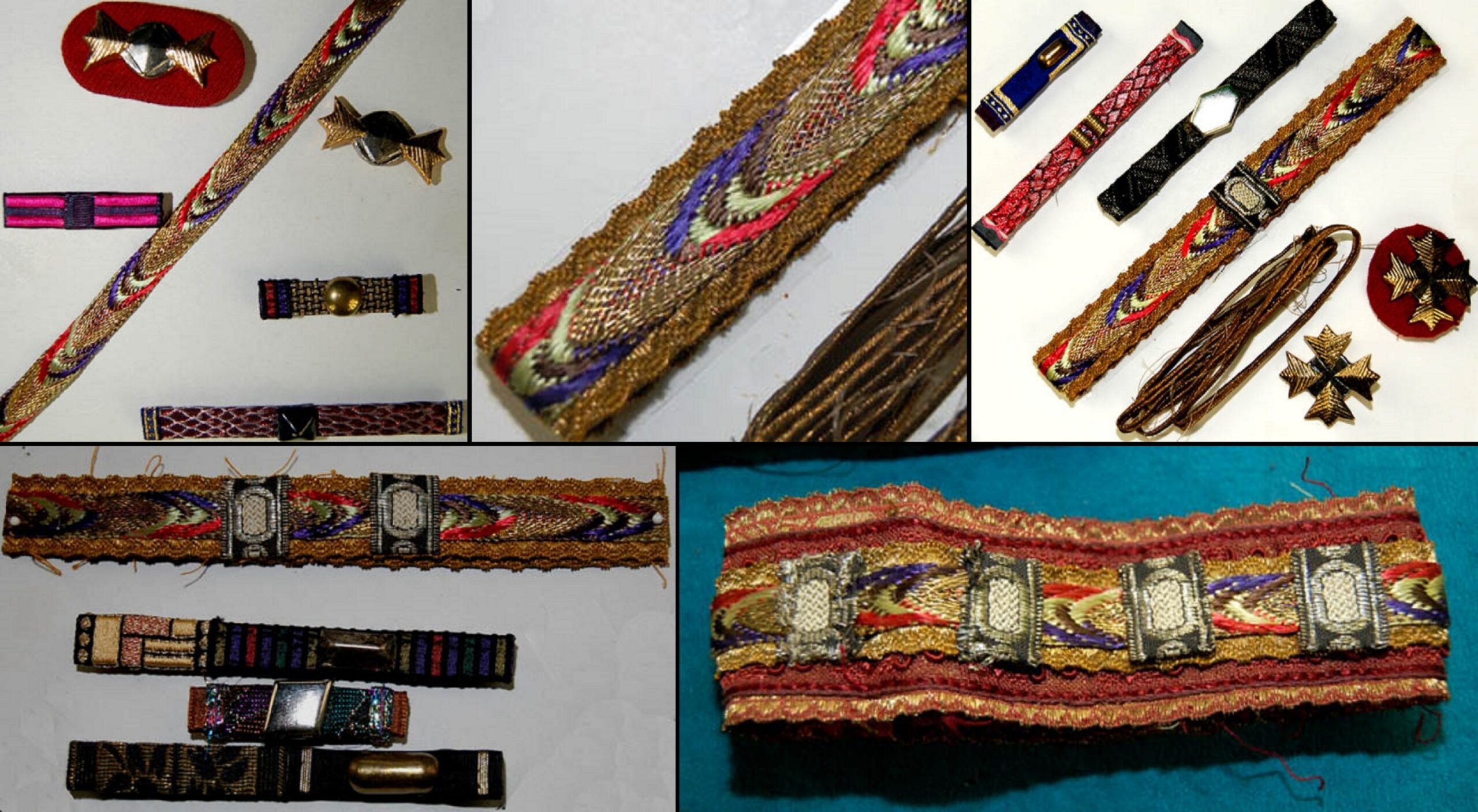
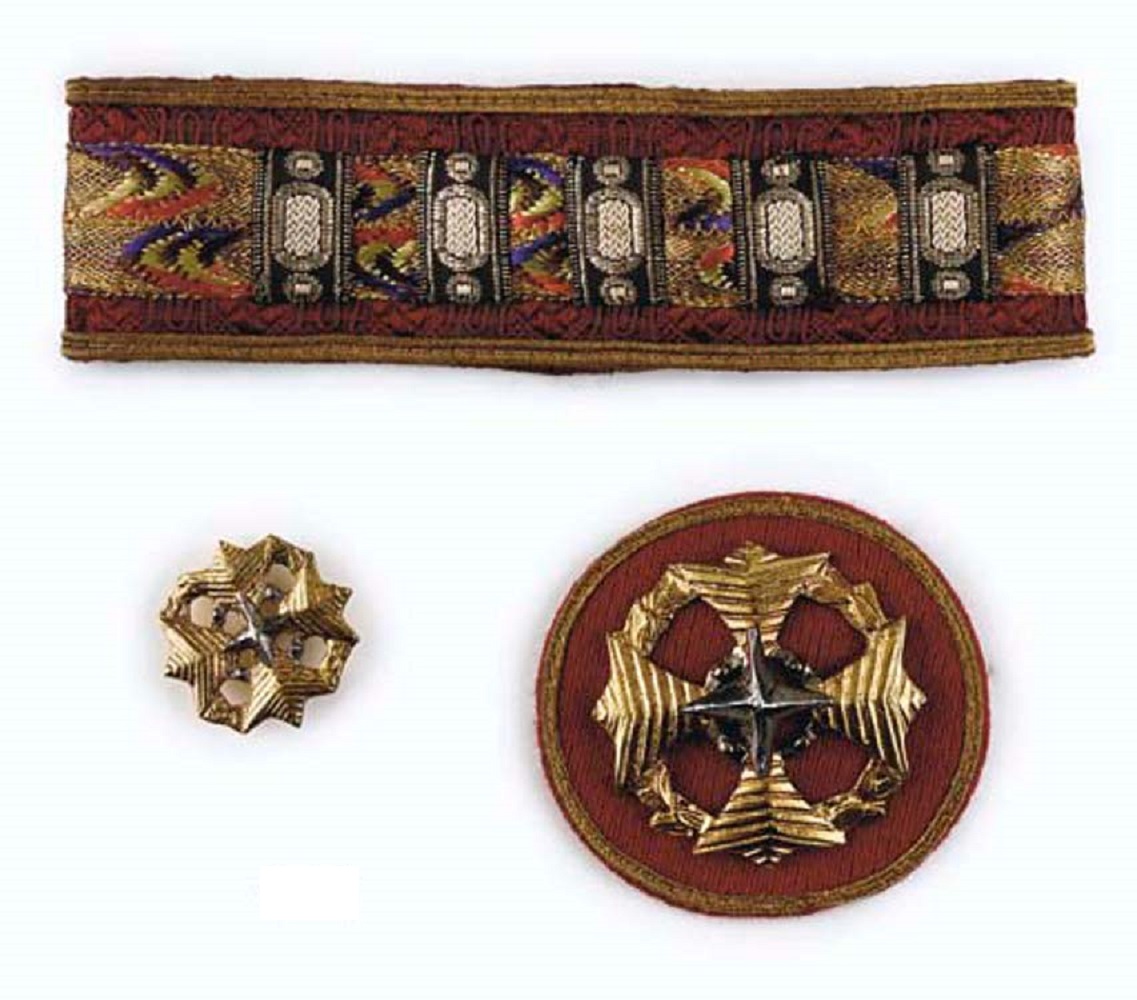
And here are some close-up auction photos of these admiral braids:
There was also this braid with five lozenges, which Fletcher didn’t mention in his notes.
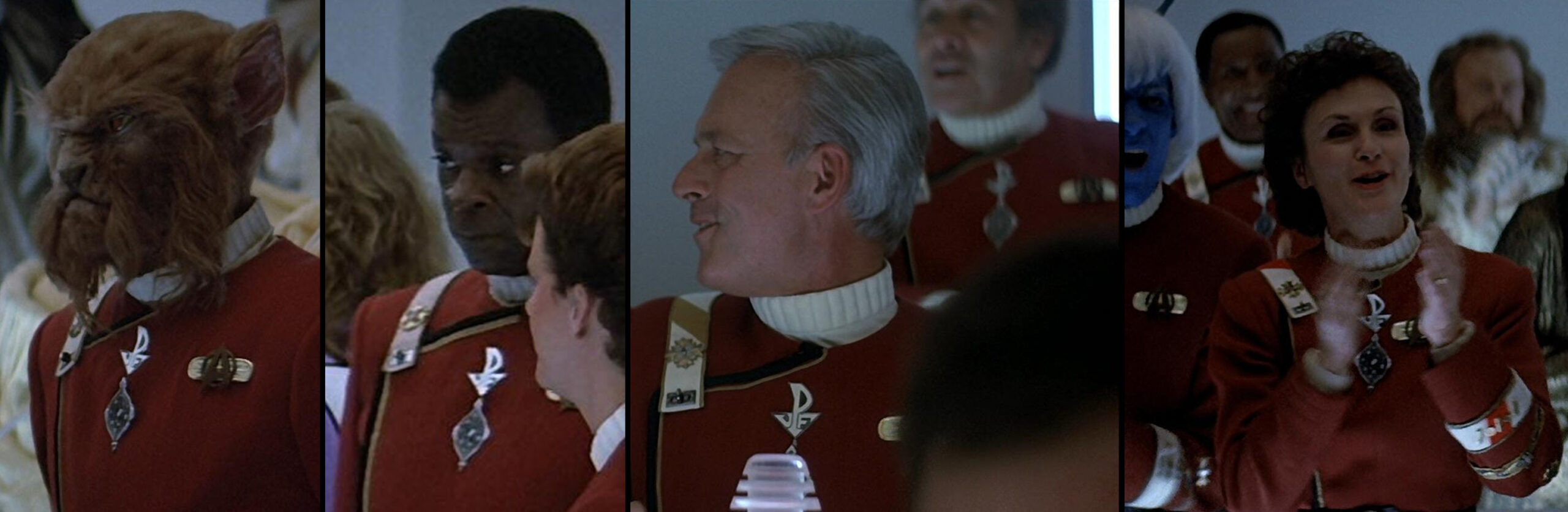
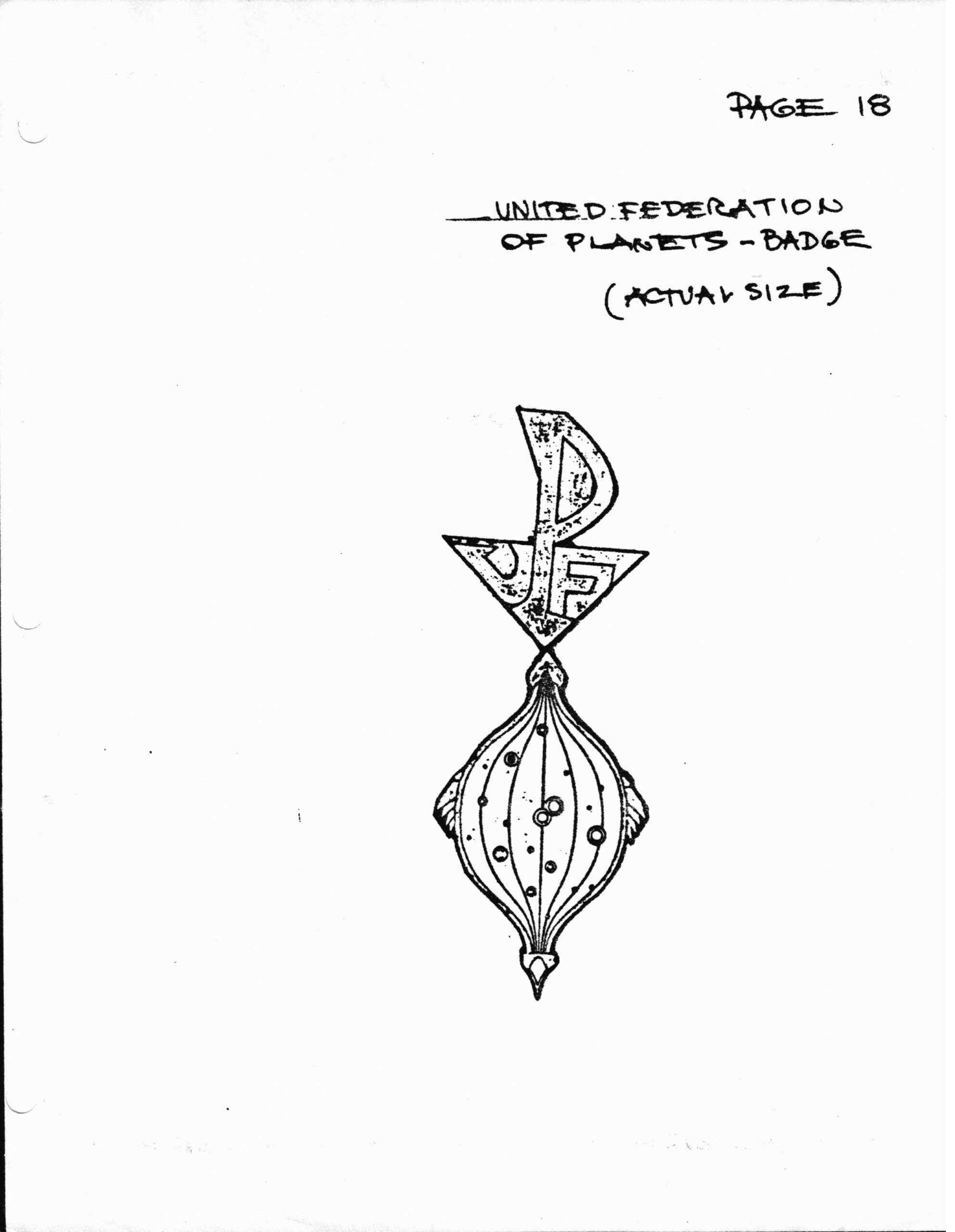
During the court-martial near the end of ST4, multiple Starfleet officers (mostly, perhaps entirely admirals) were seen wearing a large “UFP” badge on their upper front chests:
In his notes, Fletcher simply describes this as, “United Federation of Planets – Badge.”
My personal interpretation is that these were worn by members of the Federation Council.
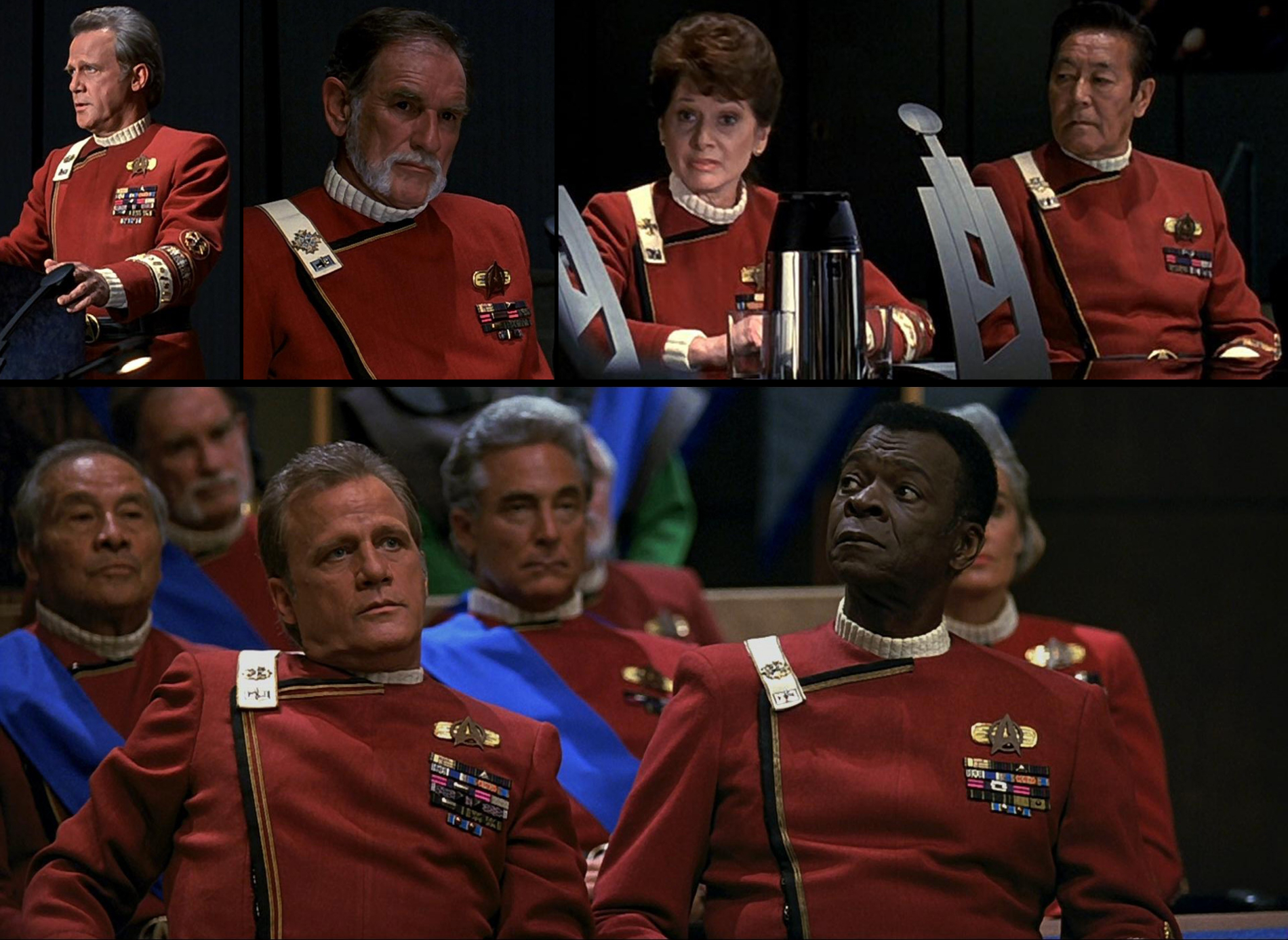
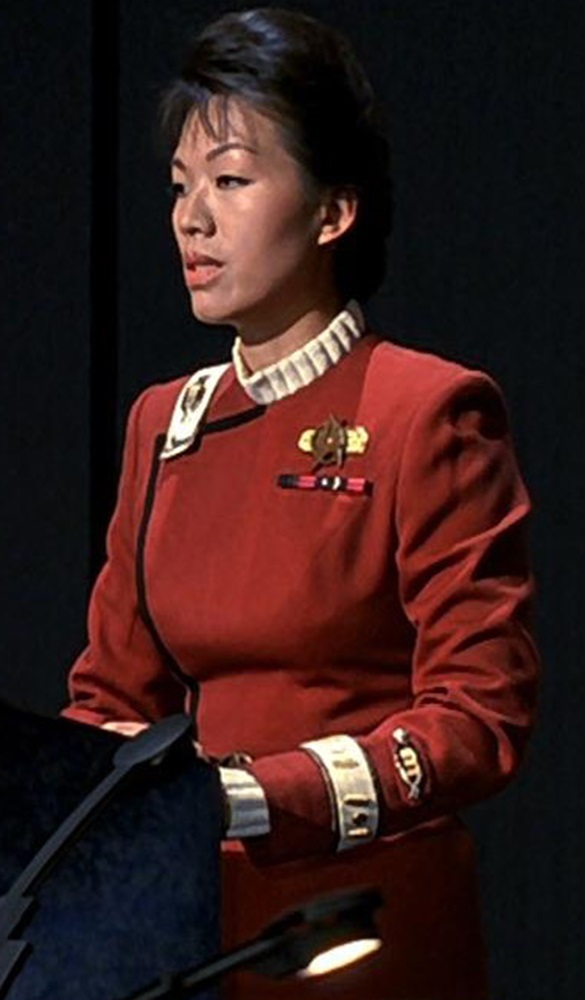
In ST6, flag officers wore award ribbons on their upper left chest, beneath the standard Starfleet chest badge.
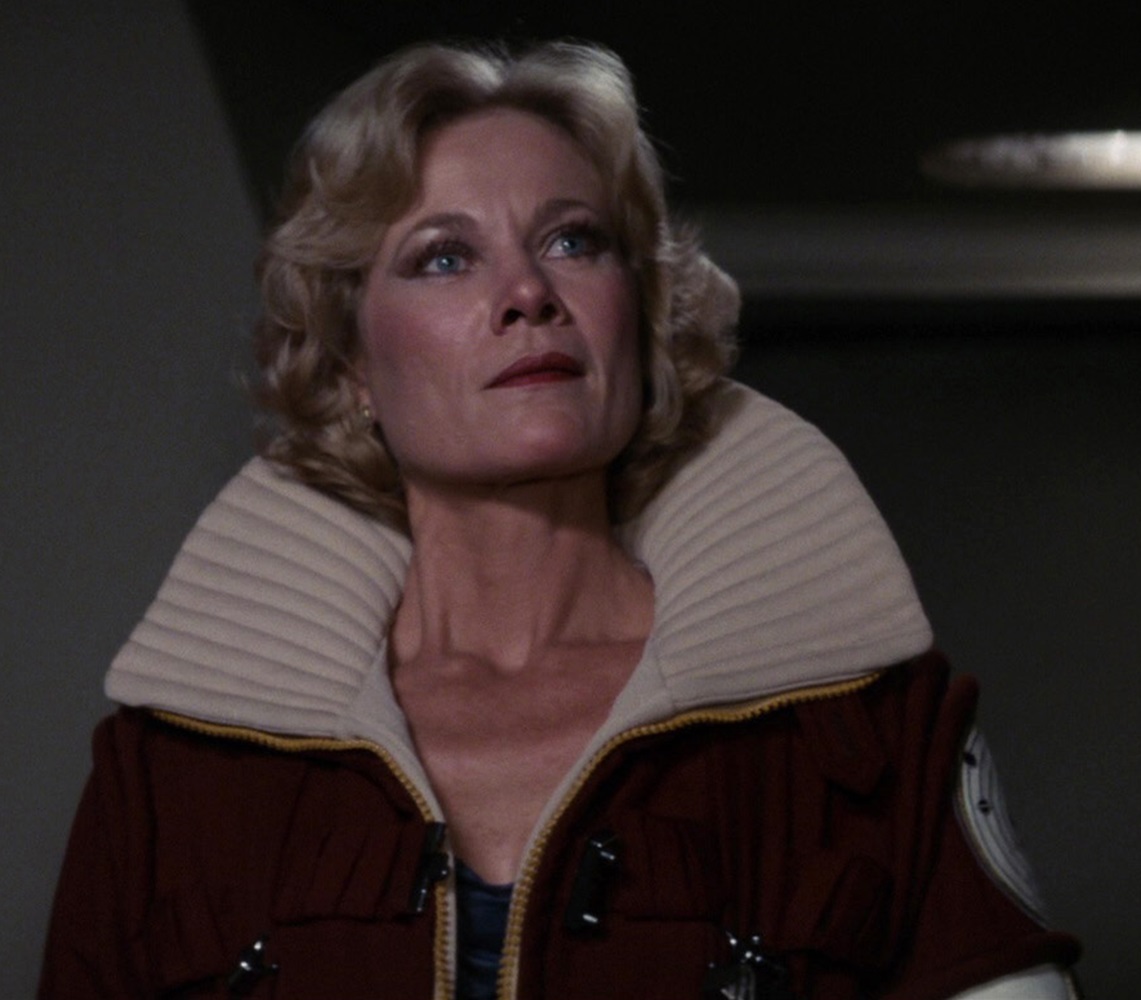
Curiously, the lady who introduced the C-in-C did as well, even though she wasn’t a flag officer.
Anyway, these awards were also seen during the prologue of Generations, which makes sense.
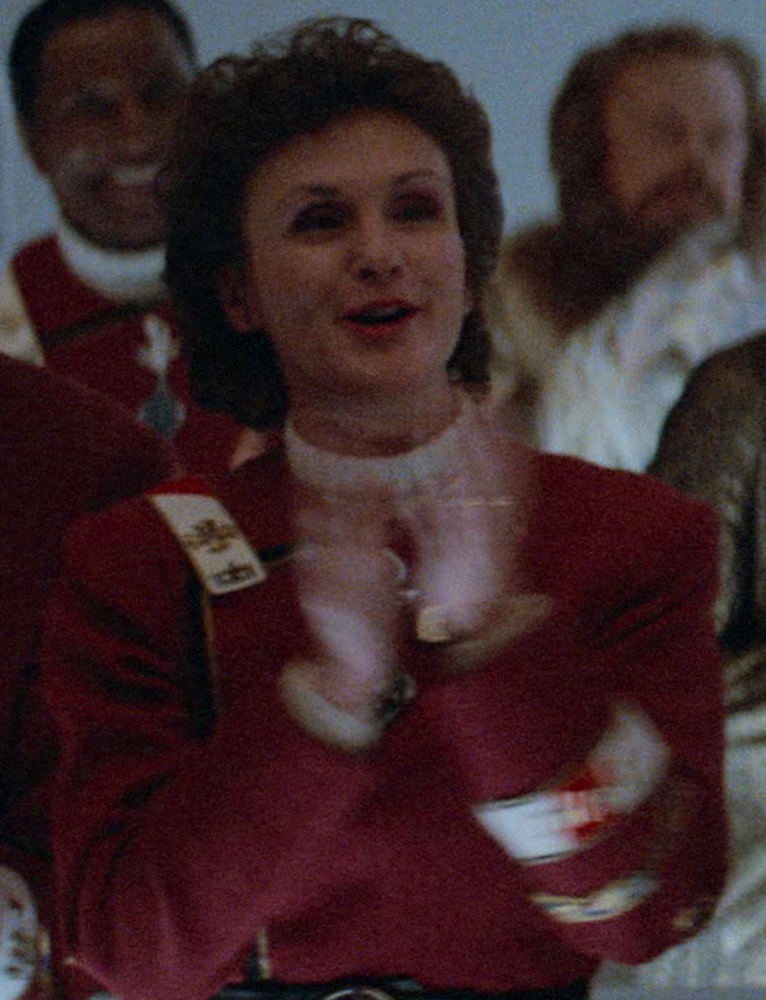
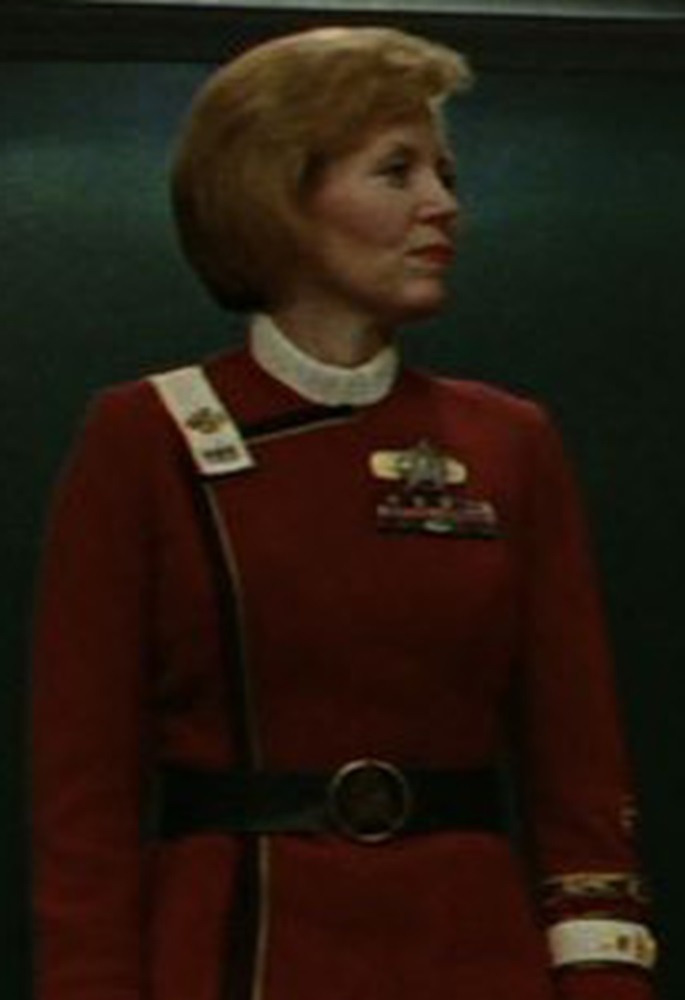
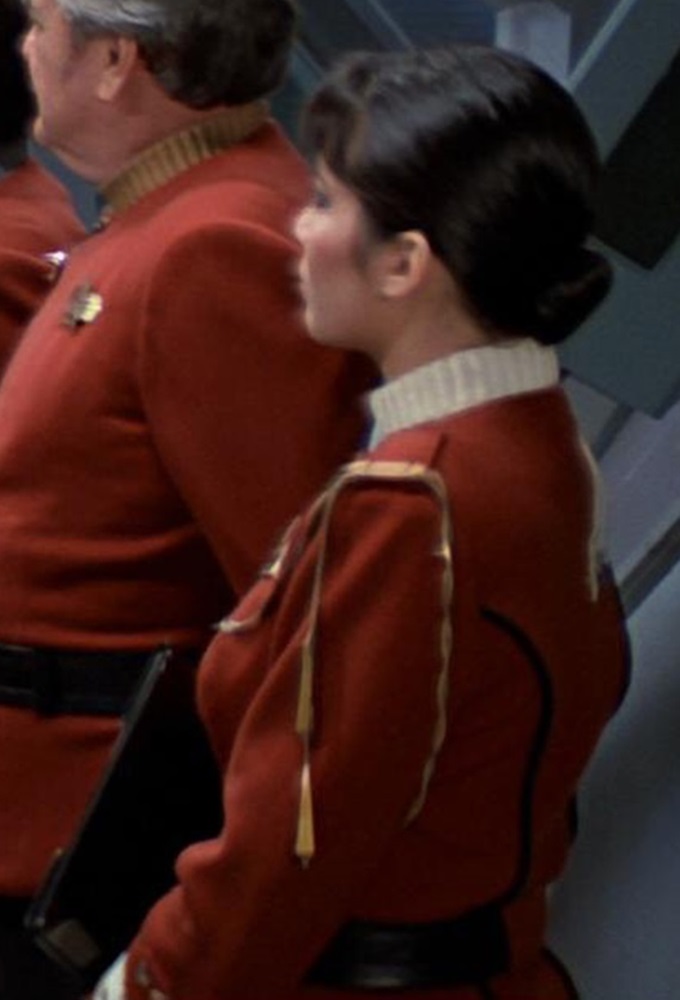
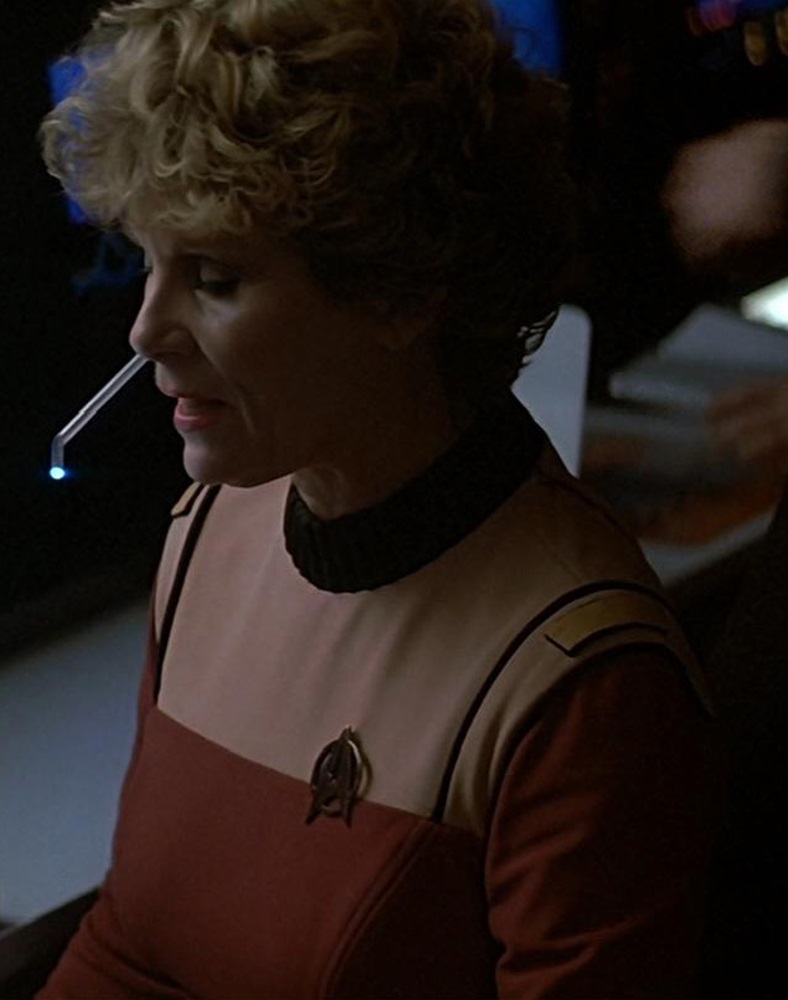
In ST3, this lady’s jacket had epaulets, and she wore a gold rope around her left shoulder.
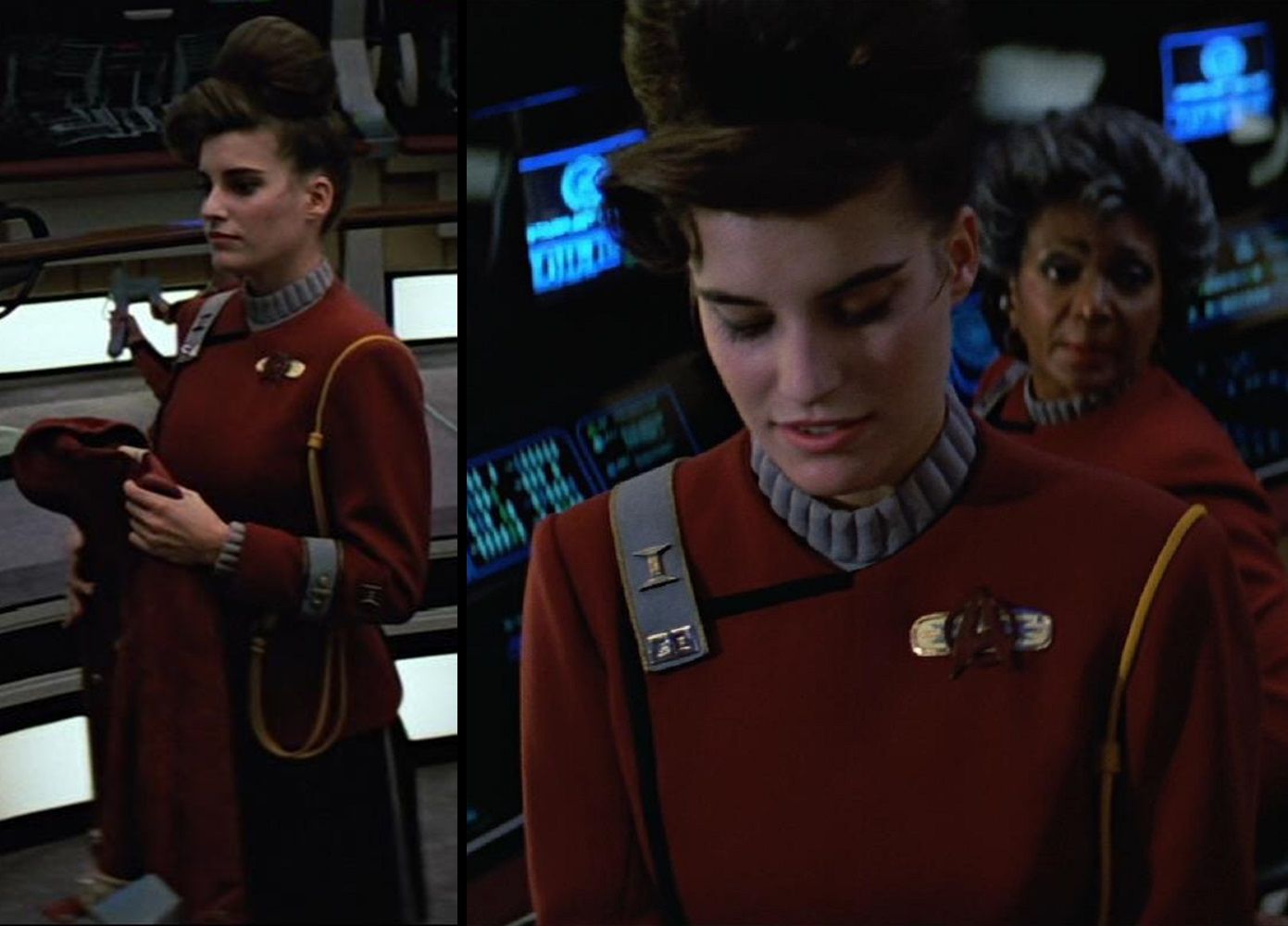
In ST5 we saw something similar, but this lady’s jacket didn’t have the epaulets.
And in ST4, this guy wore white gloves with his jacket.
Honestly, I don’t know what any of those mean. I just wanted to mention them as points of interest.
Another jacket variant was worn with these alternate chest badges in the “Starfleet Academy” video game by Interplay.
Wearing Styles
Another neat thing about these jackets is that although they were usually worn fully-closed, there were a couple other wearing styles.
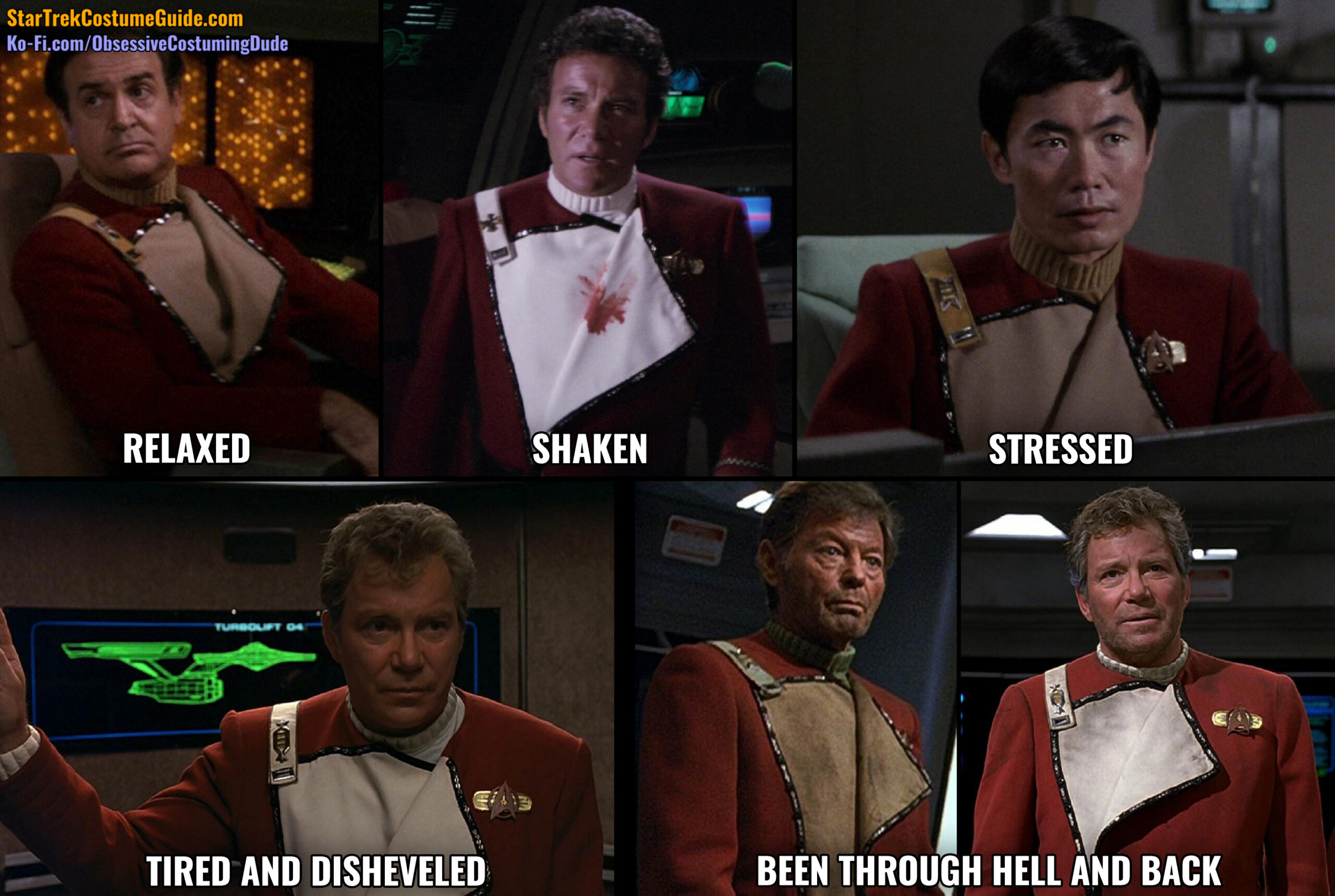
For a less “proper” look, the wearer could undo the upper right closures and let the flap drape down. This could help visually represent a variety of emotional states.
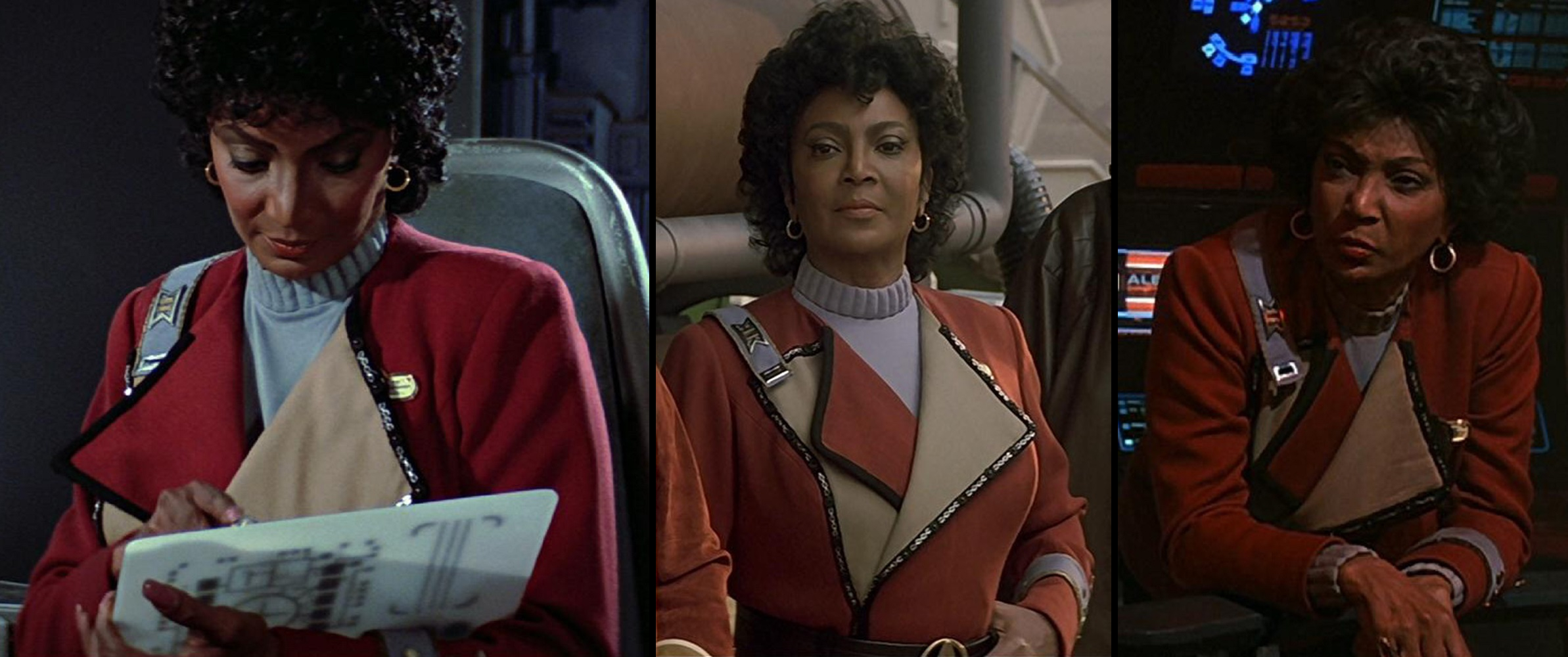
When circumstances permitted, Uhura liked to wear her jacket with both upper edges open and draping downward, like lapels.
Undershirts
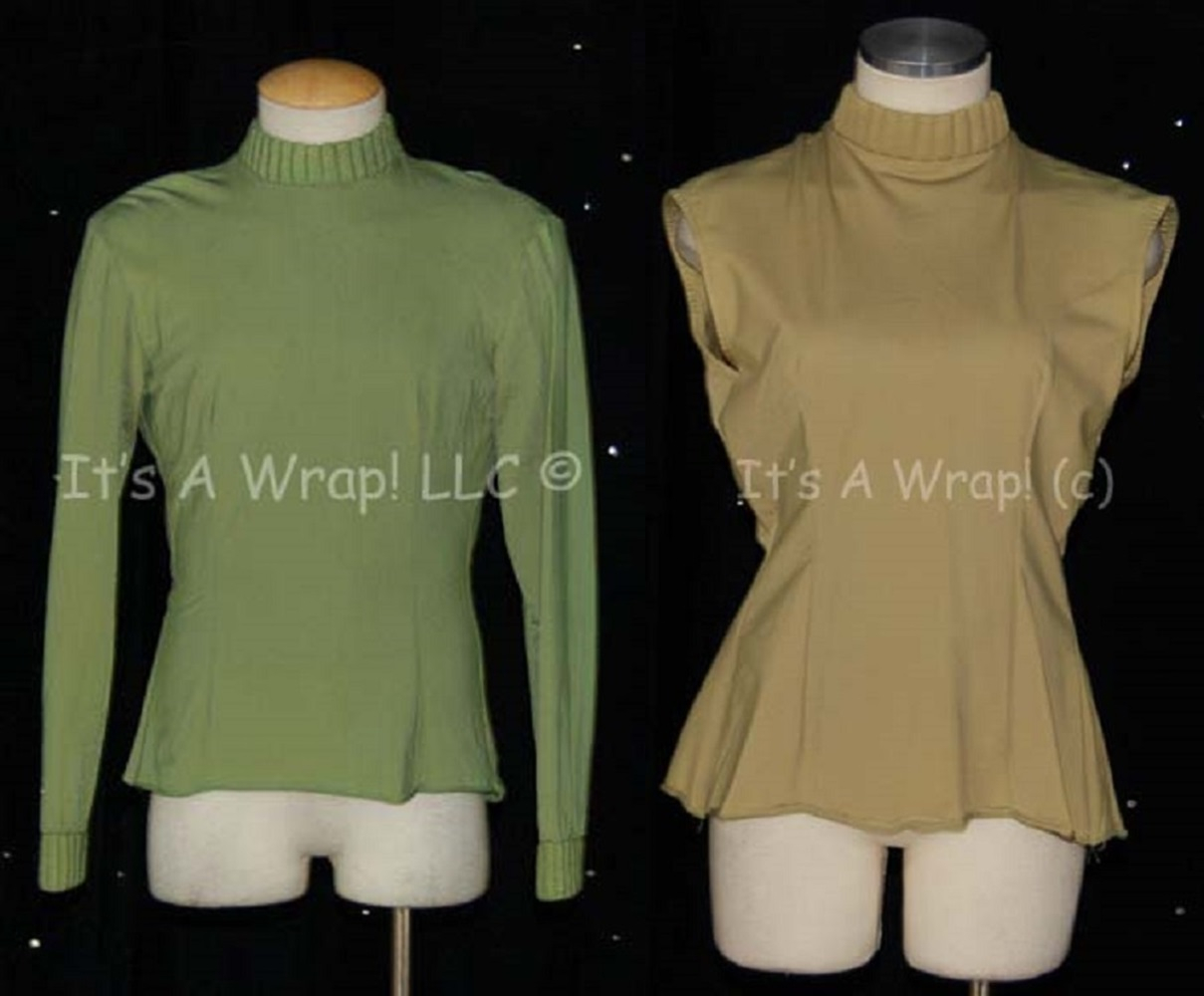
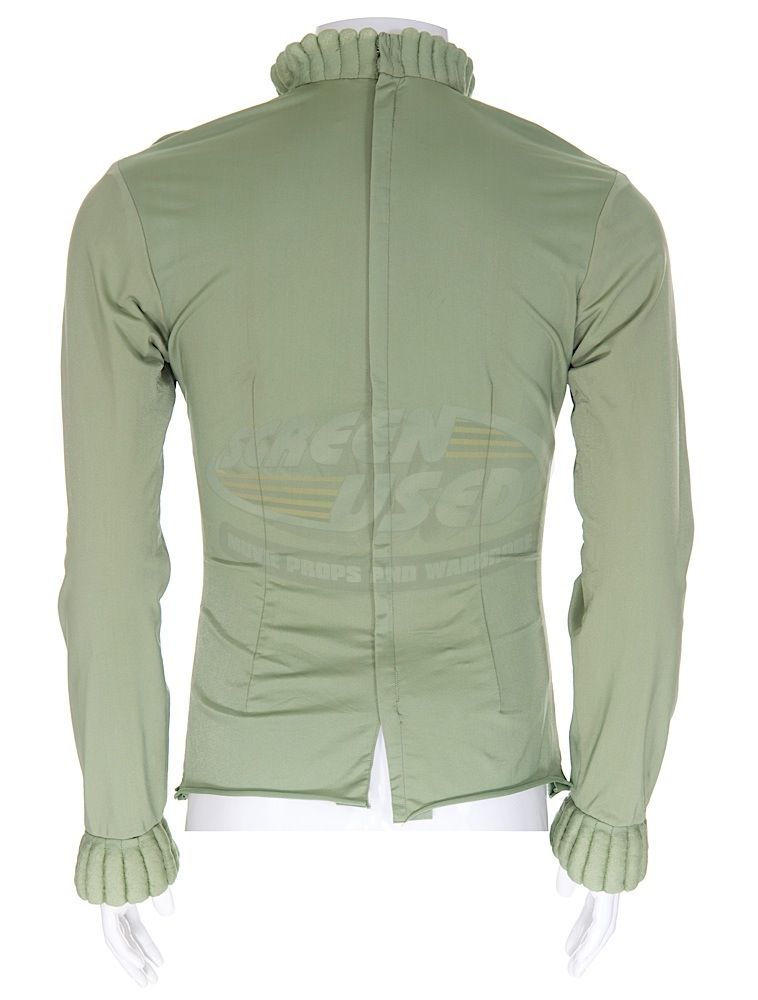
Underneath the jacket, officers were division-colored, turtleneck-style undershirts.
These were made of lightweight spandex, dull-side-out.
Both the collars and sleeve cuffs were quilted, using a technique called “trapunto.”
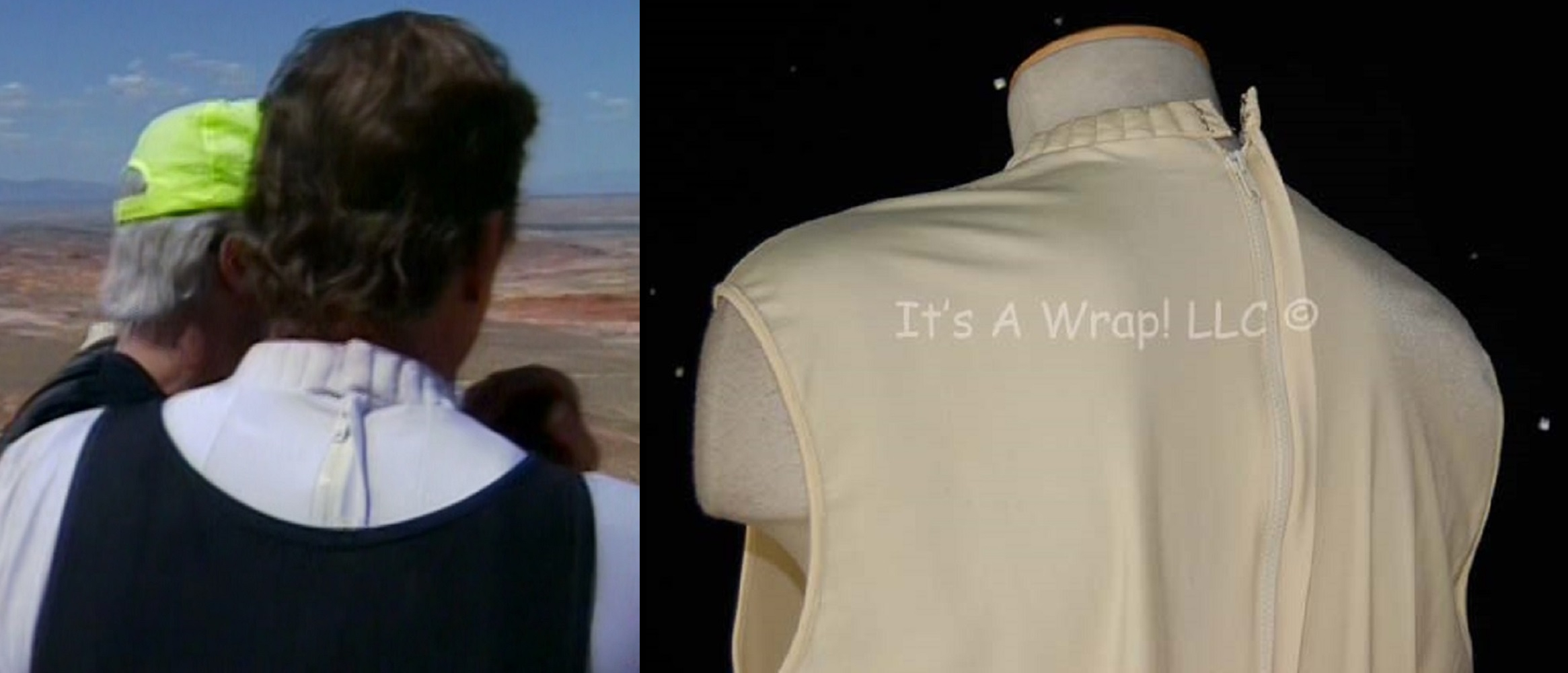
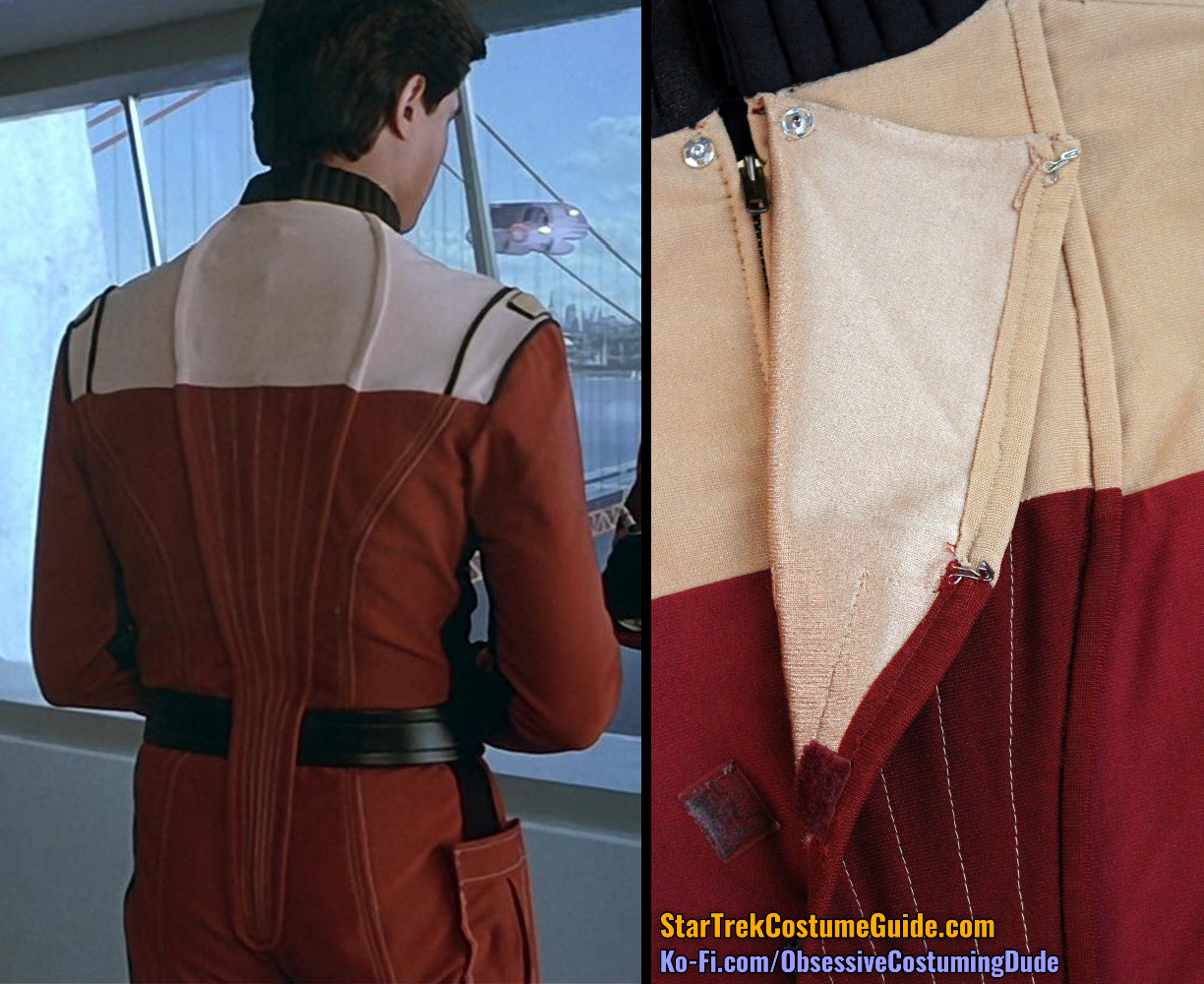
These undershirts closed up the back via a lapped, separating zipper.
Trousers
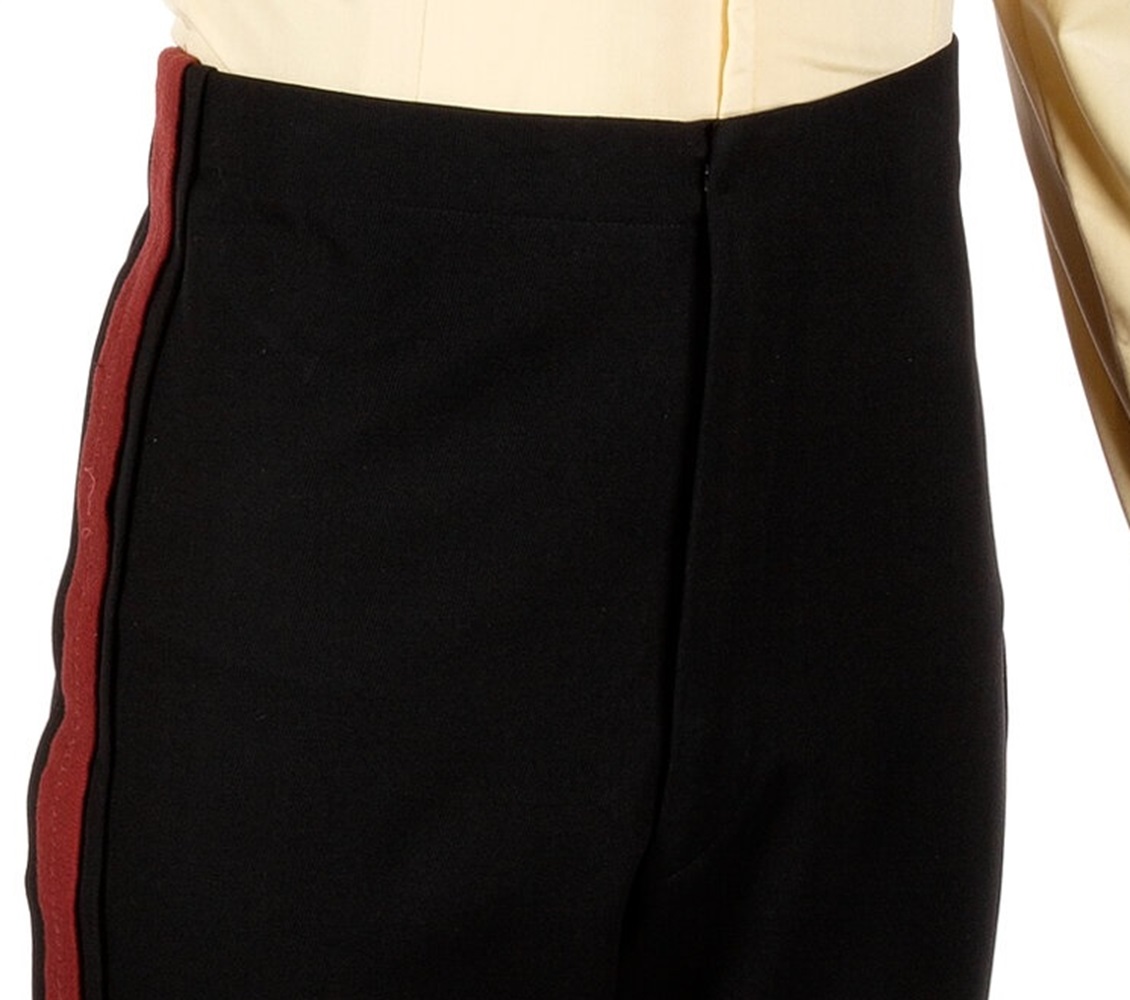
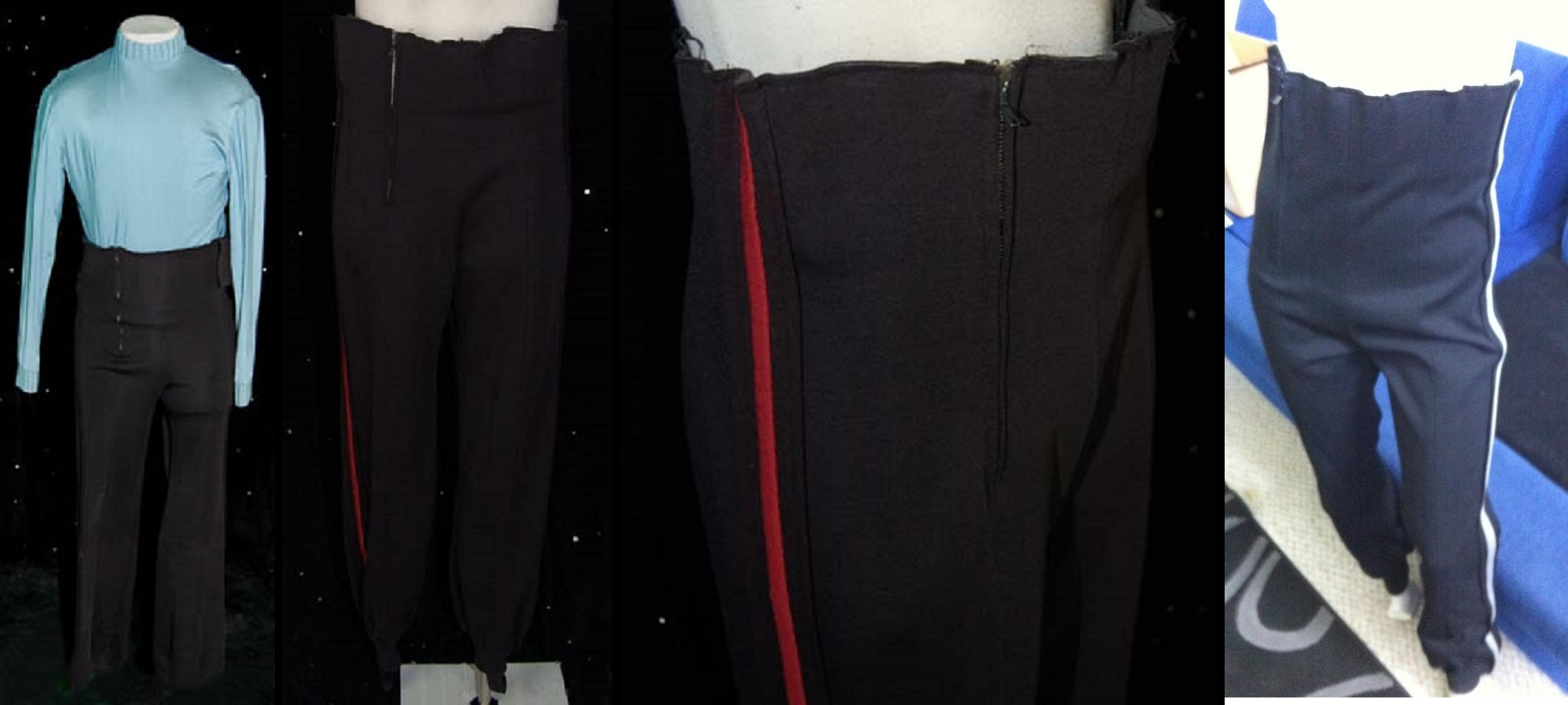
The black trousers were made in a wide variety of ways; some were little more than pajama pants, while others were well-fitted and tailored.
These were usually made of wool, but some were made of heavy jumbo spandex.
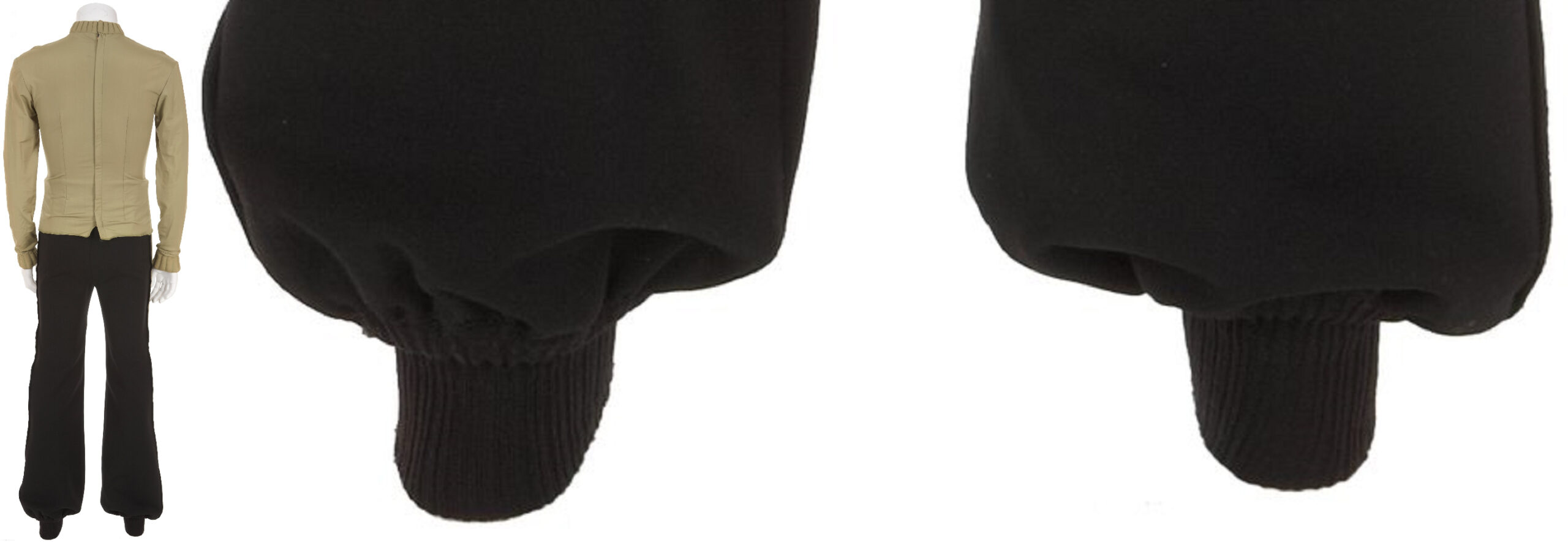
A distinctive trait they (nearly) all had in common was their exaggerated “bell-bottom” silhouette, with extra pant leg fullness beneath the knees gathered down toward the ankle.
Sometimes this fullness was elasticized down into a stretchy cuff of black knit fabric; other times it was gathered or pleated down into the cuff.
These trousers were high-waisted (at least by modern standards), extending up to the wearer’s natural waist.
Some trousers had a cut-on waistband. I believe these to have been the “ideal” standard.
Other trousers had separate, sewn-on waistbands, though.
Most of the trousers had standard front zipper flies.
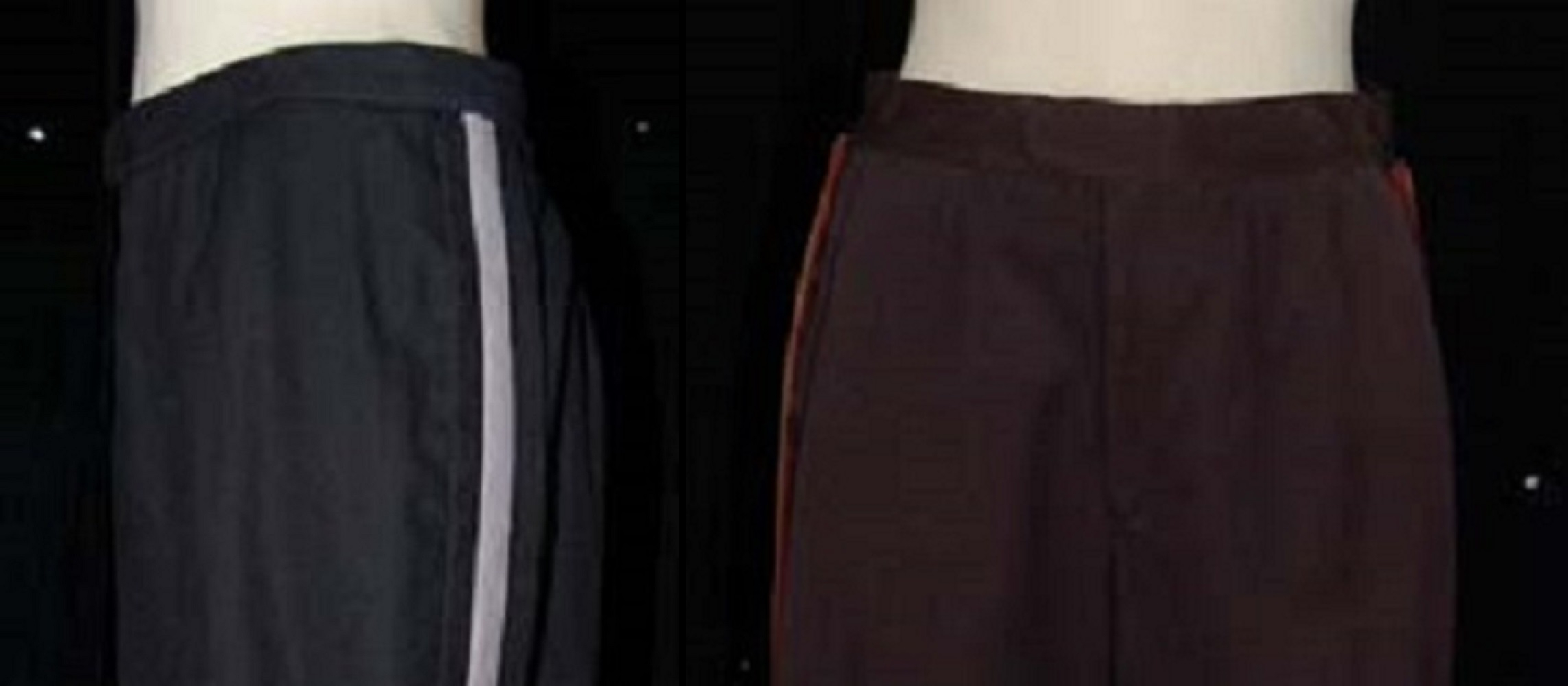
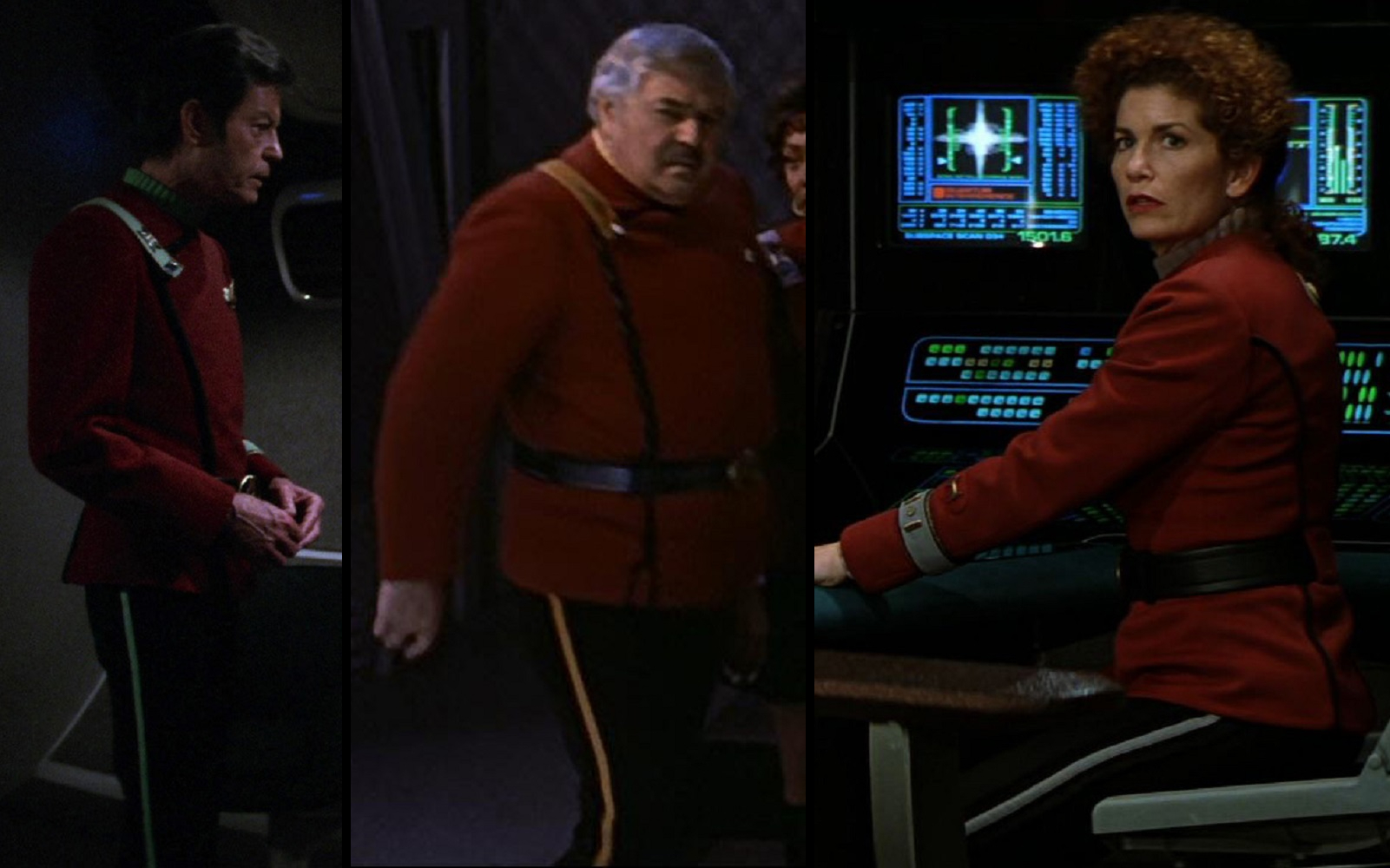
These trousers also had a narrow band of division-colored fabric along the sides of each pant leg.
The one exception was the command division, which had red stripes on the pant legs (matching the jacket fabric) instead of white.
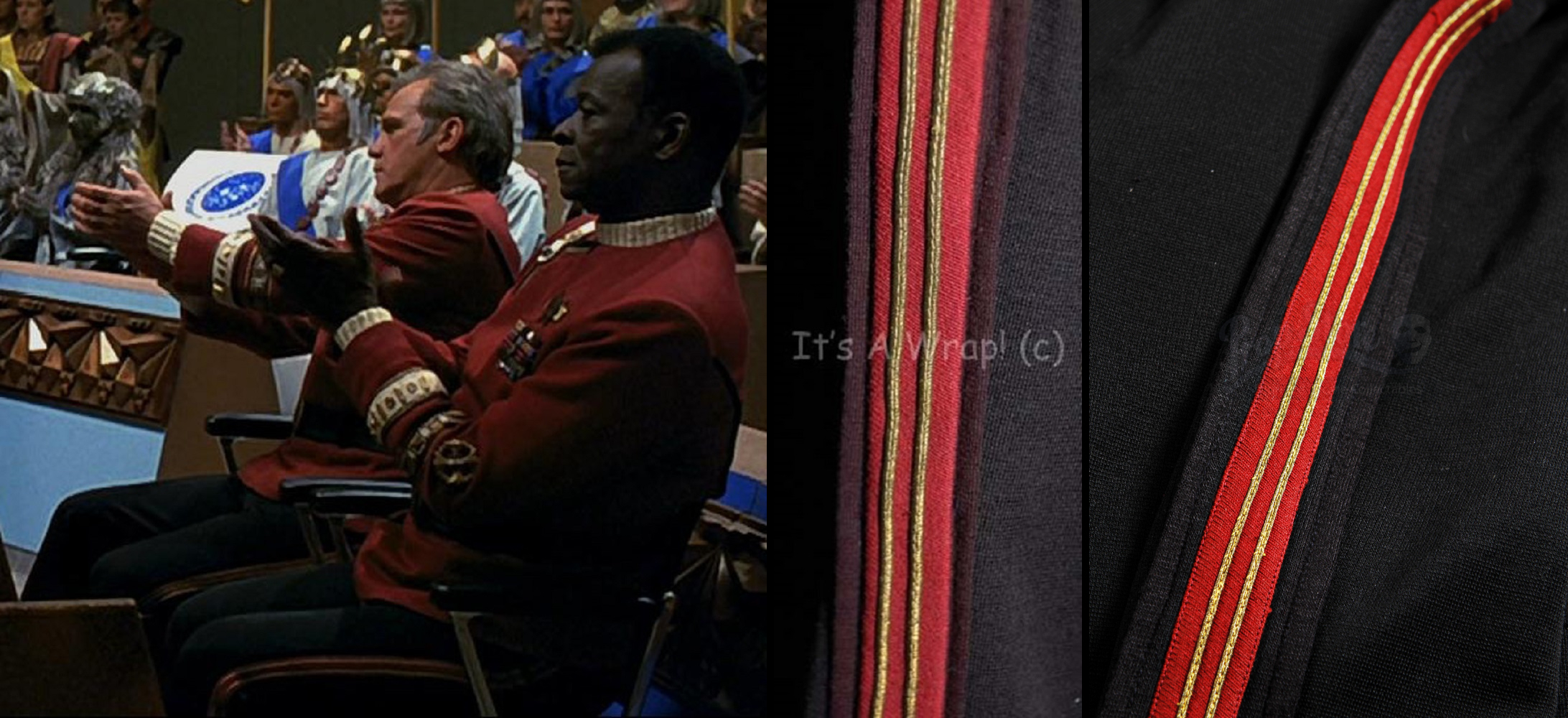
Flag officers had a wider red stripe, with gold soutache added.
According to Fletcher’s notes, commodores up to admirals had a single band of soutache.
Admiral of the Fleet (“Fleet Admiral?”) had two bands of soutache.
In ST6, the C-in-C had three bands of soutache on his pant legs.
Fletcher made no mention of this in his notes and wasn’t the costume designer for that movie anyway, so I think this was a later addition for that position.
Trousers Variations
There were a couple weird variations of these trousers.
Some had some extra seams and a strangely positioned side-front zipper.
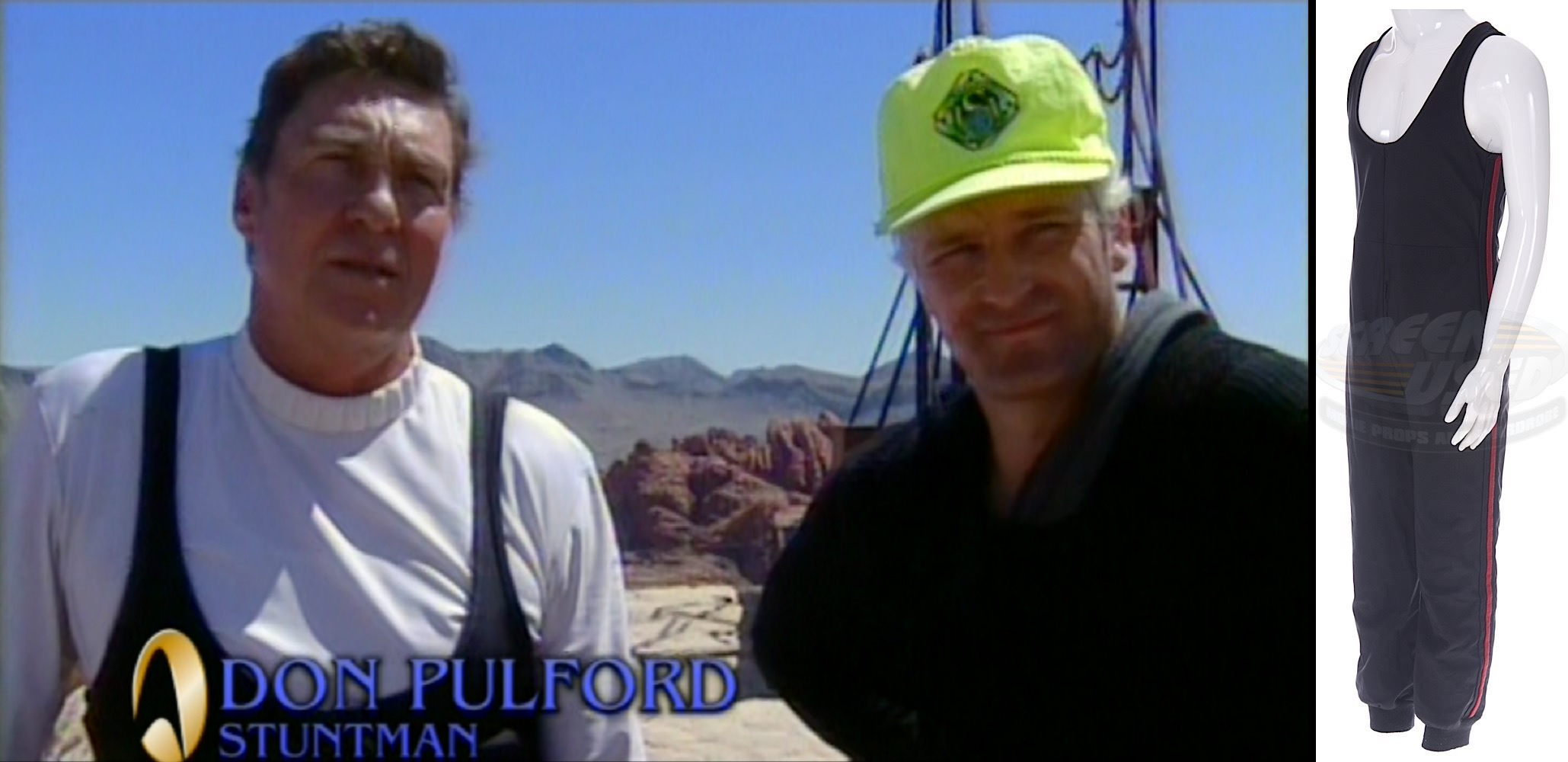
Also note that the trousers in the right three photos didn’t have a waistband at all; the upper edge was just overlocked. I think these must’ve been for extras and/or stunt use.
And for the stunt work in Generations, there was an overalls-style attachment that prevented any unwelcome “peek-a-boo” from underneath the vest.
You wouldn’t be able to tell these weren’t standard uniform trousers in the finished movies, but I wanted to quickly mention them as points of interest.
Skirt
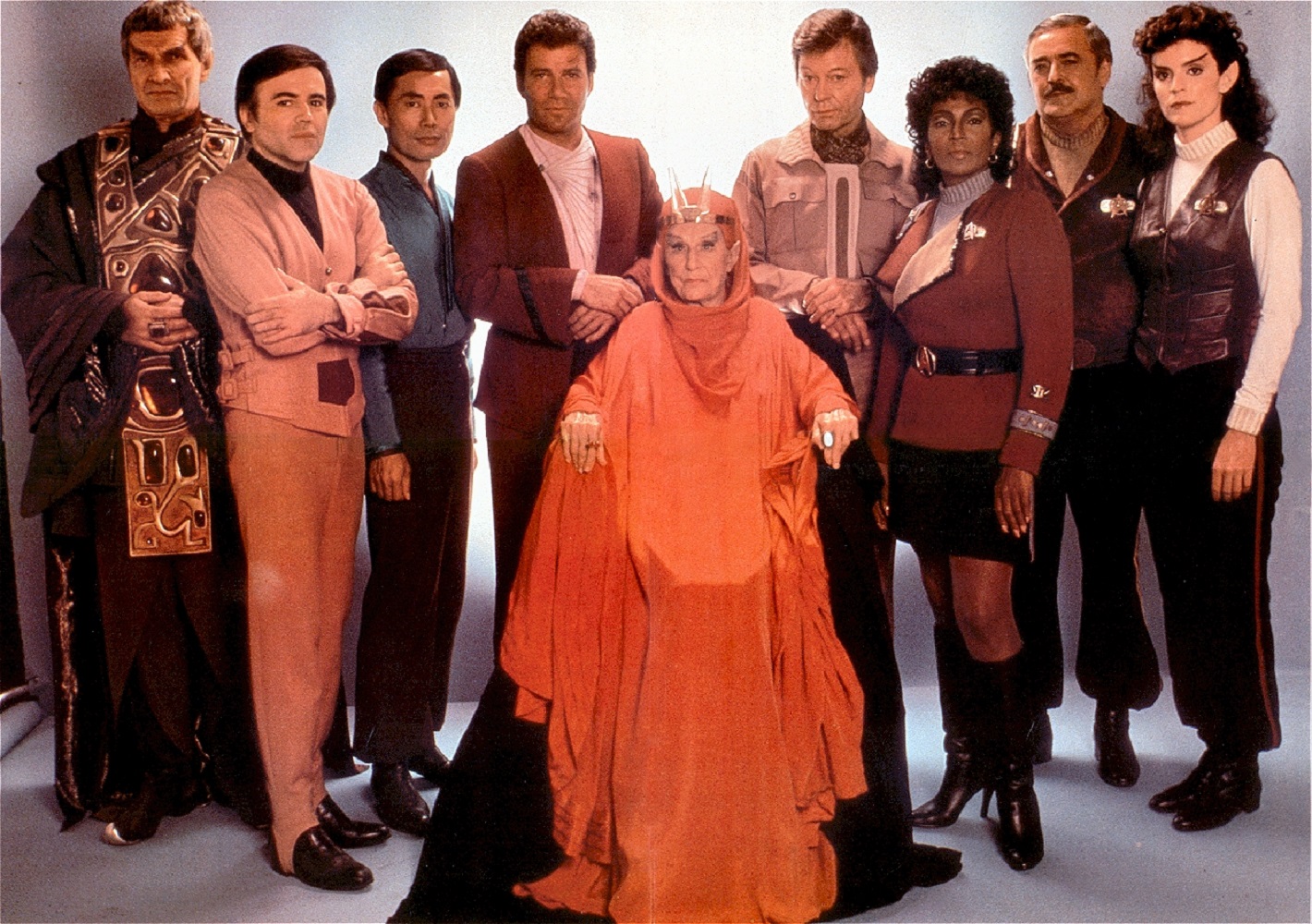
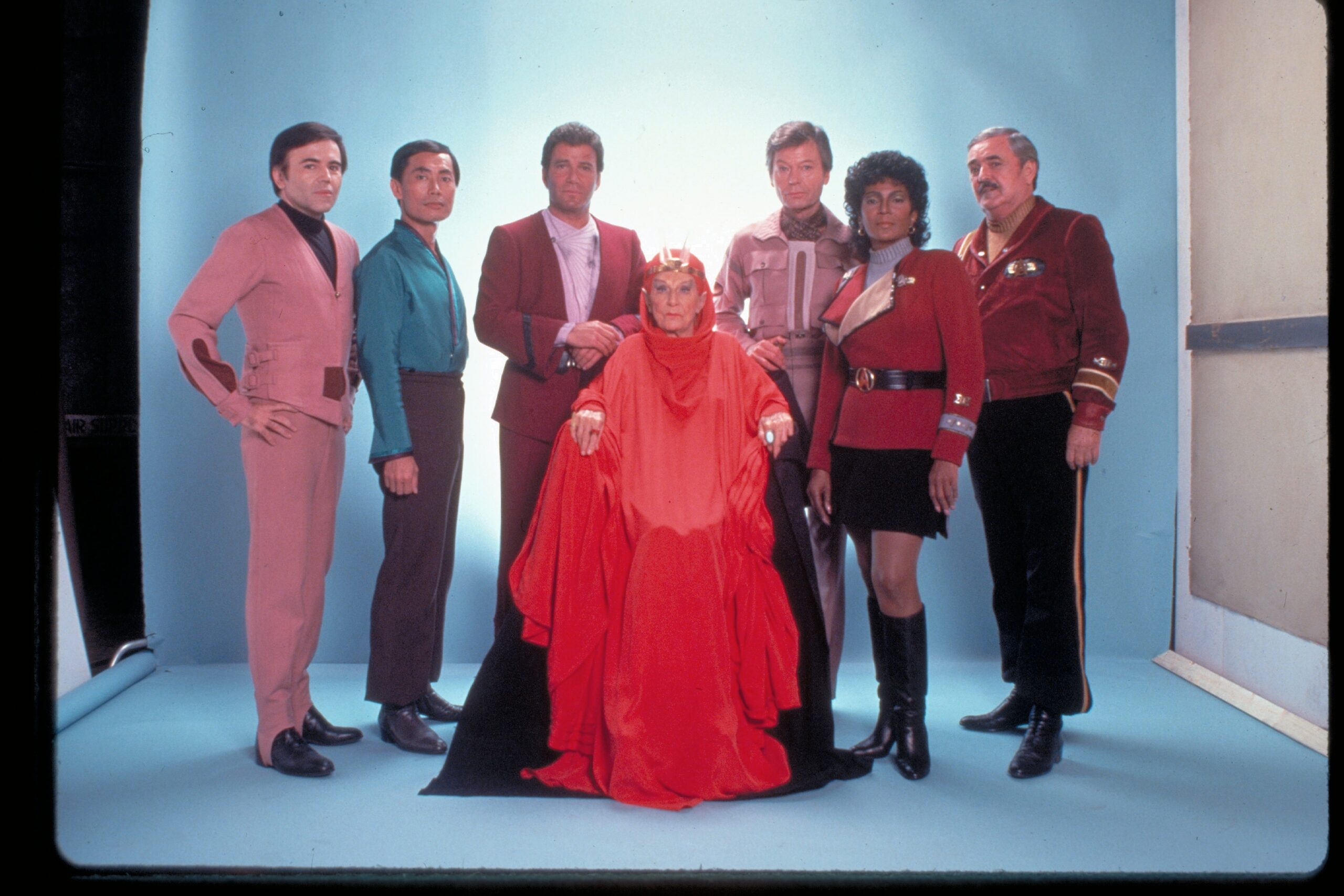
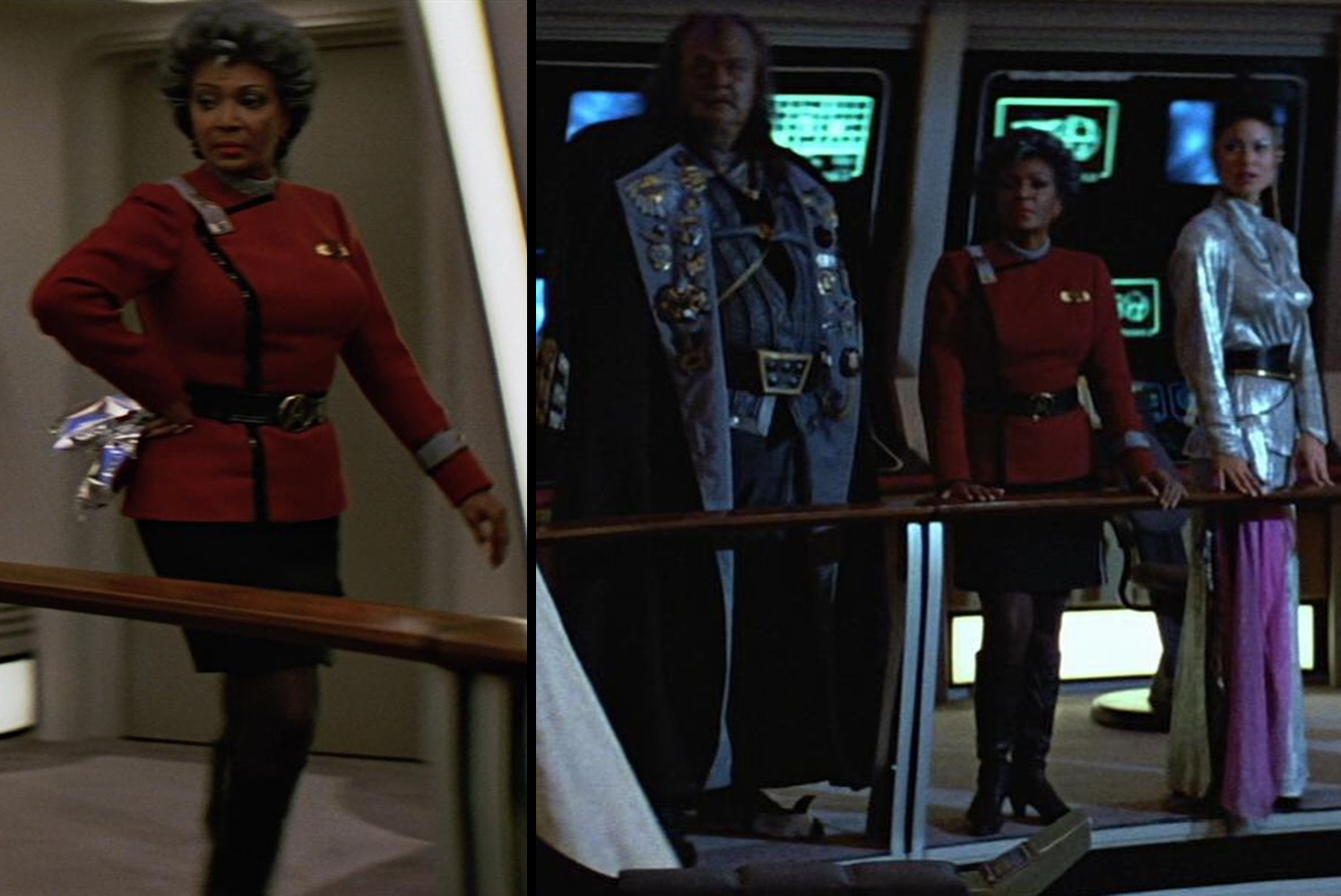
An alternative to the standard uniform trousers was a skirt, which was worn almost (?) exclusively by Uhura.
She wore this for some ST3 publicity photos:
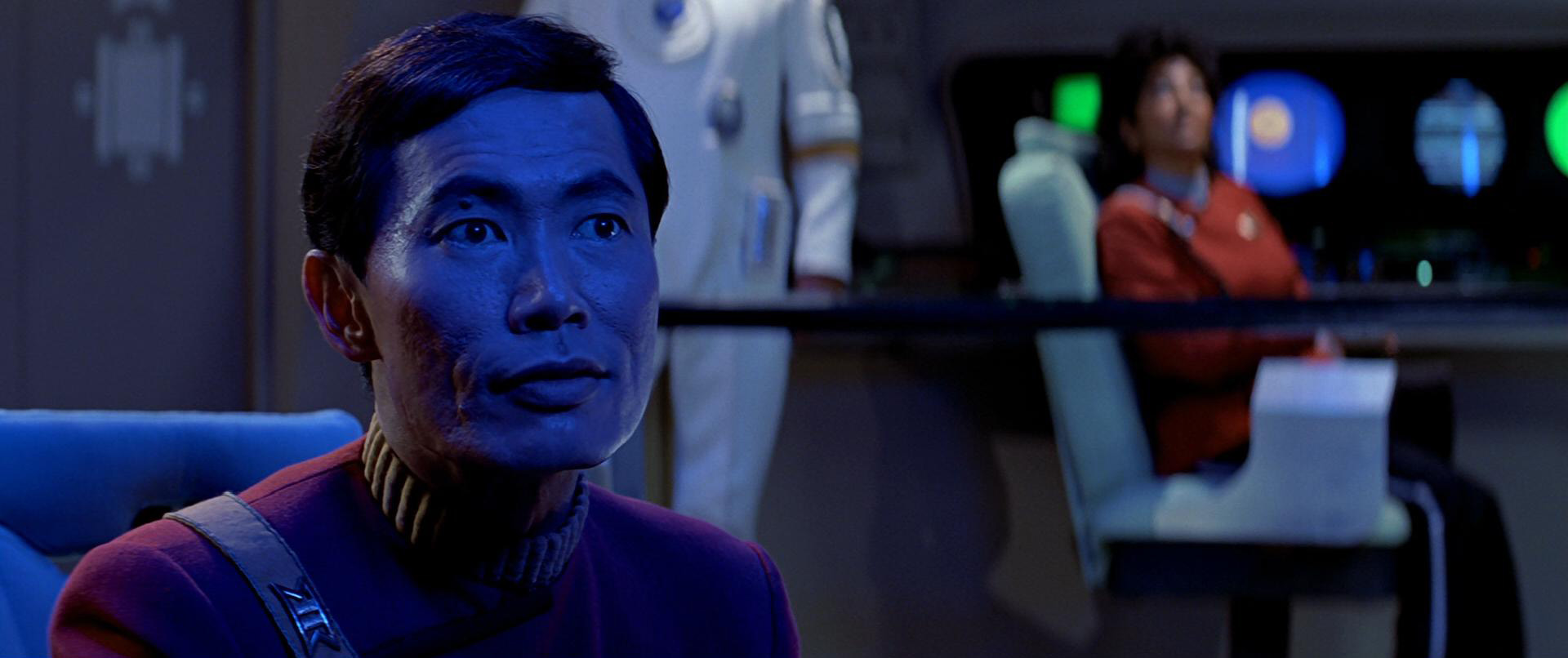
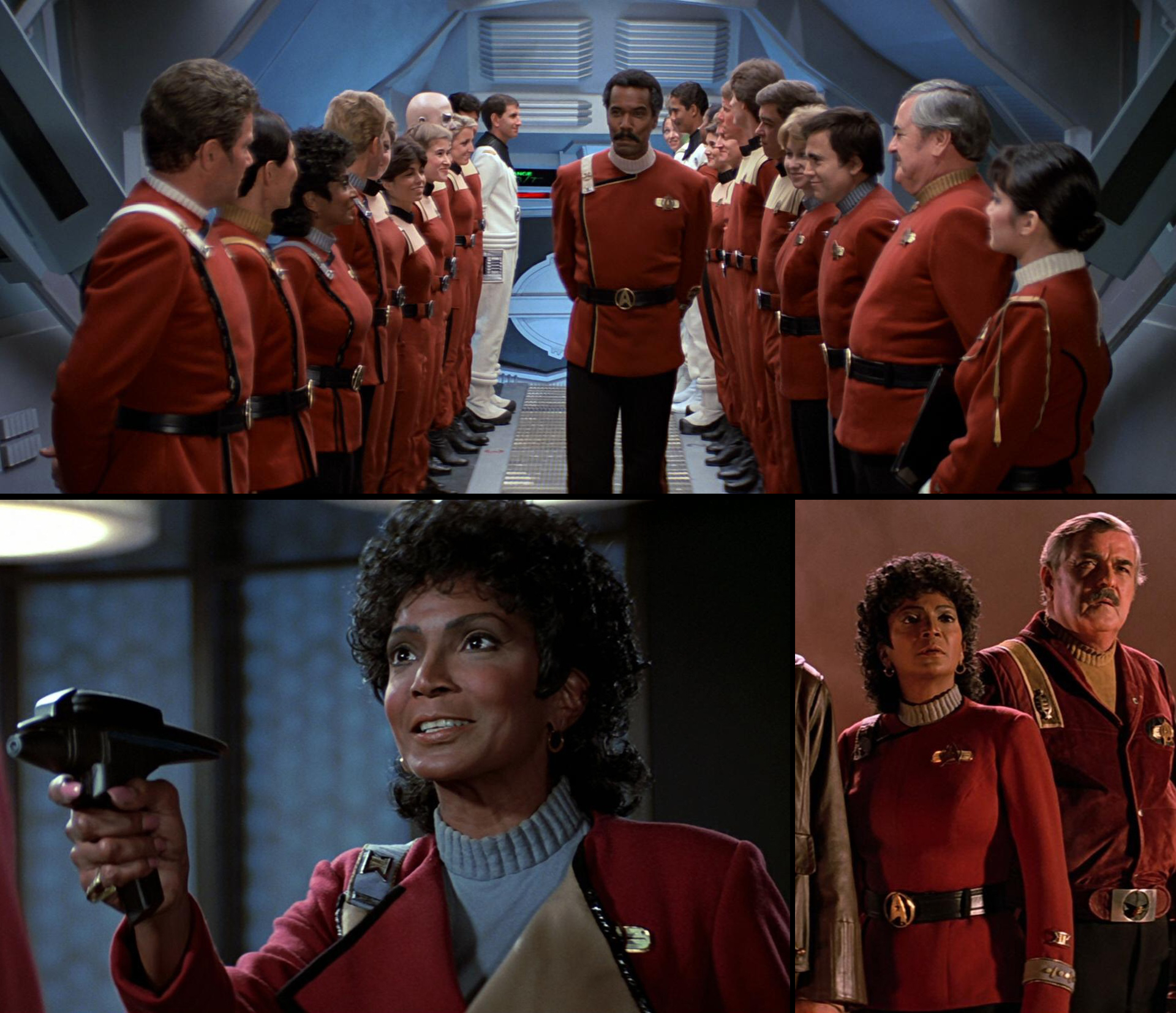
However, I’m not sure she ever actually wore the skirt in the movie itself.
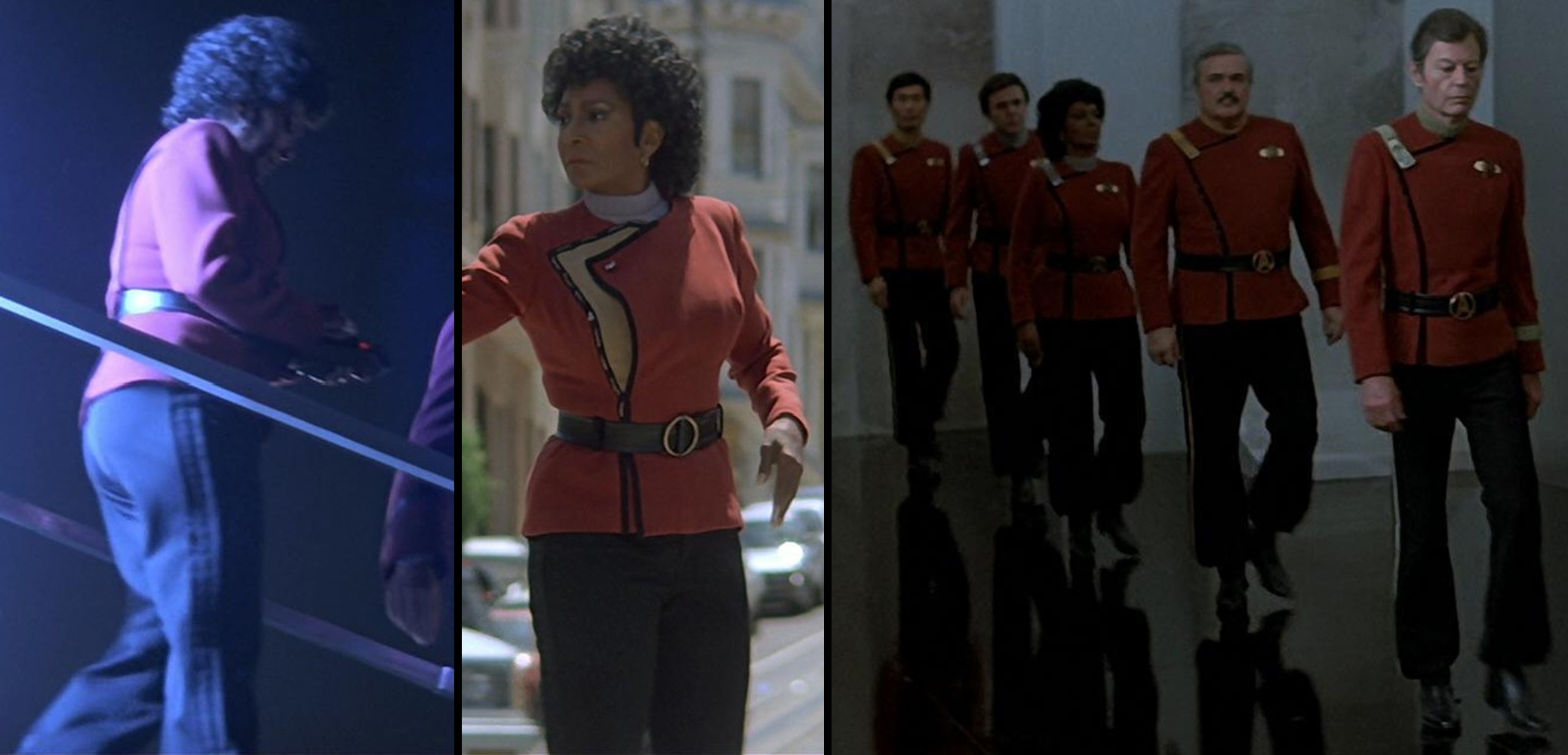
The only time we clearly saw her legs, she was wearing the standard trousers.
The rest of the time, only the upper part of her body was actually in the frame.
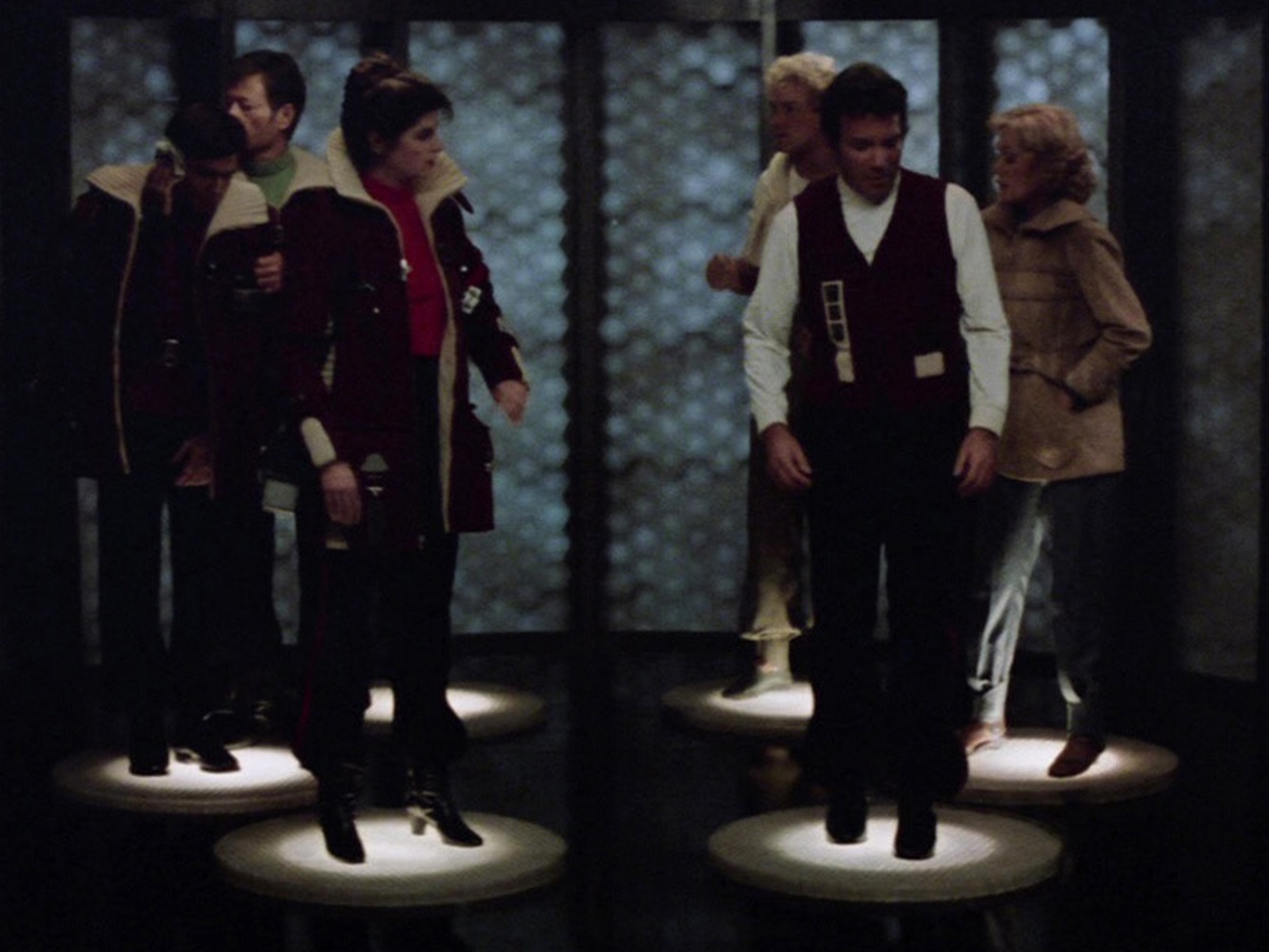
It’s possible she wore the skirt for the transporter room scene with “Mr. Adventure” and/or on Vulcan, but we never got a good enough look.
She also wore the standard trousers in ST4:
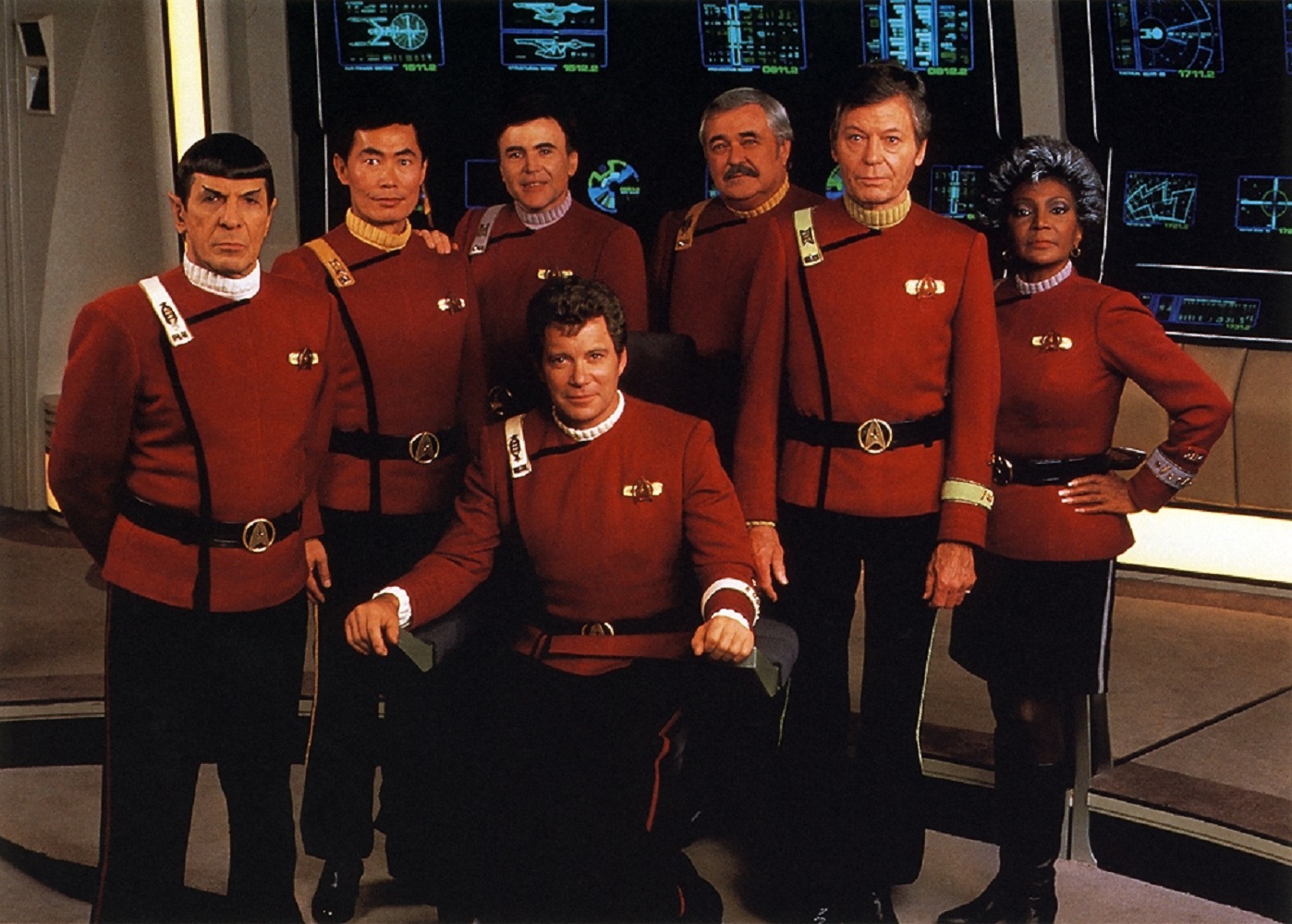
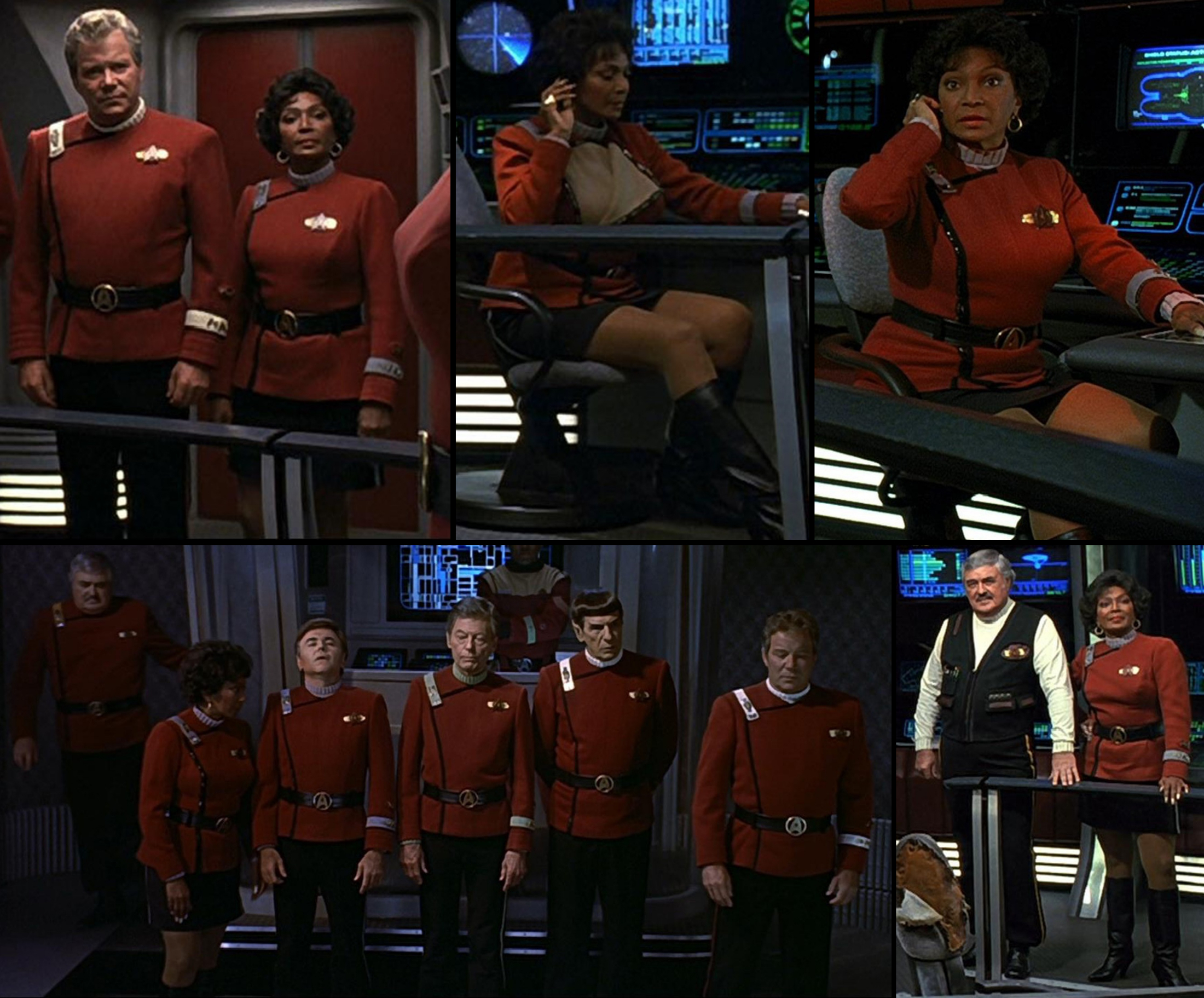
The first time I can confirm she wore the skirt was in ST5; I think she wore it for the entire movie, except for when she wore the field uniform.
She also wore it in the cast publicity photos for that movie.
She wore the skirt for all of ST6 as well.
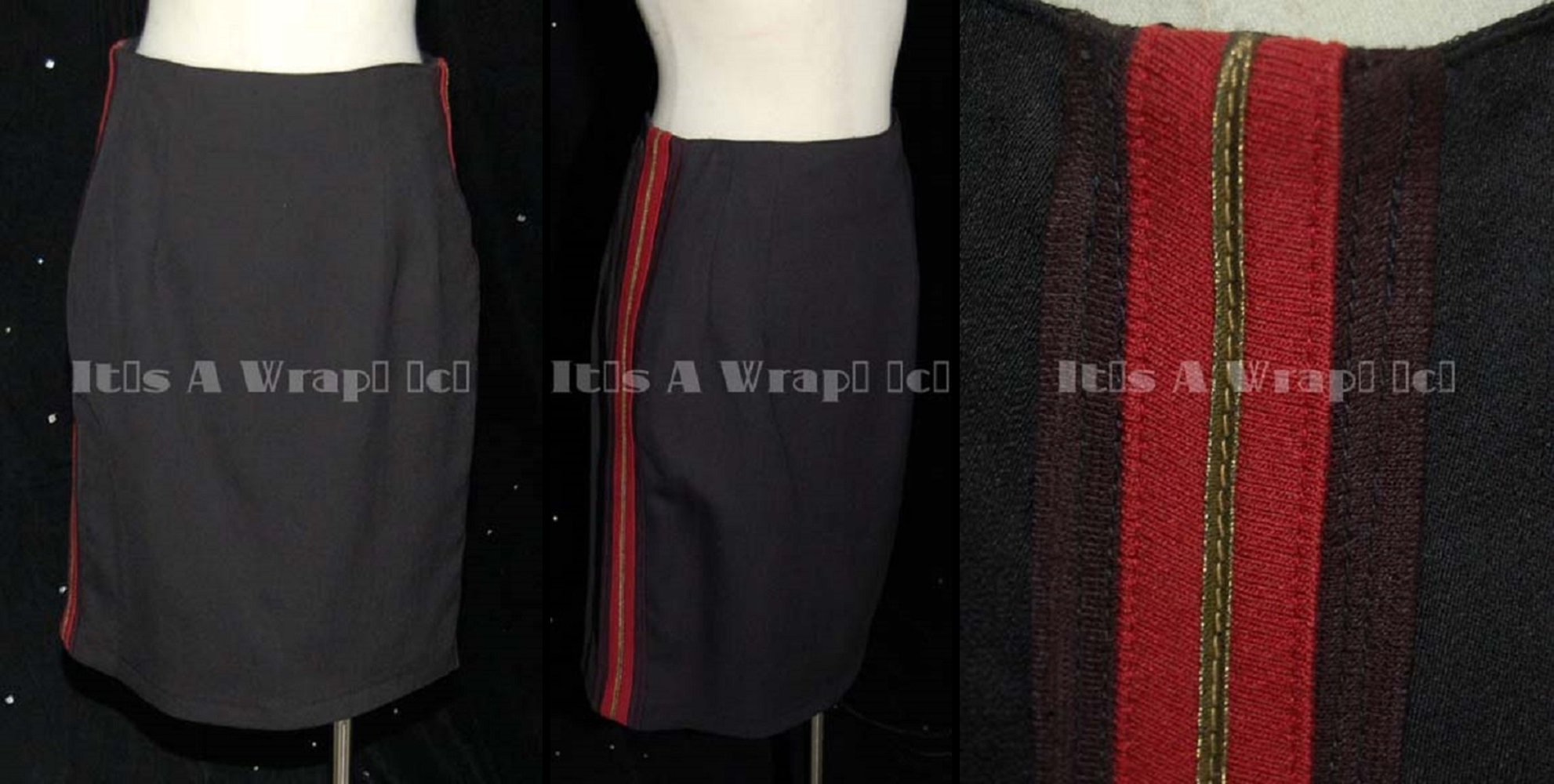
There was an auction listing for one of these skirts, but it had the wider division stripe and gold soutache for flag officers.
The only times I can think of that this would’ve been used was on one of the lady admirals in the early briefing scene, or possibly at the Khitomer peace conference.
Evolution
As originally designed, the “monster maroon” jackets were fairly short; the jacket hem was usually about the same length as the sleeves.
Some (like Chekov’s) were actually a little shorter.
They were consistently about this length all the way through ST6.
For Generations, however, costume designer Robert Blackman (one of Fletcher’s successors) noticeably lengthened the original cast members’ jackets – particularly Kirk’s and Scotty’s.
Chekov’s looked a bit longer too, but not as much as Kirk’s and Scotty’s.
It’s probably easiest to see how much longer the jackets were in these two publicity photos:
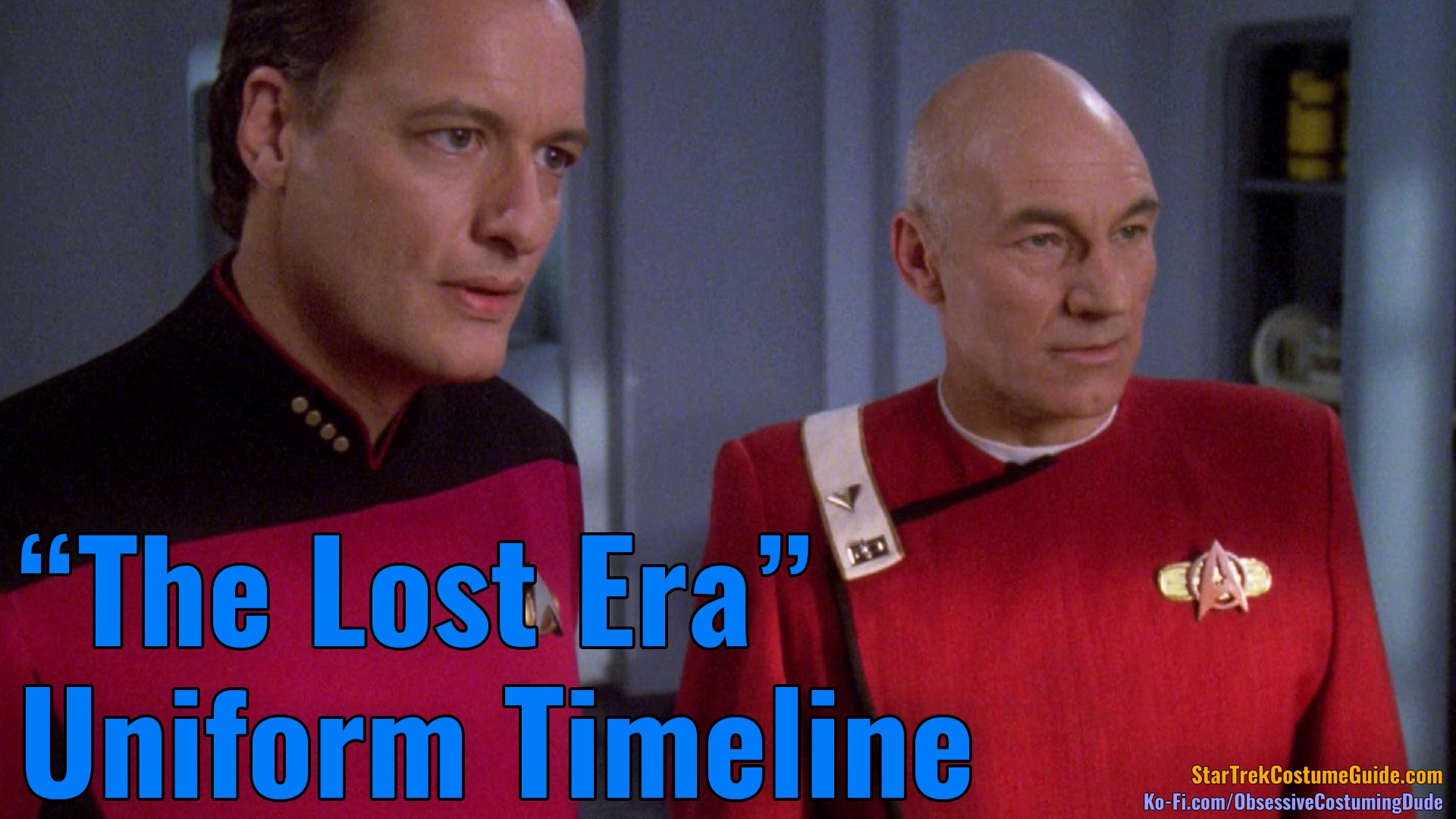
If you’d like to learn more about how these uniforms evolved into “The Lost Era” and transitioned into the TNG-era uniforms, check out this blog post and its corresponding video:
By far the most common uniforms of the TWOK-era were those worn by enlisted personnel.
The “monster maroons” were newly-made for the movie and are well-loved by fans (and deservedly so), but to me what Fletcher and his team accomplished with the enlisted uniforms is even more impressive.
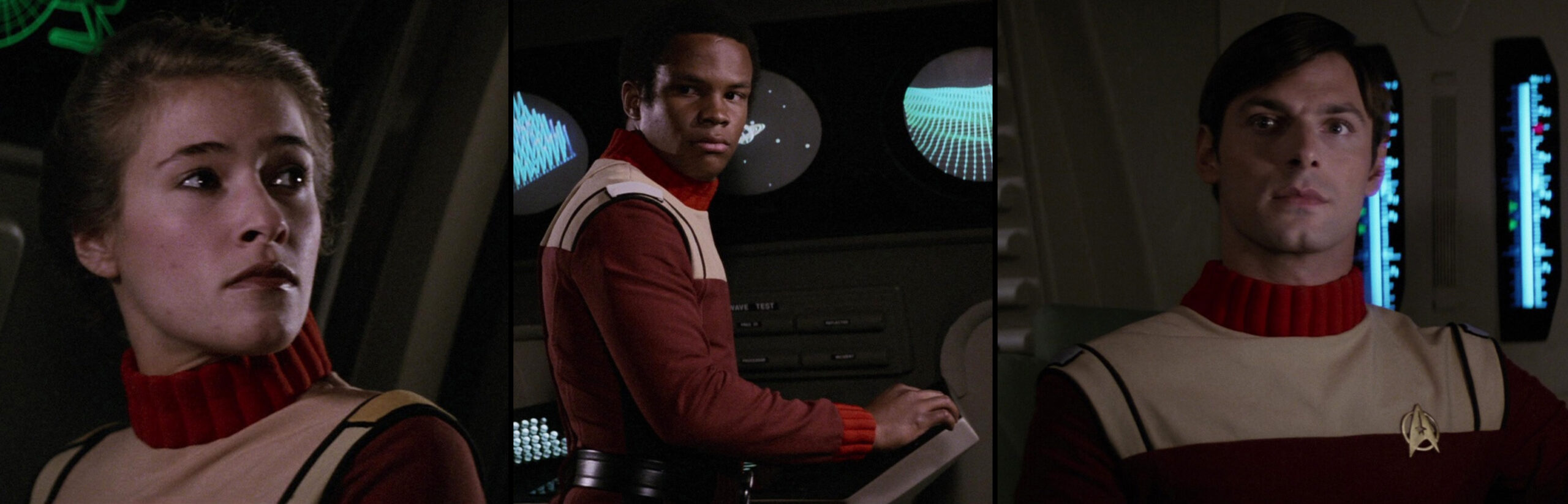
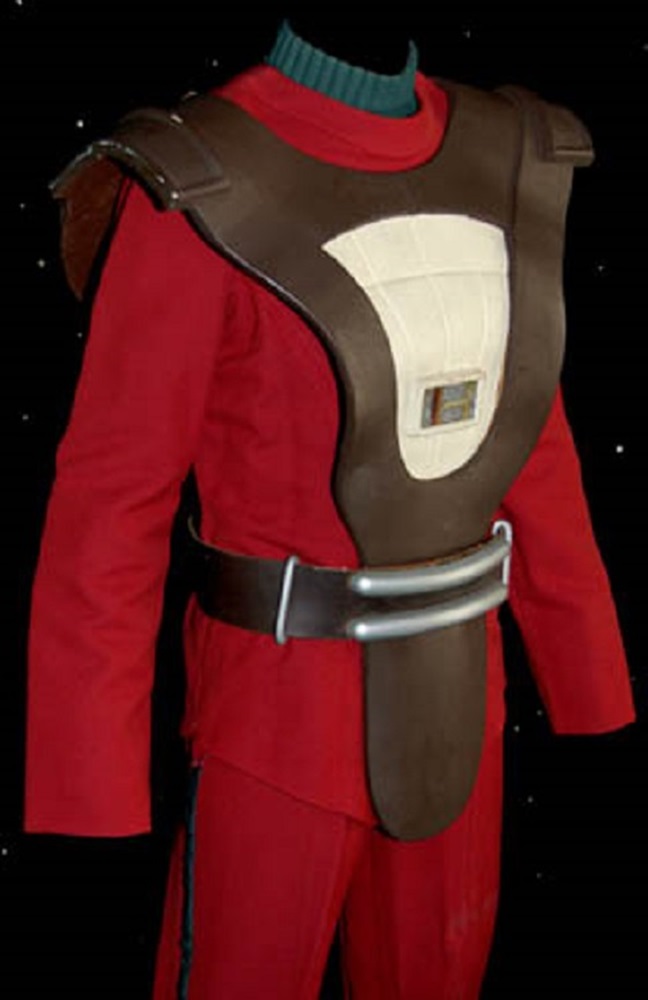
These began their lives as the TMP “Class D” jumpsuits, but they were overdyed to a new color and modified to the extent that they were virtually unrecognizable.
In my opinion, this is a perfect example of economic filmmaking – resourcefulness met with creative genius channeled toward revision, while tempered by frugality.
Transforming a wardrobe of generally-unloved uniforms into a fan-favorites is nothing short of costuming alchemy.
Turning lemons into lemonade, as it were.
“One of the first things we had to do for Star Trek II: The Wrath of Khan was redesign the entire wardrobe.
“I knew we couldn’t afford to do all the wardrobe over again, so I got Bob Fletcher to run some dye tests to find out what colors the uniforms from Star Trek: The Motion Picture would take successfully. We ended up with three colors: a gold, a blue-gray, and the wine [color] that we ultimately settled on.
“And Fletcher, who is a wonderful talent, added things, and changed things, including the tightness of the fit. He said, ‘Yes I can loosen this, drop that …’ I suggested blousing the trousers and adding the stripes. In so doing, we were able to modify and reuse much of the previous wardrobe for the cadets’ uniforms.”
Informative as this was, for clarity I just want to point out that he incorrectly referred to the enlisted crew uniforms as “cadets’ uniforms” – a common misconception we’ll get to shortly.
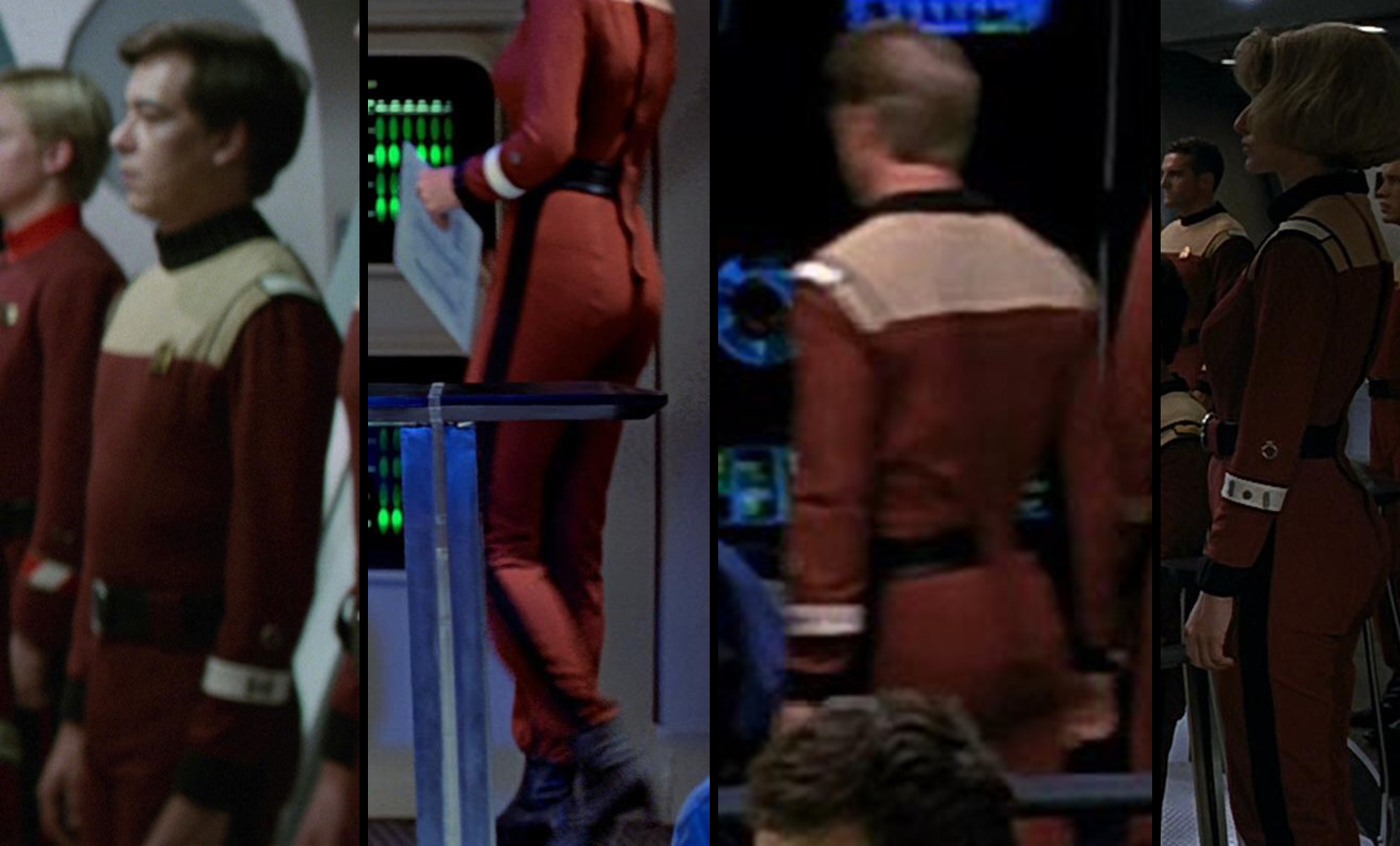
There were probably more enlisted jumpsuits made than any other uniform of the era – doubtless because of the massive head start the existing TMP jumpsuits gave the costuming department.
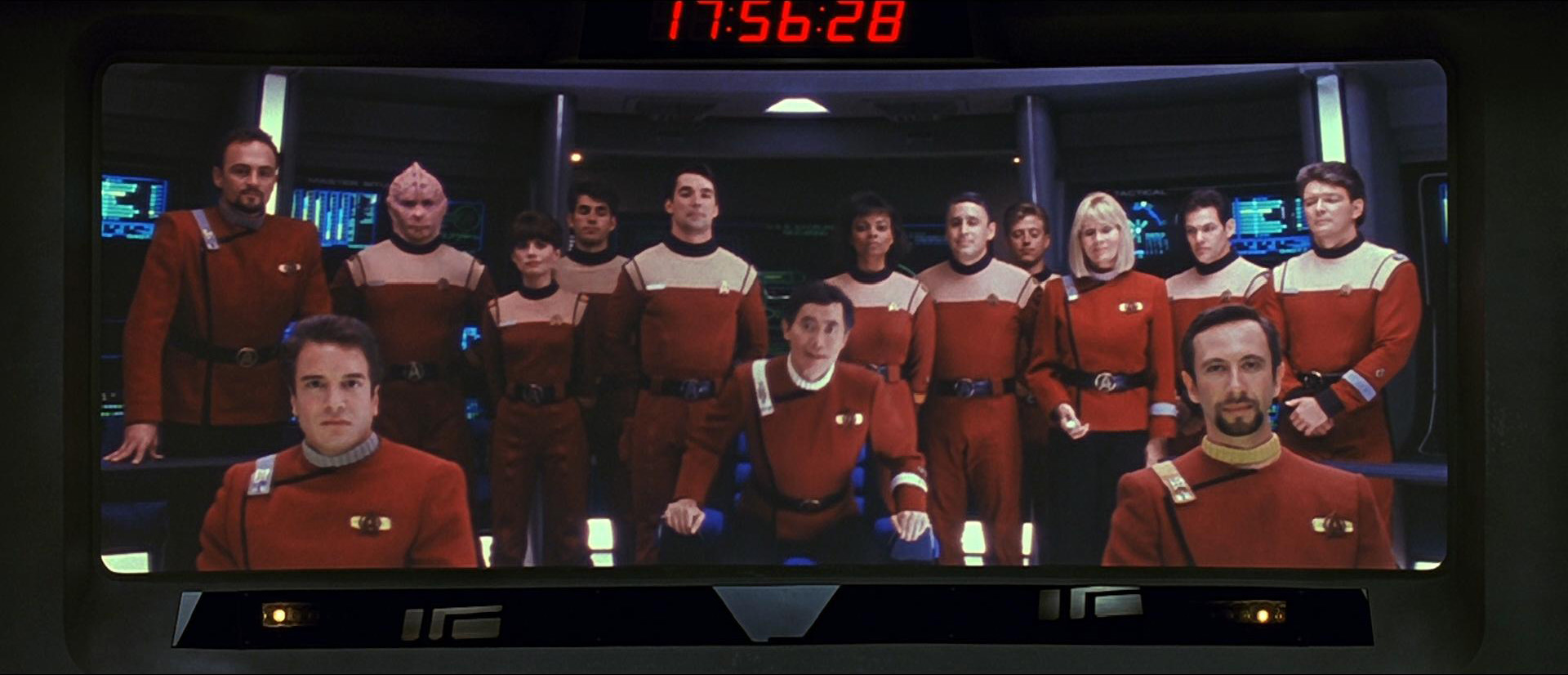
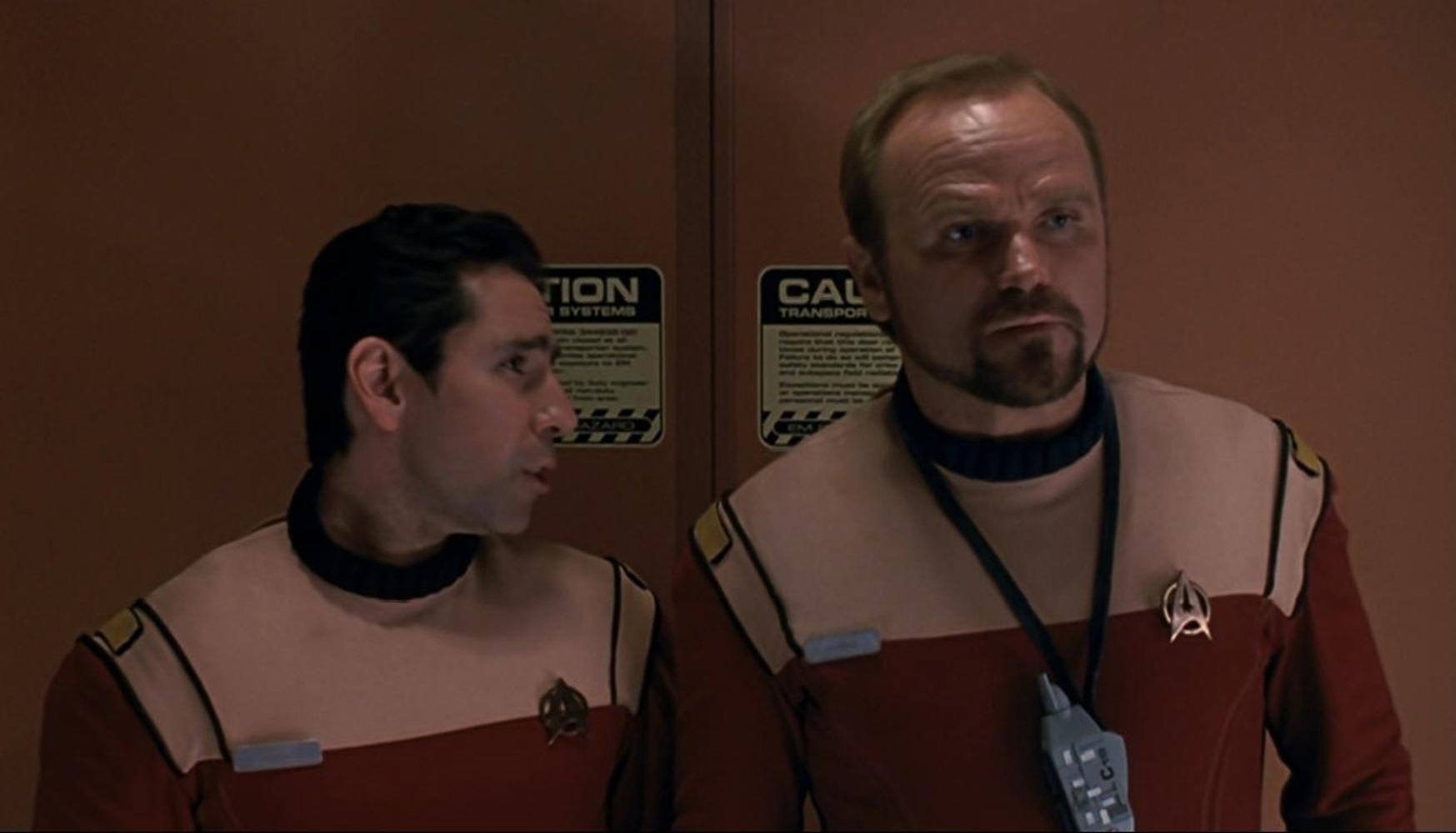
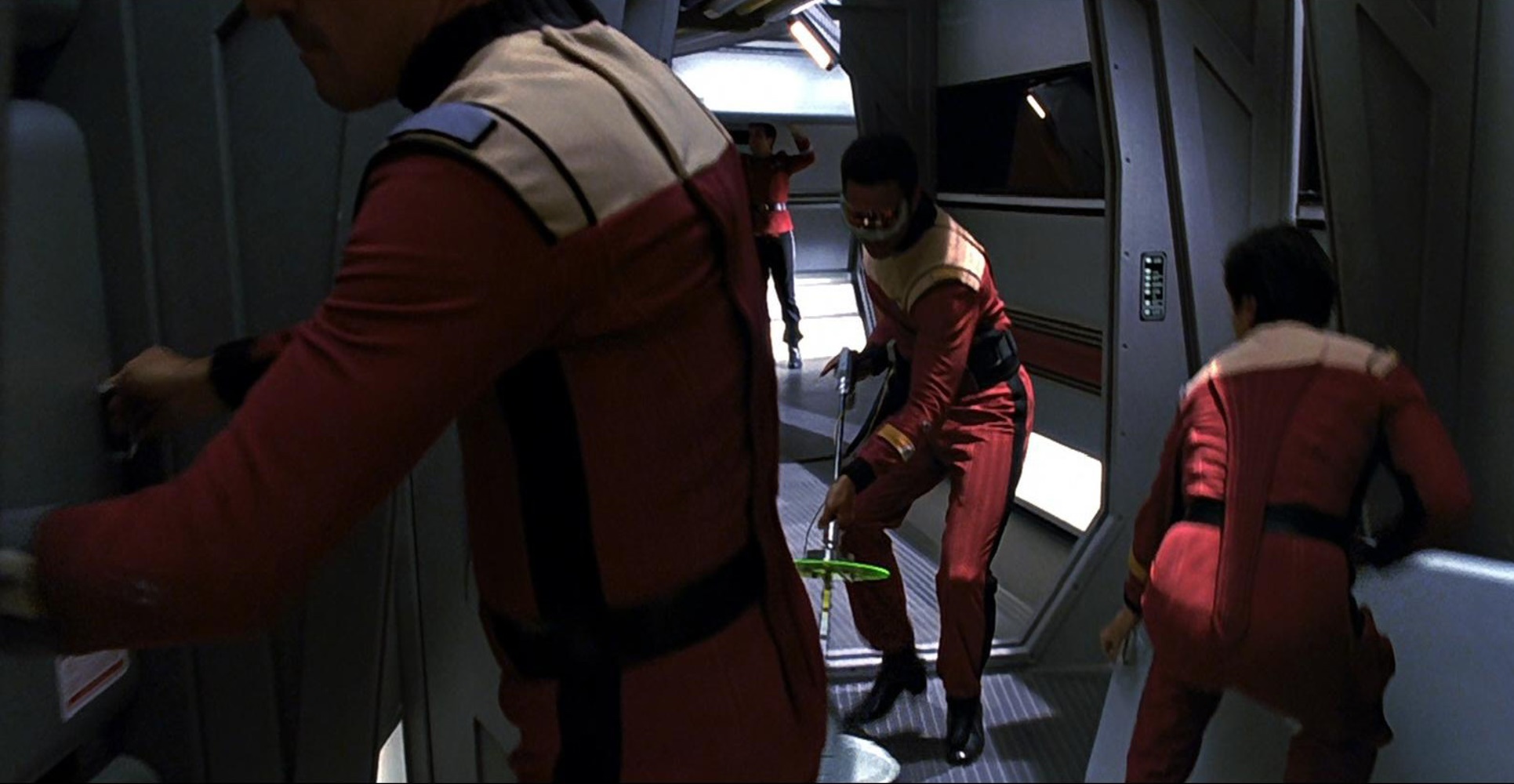
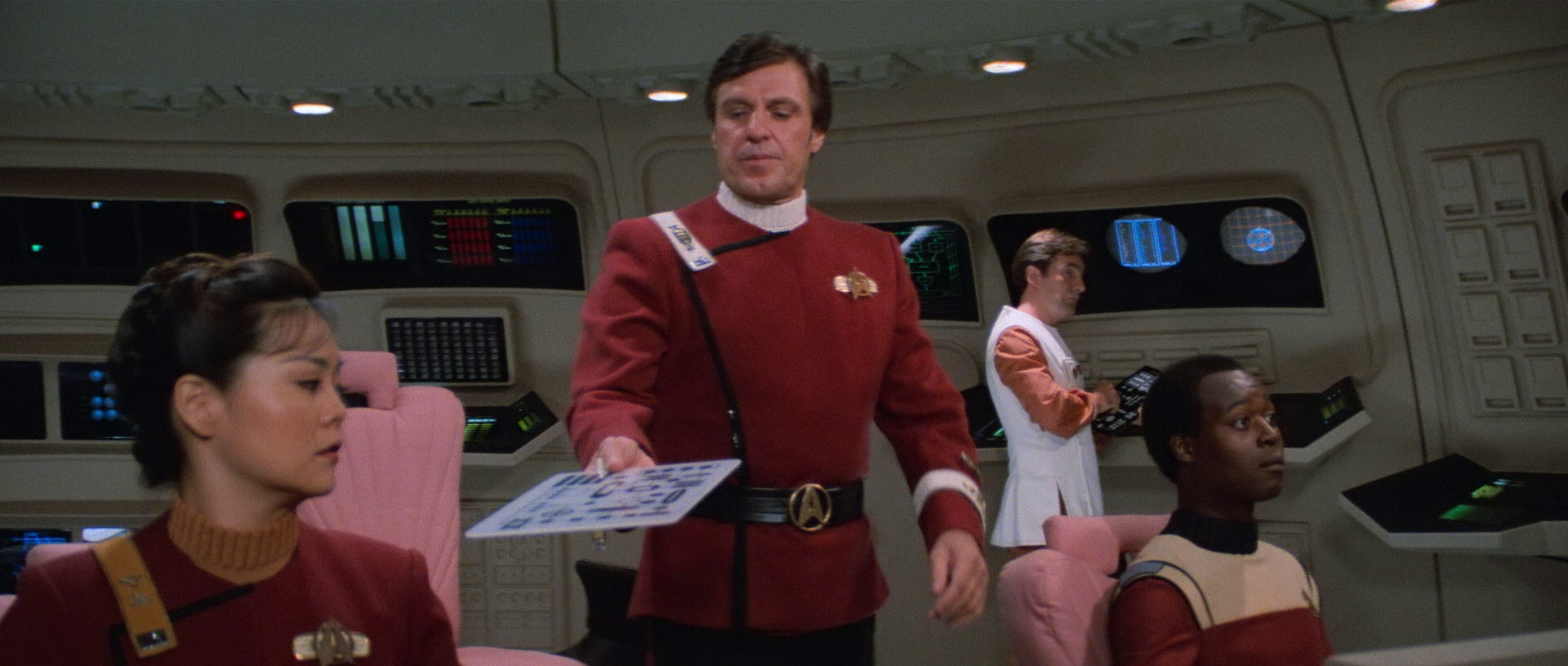
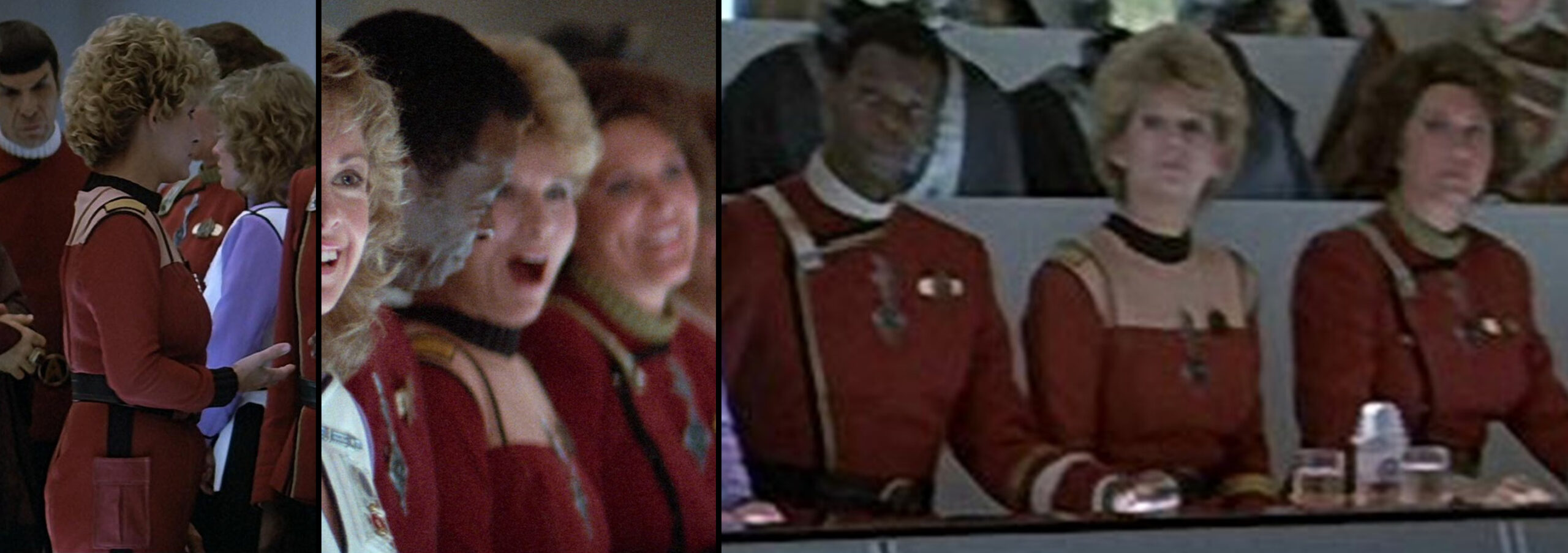
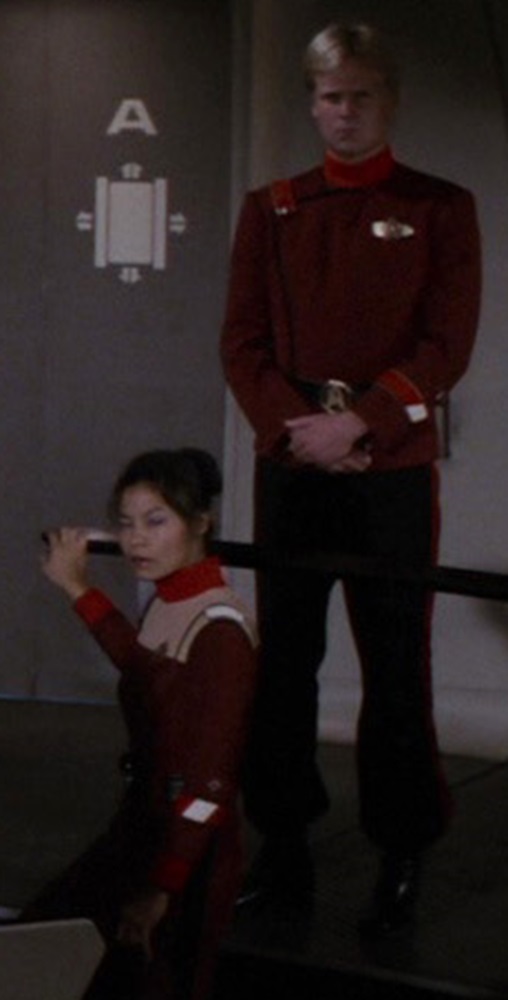
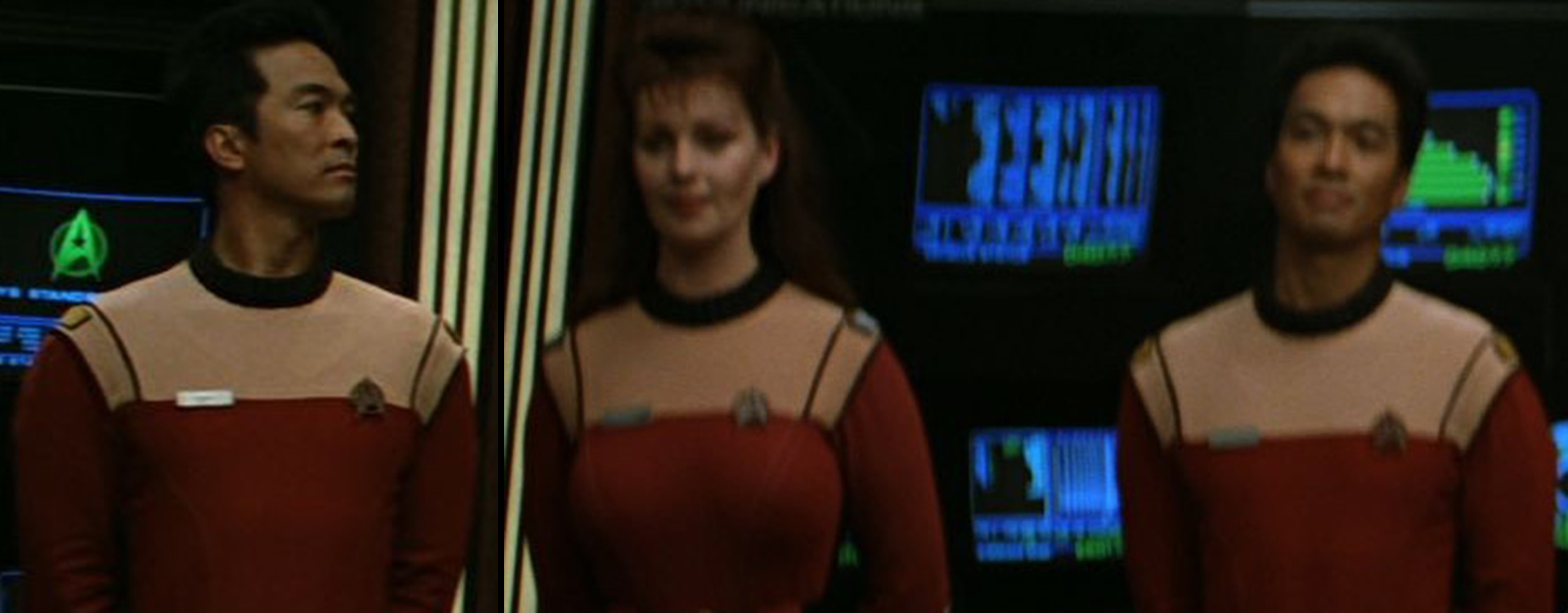
In most group shots of Starfleet crew members, the majority of extras would be wearing these.
As you can see, they blended right in with the new “monster maroons” perfectly and were clearly part of the same uniform family, while being unmistakably different.
Memorable Examples
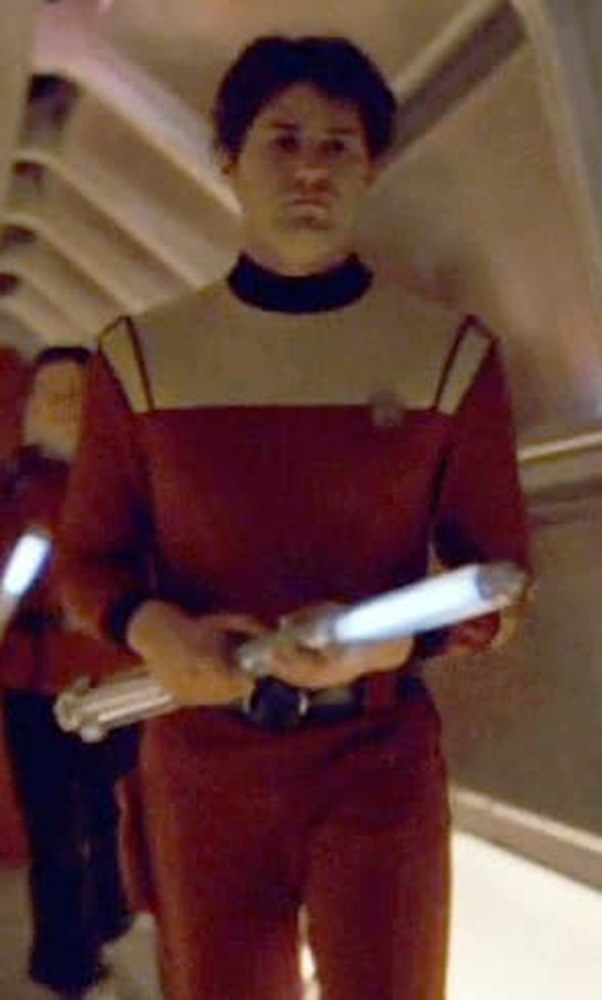
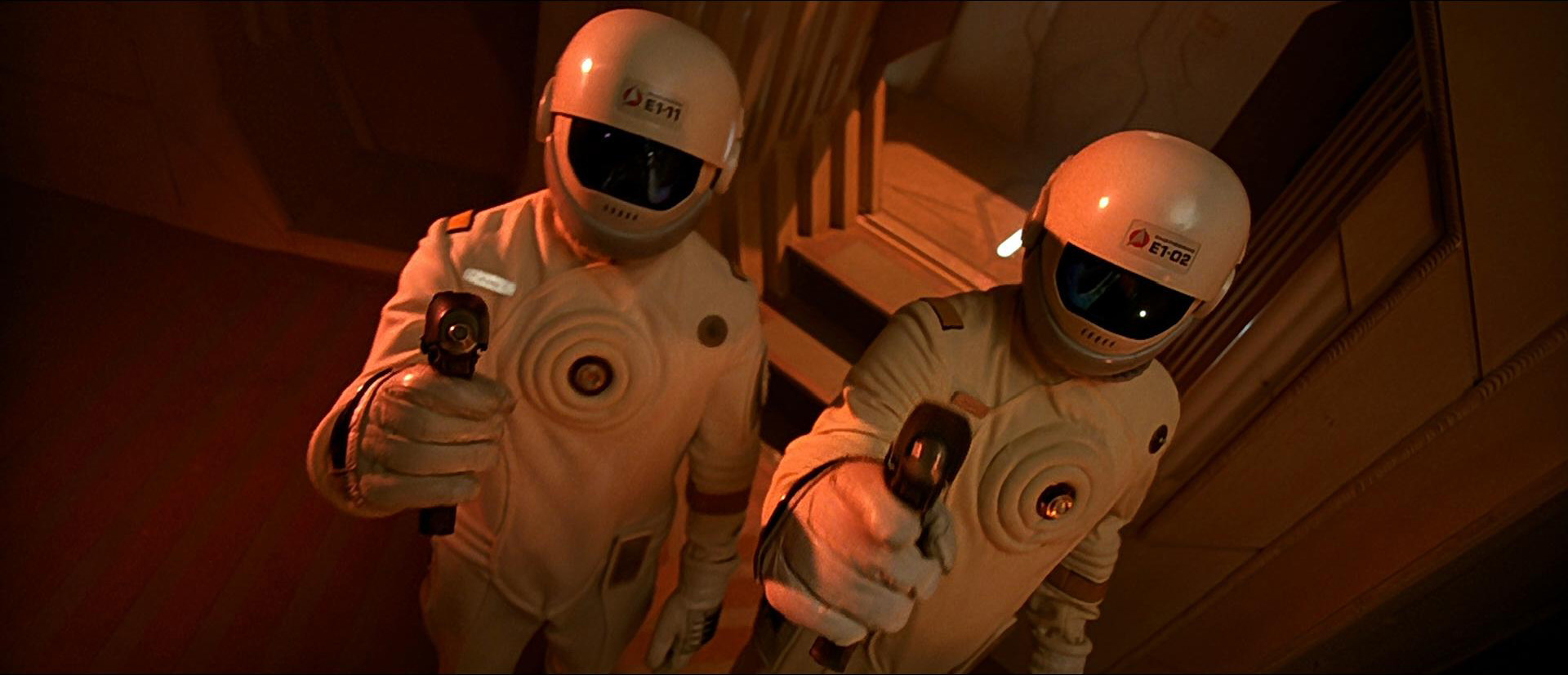
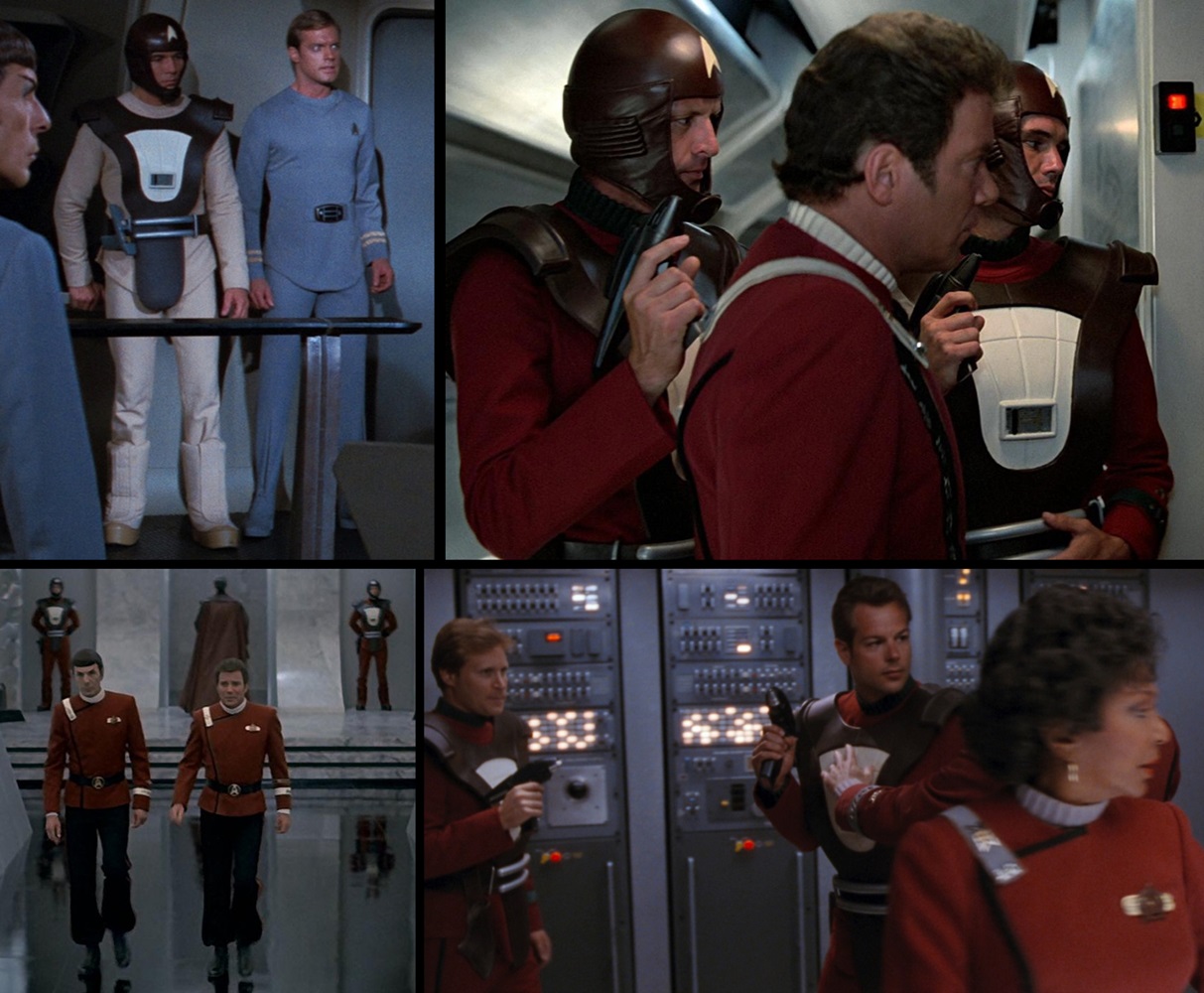
Although the enlisted jumpsuits were mainly worn by extras, the most memorable characters to wear these were probably the two assassins in ST6.
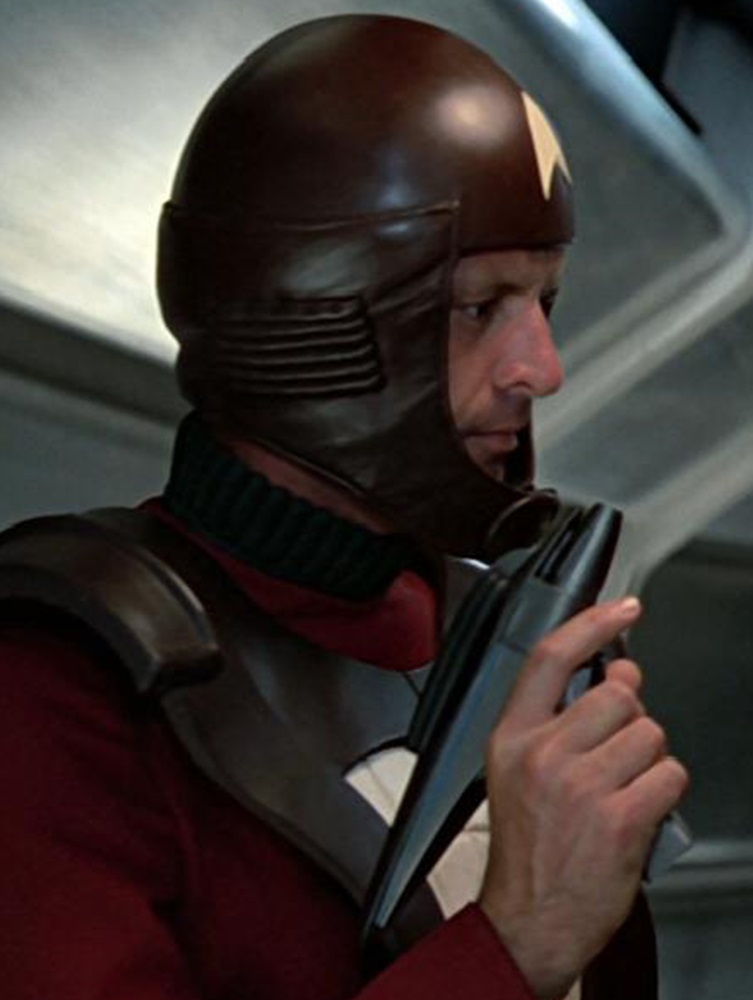
The great James Horner also had a cameo in The Wrath of Khan, wearing this uniform.
Positions
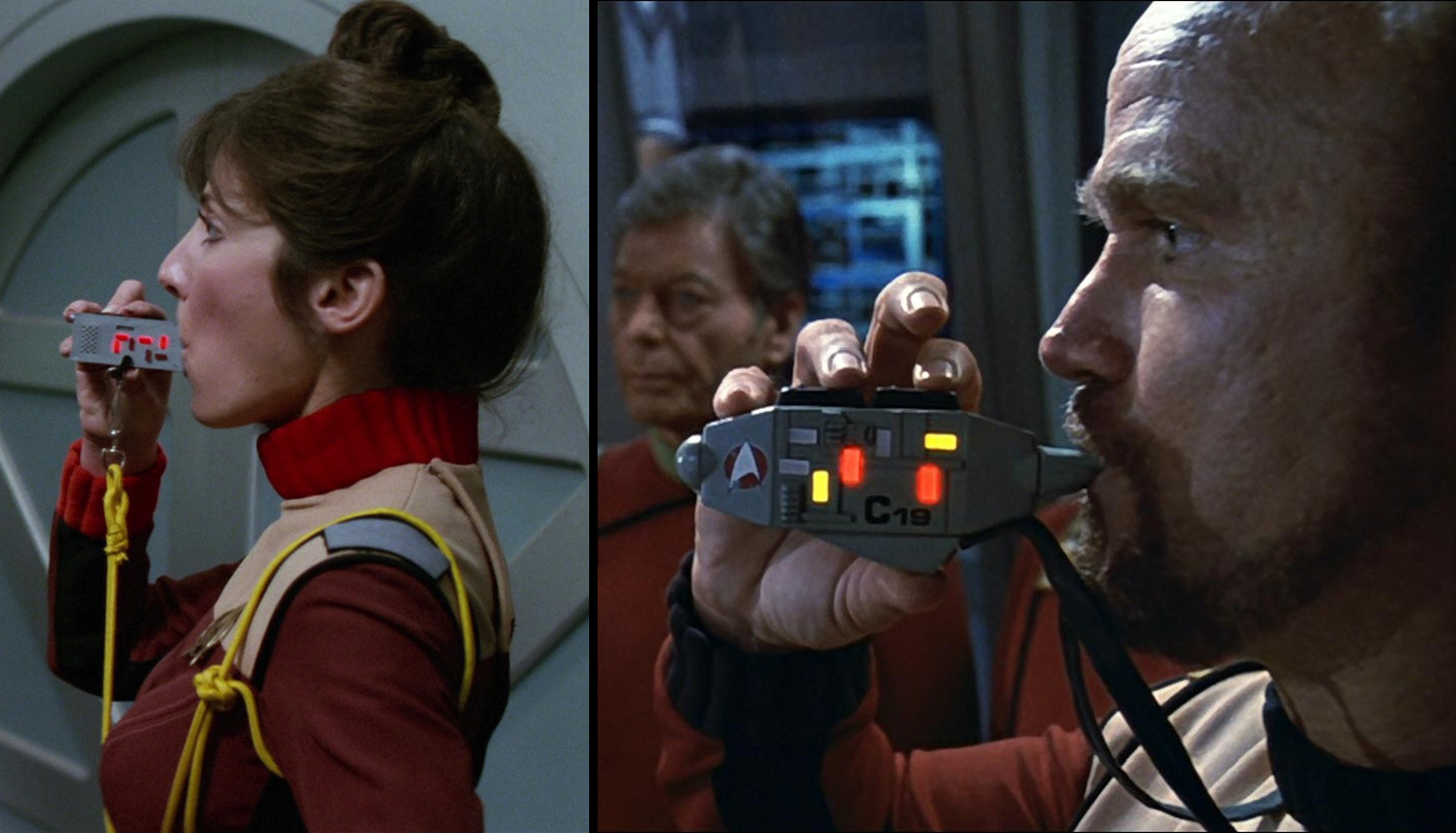
Enlisted crew had a variety of jobs, like blowing the whistle to announce the arrival of important figures:
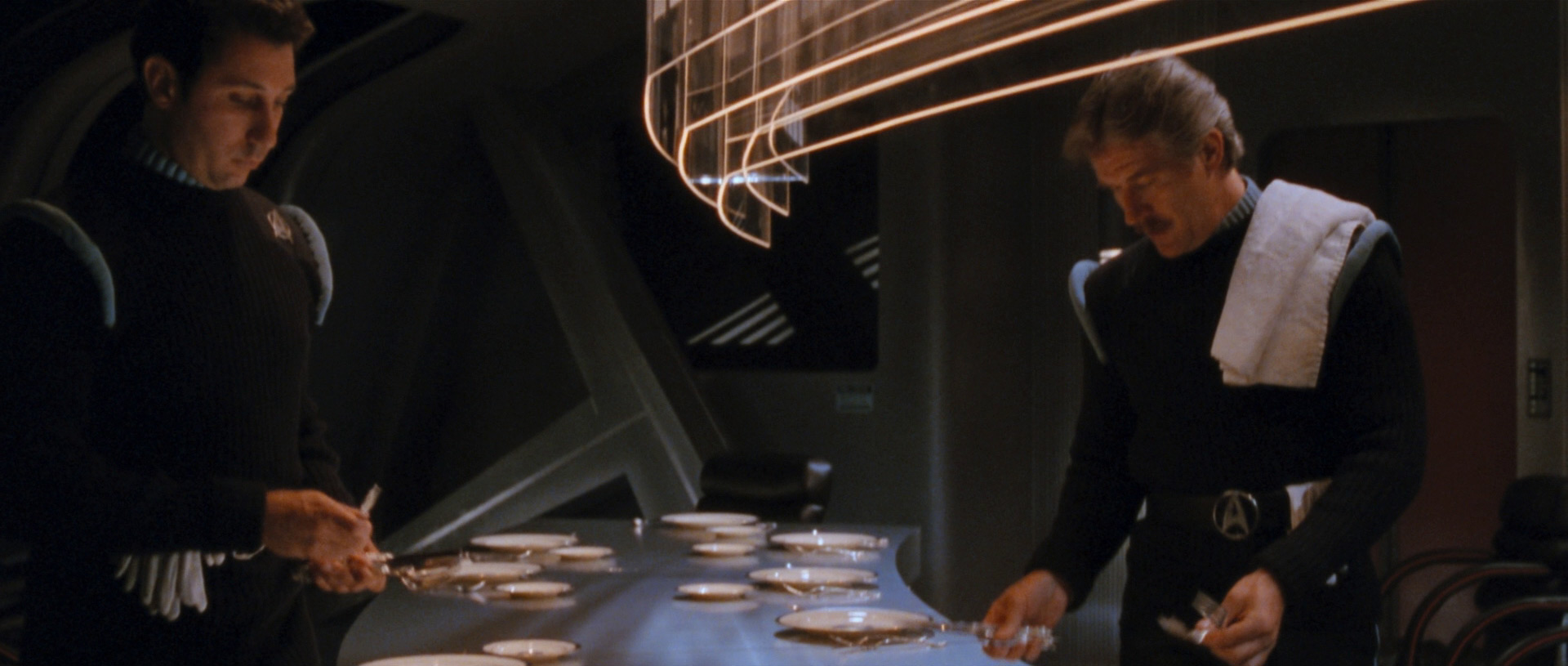
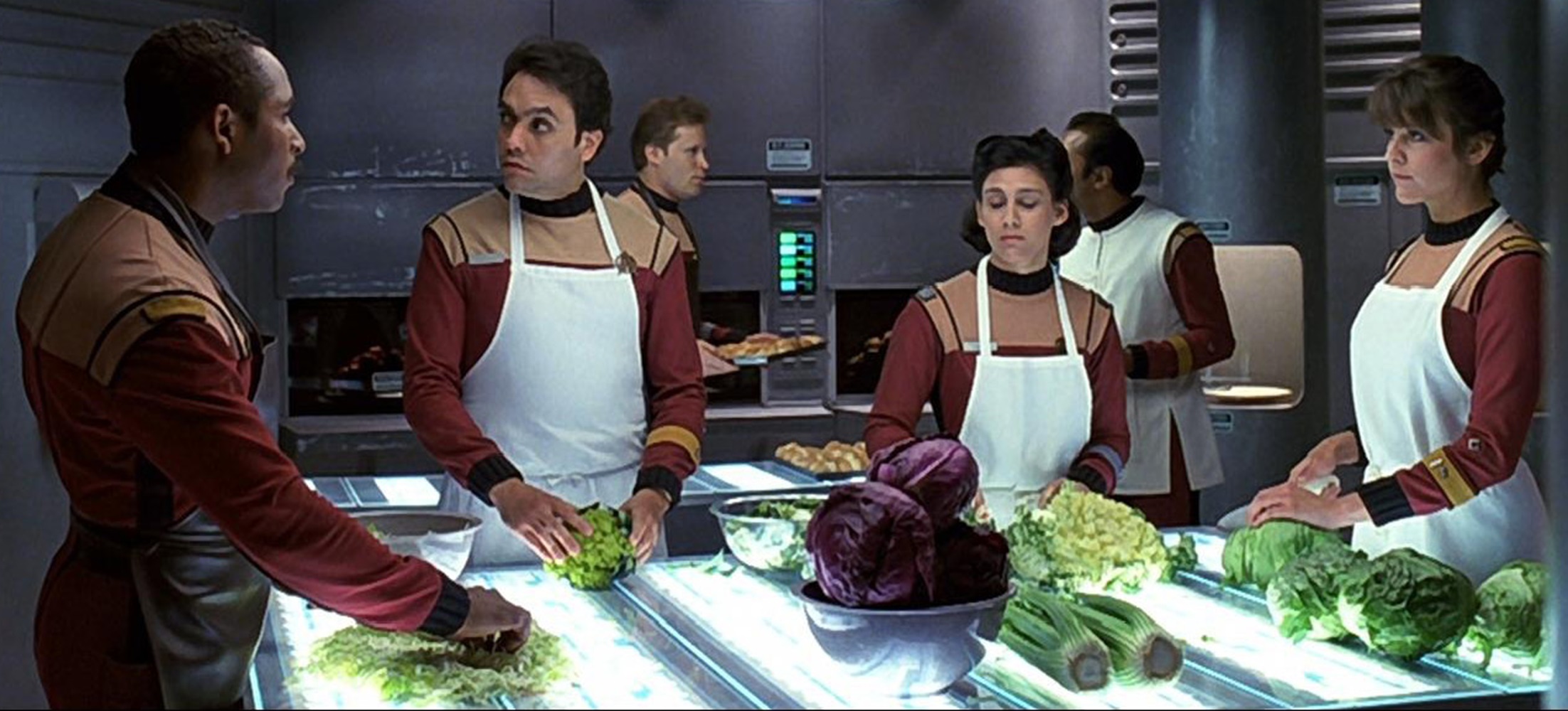
They did the cooking:
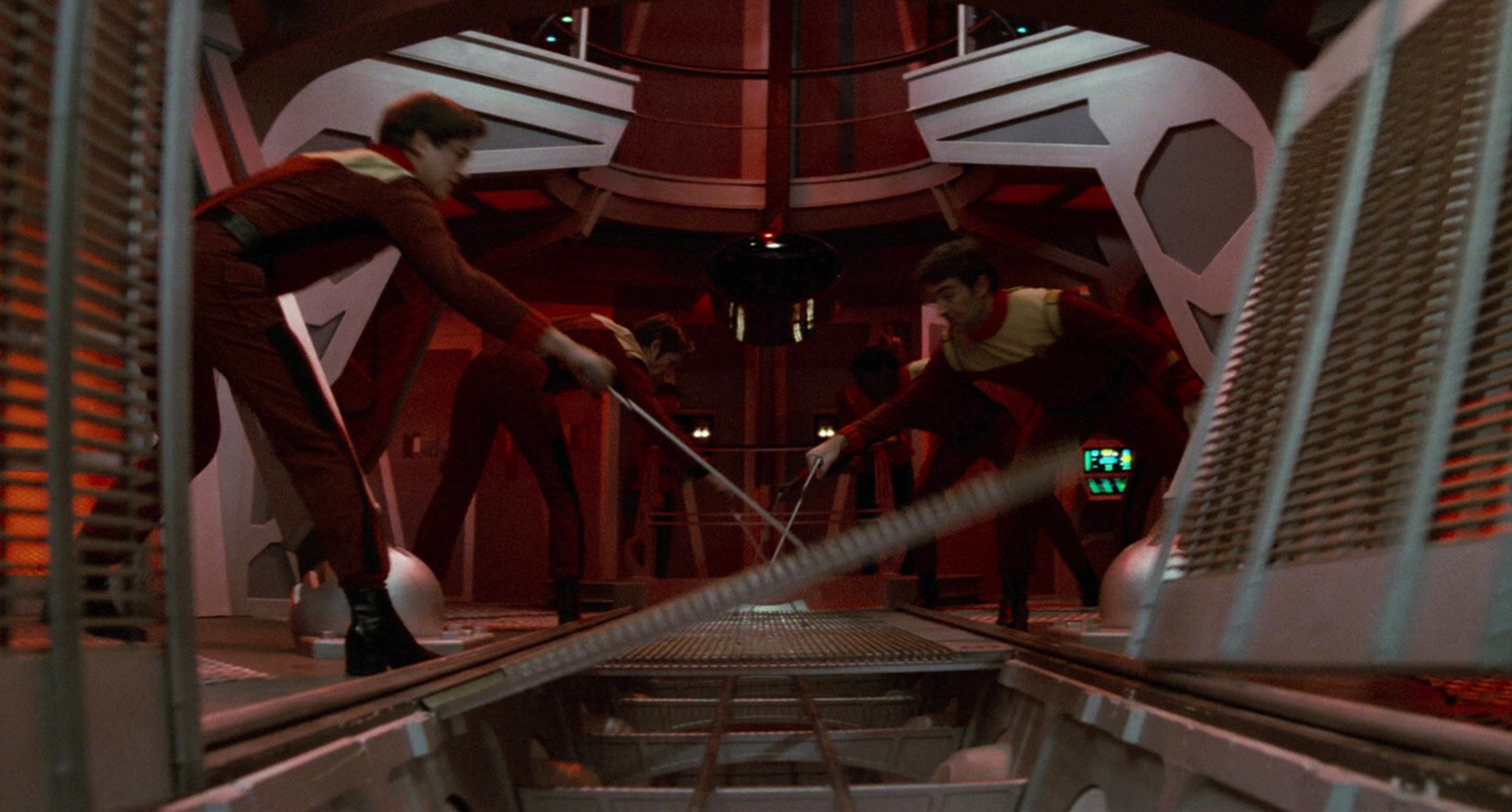
They apparently did a lot of the physical labor, like preparing the photon torpedo launchers:
During the ST6 investigation, enlisted crew members seem to have done most of the actual hunting:
They may have filled in for officers and key bridge stations as-needed, too.
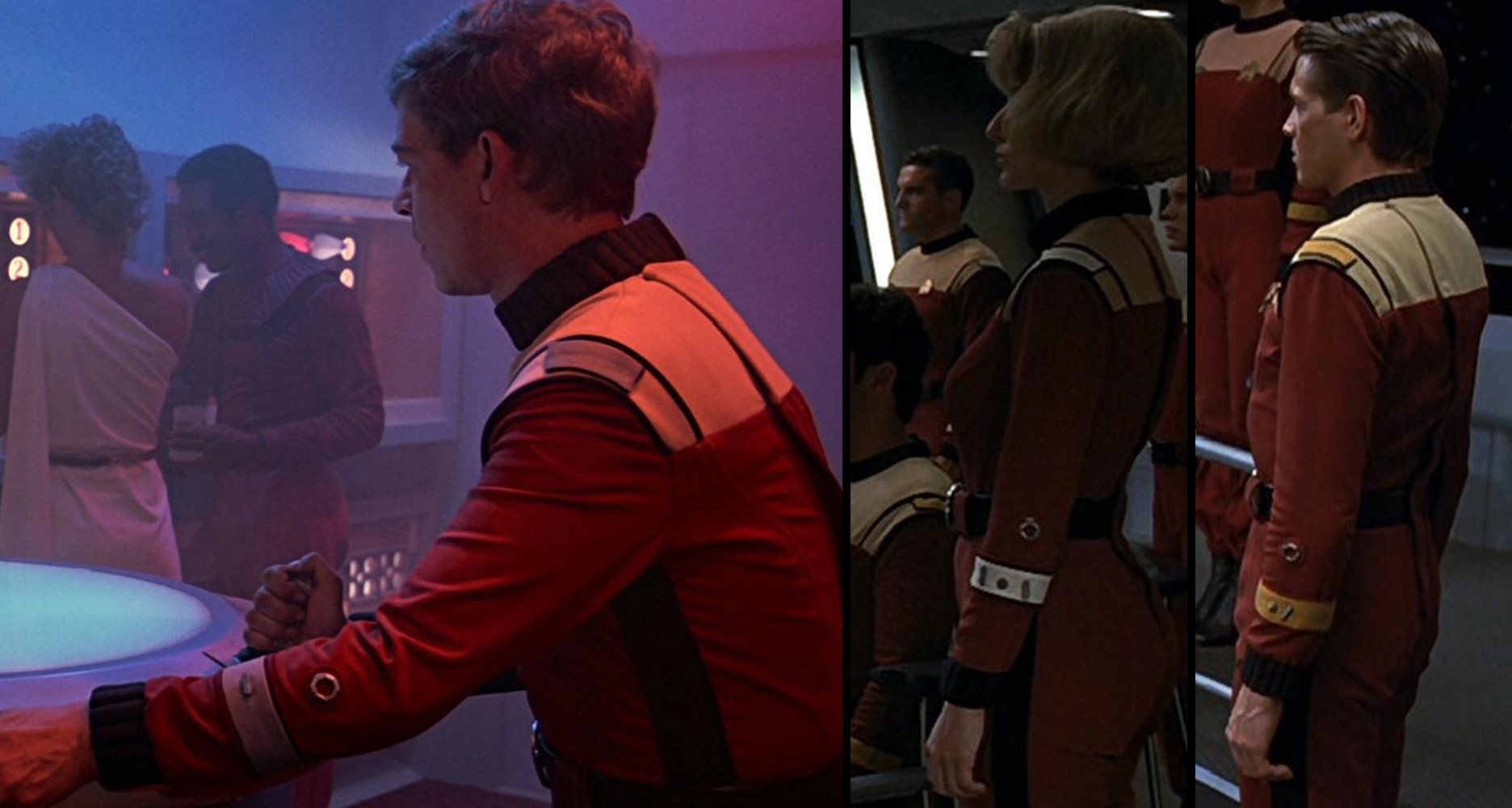
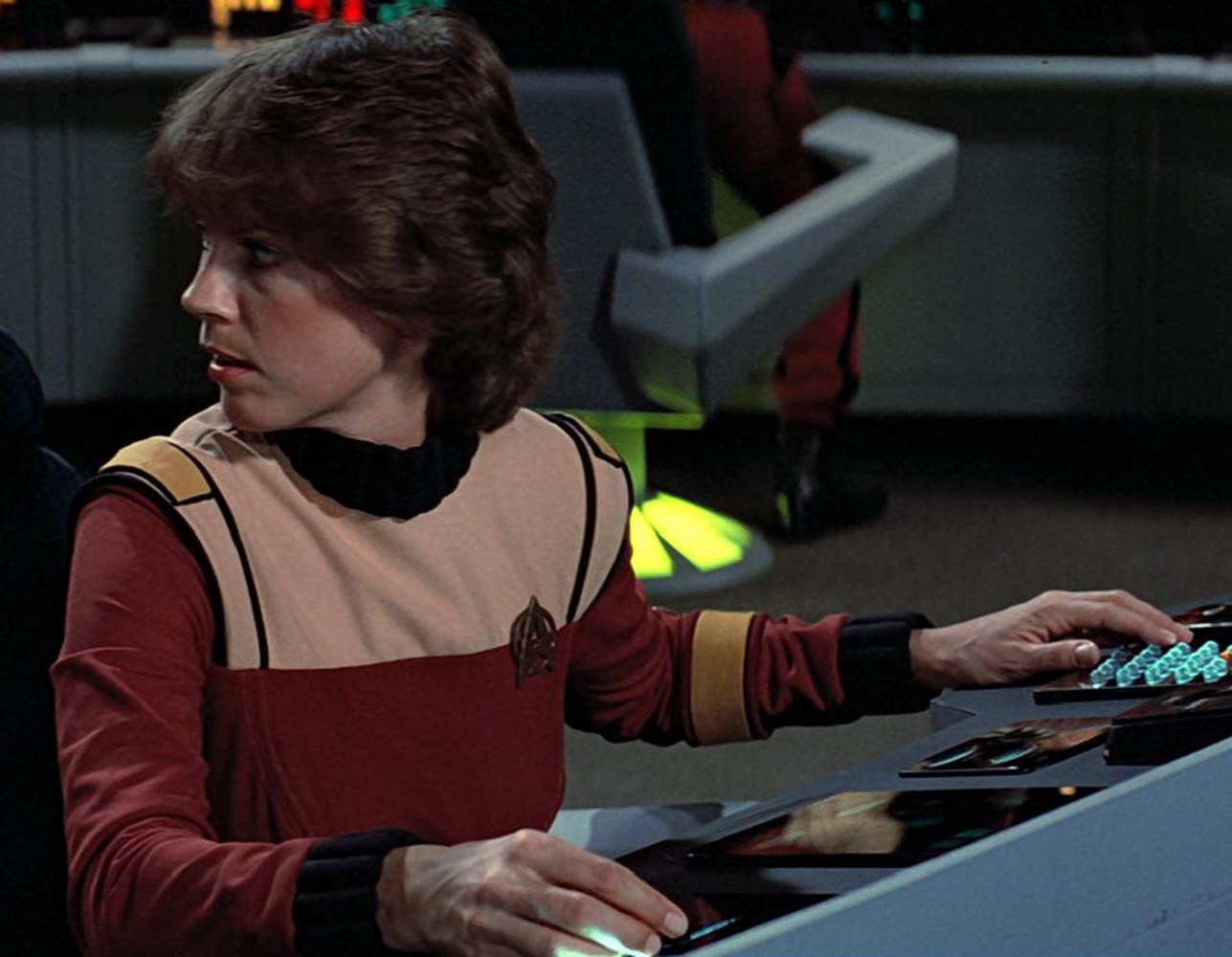
In ST2, the Enterprise pilot and navigator were both officers (or one officer and one cadet, depending on how you regard the rank of “lieutenant, junior grade”):
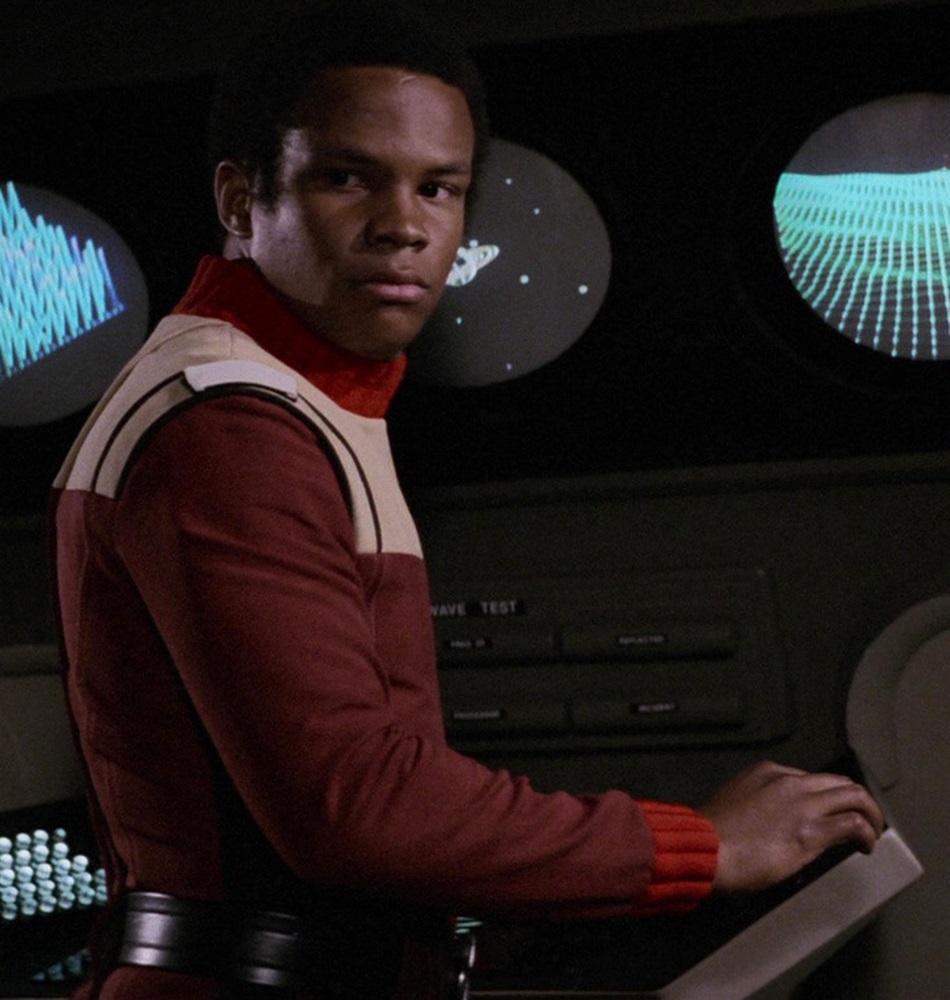
In ST3, after Saavik’s departure an enlisted crew member took over as navigator, which I’d accept considering even if it was normally an officer’s position, the Enterprise probably only had a skeleton crew on board by that point.
Assuming the two bridge stations had the same functions, we saw the reverse situation on the Excelsior, which was piloted by an enlisted crew member, while the navigator was an officer.
We then saw this again on the Grissom, although that crew member was curiously wearing sciences gray (or possibly special services blue).
I think we can safely assume that Starfleet training is extremely thorough, and all Starfleet personnel (officers and enlisted alike) have at least a basic proficiency at every station.
And I obviously have no issue with enlisted crew members manning key bridge stations like the helm and navigation; I’m just not sure what the rhyme or reason was.
In any event, in ST4 there was one enlisted lady who was also a member of the Federation Council – good for her!
Enlisted vs. Trainees
As I mentioned earlier, it’s a common misconception that cadets wore these jumpsuits and switched to the “monster maroons” once they graduated.
The jumpsuits had quilted collars and cuffs, analogous to those on the division-colored undershirts worn by officers.
Enlisted personnel always had black collars and cuffs:
However, enlisted trainees had red collars and cuffs:
Here is an enlisted trainee wearing the jumpsuit, near a cadet wearing the “monster maroon.”
Division and Rank
Both the enlisted trainees and crew members wore division-colored shoulder tabs, which were another echo of the TMP uniforms.
Like their predecessors, these shoulder tabs were made of division-colored wool gabardine over a black felt base.
In The Motion Picture these shoulder tabs also showed the wearer’s rank, mostly using the same schema seen in the series.
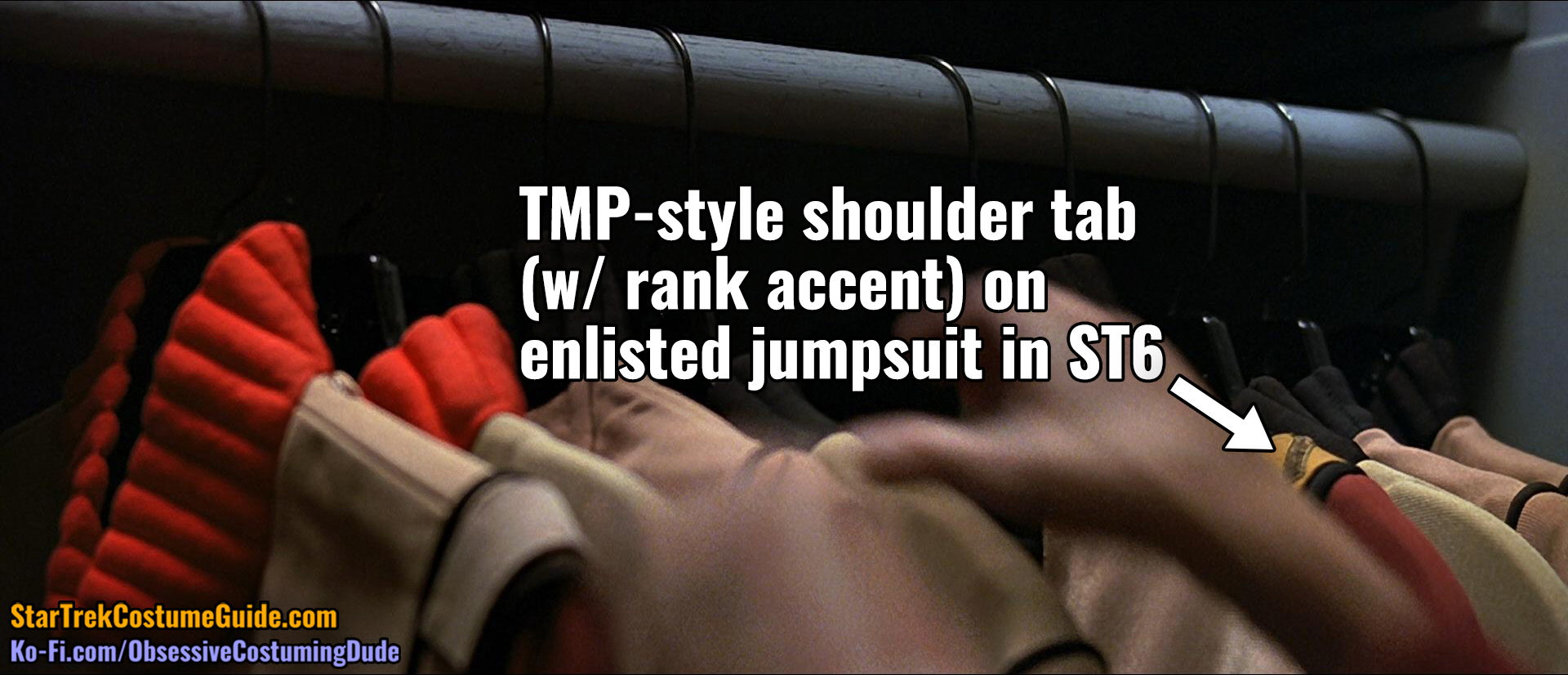
On the enlisted jumpsuits, though, the shoulder tabs were “plain” … except for when the TMP-style tabs accidentally made their way onto film, such as in this shot from ST6:
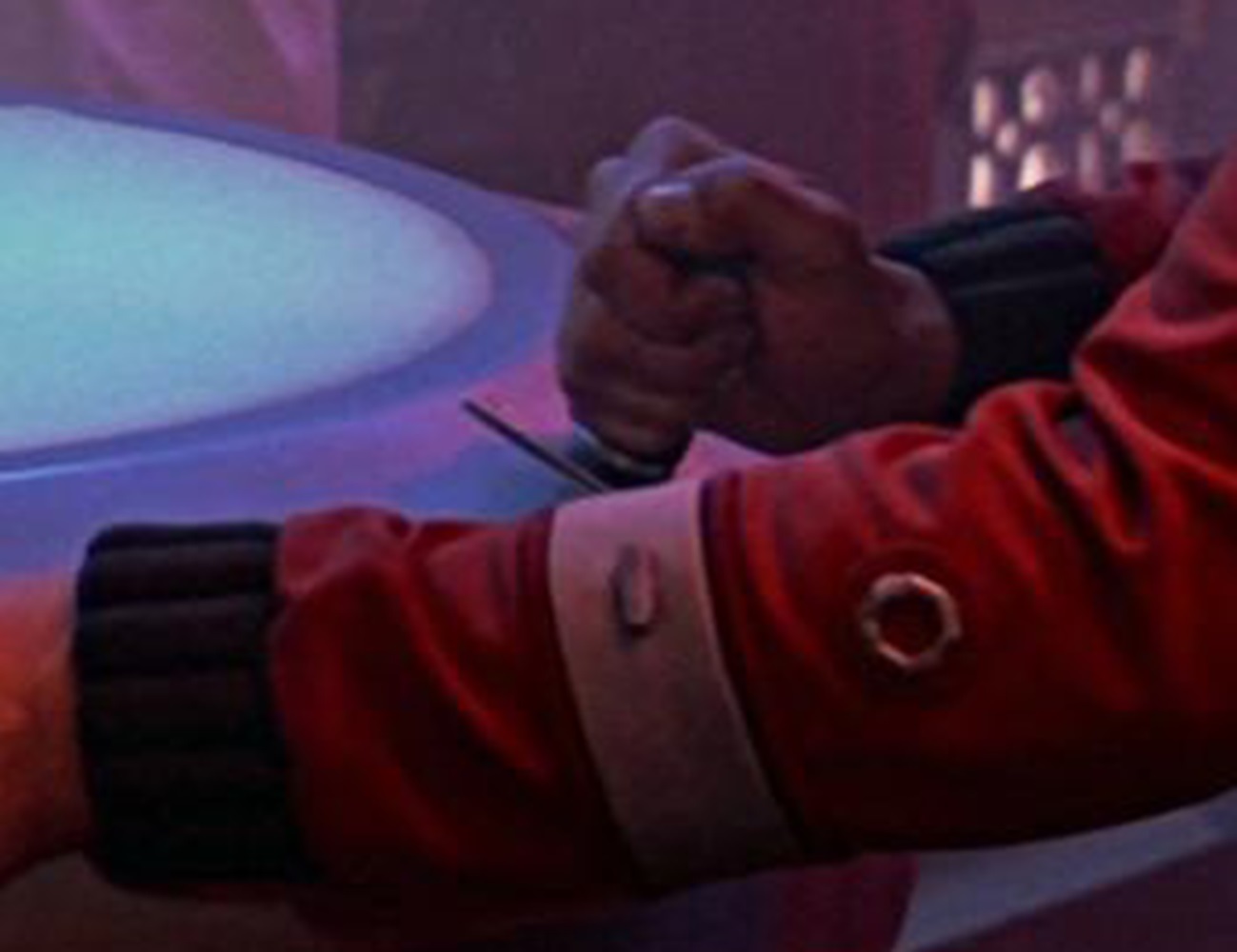
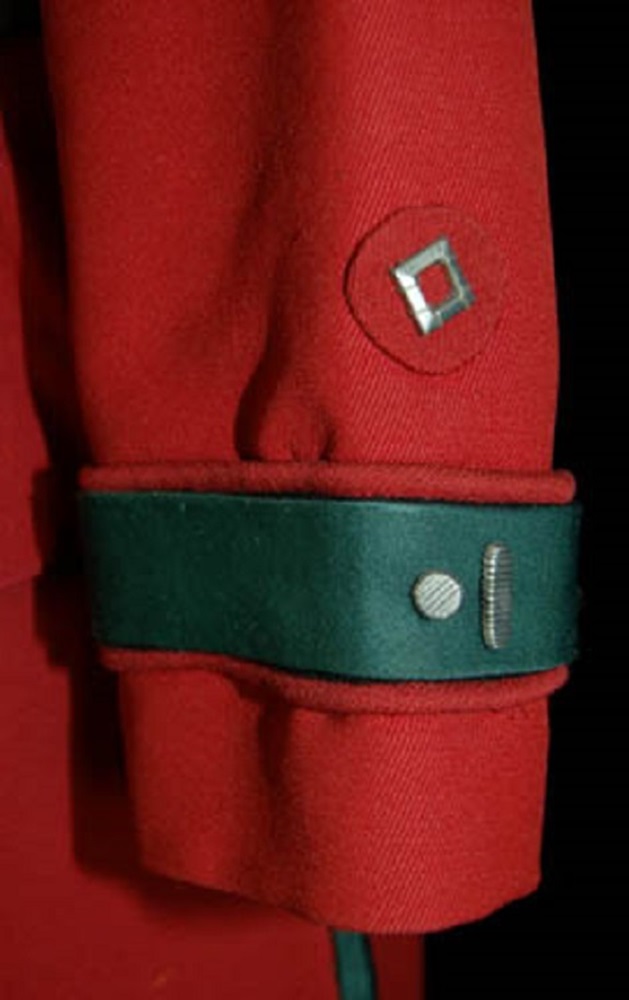
Instead, the rank insignia was worn on the lower left sleeve, above a division-colored sleeve band, just like on the officers’ jackets.
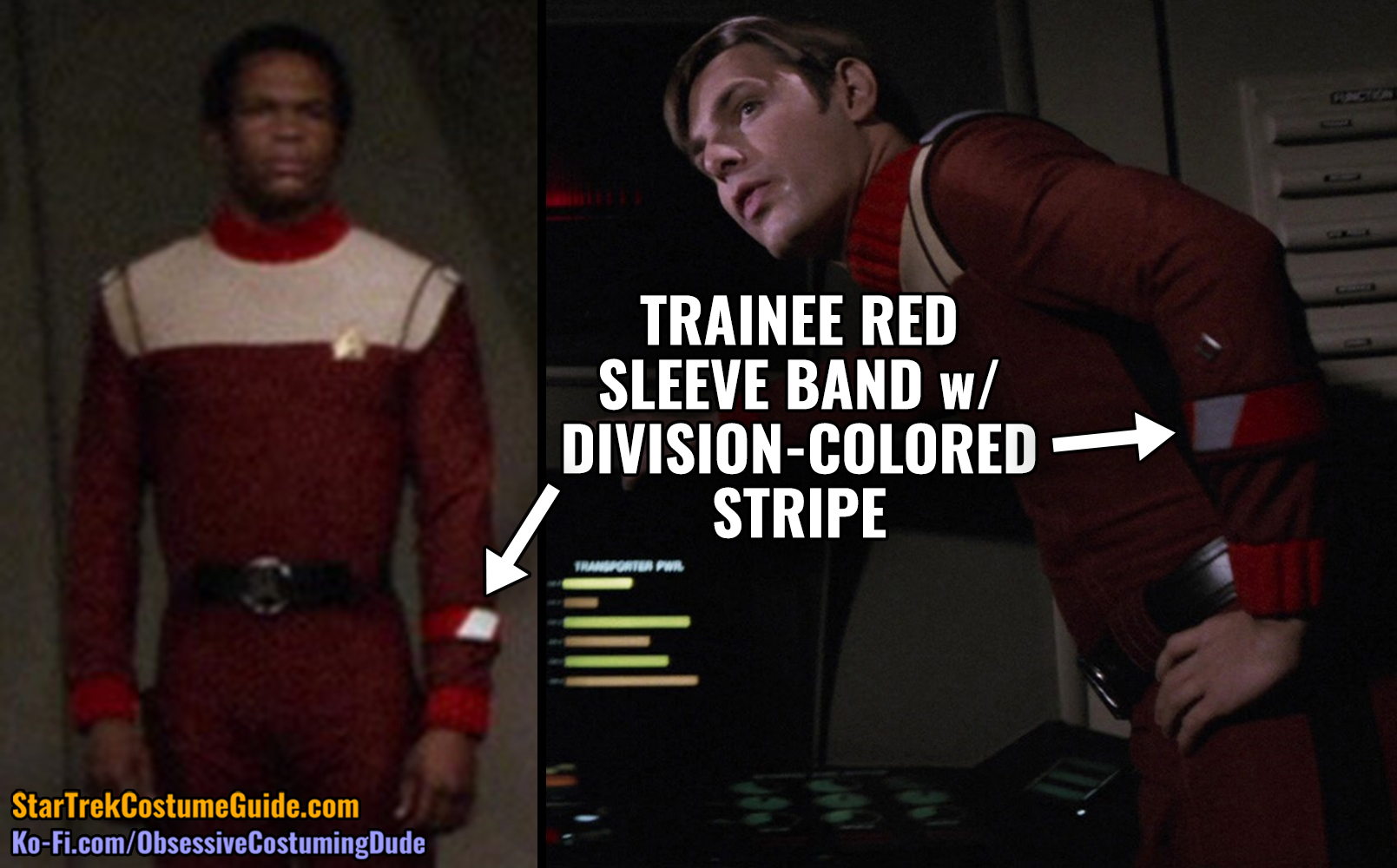
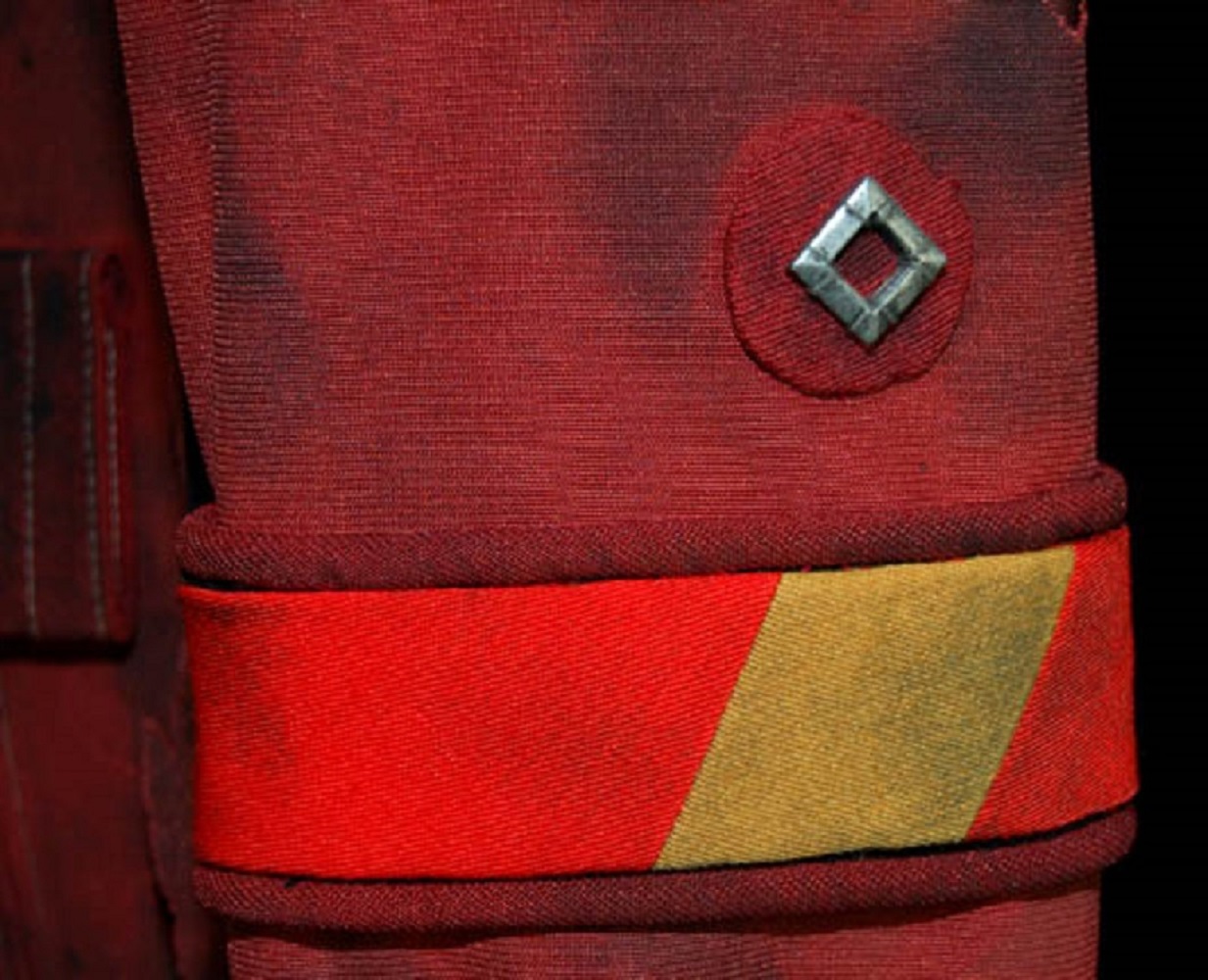
Like the cadets, trainees wore red sleeve bands with division-colored slashes.
And like the officers, enlisted crew members in leadership or managerial positions had the option of wearing a white stripe on their sleeve bands:
Fabric and Body Panels
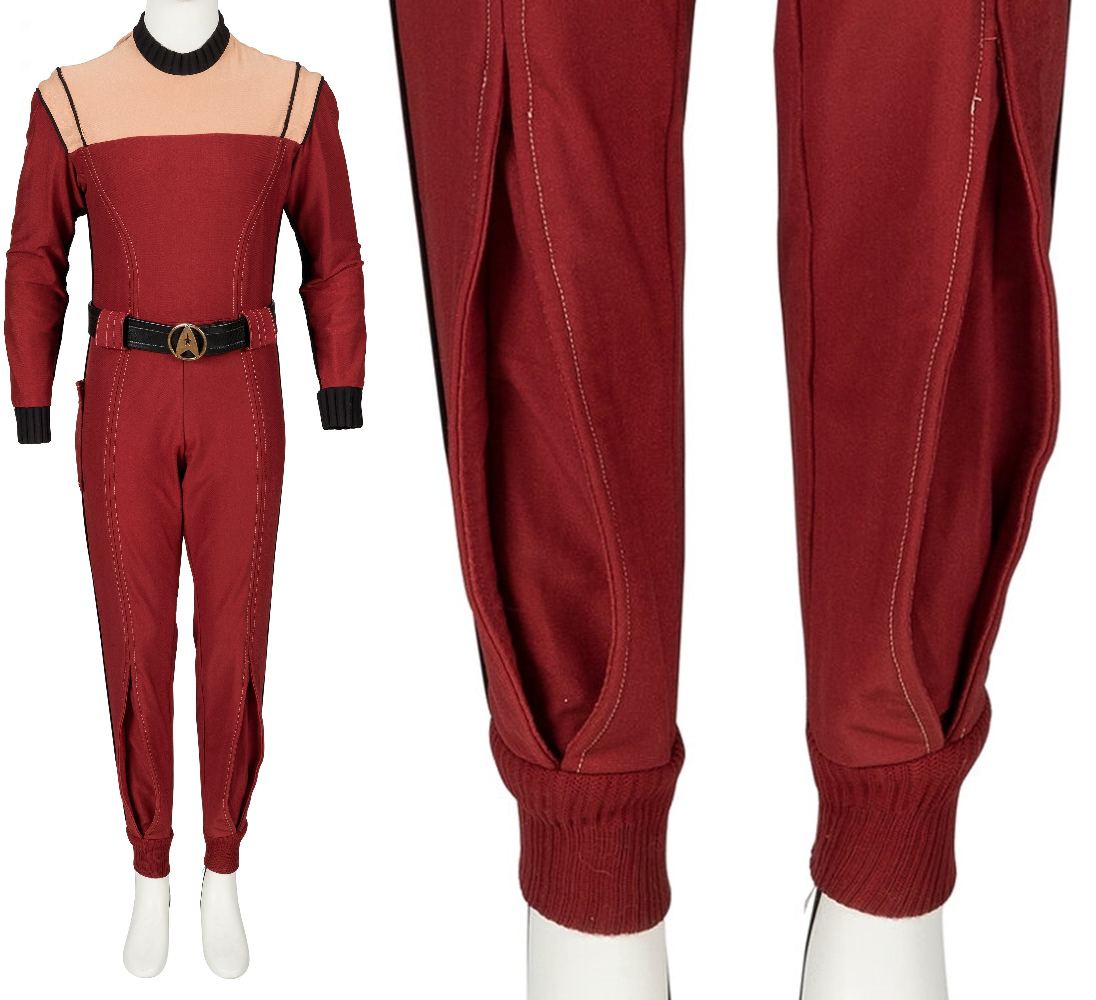
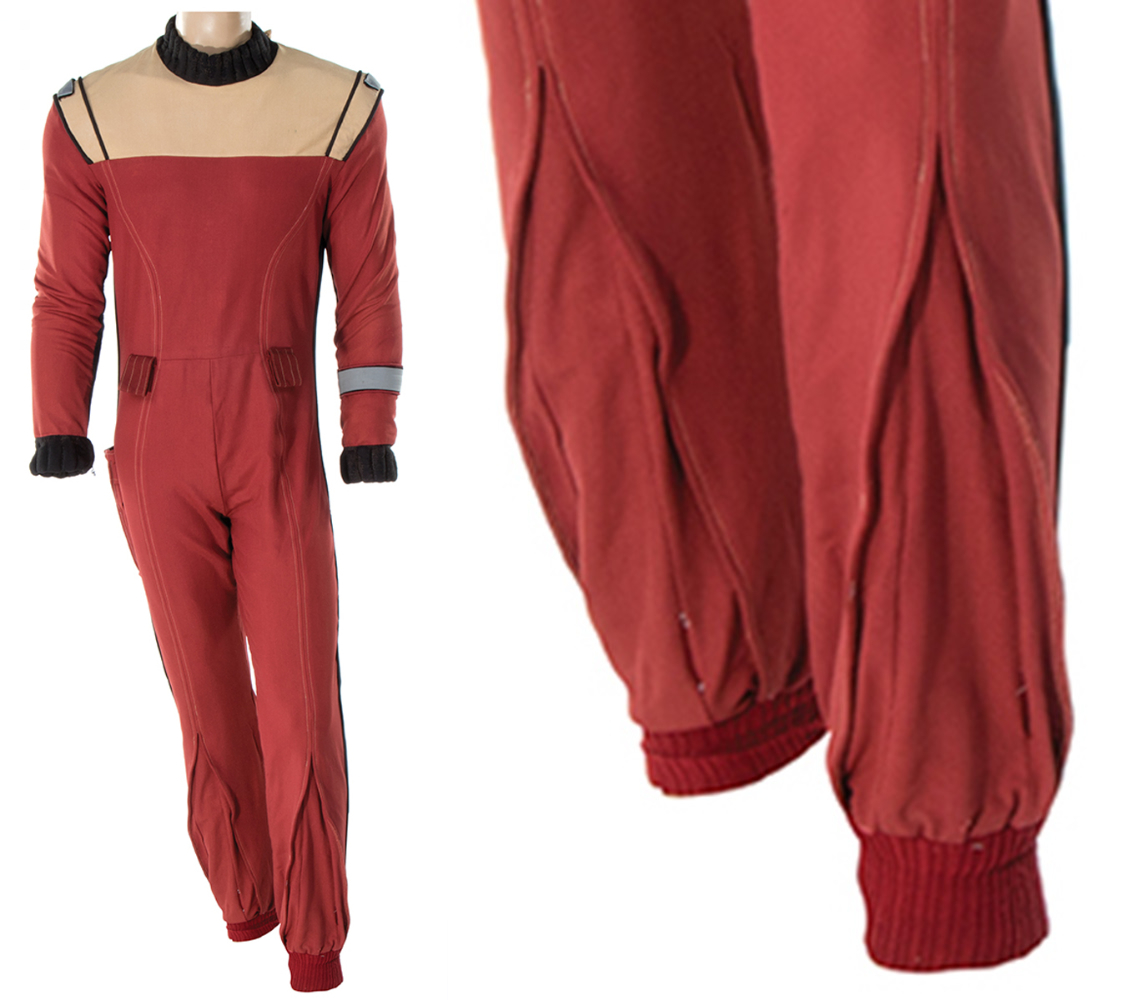
Being repurposed TMP jumpsuits, these enlisted jumpsuits were obviously made of heavy jumbo spandex, sewn with the dull side out – although some faint sparkling could occasionally be seen.
In these close-up auction photos, the jumbo spandex weave is more clearly visible:
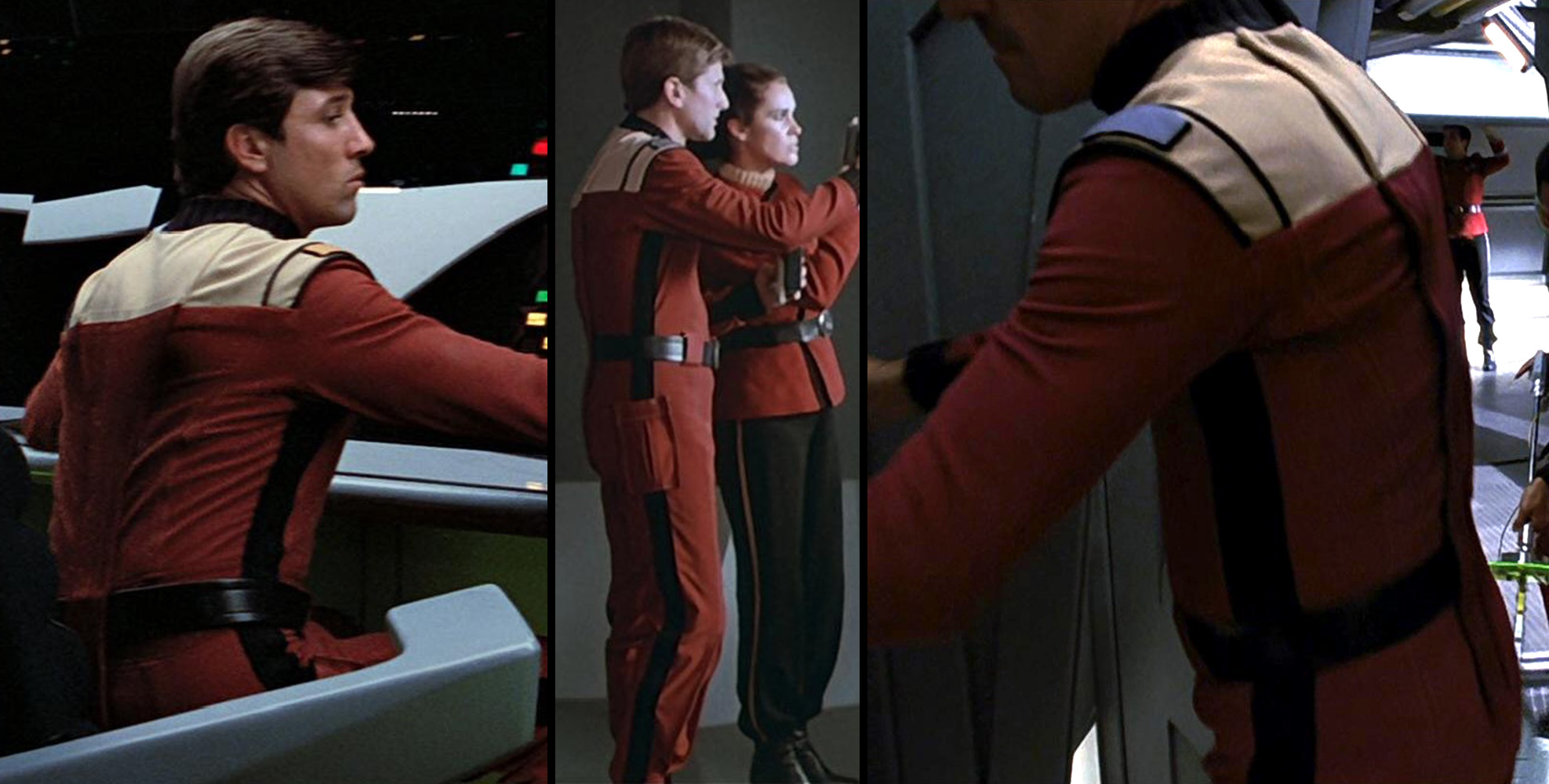
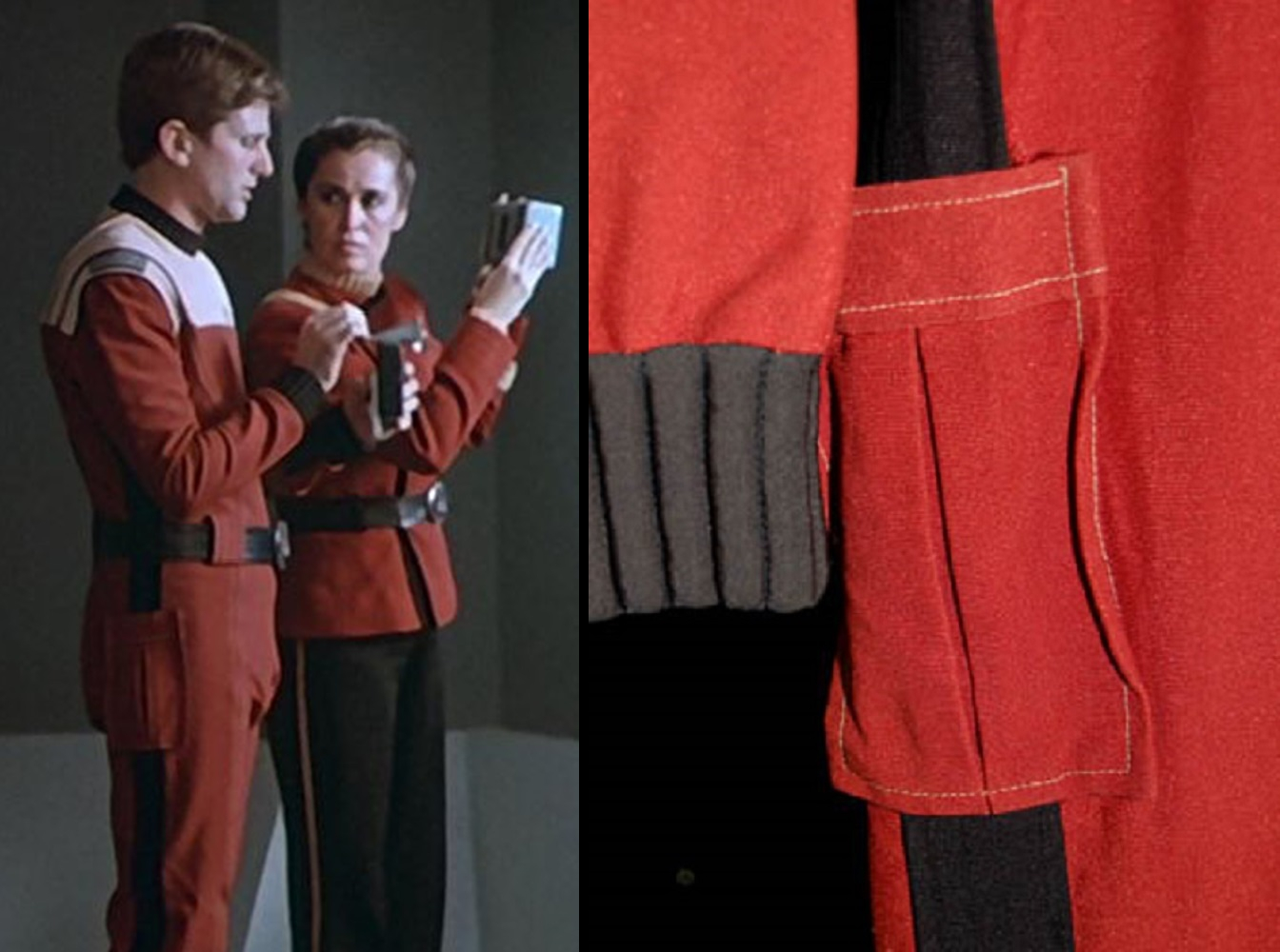
Unlike their TMP predecessors, though, a contrasting beige yoke with decorative black piping was added to the jumpsuit.
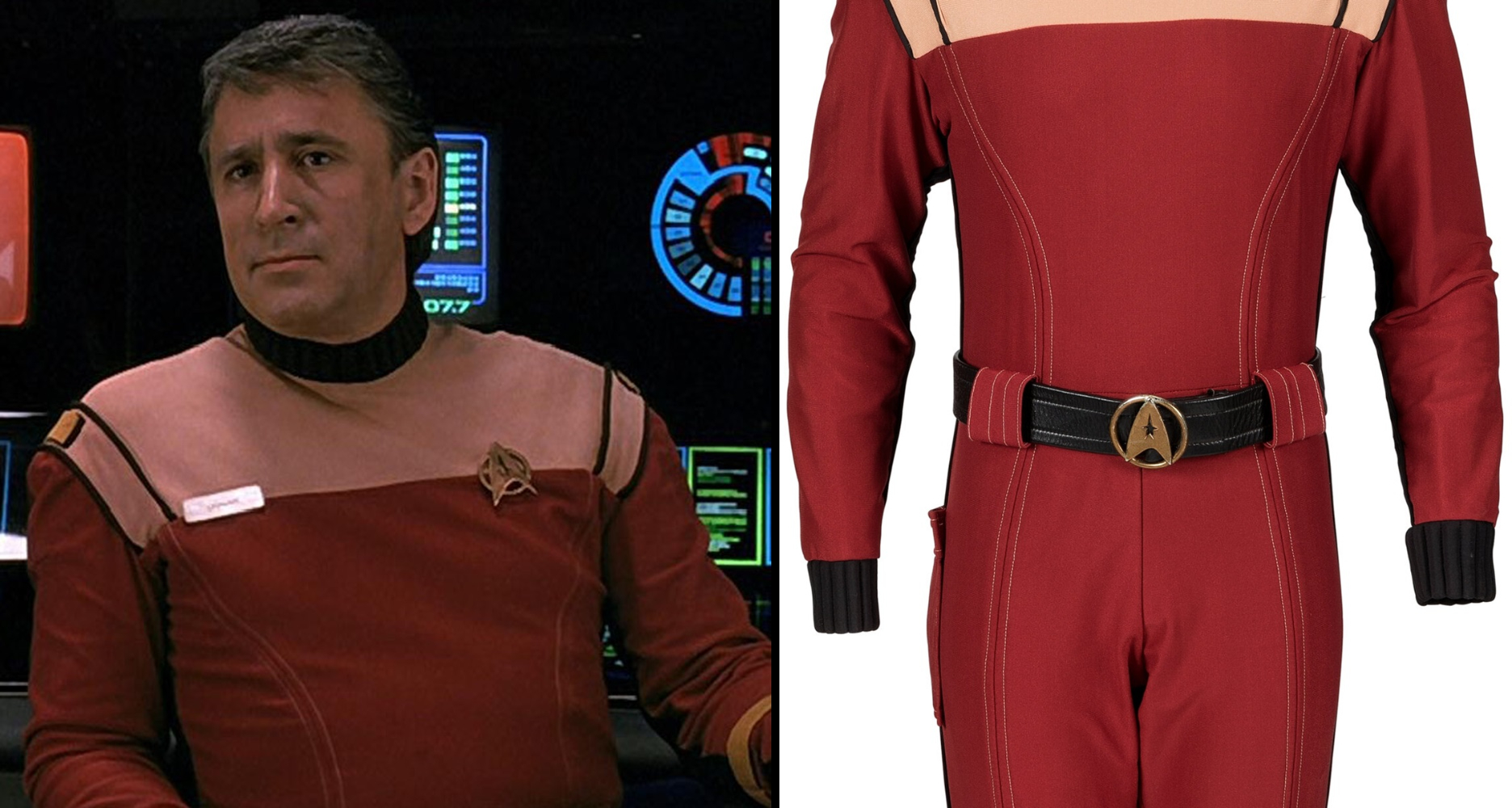
A metal chest badge the shape of the Starfleet “delta” (similar to the officer’s, minus the oblong backing) was worn on the upper left chest.
These jumpsuits were generally skin-tight and had topstitching along the side front and back seams in a contrasting, lighter thread color.
Black stripes were added to the sides of the body and underside of the sleeve.
A decorative panel was also added to the center back, adding more visual interest while also hiding the zipper.
Like their predecessors, these uniforms had a patch pocket attached to the right hip – a rarity for Star Trek costumes!
Belt
The enlisted jumpsuits were worn with belts – technically unnecessary for a jumpsuit, but I think these accomplished two things:
First, they helped make the enlisted uniforms look more analogous to the officers’.
Second, and on a more practical level, they hid the front waist seams that were covered by the “perscan” devices in The Motion Picture.
These belts appear to have been identical to the ones worn by the officers, except enlisted crew had silver belt buckles.
As you can see, a pair of belt loops was added to the front of the jumpsuit to hold the belt in place.
Lower Pant Legs
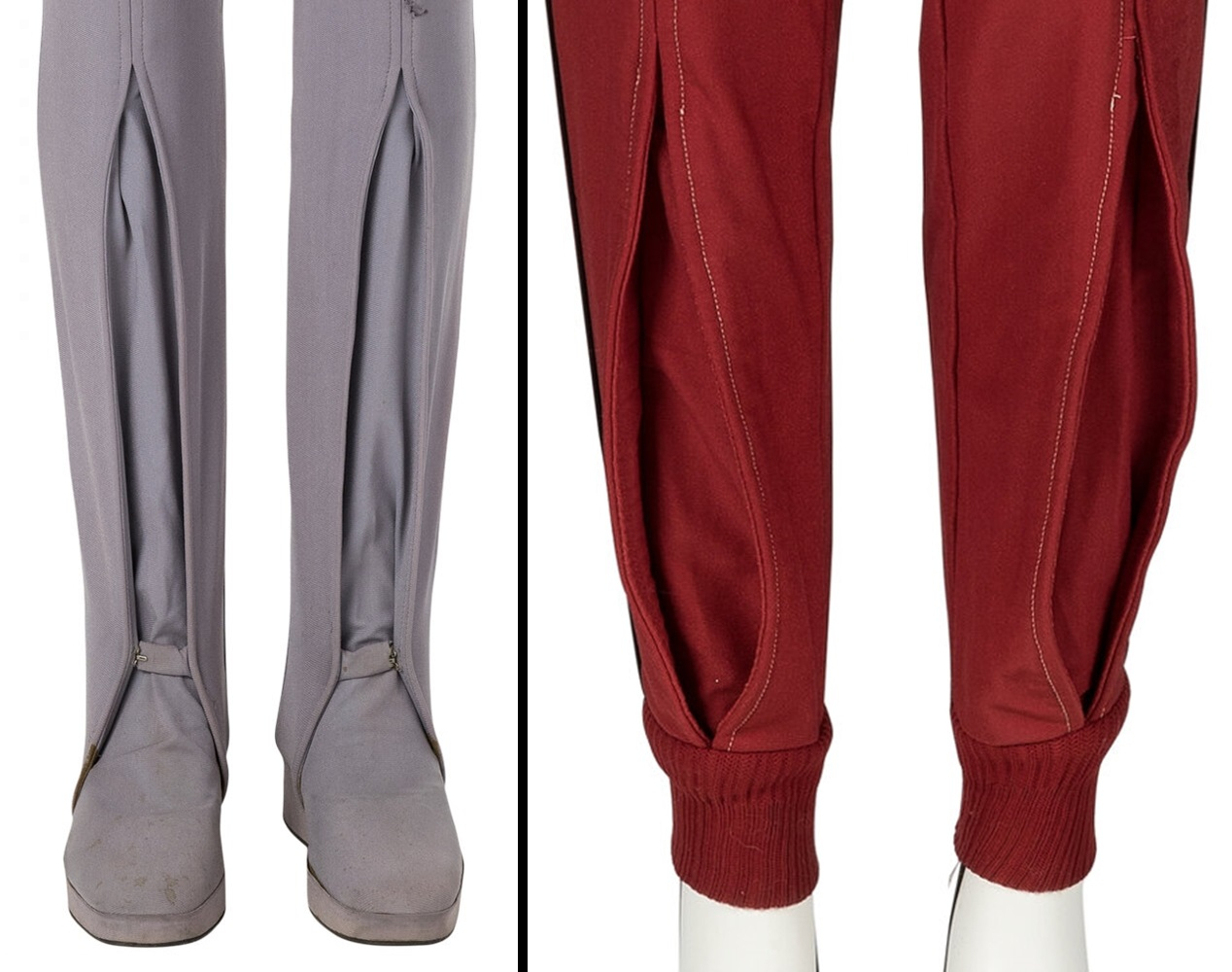
Since these were repurposed TMP jumpsuits, they had the lower front pant leg panel inserts, that formed a sort of inverted box pleat.
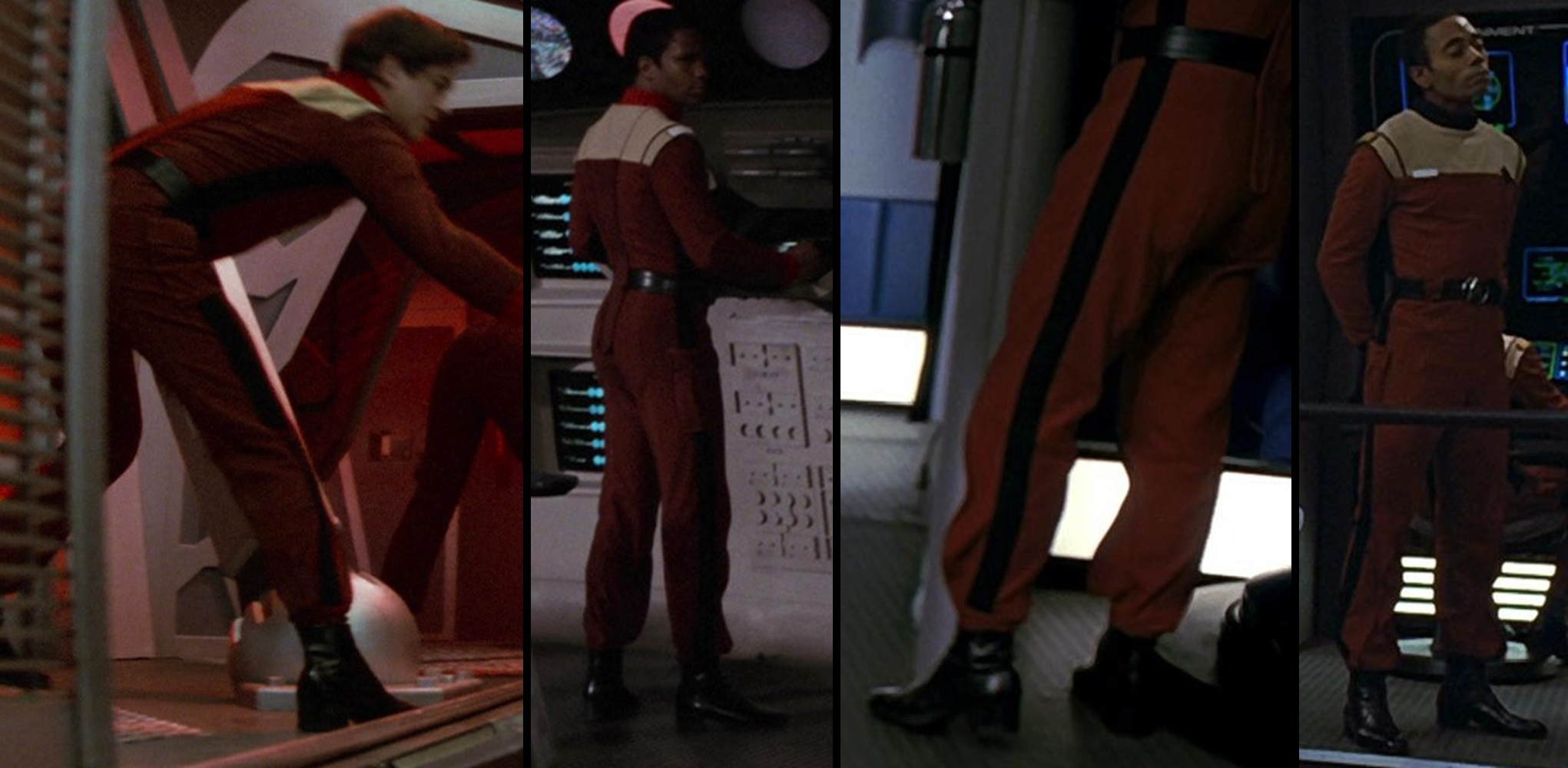
On some jumpsuits these pleats were closed at the bottom like they were on the TMP uniforms (left), but on others they were pulled open (right) – probably an attempt to widen the pant leg and achieve more of a “bell-bottom” effect similar to the officers’ trousers.
Boots
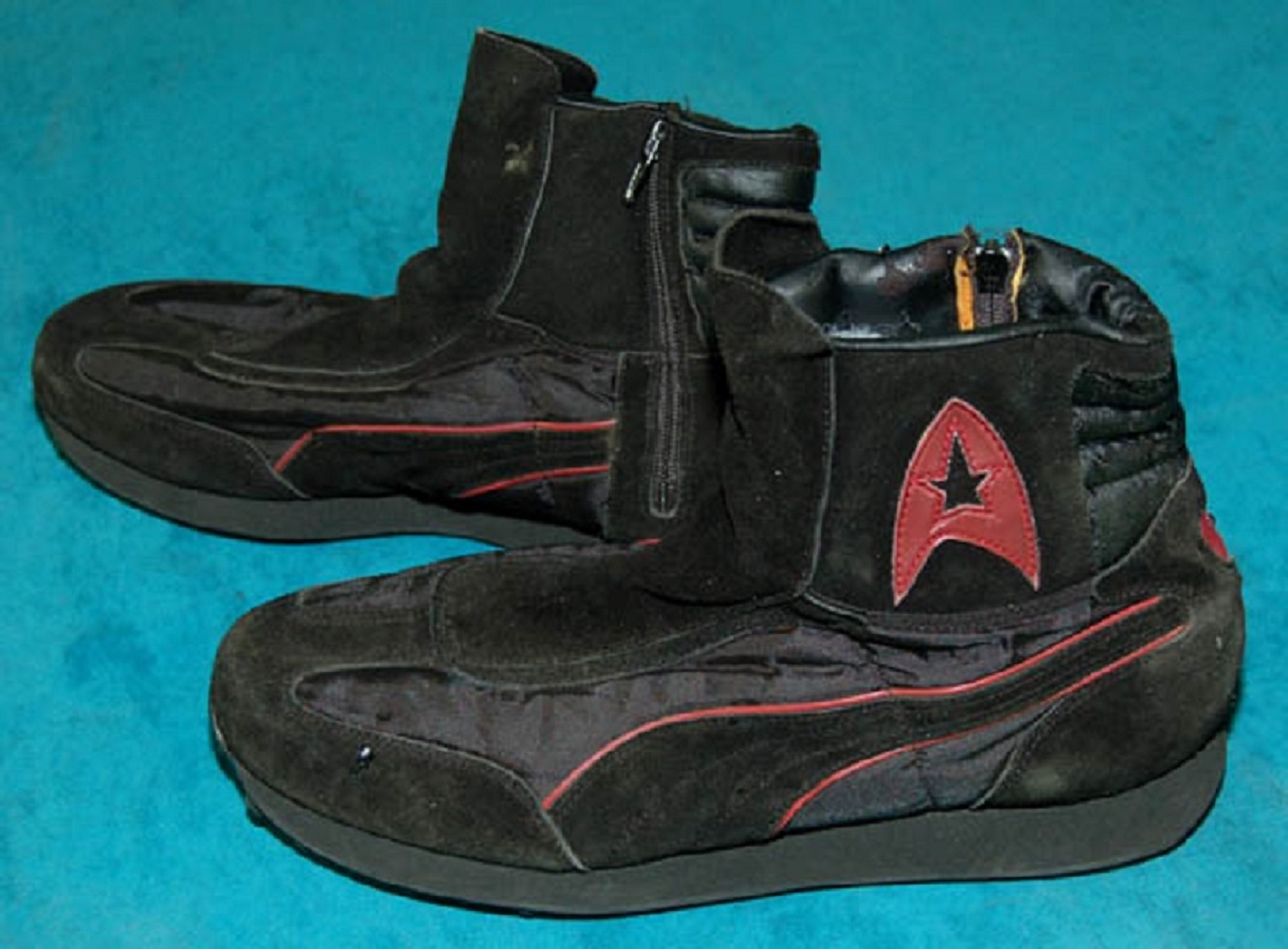
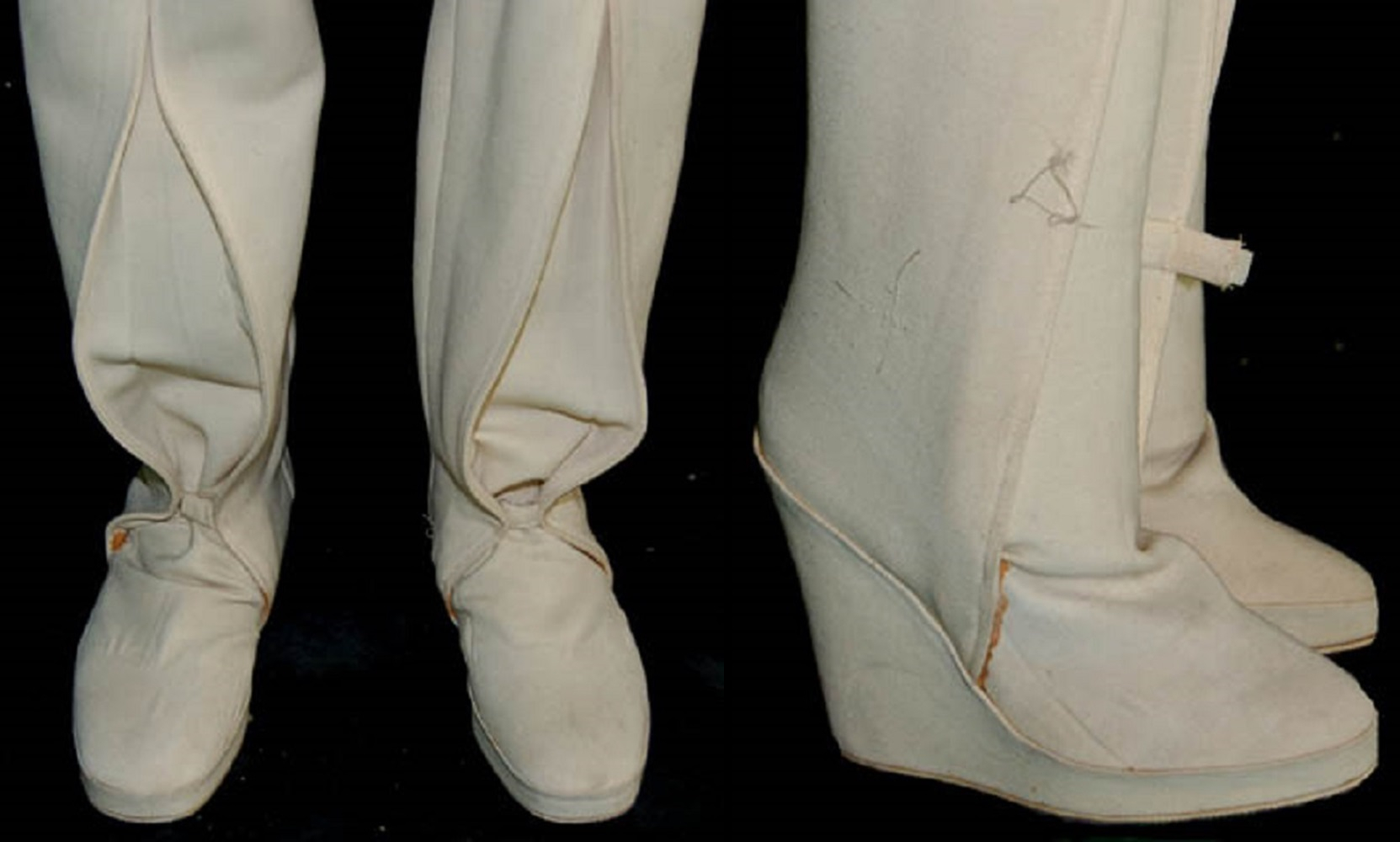
Some of the TMP uniforms had had attached shoes, but the enlisted jumpsuits were worn with black boots.
There were also these shoes, which were production-made (or rather, modified), but I don’t think they ever wound up being used in the movies.
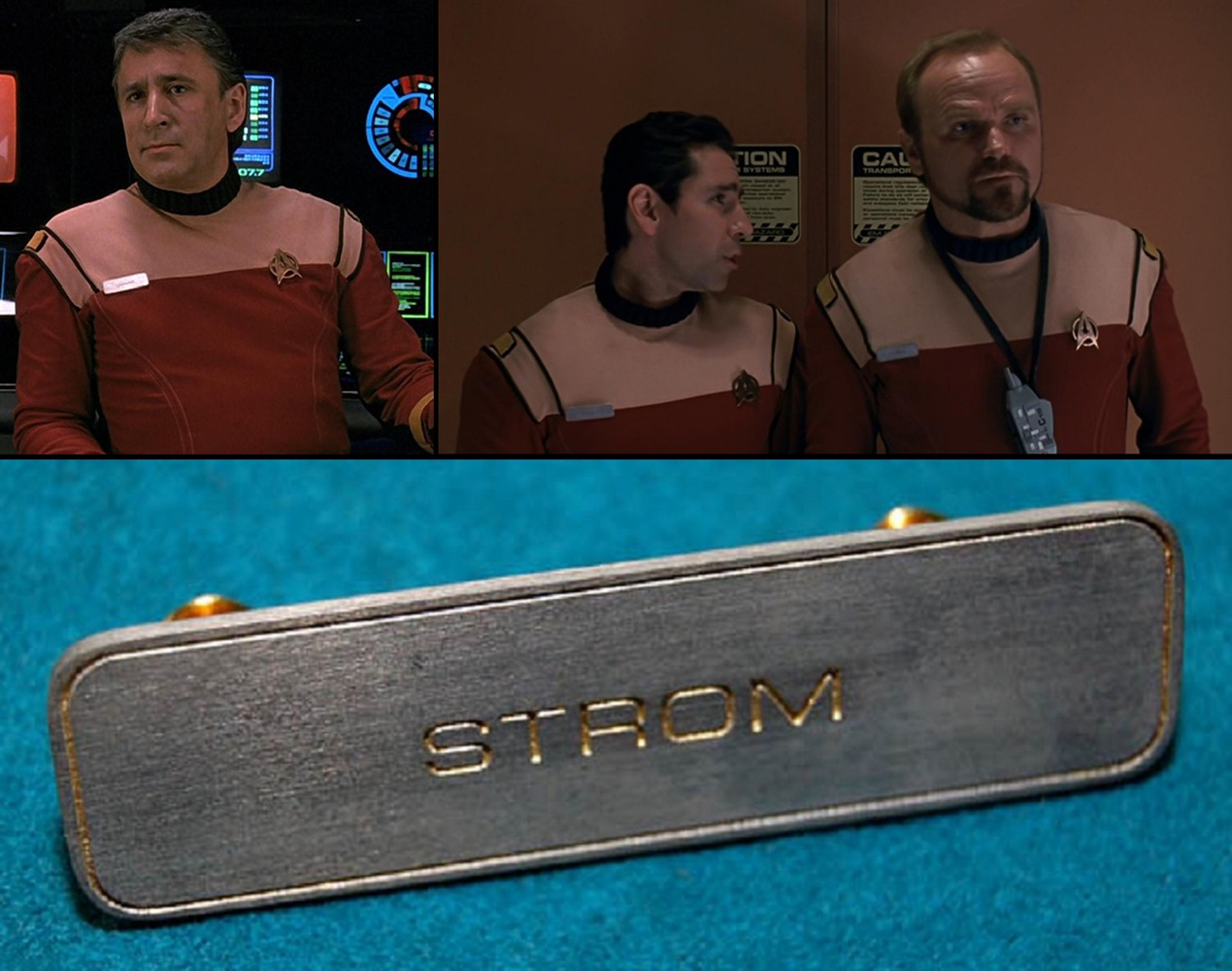
ST6 Name Tag
In ST6, a name tag was added to the wearer’s upper right chest.
Like the flag officers’ awards, these enlisted name tags continued to be used in the Generations prologue.
DEPARTMENTAL UNIFORMS
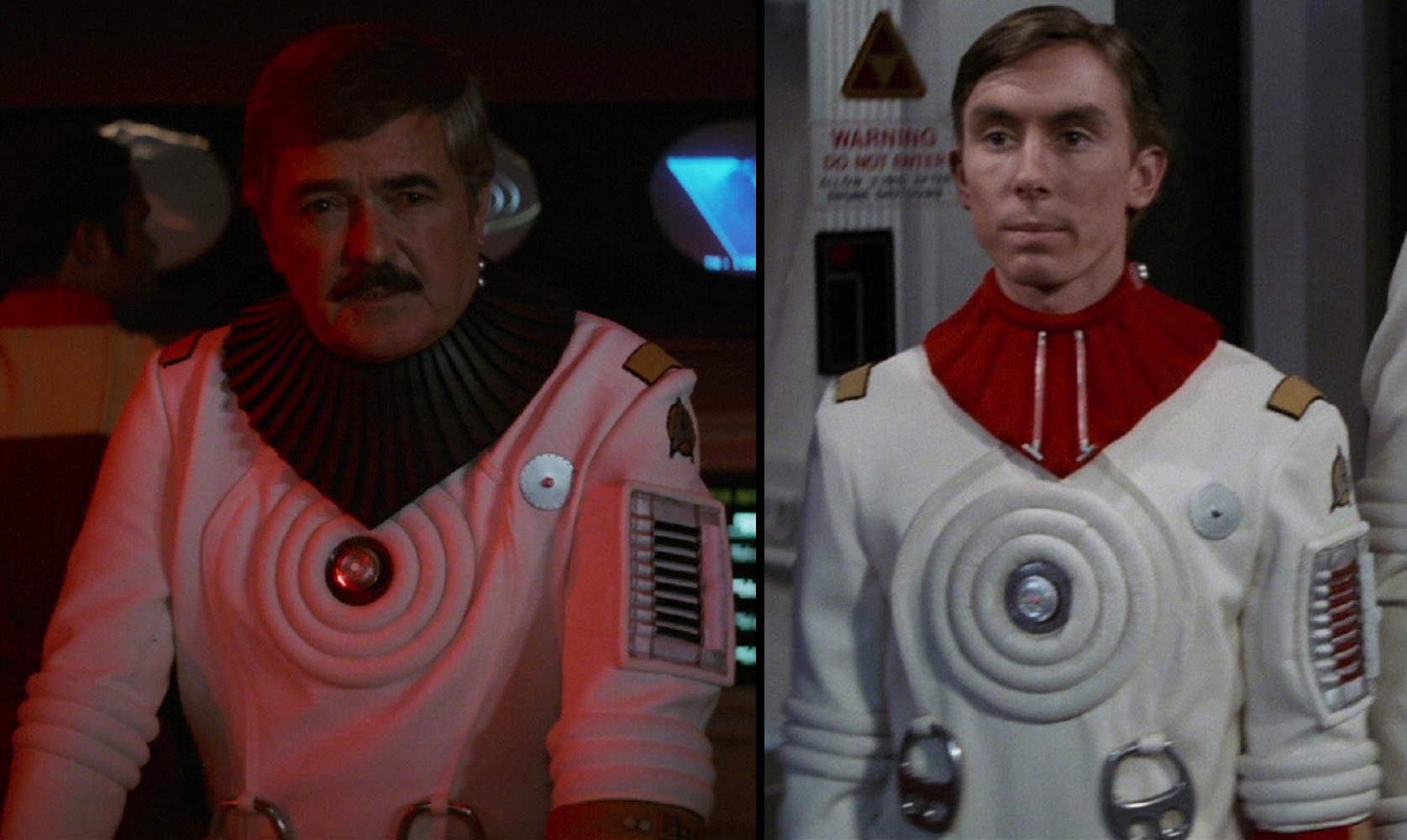
Engineering Radiation Suits
In addition to the standard officer and enlisted uniforms, there were multiple other uniform garments and options, usually for specific departments or situations.
Most of these were again recycled from The Motion Picture, although they were modified to varying extents.
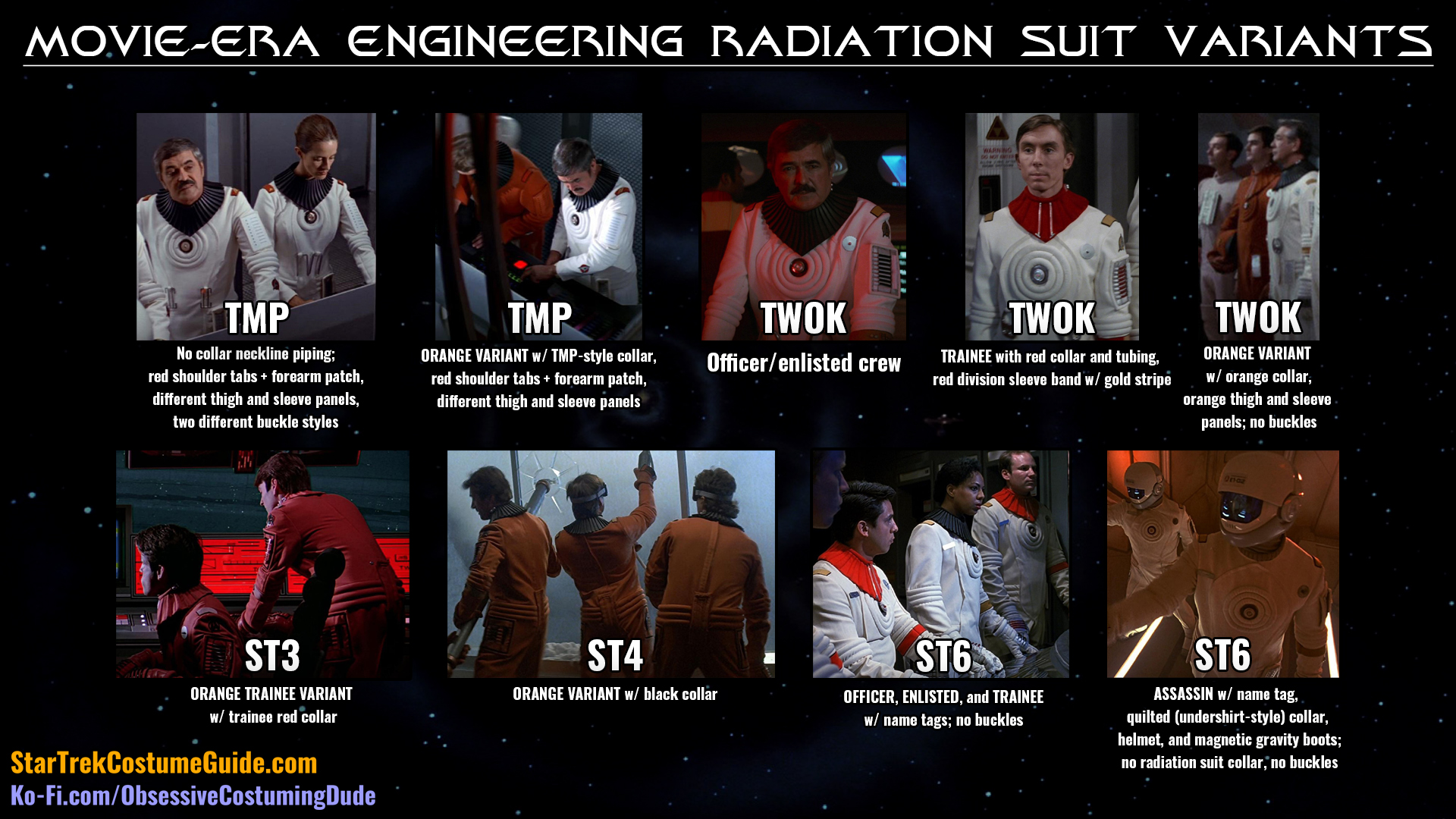
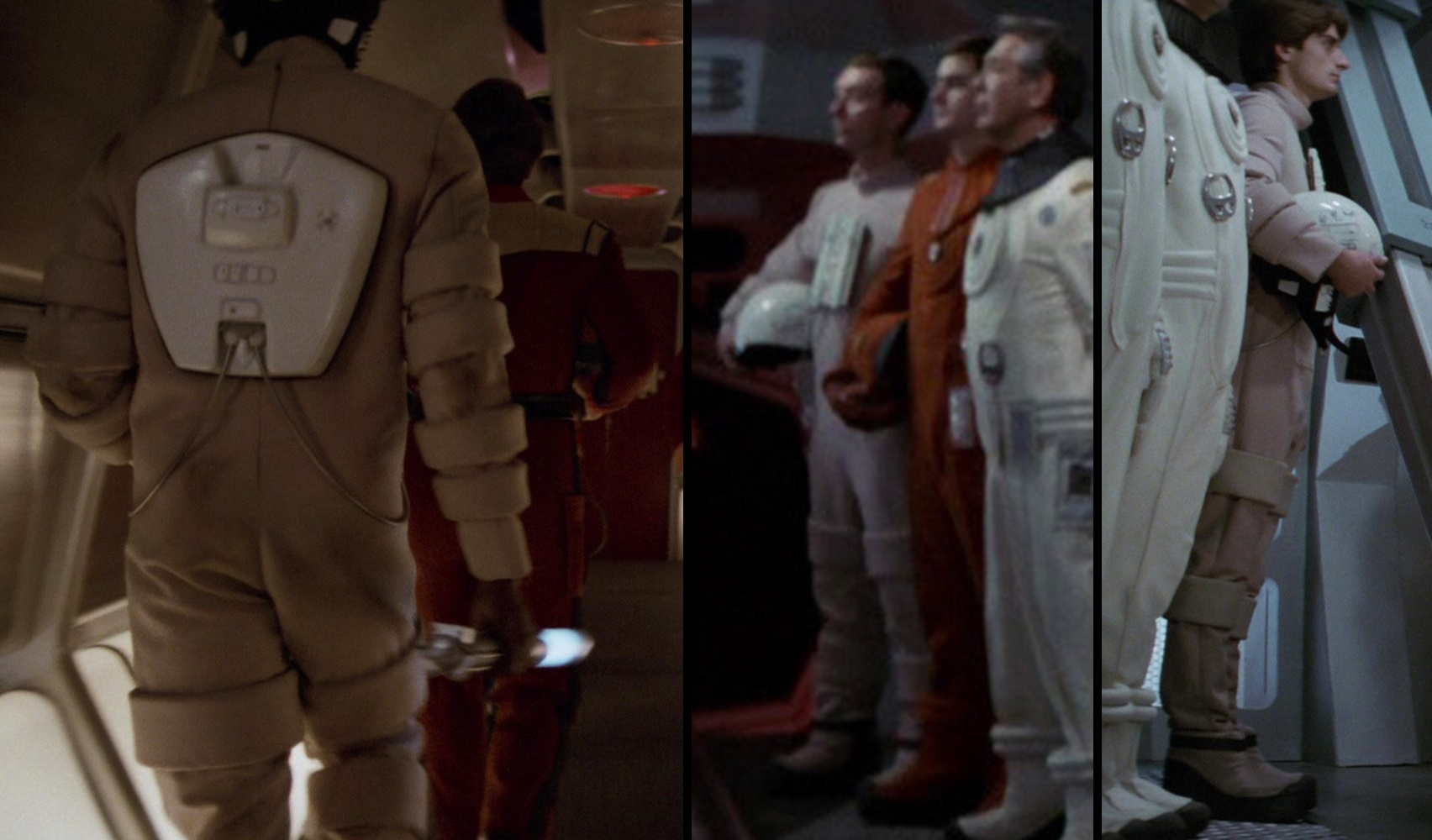
For example, the engineering radiation suits were originally from TMP and continued to be used throughout all of the following TOS movies.
I also discussed these at length in a corresponding video, so I won’t rehash everything here. For now I’ll just say that some of the finer detailing was changed from TMP to TWOK.
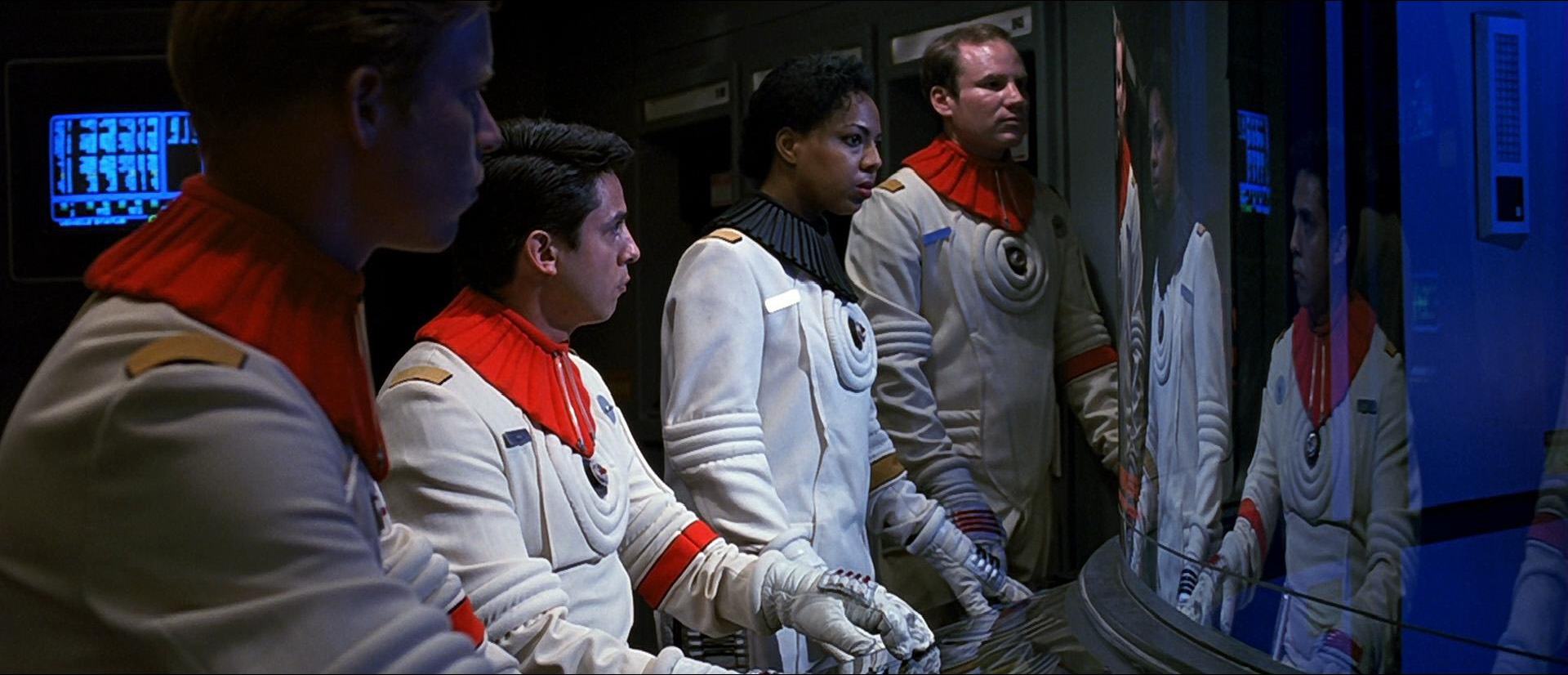
Officers and enlisted crew wore black collars and tubing, while trainees wore red collars and tubing.
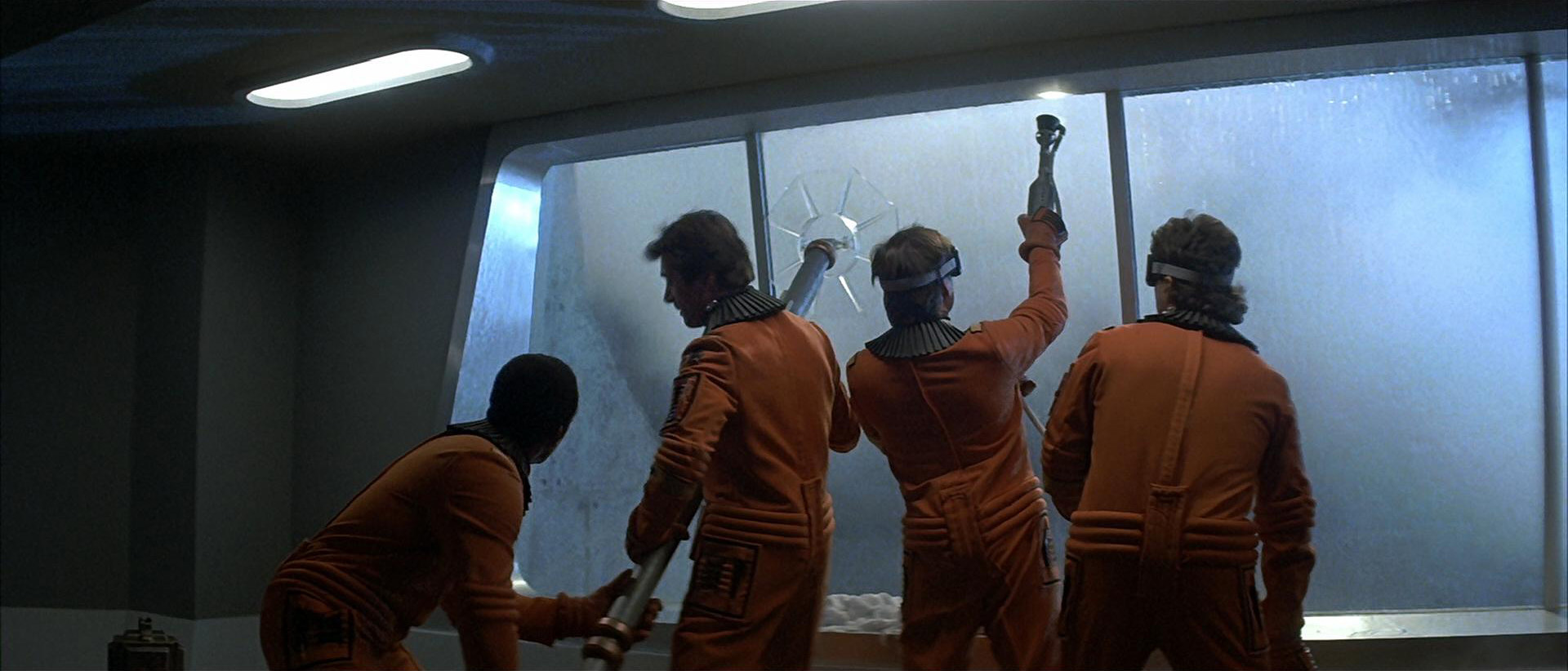
There were also orange variants of these, which Fletcher mentioned as being “emergency/fire suits” on his costume sketch:
These were usually in the background in TWOK, but they finally got their moment in ST4 when a team of them rushed in to brace the window:
In ST3 we saw these orange variants worn with trainee red collars; it makes sense that emergency personnel would need to go through some training first.
In ST6, name tags were added to these, just like they were with the enlisted jumpsuits.
The assassins wore these when they boarded the Klingon ship, but with new helmets and of course, the magnetic gravity boots.
All told, I counted eleven (!) variants of these over the course of the movies, so check out my post and video about these if you’re interested in learning more about them.
Medical Uniforms
Another departmental uniform recycled from TMP (and modified a bit) was for medical personnel.
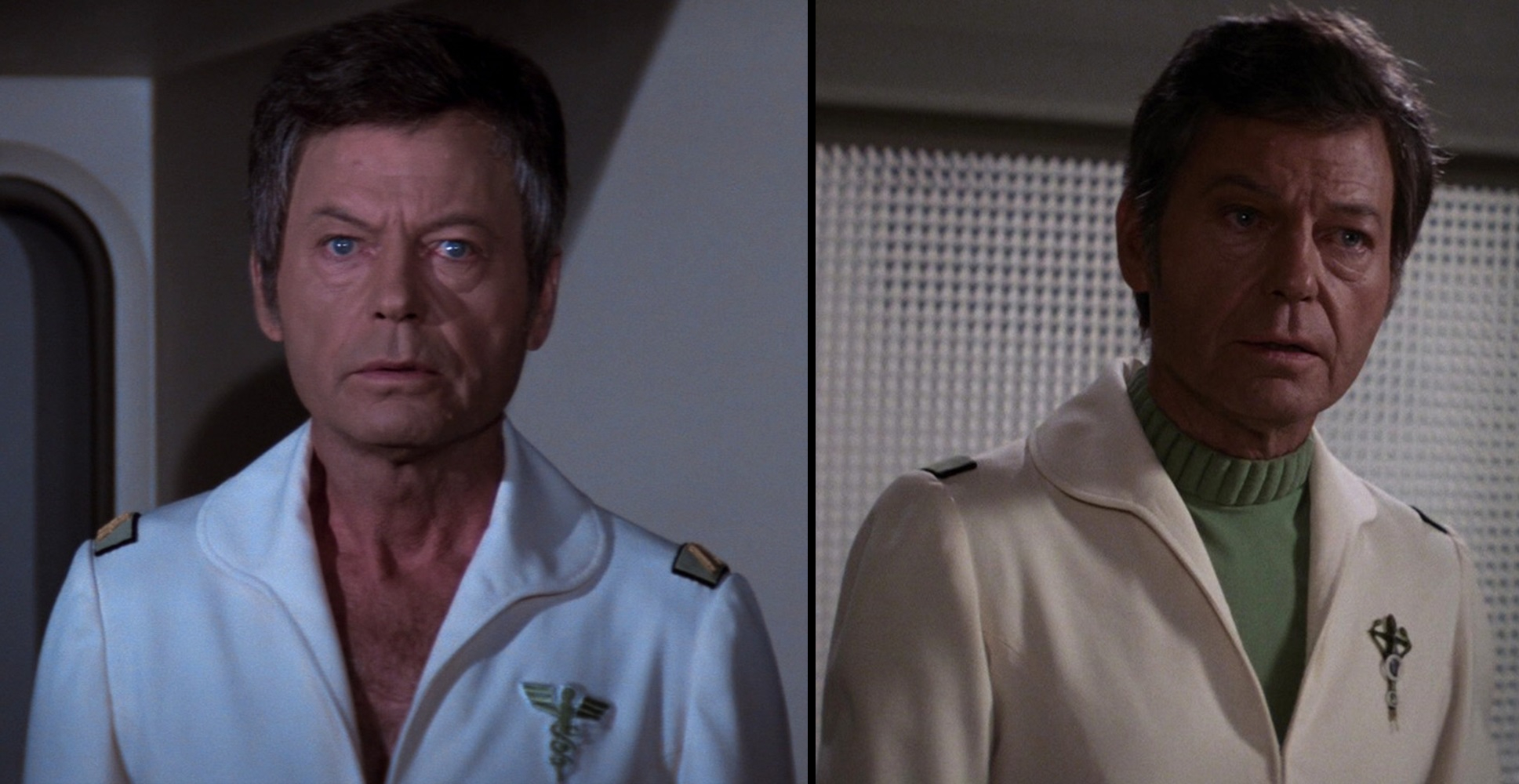
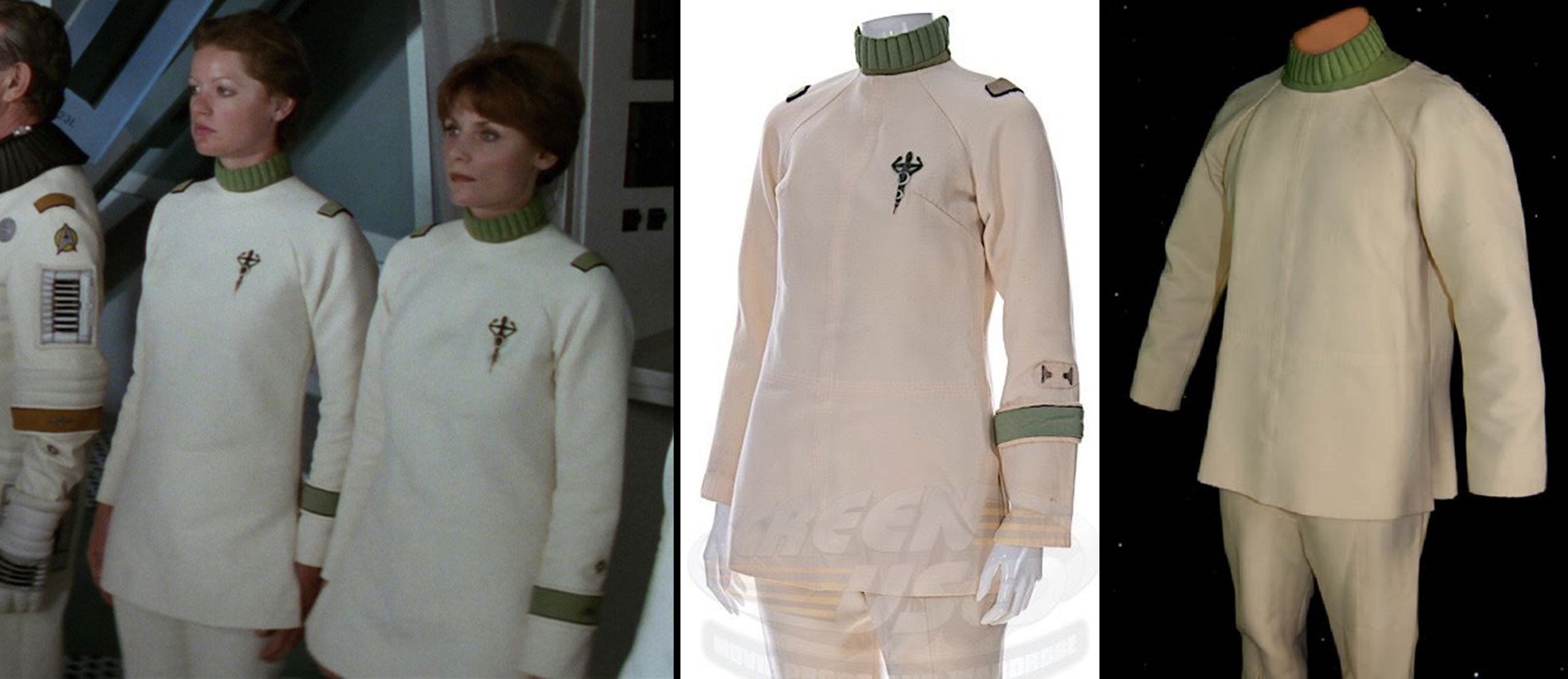
The most obvious change was that in TWOK, they were worn with the medical green division shirt underneath. (This made the previously two-piece wool uniform a three-piece ensemble, with the undershirt.)
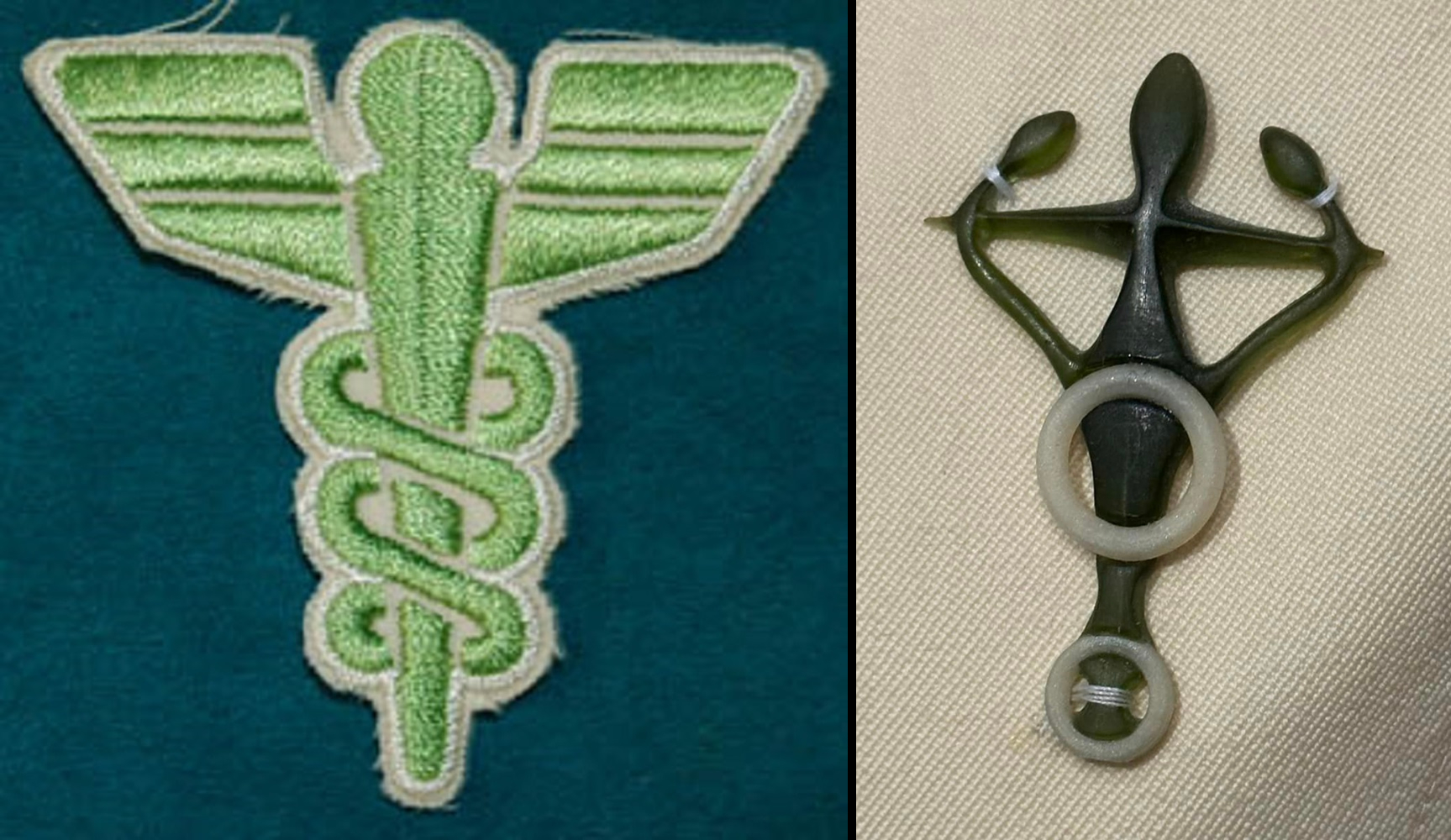
The green caduceus was a patch in TMP, but it was swapped out for a more elaborate badge for TWOK.
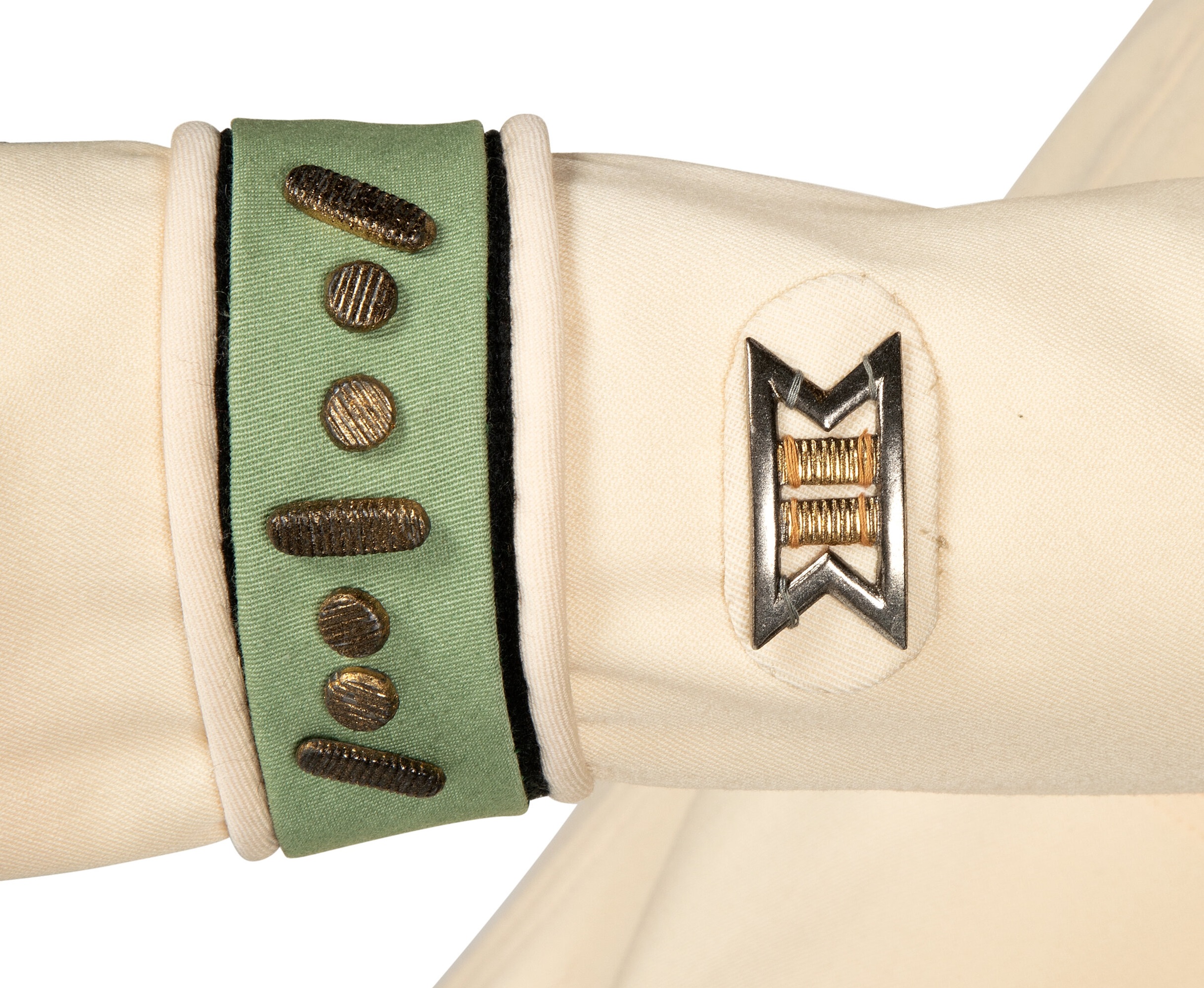
The wearer’s rank and division were shown on the lower left sleeve, just as with all the aforementioned uniforms.
Like in TMP, there were two variations of these; the version worn by Dr. McCoy (above) had an open front and rounded collar.
The other version had raglan sleeves, a closed upper front, and an open neckline with no collar.
My interpretation of this is that the collared versions were for doctors, and the other versions were for other medical staff such as nurses and technicians.
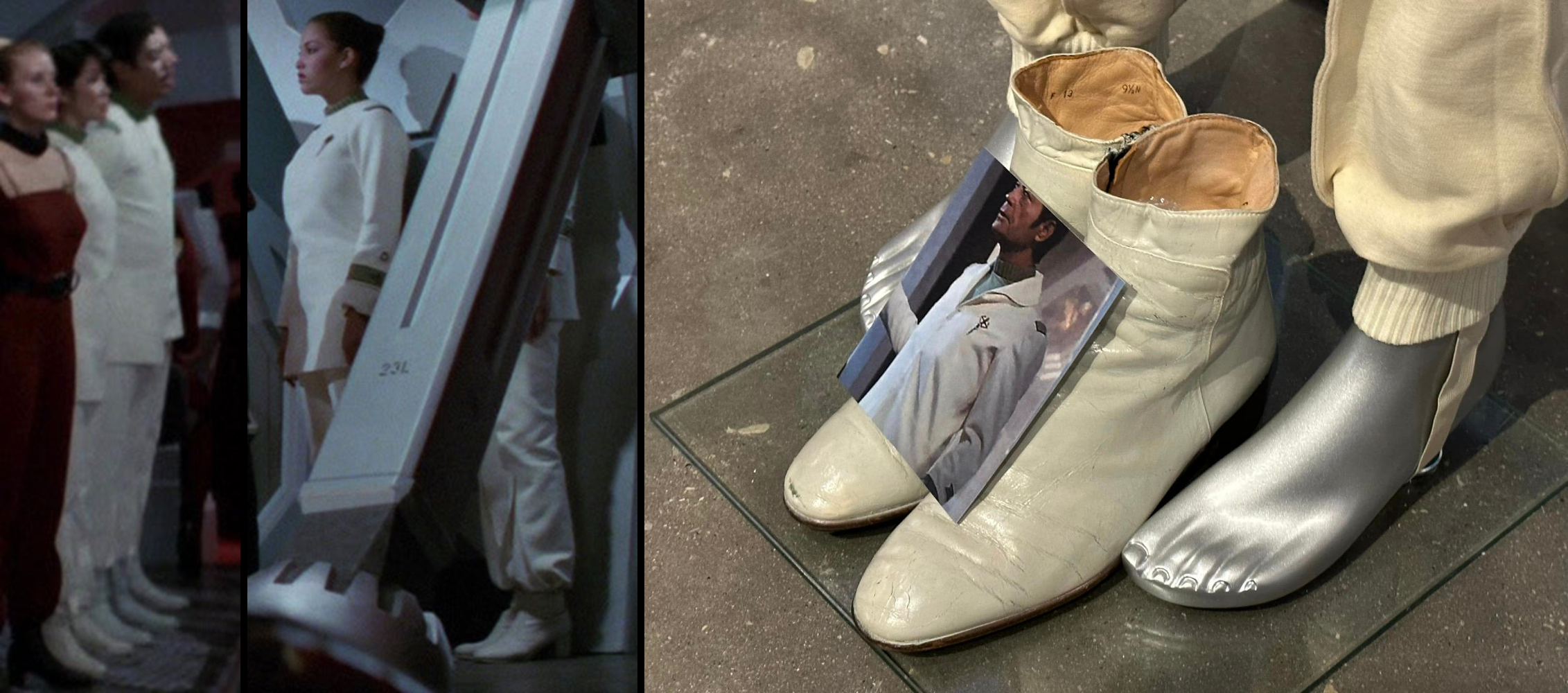
As best I can tell, these were worn with white boots in the movie:
However, it’s possible some of the TMP trousers (with attached shoes) were worn by some background extras.
Security Guards
Still another uniform modified and reused from TMP was for security guards.
Aside from the obvious color change, like the medical uniforms, these were worn with the security green division shirt underneath.
The wearer’s rank and division were again added to the lower left sleeve.
Security green stripes were also added to the pant legs.
SECONDARY UNIFORMS
Field Jackets
In The Motion Picture, Fletcher reintroduced the notion of “field jackets,” which hadn’t been seen since “The Cage.”
He revisited the idea again with TWOK, but this time he designed new field jackets from scratch instead of just reusing the ones from TMP.
With these, we can again see some influence of The Prisoner of Zenda:
The TMP field jackets actually had quite a bit of detailing, but it was mostly unicolor.
The TWOK field jackets were deep and rich in color, with contrasting collars and quilted panels, fabric straps, pockets, and lots of bling.
The “monster maroons” have the reputation of being challenging to make, but in my opinion these field jackets are the real monsters – possibly the most intricate and ornate uniform garments in all of Star Trek.
Some echoes of the TMP field jackets did make it into their TWOK successors, such as large lower front pockets, and decorative cording along the sleeves.
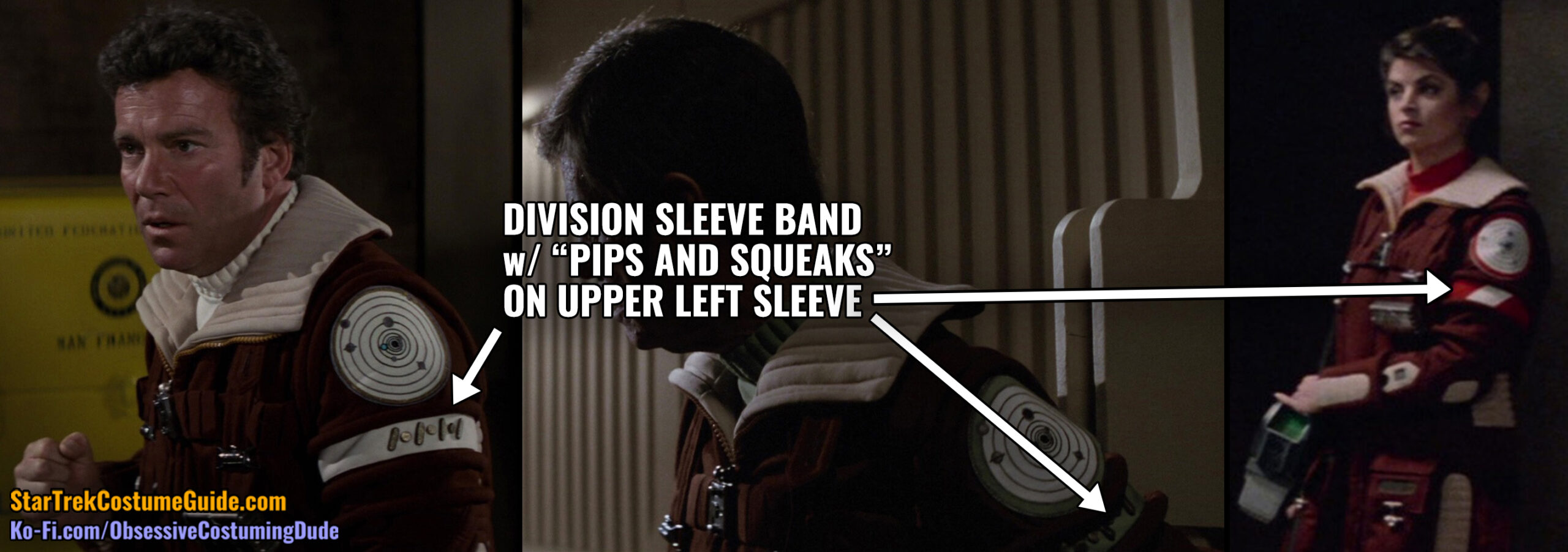
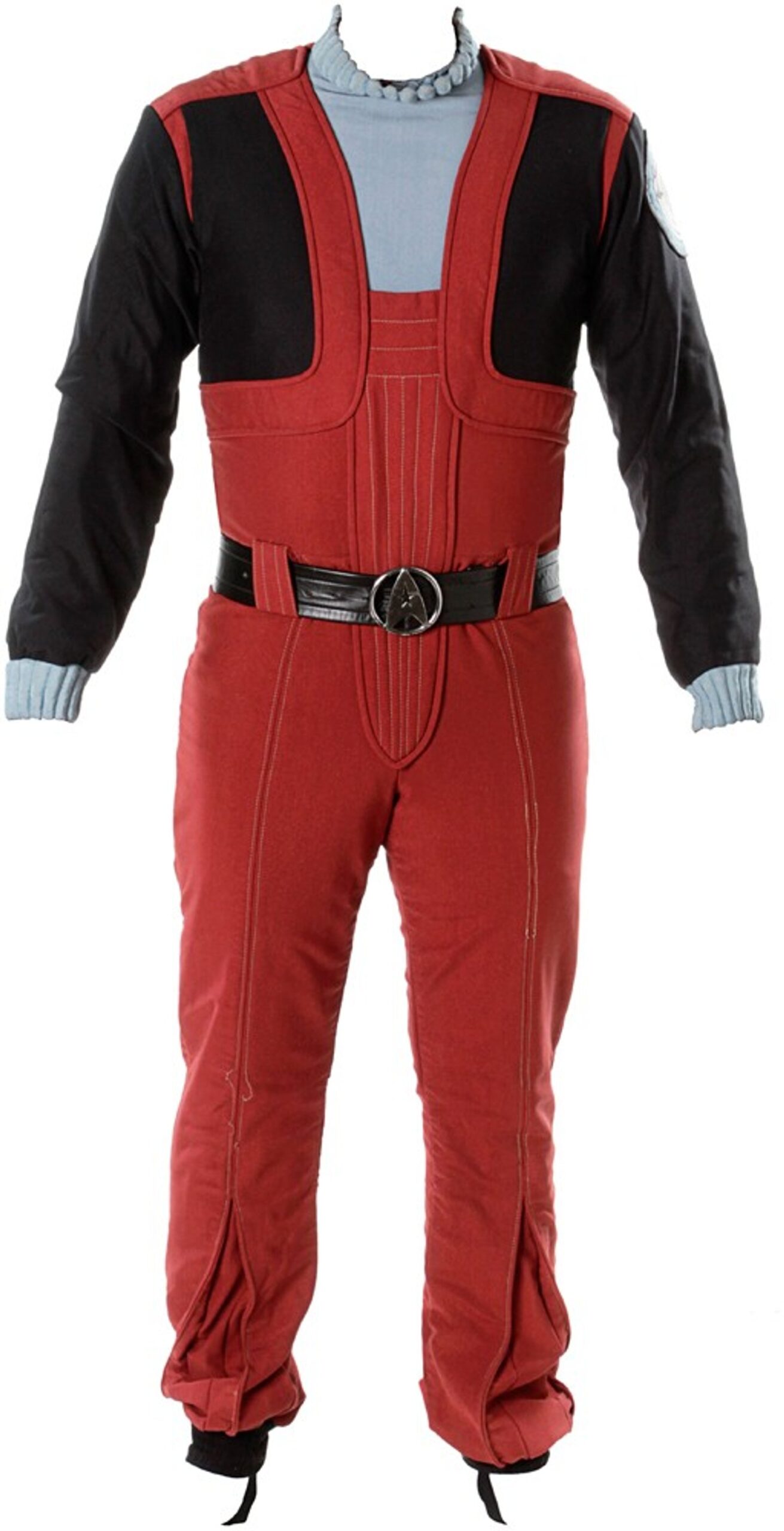
Like on the TMP field jackets, there was a division-colored band on the upper left sleeve, but instead of showing the wearer’s rank, it had the wearer’s “pips and squeaks.”
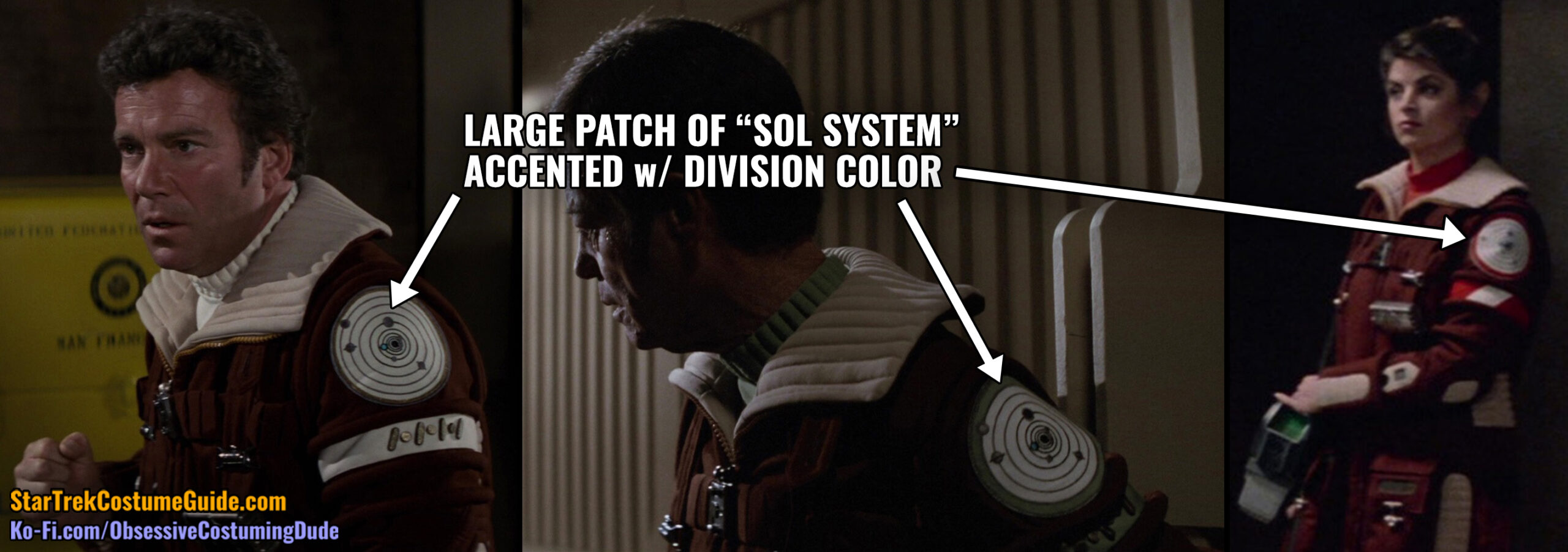
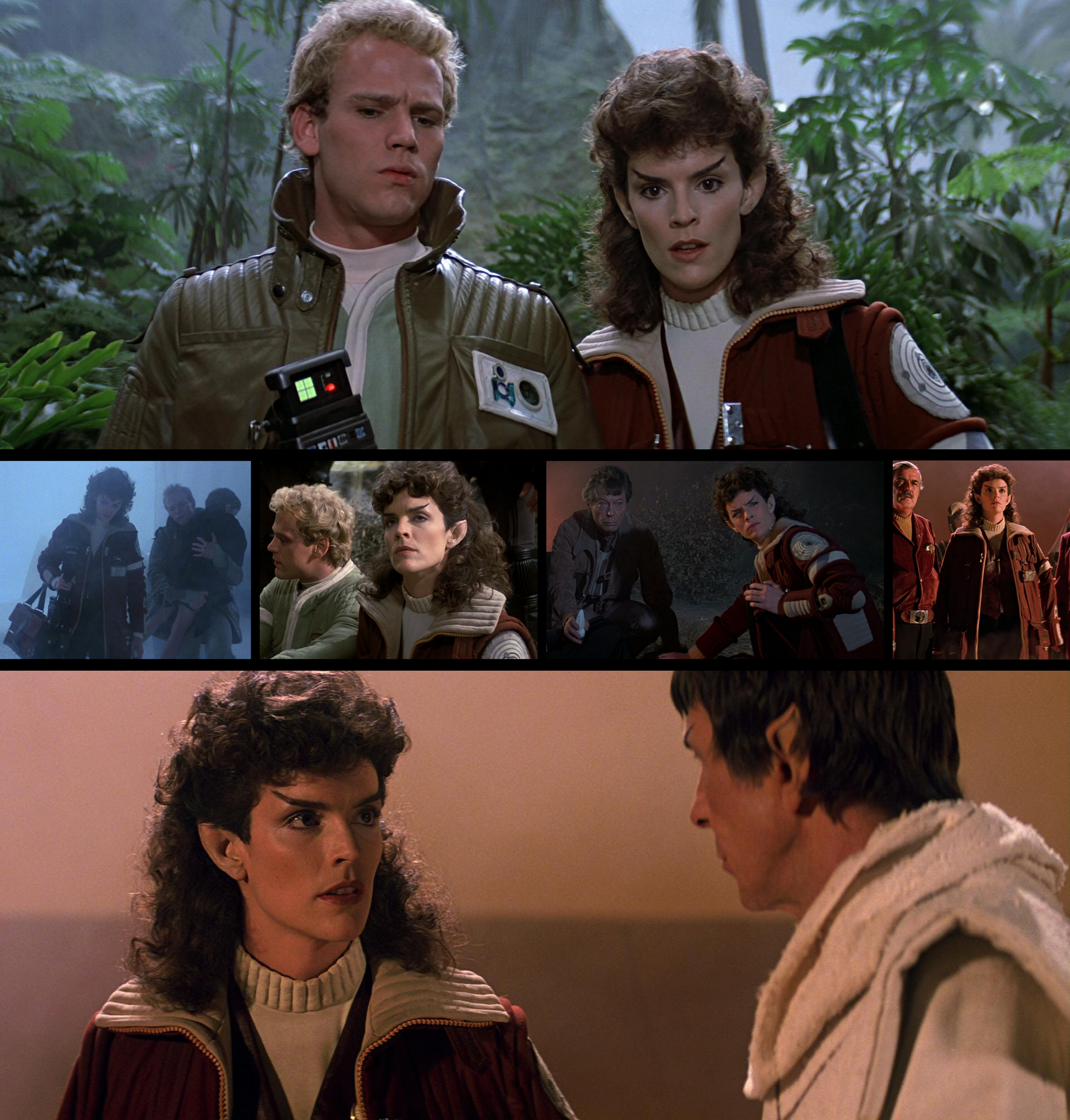
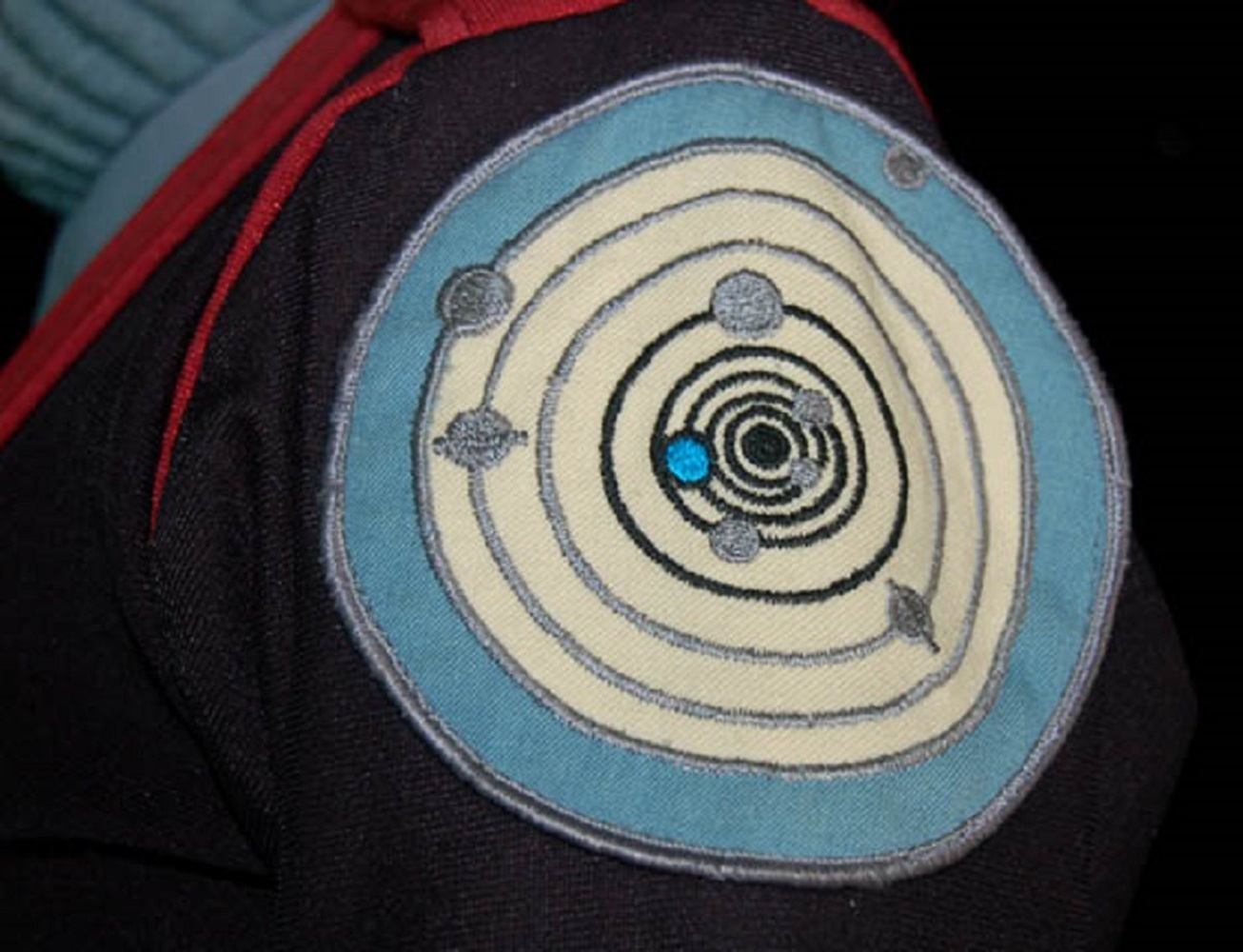
Above that, a large circular patch was added that showed our solar system, with Earth highlighted in blue. (I think it’s open to interpretation whether this is the wearer’s home planet or current assignment, since Saavik’s patch has Earth instead of Vulcan, Romulus, or Pandora.)
The outer edge of the patch was accented in the wearer’s division color.
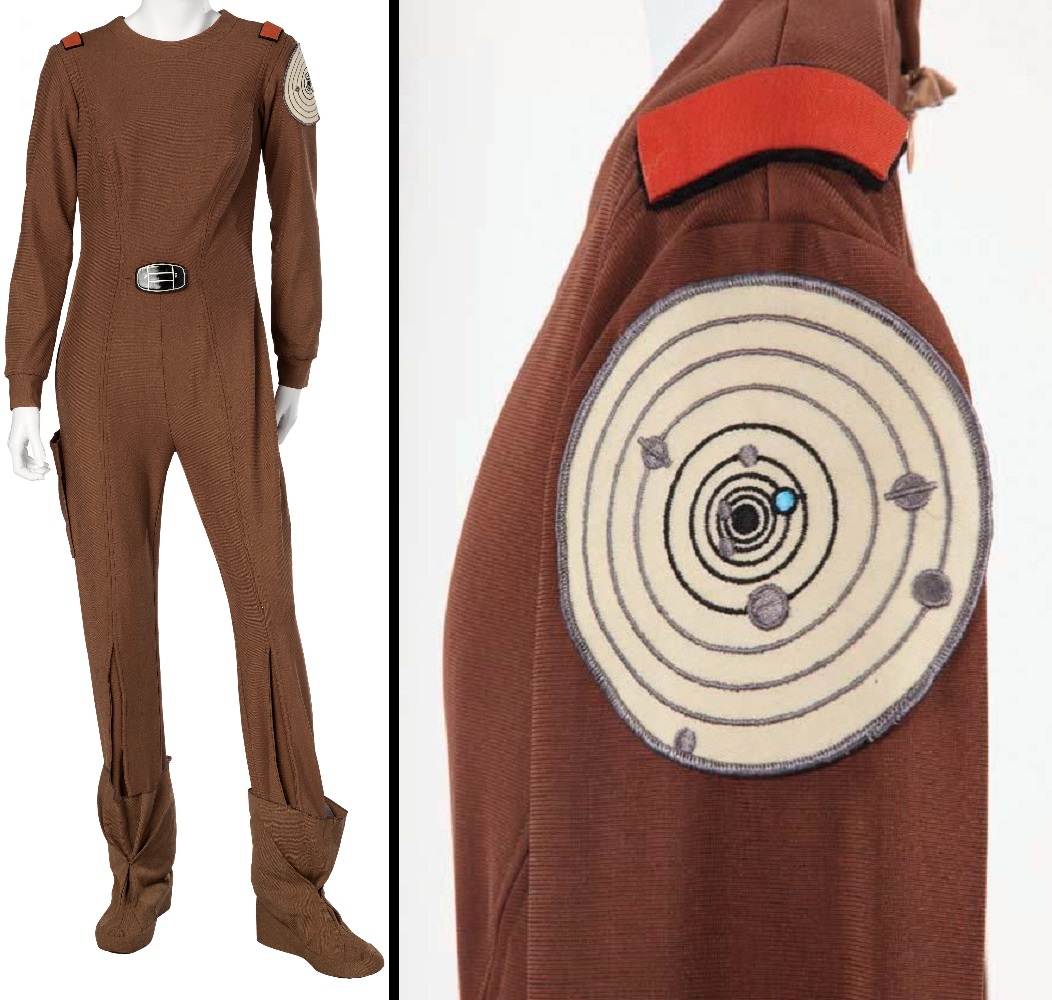
These patches were yet another brilliantly economical repurposing of the “Earthbase” patches seen in TMP – saving production time and money while also providing a subtle sense of visual continuity.
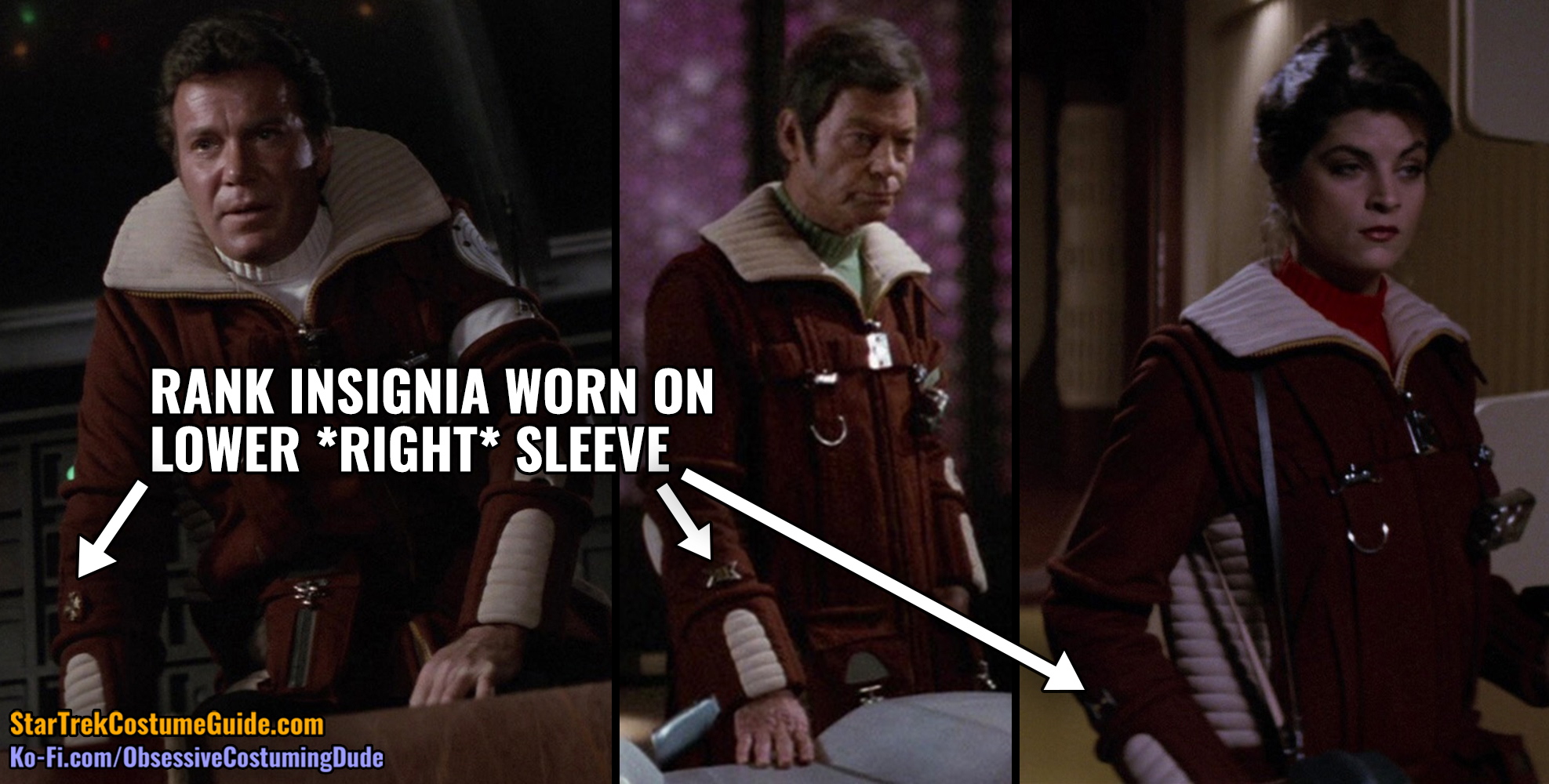
Unlike most of the other uniform garments of the era, the wearer’s rank insignia was on the lower right sleeve.
These field jackets were worn in place of the usual “monster maroon” jackets (rather than over them), with the standard undershirts and trousers.
With one exception, these were the only characters we ever saw wearing these field jackets, so how enlisted personnel would wear these (or what they would wear at all on “landing parties”) is left to our imagination.
The exception I mentioned was Dr. (Carol) Marcus, who wore Kirk’s field jacket on the bridge during the movie’s climax.
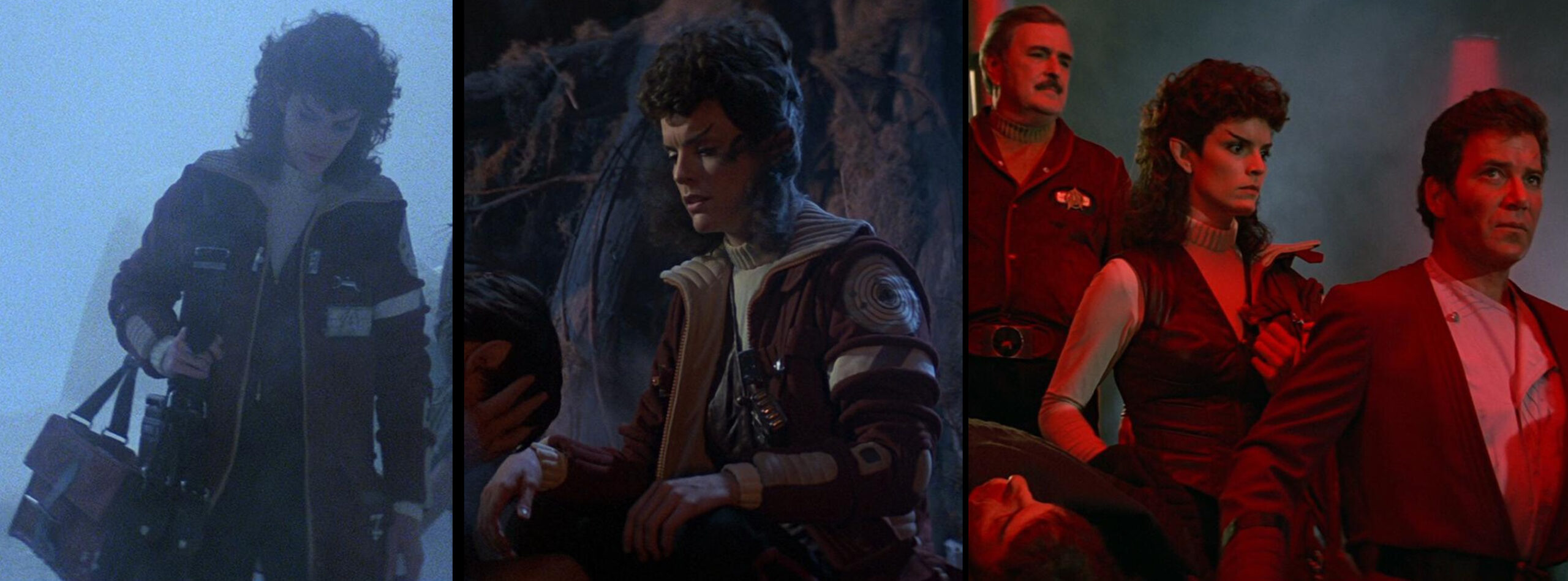
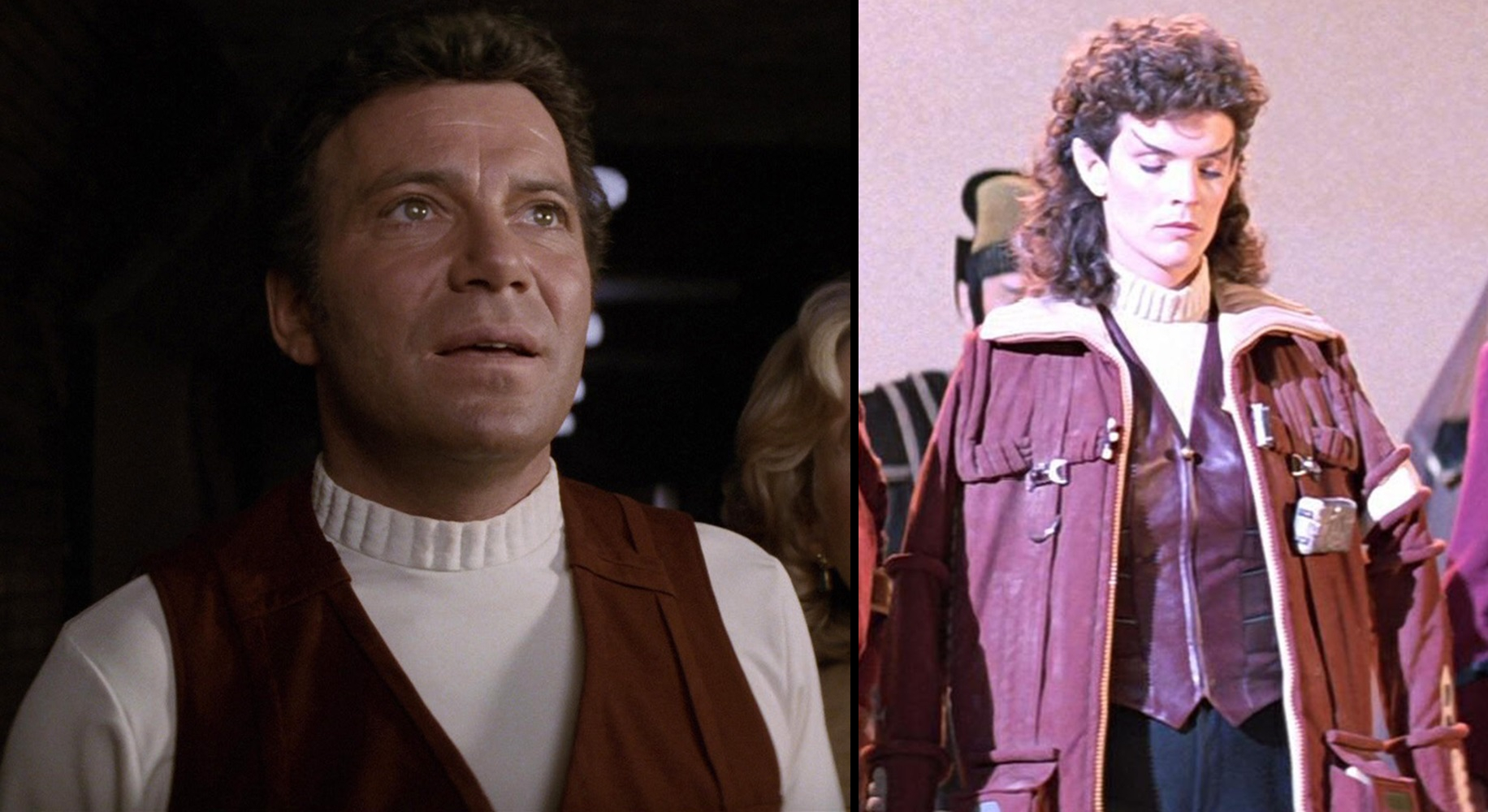
The field jacket actually had more screen time in ST3; Saavik wore it from when she and David first beamed down to Genesis all the way to the very end of the movie.
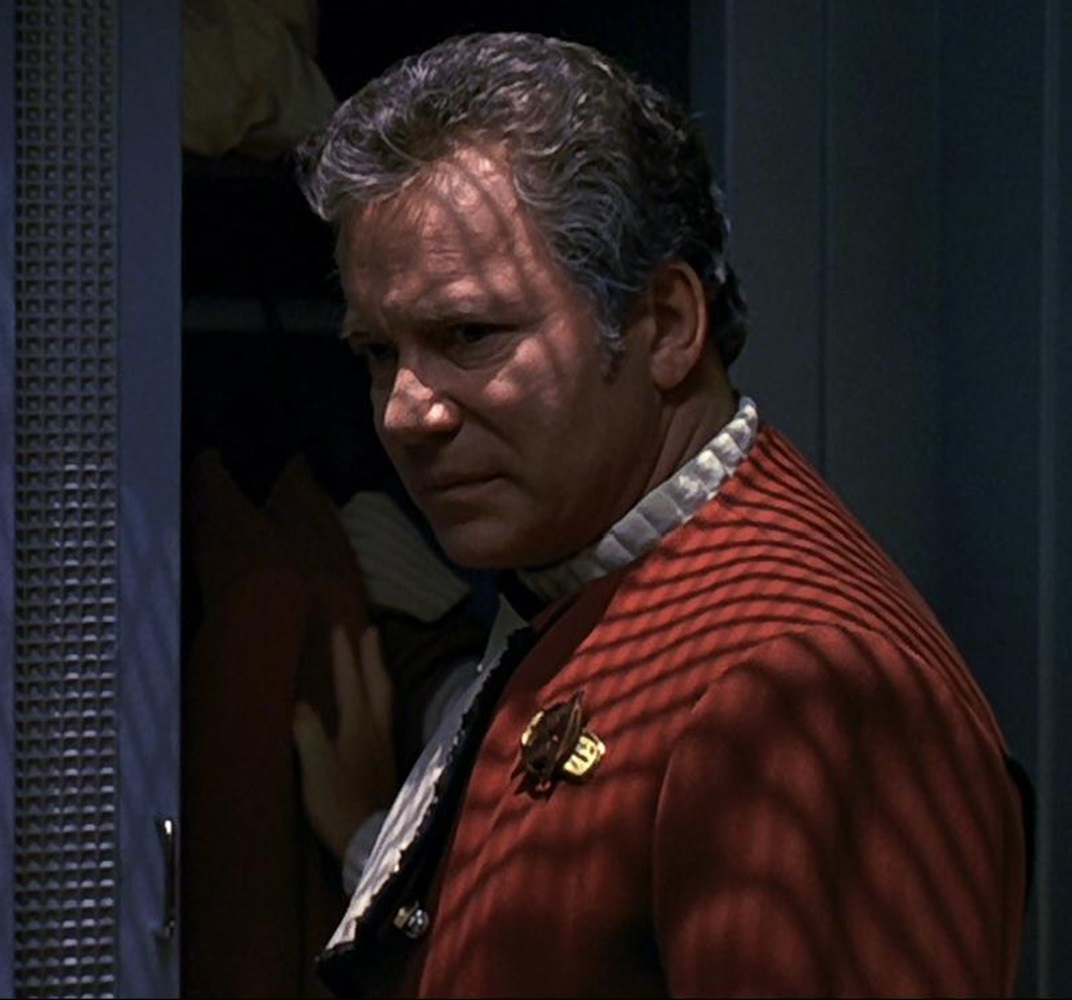
These were only ever seen in ST2 and ST3, except for a brief moment in ST6 when we saw one hanging in Kirk’s closet.
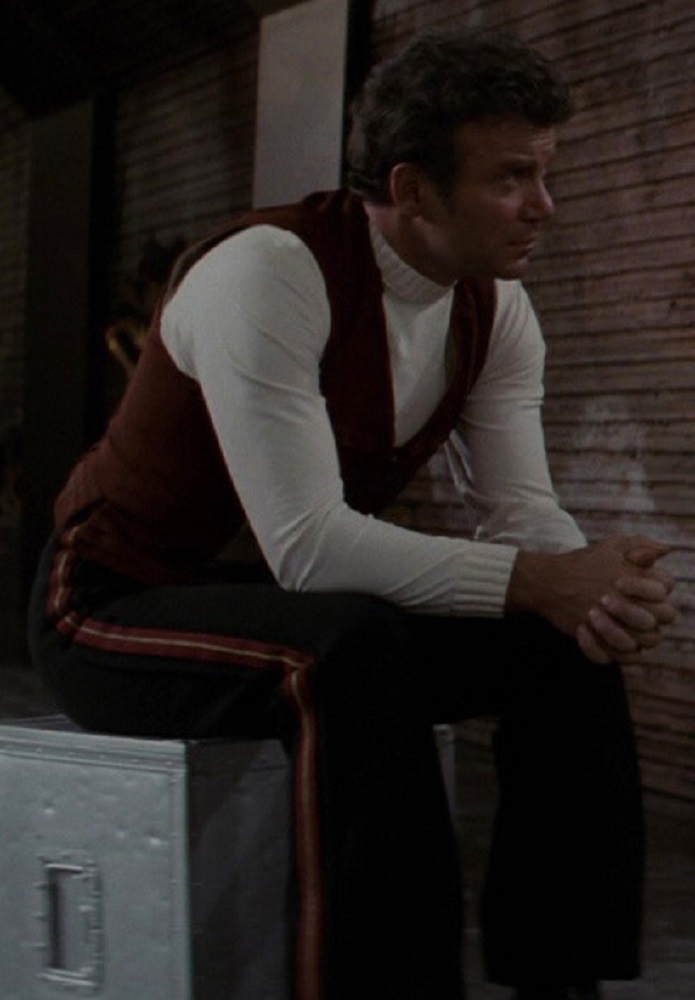
Field Vests
In addition to the field jackets, there were two field vests seen in the movies.
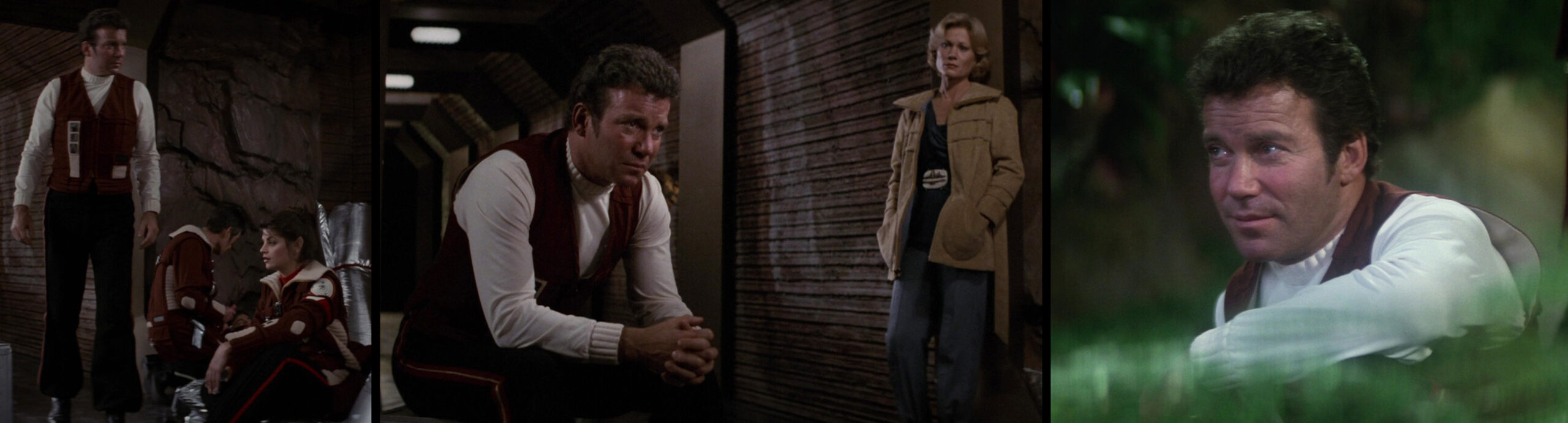
The first was worn by Kirk while they were seemingly stranded on the asteroid (he’d taken off his field jacket and Chekov was using it as a blanket), through his conversation with Carol Marcus, and during the Kobayashi Maru discussion in the Genesis cave.
He wore this when they all beamed back to the Enterprise, then he immediately changed back into the standard duty uniform.
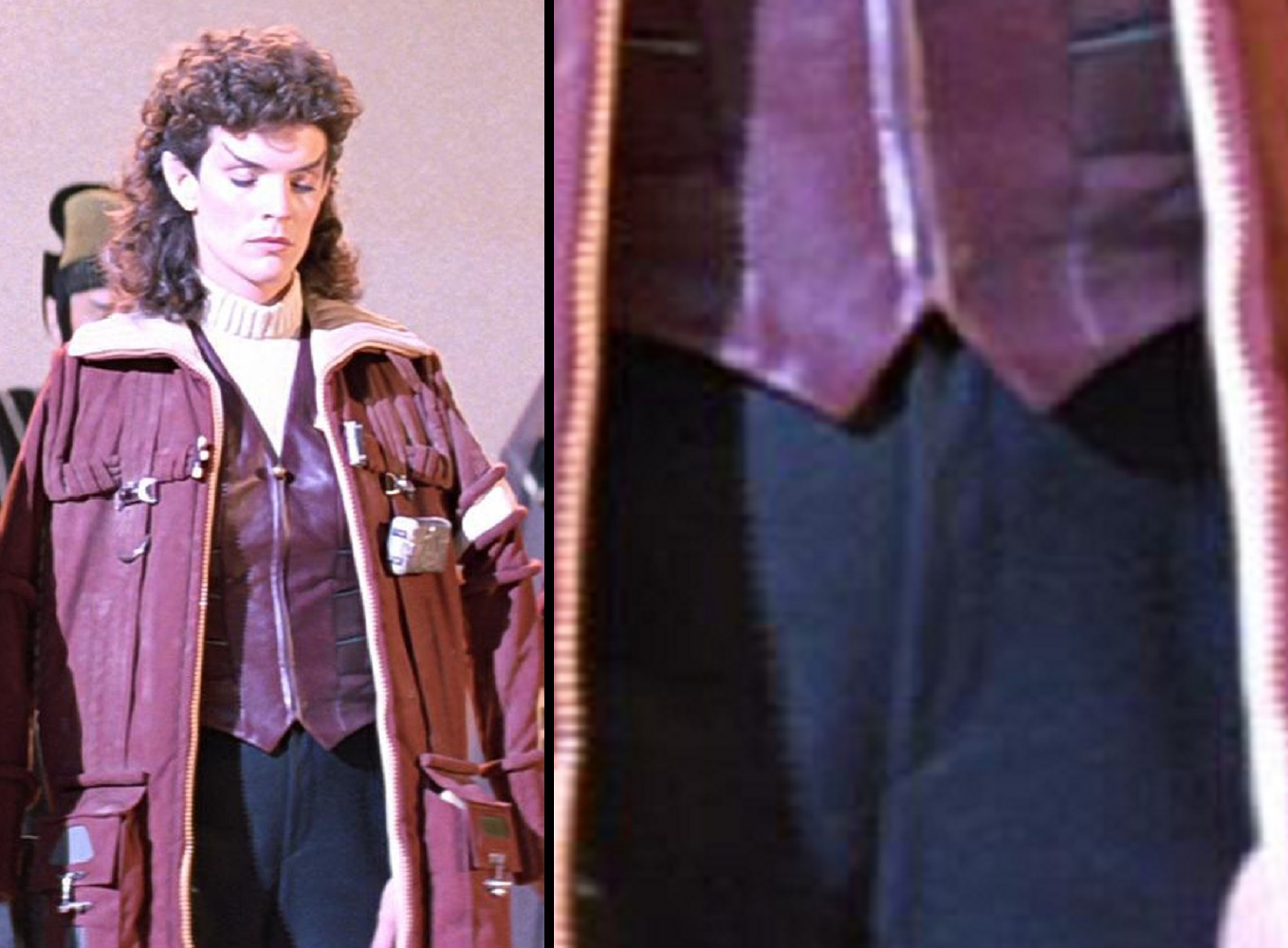
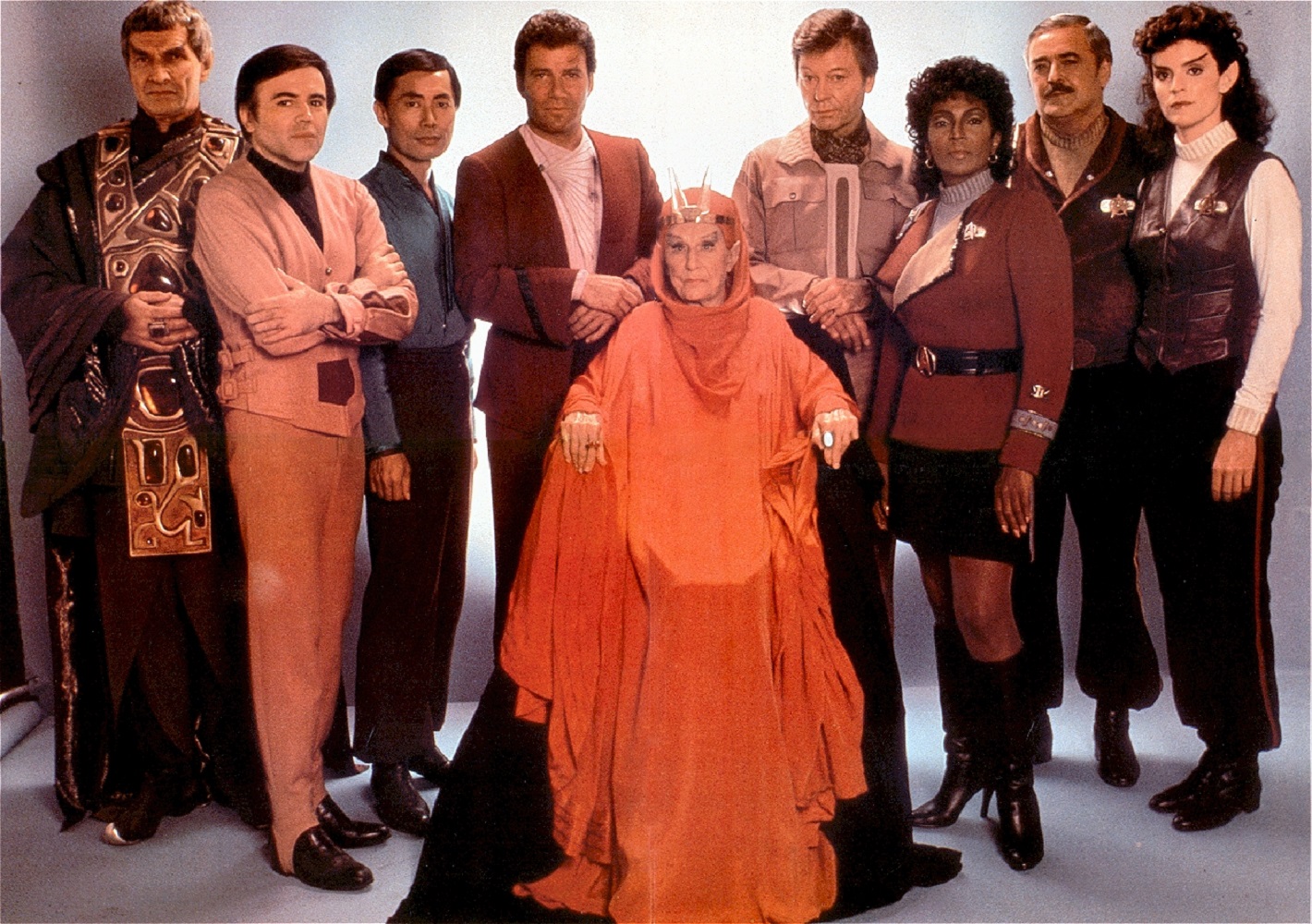
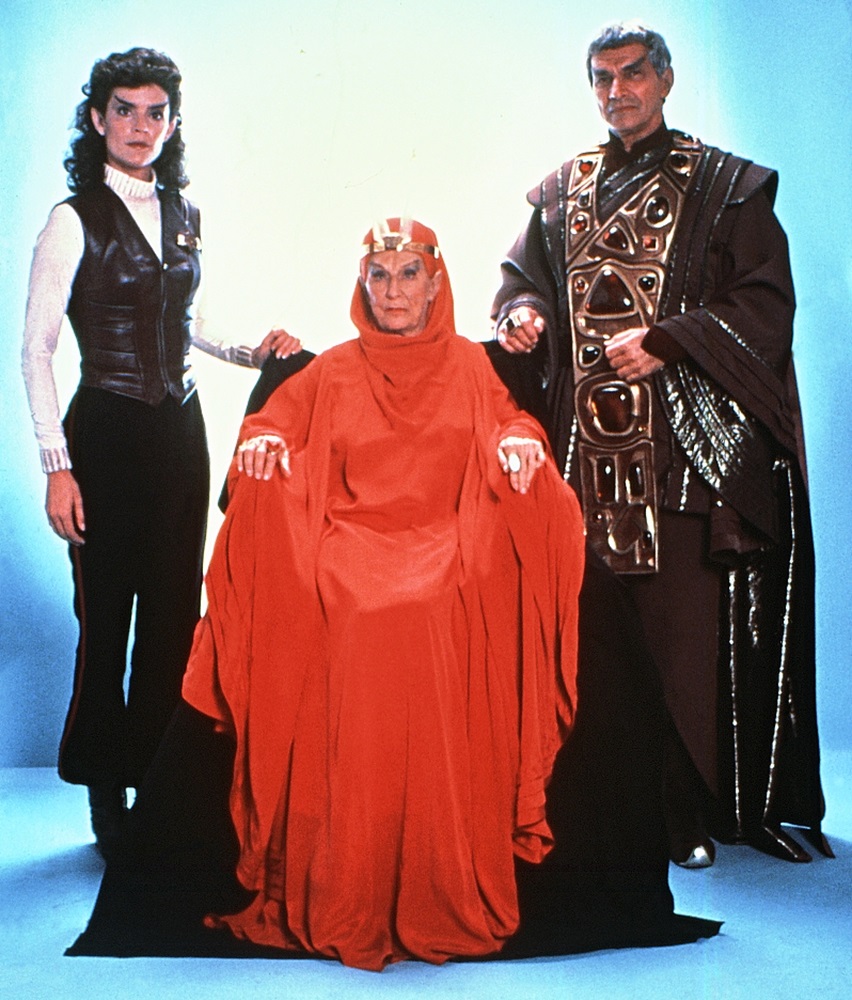
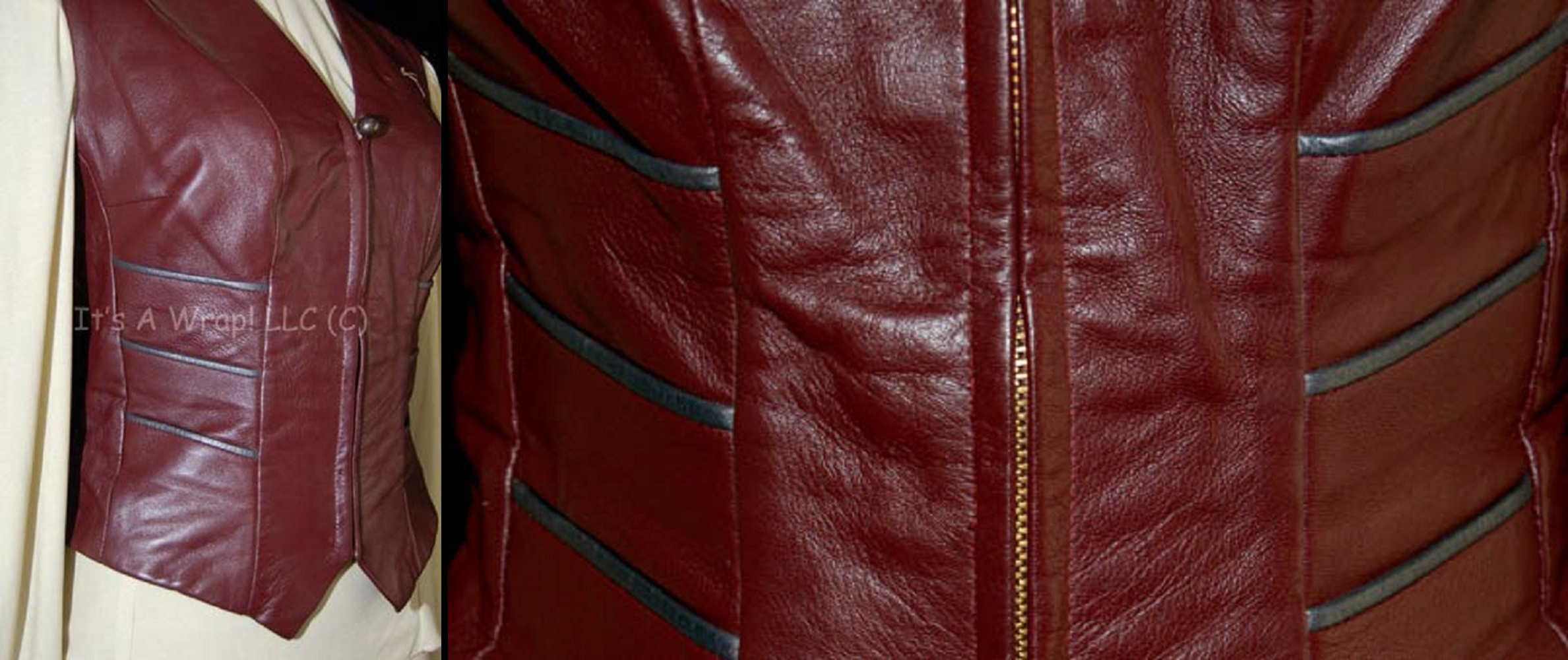
The other field vest we saw was worn by Saavik in ST3, usually under her field jacket.
She also wore it in a couple ST3 publicity photos.
Unfortunately very little detailing could be clearly seen about these in either movie, although we do know Kirk’s was fabric but Saavik’s was leather.
Here are a couple interesting auction photos of the detailing on Saavik’s vest.
I think it’s open to interpretation whether this was a gender difference, a situational or environmental difference, up to the wearer’s personal preference, or other possible explanation.
"Bomber Jacket"
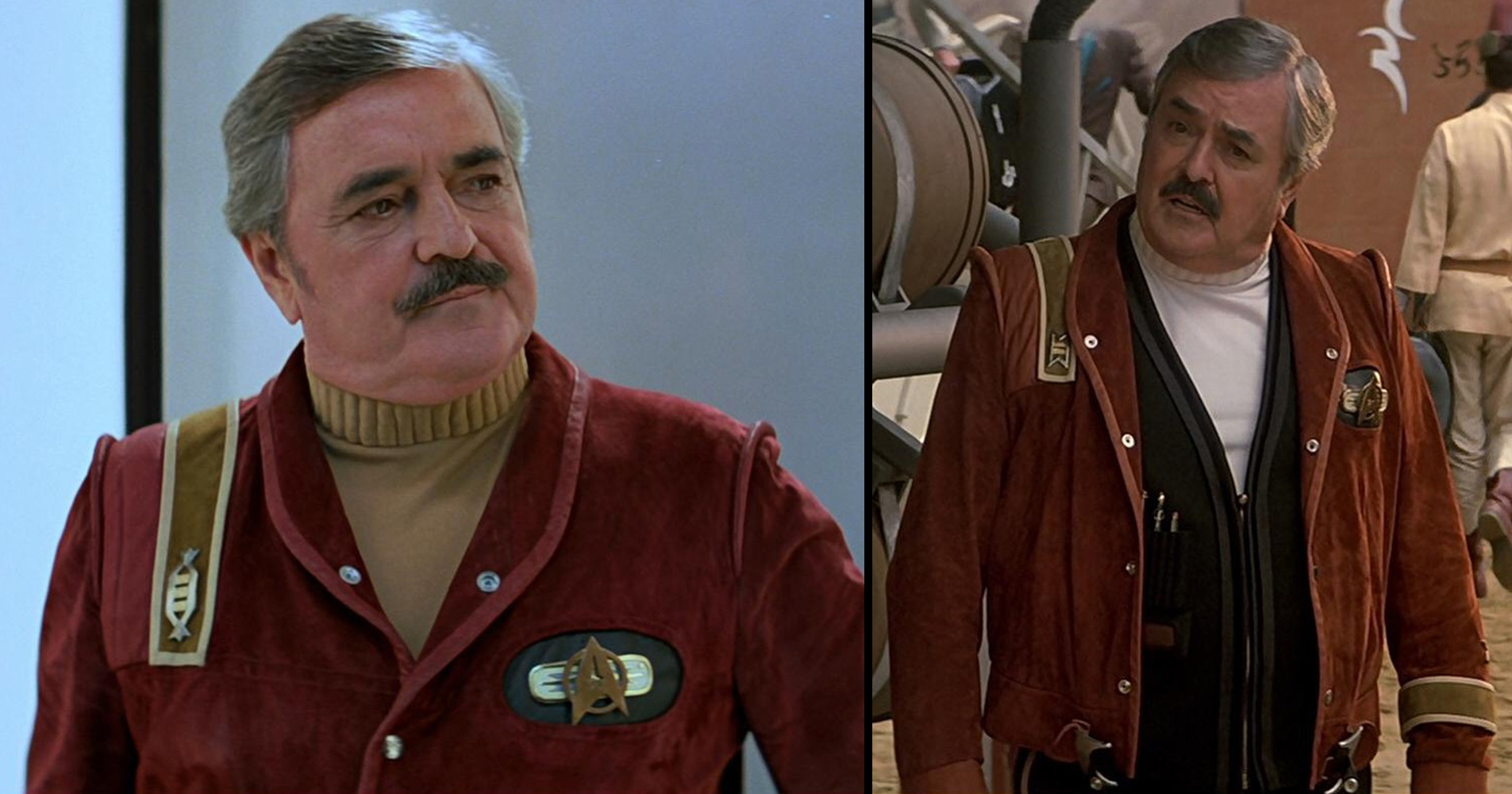
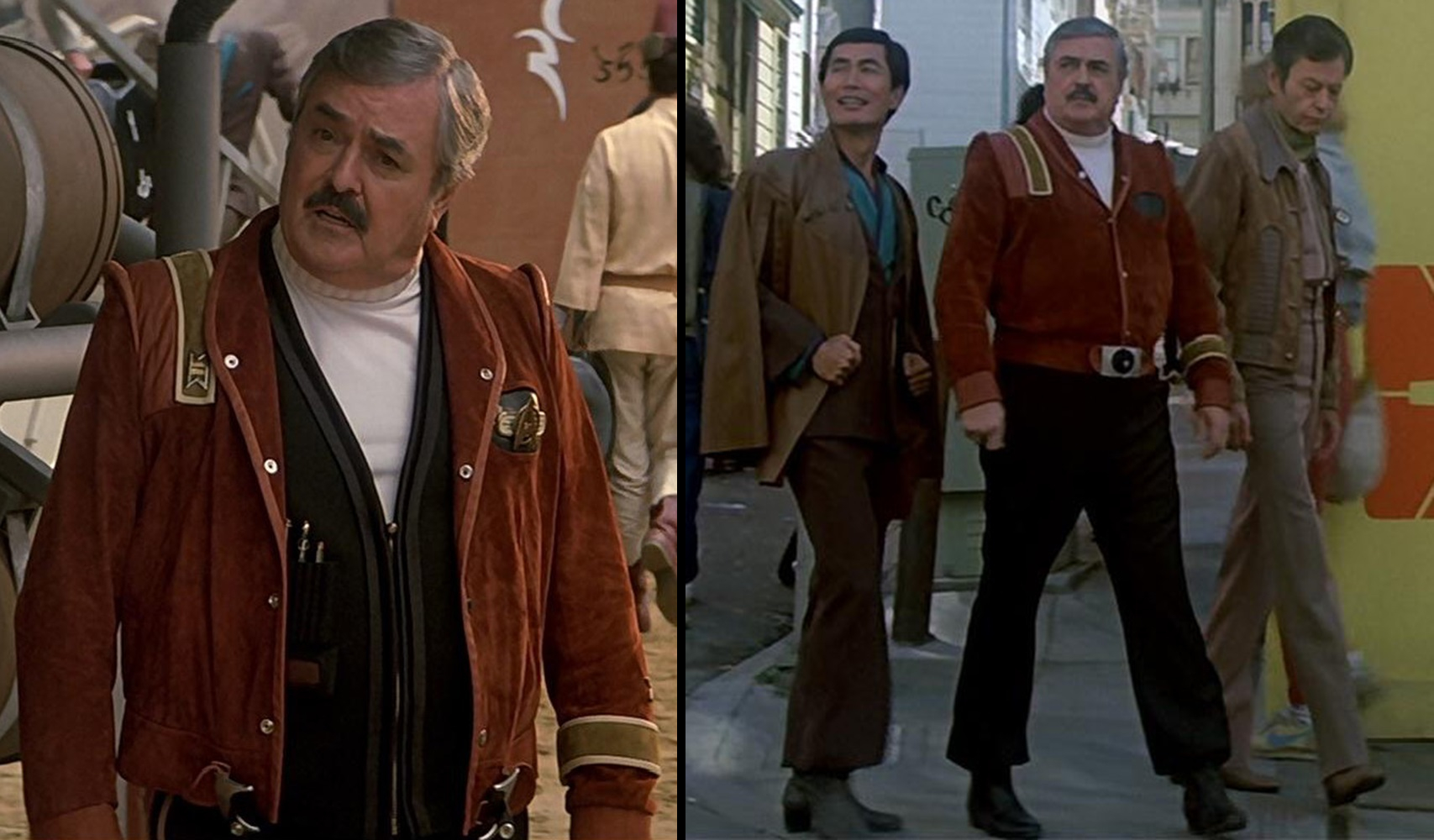
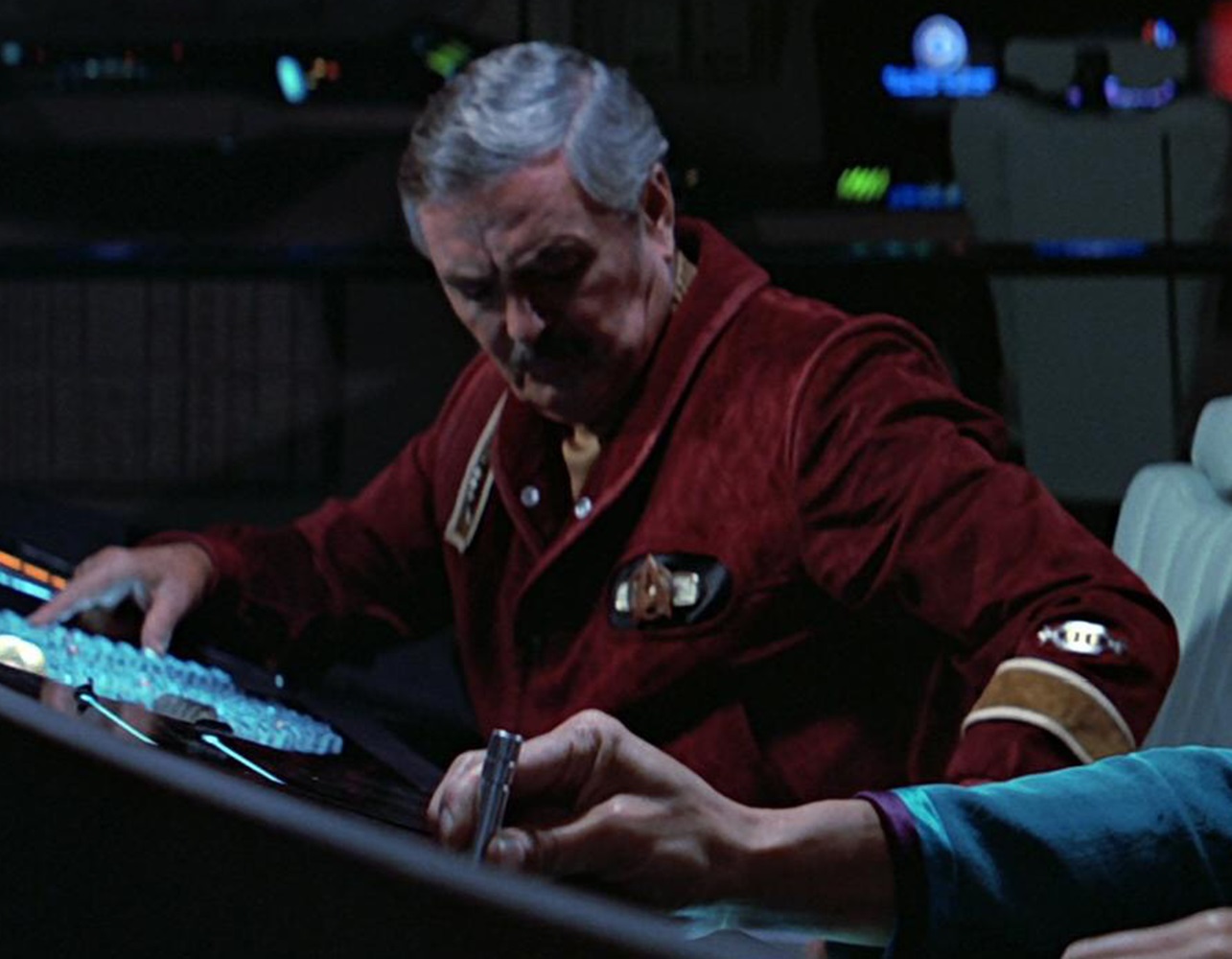
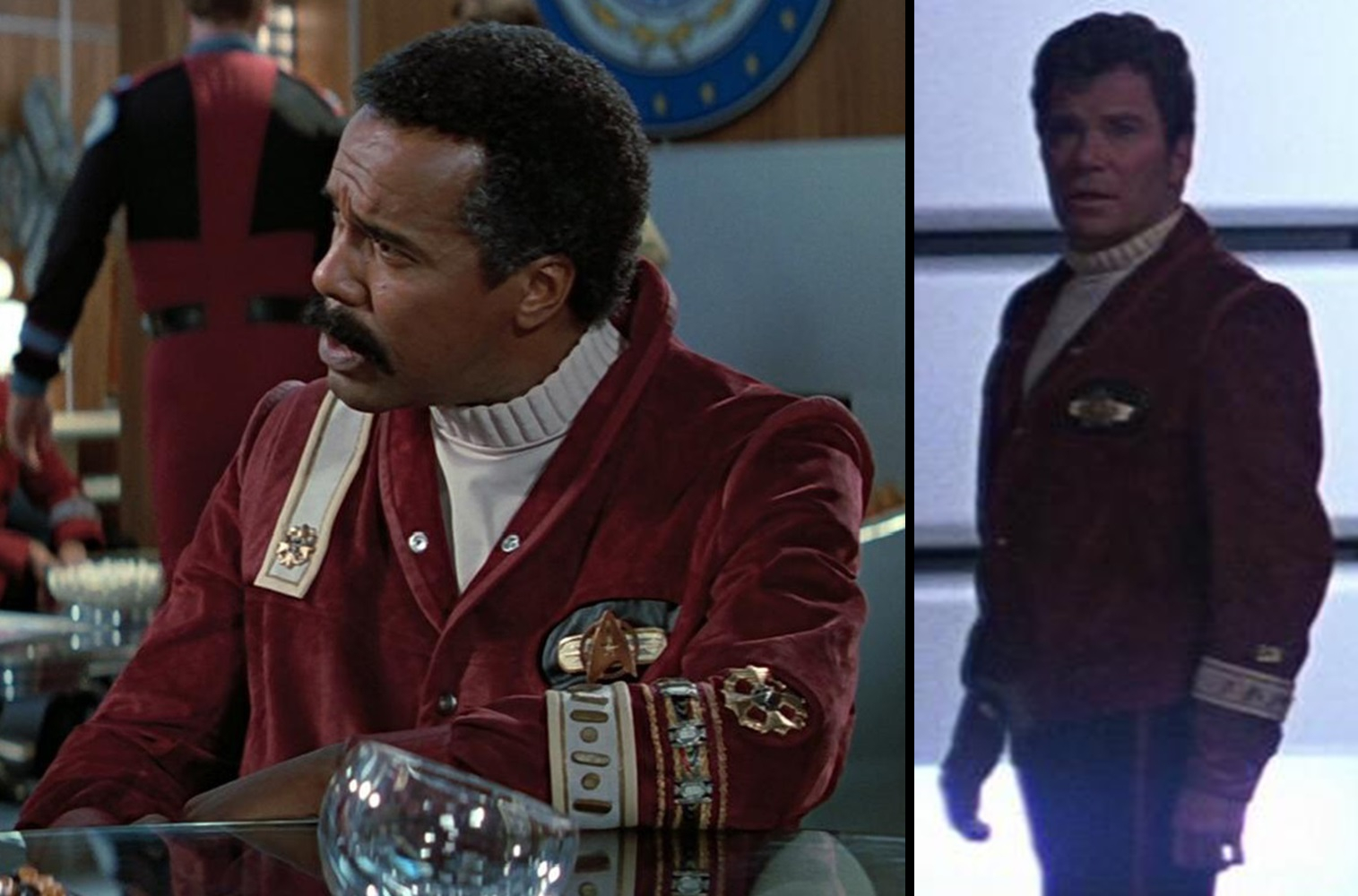
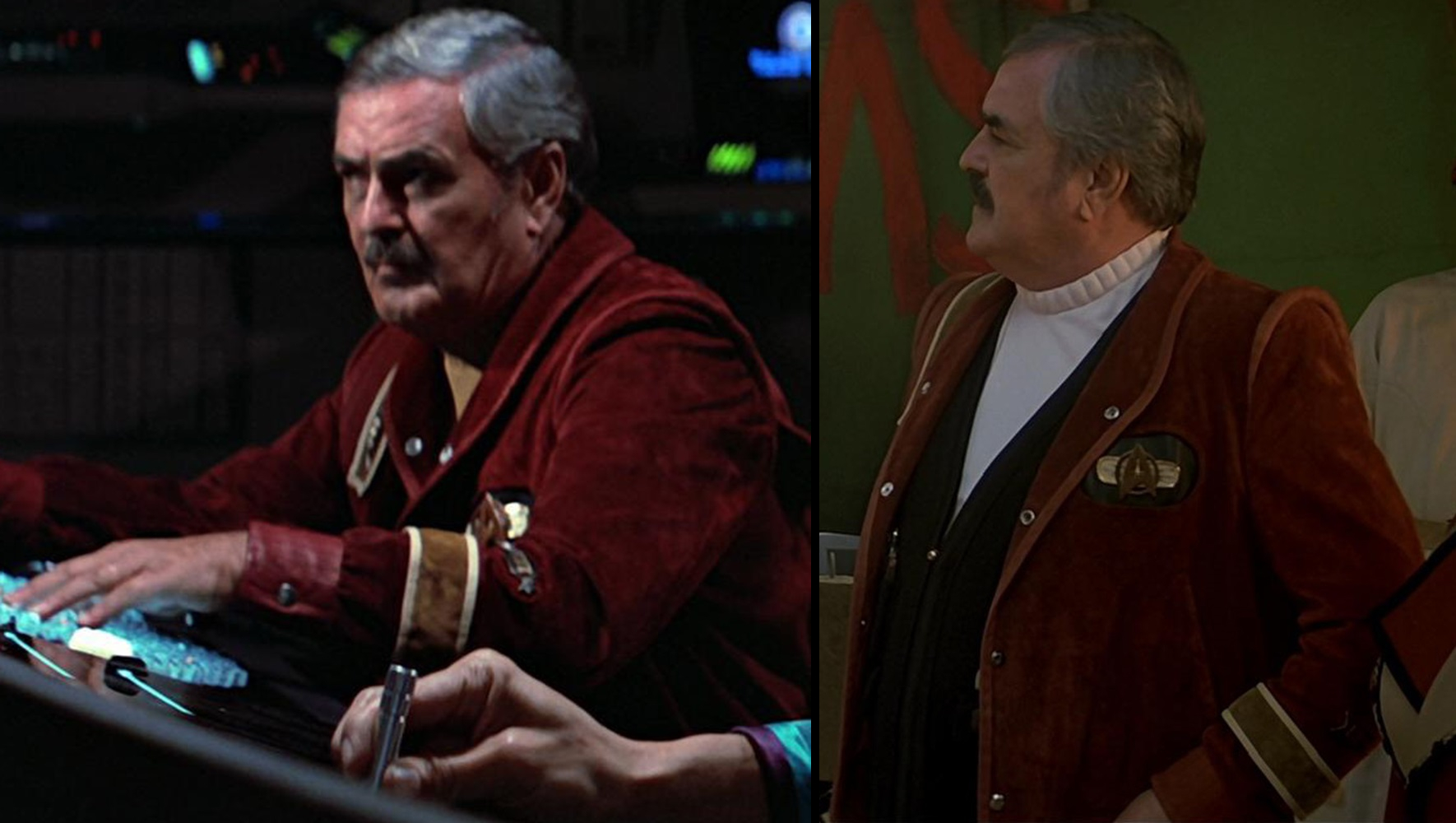
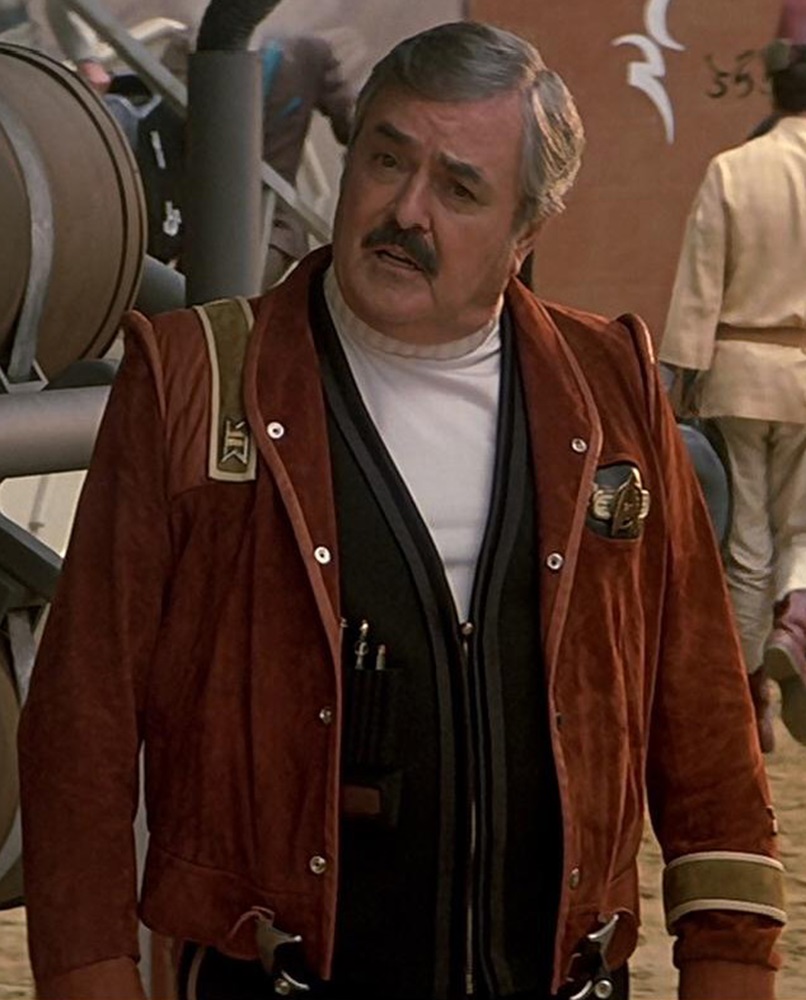
Another, more casual-looking alternative to the standard uniform jacket is usually referred to by fans as the “bomber jacket.”
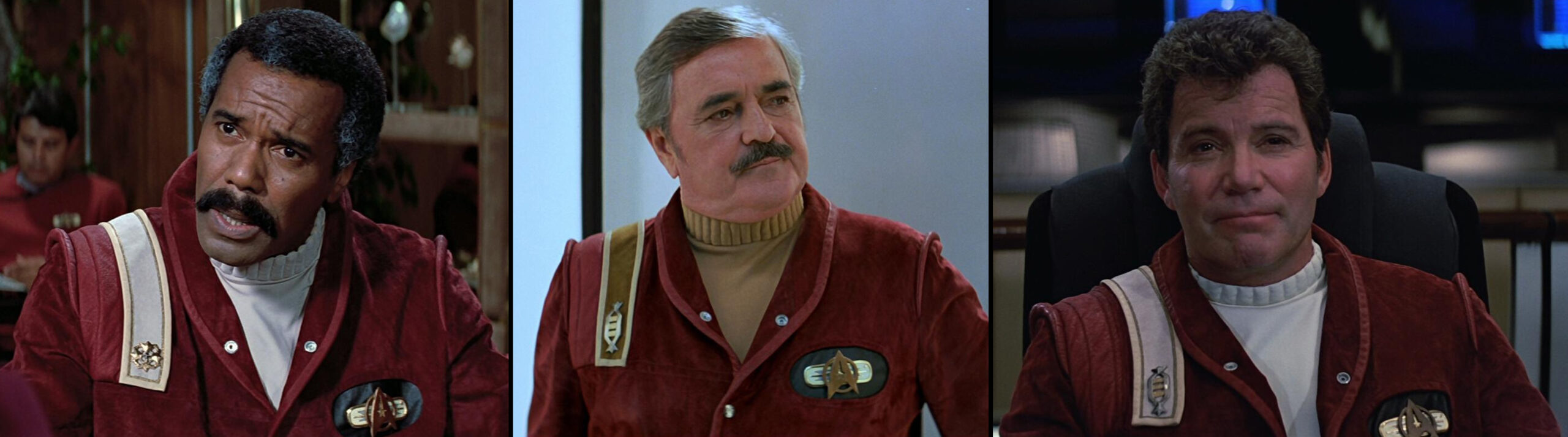
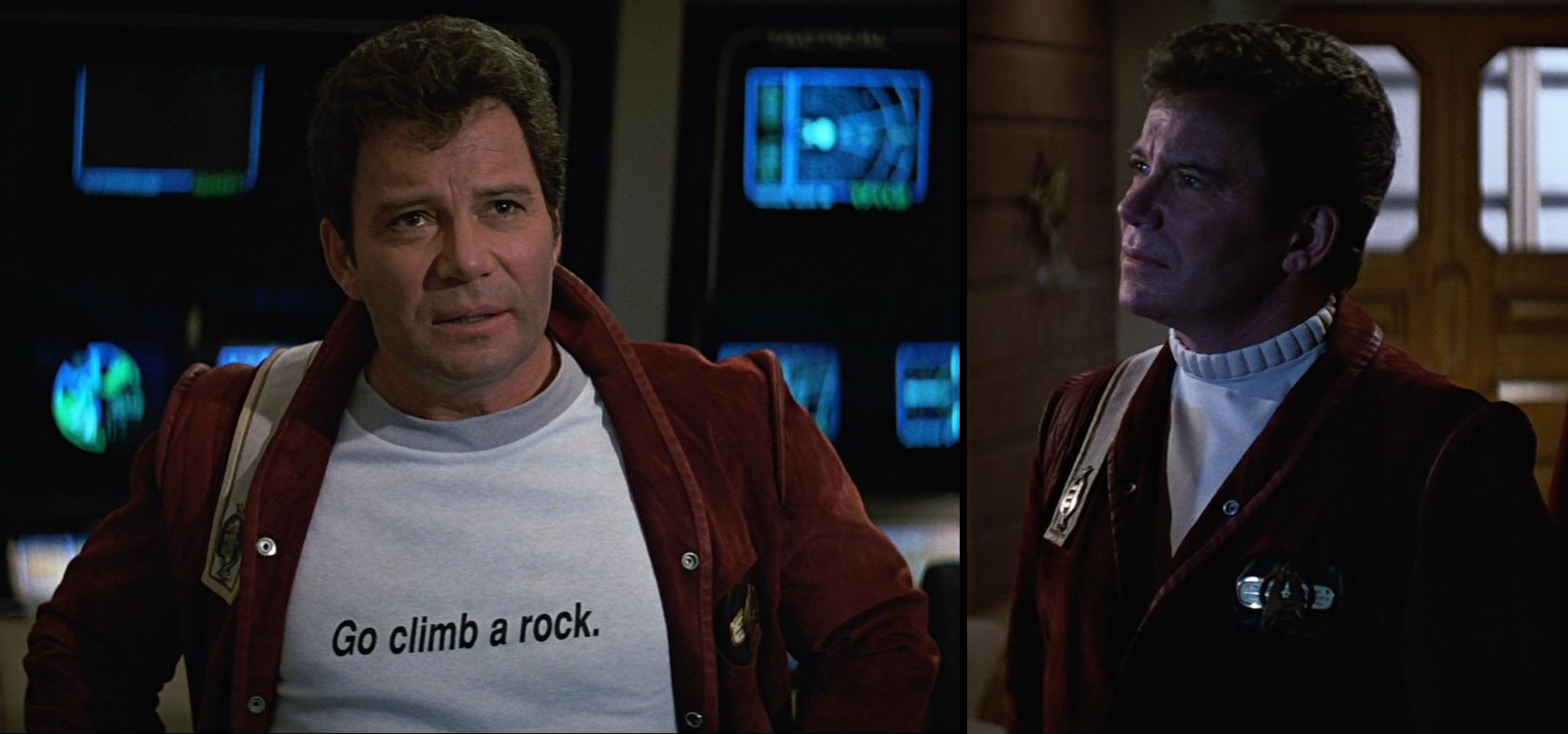
These were very rare, and as best I can tell they were only ever worn by three characters: Admiral Morrow in ST3, Scotty in ST3 and ST4, and Kirk in ST5.
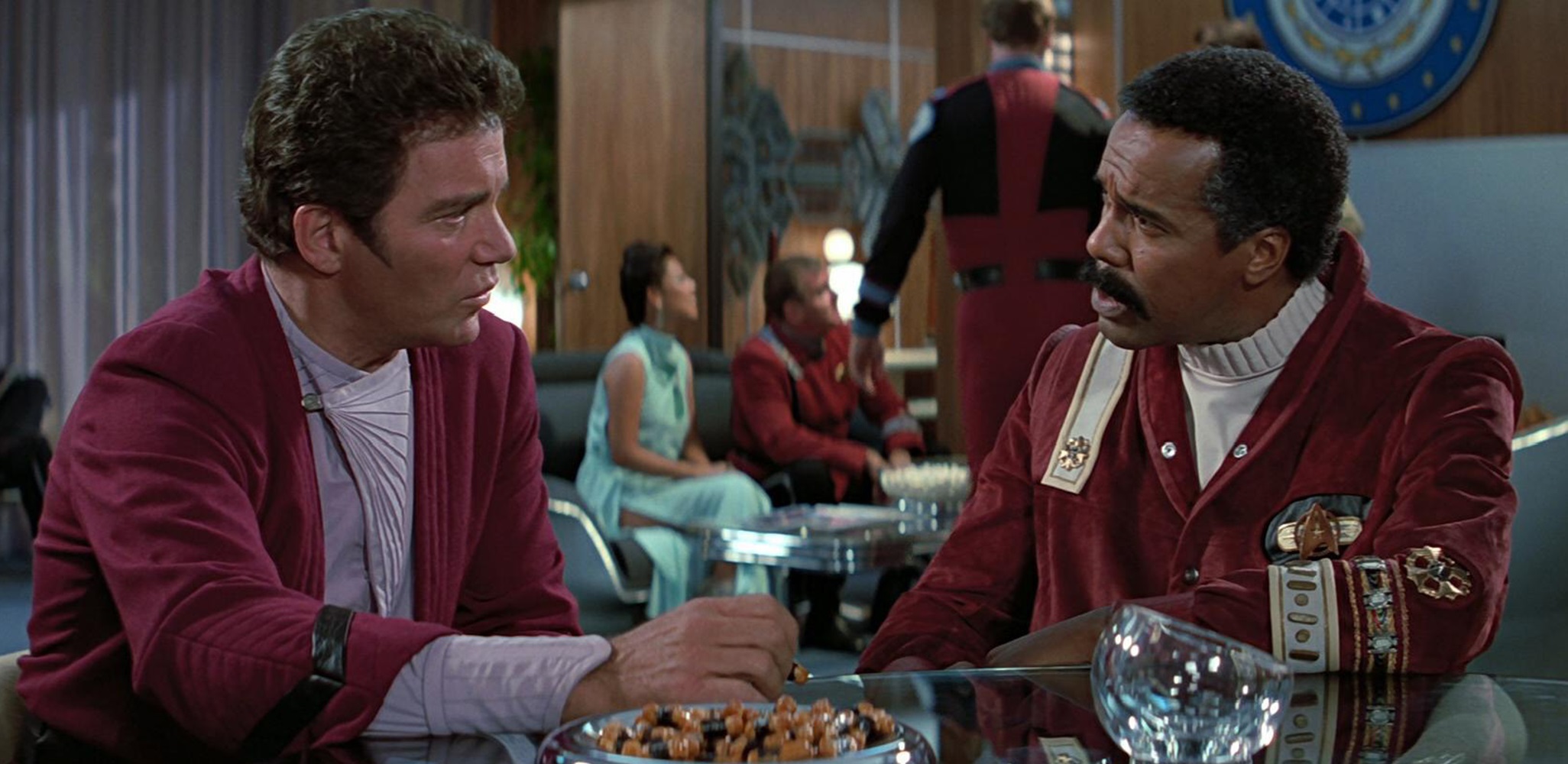
We first saw these in ST3, when Kirk met with Admiral Morrow to ask for permission to return to the Genesis planet.
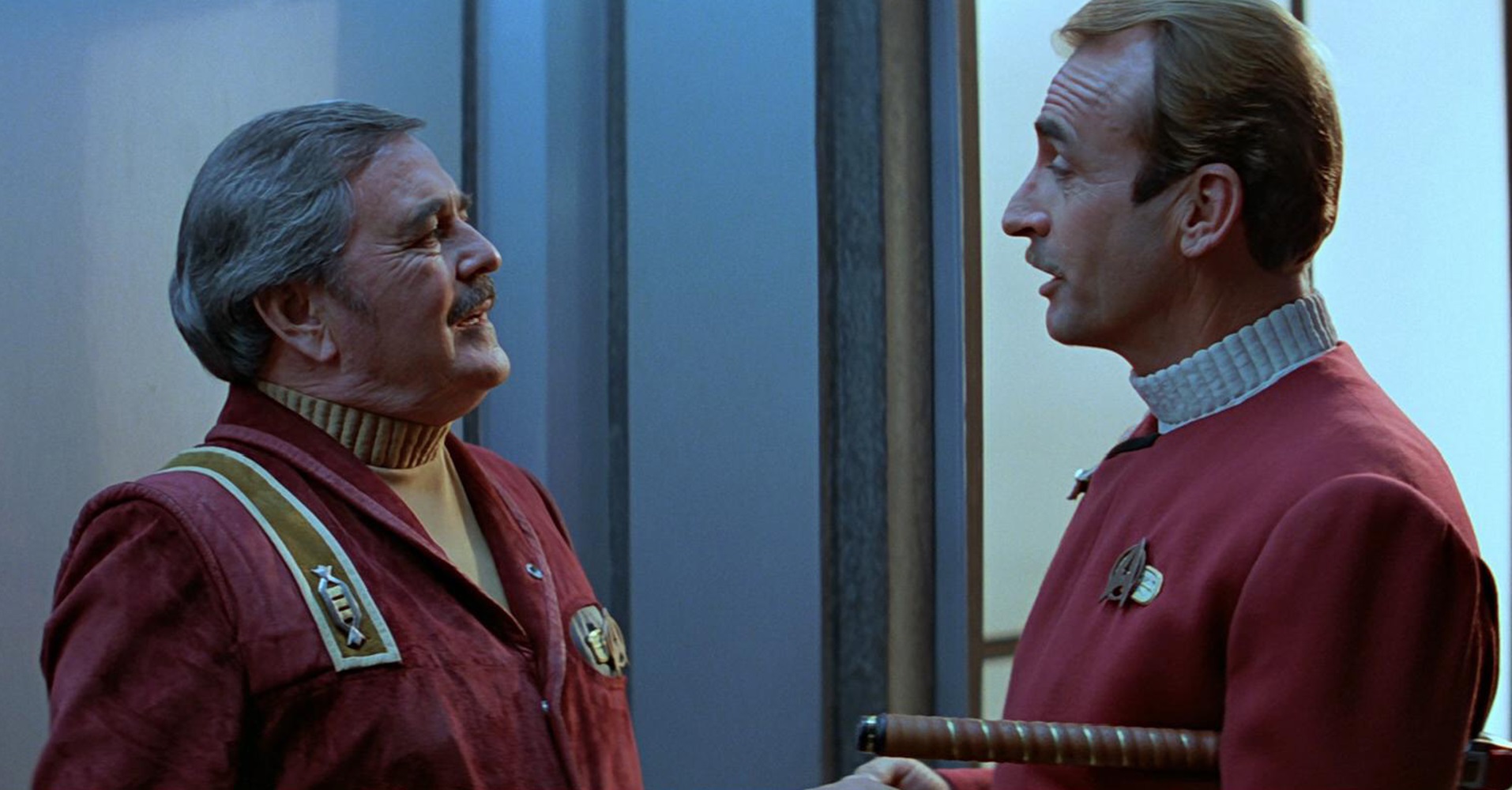
Scotty changed to his when he reported to the Excelsior.
He continued to wear it from the hijacking of the Enterprise to the very end of the movie.
He wore it on and off throughout ST4, first on Vulcan and then for his excursion into past San Francisco.
Then in ST5, Kirk wore it when he arrived back on the Enterprise and a while afterward as they got underway.
These suede jackets had shawl collars and closed up the front by a series of snaps.
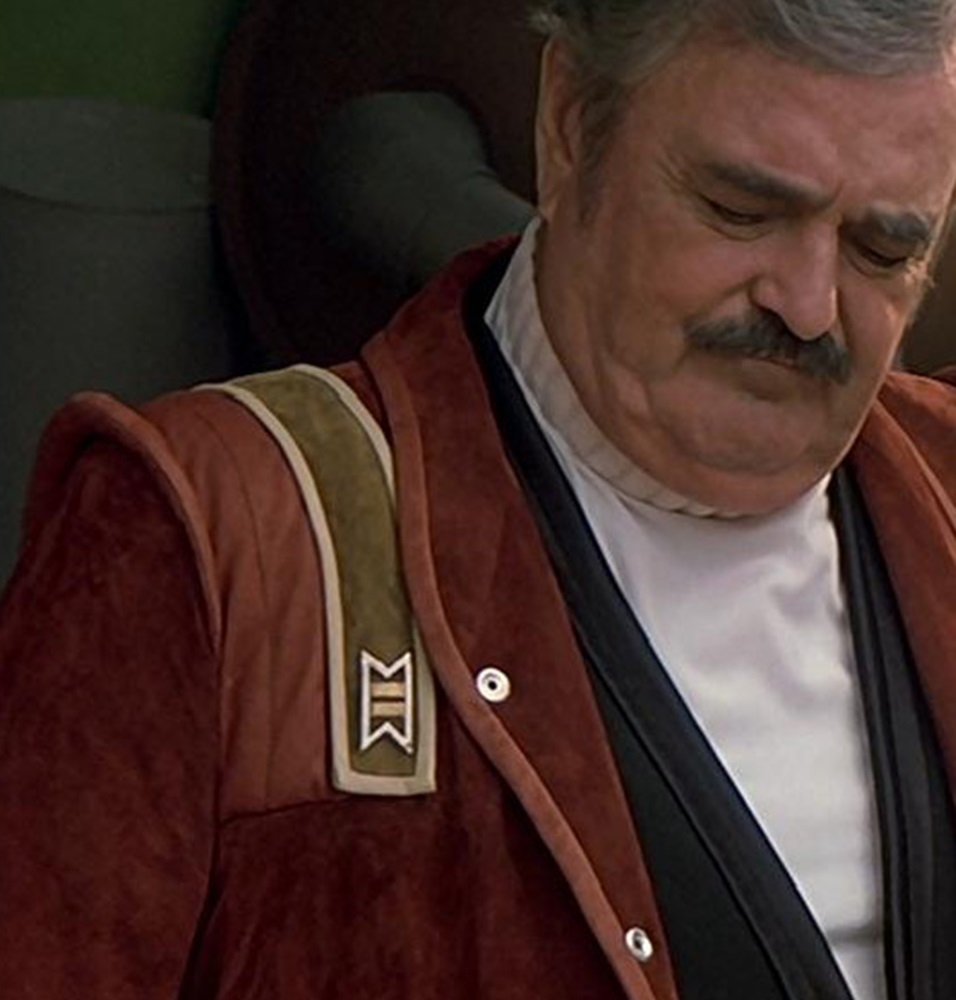
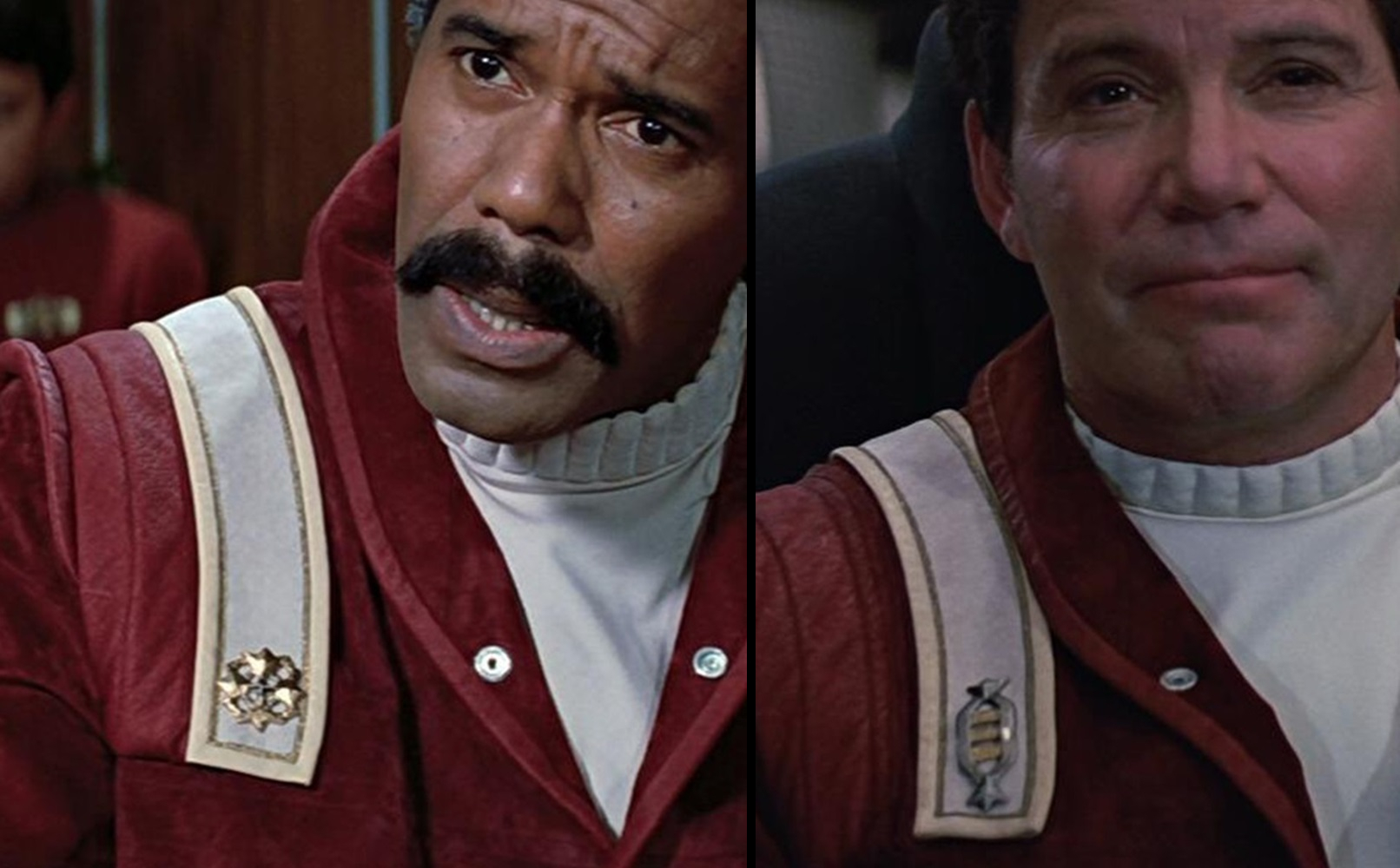
On the right was a decorative, division-colored shoulder strap similar to that on the “monster maroon” jackets. The wearer’s rank was displayed on the lower front of the strap.
Like most of the other uniforms of the era, the wearer’s rank was also shown on the lower left sleeve, above a division-colored sleeve band.
Both Admiral Morrow and Captain Kirk displayed their “pips and squeaks” on their sleeve bands, just like on the standard uniform jackets:
For some reason, Scotty did not.
For what it’s worth, I think for ST5, Admiral Morrow’s jacket was reused for Kirk; note the gold soutache along Morrow’s shoulder strap, which I assume would’ve only accented flag officers’ uniforms, like on the standard “monster maroon” jackets.
Scotty was a captain and wore captain rank insignia but his jacket didn’t have the gold soutache, so I think this was just a production mistake.
Engineering Vest
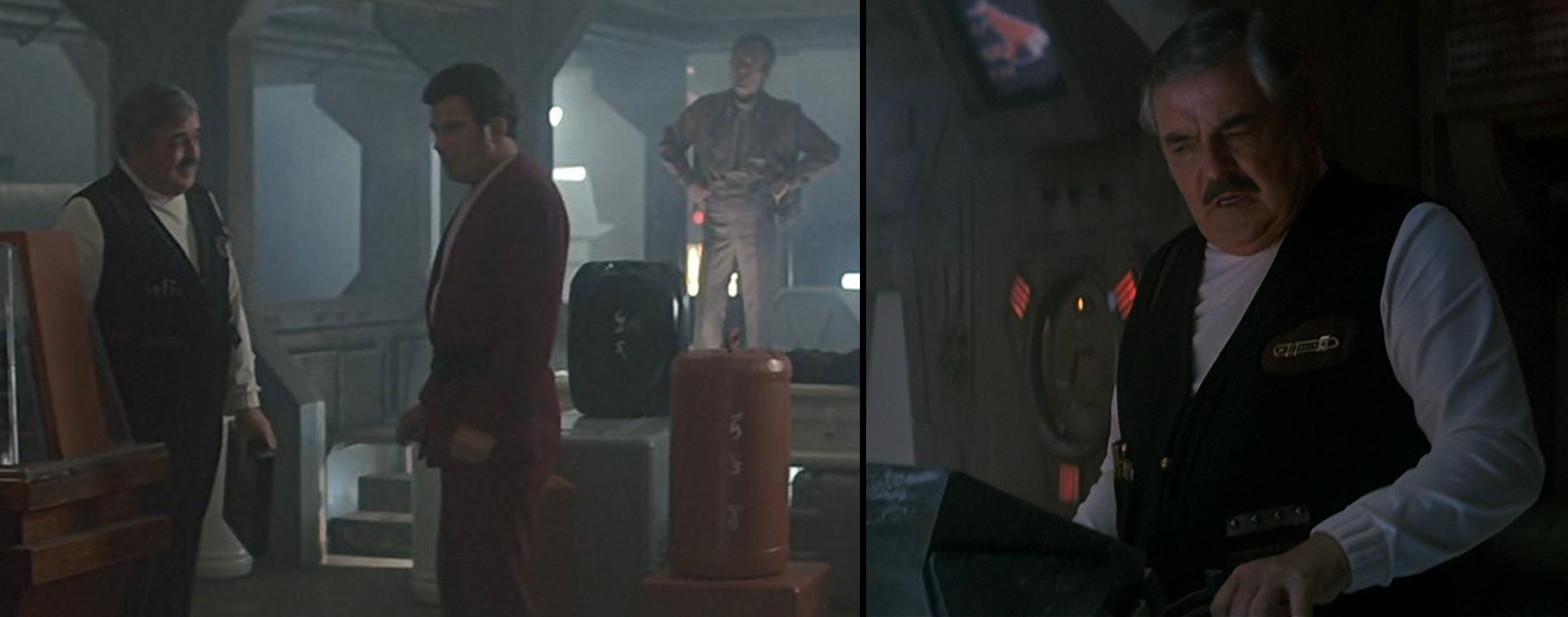
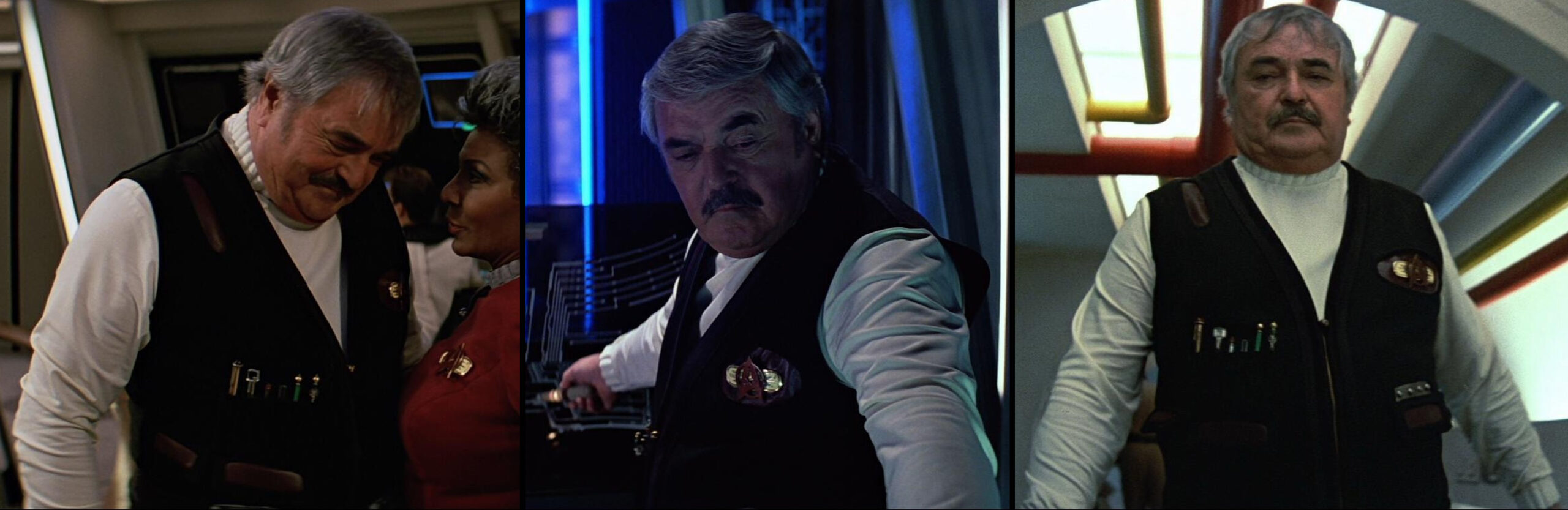
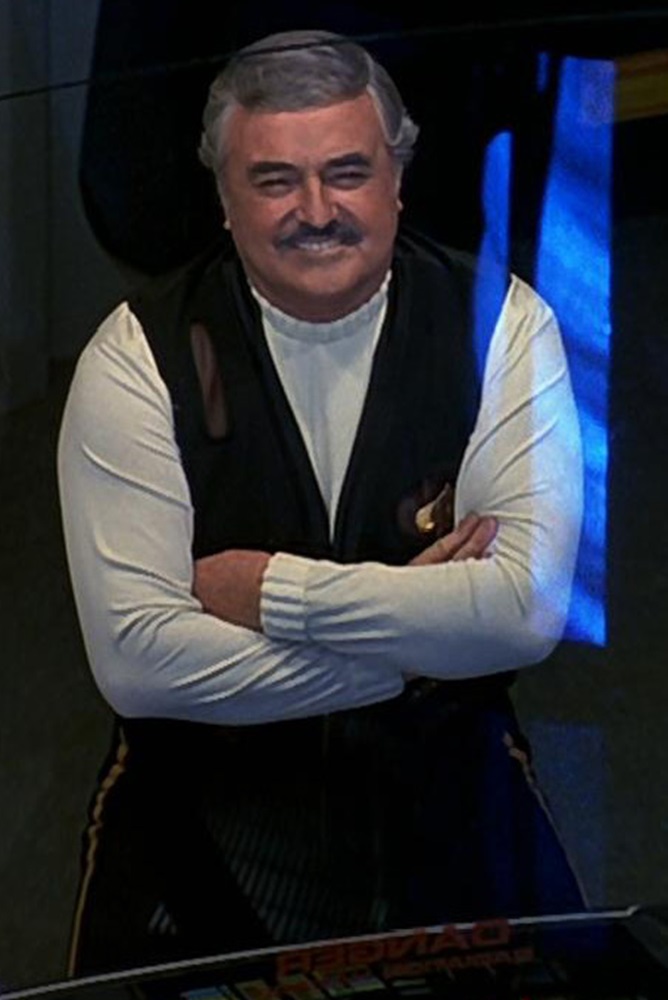
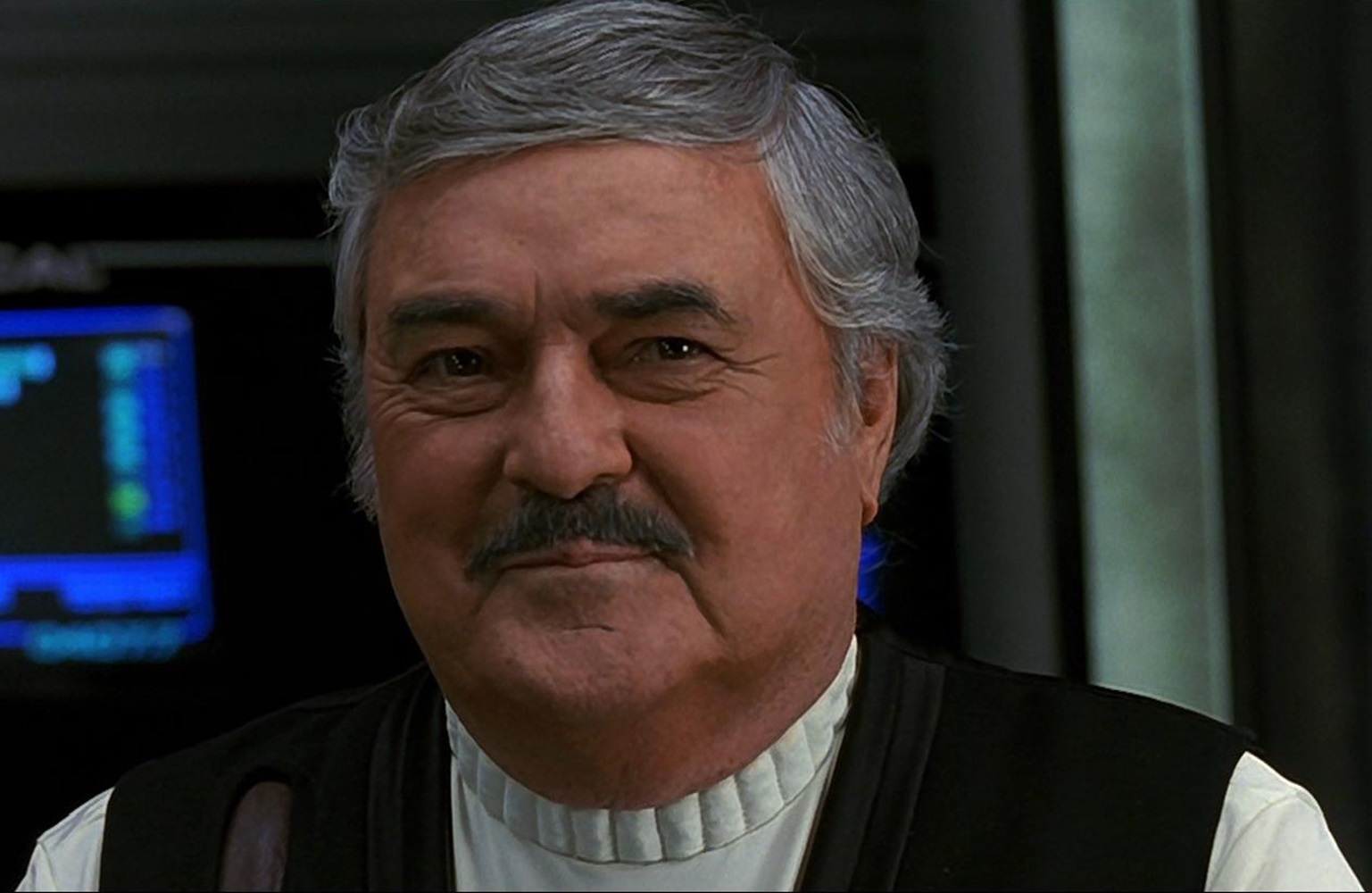
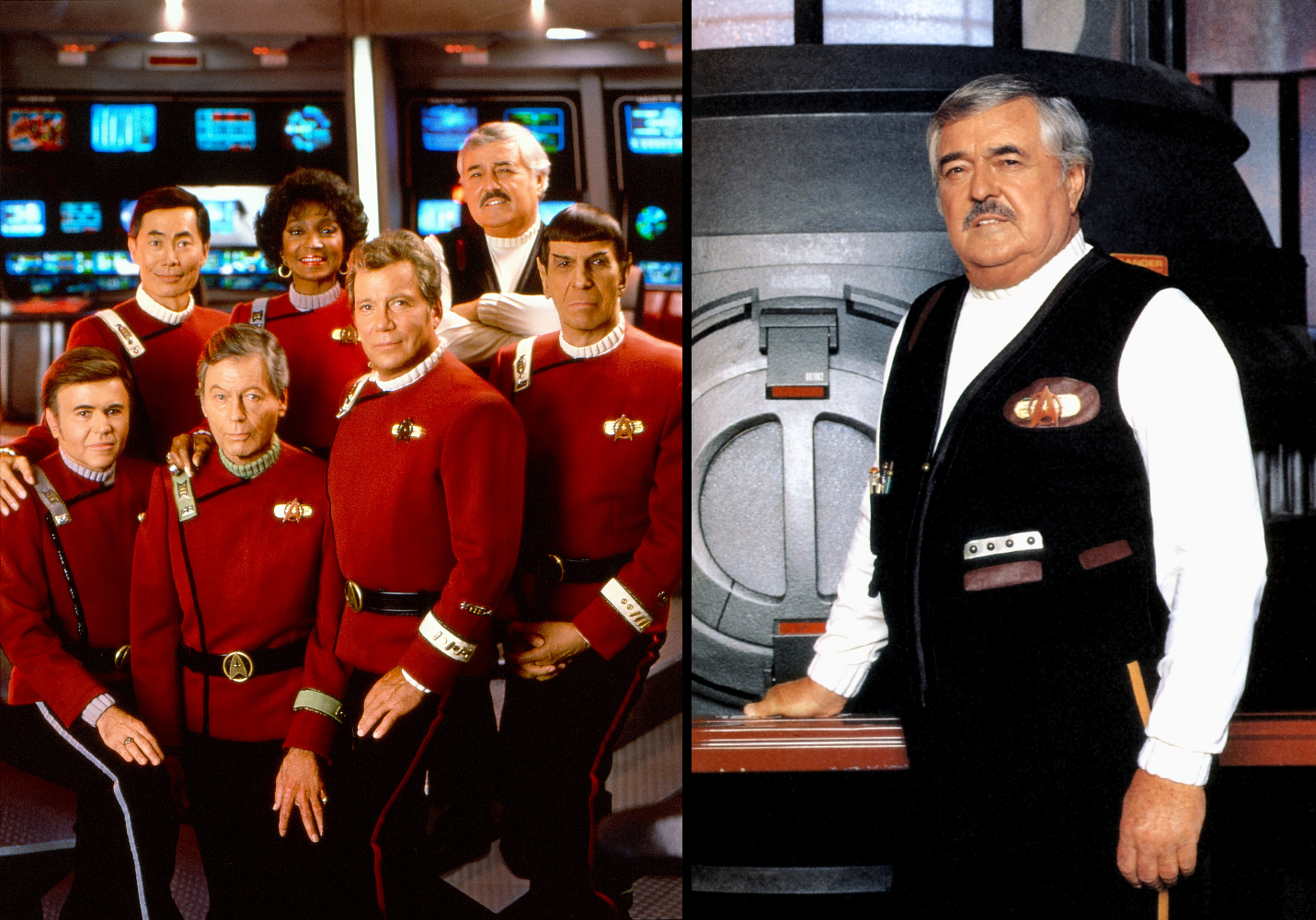
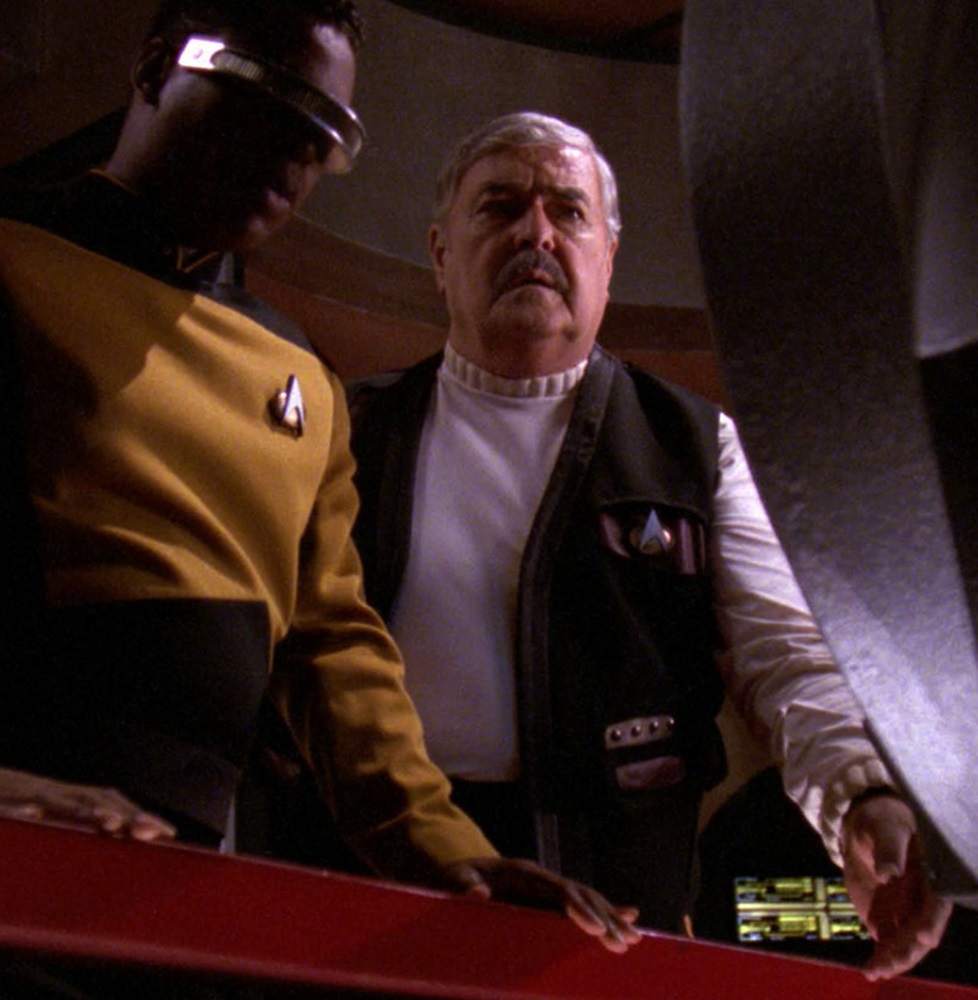
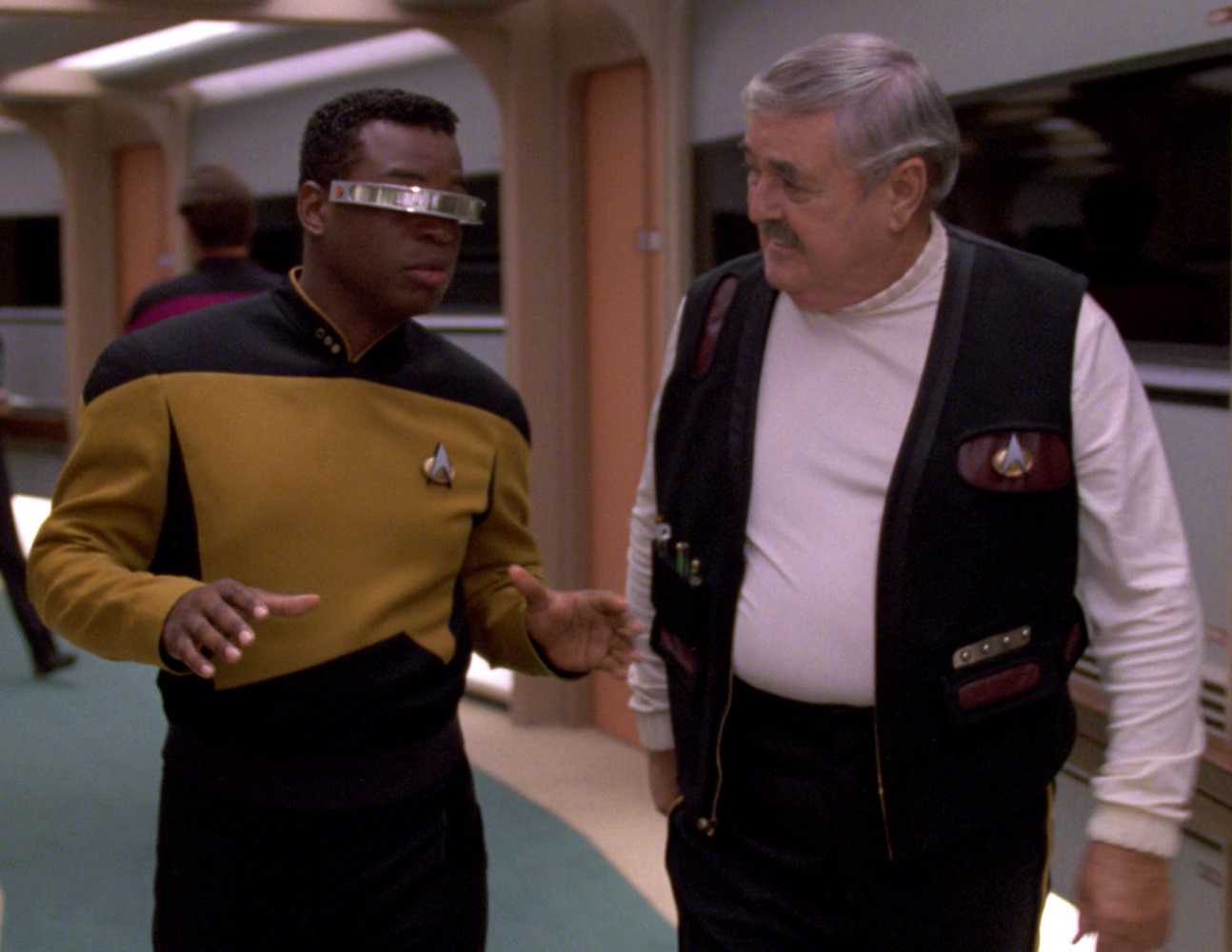
Another alternative to the standard uniform jacket was an “engineering vest,” which Scotty wore throughout most of the latter three movies.
I call it the “engineering vest” because that’s my interpretation of what I believe it was; Scotty was the only character we ever saw wearing it, he was the chief engineer, and it had what looked like little pockets and pouches for tools.
We first saw this in ST4; at first he wore it underneath his “bomber jacket.”
Once they were underway, he ditched the jacket and just wore the vest while he was on board the ship.
This seems to have immediately become his favorite outfit; he wore it every chance he got for the rest of ST4 and the following two movies.
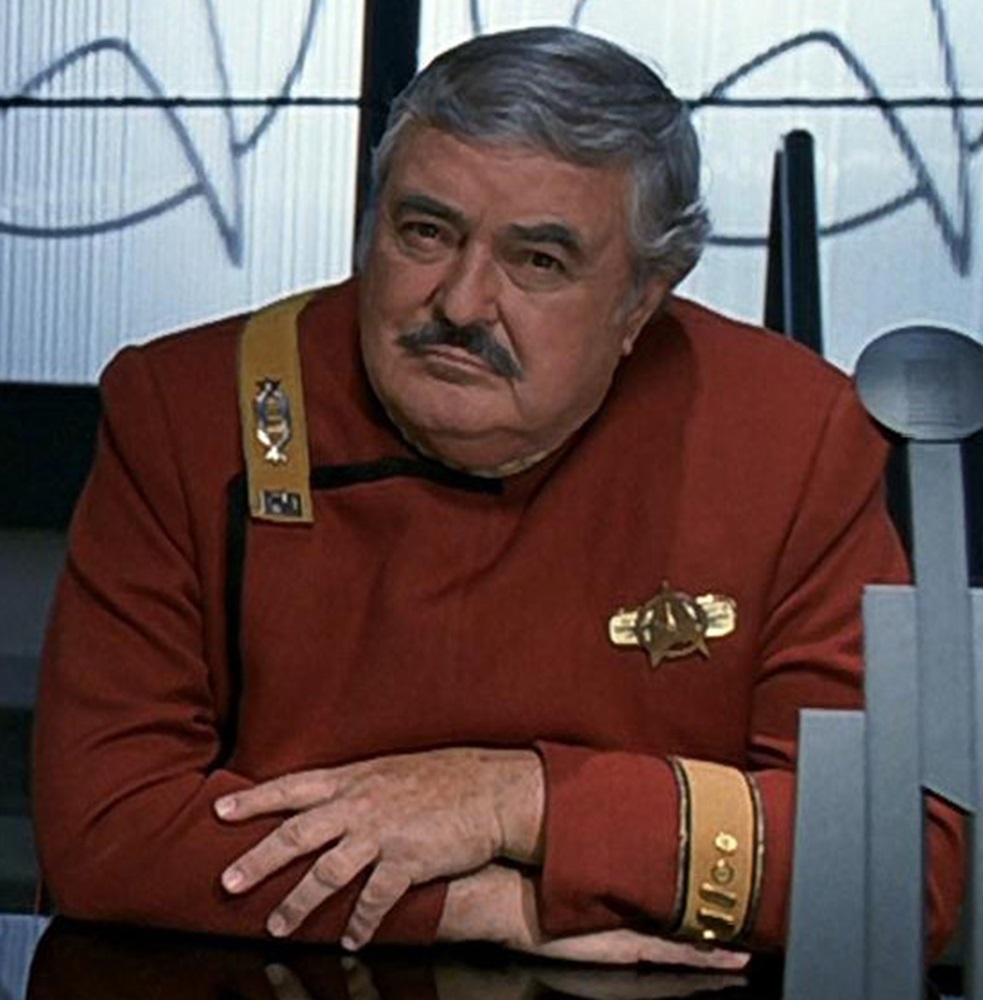
He wore the standard “monster maroon” uniform for the trial at the end of the movie and for the shuttle trip to the new Enterprise – although with the incorrect rank of commander, instead of captain.
(This was almost definitely a production mistake, but we hadn’t seen him in this uniform since he was promoted, so I like to think Scotty just grumpily pulled it out of his closet for the trial and wore it with the commander rank still attached out of spite.)
In ST5, he wore the vest for almost the entire movie.
He only put on his standard uniform jacket for the reception with the Klingons at the end.
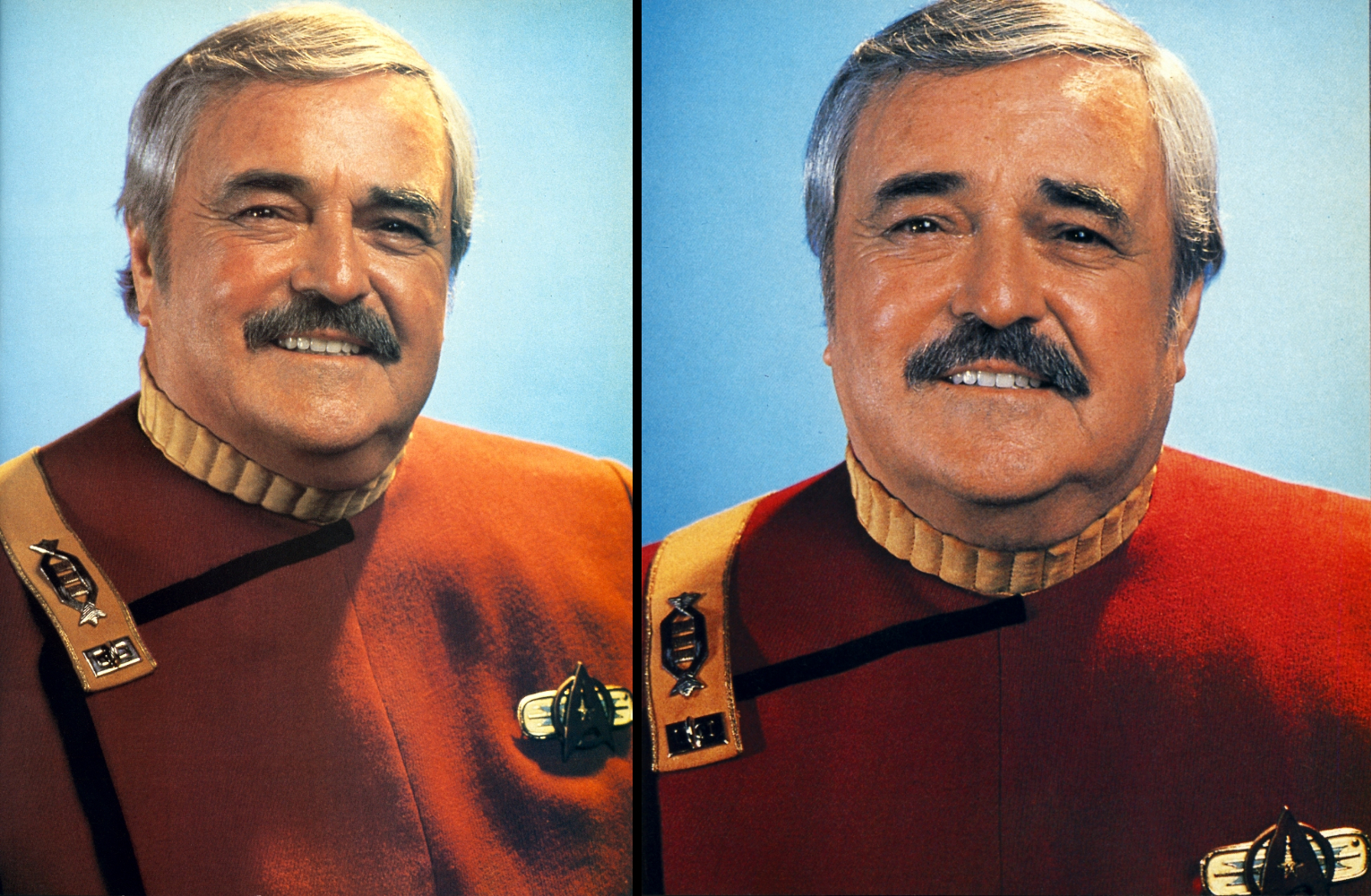
He did wear the jacket for these ST5 publicity photos, though – and with the proper “captain” rank.
He wore his “monster maroon” jacket for the briefing scene near the beginning of ST6:
But then he ditched it and switched to his preferred vest as soon as they were onboard the Enterprise and underway.
Happy to be in his favorite outfit
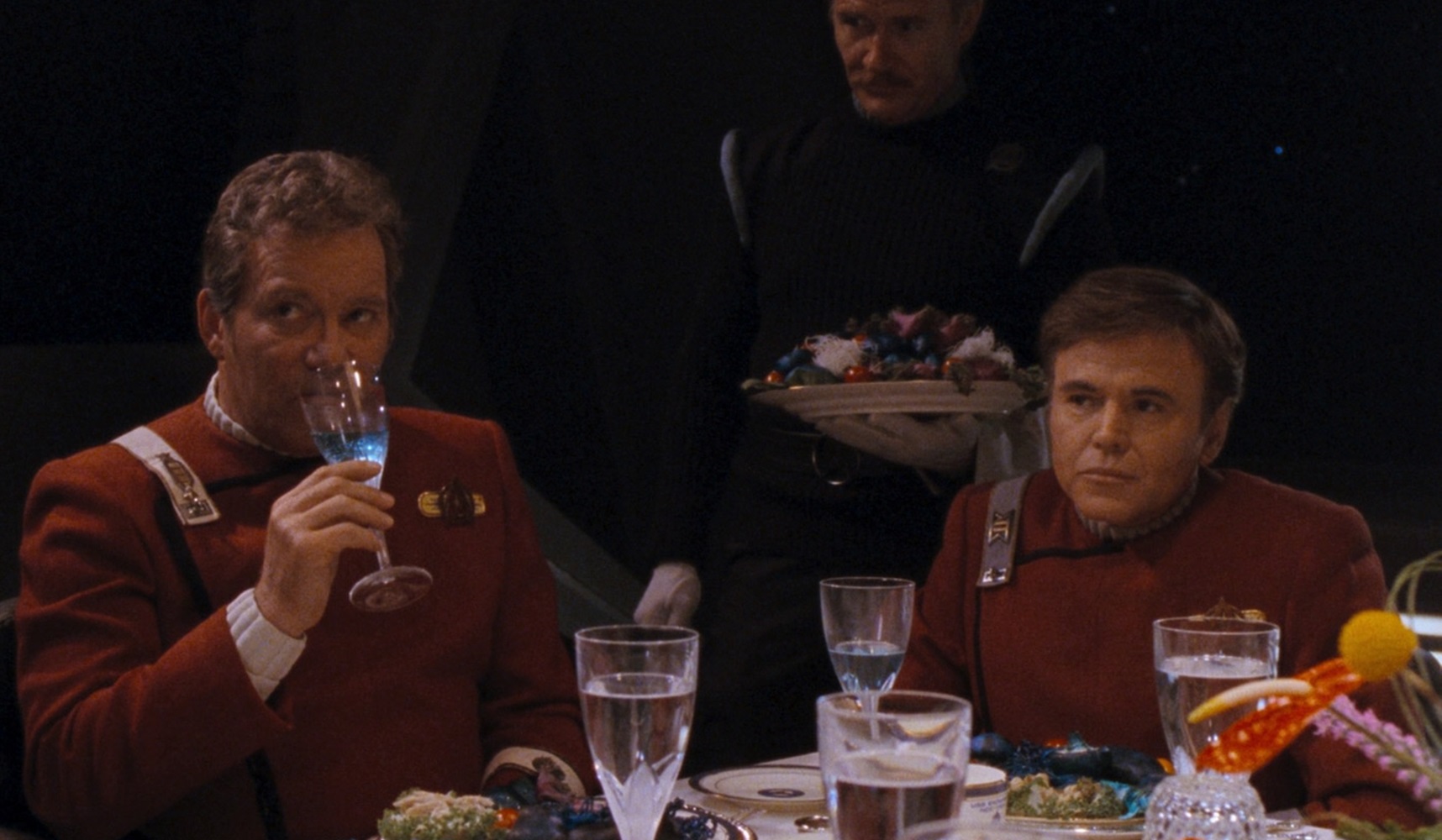
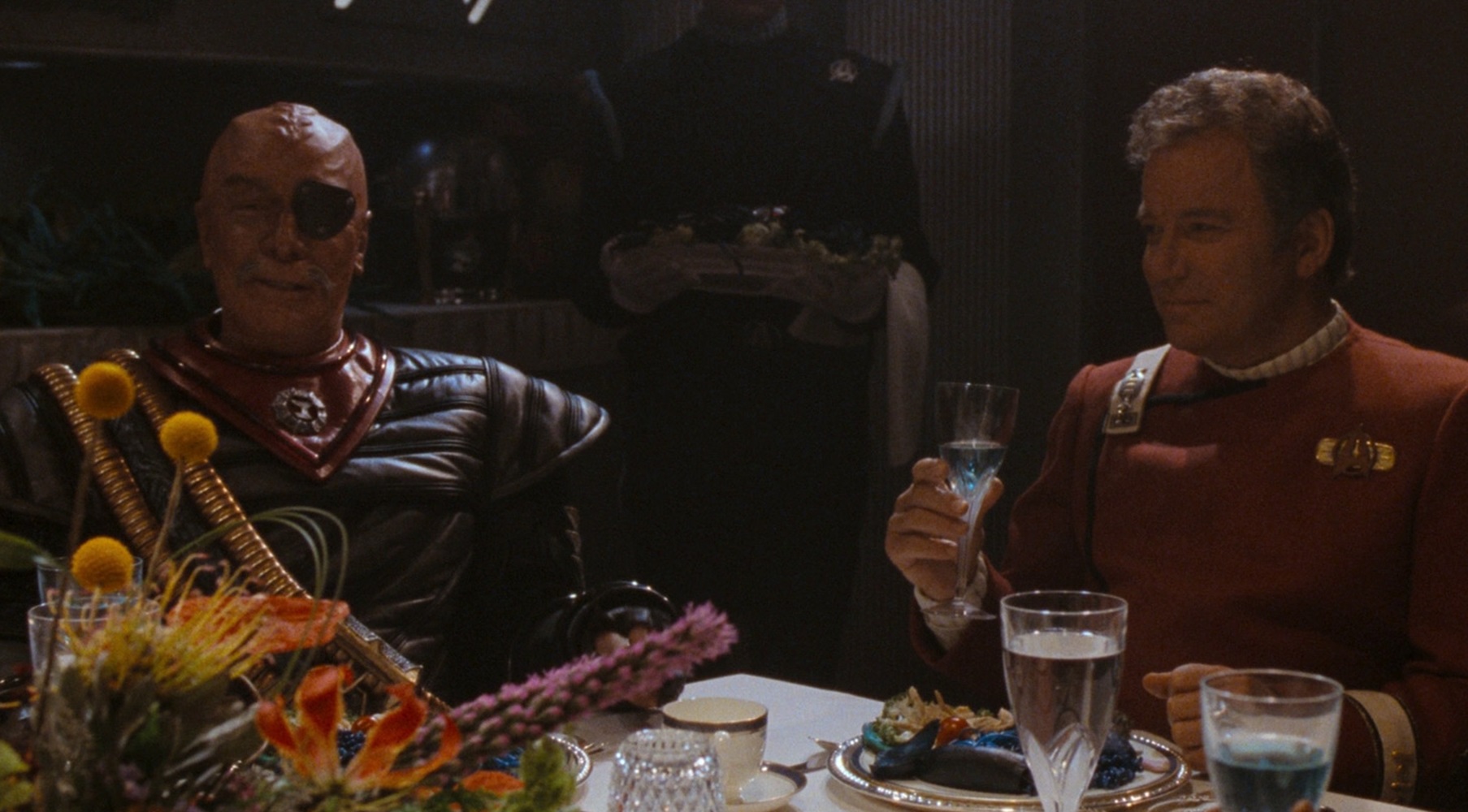
He put the standard jacket back on for the dinner with the Klingons (probably swearing under his breath as he did so), then immediately changed back out of it again afterward.
He wore the vest for most of the rest of the movie, all the way through the space battle with the Klingons:
Despite the urgency of the situation, he took the time to toss the jacket back on to beam down and save the peace conference.
As soon as they were back on the ship, though, it was back to the vest. (I bet he had it in the transporter room waiting for him.)
Happy to be in back in his favorite vest again
In my opinion, it really became his signature “look” through the later movies; he even wore it for many of the ST6 publicity photos:
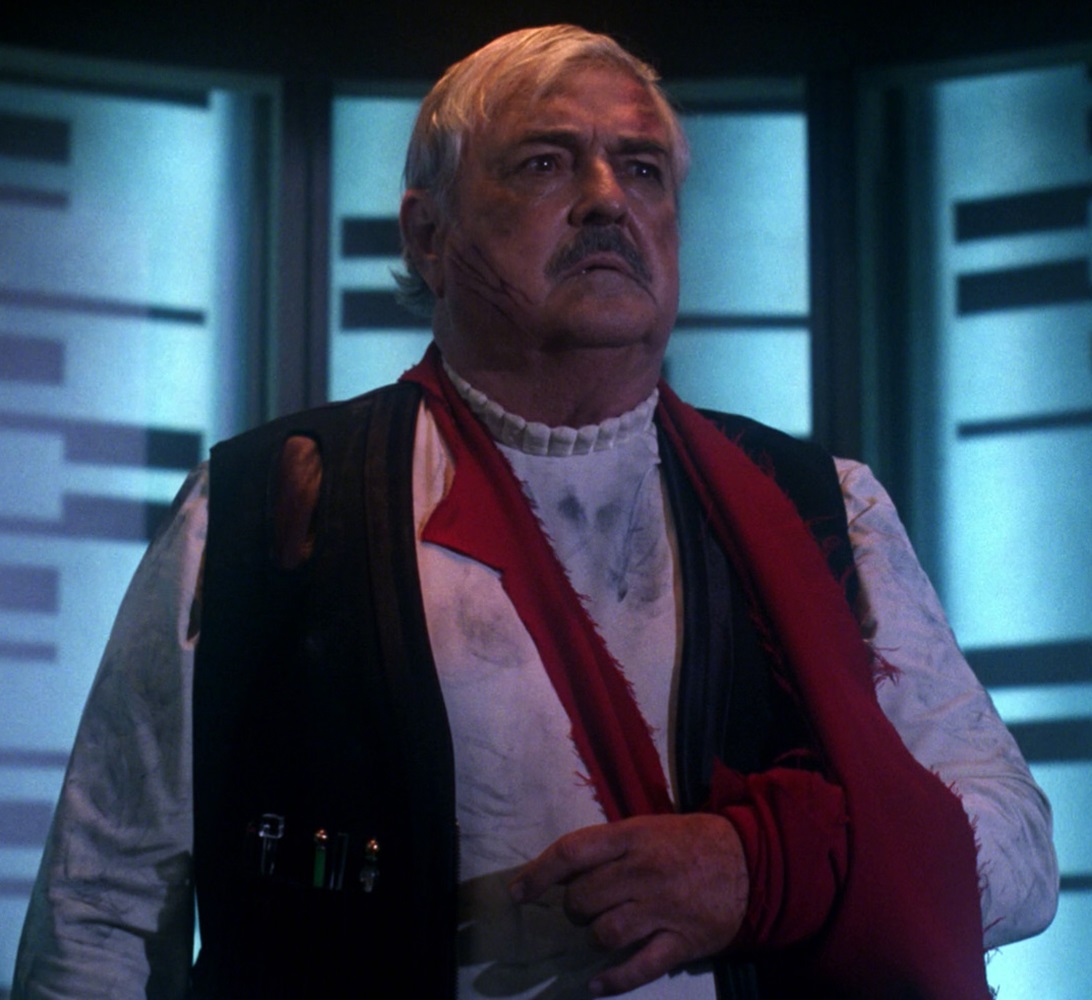
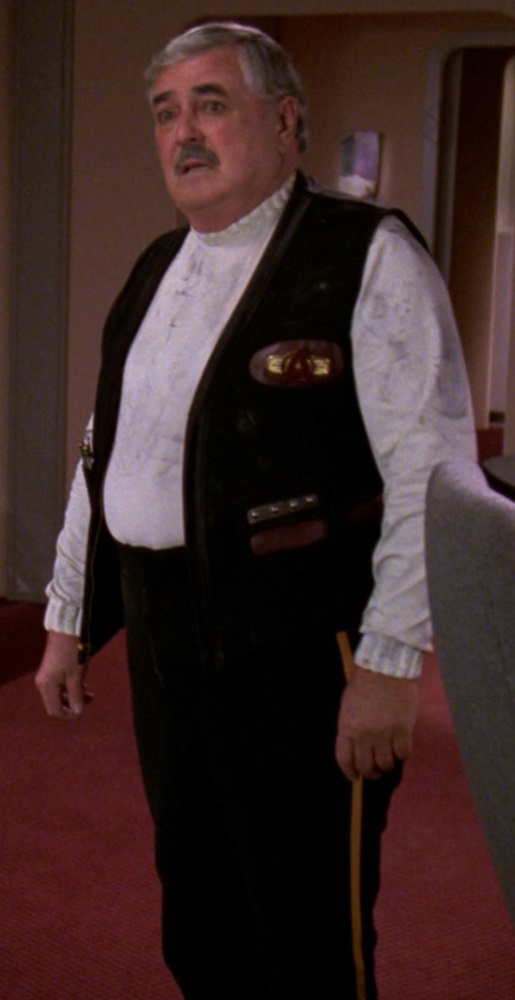
Naturally, when he showed up in the TNG episode, “Relics,” this was his outfit.
I have no evidence of this, but I’ve always thought that the red fabric he used for his sling was the same fabric as the “monster maroon” jackets – suggesting that he quickly ripped one down into some long strips to use as some emergency first aid for his arm.
Once difference for his TNG appearance was that he wore the vest unzipped.
This could’ve been a costuming choice, emotionally representing that his character was on his way to retirement and no longer an active Starfleet engineer.
(Or if we’re honest, it could’ve simply been because the vest wouldn’t actually close at that point.)
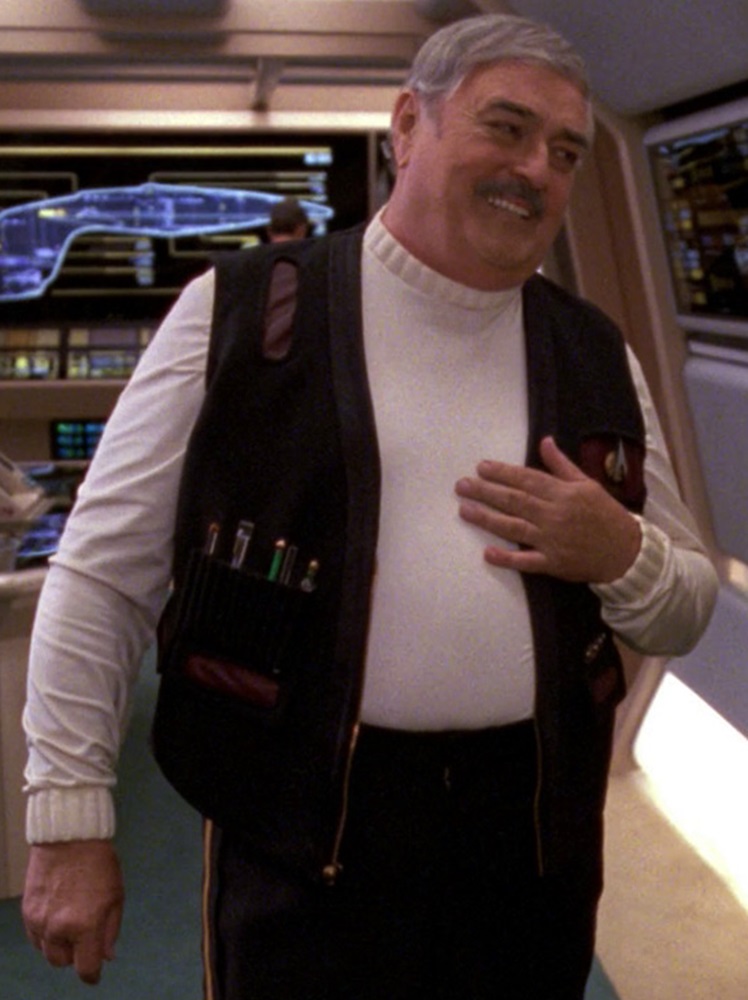
Anyway, once he was cleaned up, he didn’t change into the current Starfleet uniform, but a fresher version of the one he was already wearing.
Happy his favorite vest is clean again
However, he did swap out his older TWOK-era chest badge for the TNG-era communicator.
It was a great episode, but I do wish we would’ve seen him with the vest zipped closed again at the end.
I think this would’ve visually conveyed this step in his character’s arc – that he again had a sense of purpose and wouldn’t be retiring after all.
Anyway, he did show up one more time in Generations, wearing the standard “monster maroon” … and doesn’t he just look so happy to be wearing it again?
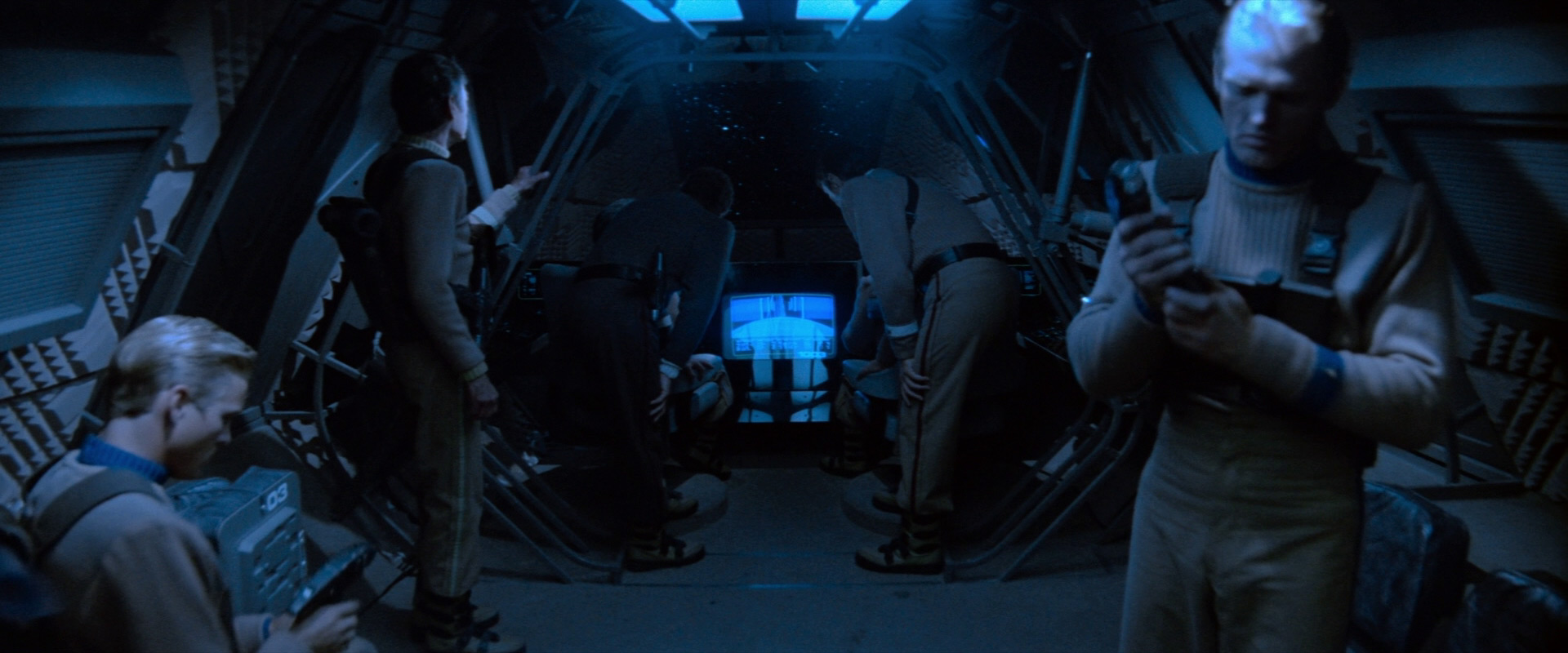
ST5 "Commando Uniforms"
There were a couple more uniforms added to the uniform family by Robert Fletcher’s successors later on.
ST5 was the first movie in the franchise without Fletcher as the costume designer; for that movie the role went to Nilo Rodis-Jamero, who designed new field uniforms for the Nimbus III rescue mission.
Like I mentioned earlier, I refer to these as “commando” uniforms to avoid confusion with the ST2/3 field jackets and their corresponding vests. (It’s possible Starfleet had retired those field uniforms in favor of these, or that they remained in use concurrently.)
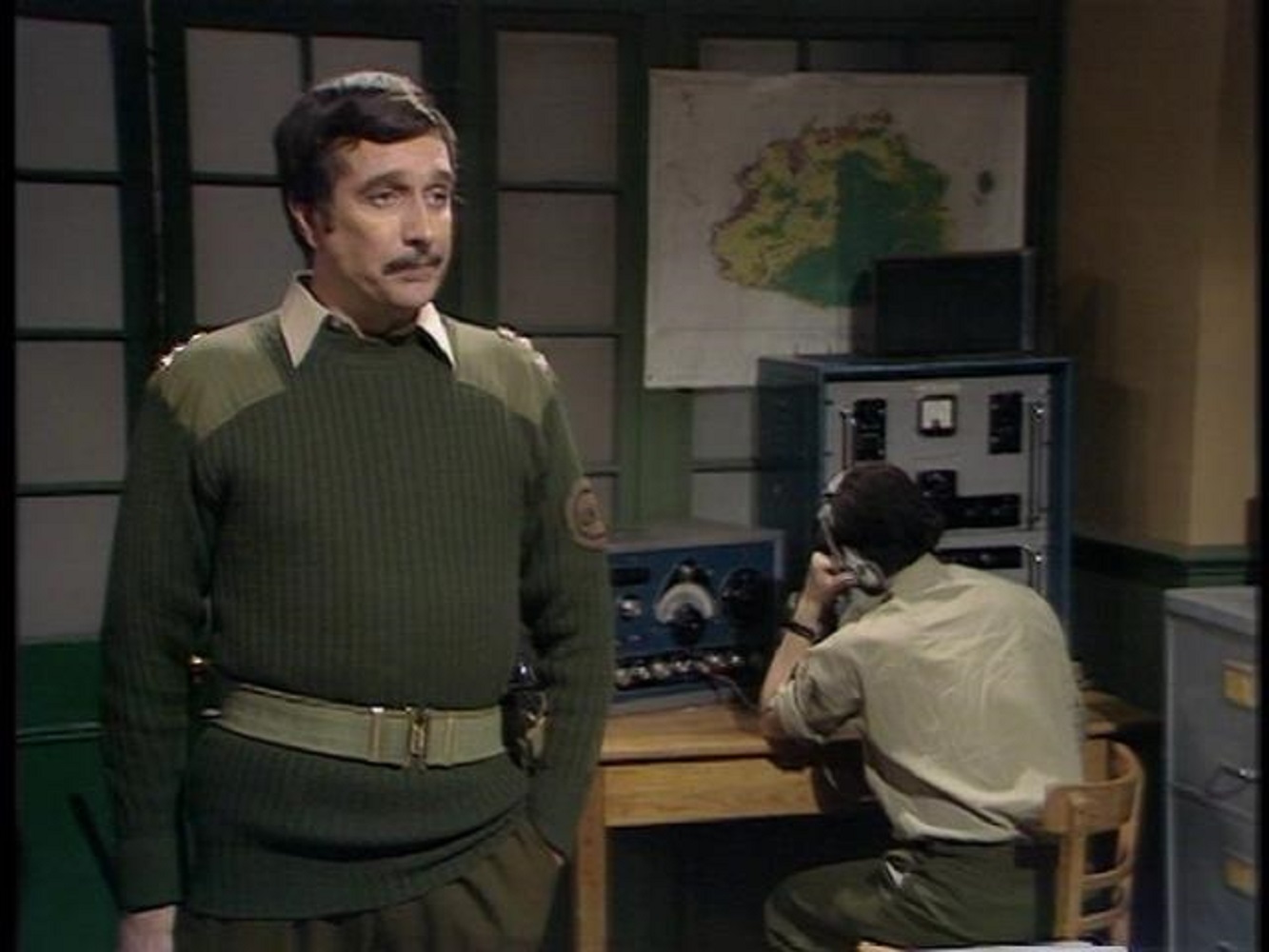
For these, Nilo Rodis-Jamero clearly drew inspiration from then-familiar British military uniforms.
DOCTOR WHO, story #71, "Invasion of the Dinosaurs (part 2)"
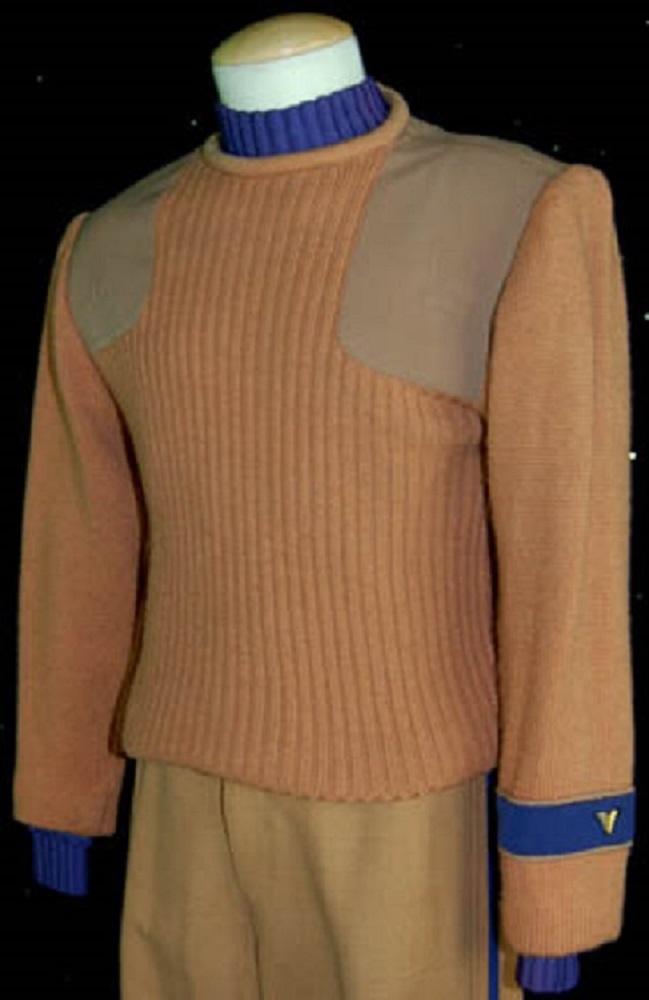
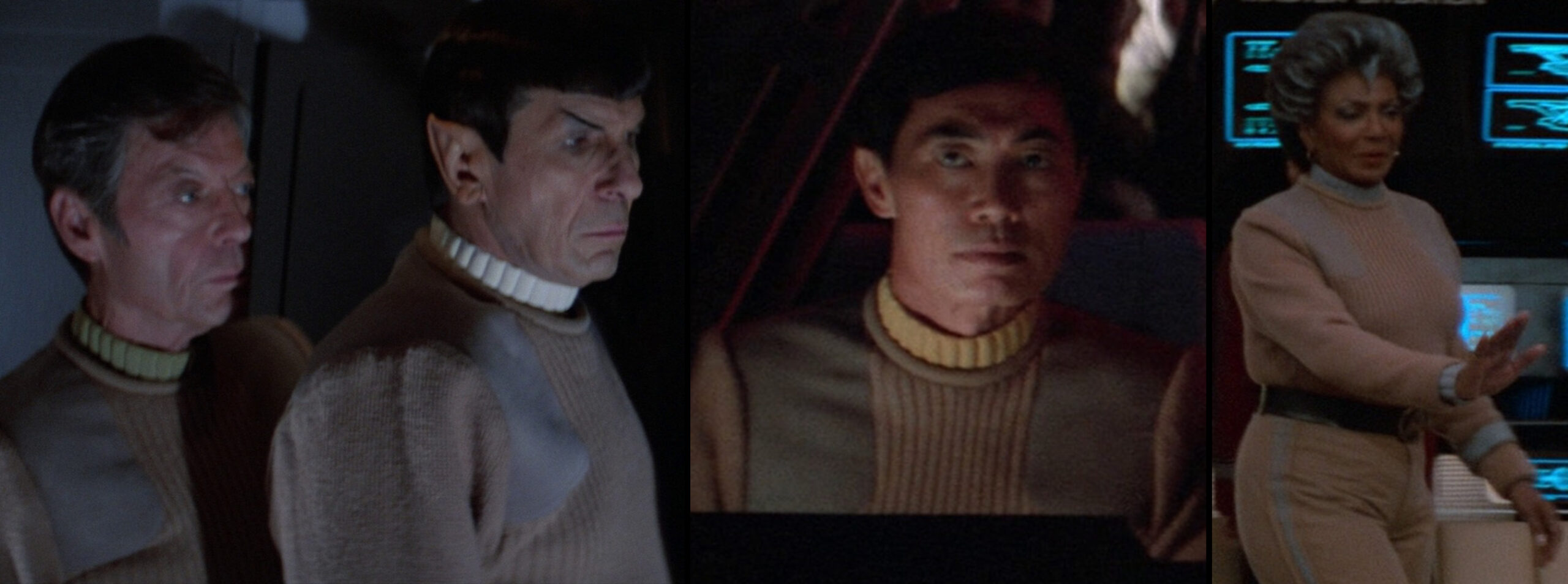
These were three-piece uniforms: a heavy knit sweater worn with a standard division shirt and a variation of the standard uniform trousers.
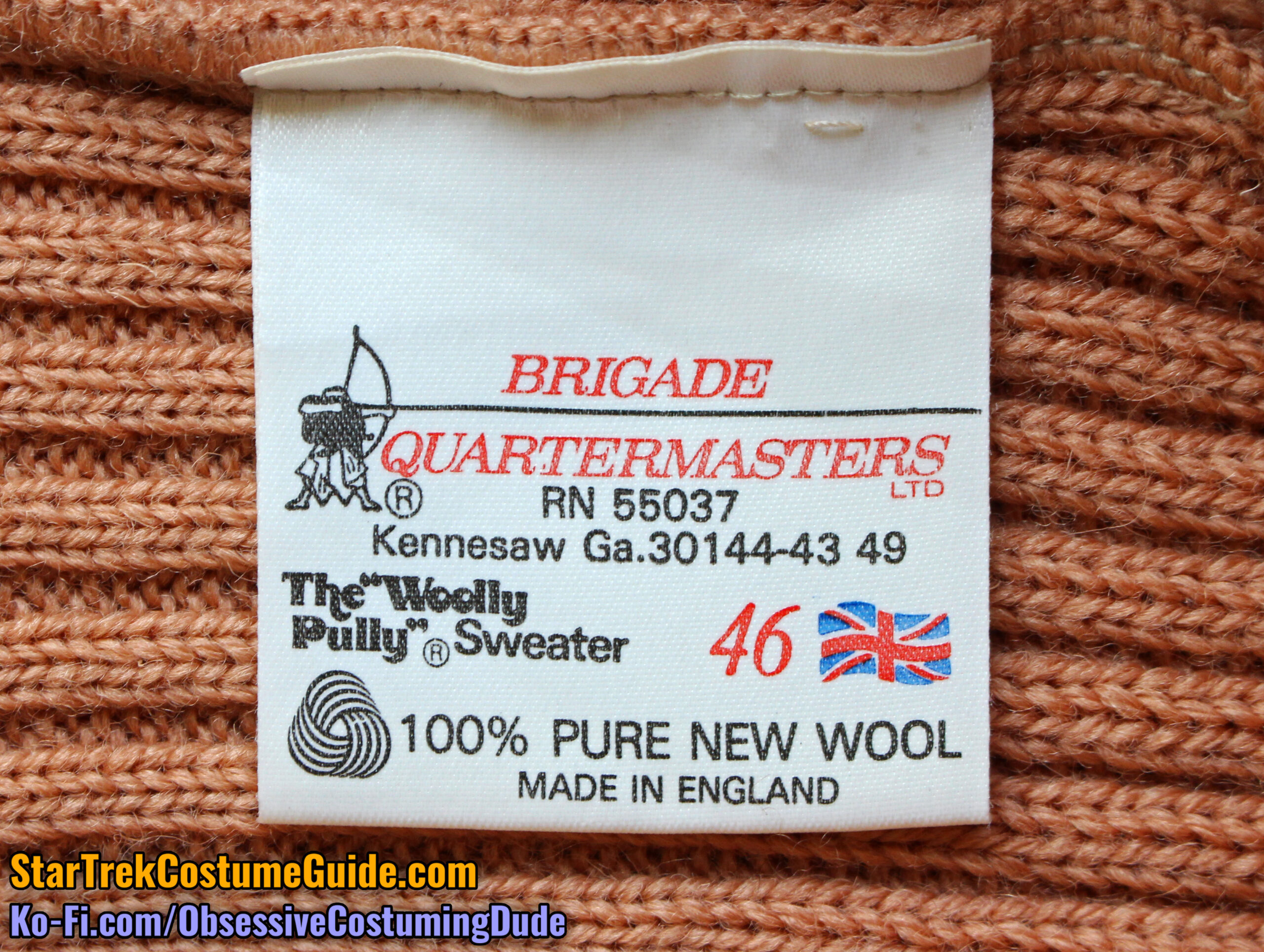
The sweaters actually began their lives as existing “Woolly Pully” sweaters, which were modified for the movie.
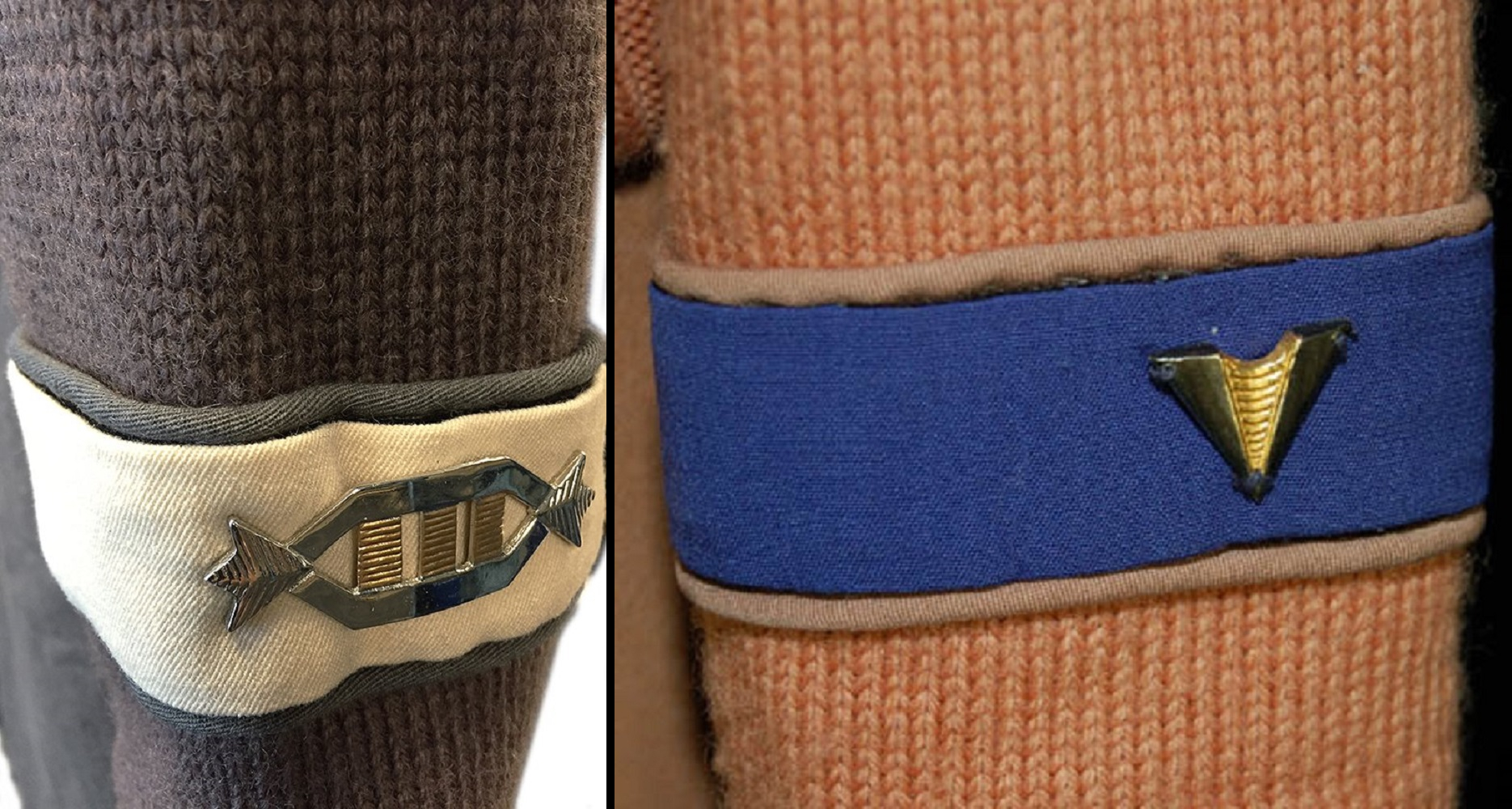
Among other changes, a division-colored sleeve band was added to the lower left sleeve, in keeping with the theme Robert Fletcher had established.
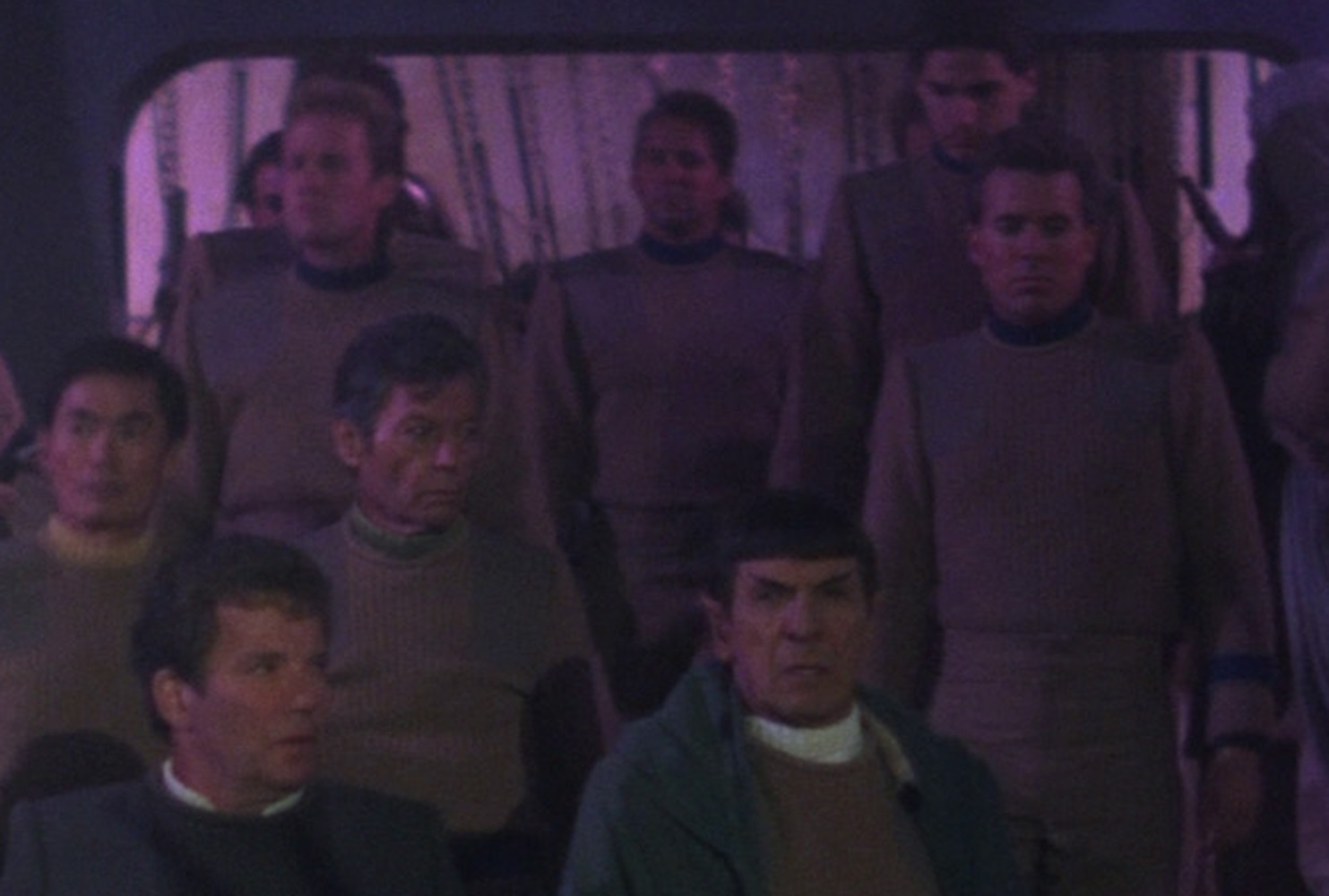
However, the wearer’s rank was worn directly on the sleeve band (instead of above it), and there were no “pips and squeaks” on these.
The main cast all wore their standard division-colored undershirts and belts with these uniforms.
The extras all wore “commando blue” undershirts and did not wear belts.
Captain Kirk wore a darker, grayish-brown version of this uniform, while all the other characters wore tan.
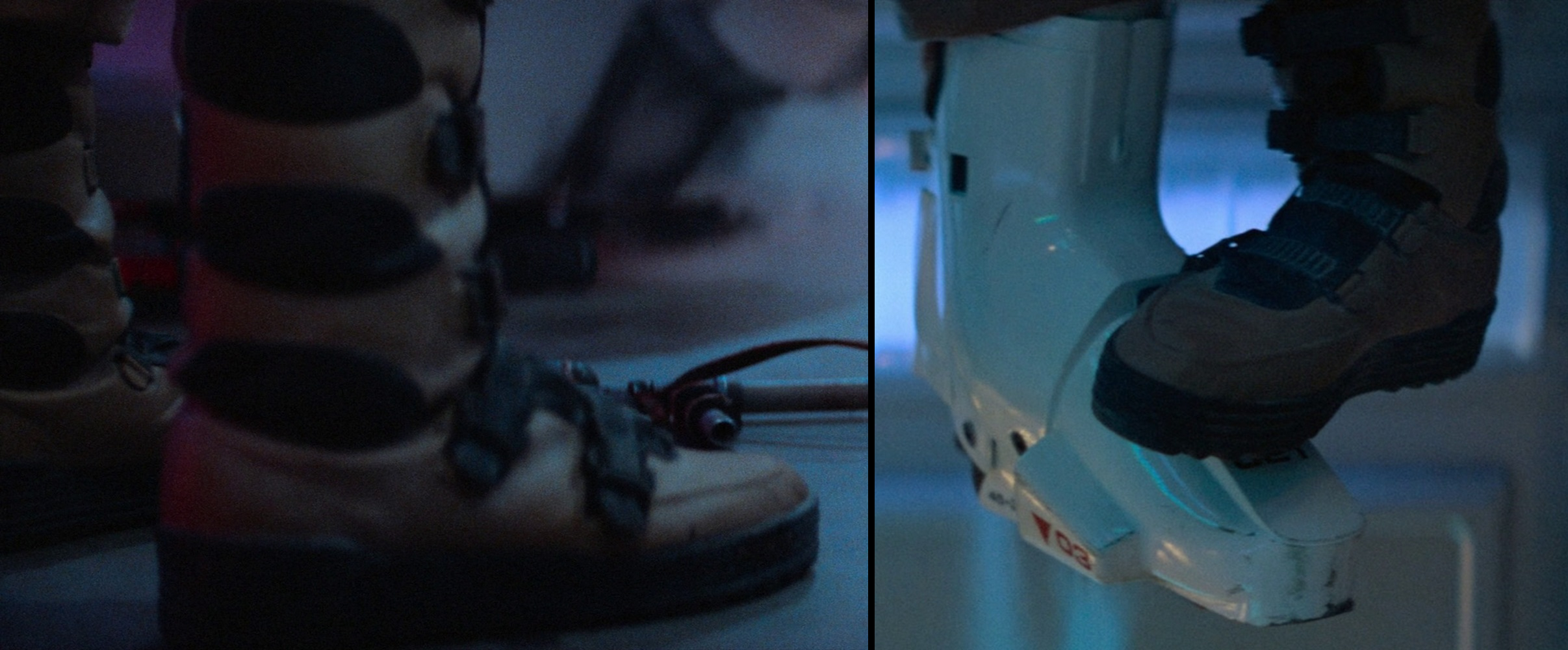
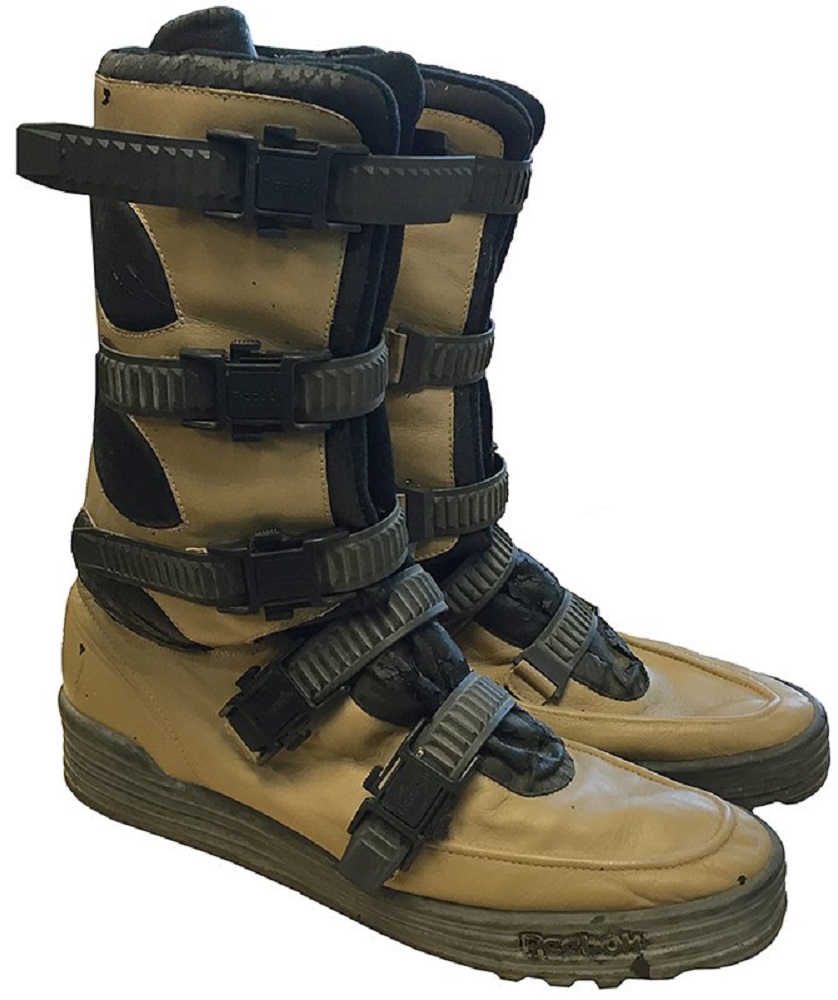
These “commando” uniforms were also worn with new boots:
These boots at least began their lives as Reeboks, although I can’t say to what extent they were or weren’t modified for production.
"Generations" Vest
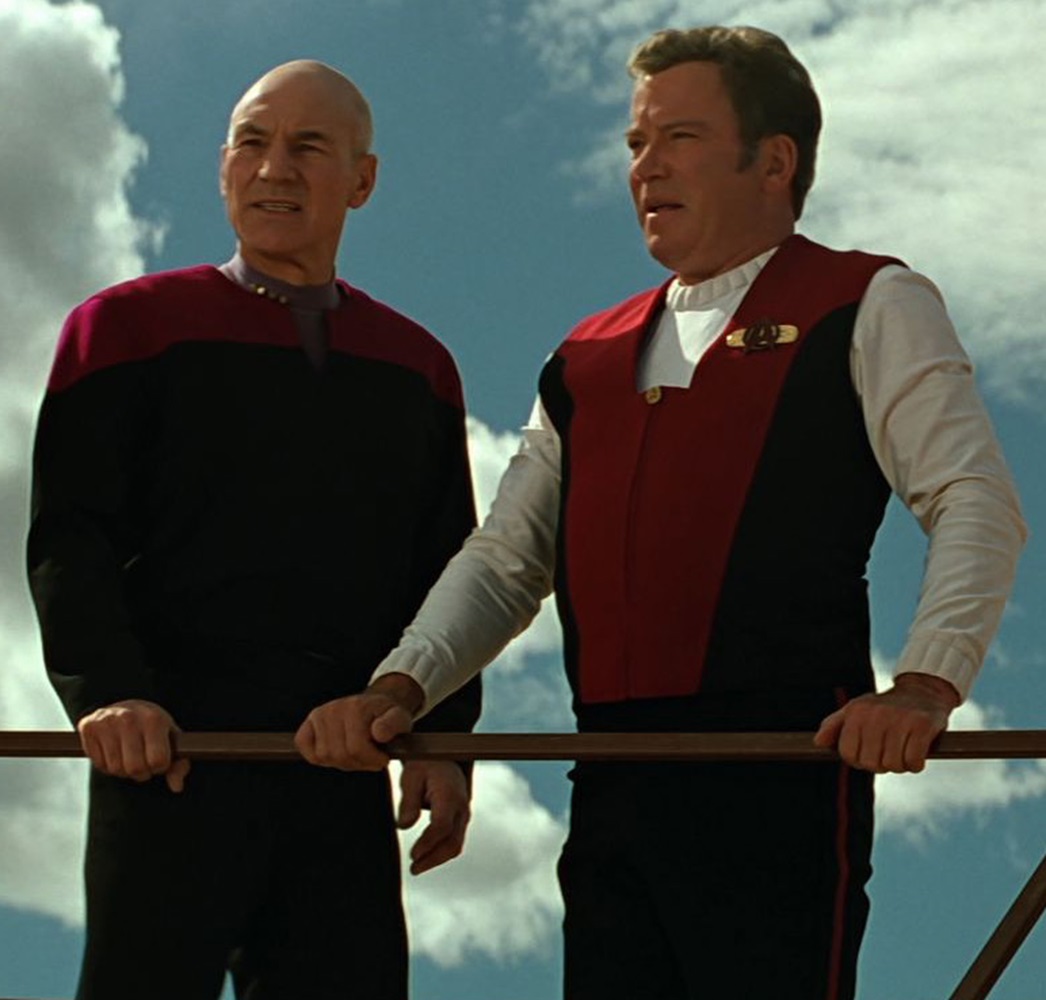
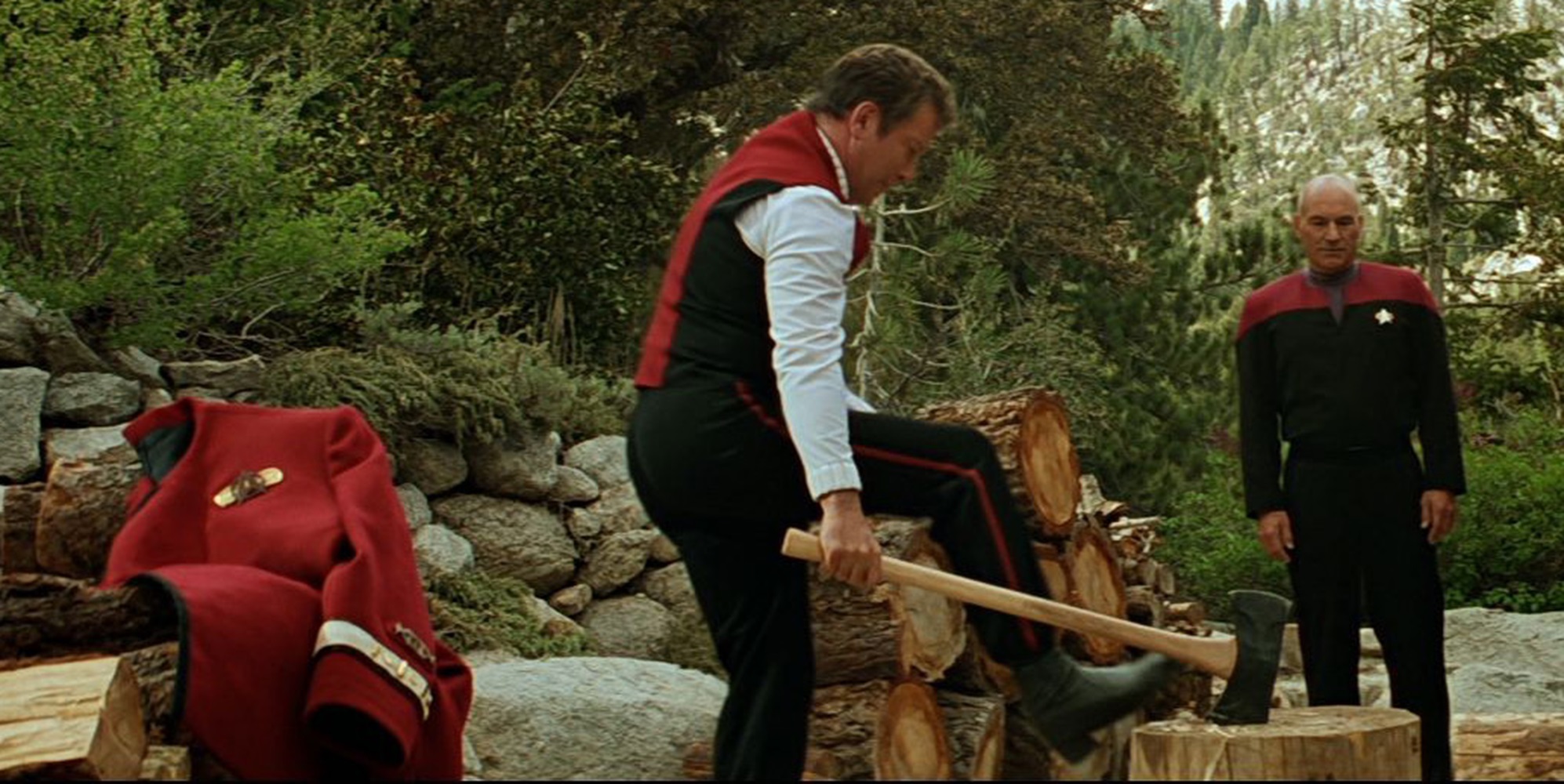
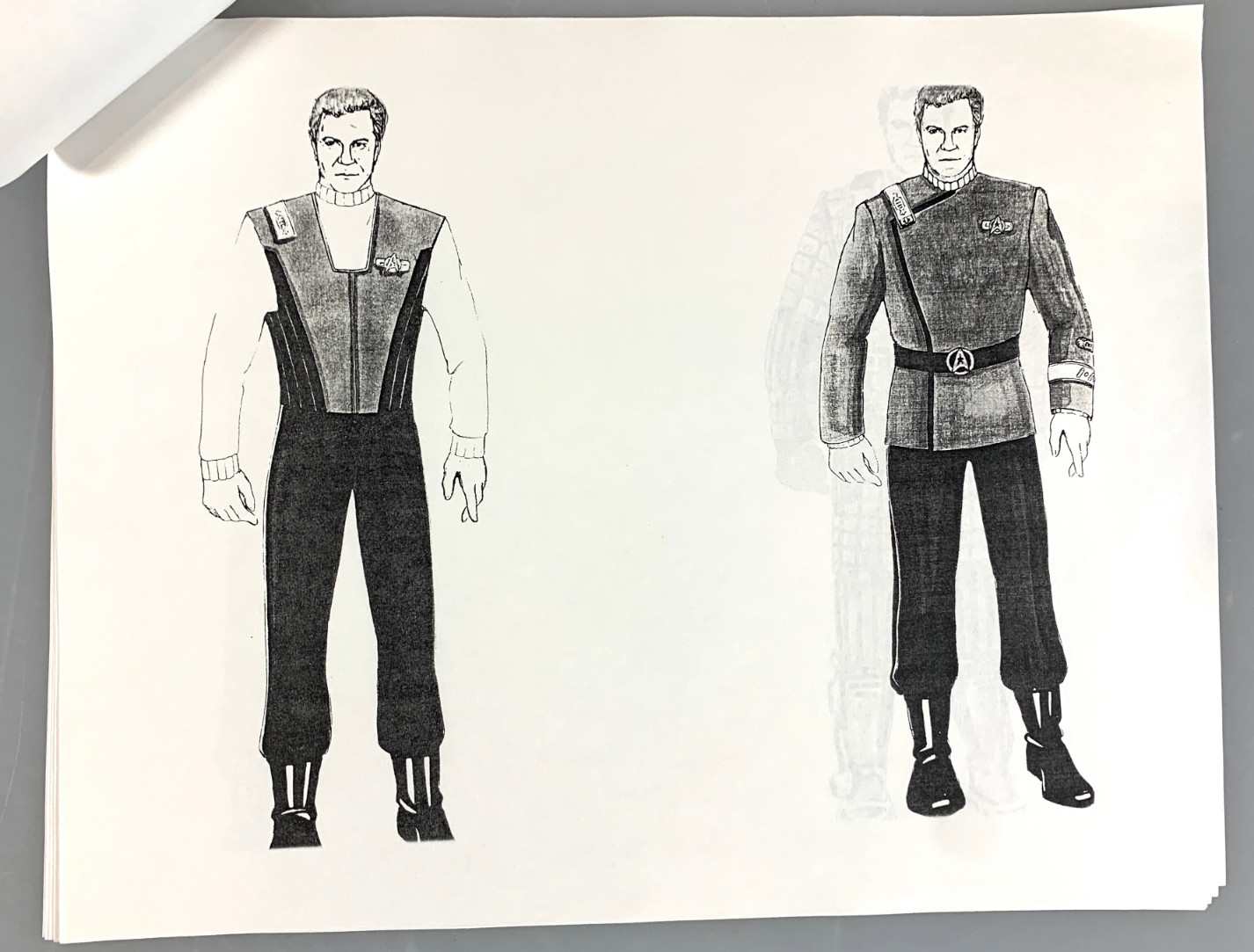
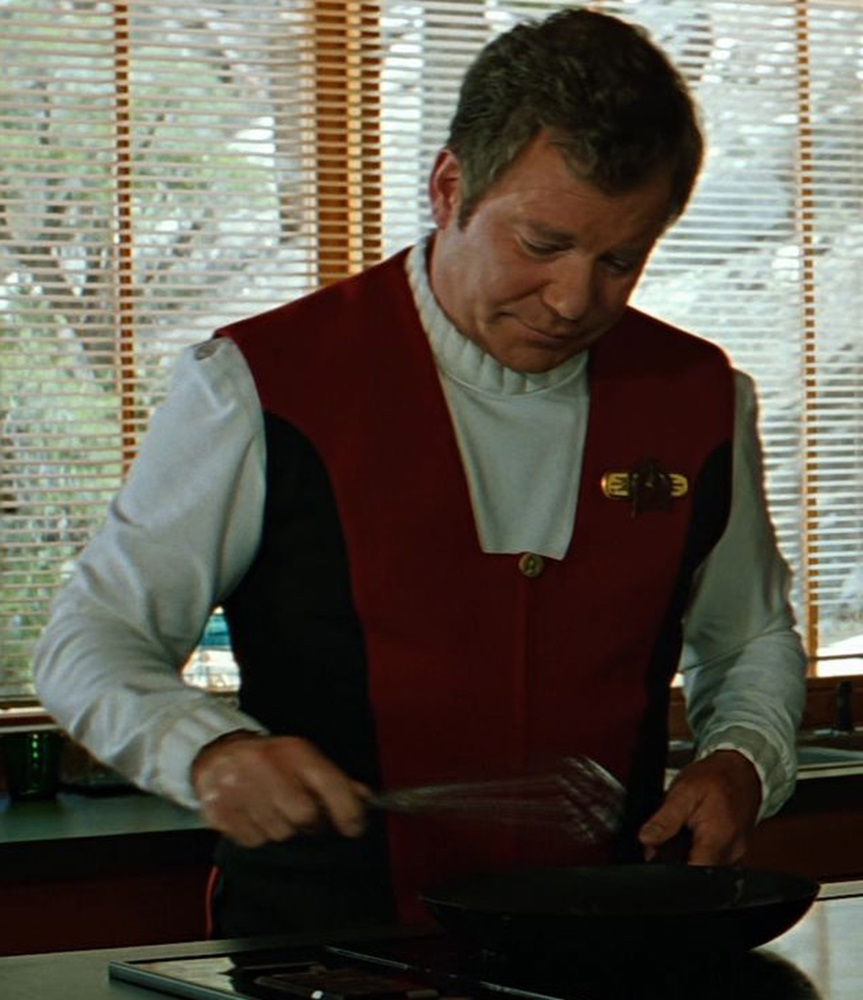
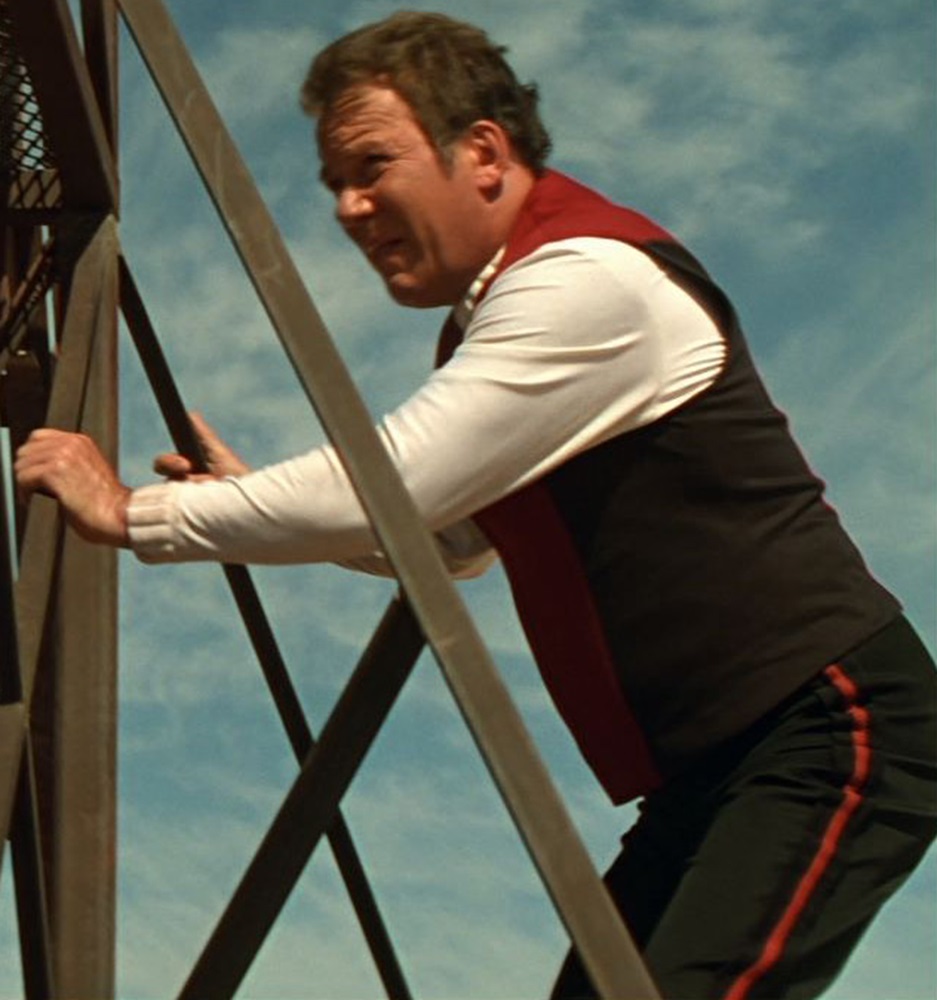
One final addition to the uniform family was made by Robert Blackman for Captain Kirk’s appearance in Generations: a simple but dignified vest.
We first saw him wearing this vest when his character was reintroduced in the Nexus.
His “monster maroon” jacket was also in the frame, which to me implied two things: that Kirk had taken off his jacket to chop wood, and that the vest itself was worn under the jacket.
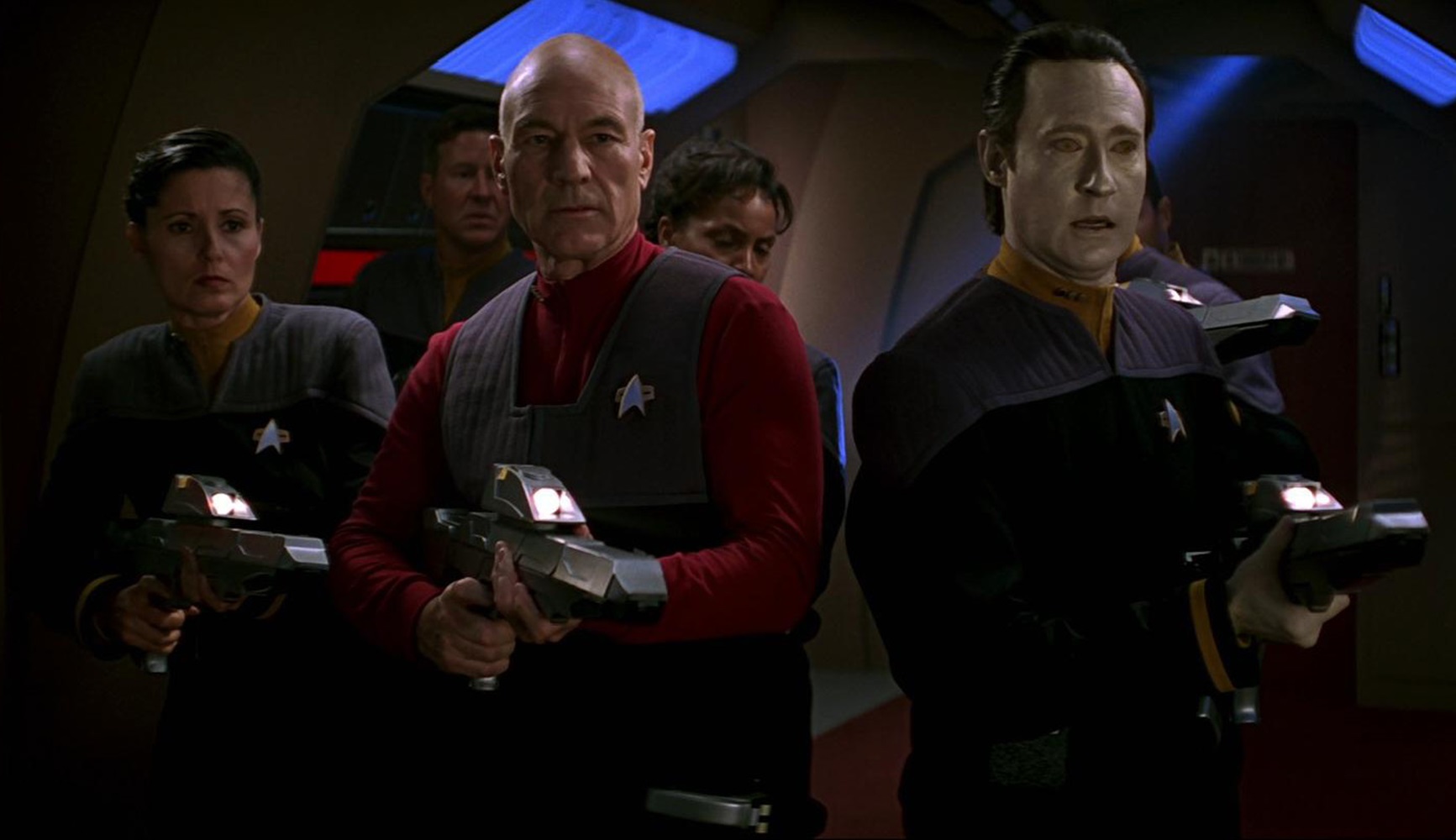
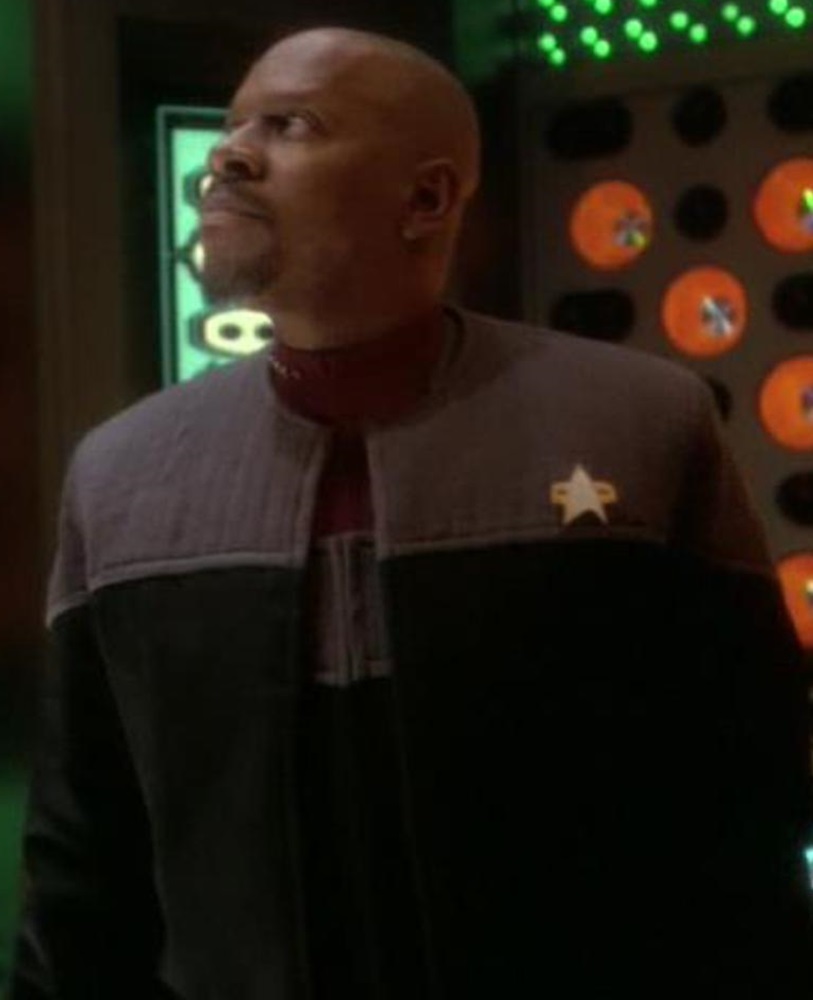
The idea of the captain having a vest option (that was also worn underneath their standard uniform jacket) was idea that Blackman followed up on in the next movie, and on Deep Space Nine.
Of course, the real reason for this vest was probably because the “monster maroons” look beautiful but aren’t very practical, particularly for rough-and-tumble action; Shatner and his stuntmen would need their full mobility for the character’s final fight on Veridian III.
This vest had red panels on the front and back, with black panels on the sides.
These black side panels had a slimming effect – something Blackman brought from his experience on TNG, with William Ware Theiss’ original designs for that show.
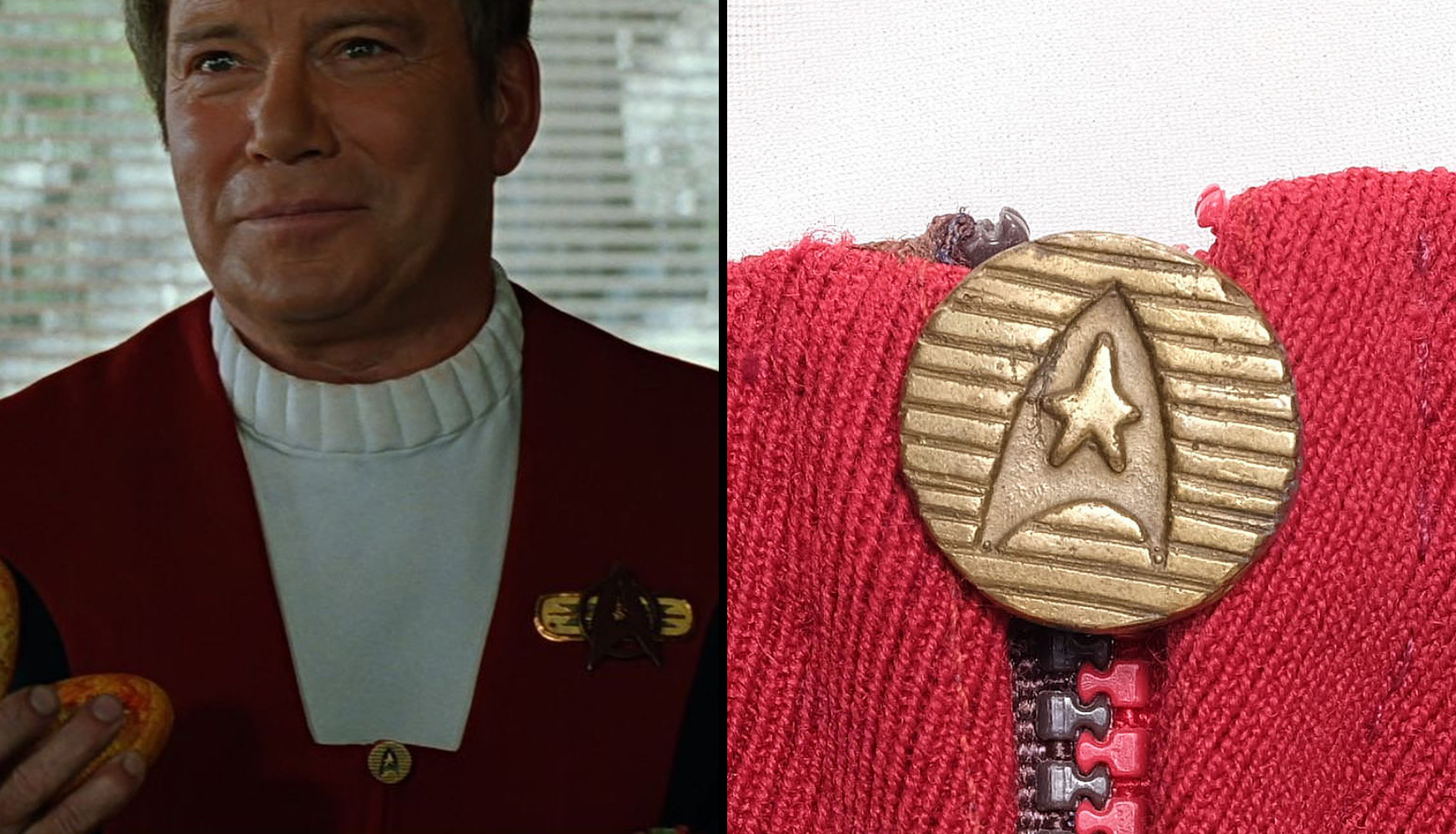
The vest was worn with the TWOK-era chest badge.
The red panels of the vest were made from cavalry twill (presumably the same as the “monster maroon” jackets), but the black side panels were made of jumbo spandex.
If you look carefully, the black spandex on the sides of the vest don’t quite match the black wool trousers.
The zipper pull was a small, round, gold piece very similar to the “pips” that Fletcher had originally designed.
... STILL MORE UNIFORMS!
Believe it or not, there are even more uniforms seen in these movies, which I’ll quickly mention because they were barely seen.
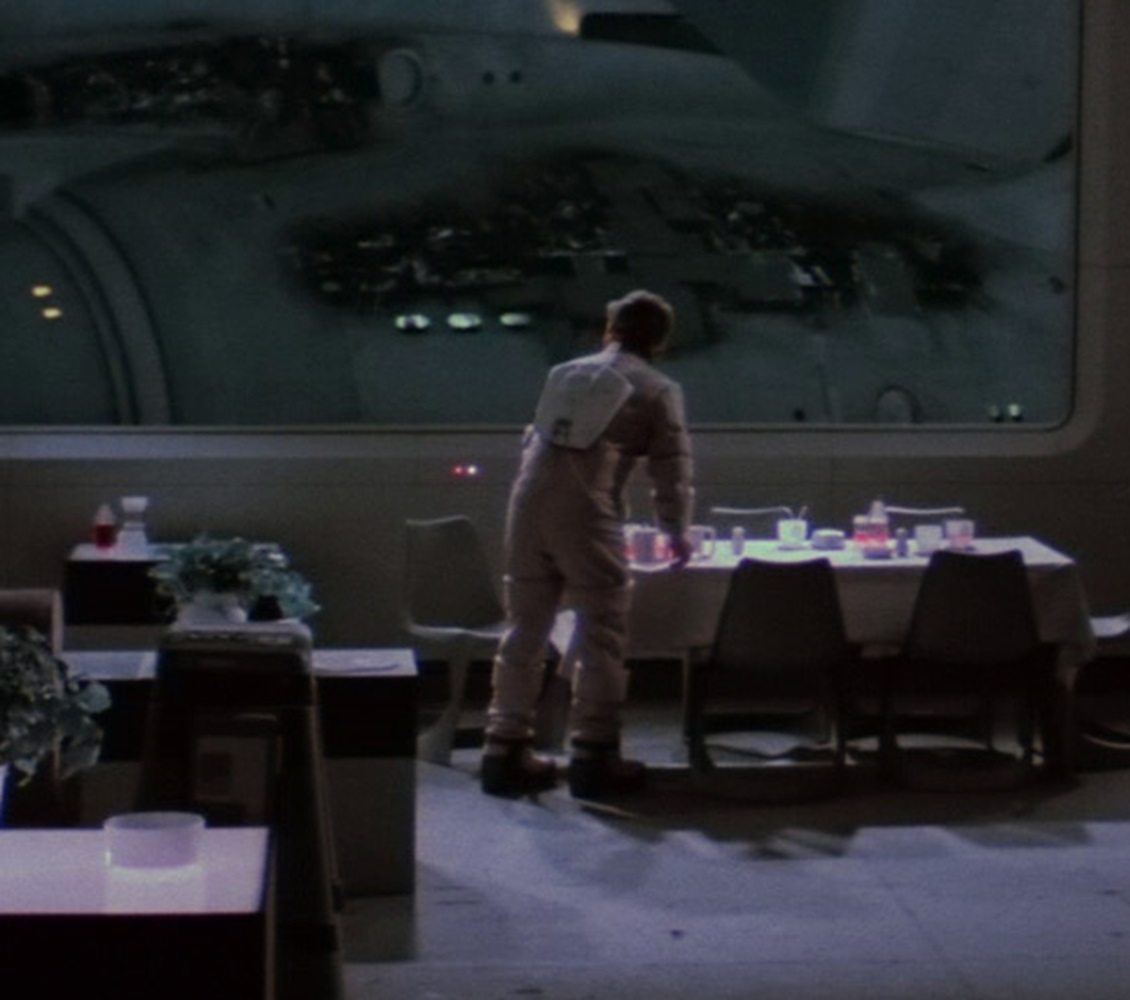
Janitors
This particular uniform was another direct reuse from TMP; I believe it was for janitors.
There was one outside the Kobayashi Maru simulator room in TWOK:
One walked by as the crew prepared for the upcoming battle in the Mutara Nebula, and there were a couple in the lineup for Spock’s funeral near the end of the movie.
We also saw one working on the starbase as the Enterprise was being stolen in ST3:
Lounge Suit
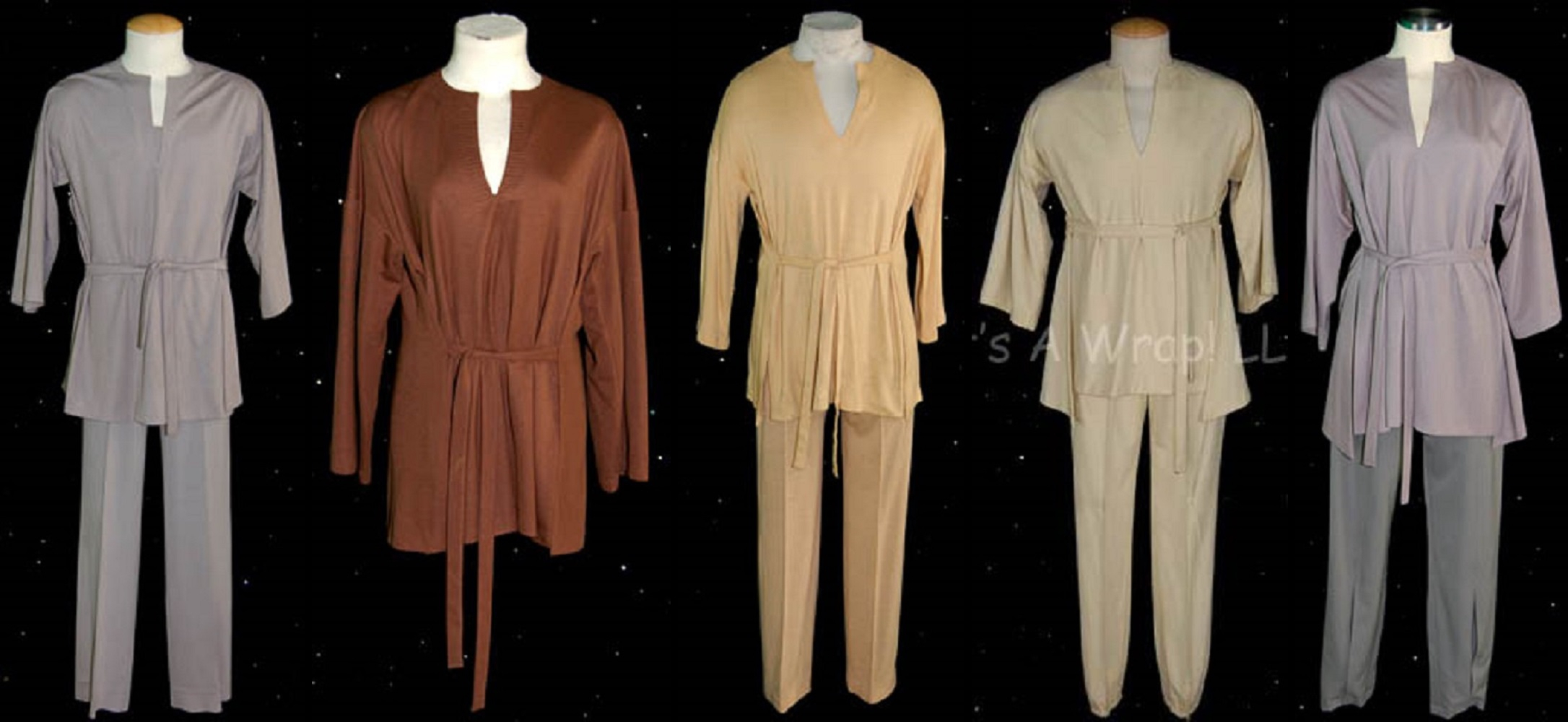
For TMP, there was a range of costumes made that may (or may not) have been uniforms:
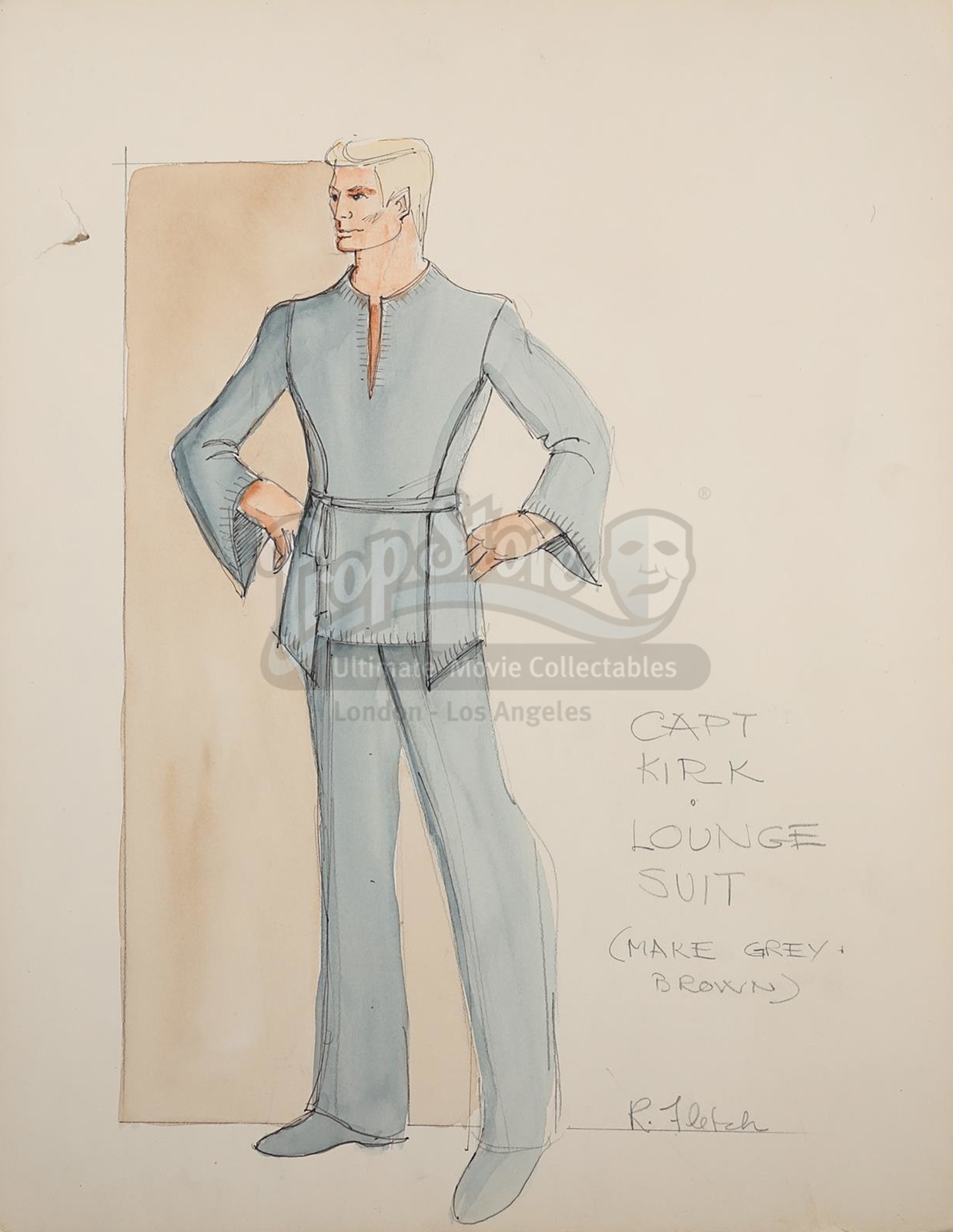
In his costume sketch, Robert Fletcher listed this as being a “lounge suit,” and most auction listings for these have them described as “off-duty” attire.
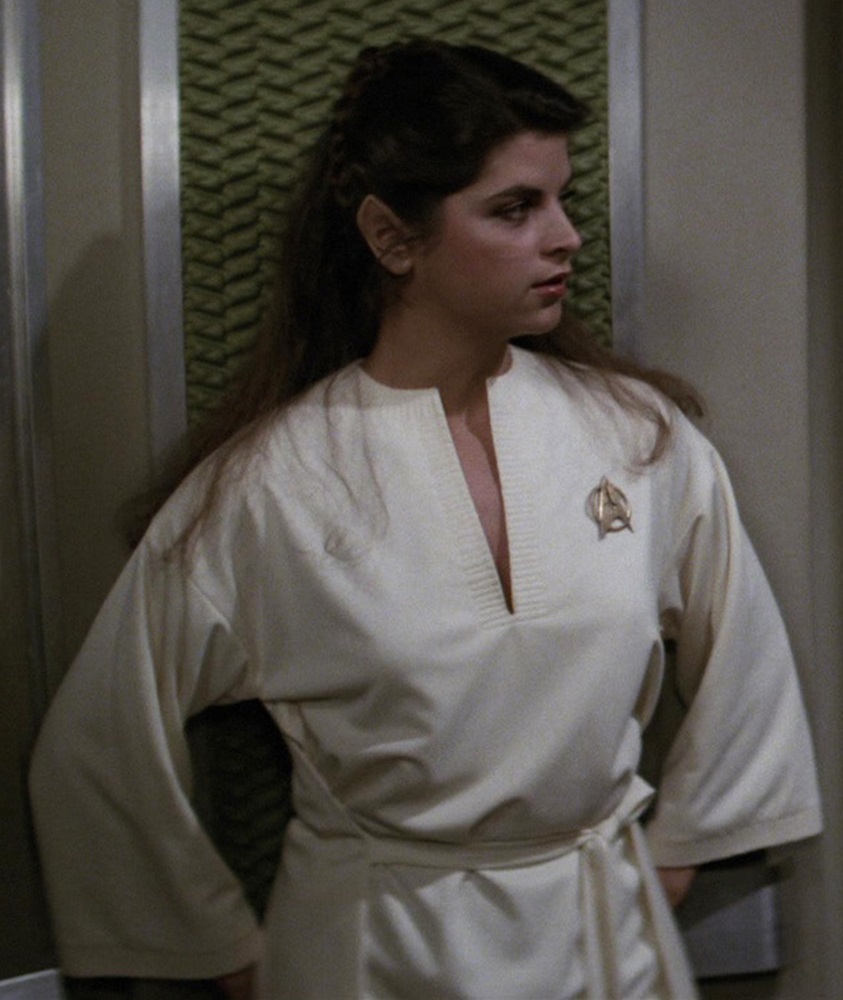
Whatever they were originally designed for, in TWOK, Saavik wore one of these during the turbolift scene with Kirk.
Because she wore it with a metal Starfleet chest badge, I wanted to mention it as a potential uniform … possibly for exercise, or some kind of training we didn’t see?
Prison Guards
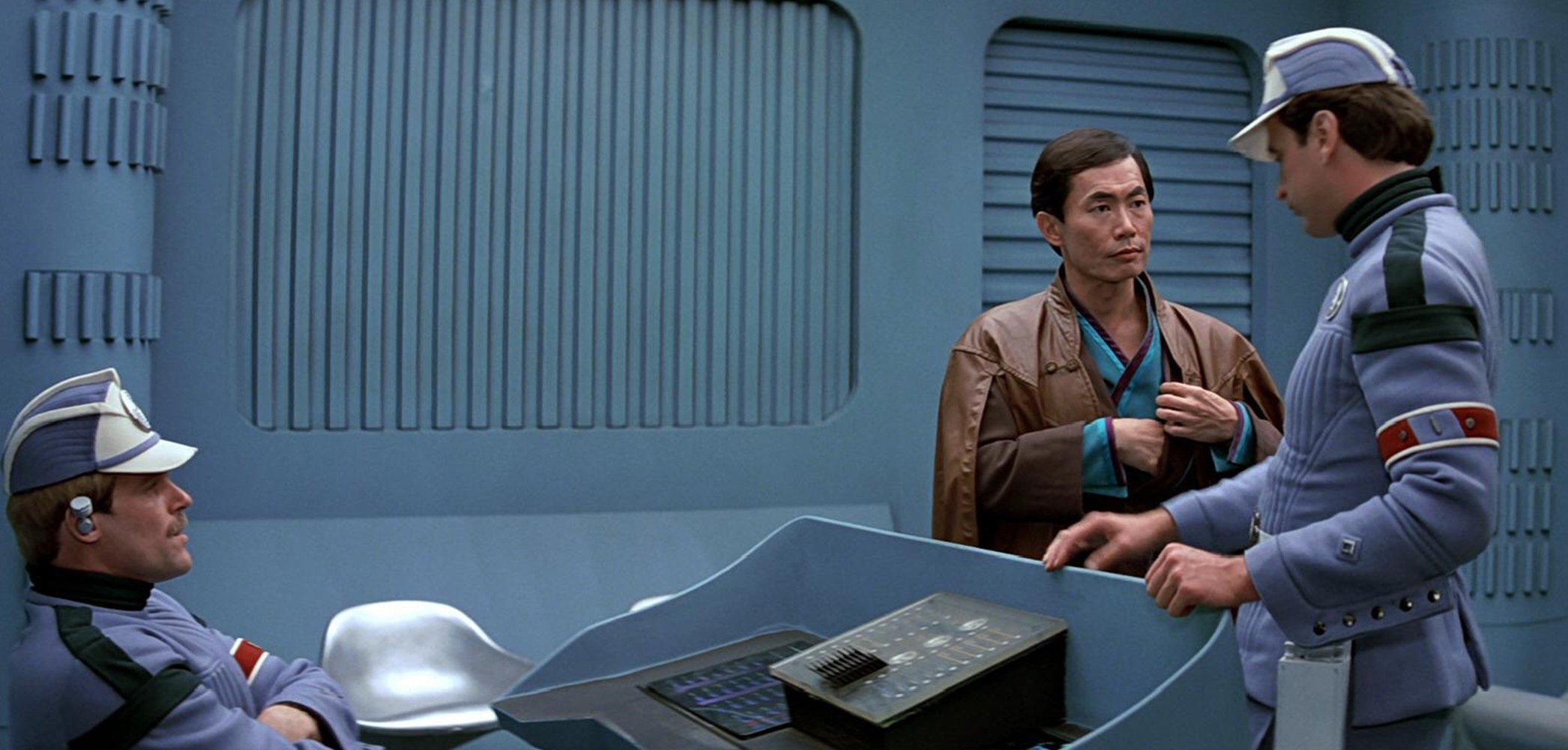
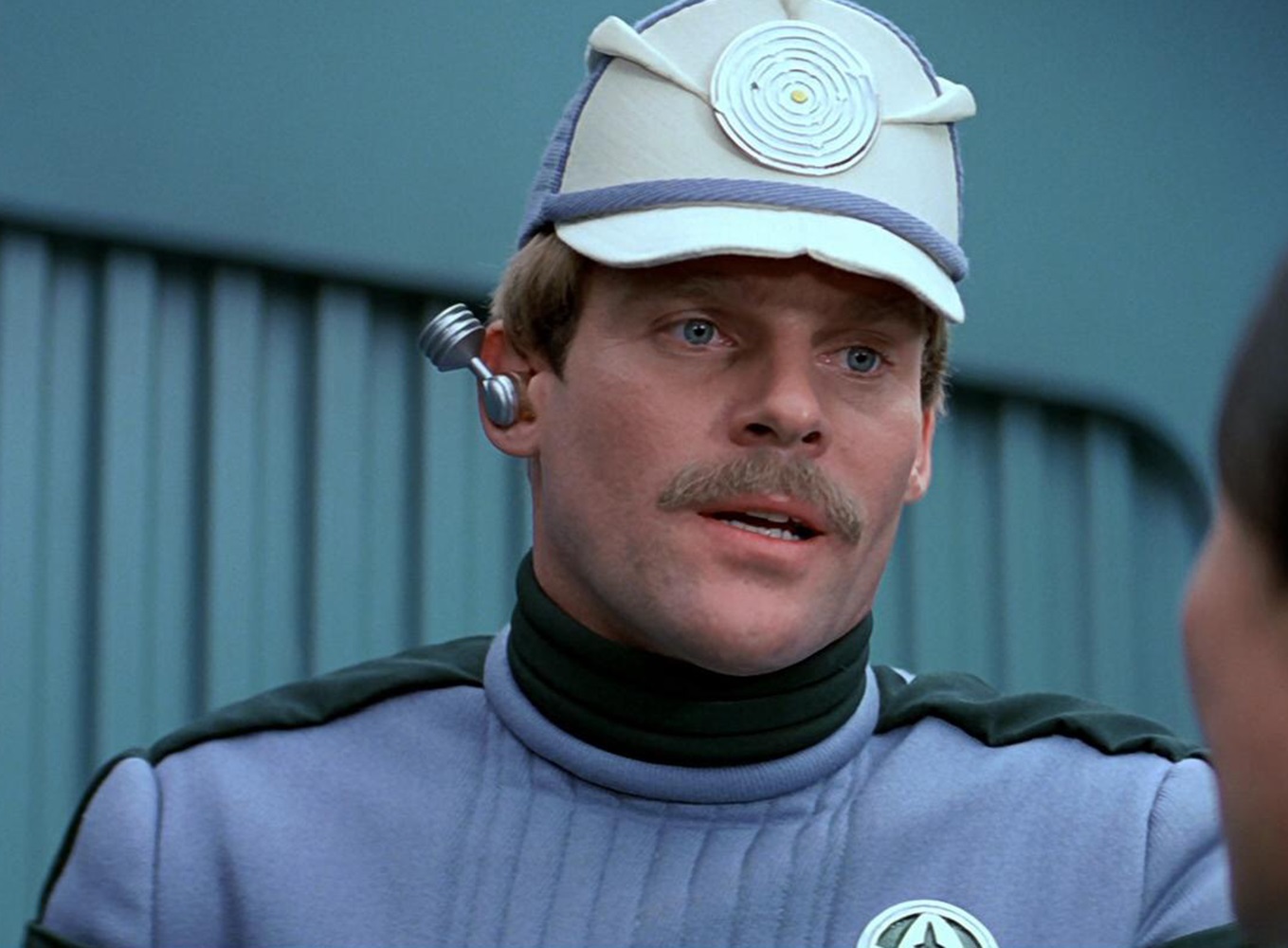
In ST3 we briefly saw these uniforms, which were different than the ones worn by the regular security guards.
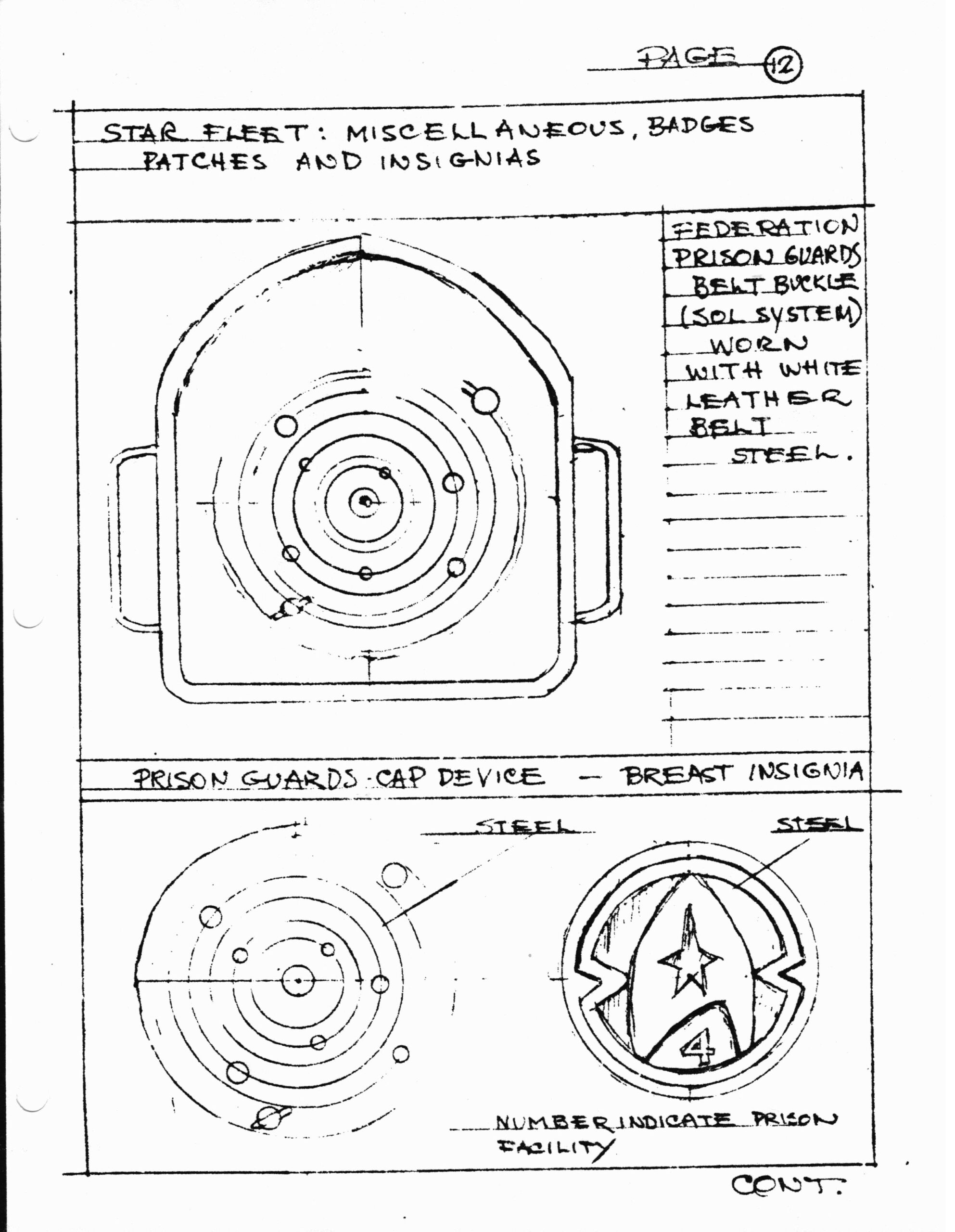
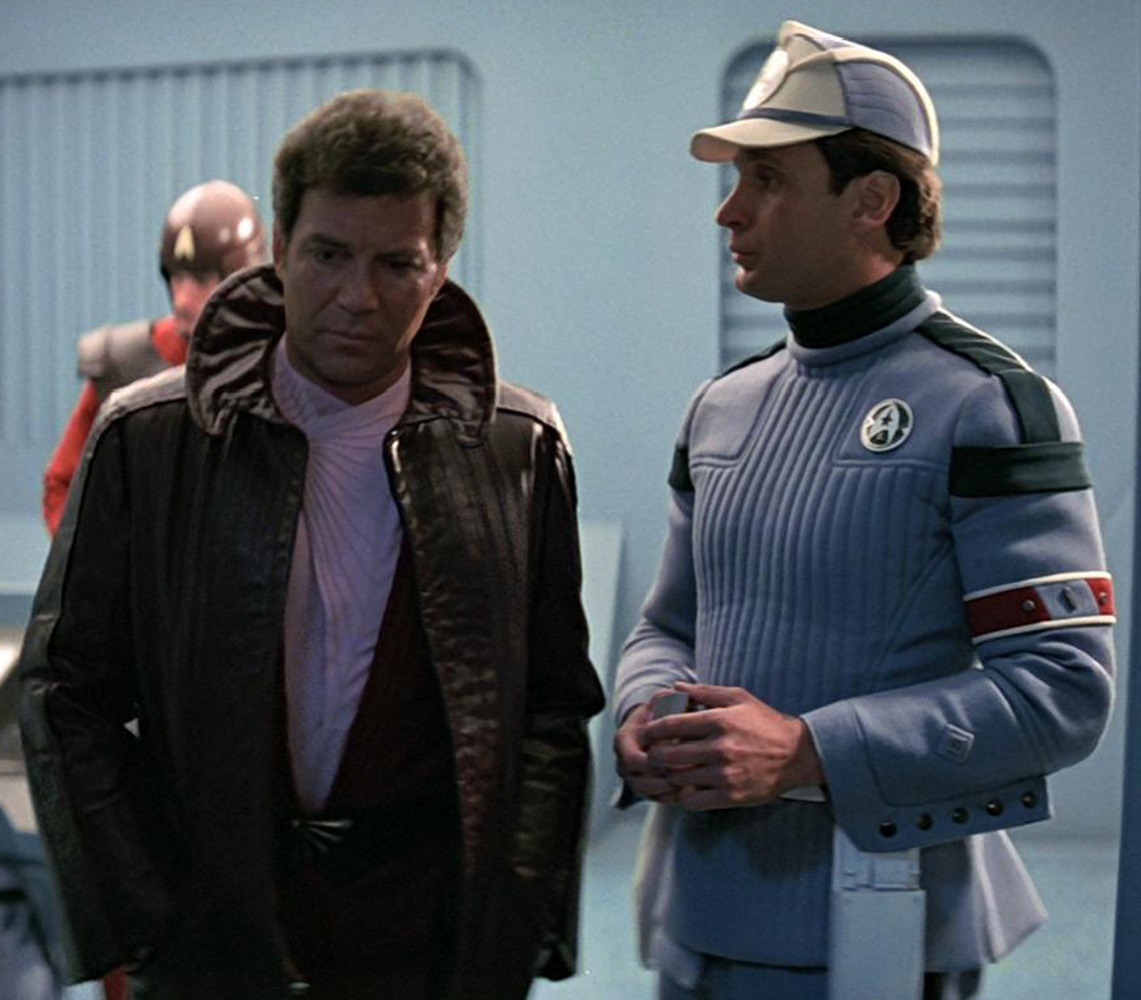
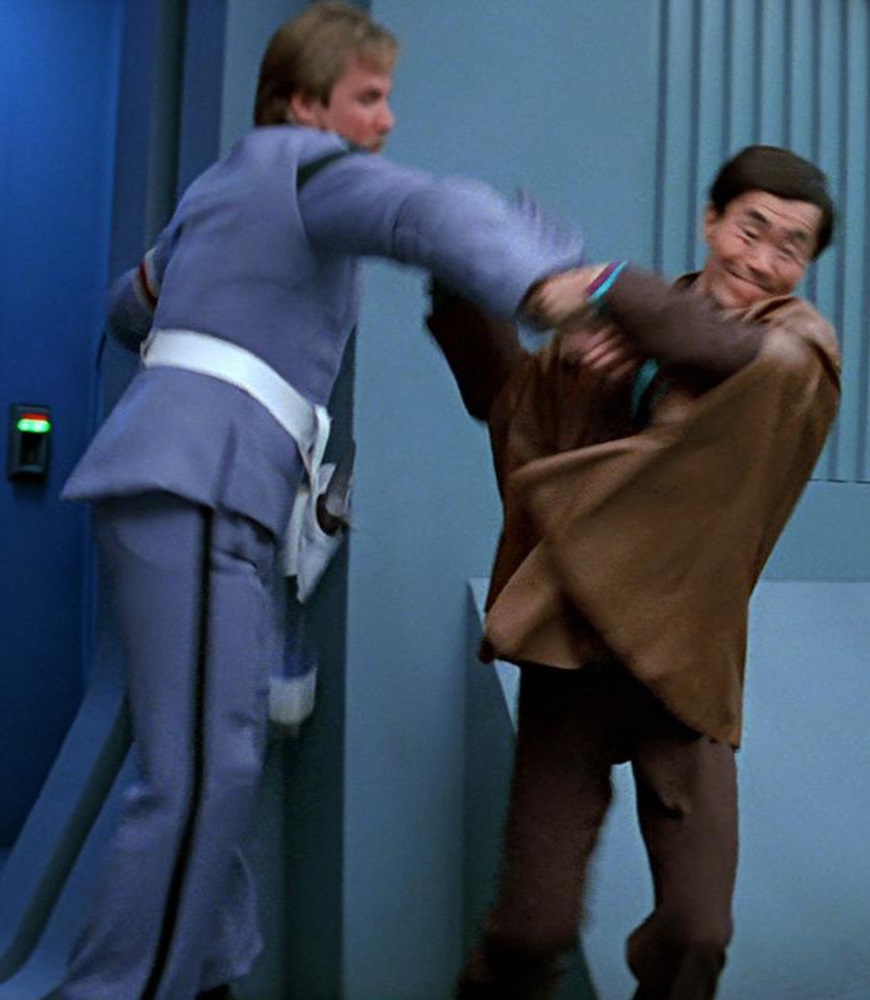
My interpretation is that these were prison guards; Fletcher did mention some things to this effect in his notes, the details of which seem to match these.
These were two-piece bluish-gray wool uniforms, with security green collars, stripes along the shoulders, and upper sleeves.
They also had security green stripes down the pant legs, like the standard black officers’ trousers.
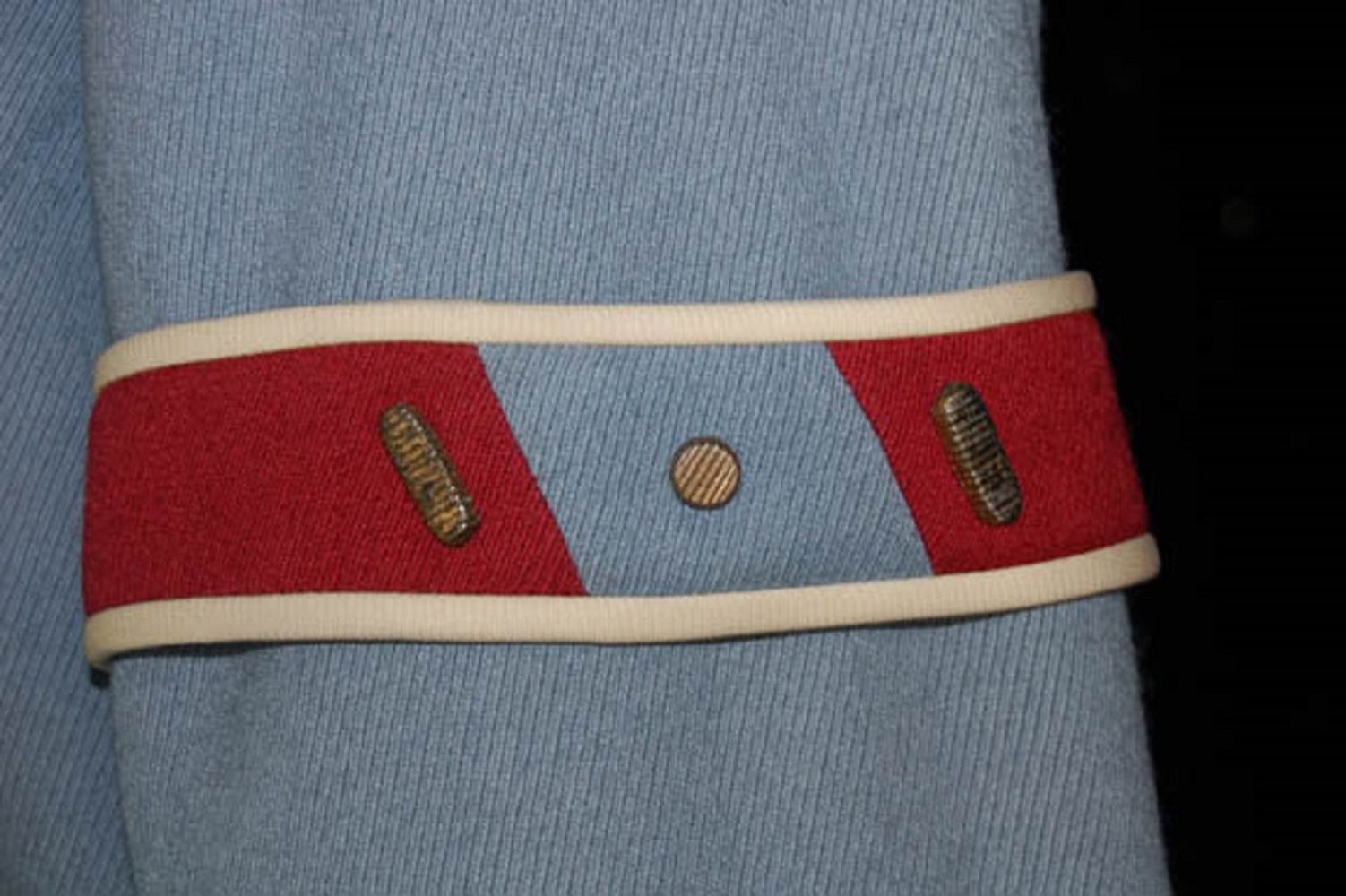
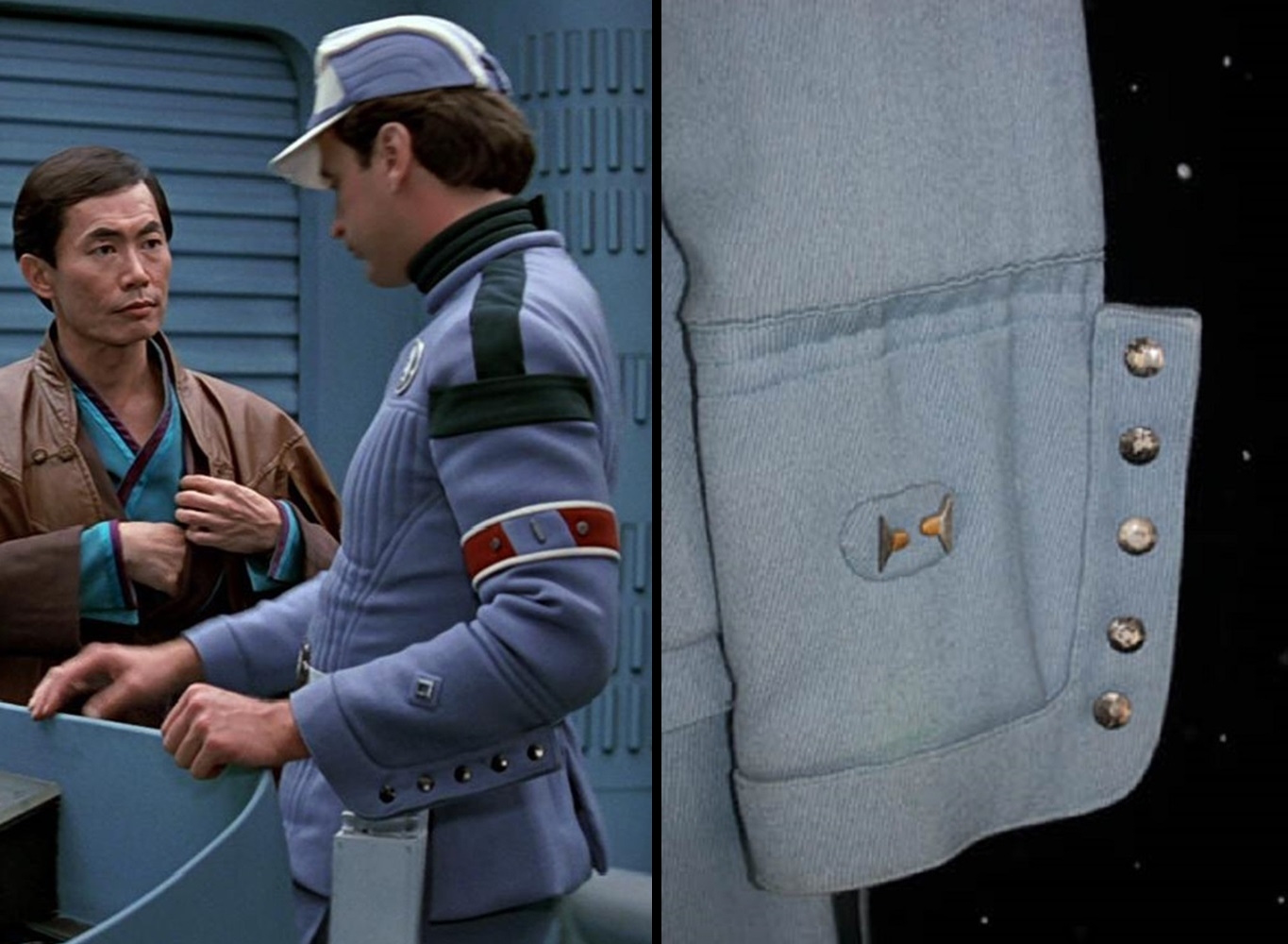
What doesn’t make sense to me is that despite all the security green accents, both of the guards we saw appear to have had division-colored sleeve bands on their right sleeves, which were trainee red with a matching bluish-gray stripe, implying they were sciences or special services cadets …?
They did have some freaking amazing sleeve cuffs though, so I’m willing to look past the confusion this time.
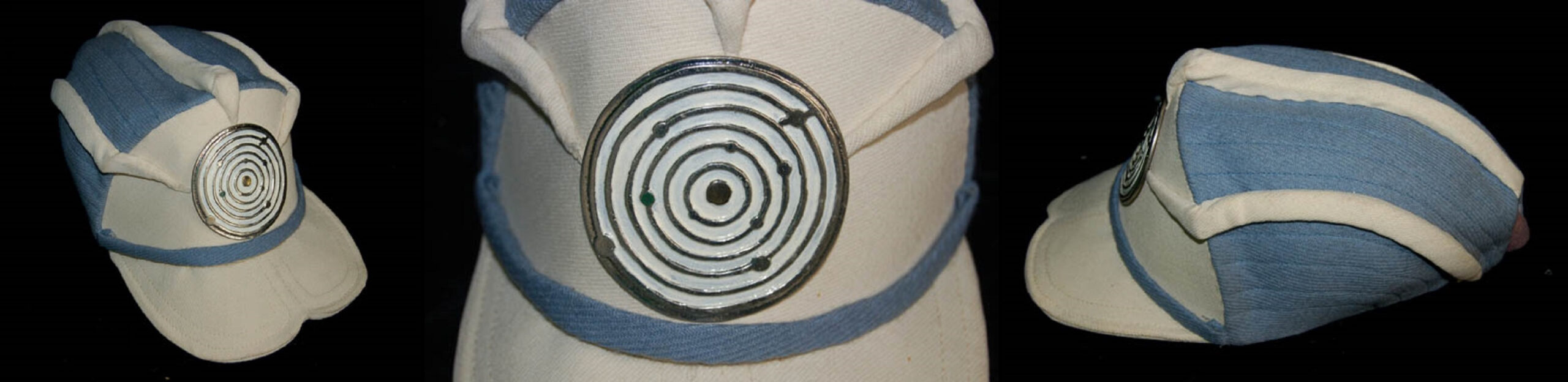
These were unique in that they were actually worn with hats, which had a variation of the TMP “Earthbase” patches that were reused on the field jackets.
ST3 Waiters
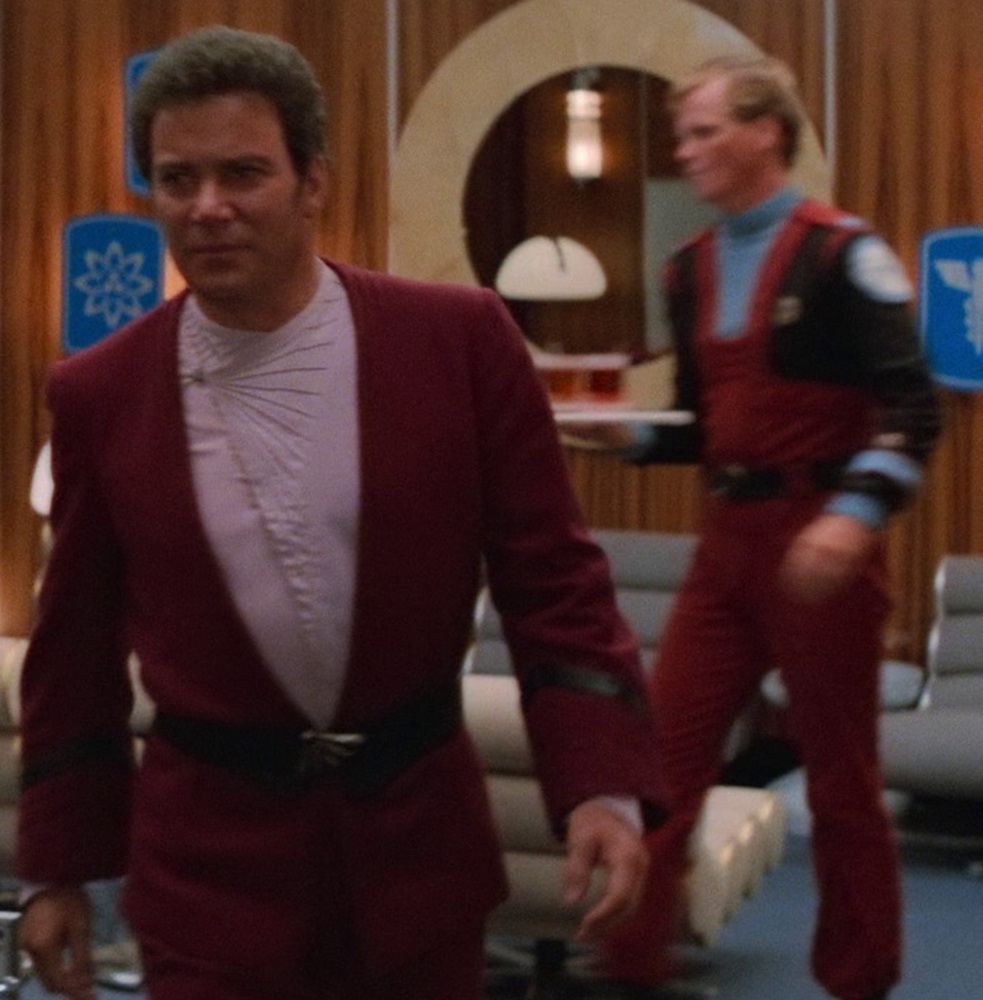
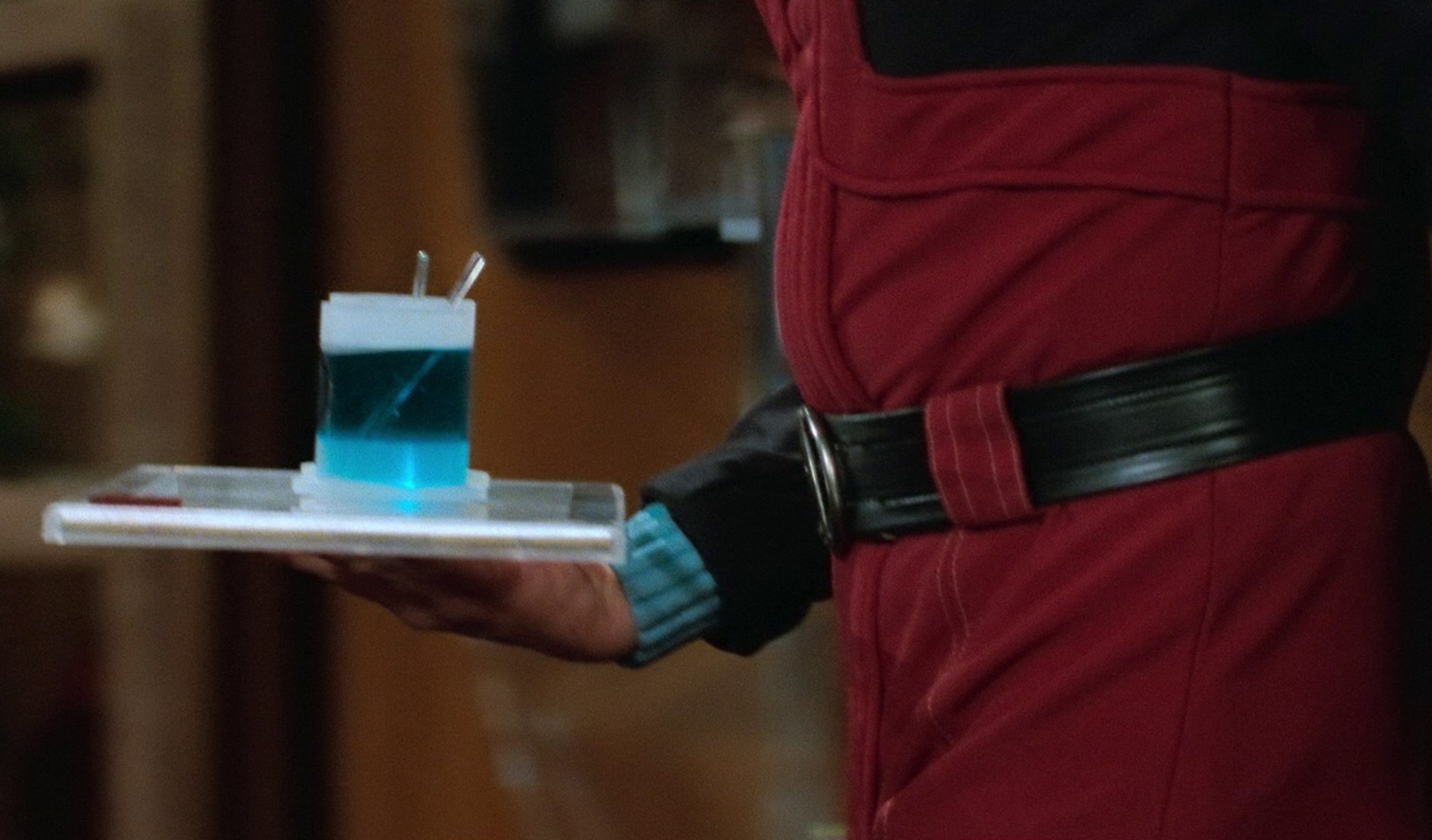
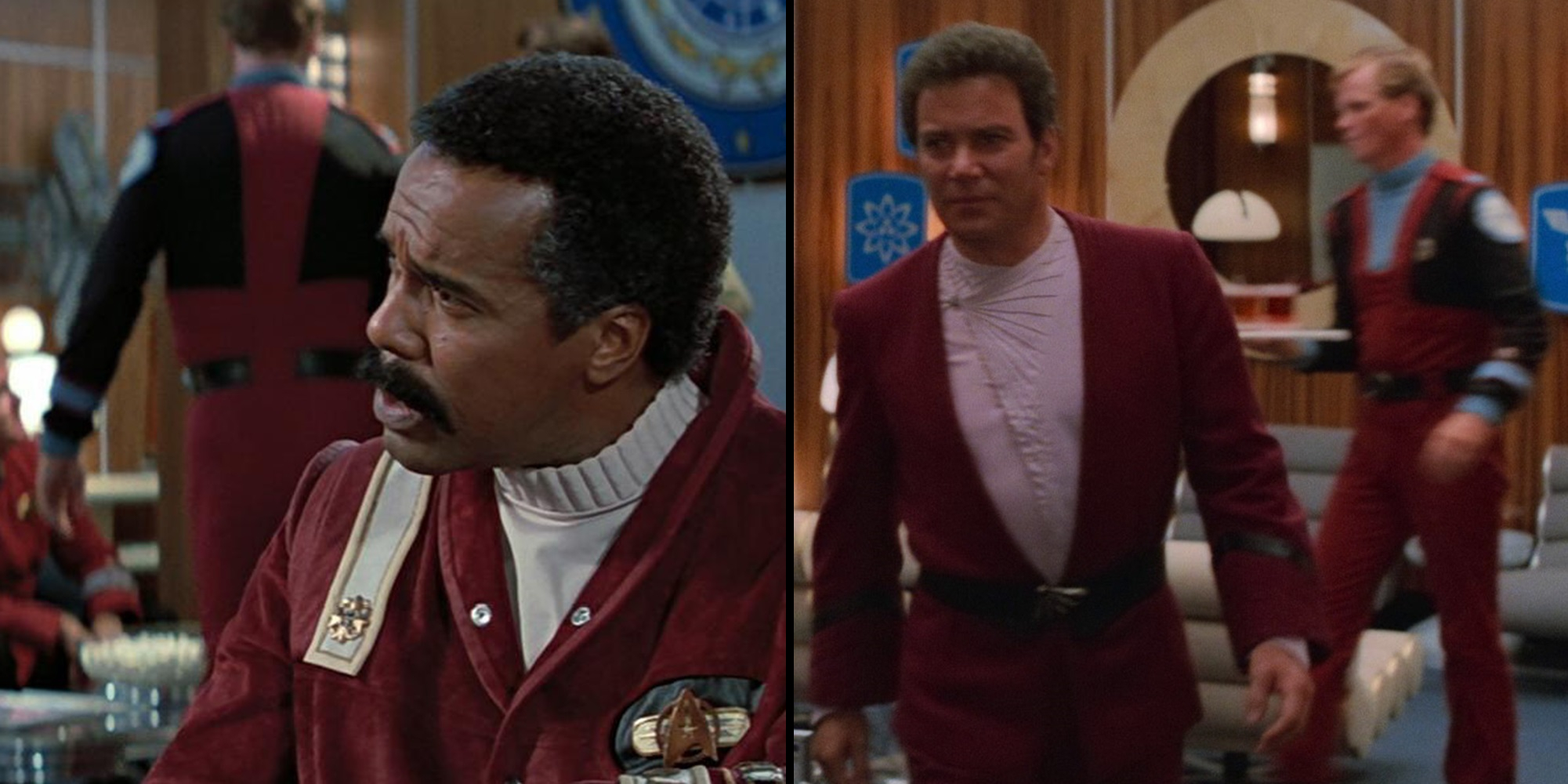
Another obscure but fun uniform was for the waiters, briefly seen in the background when Kirk met with Morrow.
One walked right by the camera for the opening shot of the scene:
Then they just went about their business while the two talked.
We didn’t get to see much of them in the movie, but thanks to some auction photos, we can see that these were spandex jumpsuits – actually very similar to the enlisted jumpsuits, but with a “special services” blue front panel, collar, and cuffs similar to those on the officers’ undershirts.
There was a large patch on the upper left sleeve, which was another clever reuse of the TMP “Earthbase” patches.
These were accented with the “special services” blue division color.
ST6 Waiters
A new Starfleet waiter design was introduced in ST6, first seen during the dinner with the Klingons.
They briefly showed up again later in the movie, and we could see that they were actually very similar to the ST5 commando uniforms.
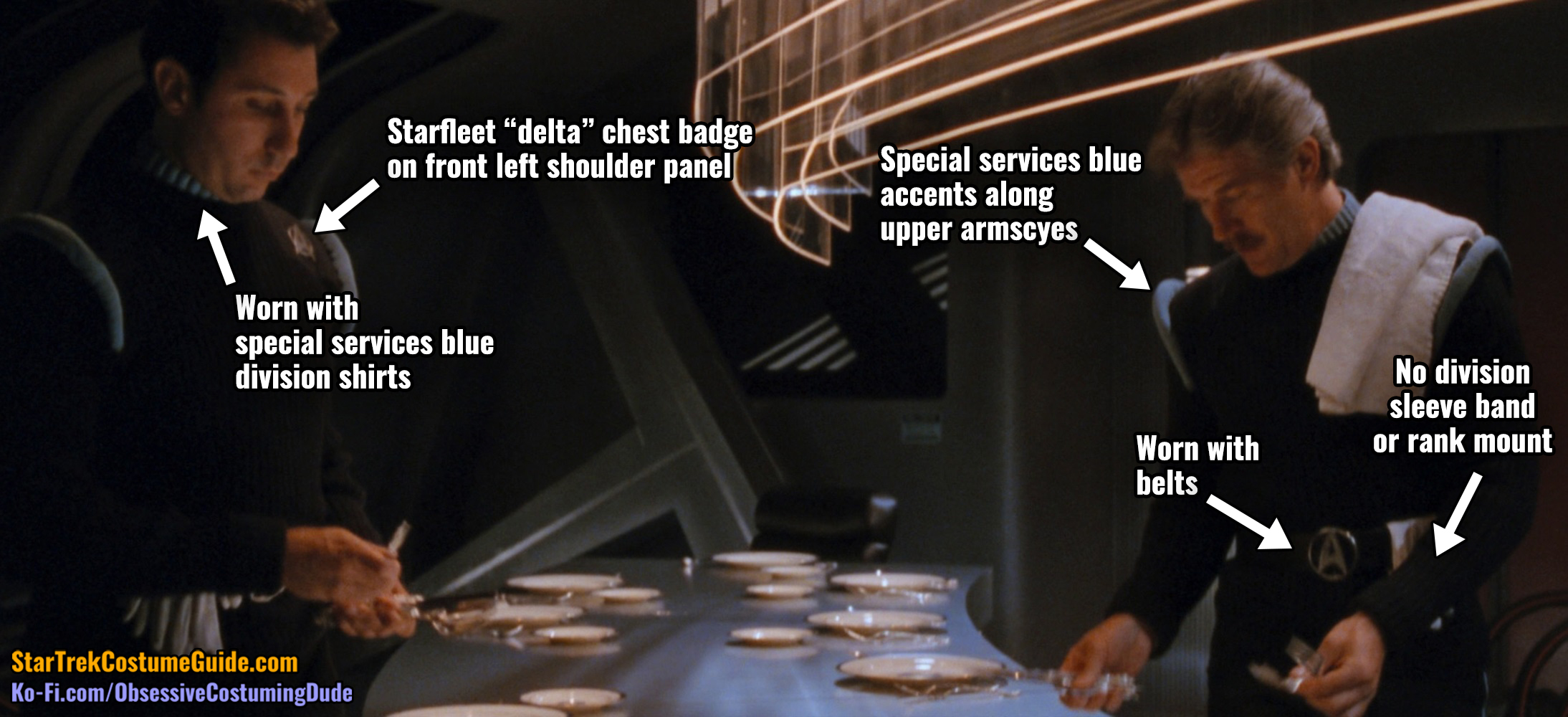
The main differences seem to have been that these were black, worn with belts and a metal Starfleet “delta” badge on the upper left shoulder panel, had some “special services” blue accents added to the upper sleeves, and had no division bands on the sleeves.
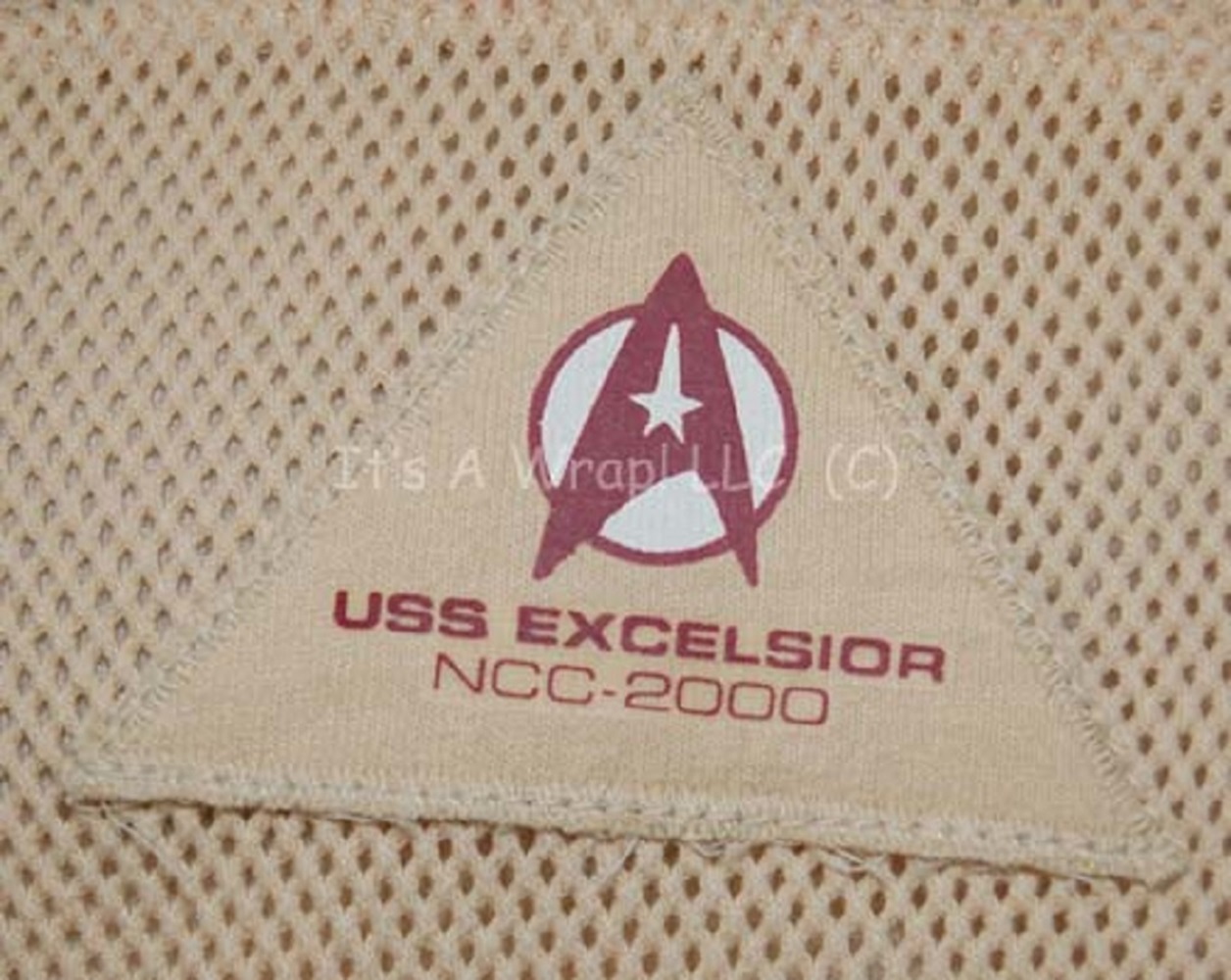
Sleepwear
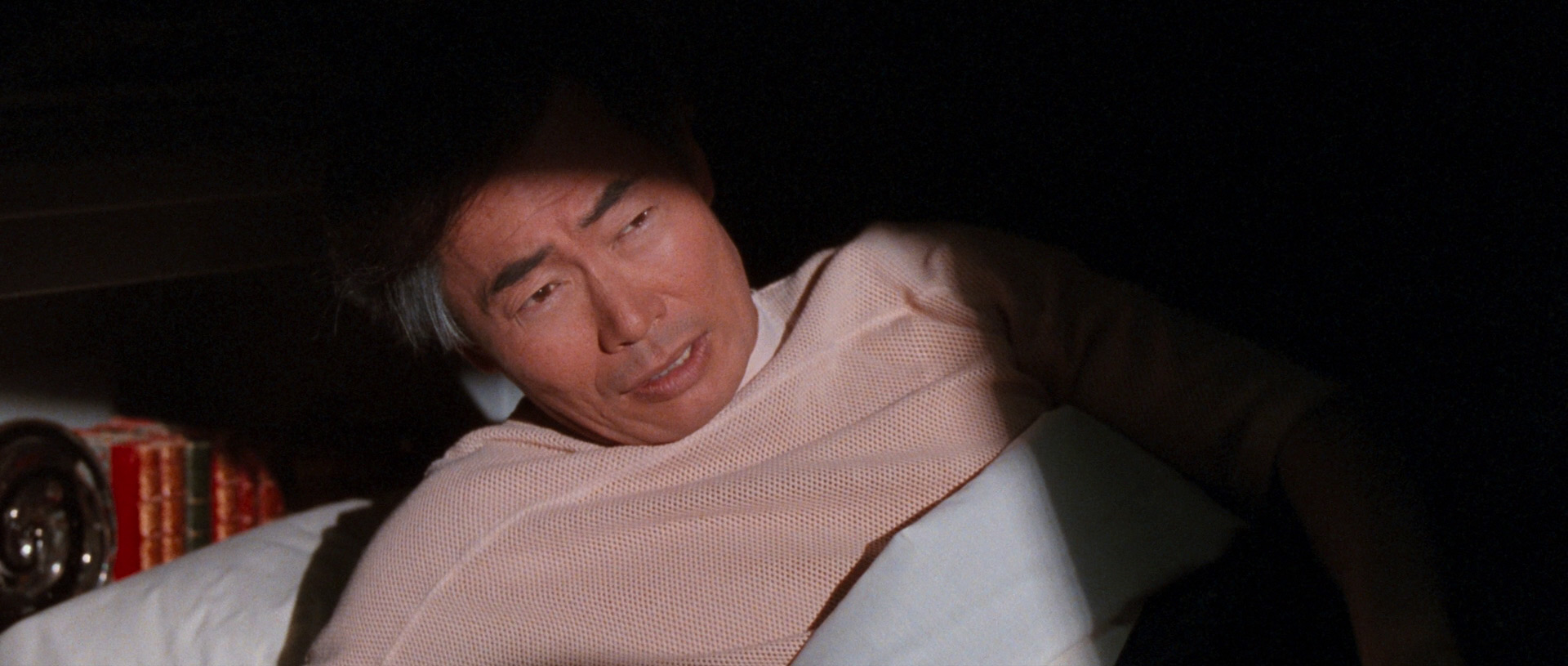
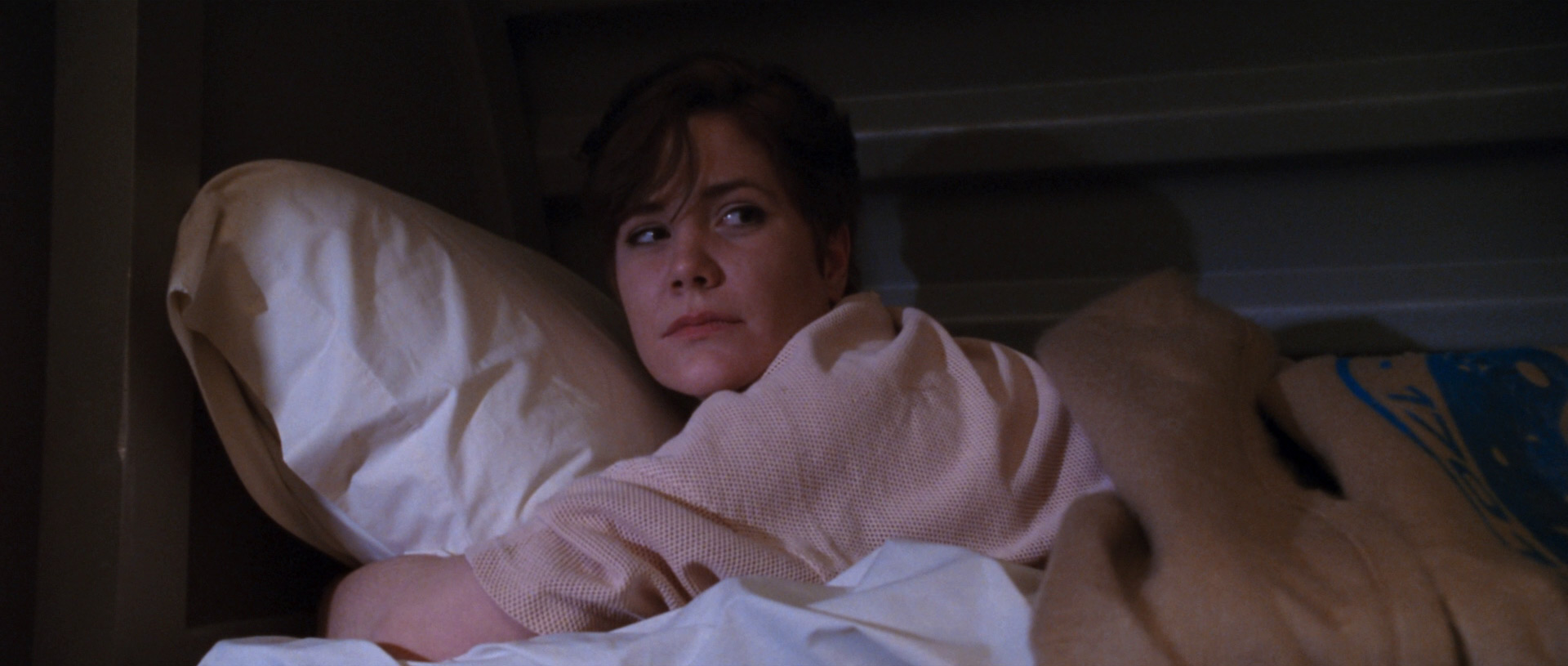
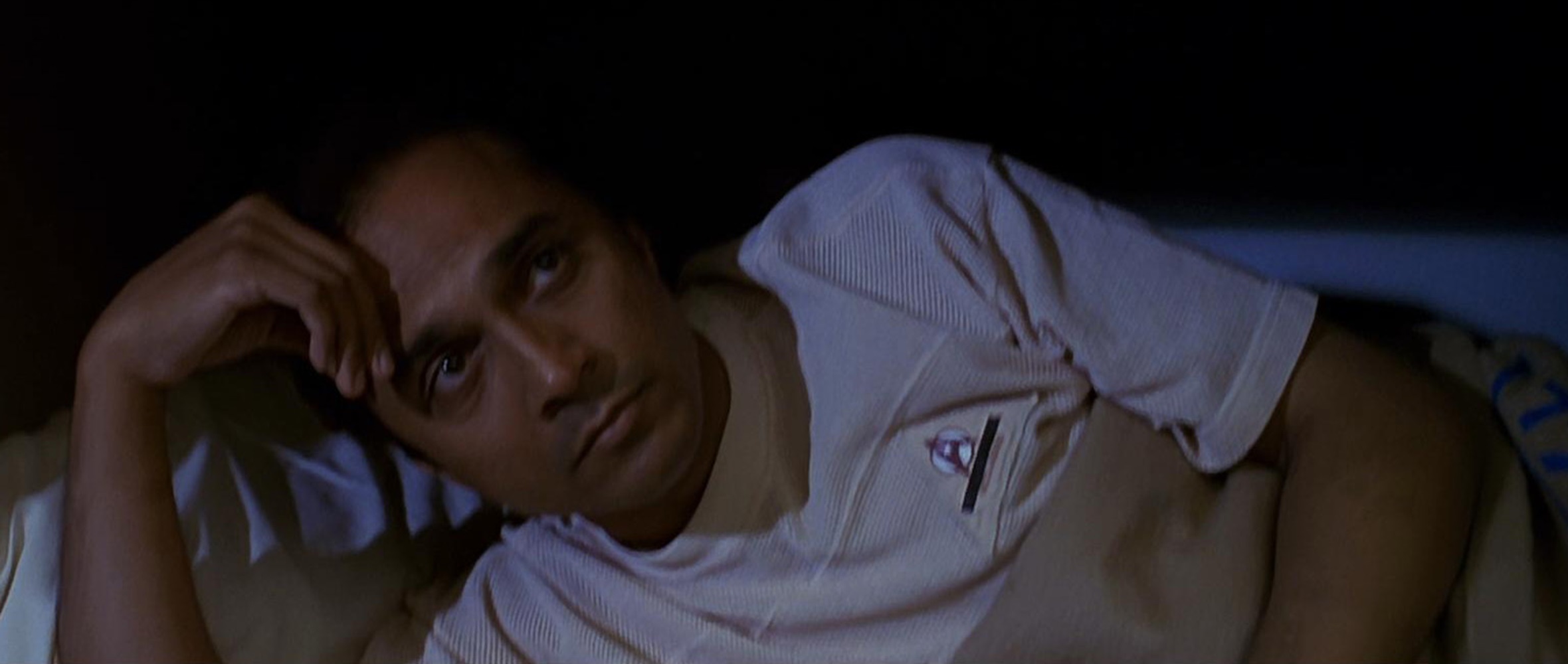
And finally, in ST6 some Starfleet-issue sleepwear was also introduced, primarily seen on Captain Sulu when Christian Slater woke him up, and on a few Enterprise crew members during the intercom announcement summoning the court reporter to sickbay.
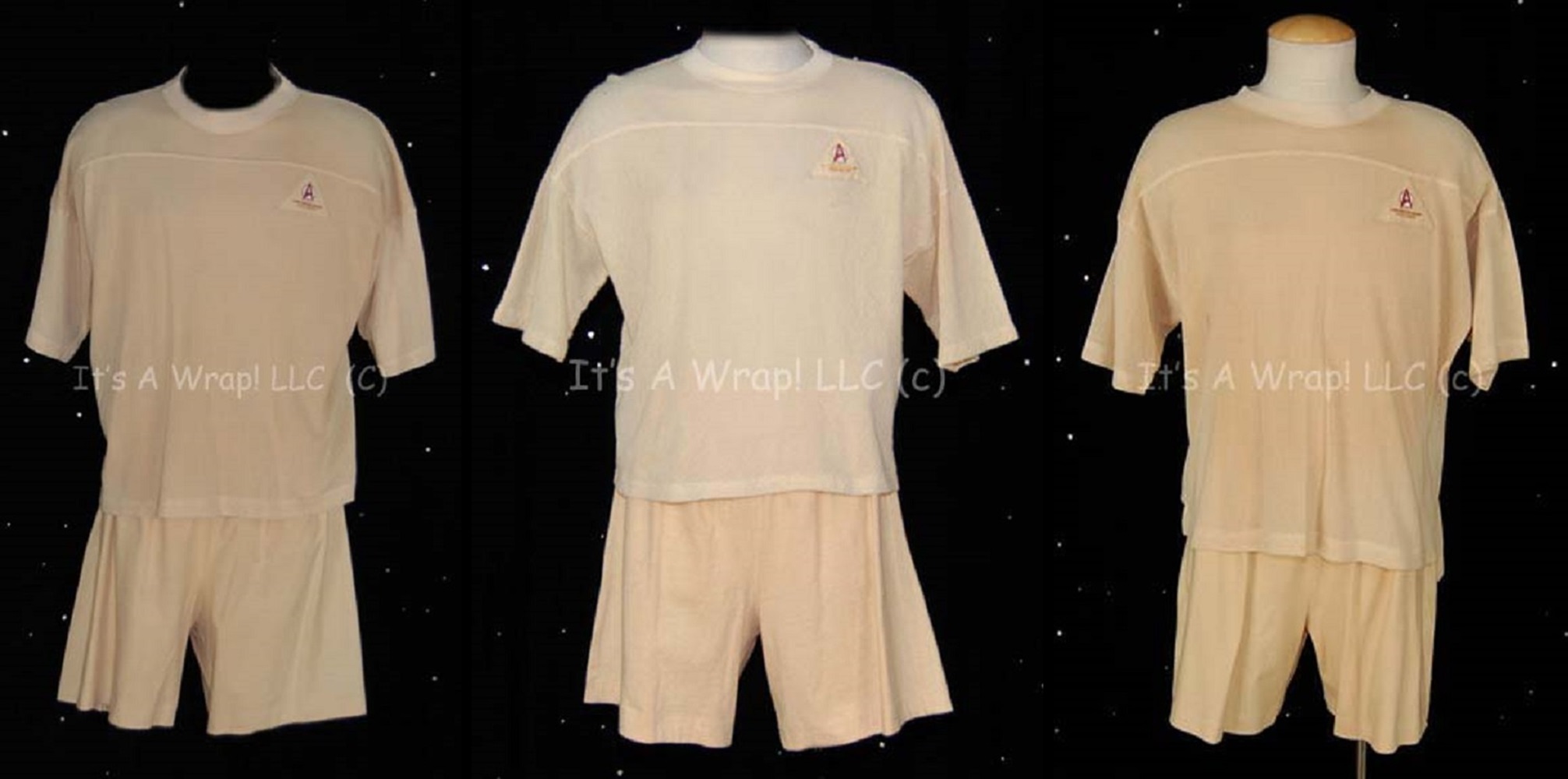
These appear to have been T-shirt and boxer shorts made with a cream-colored fabric.
The T-shirts were made with a netted fabric, but the boxer shorts were probably a solid knit fabric.
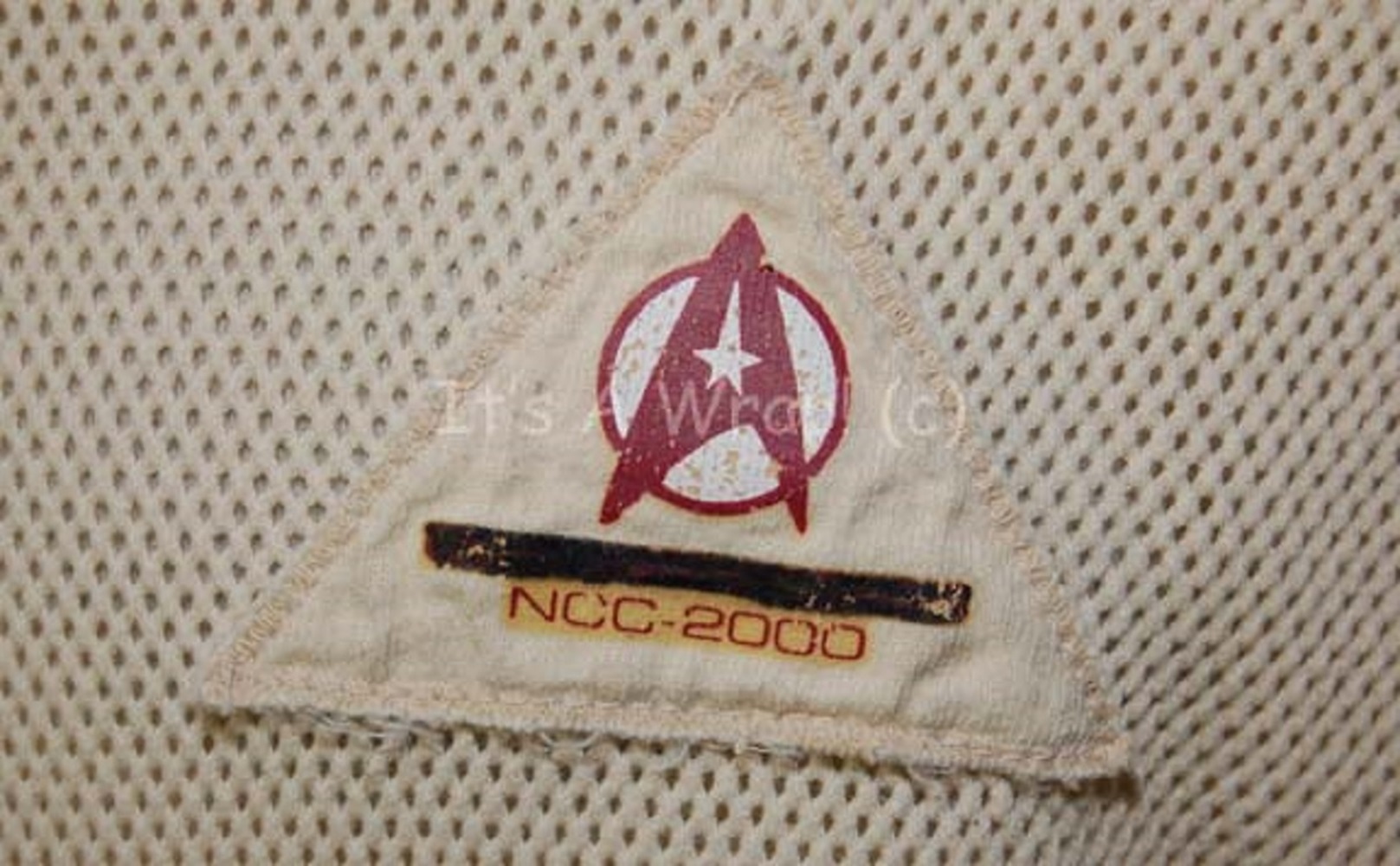
There was a small triangle on the upper left chest bearing the Starfleet “delta” symbol, along with the ship and ship’s registry.
(Strangely, Captain Sulu’s sleep shirt didn’t have this.)
On one shirt, the “U.S.S. Excelsior” text was blacked out, probably with a marker or paint.
This looks like it was done for this Enterprise crew member’s shirt, presumably to avoid having to make a separate patch (or set of patches) for Enterprise sleepwear.
(Although, one wonders why the “NCC-2000” wasn’t blotted out as well.)
CONCLUSION
Robert Fletcher established a richly-detailed uniform paradigm for these movies, with a variety of uniform options and variants for different departments and situations – many of which have become well-loved and even fan-favorites.
Aside from the sheer volume of amazing costumes, I find it particularly impressive that so much of it was done with an astonishing amount of forethought and planning. (When you consider the eight division colors and optional stripes along with the seventeen different ranks, that’s a total of 1,904 possible combinations … on almost every uniform!)
He truly made the most of the smaller budget for The Wrath of Khan; at no point do the costumes ever come across as cheap, or just lazy recycles. I think most fans would agree that TWOK is even more visually interesting and saturated than its predecessor!
Fletcher’s creative genius was on full display throughout these movies, and I think his successors were wise to stick pretty closely to what he’d established, even while making their own changes and contributions.
The costuming wizardry he and his team accomplished not only brought us an era of iconic costumes, but helped bring us a series of classic movies which continue to stand the test of time and are still enjoyed by countless fans.
Every bar of gold-pressed latinum goes toward producing more sewing and costuming resources like this, for everyone interested in Star Trek costumes. 🙂
There is a STIII publicity photo of Uhura on the starbase transporter pad wearing a skirt
Photo: https://bsky.app/profile/portalrealm.bsky.social/post/3lyat6rtkmc2j
Good catch. I was working primarily from screencaps, but someone else pointed out at the beginning of the transporter room scene with "Mr. Adventure," there is a brief, wider shot in which we can see that she was wearing the skirt. I will update this post accordingly. Thanks! 🙂
- Alex
What a great compilation on information regarding the TWOK uniform series. These were always my favorite and looked the most professional. I know there are detractors out there saying Starfleet isn’t a military service, but it is and this add credence to that argument. There are so many things in this uniform series that intertwine with real world service and duty uniforms. Great work.





There is a STIII publicity photo of Uhura on the starbase transporter pad wearing a skirt
Photo: https://bsky.app/profile/portalrealm.bsky.social/post/3lyat6rtkmc2j
Good catch. I was working primarily from screencaps, but someone else pointed out at the beginning of the transporter room scene with "Mr. Adventure," there is a brief, wider shot in which we can see that she was wearing the skirt. I will update this post accordingly. Thanks! 🙂
- Alex
What a great compilation on information regarding the TWOK uniform series. These were always my favorite and looked the most professional. I know there are detractors out there saying Starfleet isn’t a military service, but it is and this add credence to that argument. There are so many things in this uniform series that intertwine with real world service and duty uniforms. Great work.
I'm glad you enjoyed it! Thanks for reading. 🙂
- Alex